
Vitamins and Their Deficiency Diseases – Static GK & General Awareness for Competitive Exams with Memory Tricks
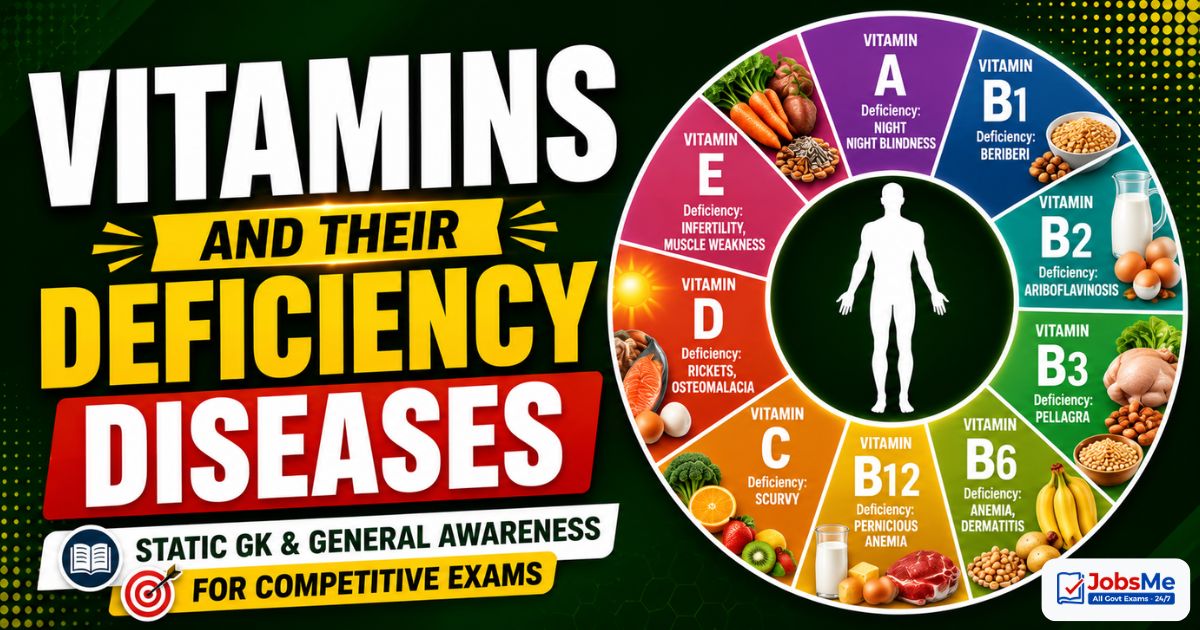
This article presents a complete list of vitamins, their chemical (scientific) names, solubility, deficiency diseases, key functions, and food sources, covering all 13 essential vitamins including Vitamin A (Retinol), Vitamin C (Ascorbic Acid), Vitamin D (Calciferol), and the entire B-complex group. It explains classic deficiency diseases such as Night Blindness, Beriberi, Pellagra, Scurvy, Rickets, and Anaemia in a simple, exam-ready format with memory tricks and one-liners for quick revision. All facts are arranged to help UPSC, SSC, IBPS, RRB, PSU, and State PCS aspirants score better in the General Science and General Awareness sections.
Jump to section
Introduction
Vitamins are organic compounds that the human body needs in small quantities to carry out essential functions such as growth, vision, blood clotting, bone formation, and energy metabolism. Since the body cannot synthesise most vitamins on its own, they must be obtained through a balanced diet. When a particular vitamin is missing or inadequate in the diet, it leads to a specific deficiency disease — for example, lack of Vitamin C causes Scurvy, lack of Vitamin D causes Rickets, and lack of Vitamin A causes Night Blindness.
Questions on vitamins, their chemical names, and the diseases caused by their deficiency are among the most frequently asked topics in the General Science and General Awareness sections of UPSC Prelims, SSC CGL, IBPS PO, RRB NTPC, SBI Clerk, State PCS, and various Insurance, Defence, and PSU exams. A typical question asks which vitamin deficiency causes a given disease, the scientific name of a vitamin, or whether a vitamin is fat-soluble or water-soluble. This article brings together every important vitamin fact in a structured, exam-ready format. To explore more such topics, you can refer to the Static GK section on Jobsme.in.
The topic also connects with current affairs themes such as government nutrition schemes, fortified food programmes, Vitamin A and iron-folic acid supplementation drives, anaemia-control initiatives, and World Health Organization advisories — making it useful for both Prelims (direct factual questions) and Mains (health, nutrition, and public-policy answers).
Core Concepts: Classification of Vitamins
Vitamins are broadly classified into two groups based on their solubility. Understanding this classification makes it easier to remember their sources, storage, and deficiency effects.
Two Main Categories
- Fat-Soluble Vitamins (A, D, E, K): These dissolve in fats and oils and are stored in the liver and fatty (adipose) tissues. Because they are stored, deficiency develops slowly, but excess intake can cause toxicity (hypervitaminosis).
- Water-Soluble Vitamins (B-complex and C): These dissolve in water and are not stored in large amounts in the body; any excess is excreted through urine. Hence they must be taken regularly through the diet. The only major exception is Vitamin B12 (Cobalamin), which can be stored in the liver for years.
Key Points to Remember
- There are 13 essential vitamins required by the human body.
- Fat-soluble vitamins are absorbed along with dietary fat in the intestine.
- Water-soluble vitamins generally need to be replenished daily because they are excreted in urine.
- Each vitamin has a common name (like Vitamin A) and a chemical/scientific name (like Retinol) — exams often test the scientific name.
List of Vitamins, Chemical Names, and Deficiency Diseases
The following tables list every essential vitamin with its chemical name, solubility, the disease caused by its deficiency, its main function, and common food sources. These are the most exam-relevant facts and must be memorised thoroughly.
Fat-Soluble Vitamins (A, D, E, K)
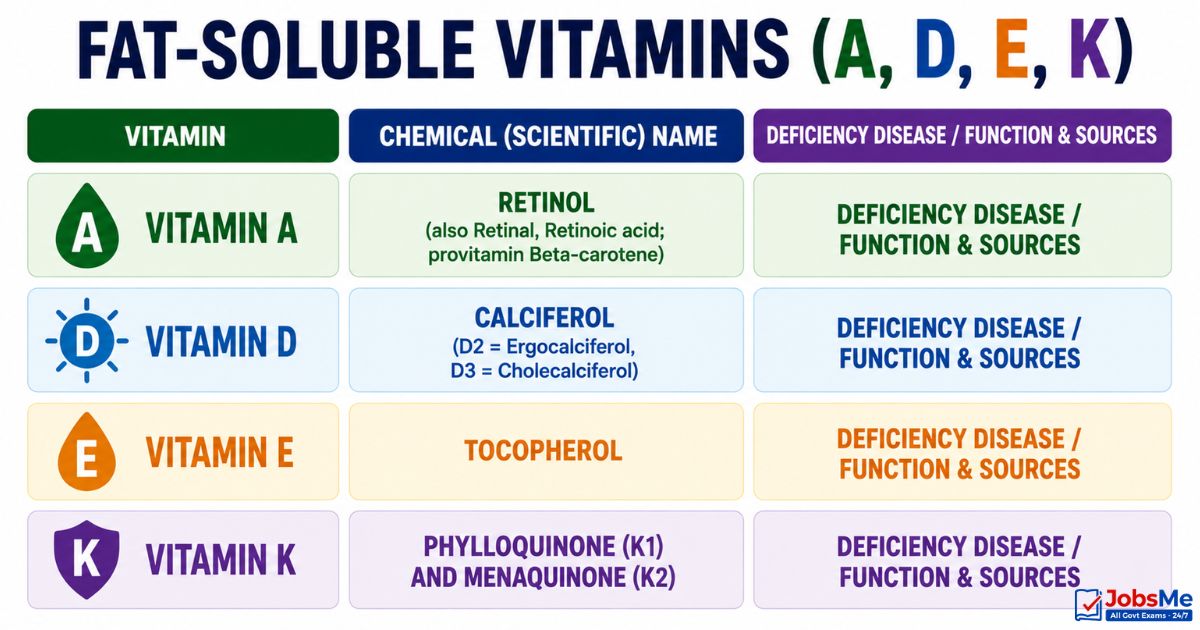
| Vitamin | Chemical (Scientific) Name | Deficiency Disease / Function & Sources |
|---|---|---|
| Vitamin A | Retinol (also Retinal, Retinoic acid; provitamin Beta-carotene) | Deficiency causes Night Blindness (Nyctalopia) and Xerophthalmia (dryness of the eye); essential for healthy vision, skin, and immunity. Sources: carrots, papaya, mango, green leafy vegetables, liver, milk, egg yolk, and fish liver oil. |
| Vitamin D | Calciferol (D2 = Ergocalciferol, D3 = Cholecalciferol) | Deficiency causes Rickets in children (soft, bent bones) and Osteomalacia in adults; helps the body absorb calcium and phosphorus for strong bones and teeth. Called the "Sunshine Vitamin" as it is synthesised by skin in sunlight. Sources: sunlight, fish, egg yolk, fortified milk, and cod liver oil. |
| Vitamin E | Tocopherol | Deficiency causes infertility (in animals), haemolysis of red blood cells, and nerve problems; acts as an antioxidant protecting cells from damage and is important for reproduction. Sources: vegetable oils, nuts, sunflower seeds, wheat germ, and green leafy vegetables. |
| Vitamin K | Phylloquinone (K1) and Menaquinone (K2) | Deficiency causes excessive bleeding due to poor blood clotting; essential for the synthesis of clotting factors (prothrombin). Sources: green leafy vegetables (spinach, cabbage), tomatoes, eggs, and liver. Also produced by bacteria in the human intestine. |
Water-Soluble Vitamins (B-Complex)
| Vitamin | Chemical (Scientific) Name | Deficiency Disease / Function & Sources |
|---|---|---|
| Vitamin B1 | Thiamine | Deficiency causes Beriberi and Wernicke-Korsakoff syndrome; needed for carbohydrate metabolism and proper nerve function. Sources: whole grains, brown rice, pulses, nuts, pork, and yeast. |
| Vitamin B2 | Riboflavin | Deficiency causes Ariboflavinosis — cracks at the corners of the mouth (cheilosis), sore tongue (glossitis), and skin problems; helps in energy production. Sources: milk, eggs, green vegetables, and dairy products. |
| Vitamin B3 | Niacin (Nicotinic acid / Niacinamide) | Deficiency causes Pellagra, remembered by the "3 D's" — Dermatitis, Diarrhoea, and Dementia; needed for energy metabolism. Sources: meat, fish, eggs, peanuts, and whole grains. |
| Vitamin B5 | Pantothenic acid | Deficiency causes Paresthesia (a burning feeling, "burning feet syndrome") and fatigue; a component of Coenzyme A, vital for energy release. Sources: meat, eggs, broccoli, avocado, and whole grains. |
| Vitamin B6 | Pyridoxine (also Pyridoxal, Pyridoxamine) | Deficiency causes Anaemia and peripheral neuropathy (nerve damage); supports protein metabolism and brain function. Sources: meat, fish, vegetables, bananas, and nuts. |
| Vitamin B7 | Biotin (also called Vitamin H) | Deficiency causes hair loss, skin rashes (dermatitis), and brittle nails; supports metabolism of carbohydrates, fats, and proteins. Sources: eggs, liver, nuts, and seeds. |
| Vitamin B9 | Folic acid / Folate | Deficiency causes Megaloblastic (Macrocytic) Anaemia and, in pregnancy, neural tube defects in the foetus; essential for DNA synthesis and red blood cell formation. Sources: green leafy vegetables, citrus fruits, beans, and liver. |
| Vitamin B12 | Cobalamin (Cyanocobalamin) | Deficiency causes Pernicious Anaemia and nerve damage; needed for red blood cell formation and the nervous system. The only B vitamin stored in the liver for years. Found only in animal sources — meat, fish, eggs, and milk — so vegetarians and vegans are at higher risk. |
Water-Soluble Vitamin C
| Vitamin | Chemical (Scientific) Name | Deficiency Disease / Function & Sources |
|---|---|---|
| Vitamin C | Ascorbic acid | Deficiency causes Scurvy — bleeding and swollen gums, slow wound healing, and weakness; acts as an antioxidant, boosts immunity, and helps the body absorb iron and form collagen. Sources: citrus fruits (orange, lemon), amla (Indian gooseberry), guava, tomatoes, and green vegetables. |
For more General Science topics useful for competitive exams, you can explore the Static GK notes and test yourself with the Static GK Quiz on Jobsme.in.
Memory Tricks and Mnemonics
Trick 1: Fat-Soluble Vitamins — "ADEK"
Only four vitamins are fat-soluble. Remember them with the simple word "ADEK" (sounds like "a deck"):
- A → Vitamin A (Retinol).
- D → Vitamin D (Calciferol).
- E → Vitamin E (Tocopherol).
- K → Vitamin K (Phylloquinone).
"ADEK is a deck of four fat cards — the rest (B and C) wash away in water."
Trick 2: Vitamin C and Scurvy — "C for Citrus, C for Scurvy"
Vitamin C (Ascorbic acid) comes from Citrus fruits and prevents Scurvy. "No C → Scurvy." Both Vitamin C and Scurvy can be linked through the letter C, and amla (Indian gooseberry) is the richest natural source.
Trick 3: Chemical Names of A, B1, C, D, E, K — "Rich Thieves Always Carry Tons of Phones"
Use this sentence to recall the chemical names of the main vitamins:
- Rich → Retinol → Vitamin A.
- Thieves → Thiamine → Vitamin B1.
- Always → Ascorbic acid → Vitamin C.
- Carry → Calciferol → Vitamin D.
- Tons → Tocopherol → Vitamin E.
- Phones → Phylloquinone → Vitamin K.
Trick 4: Pellagra and the "3 D's"
Vitamin B3 (Niacin) deficiency causes Pellagra. Remember its symptoms as the "3 D's":
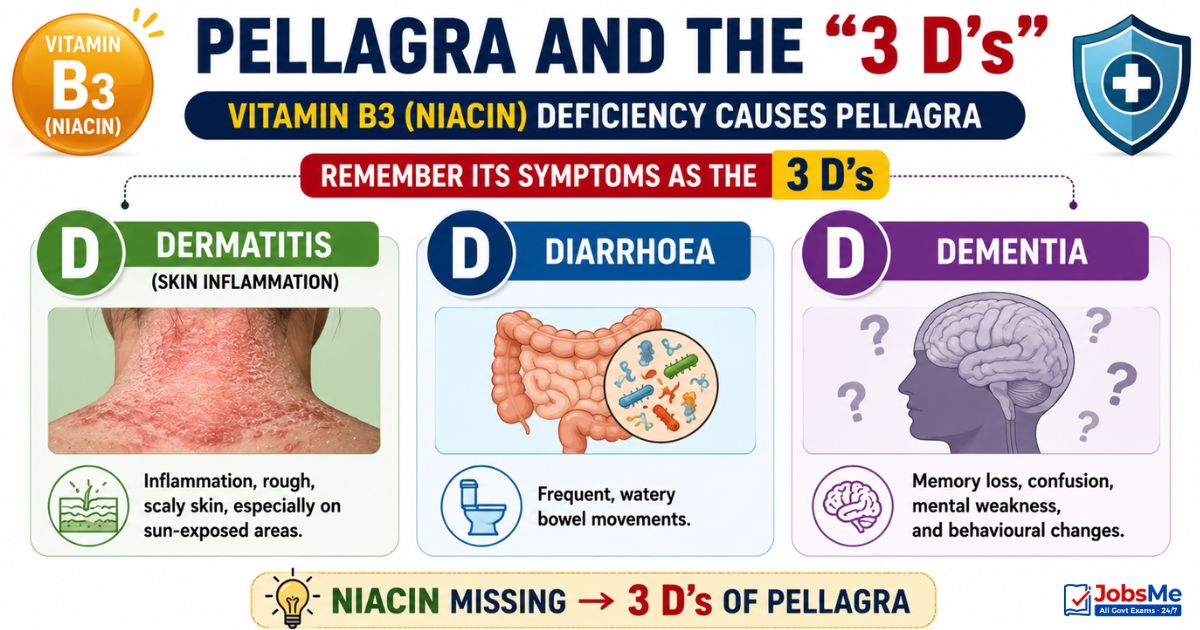
- D → Dermatitis (skin inflammation).
- D → Diarrhoea.
- D → Dementia.
"Niacin missing → 3 D's of Pellagra."
Trick 5: Bone Vitamins — "D for Dhoop (Sunlight) and Daant-Haddi (Teeth-Bones)"
Vitamin D is the "Sunshine Vitamin" because the skin makes it in sunlight (Dhoop). It strengthens bones and teeth, and its deficiency causes Rickets in children and Osteomalacia in adults. "No D → soft bones."
Trick 6: Blood Vitamins — "K for Klotting"
Vitamin K helps in blood clotting. Remember "K = Klotting" (Clotting spelt with a K). Its deficiency causes excessive bleeding because the blood fails to clot.
Trick 7: Anaemia Trio — "Three vitamins, one blood problem"
Three vitamins are linked to Anaemia (low haemoglobin/RBC problems):
- Vitamin B6 (Pyridoxine) → Anaemia + nerve damage.
- Vitamin B9 (Folic acid) → Megaloblastic Anaemia.
- Vitamin B12 (Cobalamin) → Pernicious Anaemia.
"B6, B9, B12 — the three blood-builders."
Additional Notes
Frequently Confused Facts
- Rickets vs Osteomalacia: Both are caused by Vitamin D deficiency, but Rickets occurs in children (growing bones become soft and bent) while Osteomalacia occurs in adults.
- Night Blindness vs Xerophthalmia: Both result from Vitamin A deficiency. Night Blindness is difficulty seeing in dim light; Xerophthalmia is severe dryness and damage to the eye.
- Scurvy vs Beriberi: Scurvy is caused by Vitamin C deficiency (bleeding gums); Beriberi is caused by Vitamin B1 (Thiamine) deficiency (nerve and muscle weakness).
- Pellagra vs Anaemia: Pellagra is caused by Vitamin B3 (Niacin); the various Anaemias are linked to Vitamins B6, B9, and B12.
- Vitamin H: "Vitamin H" is simply another name for Vitamin B7 (Biotin) — not a separate vitamin.
- Fat-soluble vs Water-soluble storage: Fat-soluble vitamins (A, D, E, K) are stored in the body; water-soluble vitamins (B, C) are not stored — except Vitamin B12, which is stored in the liver.
- Calciferol vs Cholecalciferol: Calciferol is the general chemical name for Vitamin D; Cholecalciferol is specifically Vitamin D3, while Ergocalciferol is Vitamin D2.
- Megaloblastic vs Pernicious Anaemia: Megaloblastic Anaemia is commonly linked to Folic acid (B9) deficiency; Pernicious Anaemia is the classic name for Vitamin B12 deficiency.
Repeating PYQ Patterns
Certain vitamin facts are asked repeatedly in competitive exams. Vitamin C - Scurvy, Vitamin D - Rickets, Vitamin A - Night Blindness, Vitamin B1 - Beriberi, Vitamin B3 - Pellagra, Vitamin K - Blood clotting, and the chemical names Ascorbic acid (C), Retinol (A), Calciferol (D), Tocopherol (E), and Thiamine (B1) appear most often in UPSC Prelims, SSC CGL, RRB NTPC, and SSC CHSL papers. Banking exams (IBPS PO, SBI Clerk) and Insurance exams frequently ask matching questions pairing a vitamin with its deficiency disease or its scientific name. RRB and Nursing/Defence exams often add the fat-soluble vs water-soluble classification and the "Sunshine Vitamin" (Vitamin D) fact. State PCS exams sometimes add nutrition-scheme questions linking Vitamin A and iron-folic acid supplementation.
Quick Insight
Vitamin knowledge is not just academic — it underpins major public-health programmes in India and worldwide. Government initiatives provide Vitamin A supplementation to children to prevent blindness, iron and folic acid (Vitamin B9) tablets to combat anaemia among women and adolescents, and food-fortification drives to add vitamins to staples like rice, salt, and edible oil. Understanding which vitamin prevents which disease helps aspirants answer both Prelims matching questions and Mains questions on nutrition, malnutrition, and health policy. For more exam-oriented science and awareness topics, you can refer to the Static GK guide and stay updated with the Daily Current Affairs section on Jobsme.in.
One-Liners for Quick Revision
- Vitamin A → Retinol → Deficiency causes Night Blindness and Xerophthalmia; fat-soluble.
- Vitamin B1 → Thiamine → Deficiency causes Beriberi; water-soluble.
- Vitamin B2 → Riboflavin → Deficiency causes Ariboflavinosis (cracked lips, sore tongue); water-soluble.
- Vitamin B3 → Niacin → Deficiency causes Pellagra (3 D's: Dermatitis, Diarrhoea, Dementia); water-soluble.
- Vitamin B5 → Pantothenic acid → Deficiency causes Paresthesia (burning feet); water-soluble.
- Vitamin B6 → Pyridoxine → Deficiency causes Anaemia and nerve damage; water-soluble.
- Vitamin B7 → Biotin (Vitamin H) → Deficiency causes hair loss and skin problems; water-soluble.
- Vitamin B9 → Folic acid → Deficiency causes Megaloblastic Anaemia and neural tube defects in pregnancy; water-soluble.
- Vitamin B12 → Cobalamin → Deficiency causes Pernicious Anaemia; only B vitamin stored in liver; found only in animal foods.
- Vitamin C → Ascorbic acid → Deficiency causes Scurvy (bleeding gums); aids iron absorption and immunity; water-soluble.
- Vitamin D → Calciferol → Deficiency causes Rickets (children) and Osteomalacia (adults); the "Sunshine Vitamin"; fat-soluble.
- Vitamin E → Tocopherol → Antioxidant, important for reproduction; deficiency causes infertility and RBC damage; fat-soluble.
- Vitamin K → Phylloquinone → Essential for blood clotting; deficiency causes excessive bleeding; fat-soluble.
- Fat-soluble vitamins → A, D, E, K (remember "ADEK"); stored in the body.
- Water-soluble vitamins → B-complex and C; not stored (except B12); excreted in urine.
- Sunshine Vitamin → Vitamin D, made by skin in sunlight.
- Richest natural source of Vitamin C → Amla (Indian gooseberry).
For more exam-ready notes like this, explore the Static GK section and attempt the Static GK Quiz on Jobsme.in. You can also check the latest openings at Latest Government Job Notifications and revise daily updates through the Daily Current Affairs page.
Free quiz • No signup required
Put this topic into practice with Indian Cultural Institutions – Static GK MCQ Quiz. It is the quickest way to reinforce what you just learned.
Frequently Asked Questions
Which vitamin deficiency causes Scurvy?
What is the chemical name of Vitamin A and which disease does its deficiency cause?
Which vitamins are fat-soluble?
Why is Vitamin D called the Sunshine Vitamin?
Which vitamin is essential for blood clotting?
What is Pellagra and which vitamin deficiency causes it?
Which vitamin deficiency causes Beriberi?
Which is the only B vitamin stored in the body, and what does its deficiency cause?
What is the difference between fat-soluble and water-soluble vitamins?
Which vitamin deficiencies are linked to Anaemia?

About the author