
Hill Stations of India – Complete Static GK & General Awareness List for Competitive Exams with Memory Tricks
This article presents a complete state-wise list of important hill stations of India, covering their locations, mountain ranges, elevations, famous nicknames, and key attractions. It includes major hill stations like Shimla (Queen of Hills), Ooty (Queen of Hill Stations), Darjeeling, Mussoorie, Nainital, Munnar, Khajjiar (Mini Switzerland of India), and Shillong (Scotland of the East), along with memory tricks and one-liners for quick revision. All facts are arranged in exam-ready format to help UPSC, SSC, IBPS, RRB, PSU, and State PCS aspirants score better in the Indian Geography and General Awareness sections.

Jump to section
- Introduction
- Core Concepts: Understanding Hill Stations of India
- Hill Stations of North India - Himalayan Region
- Hill Stations of Northeast India - Eastern Himalayas
- Hill Stations of West and South India - Western Ghats
- Hill Stations of Central, Western, and Eastern India
- Memory Tricks and Mnemonics
- Additional Notes
- One-Liners for Quick Revision
Introduction
India's varied topography is dotted with beautiful hill stations spread across the Himalayas in the north and northeast, the Western Ghats (Sahyadris) in the west and south, the Eastern Ghats, the Aravalli Range, and the Satpura Range in central India. A hill station is a town located at a higher elevation than the surrounding plains, traditionally used as a place of refuge to escape the summer heat. Most hill stations of India lie between 600 metres and 3,500 metres above sea level, and many famous ones like Shimla, Mussoorie, Ooty, and Darjeeling were developed by the British as summer retreats around a central Mall Road.
Questions on hill stations of India appear regularly in UPSC Prelims, SSC CGL, IBPS PO, RRB NTPC, State PCS, and various PSU, Insurance, and Defence exams. Questions typically ask which state a hill station is located in, which mountain range it belongs to, what its popular nickname is (such as "Queen of Hills" or "Switzerland of India"), or which river or peak it is associated with. This article brings together every important hill station in a structured, exam-ready format. To explore other related Static GK topics, you can refer to the Static GK section on Jobsme.in.
Hill stations are also closely linked to current affairs themes such as tourism promotion, eco-sensitive zones, climate change impact on Himalayan towns, UNESCO World Heritage status of mountain railways, and summer-season news coverage — making this topic doubly important for aspirants preparing for both Prelims and Mains. You can stay updated on related news through the Daily Current Affairs page.
Core Concepts: Understanding Hill Stations of India
A clear understanding of how hill stations are classified by mountain range and region makes it far easier to remember which state each one belongs to. Indian hill stations are broadly grouped by the mountain system they sit on.
Major Mountain Systems and Their Hill Stations
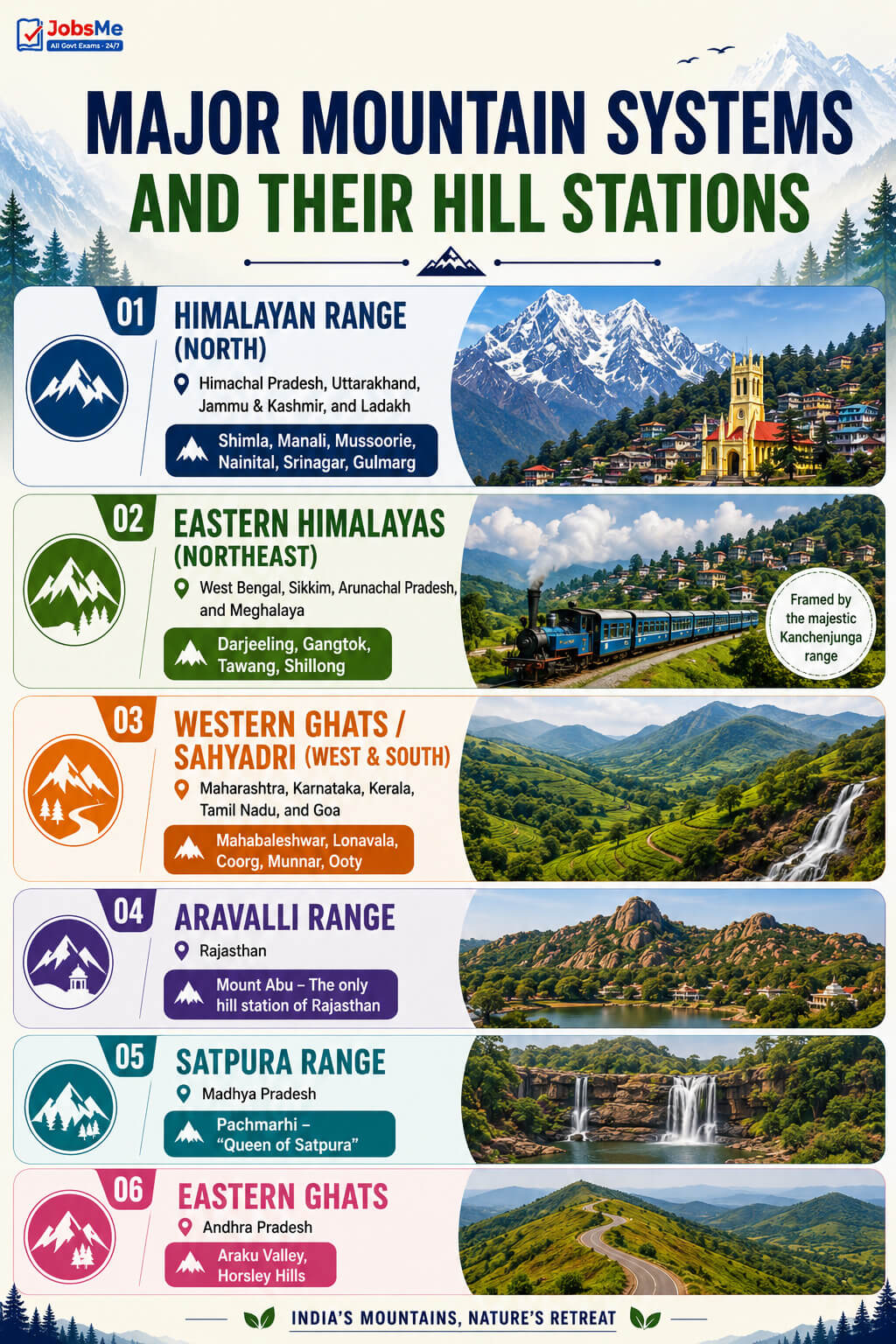
- Himalayan Range (North): Hill stations in Himachal Pradesh, Uttarakhand, Jammu & Kashmir, and Ladakh — including Shimla, Manali, Mussoorie, Nainital, Srinagar, and Gulmarg.
- Eastern Himalayas (Northeast): Hill stations in West Bengal, Sikkim, Arunachal Pradesh, and Meghalaya — including Darjeeling, Gangtok, Tawang, and Shillong, framed by the Kanchenjunga range.
- Western Ghats / Sahyadri (West and South): Hill stations in Maharashtra, Karnataka, Kerala, Tamil Nadu, and Goa — including Mahabaleshwar, Lonavala, Coorg, Munnar, and Ooty.
- Aravalli Range: Mount Abu in Rajasthan — the only hill station of Rajasthan.
- Satpura Range: Pachmarhi in Madhya Pradesh — the "Queen of Satpura."
- Eastern Ghats: Hill stations such as Araku Valley and Horsley Hills in Andhra Pradesh.
Hill Stations of North India - Himalayan Region
The following table lists the most exam-relevant hill stations of North India along with their states, mountain ranges, elevations, and key details.
| Hill Station | State / UT | Nickname & Key Details |
|---|---|---|
| Shimla | Himachal Pradesh | Known as the "Queen of Hills"; located at about 2,205 m in the Shivalik range; was the summer capital of British India; capital of Himachal Pradesh; famous for the Mall, the Ridge, and the Kalka-Shimla toy train. |
| Manali | Himachal Pradesh | Located in the Kullu Valley on the banks of the Beas River; flanked by the Dhauladhar and Pir Panjal ranges; gateway to Leh and Spiti; famous for Solang Valley, Rohtang Pass, and Manu Temple. |
| Dharamshala / McLeod Ganj | Himachal Pradesh | Located in the Kangra Valley at about 1,457 m; winter seat of the Himachal government; McLeod Ganj is the home of the Dalai Lama and the Tibetan government-in-exile. |
| Dalhousie | Himachal Pradesh | British-era hill station spread over five hills; known for colonial bungalows and pine forests; gateway to Khajjiar and Chamba. |
| Khajjiar | Himachal Pradesh | Called the "Mini Switzerland of India" / "Switzerland of India" for its rolling meadows, dense forests, and central lake; located near Dalhousie in the Chamba district. |
| Kasauli | Himachal Pradesh | Located at about 1,800 m in the Shivalik range; small colonial town filled with pine and oak; popular weekend getaway from Chandigarh. |
| Kullu | Himachal Pradesh | Capital town of Kullu district on the banks of the Beas River at about 1,230 m; famous for Dussehra celebrations, apple orchards, and temples. |
| Palampur | Himachal Pradesh | Located in the Kangra Valley; called the "Tea Capital of Northwest India"; name derived from the local word "pulum," meaning lots of water. |
| Mussoorie | Uttarakhand | Known as the "Queen of Hills" / "Queen of Hill Stations"; located at about 1,880 m near Dehradun in the Garhwal Himalayas; education hub with top boarding schools; famous for the Mall, Kempty Falls, and Lal Tibba. |
| Nainital | Uttarakhand | Called the "Lake District of India"; located in the Kumaon range around the natural Naini Lake; famous for Naini Peak, Snow View, and Tiffin Top. |
| Auli | Uttarakhand | Famous skiing destination at up to about 3,049 m in the Garhwal Himalayas; receives heavy snowfall from December to February; offers views of Nanda Devi. |
| Ranikhet | Uttarakhand | Name means "Queen's Farm"; headquarters of the Kumaon Regiment of the Indian Army; offers postcard views of the Nanda Devi peak. |
| Srinagar | Jammu & Kashmir | Located on the banks of the Jhelum River; famous for Dal Lake, shikara rides, houseboats, and Mughal gardens (Shalimar Bagh, Nishat Bagh); Kashmir is called "Paradise on Earth." |
| Gulmarg | Jammu & Kashmir | "Meadow of Flowers"; major skiing destination; home to the Gulmarg Gondola, one of the highest cable cars in the world; has one of the world's highest golf courses. |
| Pahalgam | Jammu & Kashmir | "Valley of Shepherds"; base camp for the Amarnath Yatra; located on the banks of the Lidder River. |
| Leh-Ladakh | Ladakh | Among the highest hill destinations in India; cold desert region; famous for Pangong Lake, Magnetic Hill, Zanskar Valley, and Buddhist monasteries. |
Hill Stations of Northeast India - Eastern Himalayas
The hill stations of Northeast India are nestled in the Eastern Himalayas and are known for their tea gardens, monasteries, and views of the Kanchenjunga peak. You can test your knowledge of Indian geography facts with the Static GK Quiz on Jobsme.in.
| Hill Station | State | Nickname & Key Details |
|---|---|---|
| Darjeeling | West Bengal | Located in the Lesser Himalayas at about 2,050 m; world-famous for its tea; name means "Land of the Thunderbolt"; the Darjeeling Himalayan Railway (toy train) is a UNESCO World Heritage Site; Tiger Hill offers views of Kanchenjunga. |
| Kalimpong | West Bengal | Located near Darjeeling in the Eastern Himalayas; known for flower nurseries, Buddhist monasteries, and colonial architecture. |
| Gangtok | Sikkim | Capital of Sikkim in the Eastern Himalayas; gateway to Nathula Pass and Tsomgo Lake; known for monasteries and clean streets. |
| Pelling | Sikkim | Located in West Sikkim at about 2,150 m; offers close-up views of the Kanchenjunga peak; second biggest tourist hotspot in Sikkim after Gangtok. |
| Shillong | Meghalaya | Capital of Meghalaya at about 1,496 m; called the "Scotland of the East" and the "Abode of Clouds"; has Asia's largest golf course; known for Umiam Lake and Elephant Falls. |
| Cherrapunji (Sohra) | Meghalaya | One of the wettest places on Earth; famous for living root bridges and Nohkalikai Falls; receives among the highest rainfall in the world. |
| Tawang | Arunachal Pradesh | Located at about 3,048 m near the China border; one of India's highest hill stations; home to Tawang Monastery, one of Asia's largest Buddhist monasteries; birthplace of the 6th Dalai Lama; near Sela Pass. |
Hill Stations of West and South India - Western Ghats
The Western Ghats (Sahyadri range) host some of India's most visited hill stations, known for tea, coffee, and spice plantations. The following table covers the most exam-relevant entries.
| Hill Station | State | Nickname & Key Details |
|---|---|---|
| Mahabaleshwar | Maharashtra | Highest hill station in the Western Ghats of Maharashtra; source of the Krishna River; famous for strawberries and the colonial Mahabaleshwar-Panchgani belt. |
| Panchgani | Maharashtra | Located in the Krishna Valley; name means "five hills"; popular weekend getaway near Mahabaleshwar; known for Table Land, a large volcanic plateau. |
| Lonavala | Maharashtra | Located at about 625 m in the Sahyadri range between Mumbai and Pune; famous for chikki, caves (Karla and Bhaja), and the Lonavala-Khandala twin getaway. |
| Matheran | Maharashtra | One of India's smallest hill stations at about 800 m; Asia's only automobile-free hill station (private vehicles banned); reached by a toy train from Neral; known for Echo Point and Charlotte Lake. |
| Coorg (Kodagu) | Karnataka | Called the "Scotland of India" and the "Coffee Land of India"; located at about 1,750 m in the Western Ghats; the Cauvery River originates at Talakaveri here; famous for coffee and spice plantations. |
| Nandi Hills | Karnataka | Located near Bengaluru; developed by the Ganga dynasty and used by Tipu Sultan as a summer retreat; famous for sunrise views. |
| Munnar | Kerala | Located in the Western Ghats at the meeting point of three mountain streams; famous for tea estates and the rare Neelakurinji flower that blooms once every 12 years; near Anamudi, the highest peak in South India. |
| Wayanad | Kerala | Located in Kerala's northern highlands between 700 m and 2,100 m; known for spice and coffee plantations, the prehistoric Edakkal Caves, and Banasura Sagar Dam. |
| Ooty (Udhagamandalam) | Tamil Nadu | Called the "Queen of Hill Stations"; located in the Nilgiri Hills; famous for the Nilgiri Mountain Railway (a UNESCO World Heritage Site), the Botanical Garden, and Doddabetta peak. |
| Kodaikanal | Tamil Nadu | Called the "Princess of Hill Stations"; located at about 2,133 m in the Palani Hills; famous for the star-shaped Kodaikanal Lake, Coaker's Walk, and the Neelakurinji bloom. |
| Coonoor | Tamil Nadu | Second largest hill station in the Nilgiris after Ooty; famous for tea estates, Sim's Park, and Dolphin's Nose viewpoint. |
Hill Stations of Central, Western, and Eastern India
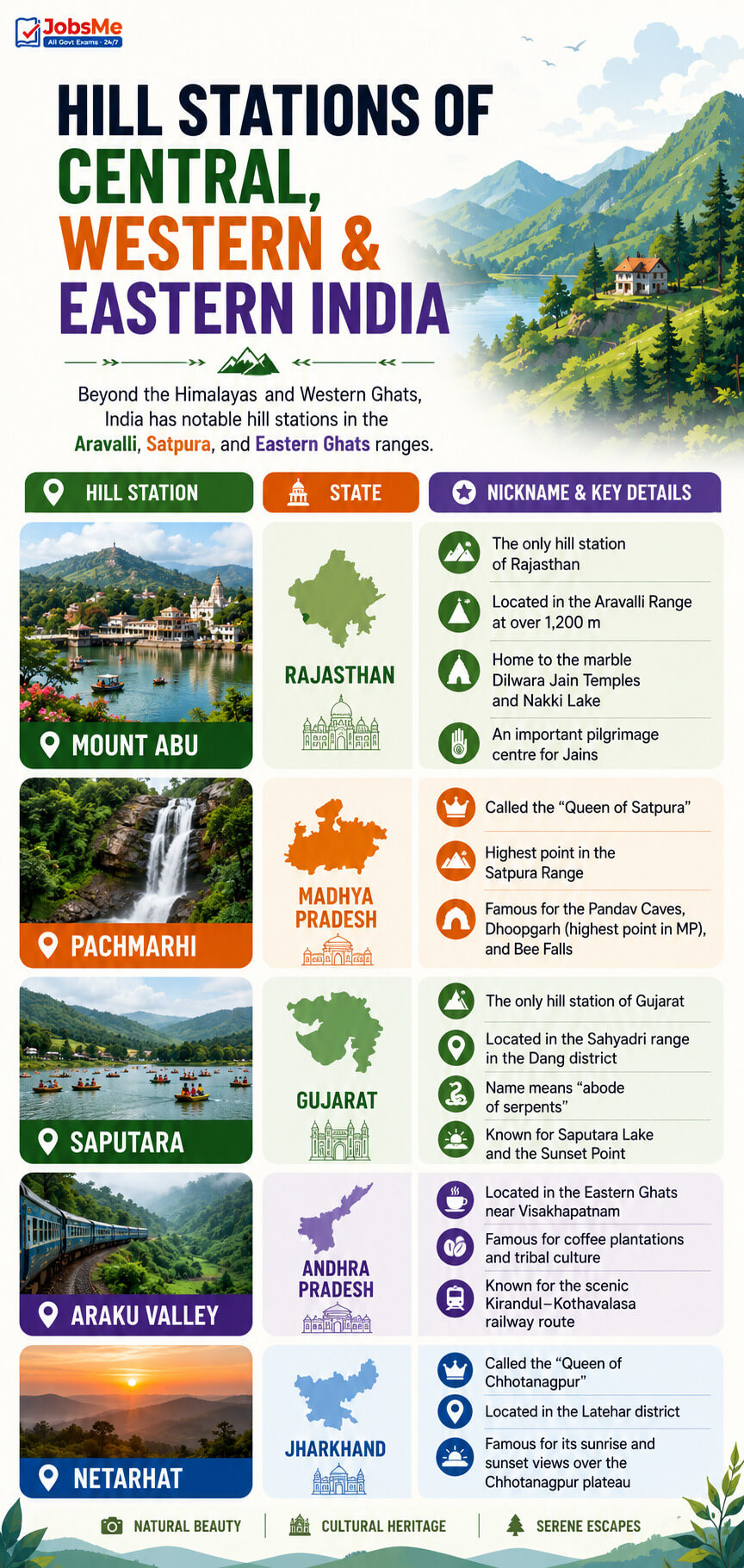
Beyond the Himalayas and Western Ghats, India has notable hill stations in the Aravalli, Satpura, and Eastern Ghats ranges.
| Hill Station | State | Nickname & Key Details |
|---|---|---|
| Mount Abu | Rajasthan | The only hill station of Rajasthan; located in the Aravalli Range at over 1,200 m; home to the marble Dilwara Jain Temples and Nakki Lake; an important pilgrimage centre for Jains. |
| Pachmarhi | Madhya Pradesh | Called the "Queen of Satpura"; highest point in the Satpura Range; famous for the Pandav Caves, Dhoopgarh (highest point in MP), and Bee Falls. |
| Saputara | Gujarat | The only hill station of Gujarat; located in the Sahyadri range in the Dang district; name means "abode of serpents"; known for Saputara Lake and the Sunset Point. |
| Araku Valley | Andhra Pradesh | Located in the Eastern Ghats near Visakhapatnam; famous for coffee plantations, tribal culture, and the scenic Kirandul-Kothavalasa railway route. |
| Netarhat | Jharkhand | Called the "Queen of Chhotanagpur"; located in the Latehar district; famous for its sunrise and sunset views over the Chhotanagpur plateau. |
Memory Tricks and Mnemonics
Trick 1: The "Queen" Hill Stations — "SMOK"
Several hill stations carry royal "Queen" titles. Remember them with the acronym "SMOK":
- S → Shimla → Queen of Hills.
- M → Mussoorie → Queen of Hills / Queen of Hill Stations.
- O → Ooty → Queen of Hill Stations.
- K → Kodaikanal → Princess of Hill Stations.
"Two Queens of Hills (Shimla, Mussoorie), two Queens of the South (Ooty the Queen, Kodaikanal the Princess)."
Trick 2: The "Switzerland of India" — Remember "KHaj"
To avoid confusion about which hill station is the Switzerland of India:
- Khajjiar (Himachal Pradesh) → Mini Switzerland of India / Switzerland of India.
"Khajjiar's meadow + lake + forest = a Swiss postcard."
Trick 3: The "Scotland" Twins — "Shillong vs Coorg"
Two hill stations are compared to Scotland; keep them apart by direction:
- Shillong (Meghalaya, Northeast) → Scotland of the East.
- Coorg (Karnataka, South) → Scotland of India.
"East goes to Shillong, South goes to Coorg."
Trick 4: "Only Hill Station" of a State — "MARS-G"
Some states have only one famous hill station. Remember the contrast:
- Mount Abu → the only hill station of Rajasthan (Aravalli Range).
- Saputara → the only hill station of Gujarat (Sahyadri Range).
"Mount Abu for Rajasthan, Saputara for Gujarat — one each."
Trick 5: UNESCO Toy Trains — "DNK Railways"
Three mountain railways form the UNESCO "Mountain Railways of India." Remember "DNK":
- D → Darjeeling Himalayan Railway (West Bengal).
- N → Nilgiri Mountain Railway → Ooty (Tamil Nadu).
- K → Kalka-Shimla Railway (Himachal Pradesh).
Trick 6: Rivers Born in Hill Stations — "KC at the Source"
Link hill stations to the rivers that originate near them:
- Krishna River → originates at Mahabaleshwar (Maharashtra).
- Cauvery River → originates at Talakaveri in Coorg (Karnataka).
"K for Krishna at Mahabaleshwar, C for Cauvery at Coorg."
Trick 7: Range-Wise Grouping — "HEW-ASE"
Group hill stations by mountain range to recall their location instantly:
- H → Himalayas → Shimla, Manali, Mussoorie, Nainital.
- E → Eastern Himalayas → Darjeeling, Gangtok, Tawang, Shillong.
- W → Western Ghats → Mahabaleshwar, Coorg, Munnar, Ooty.
- A → Aravalli → Mount Abu.
- S → Satpura → Pachmarhi.
- E → Eastern Ghats → Araku Valley.
Additional Notes
Frequently Confused Facts
- Queen of Hills: Both Shimla (Himachal Pradesh) and Mussoorie (Uttarakhand) are called the Queen of Hills. Ooty is the Queen of Hill Stations, and Kodaikanal is the Princess of Hill Stations.
- Switzerland of India: Khajjiar in Himachal Pradesh is called the Mini Switzerland / Switzerland of India — not Kashmir or Kullu.
- Scotland comparison: Shillong (Meghalaya) is the Scotland of the East; Coorg (Karnataka) is the Scotland of India. Do not interchange them.
- Only hill station of a state: Mount Abu is the only hill station of Rajasthan (Aravalli); Saputara is the only hill station of Gujarat (Sahyadri).
- Lake District of India: Nainital in Uttarakhand, not Srinagar, is the Lake District of India.
- Automobile-free hill station: Matheran in Maharashtra is Asia's only hill station where private vehicles are banned.
- Summer capital of British India: Shimla, not Darjeeling. Darjeeling was the summer capital of the Bengal Presidency.
- Tawang vs Sela Pass: Tawang is the hill town; Sela Pass is the high mountain pass on the route to it. Tawang is the birthplace of the 6th Dalai Lama.
- Neelakurinji bloom: The Neelakurinji flower blooms once every 12 years and is associated with Munnar (Kerala) and Kodaikanal (Tamil Nadu).
- Highest peak of South India: Anamudi, near Munnar, is the highest peak in South India — not Doddabetta, which is the highest in the Nilgiris.
Repeating PYQ Patterns
Certain hill stations are asked repeatedly in competitive exams. Shimla (Queen of Hills, summer capital of British India), Mussoorie (Queen of Hills), Ooty (Queen of Hill Stations, Nilgiri Railway), Darjeeling (tea, UNESCO toy train, Kanchenjunga), Khajjiar (Switzerland of India), Shillong (Scotland of the East), Mount Abu (only hill station of Rajasthan), Pachmarhi (Queen of Satpura), and Mahabaleshwar (source of the Krishna River) appear most often in UPSC Prelims, SSC CGL, and RRB NTPC papers. Banking exams (IBPS PO, SBI Clerk) frequently match hill stations with their states and nicknames. State PCS exams focus on regional ones — Uttarakhand PCS asks about Nainital and Ranikhet, Tamil Nadu PCS about Ooty and Kodaikanal, Himachal PCS about Shimla, Manali, and Dharamshala, and Maharashtra PCS about Mahabaleshwar and Matheran.
Quick Insight
Hill stations are more than tourist spots — they reflect India's geography, colonial history, and ecology in one frame. Their locations reveal the country's major mountain systems, their nicknames echo British nostalgia for European landscapes, and their fragile ecosystems make them central to current debates on sustainable tourism, eco-sensitive zones, and climate change in the Himalayas and Western Ghats. Understanding hill stations helps aspirants connect physical geography (ranges, rivers, peaks) with current affairs (tourism, environment, UNESCO heritage), which is valuable for both Prelims matching questions and Mains geography and environment answers. For further reading on related Static GK topics, you can refer to the Static GK section and stay current with the Daily Current Affairs Quiz on Jobsme.in.
One-Liners for Quick Revision
- Shimla → Queen of Hills → Himachal Pradesh; summer capital of British India; Shivalik range.
- Manali → Kullu Valley, Beas River → Himachal Pradesh; gateway to Leh and Spiti.
- Dharamshala / McLeod Ganj → Kangra Valley → Himachal Pradesh; home of the Dalai Lama.
- Dalhousie → Five-hill British town → Himachal Pradesh; gateway to Khajjiar.
- Khajjiar → Mini Switzerland of India → Himachal Pradesh; meadow, lake, and forest.
- Kasauli → Pine-and-oak colonial town → Himachal Pradesh; near Chandigarh.
- Kullu → Beas River, Dussehra → Himachal Pradesh; apple orchards.
- Palampur → Tea Capital of Northwest India → Himachal Pradesh; Kangra Valley.
- Mussoorie → Queen of Hills → Uttarakhand; near Dehradun; education hub.
- Nainital → Lake District of India → Uttarakhand; Kumaon range; Naini Lake.
- Auli → Skiing destination → Uttarakhand; views of Nanda Devi.
- Ranikhet → Queen's Farm → Uttarakhand; HQ of the Kumaon Regiment.
- Srinagar → Dal Lake, Jhelum River → Jammu & Kashmir; Mughal gardens.
- Gulmarg → Meadow of Flowers → Jammu & Kashmir; skiing and gondola.
- Pahalgam → Valley of Shepherds → Jammu & Kashmir; Amarnath base camp.
- Leh-Ladakh → Cold desert → Ladakh; Pangong Lake, Magnetic Hill.
- Darjeeling → Land of the Thunderbolt → West Bengal; tea, UNESCO toy train, Kanchenjunga.
- Kalimpong → Flower nurseries → West Bengal; Eastern Himalayas.
- Gangtok → Capital of Sikkim → gateway to Nathula Pass.
- Pelling → Kanchenjunga views → Sikkim; West Sikkim.
- Shillong → Scotland of the East / Abode of Clouds → Meghalaya; Asia's largest golf course.
- Cherrapunji (Sohra) → Wettest place on Earth → Meghalaya; living root bridges.
- Tawang → Highest hill town, monastery → Arunachal Pradesh; birthplace of 6th Dalai Lama.
- Mahabaleshwar → Source of Krishna River → Maharashtra; strawberries, Western Ghats.
- Panchgani → Five hills, Table Land → Maharashtra; Krishna Valley.
- Lonavala → Twin with Khandala → Maharashtra; Sahyadri range, chikki.
- Matheran → Automobile-free hill station → Maharashtra; toy train from Neral.
- Coorg (Kodagu) → Scotland of India / Coffee Land → Karnataka; Cauvery origin at Talakaveri.
- Nandi Hills → Tipu Sultan's summer retreat → Karnataka; sunrise views near Bengaluru.
- Munnar → Tea estates, Neelakurinji → Kerala; near Anamudi peak.
- Wayanad → Spice and coffee plantations → Kerala; Edakkal Caves.
- Ooty (Udhagamandalam) → Queen of Hill Stations → Tamil Nadu; Nilgiri Railway, Doddabetta.
- Kodaikanal → Princess of Hill Stations → Tamil Nadu; Palani Hills, Kodaikanal Lake.
- Coonoor → Second largest in Nilgiris → Tamil Nadu; tea estates, Dolphin's Nose.
- Mount Abu → Only hill station of Rajasthan → Aravalli Range; Dilwara Jain Temples.
- Pachmarhi → Queen of Satpura → Madhya Pradesh; Pandav Caves, Dhoopgarh.
- Saputara → Only hill station of Gujarat → Sahyadri range, Dang district.
- Araku Valley → Coffee and tribal culture → Andhra Pradesh; Eastern Ghats.
- Netarhat → Queen of Chhotanagpur → Jharkhand; sunrise and sunset views.
For more Static GK topics like Indian rivers, mountain ranges, and national parks, explore the Static GK section on Jobsme.in. You can also test your knowledge with the Static GK Quiz and check out the latest exam notifications at Latest Government Job Notifications.
Free quiz • No signup required
Put this topic into practice with Indian Cultural Institutions – Static GK MCQ Quiz. It is the quickest way to reinforce what you just learned.
Frequently Asked Questions
Which hill station is known as the Queen of Hills in India?
Which hill station is called the Switzerland of India?
Which is the only hill station in Rajasthan?
Why is Shillong called the Scotland of the East?
Which hill stations have UNESCO World Heritage mountain railways?
Which river originates near Mahabaleshwar?
Which is the only hill station in India where vehicles are banned?
Which hill station is known as the Lake District of India?
Which hill station was the summer capital of British India?
What is the Neelakurinji flower and which hill stations is it associated with?

About the author