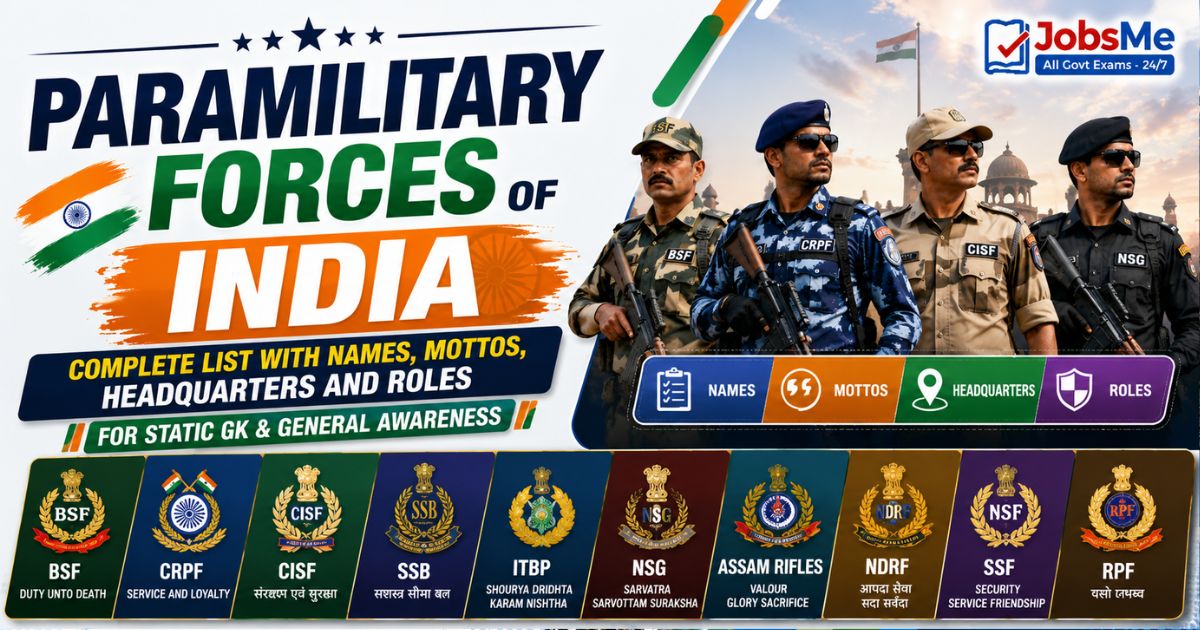
Paramilitary Forces of India – Complete List with Names, Mottos, Headquarters and Roles for Static GK & General Awareness
This article gives a complete, exam-ready guide to the Paramilitary Forces of India, covering all seven Central Armed Police Forces (CAPFs) – Assam Rifles, BSF, CISF, CRPF, ITBP, NSG, and SSB – along with the Indian Coast Guard, Special Frontier Force, Special Protection Group, Railway Protection Force, and National Disaster Response Force. It includes raising days, mottos, controlling ministries, key roles, special units like RAF and CoBRA, memory tricks, frequently confused facts, and one-liners. All facts are arranged for quick revision to help UPSC, SSC, IBPS, RRB, PSU, Defence, and State PCS aspirants score better in General Awareness and Internal Security sections.
Jump to section
Introduction
India's internal security, border protection, counter-terror response, and disaster management are handled by a wide network of armed forces known collectively as the Paramilitary Forces of India. The seven main forces under the Central Armed Police Forces (CAPFs) are the Assam Rifles (AR), Border Security Force (BSF), Central Industrial Security Force (CISF), Central Reserve Police Force (CRPF), Indo-Tibetan Border Police (ITBP), National Security Guard (NSG), and Sashastra Seema Bal (SSB). Together with the Indian Coast Guard, Special Frontier Force (SFF), Special Protection Group (SPG), Railway Protection Force (RPF), and National Disaster Response Force (NDRF), they form the backbone of India's non-military security architecture.
Questions on paramilitary forces appear regularly in UPSC Prelims, SSC CGL, IBPS PO, RRB NTPC, SBI Clerk, State PCS, Insurance, and Defence exams. Questions typically test which force guards which border, which year a force was raised, the motto and headquarters of each force, the controlling ministry, and special units like CoBRA, RAF, and Black Cat Commandos. This article brings together every important fact in a structured, exam-ready format. To explore other related topics, you can refer to the Static GK section on Jobsme.in.
The topic is also linked to current affairs such as raising day celebrations, new battalion approvals, deployments along the LAC and LoC, anti-Naxal operations, and updates on the Chief of Defence Staff (CDS) - making it doubly important for aspirants preparing for UPSC Mains, Essay papers, and Defence exam interviews as well.
Core Concepts: What are Paramilitary Forces?
Paramilitary Forces are organised armed groups that function like the military in training and discipline but are not part of the regular Armed Forces. They mainly handle internal security, border guarding, special operations, VIP protection, and disaster response. They act as a bridge between the state police and the Indian Army, allowing the Army to focus on external defence.
Important Distinctions
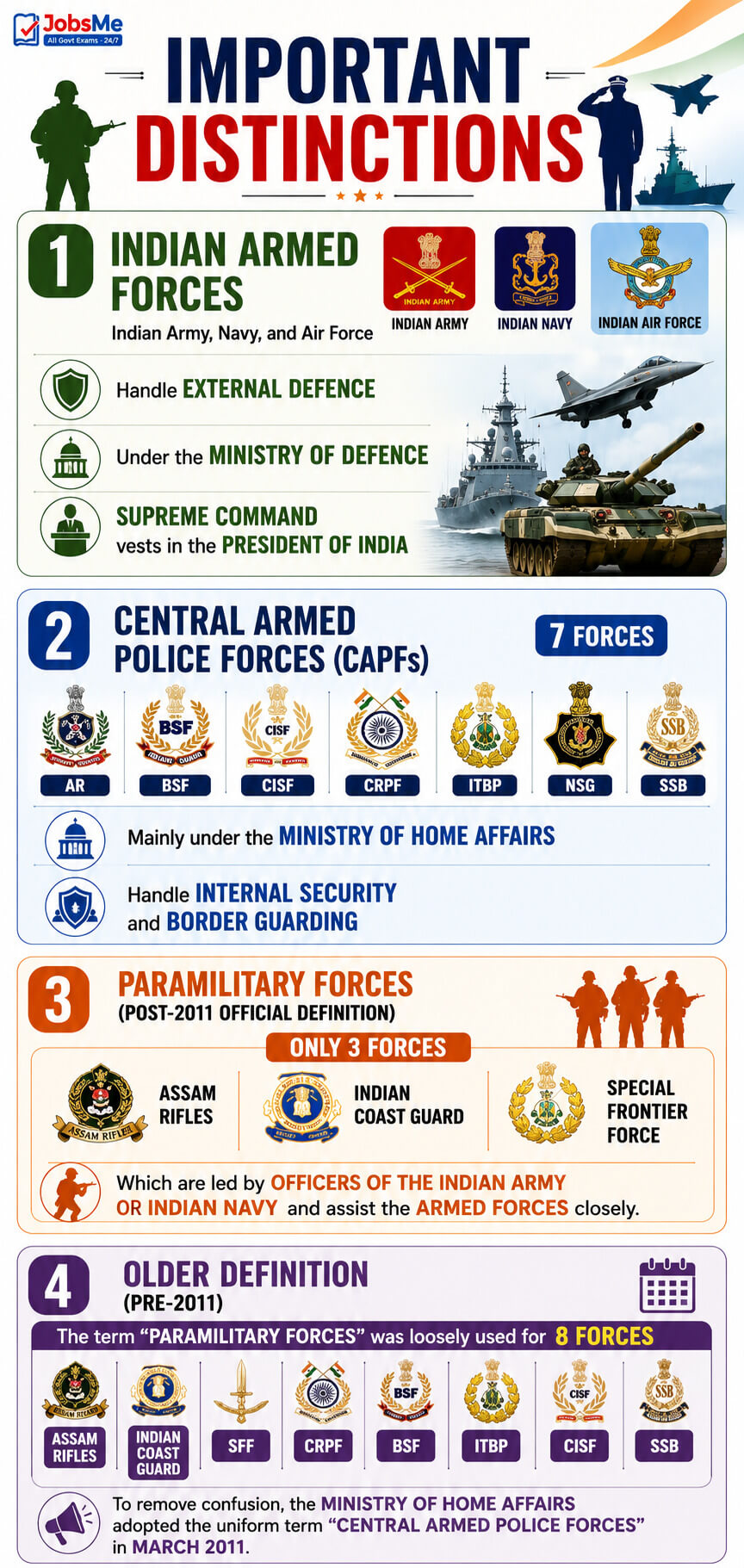
- Indian Armed Forces: Indian Army, Navy, and Air Force - handle external defence; under the Ministry of Defence; supreme command vests in the President of India.
- Central Armed Police Forces (CAPFs): Seven forces - AR, BSF, CISF, CRPF, ITBP, NSG, SSB - mainly under the Ministry of Home Affairs; handle internal security and border guarding.
- Paramilitary Forces (Post-2011 official definition): Only three - Assam Rifles, Indian Coast Guard, and Special Frontier Force - which are led by officers of the Indian Army or Indian Navy and assist the Armed Forces closely.
- Older definition (Pre-2011): The term "Paramilitary Forces" was loosely used for eight forces - Assam Rifles, Indian Coast Guard, SFF, CRPF, BSF, ITBP, CISF, and SSB. To remove confusion, the Ministry of Home Affairs adopted the uniform term "Central Armed Police Forces" in March 2011.
Key Principles Followed
- One Border, One Force: Each international border is guarded by a single designated force - BSF (Pakistan and Bangladesh), ITBP (China), SSB (Nepal and Bhutan), and Assam Rifles (Myanmar).
- Dual Control (only for Assam Rifles): Administrative control with the Ministry of Home Affairs; operational control with the Indian Army under the Ministry of Defence.
- Led by DG-rank officers: All CAPFs are headed by officers of Director General (DG) rank; six are led by IPS officers, while Assam Rifles is led by a Lieutenant General from the Indian Army.
Central Armed Police Forces (CAPFs) - Complete Profile
The following table covers all seven CAPFs with their raising day, controlling ministry, headquarters, motto, primary role, and key features - the most exam-tested data points.
| Force (Abbreviation) | Raised / Established | Ministry & Headquarters | Motto | Primary Role & Key Features |
|---|---|---|---|---|
| Assam Rifles (AR) | 1835 (as Cachar Levy with around 750 personnel) - oldest paramilitary force of India | Administrative: Ministry of Home Affairs; Operational: Ministry of Defence (Indian Army). Headquarters: Shillong, Meghalaya. | "Friends of the Hill People" / "Sentinels of the North East" | Guards the 1,643 km Indo-Myanmar border since 2002; conducts counter-insurgency operations in the North East; only paramilitary force with dual control structure; headed by a Lieutenant General of the Indian Army; renamed through stages - Assam Frontier Police (1883), Assam Military Police (1891), Eastern Bengal and Assam Military Police (1913), and finally Assam Rifles (1917); governed by the Assam Rifles Act, 2006; most decorated paramilitary force in India. |
| Border Security Force (BSF) | 1 December 1965 (after the 1965 Indo-Pak War); founding DG: K. F. Rustamji | Ministry of Home Affairs; Headquarters: New Delhi. | "Duty Unto Death" (Jeevan Paryant Kartavya) | Called "India's First Line of Defence"; world's largest border guarding force; guards the Indo-Pakistan and Indo-Bangladesh borders; prevents smuggling, infiltration, and trans-border crimes; during war, holds ground in less sensitive sectors to free the Army for offensive operations; participated in the 1971 Indo-Pak War, Operation Blue Star, Operation Black Thunder, and the Kargil War; has air wing, water wing, and an artillery regiment; conducts the daily Wagah Border ceremony. |
| Central Industrial Security Force (CISF) | 10 March 1969 (under the CISF Act, 1968); initial strength of about 2,800 personnel in 3 battalions; made a full paramilitary force in 1983 | Ministry of Home Affairs; Headquarters: New Delhi. | "Protection and Security" | Known as the "Shield of Security"; protects over 300 critical installations including nuclear plants, space establishments, airports, seaports, power plants, oil refineries, steel plants, Delhi Metro, Parliament House Complex, central jails in J&K, and heritage monuments; provides VIP security (Z+, Z, X, Y categories); the only force with a dedicated and customised Fire Wing; runs a UN Formed Police Unit (FPU) in Haiti; described as a "compensatory cost force". |
| Central Reserve Police Force (CRPF) | 27 July 1939 (as Crown Representative's Police); renamed CRPF by Act of Parliament on 28 December 1949 | Ministry of Home Affairs; Headquarters: CGO Complex, New Delhi. | "Service and Loyalty" (Sewa aur Nishtha) | Largest Central Armed Police Force in India with over 3 lakh personnel; premier internal security force; played a key role in integrating princely states like Junagarh and Kathiawar after Independence; handles riot control, anti-Naxal operations, anti-insurgency in J&K and the North East, VIP security, election duty, and UN peacekeeping missions; Sardar Vallabhbhai Patel (then Home Minister) visualised its multi-dimensional role. |
| Indo-Tibetan Border Police (ITBP) | 24 October 1962 (after the 1962 Sino-Indian War); initially raised under the CRPF Act | Ministry of Home Affairs; Headquarters: New Delhi. | "Shaurya, Dridhata, Karm Nishtha" (Valour, Steadfastness, Commitment) | Guards the 3,488 km Indo-China border from Karakoram Pass in Ladakh to Jachep La in Arunachal Pradesh; deployed in Jammu & Kashmir, Himachal Pradesh, Uttarakhand, Sikkim, and Arunachal Pradesh; specialised high-altitude mountain warfare force with trained mountaineers and skiers, operating at altitudes from 9,000 to 18,700 feet; in 2004, replaced the Assam Rifles in Sikkim and Arunachal Pradesh; acts as "First Responder" in Himalayan natural disasters; deployed in UN missions in Kosovo, Sierra Leone, Haiti, Western Sahara, Bosnia, Herzegovina, Afghanistan, and Sudan. |
| National Security Guard (NSG) | Decision taken in 1984; formally raised on 22 September 1986 under the NSG Act, 1986 | Ministry of Home Affairs; Headquarters: Manesar, Haryana. | "Sarvatra Sarvottam Suraksha" (Best Security Everywhere) | India's elite "Black Cat Commandos"; modelled on the UK's Special Air Service (SAS) and Germany's GSG-9; a Federal Contingency Zero Error Force for counter-terrorism, hostage rescue, anti-hijacking, bomb detection/disposal, and Post-Blast Investigation; dual structure: Special Action Group (SAG) - Army personnel for assault; Special Ranger Group (SRG) - CAPF and police personnel for support and VIP security; played a crucial role in countering the 26/11 Mumbai terrorist attacks (2008); deployed only in exceptional, high-risk situations. |
| Sashastra Seema Bal (SSB) | Conceived November 1962; raised March 1963 as the Special Service Bureau (after the 1962 Sino-Indian War); brought under the MHA in January 2001 | Ministry of Home Affairs; Headquarters: New Delhi. | "Service, Security and Brotherhood" | Guards the Indo-Nepal and Indo-Bhutan borders; designated as Lead Intelligence Agency for the Indo-Nepal border (June 2001) and Indo-Bhutan border (March 2004); known as the "People's Force" for engaging 78,000 villages across 15 border states; jurisdiction extends 15 km along border states such as Uttarakhand, UP, Bihar, West Bengal, Sikkim, Assam, and Arunachal Pradesh; received the President's Colours; participated in the 1965 and 1971 Indo-Pak wars, IPKF operations in Sri Lanka (1987), and 1968 North Bengal floods relief. |
Other Important Security Forces and Agencies
Apart from the seven CAPFs, several other specialised forces play a critical role in India's security framework. They are equally important from an exam point of view.
| Force / Agency | Raised / Established | Ministry / Parent Body | Primary Role & Key Features |
|---|---|---|---|
| Indian Coast Guard (ICG) | August 1978 (under the Coast Guard Act, 1978); based on recommendations of the Rustamji Committee | Ministry of Defence | India's maritime law enforcement and search-and-rescue agency; protects territorial waters, contiguous zone, and the Exclusive Economic Zone (EEZ); prevents sea-borne smuggling; protects fishermen and offshore terminals; coordinates oil spill response and marine environment protection; called the "First Responder" in the Indian Ocean Region; operates through 5 regional headquarters; conducts operations under the SAGAR doctrine (Security and Growth for All in the Region); the MARCOS (Marine Commando Force) is the Indian Navy's special forces unit, distinct from the Coast Guard. |
| Special Protection Group (SPG) | Established 1985 after the assassination of PM Indira Gandhi; formalised through the SPG Act, 1988; amended in 1991 after the assassination of Rajiv Gandhi | Cabinet Secretariat (also classified as a CAPF) | Provides proximate ("close protection") security to the Prime Minister of India, former PMs, and their immediate family members; works with the Intelligence Bureau and State/UT police; known for high leadership qualities, professionalism, and proximate security expertise. |
| Special Frontier Force (SFF) | November 1962 (after the Sino-Indian War) | Directly under Research and Analysis Wing (R&AW), India's external intelligence agency | A specialised paramilitary unit originally raised to conduct covert operations behind Chinese lines; secretive force whose details are rarely declassified; one of the three forces officially called a "Paramilitary Force" today (along with Assam Rifles and Indian Coast Guard). |
| Railway Protection Force (RPF) | Statutorily formed under the Railway Protection Force Act, 1957 | Ministry of Railways | Protects railway passengers, station areas, and railway property; handles anti-social elements on trains and in railway premises; the only armed force of the Union of India with the power to arrest, investigate, and prosecute criminals; assists in anti-trafficking operations and Operation Nanhe Faristey for rescuing children. |
| National Disaster Response Force (NDRF) | Constituted in 2006 under the Disaster Management Act, 2005 (enacted 26 December 2005); initially raised with 8 battalions, now expanded to 16 battalions | Ministry of Home Affairs (functions under NDMA) | India's specialised disaster response force; personnel drawn on deputation from BSF, CISF, CRPF, ITBP, SSB, and Assam Rifles; motto: "Aapda Seva Sadaiv Sarvatra" (Saving Lives & Beyond); headquartered in New Delhi; deployed during floods, earthquakes, cyclones, building collapses, and CBRN (Chemical, Biological, Radiological, Nuclear) emergencies; led by a Director General (IPS officer of ADGP rank). |
Special Units and Wings of Paramilitary Forces
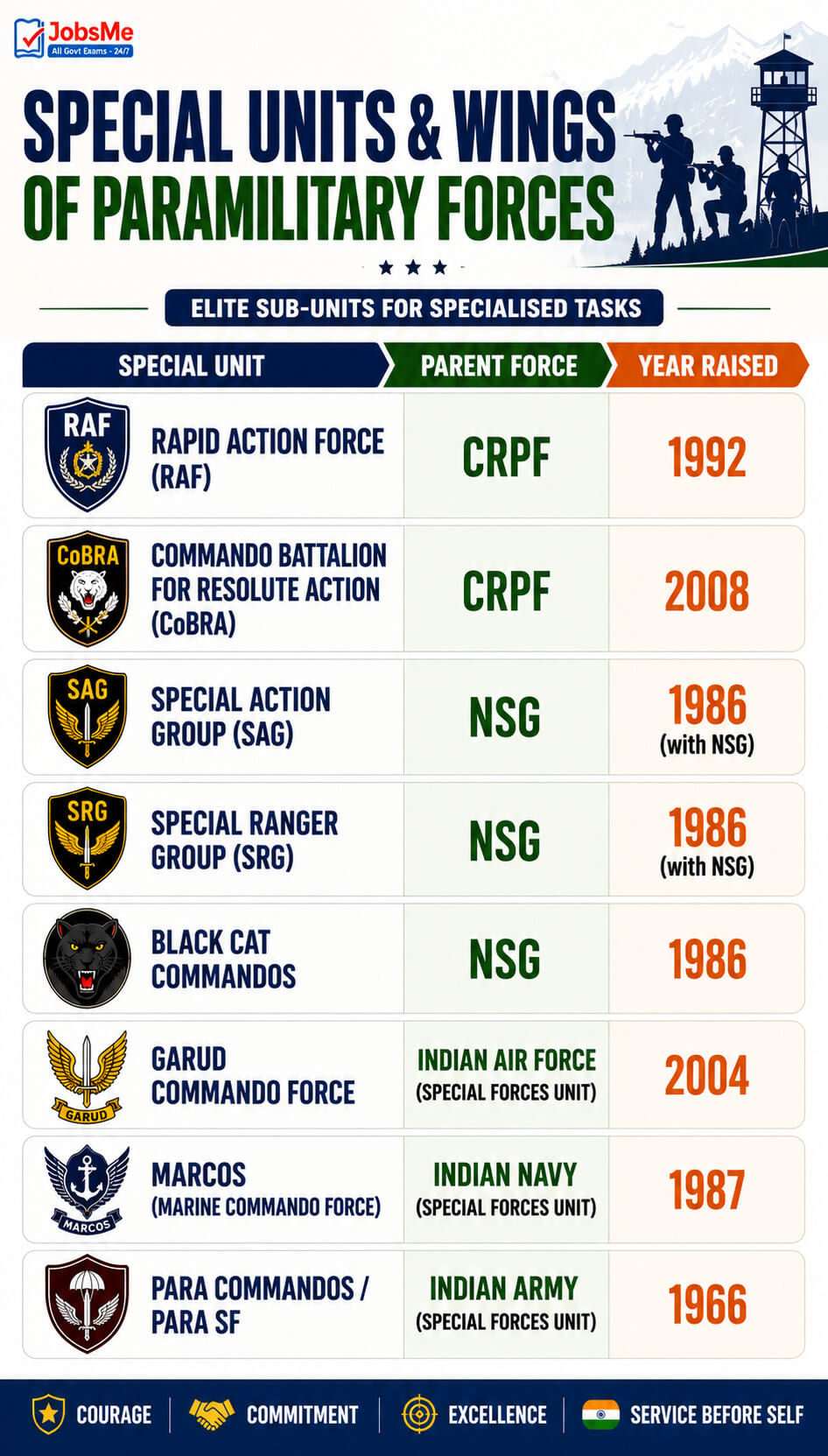
Several elite sub-units operate under the main paramilitary forces for specialised tasks. These are also frequent exam topics.
| Special Unit | Parent Force | Year Raised | Primary Function |
|---|---|---|---|
| Rapid Action Force (RAF) | CRPF | 1992 | Specialised wing for communal riots, civil unrest, and crowd control; known for quick response in tense urban situations; recognised by their distinctive blue camouflage uniform. |
| Commando Battalion for Resolute Action (CoBRA) | CRPF | 2008 | Elite jungle-warfare unit trained for anti-Naxal and anti-Maoist operations in Chhattisgarh, Jharkhand, Odisha, and other Left Wing Extremism (LWE) affected states; eight battalions deployed in the Bastar region. |
| Special Action Group (SAG) | NSG | 1986 (with NSG) | Comprises Indian Army personnel; handles direct counter-terror assault and neutralisation operations. |
| Special Ranger Group (SRG) | NSG | 1986 (with NSG) | Comprises personnel from CAPFs and State Police; mainly handles VIP security and support roles for SAG. |
| Black Cat Commandos | NSG | 1986 | Popular name for NSG commandos due to their distinctive black uniform; trained for hostage rescue, anti-hijacking, and IED neutralisation. |
| Garud Commando Force | Indian Air Force (Special Forces unit) | 2004 | Conducts airfield protection, suppression of enemy air defence, combat search and rescue, and humanitarian assistance during disasters. |
| MARCOS (Marine Commando Force) | Indian Navy (Special Forces unit) | 1987 | Specialises in anti-terrorism, anti-piracy, amphibious warfare, and maritime special operations. |
| Para Commandos / Para SF | Indian Army (Special Forces unit) | 1966 | Conducts operations behind enemy lines, anti-terror and counter-insurgency missions, and rescue during natural disasters. |
Memory Tricks and Mnemonics
Use these tricks to memorise the names, raising years, and borders covered by each paramilitary force quickly and confidently in the exam hall.
Trick 1: The Seven CAPFs - "All Brave Constables Catch Insurgents and Never Surrender"
Each word's starting letter gives one of the seven CAPFs in alphabetical order:
- All → Assam Rifles
- Brave → BSF
- Constables → CISF
- Catch → CRPF
- Insurgents → ITBP
- Never → NSG
- Surrender → SSB
"All Brave Constables Catch Insurgents and Never Surrender" - seven words, seven forces, in alphabetical order.
Trick 2: One Border, One Force - "Pak-Bang ki BSF, China me ITBP, Nepal-Bhutan SSB, Myanmar AR"
- BSF → Indo-Pakistan and Indo-Bangladesh borders
- ITBP → Indo-China border (3,488 km)
- SSB → Indo-Nepal and Indo-Bhutan borders
- Assam Rifles → Indo-Myanmar border (1,643 km)
Think of India's neighbours starting from the West and rotating clockwise: Pakistan → China → Nepal → Bhutan → Myanmar → Bangladesh - and one force is assigned to each.
Trick 3: Raising Year Order - "Assam 1835, Crown 1939, Tibet 1962, Special 1963"
Memorise CAPF raising years in chronological order:
- 1835 - Assam Rifles (oldest)
- 1939 - CRPF (as Crown Representative's Police)
- 1962 - ITBP (24 October)
- 1963 - SSB (March)
- 1965 - BSF (1 December)
- 1969 - CISF (10 March)
- 1986 - NSG (22 September)
Repeat the pattern: "AR - CRPF - ITBP - SSB - BSF - CISF - NSG" with the years 35-39-62-63-65-69-86.
Trick 4: Black Cats and the SAS Connection
The NSG = Black Cat Commandos were modelled on the UK's SAS (Special Air Service) and Germany's GSG-9. Remember: "NSG = SAS + GSG = Sarvatra Sarvottam Suraksha". Both the motto and the formation come from elite international units, so NSG follows the zero-error principle with three letters of "S" - Sarvatra, Sarvottam, Suraksha.
Trick 5: Dual Control - Only the Assam Rifles
Out of all seven CAPFs, only Assam Rifles has dual control. Remember it with the phrase: "AR ki Maa MHA, AR ka Baap Army" - administrative mother is the Ministry of Home Affairs (pays salaries), and operational father is the Indian Army (gives orders).
Trick 6: RAF for Riots, CoBRA for Comrades
Both are special units of CRPF. Use this contrast trick:
- RAF (1992): R-A-F → Riots And Fights → handles communal violence and crowd control.
- CoBRA (2008): Snake in the jungle → handles Naxal/Maoist insurgents in dense forests of Bastar, Jharkhand, and Odisha.
Trick 7: "Shield, Sword, and Saviour" - CISF, NSG, and NDRF
- CISF = Shield → "Shield of Security" - protects airports, metros, nuclear plants, and PSUs.
- NSG = Sword → "Black Cat Sword" - strikes terrorists during 26/11-type attacks.
- NDRF = Saviour → "Aapda Seva Sadaiv Sarvatra" - saves lives in disasters.
Trick 8: Ministries at a Glance
- Ministry of Home Affairs: BSF, CRPF, CISF, ITBP, SSB, NSG, NDRF, Assam Rifles (administrative).
- Ministry of Defence: Indian Army, Navy, Air Force, Indian Coast Guard; Assam Rifles (operational).
- Cabinet Secretariat: SPG.
- R&AW: SFF (Special Frontier Force).
- Ministry of Railways: RPF.
Remember: most security forces sit under MHA, except those that fight wars (MoD), protect the PM (Cabinet Secretariat), do covert ops (R&AW), or run on railways (Railways).
Additional Notes
Frequently Confused Facts
- Oldest paramilitary force: Assam Rifles (1835), not CRPF. CRPF (1939) is the oldest among the Delhi-headquartered CAPFs.
- Largest CAPF: CRPF (over 3 lakh personnel). Largest border-guarding force in the world: BSF (around 2.7-2.9 lakh personnel).
- Indo-China border: Guarded by ITBP, not Assam Rifles. AR guards the Indo-Myanmar border. After 2004, ITBP took over Sikkim and Arunachal Pradesh from AR.
- SPG vs NSG: SPG provides close protection only to the PM, former PMs, and their families. NSG provides VIP security to other high-risk protectees and handles counter-terror operations.
- Coast Guard vs MARCOS: Coast Guard is an independent armed force under the Ministry of Defence. MARCOS is the Indian Navy's special forces unit - they are separate.
- Paramilitary Forces (post-2011): Officially only AR, Indian Coast Guard, and SFF. All other forces (BSF, CRPF, CISF, ITBP, SSB, NSG) are technically CAPFs, though "paramilitary" is still used informally for them.
- NSG raised in 1984 vs 1986: Decision was taken in 1984, but the NSG formally came into being on 22 September 1986 when the NSG Act received Presidential assent.
Repeating PYQ Patterns
- UPSC Prelims: Questions on dual control of Assam Rifles, motto of NSG, formation year of BSF, and CAPF list under MHA.
- SSC CGL / CHSL: Borders guarded by each force, full forms (BSF, CRPF, CISF, ITBP, SSB, NSG, NDRF), and raising days.
- IBPS PO / Clerk: Mottos of BSF and CRPF, headquarters of forces, and Director General-related current affairs.
- RRB NTPC / Group D: "RPF works under which ministry", powers of RPF, and basics of Coast Guard.
- CAPF AC / Defence exams: NSG structure (SAG and SRG), CoBRA deployment, RAF role, and ITBP altitude operations.
- State PCS: Role of CRPF in princely state integration, SSB community-engagement role, and Assam Rifles in the North East.
Quick Insight
In recent years, paramilitary forces have stayed in the news because of LAC tensions with China (ITBP and Indian Army), BSF jurisdiction extension in border states, anti-Naxal operations by CoBRA in Chhattisgarh, deployment for election security across states, and the celebration of raising days. The post of Chief of Defence Staff (CDS), created in 2019 with General Bipin Rawat as the first incumbent, has also brought renewed focus on the coordination between the Armed Forces and the paramilitary forces. For a deeper understanding of how these topics connect to monthly news, refer to the Daily Current Affairs section on Jobsme.in. You can also strengthen your conceptual base by going through related Banking Awareness notes, which often include questions on security-related institutional frameworks.
One-Liners for Quick Revision
- Assam Rifles (AR) → Established 1835 as Cachar Levy → oldest paramilitary force; guards Indo-Myanmar border (1,643 km); dual control (MHA admin, MoD operational); headed by Lt. General.
- Border Security Force (BSF) → Raised 1 December 1965 → world's largest border guarding force; guards Indo-Pak and Indo-Bangladesh borders; motto "Duty Unto Death"; founder DG K. F. Rustamji.
- Central Industrial Security Force (CISF) → Raised 10 March 1969 → "Shield of Security"; protects nuclear plants, airports, metros, PSUs; only force with dedicated Fire Wing.
- Central Reserve Police Force (CRPF) → Formed 27 July 1939; renamed 28 December 1949 → largest CAPF; motto "Service and Loyalty"; integrated princely states (Junagarh, Kathiawar).
- Indo-Tibetan Border Police (ITBP) → Raised 24 October 1962 → guards 3,488 km Indo-China border; high-altitude specialists; motto "Shaurya, Dridhata, Karm Nishtha".
- National Security Guard (NSG) → Formed 22 September 1986 → "Black Cat Commandos"; modelled on UK's SAS and Germany's GSG-9; structure: SAG (Army) + SRG (CAPF/Police); led 26/11 response.
- Sashastra Seema Bal (SSB) → Raised March 1963 (Special Service Bureau) → guards Indo-Nepal and Indo-Bhutan borders; "People's Force"; Lead Intelligence Agency for Indo-Nepal (2001) and Indo-Bhutan (2004).
- Indian Coast Guard (ICG) → Established August 1978 → under Ministry of Defence; protects maritime zones (territorial waters, contiguous zone, EEZ); follows SAGAR doctrine; "First Responder" in IOR.
- Special Frontier Force (SFF) → Created November 1962 → covert operations behind Chinese lines; under R&AW; one of three official "Paramilitary Forces" today.
- Special Protection Group (SPG) → SPG Act 1988 (after Indira Gandhi's assassination in 1984) → close protection for PM, former PMs, and immediate family; under Cabinet Secretariat.
- Railway Protection Force (RPF) → Under Ministry of Railways → only armed force of the Union with power to arrest, investigate, and prosecute.
- National Disaster Response Force (NDRF) → Constituted 2006 under DM Act 2005 → 16 battalions drawn from CAPFs; motto "Aapda Seva Sadaiv Sarvatra"; works under NDMA and MHA.
- Rapid Action Force (RAF) → 1992; under CRPF → handles riots and communal unrest; distinct blue camouflage.
- CoBRA → 2008; under CRPF → anti-Naxal jungle warfare; deployed in Bastar, Jharkhand, Odisha.
- Special Action Group (SAG) → under NSG → Army personnel; counter-terror assault operations.
- Special Ranger Group (SRG) → under NSG → CAPF/Police personnel; VIP security and support roles.
- Garud Commando Force → Indian Air Force special forces (2004) → airfield protection, search and rescue.
- MARCOS → Indian Navy special forces (1987) → anti-terrorism, anti-piracy, maritime operations.
- Para Commandos / Para SF → Indian Army special forces → operations behind enemy lines.
- Chief of Defence Staff (CDS) → Post created 2019; first CDS General Bipin Rawat (from 31 December 2019); heads Department of Military Affairs (DMA).
- CAPF (Central Armed Police Forces) → Term adopted by MHA in March 2011 to replace "Paramilitary Forces"; covers AR, BSF, CISF, CRPF, ITBP, NSG, SSB.
- Supreme Commander of Indian Armed Forces → President of India.
- Ministry of Home Affairs → Oversees CAPFs and internal security.
- Ministry of Defence → Oversees Indian Army, Navy, Air Force, and Indian Coast Guard.
- "One Border, One Force" principle → Each international border guarded by a single designated force.
- President's Colours → Received by SSB for its national security role.
- Wagah Border ceremony → Daily drill conducted by BSF.
- Sardar Vallabhbhai Patel → Then Home Minister; visualised the multi-dimensional role of the CRPF post-Independence.
- K. F. Rustamji → First Director General and founding father of the BSF.
For more topics like this, explore the complete Static GK archive and test yourself with the Static GK Quiz on Jobsme.in. You can also check the latest exam openings on the Latest Government Job Notifications page to plan your applications. Sharpen your awareness further with the Daily Current Affairs Quiz and the Computer Awareness Quiz.
Free quiz • No signup required
Put this topic into practice with Indian Cultural Institutions – Static GK MCQ Quiz. It is the quickest way to reinforce what you just learned.
Frequently Asked Questions
What are the seven Central Armed Police Forces (CAPFs) of India?
Which is the oldest paramilitary force of India?
Which paramilitary force guards the Indo-Pakistan and Indo-Bangladesh borders?
What is the motto of the National Security Guard (NSG)?
Which paramilitary force has a dual control structure?
What is the difference between CoBRA and RAF?
Which is the largest Central Armed Police Force in India?
Under which ministry does the Indian Coast Guard function?
Why was the Special Protection Group (SPG) created and whom does it protect?
How many battalions does the National Disaster Response Force (NDRF) have?

About the author