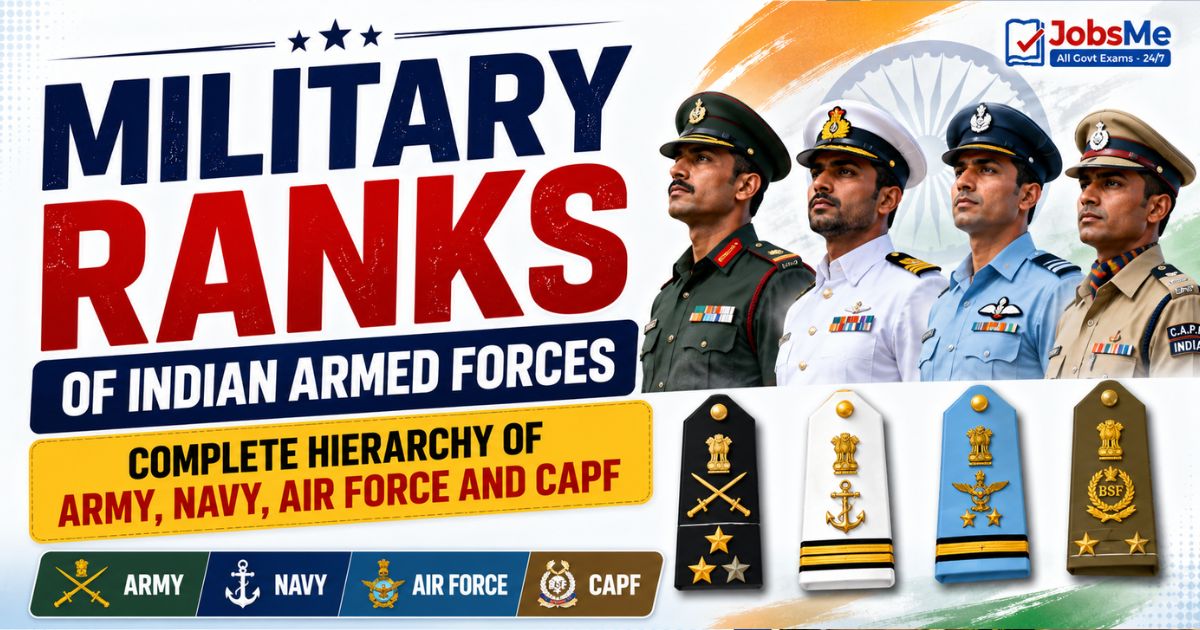
Military Ranks of Indian Armed Forces Static GK: Complete Hierarchy of Army, Navy, Air Force and CAPF
This article gives exam aspirants a complete, easy-to-revise guide to the military ranks of the Indian Armed Forces — covering the Army, Navy, Air Force and CAPF in full hierarchical order. It includes insignia, current service chiefs (2026), promotion timelines, memory tricks and one-liners crafted for UPSC, SSC, NDA, CDS, Banking and State PCS exams.
Jump to section
- Introduction
- Core Concept: Understanding the Indian Armed Forces Structure
- Chief of Defence Staff (CDS): A Modern Addition
- Ranks in the Indian Army
- Ranks in the Indian Navy
- Ranks in the Indian Air Force
- Ranks in CAPF (Central Armed Police Forces)
- Equivalent Ranks Across Army, Navy and Air Force
- Promotion Timeline of Commissioned Officers
- Memory Tricks and Mnemonics
- Additional Notes
- One-Liners for Quick Revision
Introduction
The Military Ranks of the Indian Armed Forces form one of the most frequently tested Static GK topics in competitive exams. From the apex rank of Field Marshal to the entry-level Sepoy, every rank carries specific duties, insignia and historical significance that aspirants must memorise for UPSC, SSC, NDA, CDS, Banking and Railways exams. Understanding this hierarchy is also essential for general awareness sections in IBPS PO, RRB NTPC, State PCS and Defence recruitment tests.
The Indian Armed Forces are made up of three primary service wings — the Indian Army, Indian Navy and Indian Air Force — supported by the Central Armed Police Forces (CAPF) for internal security. Each wing follows a strict hierarchical structure with three broad categories: Commissioned Officers, Junior Commissioned Officers (JCOs) and Other Ranks / Personnel Below Officer Ranks (PBOR). The President of India is the Supreme Commander of all three armed forces, while the Chief of Defence Staff (CDS) acts as the single-point military adviser to the Government.
Whether you are preparing for NDA, CDS, SSC CGL or IBPS exams, mastering these ranks gives you an easy-scoring topic. For more such curated revision material, explore our regularly updated Static GK notes section which covers every important defence-related fact in one place.
Core Concept: Understanding the Indian Armed Forces Structure
Before memorising each rank, it is important to understand the overall structure of the Indian military hierarchy. The structure is modelled on the British and Commonwealth military traditions but has been completely Indianised over the decades.
- Supreme Commander: The President of India is the constitutional and ceremonial commander-in-chief of the Indian Armed Forces.
- Chief of Defence Staff (CDS): The senior-most military officer who acts as the single-point adviser to the Government and serves as Permanent Chairman of the Chiefs of Staff Committee (CoSC).
- Service Chiefs: Chief of the Army Staff (COAS), Chief of the Naval Staff (CNS) and Chief of the Air Staff (CAS) — all four-star officers heading their respective wings.
- Three rank categories in each wing: Commissioned Officers, Junior Commissioned Officers (JCOs) / equivalent, and Other Ranks / PBOR / Sailors.
The five-star ranks — Field Marshal (Army), Admiral of the Fleet (Navy) and Marshal of the Indian Air Force (Air Force) — are wartime honorary ranks rarely conferred in India. Only two Field Marshals (Sam Manekshaw and KM Cariappa) and one Marshal of the Indian Air Force (Arjan Singh) have ever been appointed; the rank of Admiral of the Fleet has never been conferred in India.
Chief of Defence Staff (CDS): A Modern Addition
The post of Chief of Defence Staff (CDS) is the most recent and arguably the most important addition to the Indian military hierarchy.
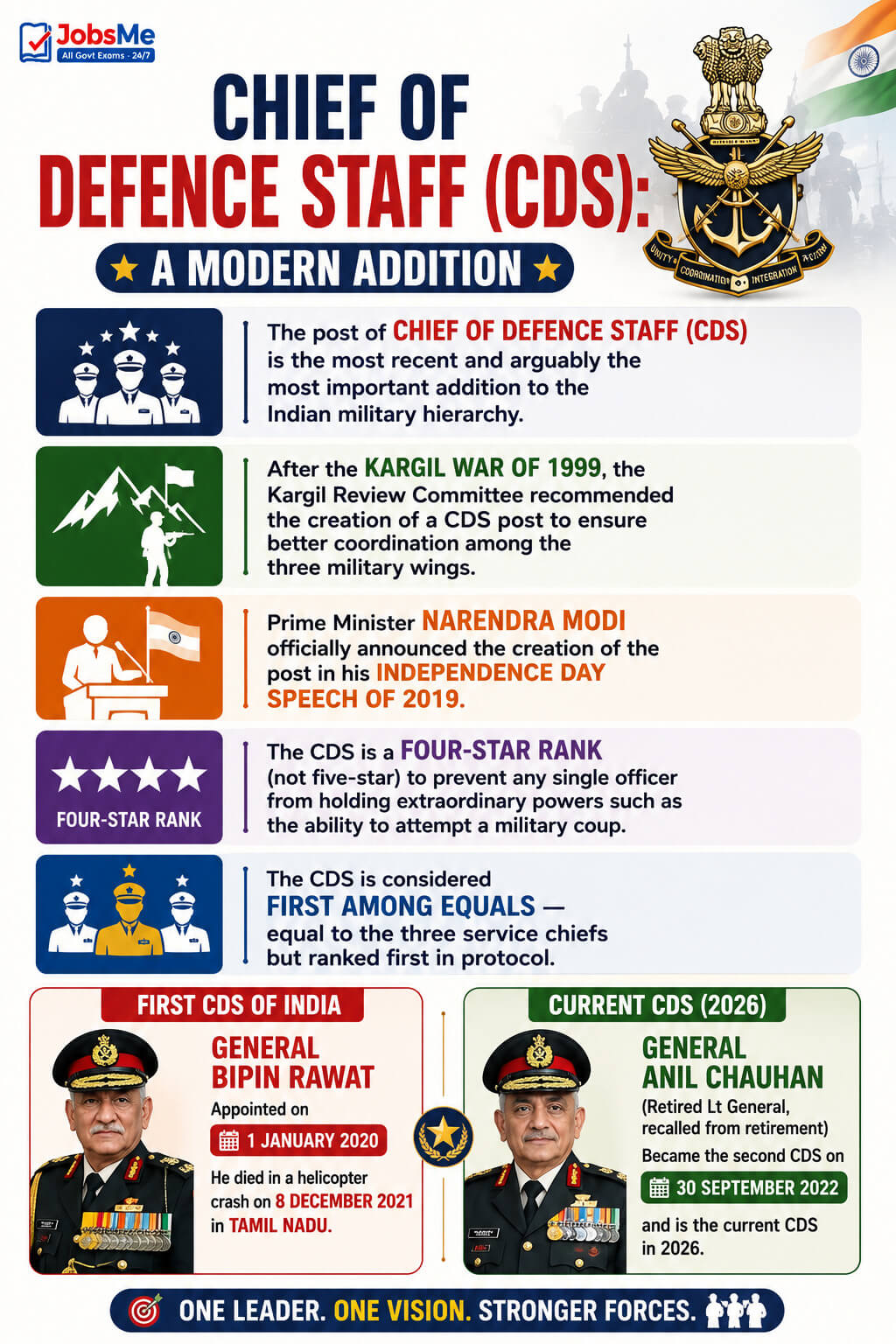
- After the Kargil War of 1999, the Kargil Review Committee recommended the creation of a CDS post to ensure better coordination among the three military wings.
- Prime Minister Narendra Modi officially announced the creation of the post in his Independence Day speech of 2019.
- The CDS is a four-star rank (not five-star) to prevent any single officer from holding extraordinary powers such as the ability to attempt a military coup.
- The CDS is considered first among equals — equal to the three service chiefs but ranked first in protocol.
- General Bipin Rawat was the first CDS of India, appointed on 1 January 2020. He died in a helicopter crash on 8 December 2021 in Tamil Nadu.
- General Anil Chauhan (retired Lt General, recalled from retirement) became the second CDS on 30 September 2022 and is the current CDS in 2026.
Ranks in the Indian Army
The Indian Army is the largest of the three services and is responsible for land-based operations. Its ranks are divided into three categories: Commissioned Officers (equivalent to All India Services and Group A officers), Junior Commissioned Officers (JCOs) (equivalent to Group B Gazetted officers) and Other Ranks (Non-Commissioned Officers and soldiers).
Commissioned Officer Ranks in Army (Highest to Lowest)
| Rank | Star Equivalent | Key Features and Duties |
|---|---|---|
| Field Marshal | Five-Star | The highest attainable rank in the Indian Army; a ceremonial wartime rank. Only two officers have ever been conferred this rank — Field Marshal Sam Manekshaw (1973) and Field Marshal KM Cariappa (1986). Insignia: National Emblem above crossed batons in a lotus wreath. |
| General | Four-Star | The highest operational rank, held by the Chief of the Army Staff (COAS) who serves as the principal military adviser to the government. Insignia: National Emblem, a five-pointed star and crossed baton and sabre. |
| Lieutenant General | Three-Star | Senior officers commanding Army Corps or heading branches of the Army at Service Headquarters. Insignia: National Emblem above a crossed baton and sabre. |
| Major General | Two-Star | Two-star officers commanding divisions or holding senior staff appointments. Insignia: A five-pointed star above a crossed baton and sabre. |
| Brigadier | One-Star | One-star officers commanding a brigade (a combined-arms unit) or holding important staff appointments. Insignia: National Emblem above three five-pointed stars. |
| Colonel | — | Senior field officers commanding an infantry battalion / regiment or serving in significant staff roles. Insignia: National Emblem above two five-pointed stars. |
| Lieutenant Colonel | — | Second-in-command of a battalion or staff officer. Insignia: National Emblem above one five-pointed star. |
| Major | — | Company commander or senior staff officer; typically second-in-command of a unit. Insignia: National Emblem only. |
| Captain | — | Leads platoons, serves as company officer or staff officer. Insignia: Three five-pointed stars. |
| Lieutenant | — | Entry-level commissioned officer position; serves as platoon commander. Officers are commissioned at this rank after completing training at NDA / IMA / OTA. Insignia: Two five-pointed stars. |
Junior Commissioned Officers (JCOs) in Army
JCOs are promoted from the ranks of Non-Commissioned Officers and are equivalent to Group B Gazetted officers. A braid band of three strands ("crimson, yellow, crimson") is placed below all JCO badges of rank.
| Rank | Key Features and Duties |
|---|---|
| Subedar Major | The highest JCO rank; principal JCO in a unit, responsible for leadership and administration. Insignia: National Emblem (Ashoka Emblem) above the braid. |
| Subedar | Commands infantry sub-units, assists officers in leadership and administration. Insignia: Two five-pointed stars above the braid. |
| Naib Subedar | Entry-level JCO rank; key link between Commissioned Officers and soldiers, often serves as platoon commander. Insignia: One five-pointed star above the braid. |
Other Ranks in Army (Non-Commissioned Officers and Soldiers)
Other Ranks are authorised to wear chevrons in the Regiment/Corps design. They form the operational backbone of the Indian Army.
| Rank | Key Features and Duties |
|---|---|
| Company Quarter Master Havildar (CQMH) | The highest Other Ranks position; responsible for logistical and administrative functions. Insignia: Three chevrons with the Ashoka Chakra on top. |
| Havildar | In charge of small units, mentors soldiers and ensures discipline. Insignia: Three chevrons. |
| Naik | Leads small teams and assists Havildars. Insignia: Two chevrons. |
| Lance Naik | Entry-level supervisory position for soldiers. Insignia: One chevron. |
| Sepoy | The initial rank for a soldier in the Indian Army; no insignia. |
Ranks in the Indian Navy
The Indian Navy safeguards India's maritime interests and operates both on the surface and underwater. The Navy ranks are divided into Officers and Sailors. The Chief of the Naval Staff (CNS), an Admiral, heads the Indian Navy.
Commissioned Officer Ranks in Navy (Highest to Lowest)
| Rank | Star Equivalent | Key Features and Duties |
|---|---|---|
| Admiral of the Fleet | Five-Star | The highest naval rank, reserved exclusively for major wartime use and honour. This rank has never been conferred in India to date. |
| Admiral | Four-Star | The highest serving rank, held by the Chief of the Naval Staff (CNS) who is the principal naval adviser to the Government. The current CNS (as of 2026) is Admiral Dinesh K Tripathi. |
| Vice Admiral | Three-Star | Commands important naval commands such as Western, Eastern or Southern Naval Command or holds significant appointments at Naval Headquarters. |
| Rear Admiral | Two-Star | Senior flag officer serving as area commander, fleet commander or in important staff positions. |
| Commodore | One-Star | Typically serves as commanding officer of a naval base or heads important naval organisations. |
| Captain | — | Commanding officer of major warships (frigates, destroyers, aircraft carriers) or holds vital staff positions. Equivalent to Colonel in the Army. |
| Commander | — | Executive officer of major ships or commanding officer of smaller ships and shore establishments. Equivalent to Lt Colonel in the Army. |
| Lieutenant Commander | — | Department head on ships or commanding officer of small vessels. Equivalent to Major in the Army. |
| Lieutenant | — | Watch-keeping officer or junior officer in various naval appointments. Equivalent to Captain in the Army. |
| Sub Lieutenant | — | Junior commissioned officer after completion of training at the Indian Naval Academy (INA). |
| Midshipman | — | Trainee officer rank; cadets enter as Midshipmen at the Indian Naval Academy and are promoted to Sub Lieutenant on completion of training. |
Sailor Ranks in Navy
Sailors form the bulk of naval personnel. Eligible sailors with exceptional leadership skills can become Commissioned Officers through schemes such as the Commission Worthy (CW) scheme and Special Duties (SD) scheme. The ranks of Master Chief Petty Officer Class II and Class I were introduced in December 1968; prior to that, Chief Petty Officer was the highest non-commissioned rank.
| Rank | Key Features and Duties |
|---|---|
| Master Chief Petty Officer 1st Class | The highest sailor rank in the Indian Navy; equivalent to Subedar Major in the Army. |
| Master Chief Petty Officer 2nd Class | Senior non-commissioned rank; equivalent to Subedar in the Army. |
| Chief Petty Officer | Senior non-commissioned rank; equivalent to Naib Subedar in the Army. |
| Petty Officer | Non-commissioned rank with supervisory duties. |
| Leading Rate | Equivalent to Naik in the Army; leads small teams. |
| Seaman 1st Class | Promoted from Seaman 2nd Class after training and service. |
| Seaman 2nd Class | The starting (entry-level) sailor rank in the Indian Navy. |
Ranks in the Indian Air Force
The Indian Air Force protects Indian airspace, conducts aerial operations and supports the Army and Navy in joint operations. The IAF ranks are divided into Commissioned Officers and Personnel Below Officer Ranks (PBOR). All officers begin their career as Flying Officers upon commissioning from the Air Force Academy.
Commissioned Officer Ranks in Air Force (Highest to Lowest)
| Rank | Star Equivalent | Key Features and Duties |
|---|---|---|
| Marshal of the Indian Air Force | Five-Star | The highest attainable rank in the IAF, conferred by the President of India after exceptional wartime service. Only Arjan Singh has been conferred this rank, making him the first and only Indian Air Force officer with a five-star rank. |
| Air Chief Marshal | Four-Star | The highest serving rank in the IAF, held by the Chief of the Air Staff (CAS). The current CAS (as of 2026) is Air Chief Marshal Amar Preet Singh. |
| Air Marshal | Three-Star | Commands operational commands such as Western, Eastern, Southern, Central or South Western Air Command, or holds important appointments at Air Headquarters. |
| Air Vice Marshal | Two-Star | Senior officer serving in crucial positions or heading key organisations such as wings and major air bases. |
| Air Commodore | One-Star | Serves as commanding officer of major air bases or heads important units. |
| Group Captain | — | Commands flying squadrons or air force stations; equivalent to Colonel in the Army. |
| Wing Commander | — | Commanding officer of flying units / squadrons or serves in important staff roles; equivalent to Lt Colonel in the Army. |
| Squadron Leader | — | Commands flights within a squadron or serves as staff officer; equivalent to Major in the Army. |
| Flight Lieutenant | — | Serves as pilot or staff officer; equivalent to Captain in the Army. |
| Flying Officer | — | Entry-level commissioned officer rank in the IAF; officers are commissioned at this rank from the Air Force Academy. |
Personnel Below Officer Ranks (PBOR) in Air Force
Master Warrant Officer is the senior-most PBOR rank with NATO ranking of OF-9 equivalent. Aircraftsman is the basic training rank of the IAF. In extraordinary cases, PBOR can be promoted to Honorary Officer ranks.
| Rank | Key Features and Duties |
|---|---|
| Master Warrant Officer | The senior-most PBOR rank in the IAF; equivalent to Subedar Major in the Army. |
| Warrant Officer | Senior PBOR rank with leadership and technical supervisory roles. |
| Junior Warrant Officer | Senior non-commissioned rank in the IAF. |
| Sergeant | Non-commissioned officer with supervisory duties. |
| Corporal | Junior non-commissioned officer rank; equivalent to Naik in the Army. |
| Leading Aircraftsman | Promoted from Aircraftsman after training and service. |
| Aircraftsman | The training and entry-level rank of the IAF. |
Ranks in CAPF (Central Armed Police Forces)
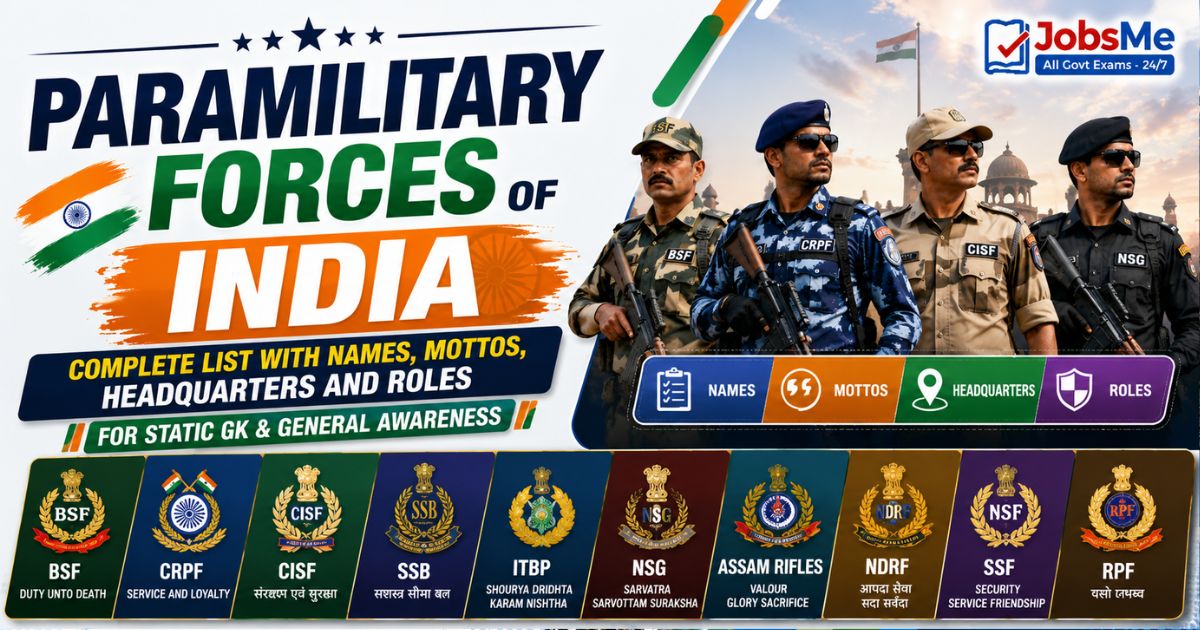
The Central Armed Police Forces include BSF, CRPF, CISF, ITBP, SSB and Assam Rifles, which function under the Ministry of Home Affairs. The CAPF ranks are divided into Gazetted Officers and Non-Gazetted Officers.
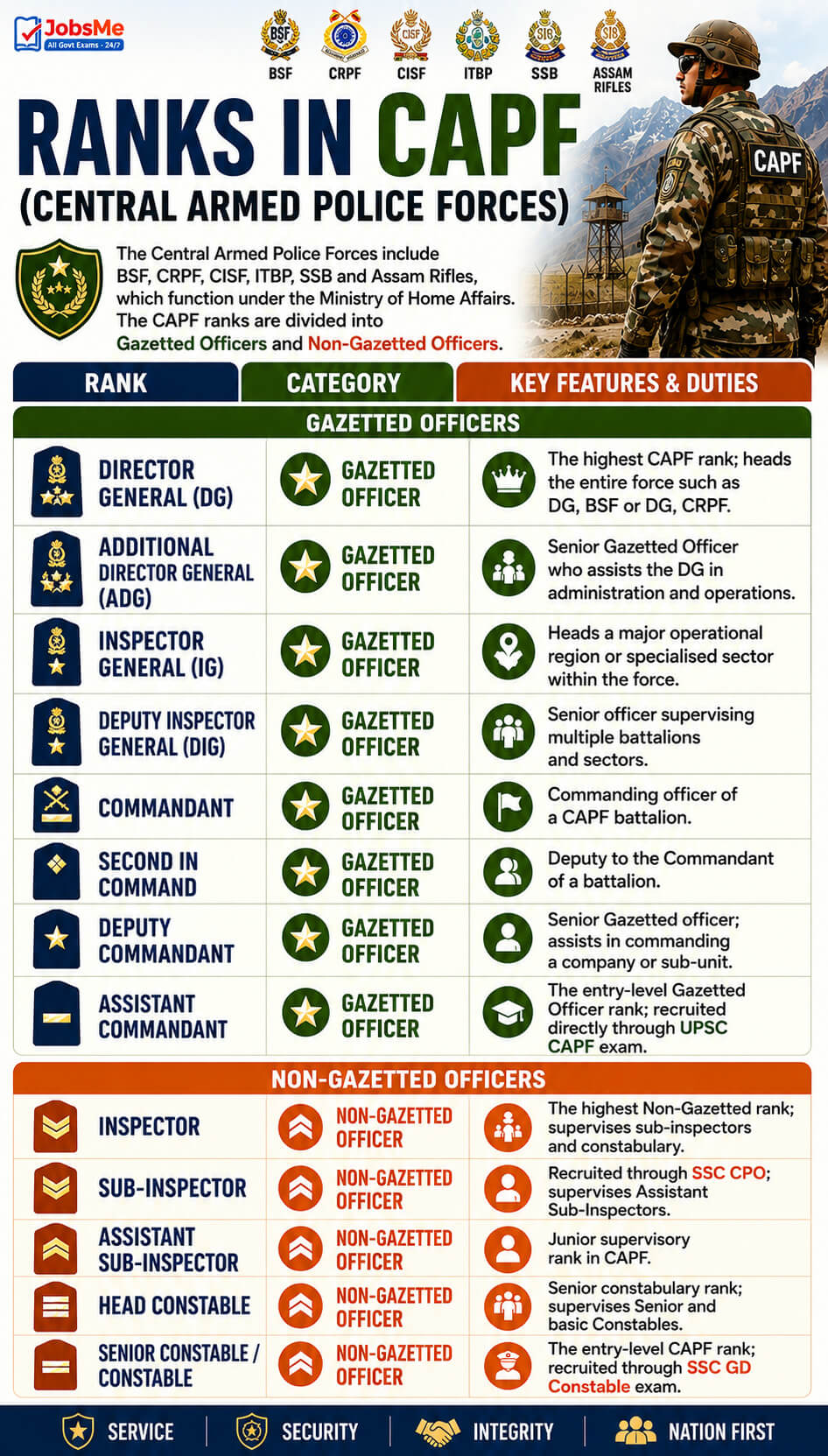
| Rank | Category | Key Features and Duties |
|---|---|---|
| Director General (DG) | Gazetted Officer | The highest CAPF rank; heads the entire force such as DG, BSF or DG, CRPF. |
| Additional Director General (ADG) | Gazetted Officer | Senior Gazetted Officer who assists the DG in administration and operations. |
| Inspector General (IG) | Gazetted Officer | Heads a major operational region or specialised sector within the force. |
| Deputy Inspector General (DIG) | Gazetted Officer | Senior officer supervising multiple battalions and sectors. |
| Commandant | Gazetted Officer | Commanding officer of a CAPF battalion. |
| Second in Command | Gazetted Officer | Deputy to the Commandant of a battalion. |
| Deputy Commandant | Gazetted Officer | Senior Gazetted officer; assists in commanding a company or sub-unit. |
| Assistant Commandant | Gazetted Officer | The entry-level Gazetted Officer rank; recruited directly through UPSC CAPF exam. |
| Inspector | Non-Gazetted Officer | The highest Non-Gazetted rank; supervises sub-inspectors and constabulary. |
| Sub-Inspector | Non-Gazetted Officer | Recruited through SSC CPO; supervises Assistant Sub-Inspectors. |
| Assistant Sub-Inspector | Non-Gazetted Officer | Junior supervisory rank in CAPF. |
| Head Constable | Non-Gazetted Officer | Senior constabulary rank; supervises Senior and basic Constables. |
| Senior Constable / Constable | Non-Gazetted Officer | The entry-level CAPF rank; recruited through SSC GD Constable exam. |
Important Firsts in CAPF
- In 1992, Asha Sinha became the first Woman Commandant of the Central Armed Forces in India.
- In 2016, IPS Officer Archana Ramasundaram became the first woman to become the Director-General of a Paramilitary Force as DG, Sashastra Seema Bal (SSB).
Equivalent Ranks Across Army, Navy and Air Force
This comparison table is one of the most frequently asked questions in defence exams and SSC GK papers.
| Army | Navy | Air Force |
|---|---|---|
| Field Marshal | Admiral of the Fleet | Marshal of the Indian Air Force |
| General | Admiral | Air Chief Marshal |
| Lieutenant General | Vice Admiral | Air Marshal |
| Major General | Rear Admiral | Air Vice Marshal |
| Brigadier | Commodore | Air Commodore |
| Colonel | Captain | Group Captain |
| Lieutenant Colonel | Commander | Wing Commander |
| Major | Lieutenant Commander | Squadron Leader |
| Captain | Lieutenant | Flight Lieutenant |
| Lieutenant | Sub Lieutenant | Flying Officer |
Promotion Timeline of Commissioned Officers
The promotion of commissioned officers in the Indian Armed Forces is based on a combination of years of service, merit and selection.
| Army | Navy | Air Force | Years of Service |
|---|---|---|---|
| Lieutenant → Captain | Sub Lieutenant → Lieutenant | Flying Officer → Flight Lieutenant | 2 years |
| Captain → Major | Lieutenant → Lt Commander | Flight Lieutenant → Squadron Leader | 6 years |
| Major → Lt Colonel | Lt Commander → Commander | Squadron Leader → Wing Commander | 13 years |
| Lt Colonel → Colonel | Commander → Captain (Navy) | Wing Commander → Group Captain | Selection Basis |
Memory Tricks and Mnemonics
Trick 1: "FM-GLM-BCL-MCL" for Army Commissioned Officers (Top to Bottom)
Use the acronym "FM-GLM-BCL-MCL" to recall all 10 commissioned officer ranks of the Indian Army from highest to lowest.
- Field Marshal → M
- General → Lieutenant General → Major General
- Brigadier → Colonel → Lieutenant Colonel
- Major → Captain → Lieutenant
Trick 2: "Sepoy Loves Naik's Heavy Cake" for Army Other Ranks
Use this story line: "Sepoy Loves Naik's Heavy Cake" — to remember Other Ranks in ascending order.
- Sepoy → Lance Naik → Naik → Havildar → CQMH
Trick 3: "MAVeRiC CCSeLFlyF" for Navy and Air Force Top Officers
For Navy (descending): Admiral of Fleet → Admiral → Vice Admiral → Rear Admiral → Commodore. Try "All Vice Rear Commodores" to recall after Admiral.
For Air Force (descending): Marshal → Air Chief Marshal → Air Marshal → Air Vice Marshal → Air Commodore. Just remember "Marshal of Air, then Chief Marshal, then plain Marshal — keep adding Air".
Trick 4: "Field Marshal Sam-K" — Only Two FMs of India
To remember the two Field Marshals of the Indian Army, use "Sam-K":
- Sam Manekshaw (1973 — first FM)
- KM Cariappa (1986 — second FM)
And only one Marshal of the Indian Air Force — Arjan Singh (2002). Trick: "Air Force ka Arjan".
Trick 5: Army vs Navy — Captain Confusion
Memory tip: A Captain in the Army is a junior officer (just three stars), but a Captain in the Navy is a senior officer equivalent to a Colonel in the Army. Remember: "Navy Captain = Army Colonel". This is a favourite trap in SSC CGL and Banking Awareness exams.
Trick 6: Lieutenant Trap — Smallest Rank in All Three Wings
Use "Lieutenant is Lowest in 3 Forces":
- Army → Lieutenant is the entry-level commissioned officer rank.
- Navy → Lieutenant equals Captain (Army).
- Air Force → There is no Lieutenant; the entry-level rank is Flying Officer.
Trick 7: "1999-2019-2020-2021" — CDS Timeline
Easy chronology of CDS post: "1999 Kargil, 2019 Modi announces, 2020 Bipin Rawat appointed, 2021 Rawat dies, 2022 Anil Chauhan takes over".
Additional Notes
Frequently Confused Facts
- Field Marshal vs Marshal of the Indian Air Force: Field Marshal is an Army rank (two recipients), while Marshal of the IAF is the Air Force rank (only one recipient — Arjan Singh).
- Admiral of the Fleet vs Admiral: Admiral of the Fleet is a wartime ceremonial rank never conferred in India; Admiral is the operational four-star rank of the CNS.
- Captain (Army) vs Captain (Navy): Army Captain is equivalent to a Navy Lieutenant, while Navy Captain is equivalent to an Army Colonel.
- Lieutenant (Army) vs Lieutenant (Navy): Army Lieutenant is the lowest officer rank, while Navy Lieutenant equals an Army Captain.
- Subedar Major vs Master Warrant Officer: Both are the highest non-commissioned ranks in Army and Air Force respectively but carry different insignia.
- Brigadier vs Air Commodore vs Commodore: All three are one-star equivalents in Army, Air Force and Navy.
- CDS vs COAS: CDS is the single-point military adviser to the Government and chairman of CoSC, while COAS heads only the Indian Army.
Repeating PYQ Patterns
- UPSC Prelims and NDA / CDS: Heavy focus on equivalent ranks across Army, Navy and Air Force, the CDS post and its functions.
- SSC CGL / CHSL: Questions on the first CDS, Field Marshals of India, current service chiefs and Marshal Arjan Singh.
- Banking Awareness (IBPS / SBI): Current service chiefs are repeatedly asked in the General Awareness section. Stay updated through our banking awareness notes.
- Railways NTPC / Group D: Basic hierarchy questions — highest rank in each force, entry-level ranks and equivalent ranks.
- State PCS: CAPF hierarchy, first woman DG of a paramilitary force and historical firsts.
- Defence Recruitment (NDA / CDS / AFCAT): Detailed knowledge of insignia, promotion timelines and JCO ranks.
Quick Insight: Real-World Relevance in 2026
The Indian Armed Forces are undergoing major theatre command reforms in 2026 under the leadership of the Chief of Defence Staff. The current CDS, General Anil Chauhan, has been driving integration of the three services through the proposed Integrated Theatre Commands. Operations such as Operation Sindoor (May 2025) and ongoing border modernisation along the LAC have brought military ranks and hierarchy back into the news. With a major leadership transition in the Navy — Vice Admiral Krishna Swaminathan set to take over as the next CNS in mid-2026 — current affairs questions on service chiefs are increasingly common. Stay updated with the latest defence news on our daily current affairs page.
One-Liners for Quick Revision
- Supreme Commander of Indian Armed Forces → President of India → A constitutional and ceremonial position.
- Chief of Defence Staff (CDS) → Four-star rank, single-point military adviser to the Government → Permanent Chairman of CoSC.
- First CDS of India → General Bipin Rawat → Appointed 1 January 2020, died in helicopter crash 8 December 2021.
- Current CDS (2026) → General Anil Chauhan → Took office 30 September 2022, the second CDS of India.
- Kargil War year → 1999 → Triggered the recommendation for creation of CDS post.
- CDS announcement → Independence Day 2019 → By PM Narendra Modi.
- Highest Indian Army rank → Field Marshal → A ceremonial five-star wartime rank.
- Field Marshals of India → Sam Manekshaw (1973) and KM Cariappa (1986) → Only two recipients.
- Current Chief of Army Staff (2026) → General Upendra Dwivedi → Took charge 30 June 2024.
- Army Commissioned Officer ranks count → 10 ranks → From Field Marshal down to Lieutenant.
- Entry-level Army Commissioned Officer → Lieutenant → After NDA / IMA / OTA training.
- Highest JCO rank in Army → Subedar Major → Wears Ashoka Emblem insignia.
- Junior Commissioned Officer ranks (Army) → Naib Subedar, Subedar, Subedar Major → Three ranks total.
- Highest Other Ranks position in Army → Company Quarter Master Havildar (CQMH) → Insignia of three chevrons and Ashoka Chakra.
- Lowest Army rank → Sepoy → The initial soldier rank.
- Indian Army Other Ranks order (ascending) → Sepoy → Lance Naik → Naik → Havildar → CQMH.
- Highest Indian Navy rank → Admiral of the Fleet → A wartime ceremonial rank never conferred in India.
- Highest serving Navy rank → Admiral → Held by the Chief of Naval Staff.
- Current Chief of Naval Staff (2026) → Admiral Dinesh K Tripathi → To be succeeded by Admiral Krishna Swaminathan on 31 May 2026.
- Indian Navy entry-level officer rank → Midshipman → Promoted to Sub Lieutenant after INA training.
- Navy Commissioned Officer ranks count → 10 ranks (plus Admiral of the Fleet as wartime).
- Highest sailor rank in Navy → Master Chief Petty Officer 1st Class → Equivalent to Subedar Major.
- Lowest sailor rank in Navy → Seaman 2nd Class → Entry-level.
- Sailor to Officer schemes → Commission Worthy (CW) scheme and Special Duties (SD) scheme.
- Naval ranks Master Chief Petty Officer introduced → December 1968 → Before this, Chief Petty Officer was the highest non-commissioned rank.
- Indian Naval Academy location → Ezhimala, Kerala → Where Midshipmen train.
- Highest IAF rank → Marshal of the Indian Air Force → Five-star rank.
- Only Marshal of the Indian Air Force → Arjan Singh → First and only living Indian military officer (at the time) with a five-star rank, promoted in 2002.
- Current Chief of Air Staff (2026) → Air Chief Marshal Amar Preet Singh → Took charge 30 September 2024.
- IAF entry-level officer rank → Flying Officer → Commissioned from Air Force Academy, Dundigal.
- IAF Commissioned Officer ranks count → 10 ranks plus Marshal of the IAF.
- Highest PBOR rank in IAF → Master Warrant Officer → NATO ranking OF-9 equivalent.
- Lowest IAF rank → Aircraftsman → Training rank.
- IAF PBOR ranks (ascending) → Aircraftsman → Leading Aircraftsman → Corporal → Sergeant → JWO → WO → MWO.
- CAPF parent ministry → Ministry of Home Affairs → Includes BSF, CRPF, CISF, ITBP, SSB, Assam Rifles.
- Highest CAPF rank → Director General (DG) → Heads a force such as DG, BSF or DG, CRPF.
- CAPF entry-level Gazetted Officer → Assistant Commandant → Recruited through UPSC CAPF exam.
- Highest CAPF Non-Gazetted rank → Inspector.
- Lowest CAPF rank → Constable → Recruited through SSC GD Constable exam.
- First woman Commandant of Central Armed Forces → Asha Sinha → 1992.
- First woman DG of a Paramilitary Force → Archana Ramasundaram → 2016 as DG, SSB.
- Army equivalent of Navy Captain → Colonel → Not Captain (Army).
- Navy equivalent of Army Major → Lieutenant Commander.
- Air Force equivalent of Army Brigadier → Air Commodore (one-star).
- Army equivalent of Air Marshal → Lieutenant General (three-star).
- Army Lieutenant to Captain promotion → 2 years of service.
- Army Captain to Major promotion → 6 years of service.
- Army Major to Lt Colonel promotion → 13 years of service.
- Lt Colonel to Colonel promotion → Selection basis (merit-based).
For more such detailed Static GK material and rapid revision quizzes, explore our daily current affairs quizzes, attempt the Static GK quiz section and keep an eye on the latest government job notifications for upcoming defence and CAPF recruitments.
Free quiz • No signup required
Put this topic into practice with Indian Cultural Institutions – Static GK MCQ Quiz. It is the quickest way to reinforce what you just learned.
Frequently Asked Questions
What is the highest rank in the Indian Army?
Who is the current Chief of Defence Staff (CDS) of India in 2026?
Who was the first Chief of Defence Staff of India?
How many commissioned officer ranks are there in the Indian Army?
What is the highest rank in the Indian Navy?
Who is the only Marshal of the Indian Air Force?
What is the rank equivalent of a Brigadier in the Indian Navy and Air Force?
Why is the CDS a four-star rank and not a five-star rank?
What is the lowest rank in the Indian Army?
Who was the first woman to become Director General of a Paramilitary Force in India?

About the author