
Scientific Names of Plants and Animals – Static GK & General Awareness for Competitive Exams with Memory Tricks
This article presents a complete list of scientific names (binomial nomenclature) of common animals, birds, plants, fruits, vegetables, and crops, along with the meaning of genus and species and the rules for writing scientific names correctly. It includes high-frequency exam facts like Homo sapiens (human), Panthera tigris (tiger), Mangifera indica (mango), and Oryza sativa (rice), with memory tricks and one-liners for quick revision. All facts are arranged in exam-ready format to help UPSC, SSC, IBPS, RRB, PSU, and State PCS aspirants score better in the General Awareness and General Science sections.
Jump to section
Introduction
Every living organism on Earth has a unique two-part Latin name known as its scientific name. The system used to assign these names is called Binomial Nomenclature, developed by the Swedish naturalist Carolus Linnaeus (Carl Linnaeus). For example, the scientific name of humans is Homo sapiens, of the tiger is Panthera tigris, and of mango is Mangifera indica. These names remain the same across every country and language, which is exactly why examiners love testing them.
Questions on scientific names of plants and animals appear regularly in SSC CGL, SSC CHSL, RRB NTPC, RRB Group D, IBPS PO, IBPS Clerk, SBI Clerk, State PCS, NDA, CDS, and various PSU and Insurance exams, usually in the General Science or General Awareness section. A typical question asks for the scientific name of a given organism, the common name behind a given Latin name, or who introduced binomial nomenclature. This article brings together every important scientific name in a structured, exam-ready format. To explore other related topics, you can refer to the Static GK section on Jobsme.in.
Scientific names are also linked to current affairs themes such as newly discovered species, conservation of endangered animals like the tiger (Panthera tigris) and Asiatic lion (Panthera leo persica), Project Tiger and Project Elephant updates, and biodiversity reports — making this topic useful for both Prelims-style direct questions and for the General Studies preparation needed in UPSC and State PCS exams. For daily updates, aspirants can check Daily Current Affairs on Jobsme.in.
Core Concepts: Binomial Nomenclature
Binomial nomenclature is the formal system of naming every species using two Latin words. The first word is the genus (a broader group) and the second word is the species (the specific organism). Understanding the basic rules makes it much easier to remember and write scientific names correctly in the exam.
Key Definitions
- Nomenclature: The system of giving scientific names to organisms so that the whole world refers to a species by one common, standardized name instead of varying local names.
- Binomial Nomenclature: The two-name naming system (genus + species) introduced by Carolus Linnaeus, the "Father of Taxonomy."
- Genus: The first part of the name, written with a capital first letter, denoting a group of closely related species. Example: Panthera in Panthera tigris.
- Species: The second part, written in lowercase, denoting the exact organism. Example: tigris in Panthera tigris.
- Taxonomy: The branch of science dealing with identification, naming, and classification of organisms.
Universal Rules for Writing Scientific Names
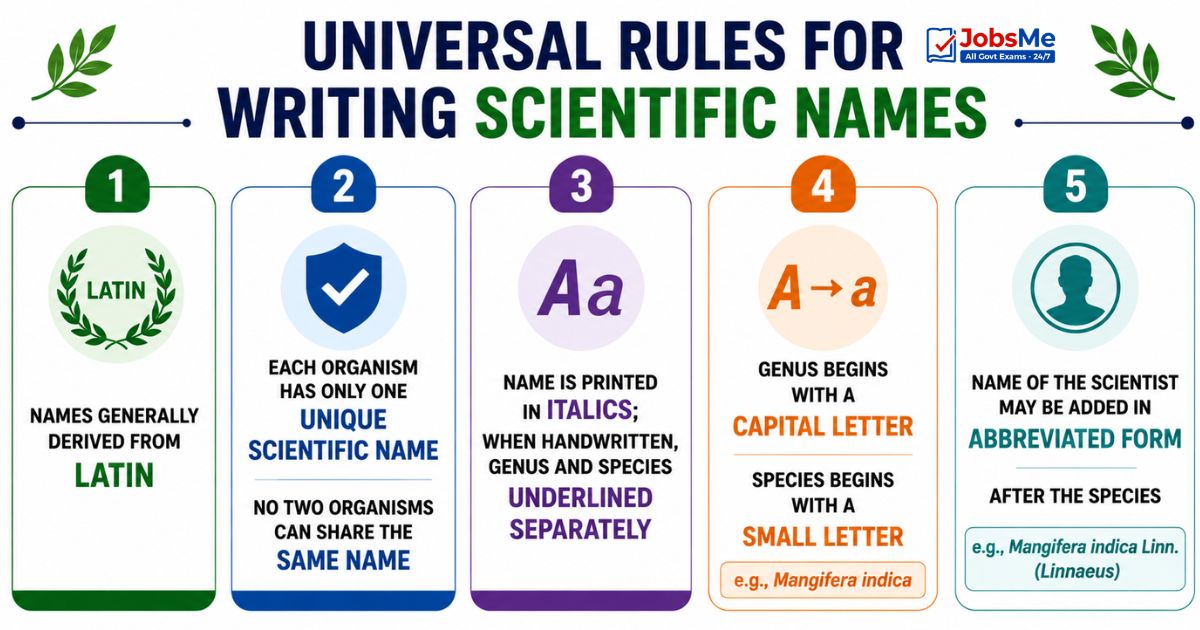
- Scientific names are generally derived from Latin, regardless of the organism's origin.
- Each organism has only one unique scientific name; no two organisms can share the same name.
- The name is printed in italics; when handwritten, the genus and species are underlined separately.
- The genus begins with a capital letter and the species begins with a small letter (e.g., Mangifera indica).
- The name of the scientist who discovered the organism may be added in abbreviated form after the species (e.g., Mangifera indica Linn. for Linnaeus).
Scientific Names of Animals and Birds
The following table lists the most exam-relevant scientific names of mammals, birds, reptiles, and insects, along with key features useful for revision.
| Common Name | Scientific Name | Key Features / Details |
|---|---|---|
| Human (Modern Man) | Homo sapiens | Genus "Homo," species "sapiens" meaning "wise man"; the most frequently asked scientific name in competitive exams. |
| Tiger | Panthera tigris | National animal of India; largest member of the cat family; protected under Project Tiger (1973). |
| Lion | Panthera leo | Asiatic lion subspecies is Panthera leo persica, found in Gir National Park, Gujarat. |
| Leopard / Panther | Panthera pardus | Member of the genus Panthera, same as the tiger and lion; known for its rosette-patterned coat. |
| Cat (Domestic) | Felis domesticus / Felis catus | Belongs to family Felidae; a common house pet domesticated for thousands of years. |
| Dog (Domestic) | Canis familiaris | Belongs to family Canidae and order Carnivora; one of the earliest domesticated animals. |
| Horse | Equus caballus | Genus Equus, which also includes zebras and donkeys; a hoofed mammal used for transport and sport. |
| Zebra | Equus quagga / Equus zebra | Same genus (Equus) as the horse; known for its black-and-white stripes. |
| Buffalo | Bubalus bubalis | The Indian water buffalo; an important domesticated animal for milk and farming. |
| Cow | Bos indicus / Bos taurus | Bos indicus is the humped Indian zebu cattle; a key livestock animal across India. |
| Giraffe | Giraffa camelopardalis | Tallest living land animal; native to Africa, not India. |
| Rabbit | Oryctolagus cuniculus | A small mammal known for rapid breeding; widely studied in biology. |
| Rhesus Monkey | Macaca mulatta | The species behind the "Rh factor" in human blood groups; widely used in medical research. |
| Peacock | Pavo cristatus | National bird of India; the male is famous for its colourful tail feathers. |
| Crow (House Crow) | Corvus splendens | A highly intelligent and common bird across Indian towns and cities. |
| Pigeon | Columba livia | The common rock pigeon; historically used to carry messages. |
| Sparrow | Passer domesticus | The house sparrow; World Sparrow Day is observed on 20 March. |
| Indian Cobra | Naja naja | One of India's "big four" venomous snakes; easily recognised by its hood. |
| King Cobra | Ophiophagus hannah | World's longest venomous snake; the species name means "snake-eater." |
| Rat Snake | Ptyas mucosa | A common non-venomous snake (Indian rat snake) often confused with the cobra. |
| Crocodile (Mugger) | Crocodylus palustris | The Indian marsh crocodile; a large freshwater reptile found in rivers and lakes. |
| Frog | Rana tigrina | The Indian bullfrog; a common amphibian studied in school biology. |
| Honey Bee | Apis indica / Apis dorsata | Apis dorsata is the giant rock bee; honey bees are vital pollinators for crops. |
| Housefly | Musca domestica | A common insect and carrier of several diseases; widely used in biology studies. |
| American Cockroach | Periplaneta americana | The largest common species of cockroach; a frequently asked entomology fact. |
| Elephant (Asian) | Elephas maximus | The Asian elephant; India's Heritage Animal, protected under Project Elephant. |
Scientific Names of Plants, Fruits, Vegetables and Crops
This section covers the most commonly asked botanical names. They are grouped into fruits, vegetables and spices, cereals and pulses, and important trees and plants for easier revision. You can practise more such facts in the Static GK Quiz on Jobsme.in.
Fruits
| Common Name | Scientific Name | Key Features / Details |
|---|---|---|
| Mango | Mangifera indica | National fruit of India; the classic example used to explain binomial nomenclature. |
| Apple | Pyrus malus / Malus domestica | A widely cultivated temperate fruit grown mainly in hilly regions like Himachal and Kashmir. |
| Banana | Musa paradisiaca | One of the most widely grown tropical fruits; rich in potassium. |
| Orange | Citrus aurantium | A citrus fruit rich in Vitamin C; belongs to the genus Citrus. |
| Lemon | Citrus limon | A sour citrus fruit; a common source of Vitamin C. |
| Guava | Psidium guajava | A tropical fruit very rich in Vitamin C and dietary fibre. |
| Papaya | Carica papaya | A tropical fruit; its enzyme papain is used as a meat tenderiser and digestive aid. |
| Pineapple | Ananas sativus / Ananas comosus | A tropical fruit; not a single fruit but a cluster of fused berries. |
| Pomegranate | Punica granatum | A fruit rich in antioxidants, grown widely in Maharashtra and Gujarat. |
| Watermelon | Citrullus lanatus / Citrullus vulgaris | A summer fruit with very high water content. |
| Sapota (Chiku) | Achras sapota / Manilkara zapota | A sweet brown tropical fruit grown widely in western and southern India. |
| Jackfruit | Artocarpus heterophyllus | The largest tree-borne fruit in the world; state fruit of Kerala. |
Vegetables and Spices
| Common Name | Scientific Name | Key Features / Details |
|---|---|---|
| Potato | Solanum tuberosum | A starchy tuber crop; belongs to the same genus (Solanum) as brinjal and tomato. |
| Tomato | Solanum lycopersicum | Botanically a fruit but used as a vegetable; rich in the antioxidant lycopene. |
| Brinjal (Eggplant) | Solanum melongena | A common vegetable of the nightshade family; India's first GM food crop test (Bt brinjal). |
| Onion | Allium cepa | A bulb vegetable of the genus Allium; a major commercial crop in Maharashtra. |
| Garlic | Allium sativum | Same genus (Allium) as onion; valued for medicinal and culinary uses. |
| Carrot | Daucus carota | A root vegetable rich in beta-carotene, a source of Vitamin A. |
| Radish | Raphanus sativus | A root vegetable with a sharp taste; grown in the cool season. |
| Cucumber | Cucumis sativus | A creeper vegetable with high water content, eaten raw in salads. |
| Pea | Pisum sativum | The plant used by Gregor Mendel in his famous experiments on heredity. |
| Spinach | Spinacia oleracea | A leafy green vegetable rich in iron and folate. |
| Capsicum | Capsicum annuum | Also called bell pepper; belongs to the genus Capsicum. |
| Black Pepper | Piper nigrum | Known as the "King of Spices"; a major spice export from Kerala. |
| Clove | Syzygium aromaticum | A dried flower bud used as a spice and in traditional medicine. |
| Coriander | Coriandrum sativum | Used both as a herb (leaves) and a spice (seeds). |
| Ginger | Zingiber officinale | An underground stem (rhizome) used as a spice and medicine. |
| Turmeric | Curcuma longa | A yellow rhizome spice; its active compound is curcumin, known for anti-inflammatory properties. |
| Curry Leaf | Murraya koenigii | An aromatic leaf widely used in South Indian cooking. |
Cereals, Pulses and Cash Crops
| Common Name | Scientific Name | Key Features / Details |
|---|---|---|
| Rice | Oryza sativa | India's most important staple cereal crop, grown mainly in the kharif season. |
| Wheat | Triticum aestivum | A major rabi cereal crop; staple food of north India. |
| Maize (Corn) | Zea mays | A versatile cereal used as food, fodder, and for industrial products. |
| Barley | Hordeum vulgare | A rabi cereal grown for food, animal feed, and brewing. |
| Jowar (Sorghum) | Sorghum vulgare / Sorghum bicolor | A drought-resistant millet crop; an important coarse grain. |
| Finger Millet (Ragi) | Eleusine coracana | A nutrient-rich millet; high in calcium and grown in dry regions. |
| Black Gram (Urad) | Vigna mungo / Phaseolus mungo | An important pulse used widely in Indian cuisine. |
| Green Gram (Moong) | Vigna radiata / Phaseolus aureus | A protein-rich pulse and common sprouting bean. |
| Soybean | Glycine max | An oilseed and protein-rich legume; a major crop in Madhya Pradesh. |
| Cotton | Gossypium herbaceum | A major cash and fibre crop; basis of the textile industry. |
| Tobacco | Nicotiana tabacum | A cash crop; the source of nicotine. |
| Sugarcane | Saccharum officinarum | A major cash crop; the main source of sugar and jaggery in India. |
Important Trees and Plants
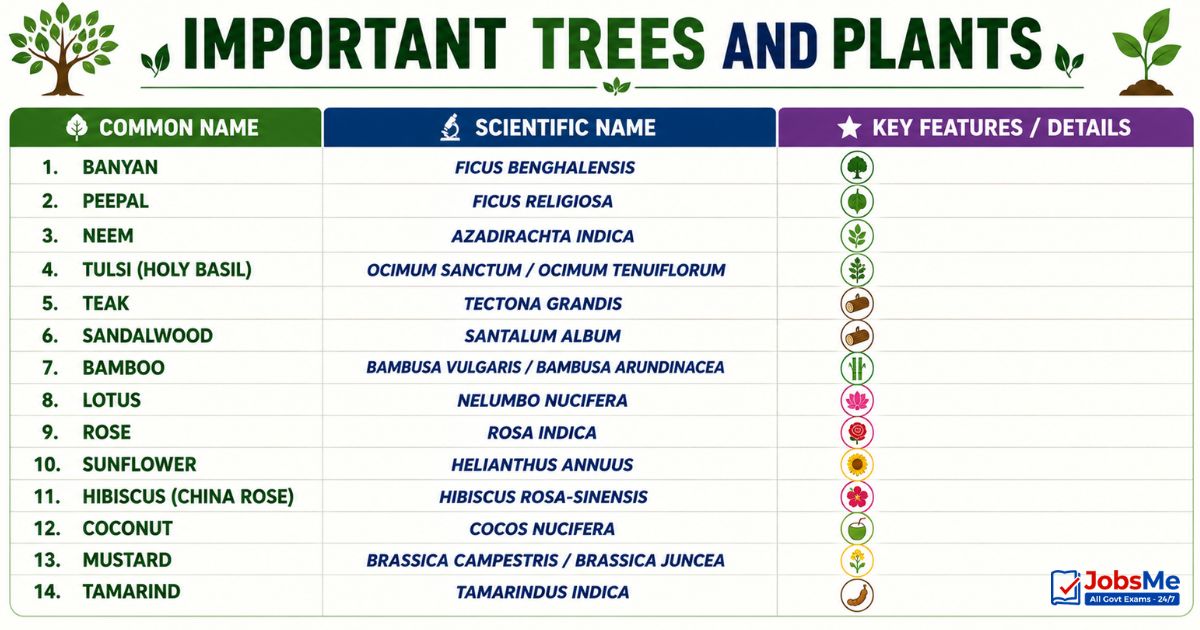
| Common Name | Scientific Name | Key Features / Details |
|---|---|---|
| Banyan | Ficus benghalensis | The national tree of India; famous for its aerial prop roots. |
| Peepal | Ficus religiosa | The sacred fig; same genus (Ficus) as the banyan; of religious importance. |
| Neem | Azadirachta indica | A medicinal tree valued in Ayurveda for its antibacterial properties. |
| Tulsi (Holy Basil) | Ocimum sanctum / Ocimum tenuiflorum | A sacred medicinal herb widely grown in Indian homes. |
| Teak | Tectona grandis | A high-value hardwood timber tree used in furniture. |
| Sandalwood | Santalum album | An aromatic tree valued for its fragrant wood and oil; major crop in Karnataka. |
| Bamboo | Bambusa vulgaris / Bambusa arundinacea | A fast-growing woody grass; legally treated as grass, not a tree, in India. |
| Lotus | Nelumbo nucifera | The national flower of India; an aquatic plant of cultural significance. |
| Rose | Rosa indica | A popular ornamental flowering plant of the genus Rosa. |
| Sunflower | Helianthus annuus | An oilseed crop whose flower head tracks the movement of the sun. |
| Hibiscus (China Rose) | Hibiscus rosa-sinensis | A common ornamental flowering plant of the family Malvaceae. |
| Coconut | Cocos nucifera | The "Tree of Life"; called Kalpavriksha for its many uses. |
| Mustard | Brassica campestris / Brassica juncea | An important oilseed crop grown in the rabi season. |
| Tamarind | Tamarindus indica | A leguminous tree whose tangy fruit pulp is used in cooking. |
Memory Tricks and Mnemonics
Trick 1: The "Panthera" Big Cats — One Genus, Three Animals
The most powerful cats all share the genus Panthera. Remember the formula "Panthera = Tiger, Lion, Leopard."
- Panthera tigris → Tiger.
- Panthera leo → Lion (Asiatic lion = Panthera leo persica).
- Panthera pardus → Leopard / Panther.
"Three big cats, one royal surname — Panthera."
Trick 2: The "Solanum Family" — Potato, Tomato, Brinjal
Three everyday vegetables share the genus Solanum. Use "PTB are Solanum siblings."
- Solanum tuberosum → Potato (tuber = tuberosum).
- Solanum lycopersicum → Tomato.
- Solanum melongena → Brinjal.
Trick 3: The "Allium Bulbs" — Onion and Garlic
Onion and garlic both belong to genus Allium:
- Allium cepa → Onion.
- Allium sativum → Garlic.
"Allium makes you cry (onion) and adds spice (garlic)."
Trick 4: The "Ficus Sacred Trees" — Banyan and Peepal
The two most sacred Indian trees share genus Ficus:
- Ficus benghalensis → Banyan (National Tree of India).
- Ficus religiosa → Peepal (the "religious" fig).
"Ficus religiosa is religious — Peepal; the other big one is Banyan."
Trick 5: The "Equus Hoofed" Group — Horse and Zebra
Horse and zebra are cousins under genus Equus:
- Equus caballus → Horse.
- Equus quagga / Equus zebra → Zebra.
Trick 6: The "indica" Indians — Made in India Species
Many Indian-origin species end with the species name "indica." Group them together:
- Mangifera indica → Mango.
- Azadirachta indica → Neem.
- Tamarindus indica → Tamarind.
- Rosa indica → Rose.
- Bos indicus → Indian (Zebu) Cow.
"If it ends in indica, it has an Indian connection."
Trick 7: National Symbols Scientific Names — "TPLB"
Remember India's national living symbols and their Latin names with "TPLB":
- T → Tiger (Panthera tigris) — National Animal.
- P → Peacock (Pavo cristatus) — National Bird.
- L → Lotus (Nelumbo nucifera) — National Flower.
- B → Banyan (Ficus benghalensis) — National Tree; plus Mango (Mangifera indica) — National Fruit.
Additional Notes
Frequently Confused Facts
- Tiger vs Lion: Panthera tigris is the tiger (National Animal of India); Panthera leo is the lion, and the Asiatic lion is Panthera leo persica (found in Gir).
- Banyan vs Peepal: Both are genus Ficus. Banyan is Ficus benghalensis (National Tree); Peepal is Ficus religiosa (the sacred/religious fig).
- Mango vs Apple: Mango is Mangifera indica (National Fruit); apple is Pyrus malus / Malus domestica — students often mix up the genus.
- Potato vs Tomato vs Brinjal: All are genus Solanum — Potato (tuberosum), Tomato (lycopersicum), Brinjal (melongena).
- Onion vs Garlic: Both are genus Allium — Onion is cepa, Garlic is sativum.
- Indian Cobra vs King Cobra: Indian cobra is Naja naja; King cobra is Ophiophagus hannah (a different genus, despite the shared common name).
- Rice vs Wheat: Rice is Oryza sativa (kharif crop); Wheat is Triticum aestivum (rabi crop).
- Genus vs Species: The first word (capitalised) is the genus; the second word (lowercase) is the species. Both are written in italics.
Repeating PYQ Patterns
Certain scientific names are asked again and again in competitive exams. Homo sapiens (human), Panthera tigris (tiger), Pavo cristatus (peacock), Mangifera indica (mango), Oryza sativa (rice), Triticum aestivum (wheat), Allium cepa (onion), Solanum tuberosum (potato), Ficus benghalensis (banyan), and Azadirachta indica (neem) appear most frequently in SSC CGL, SSC CHSL, RRB NTPC, and RRB Group D papers. Banking exams (IBPS PO, SBI Clerk) and Insurance exams usually ask the inventor of binomial nomenclature (Carolus Linnaeus) and basic rules of writing scientific names. State PCS and UPSC link this topic to biodiversity, agriculture crops, and conservation projects. NDA and CDS exams often include the scientific names of national symbols.
Quick Insight
Scientific names are far more than dry Latin labels — they are the universal language of biology. Because a tiger is Panthera tigris in every country, scientists, conservationists, and governments can discuss the same species without confusion, which is vital for biodiversity treaties, wildlife protection laws, and agricultural trade. This is why the topic connects directly to current affairs on endangered species, new species discoveries, and India's conservation programmes like Project Tiger and Project Elephant. Understanding the genus-species logic also helps aspirants eliminate wrong options quickly in the exam. For more revision, explore the Static GK notes and the Banking Awareness section on Jobsme.in.
One-Liners for Quick Revision
- Binomial Nomenclature → Two-name system (genus + species) → introduced by Carolus Linnaeus.
- Human → Homo sapiens → means "wise man."
- Tiger → Panthera tigris → National Animal of India.
- Lion → Panthera leo → Asiatic lion is Panthera leo persica (Gir).
- Leopard / Panther → Panthera pardus → genus Panthera.
- Cat → Felis domesticus / Felis catus → family Felidae.
- Dog → Canis familiaris → family Canidae, order Carnivora.
- Horse → Equus caballus → genus Equus.
- Zebra → Equus quagga / Equus zebra → same genus as horse.
- Buffalo → Bubalus bubalis → Indian water buffalo.
- Cow → Bos indicus / Bos taurus → Bos indicus is the Indian zebu.
- Giraffe → Giraffa camelopardalis → tallest land animal.
- Rabbit → Oryctolagus cuniculus → known for rapid breeding.
- Rhesus Monkey → Macaca mulatta → source of the Rh factor.
- Elephant (Asian) → Elephas maximus → India's Heritage Animal.
- Peacock → Pavo cristatus → National Bird of India.
- Crow → Corvus splendens → common house crow.
- Pigeon → Columba livia → rock pigeon.
- Sparrow → Passer domesticus → house sparrow (World Sparrow Day: 20 March).
- Indian Cobra → Naja naja → one of the "big four" venomous snakes.
- King Cobra → Ophiophagus hannah → world's longest venomous snake.
- Rat Snake → Ptyas mucosa → non-venomous, often confused with cobra.
- Crocodile (Mugger) → Crocodylus palustris → Indian marsh crocodile.
- Frog → Rana tigrina → Indian bullfrog.
- Honey Bee → Apis indica / Apis dorsata → key pollinators.
- Housefly → Musca domestica → disease carrier.
- American Cockroach → Periplaneta americana → largest common cockroach.
- Mango → Mangifera indica → National Fruit of India.
- Apple → Pyrus malus / Malus domestica → temperate fruit.
- Banana → Musa paradisiaca → rich in potassium.
- Orange → Citrus aurantium → rich in Vitamin C.
- Lemon → Citrus limon → sour citrus fruit.
- Guava → Psidium guajava → rich in Vitamin C.
- Papaya → Carica papaya → source of papain enzyme.
- Pineapple → Ananas sativus / Ananas comosus → cluster of fused berries.
- Pomegranate → Punica granatum → rich in antioxidants.
- Watermelon → Citrullus lanatus → high water content.
- Sapota (Chiku) → Achras sapota / Manilkara zapota → sweet brown fruit.
- Jackfruit → Artocarpus heterophyllus → largest tree-borne fruit.
- Potato → Solanum tuberosum → genus Solanum.
- Tomato → Solanum lycopersicum → rich in lycopene.
- Brinjal → Solanum melongena → nightshade family.
- Onion → Allium cepa → genus Allium.
- Garlic → Allium sativum → same genus as onion.
- Carrot → Daucus carota → rich in beta-carotene.
- Radish → Raphanus sativus → cool-season root vegetable.
- Cucumber → Cucumis sativus → high water content.
- Pea → Pisum sativum → used by Mendel in heredity experiments.
- Spinach → Spinacia oleracea → rich in iron.
- Capsicum → Capsicum annuum → bell pepper.
- Black Pepper → Piper nigrum → "King of Spices."
- Clove → Syzygium aromaticum → dried flower bud.
- Coriander → Coriandrum sativum → herb and spice.
- Ginger → Zingiber officinale → underground rhizome.
- Turmeric → Curcuma longa → contains curcumin.
- Curry Leaf → Murraya koenigii → South Indian aromatic leaf.
- Rice → Oryza sativa → staple kharif crop.
- Wheat → Triticum aestivum → staple rabi crop.
- Maize → Zea mays → cereal, fodder, industrial crop.
- Barley → Hordeum vulgare → rabi cereal.
- Jowar → Sorghum vulgare / Sorghum bicolor → drought-resistant millet.
- Ragi (Finger Millet) → Eleusine coracana → rich in calcium.
- Black Gram (Urad) → Vigna mungo → common pulse.
- Green Gram (Moong) → Vigna radiata → protein-rich pulse.
- Soybean → Glycine max → oilseed and legume.
- Cotton → Gossypium herbaceum → fibre and cash crop.
- Tobacco → Nicotiana tabacum → source of nicotine.
- Sugarcane → Saccharum officinarum → source of sugar.
- Banyan → Ficus benghalensis → National Tree of India.
- Peepal → Ficus religiosa → sacred fig.
- Neem → Azadirachta indica → medicinal tree.
- Tulsi → Ocimum sanctum → sacred medicinal herb.
- Teak → Tectona grandis → hardwood timber.
- Sandalwood → Santalum album → aromatic wood.
- Bamboo → Bambusa vulgaris / Bambusa arundinacea → woody grass.
- Lotus → Nelumbo nucifera → National Flower of India.
- Rose → Rosa indica → ornamental flower.
- Sunflower → Helianthus annuus → oilseed; tracks the sun.
- Hibiscus → Hibiscus rosa-sinensis → China rose, family Malvaceae.
- Coconut → Cocos nucifera → "Tree of Life" (Kalpavriksha).
- Mustard → Brassica campestris / Brassica juncea → rabi oilseed.
- Tamarind → Tamarindus indica → tangy leguminous fruit.
For more Static GK topics like national symbols, important crops, and general science, explore the Static GK section on Jobsme.in. You can also test yourself with the Static GK Quiz and the Daily Current Affairs Quiz, and check the latest openings at Latest Government Job Notifications.
Free quiz • No signup required
Put this topic into practice with Indian Cultural Institutions – Static GK MCQ Quiz. It is the quickest way to reinforce what you just learned.
Frequently Asked Questions
Who developed the system of binomial nomenclature?
What is the scientific name of human beings?
What is the scientific name of the tiger, the national animal of India?
What are the rules for writing a scientific name correctly?
What is the scientific name of mango and why is it important?
Why do potato, tomato and brinjal share the same genus?
What is the difference between the Indian cobra and the king cobra?
What are the scientific names of India's national symbols?
What is the scientific name of rice and wheat?
Why are scientific names the same in every country?

About the author