
Acids, Bases and Salts – Static GK & General Awareness for Competitive Exams with Memory Tricks
This article presents a complete, exam-ready guide to Acids, Bases and Salts, covering their definitions, properties, the pH scale, acid-base indicators, common acids and bases with their chemical formulas and sources, and important salts of daily life like common salt, baking soda, washing soda, bleaching powder and plaster of Paris. It explains key concepts such as neutralisation, strong vs weak acids, natural and synthetic indicators, and the everyday and industrial uses of each chemical, along with memory tricks and one-liners for quick revision. All facts are arranged in a structured format to help UPSC, SSC, IBPS, RRB, PSU, and State PCS aspirants score better in the General Science and General Awareness sections.
Jump to section
Introduction
Acids, bases and salts are among the most fundamental concepts in chemistry and form a high-scoring portion of the General Science syllabus in almost every competitive exam. From the sour taste of lemon (citric acid) and the tang of vinegar (acetic acid) to the slippery feel of soap (a base) and the common salt on our dining table, these three classes of compounds are present everywhere in daily life. An acid turns blue litmus red and releases hydrogen ions (H+) in water, a base turns red litmus blue and releases hydroxide ions (OH-), and a salt is formed when an acid reacts with a base in a neutralisation reaction.
Questions on acids, bases and salts appear regularly in SSC CGL, SSC CHSL, RRB NTPC, IBPS PO, IBPS Clerk, SBI Clerk, UPSC Prelims, State PCS, and various Defence, Insurance and PSU exams. Examiners frequently ask the chemical name and formula of everyday substances (such as washing soda or plaster of Paris), the pH value of common solutions, the colour change of indicators, or which acid is present in a particular fruit or part of the body. This article brings together every important fact on the topic in a clear, exam-ready format. To explore other related General Science and Static GK topics, you can refer to the Static GK section on Jobsme.in.
The topic is also closely linked to current affairs and applied science themes such as soil pH and fertilisers in agriculture, antacids and digestion in health awareness, acid rain in environmental studies, and food preservation — making it doubly important for aspirants preparing for both the objective Prelims papers and the descriptive sections of various exams. Regularly practising questions through the Static GK Quiz helps lock these facts into long-term memory.
Core Concepts: Acids, Bases, Salts and the pH Scale
Understanding the basic definitions and the way each class of compound behaves is the key to answering every question on this topic. The three classes are linked by the neutralisation reaction, in which an acid and a base react together to produce a salt and water.
Key Definitions
- Acid: A substance that has a sour taste, turns blue litmus paper red, and releases hydrogen ions (H+) when dissolved in water. Acids react with active metals to release hydrogen gas. Example: hydrochloric acid (HCl), sulphuric acid (H2SO4).
- Base: A substance that has a bitter taste, feels soapy or slippery, turns red litmus paper blue, and releases hydroxide ions (OH-) in water. A base that is soluble in water is called an alkali. Example: sodium hydroxide (NaOH), potassium hydroxide (KOH).
- Salt: An ionic compound formed when the hydrogen ion of an acid is replaced by a metal ion (or ammonium ion). Salts are produced in neutralisation reactions. Example: sodium chloride (NaCl), copper sulphate (CuSO4).
- Neutralisation: The reaction between an acid and a base to form salt and water. Example: HCl + NaOH gives NaCl + H2O.
Strong vs Weak Acids and Bases
- Strong acids dissociate completely in water and release a large number of H+ ions. Examples: HCl, H2SO4, HNO3.
- Weak acids dissociate only partially and release fewer H+ ions. Examples: acetic acid (CH3COOH), carbonic acid (H2CO3).
- Strong bases dissociate completely. Examples: NaOH, KOH.
- Weak bases dissociate partially. Examples: ammonium hydroxide (NH4OH), calcium hydroxide [Ca(OH)2].
The pH Scale
- The pH scale measures how acidic or basic a solution is, on a range from 0 to 14.
- A pH less than 7 indicates an acidic solution; the lower the value, the stronger the acid.
- A pH equal to 7 indicates a neutral solution, such as pure water.
- A pH greater than 7 indicates a basic (alkaline) solution; the higher the value, the stronger the base.
- The term pH stands for "potential of Hydrogen" and was introduced by the Danish chemist S. P. L. Sorensen.
Acid-Base Indicators
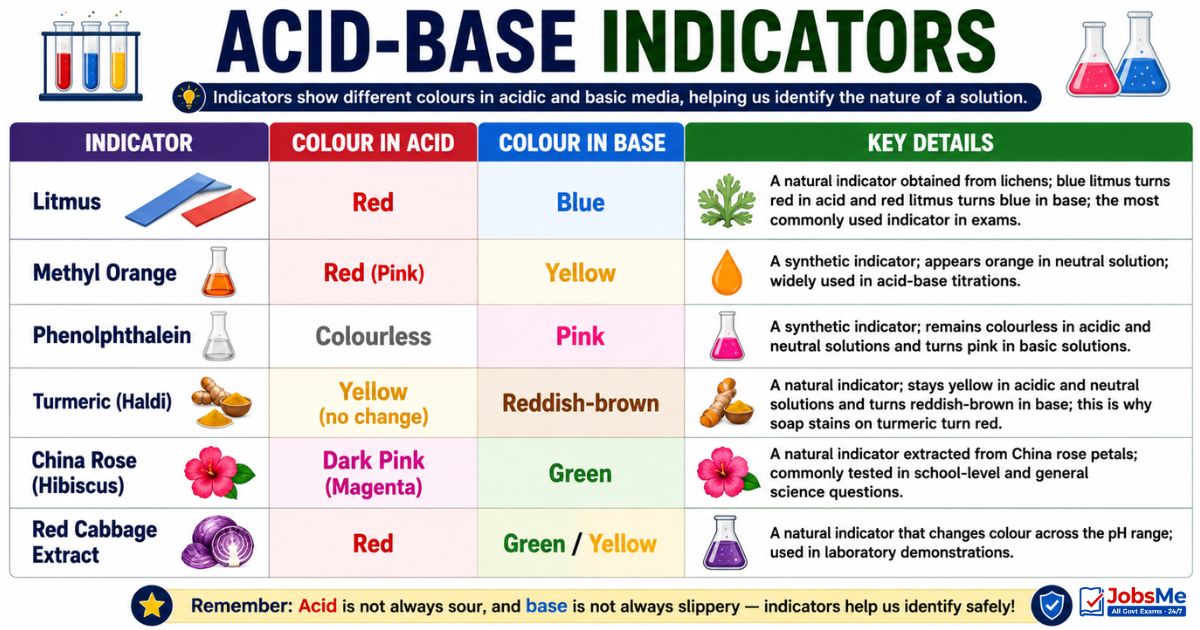
An indicator is a substance that shows a different colour in acidic and basic media, helping us identify the nature of a solution without tasting it. Indicators are a favourite area for objective questions in competitive exams.
| Indicator | Colour in Acid | Colour in Base | Key Details |
|---|---|---|---|
| Litmus | Red | Blue | A natural indicator obtained from lichens; blue litmus turns red in acid and red litmus turns blue in base; the most commonly used indicator in exams. |
| Methyl Orange | Red (Pink) | Yellow | A synthetic indicator; appears orange in neutral solution; widely used in acid-base titrations. |
| Phenolphthalein | Colourless | Pink | A synthetic indicator; remains colourless in acidic and neutral solutions and turns pink in basic solutions. |
| Turmeric (Haldi) | Yellow (no change) | Reddish-brown | A natural indicator; stays yellow in acidic and neutral solutions and turns reddish-brown in base; this is why soap stains on turmeric turn red. |
| China Rose (Hibiscus) | Dark Pink (Magenta) | Green | A natural indicator extracted from China rose petals; commonly tested in school-level and general science questions. |
| Red Cabbage Extract | Red | Green / Yellow | A natural indicator that changes colour across the pH range; used in laboratory demonstrations. |
Substances like onion and vanilla that change their smell in acidic or basic media are called olfactory indicators.
Common Acids - Sources, Formulas and Uses
The following table lists the most exam-relevant acids along with their chemical formulas, natural sources, and important uses. Acids found in nature (fruits, animals, plants) are called organic acids, while those prepared in laboratories and industries are called mineral or inorganic acids.
Organic (Natural) Acids and Their Sources
| Acid | Natural Source | Key Details |
|---|---|---|
| Acetic Acid (CH3COOH) | Vinegar | The acid present in vinegar; a weak organic acid; dilute acetic acid is used as a food preservative and flavouring agent. |
| Citric Acid | Citrus fruits — lemon, orange, lime | Gives citrus fruits their sour taste; a weak acid used in food and soft drinks; also acts as a preservative and cleaning agent. |
| Lactic Acid | Sour milk / Curd | Formed during the souring of milk; also produced in muscles during heavy exercise, causing muscle fatigue and cramps. |
| Tartaric Acid | Tamarind, Grapes | A weak acid present in tamarind and grapes; used in baking powder along with baking soda. |
| Oxalic Acid | Tomato, Spinach | Present in tomatoes and many green leafy vegetables; used as a bleaching and cleaning agent; toxic in large amounts. |
| Malic Acid | Apple | Gives apples their characteristic sour-tart taste; a common organic acid in many fruits. |
| Formic Acid (HCOOH) | Ant sting, Bee sting, Nettle plant | The simplest organic acid; responsible for the burning sensation of an ant or bee sting; the sting is treated with a mild base like baking soda. |
| Ascorbic Acid (Vitamin C) | Amla, Citrus fruits, Guava | Also known as Vitamin C; an antioxidant essential for immunity; its deficiency causes the disease scurvy. |
| Tannic Acid | Tea, Coffee | Gives tea and coffee their slightly bitter, astringent taste; also used in tanning leather. |
| Hydrochloric Acid (HCl) — gastric | Human stomach (gastric juice) | Secreted in the stomach to aid digestion and kill germs; its excess causes acidity, relieved by antacids (mild bases). |
Mineral (Inorganic) Acids and Their Uses
| Acid | Formula | Key Details and Uses |
|---|---|---|
| Hydrochloric Acid | HCl | A strong acid; secreted in the human stomach; used for cleaning metals (pickling), in the leather industry, and in laboratories. |
| Sulphuric Acid | H2SO4 | Called the "King of Chemicals"; a strong acid used in fertilisers, car batteries (lead storage), petroleum refining and detergents. |
| Nitric Acid | HNO3 | A strong acid used in making fertilisers, explosives (TNT), and dyes; a mixture of nitric and hydrochloric acid (3:1) is called Aqua Regia, which dissolves gold and platinum. |
| Carbonic Acid | H2CO3 | A weak acid formed when carbon dioxide dissolves in water; gives the fizz to soft drinks and soda water. |
| Phosphoric Acid | H3PO4 | Used in fertilisers, soft drinks (as an acidity regulator), and rust-removal products. |
Common Bases and Their Uses
Bases that dissolve in water are called alkalis. The following table covers the most frequently asked bases in competitive exams.
| Base | Formula | Common Name and Key Uses |
|---|---|---|
| Sodium Hydroxide | NaOH | Common name Caustic Soda; a strong base used in making soap, paper, and in the textile industry. |
| Potassium Hydroxide | KOH | Common name Caustic Potash; a strong base used in making soft soaps and alkaline batteries. |
| Calcium Hydroxide | Ca(OH)2 | Common name Slaked Lime; used in whitewashing walls, in making bleaching powder, and to reduce soil acidity. |
| Magnesium Hydroxide | Mg(OH)2 | Common name Milk of Magnesia; a mild base used as an antacid to relieve indigestion and as a laxative. |
| Ammonium Hydroxide | NH4OH | A weak base; used in household cleaning agents and in the manufacture of fertilisers. |
Important Salts of Daily Life
Salts are formed by the neutralisation of an acid with a base. Several salts have important everyday and industrial uses, and their common names, chemical names and formulas are among the most repeatedly asked facts in SSC, RRB and Banking exams.
| Common Name | Chemical Name | Formula | Key Details and Uses |
|---|---|---|---|
| Common Salt / Table Salt | Sodium Chloride | NaCl | Obtained from sea water by evaporation; used in cooking and as a raw material to make caustic soda, washing soda, baking soda and bleaching powder. |
| Baking Soda | Sodium Bicarbonate (Sodium Hydrogen Carbonate) | NaHCO3 | A mild, non-corrosive base; used in baking, as an antacid, and in soda-acid fire extinguishers; prepared by the Solvay process. |
| Washing Soda | Sodium Carbonate Decahydrate | Na2CO3.10H2O | A hydrated salt used for washing clothes, removing hardness of water, and in the glass and paper industries; obtained by heating baking soda and recrystallising. |
| Bleaching Powder | Calcium Oxychloride (Calcium Hypochlorite) | CaOCl2 | Prepared by passing chlorine gas over dry slaked lime; used for bleaching cloth and paper, and for disinfecting drinking water. |
| Plaster of Paris (POP) | Calcium Sulphate Hemihydrate | CaSO4.½H2O | Made by heating gypsum at about 100°C (373 K); sets into a hard mass on adding water; used for plastering fractured bones, making statues, toys and decorative material. |
| Gypsum | Calcium Sulphate Dihydrate | CaSO4.2H2O | The raw material for plaster of Paris; also used in cement and as a soil conditioner. |
| Blue Vitriol | Copper Sulphate Pentahydrate | CuSO4.5H2O | A blue crystalline salt; used as a fungicide, in electroplating, and to test for water (turns white salt blue). |
| Green Vitriol | Ferrous Sulphate Heptahydrate | FeSO4.7H2O | A green crystalline salt; used to treat iron deficiency and in the manufacture of ink and pigments. |
| Epsom Salt | Magnesium Sulphate Heptahydrate | MgSO4.7H2O | Used as a laxative (purgative) and in bath salts to relieve sore muscles. |
| Hypo (Photographer's Salt) | Sodium Thiosulphate | Na2S2O3.5H2O | Used as a fixer in photography to remove undeveloped silver salts from film. |
pH Values of Common Substances
Examiners often ask whether a given substance is acidic, neutral or basic. The table below lists approximate pH values of common everyday substances.
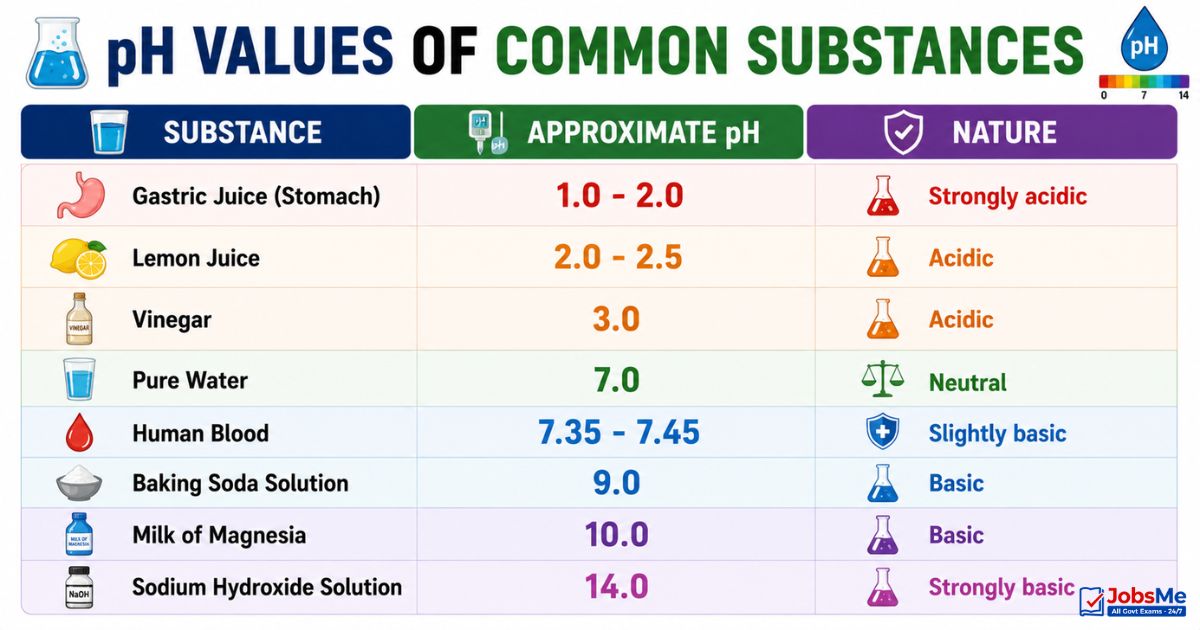
| Substance | Approximate pH | Nature |
|---|---|---|
| Gastric Juice (Stomach) | 1.0 - 2.0 | Strongly acidic |
| Lemon Juice | 2.0 - 2.5 | Acidic |
| Vinegar | 3.0 | Acidic |
| Pure Water | 7.0 | Neutral |
| Human Blood | 7.35 - 7.45 | Slightly basic |
| Baking Soda Solution | 9.0 | Basic |
| Milk of Magnesia | 10.0 | Basic |
| Sodium Hydroxide Solution | 14.0 | Strongly basic |
Memory Tricks and Mnemonics
Trick 1: Litmus Colour Change — "Blue Boils into Red Acid"
To remember which litmus changes in which medium:
- Acid → turns Blue litmus Red.
- Base → turns Red litmus Blue.
"Acid Brings Red; Base Brings Blue (A-B-R, B-B-B)."
Trick 2: The pH Scale Direction — "Low is Sour, High is Slippery"
- pH below 7 → Acidic (think of sour lemon, pH around 2).
- pH equal to 7 → Neutral (pure water).
- pH above 7 → Basic (think of slippery soap, pH around 9-10).
"Seven is the centre; below it is sour, above it is soapy."
Trick 3: Acids in Fruits — "Lemon Citric, Apple Malic, Grape Tartaric"
Link each fruit or source to its acid:
- Lemon / Orange → Citric acid.
- Apple → Malic acid.
- Tamarind / Grapes → Tartaric acid.
- Tomato / Spinach → Oxalic acid.
- Curd / Sour milk → Lactic acid.
- Vinegar → Acetic acid.
- Ant / Bee sting → Formic acid.
Trick 4: The Three "Sodas" — "Bake, Wash, Caustic"
All three start from common salt; remember by their action:
- Baking Soda → NaHCO3 (you bake with bicarbonate).
- Washing Soda → Na2CO3.10H2O (you wash with carbonate).
- Caustic Soda → NaOH (the caustic, soap-making one).
"Bake with Bi, Wash with Carbo, Caustic is OH."
Trick 5: Vitriols by Colour — "Blue Copper, Green Iron"
- Blue Vitriol → Copper Sulphate (CuSO4.5H2O) — blue.
- Green Vitriol → Ferrous Sulphate (FeSO4.7H2O) — green.
- White Vitriol → Zinc Sulphate (ZnSO4.7H2O) — white.
"Colour of the metal decides the colour of the vitriol."
Trick 6: Strong Acids — "Nitric, Sulphuric, Hydrochloric are the Strong Three"
The three most common strong mineral acids:
- HCl → Hydrochloric acid.
- H2SO4 → Sulphuric acid (King of Chemicals).
- HNO3 → Nitric acid.
"Weak ones are the organic ones from kitchen and fruits; strong ones are the mineral ones from the lab."
Trick 7: Plaster of Paris vs Gypsum — "Heat Removes Water"
- Gypsum → CaSO4.2H2O (full water).
- Heat gypsum at 373 K → lose most of the water → Plaster of Paris → CaSO4.½H2O (half water).
- Add water to POP → it sets back into a hard mass of gypsum.
"Gypsum gives POP on heating; POP gives gypsum on wetting."
Additional Notes
Frequently Confused Facts
- Baking Soda vs Washing Soda: Baking soda is sodium bicarbonate (NaHCO3); washing soda is sodium carbonate decahydrate (Na2CO3.10H2O). Washing soda is obtained by heating baking soda.
- Caustic Soda vs Caustic Potash: Caustic soda is sodium hydroxide (NaOH); caustic potash is potassium hydroxide (KOH).
- Slaked Lime vs Quick Lime: Quick lime is calcium oxide (CaO); slaked lime is calcium hydroxide [Ca(OH)2], formed by adding water to quick lime.
- Citric vs Acetic Acid: Citric acid is found in citrus fruits like lemon; acetic acid is found in vinegar.
- Lactic vs Tartaric Acid: Lactic acid is in curd and sour milk; tartaric acid is in tamarind and grapes.
- Formic vs Acetic Acid: Formic acid (HCOOH) is in ant and bee stings; acetic acid (CH3COOH) is in vinegar.
- Methyl Orange vs Phenolphthalein: Methyl orange turns red in acid and yellow in base; phenolphthalein is colourless in acid and pink in base.
- Blue Vitriol vs Green Vitriol: Blue vitriol is copper sulphate; green vitriol is ferrous sulphate.
- Alkali vs Base: Every alkali is a base, but only bases that dissolve in water are called alkalis (e.g., NaOH, KOH).
- Plaster of Paris vs Gypsum: Both are calcium sulphate; POP has half a water molecule (CaSO4.½H2O), gypsum has two (CaSO4.2H2O).
Repeating PYQ Patterns
Certain acid-base-salt facts are asked repeatedly in competitive exams. The acid present in vinegar (acetic), lemon (citric), curd (lactic), tamarind (tartaric), tomato (oxalic), apple (malic), and ant sting (formic); the chemical names and formulas of baking soda, washing soda, bleaching powder and plaster of Paris; the pH scale range of 0 to 14; the colour change of litmus, methyl orange and phenolphthalein; and the gas released when an acid reacts with a metal (hydrogen) appear most often in SSC CGL, SSC CHSL, RRB NTPC and RRB Group D papers. Banking exams (IBPS PO, SBI Clerk) frequently focus on common-name-to-formula matching for everyday chemicals. UPSC Prelims tends to ask applied questions on soil pH, acid rain, antacids, and the role of stomach acid in digestion.
Quick Insight
Acids, bases and salts are not just laboratory chemicals — they govern much of daily life and current affairs. Soil that is too acidic or too basic is corrected by adding lime or gypsum, directly affecting agriculture and food security. Acid rain, caused by sulphur and nitrogen oxides from industries and vehicles, damages monuments like the Taj Mahal and is a recurring environmental theme. Antacids that neutralise excess stomach acid, fluoride in toothpaste that protects against tooth decay caused by acid, and chlorine compounds that disinfect drinking water all rest on the chemistry of neutralisation. Understanding these links helps aspirants answer both direct objective questions and applied current affairs questions. For further reading, explore the Static GK notes and stay updated through Daily Current Affairs on Jobsme.in.
One-Liners for Quick Revision
- Acid → Sour taste, turns blue litmus red, releases H+ ions in water.
- Base → Bitter taste, soapy feel, turns red litmus blue, releases OH- ions in water.
- Salt → Formed by neutralisation of an acid and a base, giving salt and water.
- Alkali → A base that is soluble in water (example: NaOH, KOH).
- Neutralisation → Acid + Base → Salt + Water (HCl + NaOH → NaCl + H2O).
- pH scale → Ranges from 0 to 14; below 7 acidic, 7 neutral, above 7 basic.
- pH full form → Potential of Hydrogen; concept given by S. P. L. Sorensen.
- Litmus → Natural indicator from lichens; red in acid, blue in base.
- Methyl Orange → Red in acid, yellow in base.
- Phenolphthalein → Colourless in acid, pink in base.
- Turmeric → Yellow in acid, reddish-brown in base.
- China Rose → Dark pink in acid, green in base.
- Acetic Acid (CH3COOH) → Present in vinegar.
- Citric Acid → Present in citrus fruits like lemon and orange.
- Lactic Acid → Present in curd and sour milk; also in tired muscles.
- Tartaric Acid → Present in tamarind and grapes.
- Oxalic Acid → Present in tomato and spinach.
- Malic Acid → Present in apple.
- Formic Acid (HCOOH) → Present in ant and bee stings.
- Ascorbic Acid → Vitamin C; deficiency causes scurvy.
- Tannic Acid → Present in tea and coffee.
- Hydrochloric Acid (HCl) → Secreted in the stomach; aids digestion.
- Sulphuric Acid (H2SO4) → King of Chemicals; used in car batteries and fertilisers.
- Nitric Acid (HNO3) → Used in explosives and fertilisers.
- Aqua Regia → 3:1 mixture of HCl and HNO3; dissolves gold and platinum.
- Carbonic Acid (H2CO3) → Gives the fizz in soft drinks.
- Sodium Hydroxide (NaOH) → Caustic Soda; used in soap making.
- Potassium Hydroxide (KOH) → Caustic Potash; used in soft soaps.
- Calcium Hydroxide [Ca(OH)2] → Slaked Lime; used in whitewashing.
- Magnesium Hydroxide [Mg(OH)2] → Milk of Magnesia; used as an antacid.
- Common Salt (NaCl) → Sodium chloride; obtained from sea water by evaporation.
- Baking Soda (NaHCO3) → Sodium bicarbonate; used in baking and as an antacid.
- Washing Soda (Na2CO3.10H2O) → Sodium carbonate decahydrate; removes hardness of water.
- Bleaching Powder (CaOCl2) → Calcium oxychloride; disinfects water and bleaches cloth.
- Plaster of Paris (CaSO4.½H2O) → Calcium sulphate hemihydrate; sets fractured bones.
- Gypsum (CaSO4.2H2O) → Calcium sulphate dihydrate; raw material for POP.
- Quick Lime (CaO) → Calcium oxide; used in cement and steel industries.
- Blue Vitriol (CuSO4.5H2O) → Copper sulphate; used as a fungicide.
- Green Vitriol (FeSO4.7H2O) → Ferrous sulphate; treats iron deficiency.
- Epsom Salt (MgSO4.7H2O) → Magnesium sulphate; used as a laxative.
- Hypo (Na2S2O3.5H2O) → Sodium thiosulphate; used as a fixer in photography.
- Acid + Metal → Releases hydrogen gas and forms a salt.
- Acid + Carbonate / Bicarbonate → Releases carbon dioxide gas.
- Diluting acid → Always add acid to water slowly; the process is exothermic.
For more General Science and Static GK topics like Vitamins, Important Discoveries and the Periodic Table, explore the Static GK section on Jobsme.in. You can also test your preparation with the Static GK Quiz and check the newest openings at Latest Government Job Notifications.
Free quiz • No signup required
Put this topic into practice with Indian Cultural Institutions – Static GK MCQ Quiz. It is the quickest way to reinforce what you just learned.
Frequently Asked Questions
What is the pH range of acids and bases?
Which acid is present in vinegar and which one in lemon?
What happens when an acid reacts with a metal?
What is the chemical name and formula of baking soda and washing soda?
How does litmus paper indicate acids and bases?
What is neutralisation reaction?
Why is sulphuric acid called the King of Chemicals?
What is plaster of Paris and how is it prepared?
Which acid is found in the human stomach and what is its function?
What is aqua regia and why is it important?

About the author