
List of 118 Elements, Their Symbols and Atomic Numbers – Static GK & General Science for Competitive Exams with Memory Tricks
This article presents the complete list of all 118 elements of the modern periodic table with their chemical symbols and atomic numbers, from Hydrogen (H, 1) to Oganesson (Og, 118), along with the Latin-origin symbols that confuse most students. It includes important facts on atomic number, chemical symbols, smallest and largest atoms, and exam-ready memory tricks and one-liners for quick revision. All facts are arranged in exam-ready format to help UPSC, SSC, IBPS, RRB, PSU, and State PCS aspirants score better in the General Science and General Awareness sections.
Jump to section
Introduction
The periodic table is one of the most important tools in chemistry. It arranges all known chemical elements in a way that displays periodic trends in their chemical properties. Each element is identified by a unique chemical symbol and a unique atomic number. As of today, the modern periodic table contains a total of 118 elements, beginning with Hydrogen (H, atomic number 1) and ending with Oganesson (Og, atomic number 118).
While most symbols are derived from the English name of the element, several important symbols come from Latin roots, which is exactly where examiners like to set traps. For example, silver is written as Ag from its Latin name Argentum, and iron is written as Fe from the Latin word Ferrum. Because these symbols do not always match the English names, beginners often find them tricky to memorise. This article lists every element, its symbol, and its atomic number in a clean, exam-ready format. To explore more General Science and Static GK topics, you can refer to the Static GK section on Jobsme.in.
Questions on elements, symbols, and atomic numbers appear regularly in the General Science and General Awareness portions of SSC CGL, SSC CHSL, RRB NTPC, RRB Group D, IBPS, UPSC Prelims, and various PSU, Defence, and Insurance exams. Typical questions ask for the symbol of a given element, the atomic number of a common element, which Latin-origin symbol matches which element, or the smallest and largest atom. Mastering this single topic can fetch easy, guaranteed marks in the science section.
Core Concepts: Elements, Symbols and Atomic Numbers
Before memorising the full list, it helps to understand a few basic definitions. These concepts are themselves directly asked as one-mark questions in competitive exams.
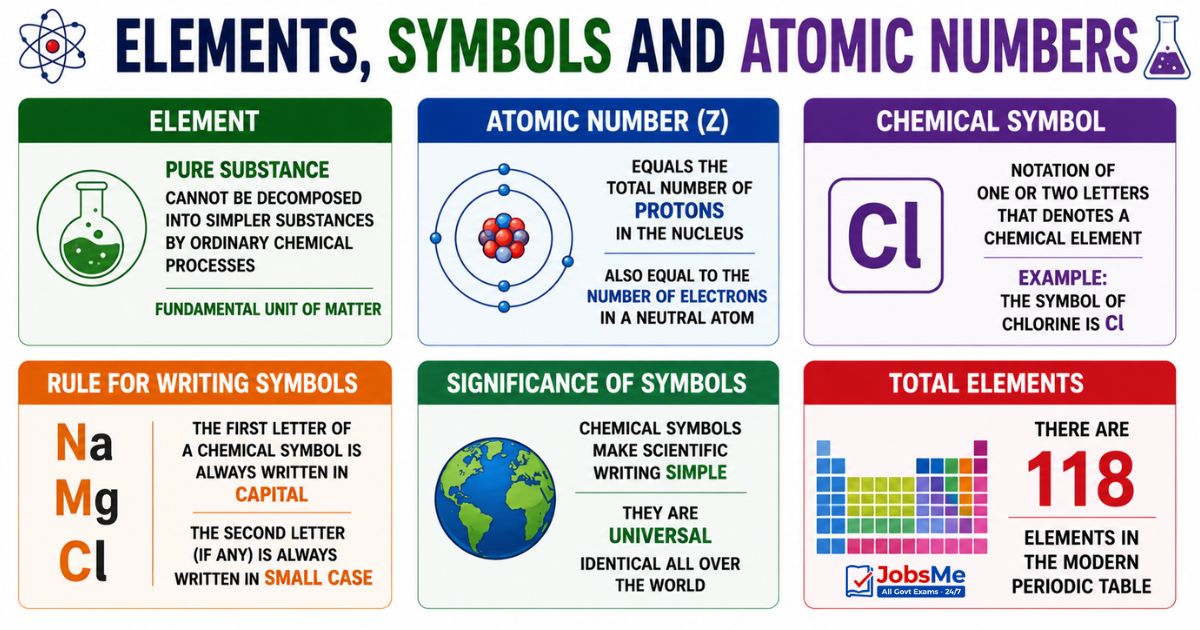
- Element: An element is a pure substance that cannot be decomposed into simpler substances by ordinary chemical processes. It is the fundamental unit of matter.
- Atomic Number (Z): The atomic number of an atom equals the total number of protons present in the nucleus of the atom, which is also equal to the number of electrons in a neutral atom.
- Chemical Symbol: A chemical symbol is a notation of one or two letters that denotes a chemical element. Example: the symbol of chlorine is Cl.
- Rule for Writing Symbols: The first letter of a chemical symbol is always written in capital, while the second letter (if any) is always written in small case. Example: Na, Mg, Cl.
- Significance of Symbols: Chemical symbols make scientific writing simple and are universal, meaning they are identical all over the world.
- Total Elements: There are 118 elements in the modern periodic table.
Knowing these definitions clearly is important because exams often combine a definition question with a symbol-matching question. For more on basic science definitions, you can practise with the Static GK Quiz on Jobsme.in.
List of All 118 Elements with Symbols and Atomic Numbers
The following table lists all 118 elements of the modern periodic table in order of increasing atomic number, along with their official chemical symbols. This is the master reference table for all your exam preparation.
Elements 1 to 40 (Hydrogen to Zirconium)
| Atomic Number | Name of the Element | Symbol | Key Detail |
|---|---|---|---|
| 1 | Hydrogen | H | Lightest element; most abundant in the universe. |
| 2 | Helium | He | Smallest atom (radius 31 pm); a noble gas. |
| 3 | Lithium | Li | Lightest metal; used in batteries. |
| 4 | Beryllium | Be | Alkaline earth metal. |
| 5 | Boron | B | Metalloid used in glass and ceramics. |
| 6 | Carbon | C | Basis of all organic life; forms diamond and graphite. |
| 7 | Nitrogen | N | Makes up about 78% of Earth's atmosphere. |
| 8 | Oxygen | O | Essential for respiration; about 21% of air. |
| 9 | Fluorine | F | Most reactive non-metal. |
| 10 | Neon | Ne | Noble gas used in glowing signs. |
| 11 | Sodium | Na | Symbol from Latin "Natrium"; highly reactive metal. |
| 12 | Magnesium | Mg | Burns with a bright white flame. |
| 13 | Aluminium | Al | Most abundant metal in Earth's crust. |
| 14 | Silicon | Si | Key material for semiconductors and chips. |
| 15 | Phosphorus | P | Found in matchsticks and fertilisers. |
| 16 | Sulfur | S | Yellow non-metal; used in sulphuric acid. |
| 17 | Chlorine | Cl | Used to disinfect water. |
| 18 | Argon | Ar | Noble gas; most abundant noble gas in air. |
| 19 | Potassium | K | Symbol from Latin "Kalium"; essential for the body. |
| 20 | Calcium | Ca | Found in bones, teeth, and limestone. |
| 21 | Scandium | Sc | Transition metal. |
| 22 | Titanium | Ti | Strong, light metal used in aircraft. |
| 23 | Vanadium | V | Used to strengthen steel. |
| 24 | Chromium | Cr | Used in stainless steel and chrome plating. |
| 25 | Manganese | Mn | Used in steel making and dry cells. |
| 26 | Iron | Fe | Symbol from Latin "Ferrum"; most used metal. |
| 27 | Cobalt | Co | Used in magnets and alloys. |
| 28 | Nickel | Ni | Used in coins and stainless steel. |
| 29 | Copper | Cu | Symbol from Latin "Cuprum"; excellent conductor. |
| 30 | Zinc | Zn | Used in galvanising iron. |
| 31 | Gallium | Ga | Melts in the hand (low melting point). |
| 32 | Germanium | Ge | Metalloid used in semiconductors. |
| 33 | Arsenic | As | Toxic metalloid. |
| 34 | Selenium | Se | Used in photocells. |
| 35 | Bromine | Br | Only non-metal liquid at room temperature. |
| 36 | Krypton | Kr | Noble gas used in lighting. |
| 37 | Rubidium | Rb | Highly reactive alkali metal. |
| 38 | Strontium | Sr | Gives red colour in fireworks. |
| 39 | Yttrium | Y | Used in LEDs and superconductors. |
| 40 | Zirconium | Zr | Used in nuclear reactors. |
Elements 41 to 80 (Niobium to Mercury)
| Atomic Number | Name of the Element | Symbol | Key Detail |
|---|---|---|---|
| 41 | Niobium | Nb | Used in superalloys and superconductors. |
| 42 | Molybdenum | Mo | Strengthens steel at high temperatures. |
| 43 | Technetium | Tc | First artificially produced element. |
| 44 | Ruthenium | Ru | Platinum-group metal. |
| 45 | Rhodium | Rh | Used in catalytic converters. |
| 46 | Palladium | Pd | Used in catalytic converters and jewellery. |
| 47 | Silver | Ag | Symbol from Latin "Argentum"; best conductor of electricity. |
| 48 | Cadmium | Cd | Used in rechargeable batteries. |
| 49 | Indium | In | Used in touchscreen displays. |
| 50 | Tin | Sn | Symbol from Latin "Stannum"; used in solder. |
| 51 | Antimony | Sb | Symbol from Latin "Stibium"; used in flame retardants. |
| 52 | Tellurium | Te | Metalloid used in alloys. |
| 53 | Iodine | I | Essential for the thyroid gland. |
| 54 | Xenon | Xe | Noble gas used in car headlamps. |
| 55 | Cesium | Cs | Largest atom (radius 298 pm); used in atomic clocks. |
| 56 | Barium | Ba | Used in medical imaging (barium meal). |
| 57 | Lanthanum | La | First lanthanide; used in camera lenses. |
| 58 | Cerium | Ce | Most abundant rare earth element. |
| 59 | Praseodymium | Pr | Used in strong magnets. |
| 60 | Neodymium | Nd | Used in powerful permanent magnets. |
| 61 | Promethium | Pm | Radioactive rare earth element. |
| 62 | Samarium | Sm | Used in magnets and lasers. |
| 63 | Europium | Eu | Used in red phosphors in screens. |
| 64 | Gadolinium | Gd | Used in MRI contrast agents. |
| 65 | Terbium | Tb | Used in green phosphors. |
| 66 | Dysprosium | Dy | Used in magnets and lasers. |
| 67 | Holmium | Ho | Has the highest magnetic strength of any element. |
| 68 | Erbium | Er | Used in fibre-optic communication. |
| 69 | Thulium | Tm | Rarest naturally occurring lanthanide. |
| 70 | Ytterbium | Yb | Used in atomic clocks and lasers. |
| 71 | Lutetium | Lu | Last lanthanide; used in catalysts. |
| 72 | Hafnium | Hf | Used in nuclear control rods. |
| 73 | Tantalum | Ta | Used in electronic capacitors. |
| 74 | Tungsten | W | Symbol from "Wolfram"; highest melting point of all metals. |
| 75 | Rhenium | Re | Used in jet engine parts. |
| 76 | Osmium | Os | Densest naturally occurring element. |
| 77 | Iridium | Ir | Most corrosion-resistant metal. |
| 78 | Platinum | Pt | Precious metal used in jewellery and catalysts. |
| 79 | Gold | Au | Symbol from Latin "Aurum"; highly malleable precious metal. |
| 80 | Mercury | Hg | Symbol from Latin "Hydrargyrum"; only metal liquid at room temperature. |
Elements 81 to 118 (Thallium to Oganesson)
| Atomic Number | Name of the Element | Symbol | Key Detail |
|---|---|---|---|
| 81 | Thallium | Tl | Toxic metal once used in rat poison. |
| 82 | Lead | Pb | Symbol from Latin "Plumbum"; heavy, soft metal. |
| 83 | Bismuth | Bi | Used in medicines and cosmetics. |
| 84 | Polonium | Po | Radioactive; discovered by Marie Curie. |
| 85 | Astatine | At | Rarest naturally occurring element. |
| 86 | Radon | Rn | Radioactive noble gas. |
| 87 | Francium | Fr | Most reactive metal; extremely rare. |
| 88 | Radium | Ra | Radioactive; discovered by Marie and Pierre Curie. |
| 89 | Actinium | Ac | First actinide; radioactive. |
| 90 | Thorium | Th | Used as nuclear fuel; abundant in India. |
| 91 | Protactinium | Pa | Rare radioactive metal. |
| 92 | Uranium | U | Used as nuclear fuel; key in atomic energy. |
| 93 | Neptunium | Np | First transuranium element. |
| 94 | Plutonium | Pu | Used in nuclear weapons and reactors. |
| 95 | Americium | Am | Used in smoke detectors. |
| 96 | Curium | Cm | Named after Marie and Pierre Curie. |
| 97 | Berkelium | Bk | Named after Berkeley, California. |
| 98 | Californium | Cf | Used in neutron sources. |
| 99 | Einsteinium | Es | Named after Albert Einstein. |
| 100 | Fermium | Fm | Named after Enrico Fermi. |
| 101 | Mendelevium | Md | Named after Dmitri Mendeleev, father of the periodic table. |
| 102 | Nobelium | No | Named after Alfred Nobel. |
| 103 | Lawrencium | Lr | Named after Ernest Lawrence. |
| 104 | Rutherfordium | Rf | Named after Ernest Rutherford. |
| 105 | Dubnium | Db | Named after Dubna, Russia. |
| 106 | Seaborgium | Sg | Named after Glenn Seaborg. |
| 107 | Bohrium | Bh | Named after Niels Bohr. |
| 108 | Hassium | Hs | Named after the German state of Hesse. |
| 109 | Meitnerium | Mt | Named after Lise Meitner. |
| 110 | Darmstadtium | Ds | Named after Darmstadt, Germany. |
| 111 | Roentgenium | Rg | Named after Wilhelm Roentgen. |
| 112 | Copernicium | Cn | Named after Nicolaus Copernicus. |
| 113 | Nihonium | Nh | First element discovered in Asia (Japan). |
| 114 | Flerovium | Fl | Named after the Flerov Laboratory. |
| 115 | Moscovium | Mc | Named after Moscow. |
| 116 | Livermorium | Lv | Named after Lawrence Livermore Laboratory. |
| 117 | Tennessine | Ts | Named after the US state of Tennessee. |
| 118 | Oganesson | Og | Last and heaviest element; named after Yuri Oganessian. |
Elements with Latin or Non-English Symbols
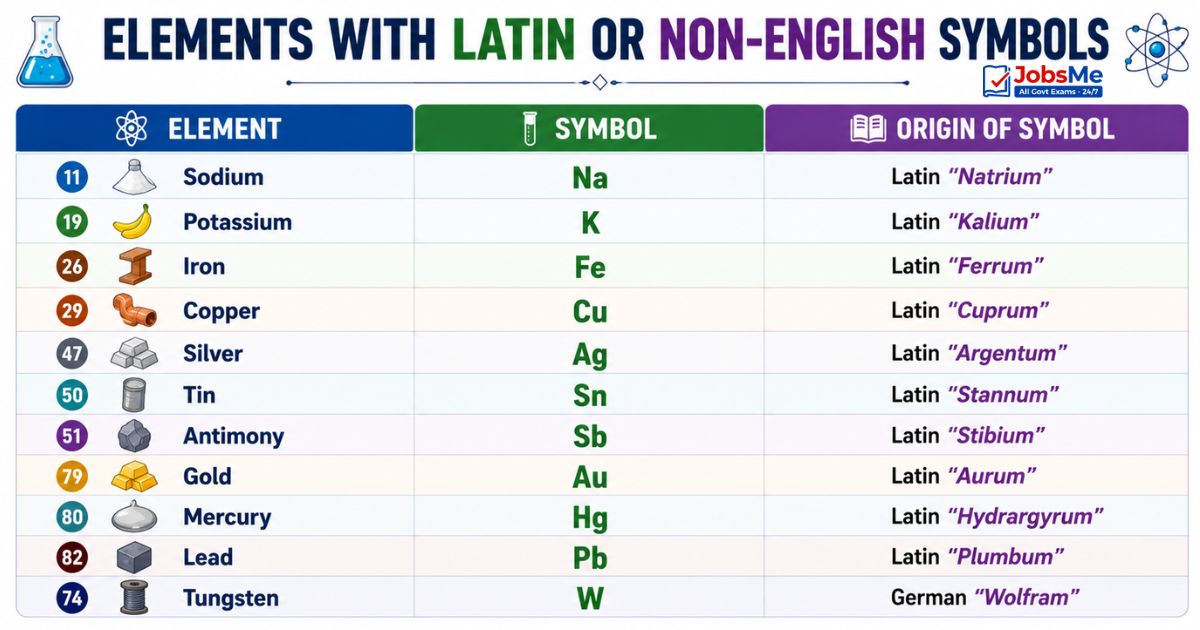
These elements are the most commonly tested because their symbols do not match their English names. Learn this short table thoroughly.
| Element | Symbol | Origin of Symbol |
|---|---|---|
| Sodium | Na | Latin "Natrium" |
| Potassium | K | Latin "Kalium" |
| Iron | Fe | Latin "Ferrum" |
| Copper | Cu | Latin "Cuprum" |
| Silver | Ag | Latin "Argentum" |
| Tin | Sn | Latin "Stannum" |
| Antimony | Sb | Latin "Stibium" |
| Gold | Au | Latin "Aurum" |
| Mercury | Hg | Latin "Hydrargyrum" |
| Lead | Pb | Latin "Plumbum" |
| Tungsten | W | German "Wolfram" |
Memory Tricks and Mnemonics
Trick 1: Latin Symbols — "Ten Tricky Ones"
The ten Latin-origin symbols are the most frequently asked. Group them as the "tricky ten" and learn the Latin name with each:
- Na (Sodium) → Natrium
- K (Potassium) → Kalium
- Fe (Iron) → Ferrum
- Cu (Copper) → Cuprum
- Ag (Silver) → Argentum
- Sn (Tin) → Stannum
- Sb (Antimony) → Stibium
- Au (Gold) → Aurum
- Hg (Mercury) → Hydrargyrum
- Pb (Lead) → Plumbum
"Latin names, English elements — that is the only trap."
Trick 2: First 20 Elements — "HHe LiBe BCNOF Ne"
Memorise the first 20 elements (atomic numbers 1-20) using this popular line, read as small chunks:
"Happy Henry Lives Beside Boron Cottage, Near Our Friend Nelly Nancy Mg Alli Sister Police Stops Clearly Around King's Castle."
- H, He, Li, Be, B (1-5)
- C, N, O, F, Ne (6-10)
- Na, Mg, Al, Si, P (11-15)
- S, Cl, Ar, K, Ca (16-20)
Trick 3: Noble Gases — "He Never Argues, Kindly Xenon Runs"
The six noble gases in order are easy to remember as:
- He → Helium (2)
- Ne → Neon (10)
- Ar → Argon (18)
- Kr → Krypton (36)
- Xe → Xenon (54)
- Rn → Radon (86)
"He Ne Argues, Kr Xe Run" — Helium to Radon, top to bottom of Group 18.
Trick 4: Smallest vs Largest Atom — "Helium Small, Caesium Tall"
Many students confuse these two. Remember:
- Smallest atom: Helium (He), radius about 31 pm.
- Largest atom: Caesium / Cesium (Cs), radius about 298 pm.
"He is the smallest, Cs is the tallest."
Trick 5: Special Liquids — "Two Liquids, One Each"
Only two elements are liquid at room temperature; remember one metal and one non-metal:
- Mercury (Hg) → only metal that is liquid at room temperature.
- Bromine (Br) → only non-metal that is liquid at room temperature.
"Mercury the metal, Bromine the non-metal — both flow."
Trick 6: "Extremes" of the Periodic Table
Examiners love superlatives. Group these "most/least" facts together:
- Lightest element: Hydrogen (H, 1).
- Most abundant metal in Earth's crust: Aluminium (Al, 13).
- Highest melting point metal: Tungsten (W, 74).
- Densest naturally occurring element: Osmium (Os, 76).
- Most reactive metal: Francium (Fr, 87); Most reactive non-metal: Fluorine (F, 9).
- Last and heaviest element: Oganesson (Og, 118).
Trick 7: Scientist-Named Elements — "Famous Names in the Table"
Several heavy elements are named after famous scientists, which makes them easy to recall:
- Curium (Cm) → Marie and Pierre Curie.
- Einsteinium (Es) → Albert Einstein.
- Fermium (Fm) → Enrico Fermi.
- Mendelevium (Md) → Dmitri Mendeleev.
- Nobelium (No) → Alfred Nobel.
- Bohrium (Bh) → Niels Bohr.
- Rutherfordium (Rf) → Ernest Rutherford.
Additional Notes
Frequently Confused Facts
- Atomic Number vs Mass Number: Atomic number is the number of protons (or electrons in a neutral atom); mass number is the total number of protons plus neutrons.
- Smallest vs Largest Atom: Helium is the smallest atom (about 31 pm), while Caesium is the largest atom (about 298 pm).
- Sodium symbol Na vs Nitrogen symbol N: Na is Sodium (from Natrium); N alone is Nitrogen.
- Potassium K vs Krypton Kr: K is Potassium (from Kalium); Kr is Krypton, a noble gas.
- Mercury Hg vs Hydrogen H: Hg is Mercury (from Hydrargyrum); H is Hydrogen.
- Lead Pb vs Lutetium Lu vs Palladium Pd: Pb is Lead (Plumbum); Pd is Palladium; Lu is Lutetium.
- Tin Sn vs Antimony Sb: Sn is Tin (Stannum); Sb is Antimony (Stibium) — both Latin and easily swapped.
- Only liquid metal vs only liquid non-metal: Mercury is the only liquid metal; Bromine is the only liquid non-metal at room temperature.
- Total elements: The modern periodic table has exactly 118 elements, not 92 (92 is only the count up to Uranium, the last natural element).
Repeating PYQ Patterns
Certain facts from this topic are asked repeatedly in competitive exams. Symbols of Sodium (Na), Potassium (K), Iron (Fe), Gold (Au), Silver (Ag), Mercury (Hg), and Lead (Pb) are the most frequently tested in SSC CGL, SSC CHSL, RRB NTPC, and RRB Group D. The total number of elements (118), the smallest atom (Helium), the largest atom (Caesium), and the only liquid metal (Mercury) appear regularly in UPSC Prelims and State PCS General Science sections. Banking exams such as IBPS PO and SBI Clerk usually keep these questions simple, asking for the symbol or atomic number of one common element. Defence and PSU exams often combine this topic with general chemistry, asking which element is named after a scientist or which symbol has a Latin origin.
Quick Insight
The periodic table is not a fixed, finished object — it grows as scientists synthesise new super-heavy elements in laboratories. The four most recent additions, Nihonium (113), Moscovium (115), Tennessine (117), and Oganesson (118), were formally added in 2016, completing the seventh period of the table. Nihonium holds special significance as the first element discovered in Asia, by scientists in Japan. For exam purposes, knowing that there are 118 elements and being able to match common symbols and atomic numbers is enough to confidently attempt the General Science questions. To strengthen your science basics further, refer to the Static GK notes and attempt the Static GK Quiz on Jobsme.in.
One-Liners for Quick Revision
- Total elements in modern periodic table → 118 → from Hydrogen (1) to Oganesson (118).
- Atomic number → equals number of protons → also equals electrons in a neutral atom.
- Element → cannot be broken into simpler substances by chemical means → fundamental unit of matter.
- Chemical symbol → one or two letters → first letter capital, second letter small.
- Hydrogen → H → atomic number 1 → lightest element.
- Helium → He → atomic number 2 → smallest atom (about 31 pm).
- Carbon → C → atomic number 6 → basis of organic chemistry.
- Nitrogen → N → atomic number 7 → about 78% of air.
- Oxygen → O → atomic number 8 → needed for respiration.
- Sodium → Na → atomic number 11 → from Latin Natrium.
- Aluminium → Al → atomic number 13 → most abundant metal in Earth's crust.
- Silicon → Si → atomic number 14 → used in semiconductors.
- Potassium → K → atomic number 19 → from Latin Kalium.
- Calcium → Ca → atomic number 20 → found in bones and teeth.
- Iron → Fe → atomic number 26 → from Latin Ferrum.
- Copper → Cu → atomic number 29 → from Latin Cuprum.
- Zinc → Zn → atomic number 30 → used in galvanising.
- Bromine → Br → atomic number 35 → only liquid non-metal.
- Silver → Ag → atomic number 47 → from Latin Argentum → best electrical conductor.
- Tin → Sn → atomic number 50 → from Latin Stannum.
- Antimony → Sb → atomic number 51 → from Latin Stibium.
- Iodine → I → atomic number 53 → essential for the thyroid.
- Caesium / Cesium → Cs → atomic number 55 → largest atom (about 298 pm).
- Tungsten → W → atomic number 74 → from Wolfram → highest melting point metal.
- Osmium → Os → atomic number 76 → densest natural element.
- Gold → Au → atomic number 79 → from Latin Aurum.
- Mercury → Hg → atomic number 80 → from Latin Hydrargyrum → only liquid metal.
- Lead → Pb → atomic number 82 → from Latin Plumbum.
- Uranium → U → atomic number 92 → last natural element → nuclear fuel.
- Francium → Fr → atomic number 87 → most reactive metal.
- Fluorine → F → atomic number 9 → most reactive non-metal.
- Oganesson → Og → atomic number 118 → last and heaviest element.
- Hydrogen isotope without neutron → Protium → only atom that can exist without a neutron.
To keep revising more General Science and Static GK topics, explore the Static GK section, test yourself with the Static GK Quiz, and stay updated with the Latest Government Job Notifications on Jobsme.in.
Free quiz • No signup required
Put this topic into practice with Indian Cultural Institutions – Static GK MCQ Quiz. It is the quickest way to reinforce what you just learned.
Frequently Asked Questions
How many elements are there in the modern periodic table?
What is the atomic number of an element?
What is a chemical symbol and how is it written?
Why is the symbol of sodium Na and not So?
What are the symbols of iron, gold, silver, and mercury?
Which is the smallest and which is the largest atom?
Which elements are liquid at room temperature?
What is an element?
Can an atom exist without neutrons?
Which is the last and heaviest element in the periodic table?

About the author