
Important Laws of Physics – Static GK & General Awareness for Competitive Exams with Formulas and Memory Tricks
This article presents a complete list of the most important laws of physics, covering laws of motion, gravitation, electricity, magnetism, optics, thermodynamics, gas laws, and modern physics, along with their statements, formulas, discoverers, and real-life applications. It includes frequently asked laws like Newton's Three Laws of Motion, Ohm's Law, Coulomb's Law, Archimedes' Principle, Hooke's Law, Boyle's Law, the Laws of Thermodynamics, and Kepler's Laws, with memory tricks and one-liners for quick revision. All facts are arranged in exam-ready format to help UPSC, SSC, IBPS, RRB, PSU, and State PCS aspirants score better in the General Science and Physics sections.
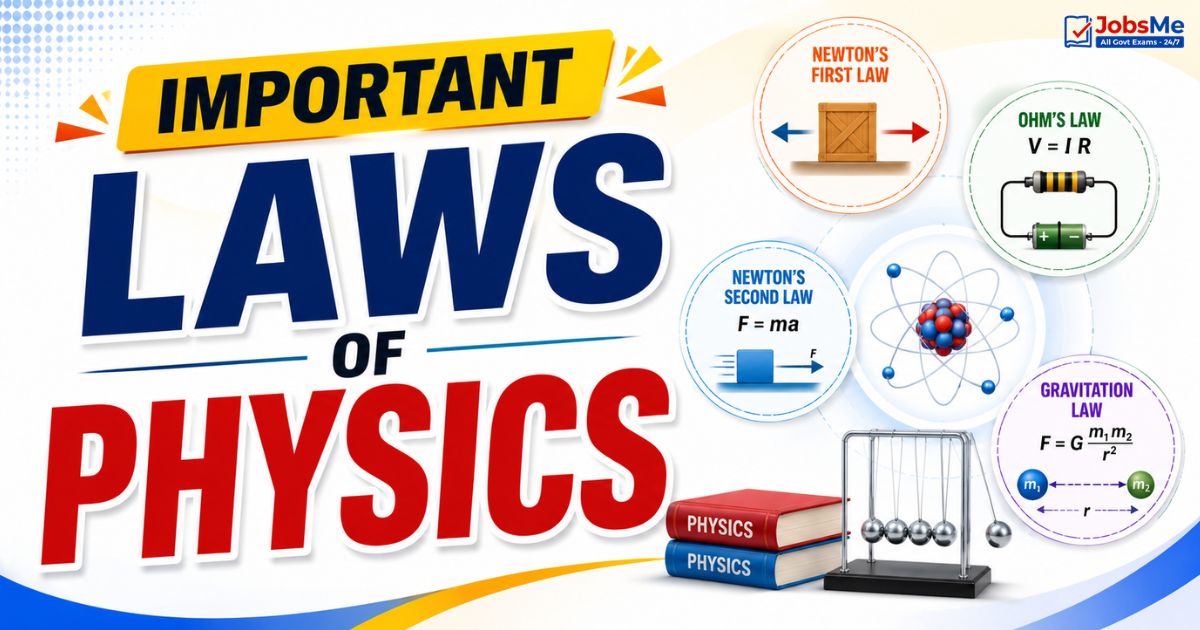
Jump to section
Introduction
Physics is governed by a set of fundamental laws that describe how matter, energy, force, and motion behave in the universe. From Newton's Laws of Motion that explain how objects move, to Ohm's Law that governs the flow of electric current, and the Laws of Thermodynamics that define energy transfer, these principles form the backbone of the General Science section in almost every competitive exam. Understanding the statement, formula, and discoverer of each law is essential for scoring well.
Questions on important laws of physics appear regularly in UPSC Prelims, SSC CGL, IBPS PO, RRB NTPC, SBI Clerk, State PCS, and various Insurance, Defence, and PSU exams. Questions typically ask which law is associated with which scientist, the formula of a particular law, the principle behind a daily-life phenomenon, or which law explains a specific application like the working of a rocket or a hydraulic lift. This article brings together every important law of physics in a structured, exam-ready format. To explore other related Static GK topics, you can refer to the Static GK section on Jobsme.in.
Laws of physics are also closely linked to current affairs themes such as Nobel Prize announcements in Physics, ISRO and space mission launches (which rely on Newton's laws and Kepler's laws), renewable energy developments (governed by thermodynamics), and breakthroughs in semiconductors and electronics — making this topic doubly important for aspirants preparing for both Prelims and General Awareness sections.
Core Concepts: Understanding Laws of Physics
A law of physics is a concise statement, usually expressed mathematically, that describes a consistent and universal relationship observed in nature. Unlike a theory, a law states what happens under given conditions without necessarily explaining why. Understanding which branch of physics a law belongs to helps students remember it longer and answer related questions confidently.
Branches of Physics and Their Key Laws
- Mechanics: Deals with motion and force. Example: Newton's Laws of Motion, Law of Conservation of Momentum, Hooke's Law.
- Gravitation: Deals with attraction between masses. Example: Newton's Law of Universal Gravitation, Kepler's Laws of Planetary Motion.
- Fluid Mechanics: Deals with liquids and gases. Example: Archimedes' Principle, Pascal's Law, Bernoulli's Principle.
- Electricity and Magnetism: Deals with charges and fields. Example: Ohm's Law, Coulomb's Law, Faraday's Laws, Lenz's Law.
- Thermodynamics and Heat: Deals with heat and energy transfer. Example: Laws of Thermodynamics, Gas Laws, Stefan-Boltzmann Law.
- Optics and Waves: Deals with light and sound. Example: Laws of Reflection, Snell's Law of Refraction, Doppler Effect.
- Modern Physics: Deals with atoms and radiation. Example: Photoelectric Effect, Law of Radioactive Decay.
Laws of Motion, Force, and Gravitation
The following table lists the most exam-relevant laws of mechanics and gravitation along with their statements, formulas, and discoverers.
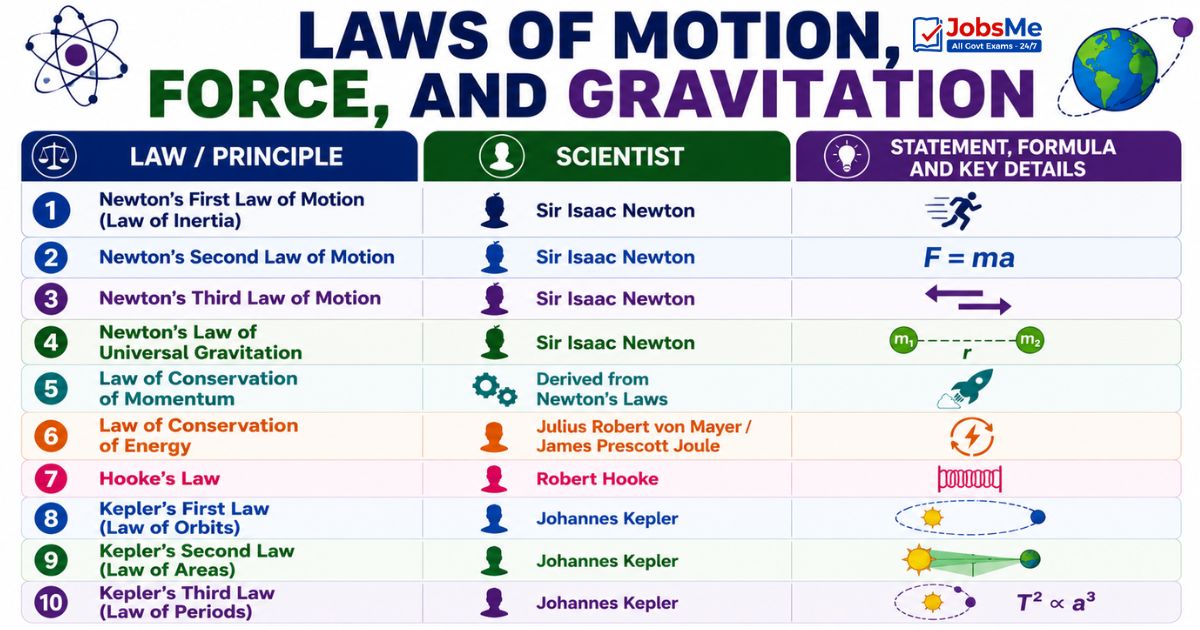
| Law / Principle | Scientist | Statement, Formula and Key Details |
|---|---|---|
| Newton's First Law of Motion (Law of Inertia) | Sir Isaac Newton | A body remains at rest or in uniform motion in a straight line unless acted upon by an external force. It defines inertia and the very concept of force; explains why passengers jerk forward when a bus stops suddenly. |
| Newton's Second Law of Motion | Sir Isaac Newton | The rate of change of momentum of a body is directly proportional to the applied force and acts in the direction of the force. Formula: Force = mass × acceleration (F = ma); it gives the quantitative definition of force, with SI unit Newton (N). |
| Newton's Third Law of Motion | Sir Isaac Newton | For every action there is an equal and opposite reaction. Explains the recoil of a gun, the swimming of a fish, the walking of a person, and the launching of rockets. |
| Newton's Law of Universal Gravitation | Sir Isaac Newton | Every particle attracts every other particle with a force directly proportional to the product of their masses and inversely proportional to the square of the distance between them. Formula: F = G(m1 × m2)/r²; G is the universal gravitational constant (6.674 × 10⁻¹¹ N·m²/kg²). |
| Law of Conservation of Momentum | Derived from Newton's Laws | In the absence of an external force, the total momentum of a system of bodies remains constant. It is the principle behind rocket propulsion and recoil of firearms. |
| Law of Conservation of Energy | Julius Robert von Mayer / James Prescott Joule | Energy can neither be created nor destroyed; it can only be transformed from one form to another. The total energy of an isolated system remains constant. |
| Hooke's Law | Robert Hooke | Within the elastic limit, the stress applied to a material is directly proportional to the strain produced. Formula: Stress ∝ Strain; the constant of proportionality is the modulus of elasticity. Explains the behaviour of springs. |
| Kepler's First Law (Law of Orbits) | Johannes Kepler | Every planet moves around the Sun in an elliptical orbit with the Sun at one of the two foci of the ellipse. |
| Kepler's Second Law (Law of Areas) | Johannes Kepler | The line joining a planet to the Sun sweeps out equal areas in equal intervals of time, which means a planet moves faster when closer to the Sun. |
| Kepler's Third Law (Law of Periods) | Johannes Kepler | The square of the orbital period of a planet is directly proportional to the cube of the semi-major axis of its orbit. Formula: T² ∝ a³. |
Laws of Fluids, Heat, and Thermodynamics
The following table lists important laws related to fluids, gases, heat, and thermodynamics frequently asked in competitive exams.
| Law / Principle | Scientist | Statement, Formula and Key Details |
|---|---|---|
| Archimedes' Principle | Archimedes | A body wholly or partially immersed in a fluid experiences an upward buoyant force equal to the weight of the fluid displaced by it. Explains floating of ships, submarines, and why we feel lighter in water. |
| Pascal's Law | Blaise Pascal | Pressure applied to an enclosed fluid is transmitted equally and undiminished in all directions throughout the fluid. It is the working principle of hydraulic lifts, hydraulic brakes, and hydraulic presses. |
| Bernoulli's Principle | Daniel Bernoulli | For a flowing fluid, where the speed is high the pressure is low, and where the speed is low the pressure is high. Explains the lift of aircraft wings, the spin of a cricket ball, and atomisers. |
| Boyle's Law | Robert Boyle | At constant temperature, the volume of a fixed mass of gas is inversely proportional to its pressure. Formula: P × V = constant (or P₁V₁ = P₂V₂). |
| Charles's Law | Jacques Charles | At constant pressure, the volume of a fixed mass of gas is directly proportional to its absolute temperature. Formula: V/T = constant. |
| Gay-Lussac's Law (Pressure Law) | Joseph Louis Gay-Lussac | At constant volume, the pressure of a fixed mass of gas is directly proportional to its absolute temperature. Formula: P/T = constant. |
| Avogadro's Law | Amedeo Avogadro | Equal volumes of all gases, at the same temperature and pressure, contain an equal number of molecules. Avogadro's number is 6.022 × 10²³ per mole. |
| Zeroth Law of Thermodynamics | Ralph Fowler (named) | If two systems are each in thermal equilibrium with a third system, then they are in thermal equilibrium with each other. It forms the basis of temperature measurement. |
| First Law of Thermodynamics | Based on Conservation of Energy | Heat supplied to a system is equal to the increase in internal energy plus the work done by the system. Formula: Q = ΔU + W. It is the law of conservation of energy applied to heat. |
| Second Law of Thermodynamics | Rudolf Clausius / Lord Kelvin | Heat cannot flow spontaneously from a colder body to a hotter body without external work; the entropy of an isolated system always tends to increase. |
| Stefan-Boltzmann Law | Josef Stefan and Ludwig Boltzmann | The total energy radiated per unit surface area of a black body is directly proportional to the fourth power of its absolute temperature. Formula: E ∝ T⁴. |
| Wien's Displacement Law | Wilhelm Wien | The wavelength at which a black body emits maximum radiation is inversely proportional to its absolute temperature. Formula: λmax = b/T, where b is Wien's constant (2.898 × 10⁻³ m·K). |
| Newton's Law of Cooling | Sir Isaac Newton | The rate of loss of heat by a body is directly proportional to the difference in temperature between the body and its surroundings, provided the difference is small. |
Laws of Electricity, Magnetism, Light, and Modern Physics
The following table covers the most exam-relevant laws of electricity, magnetism, optics, sound, and modern physics.
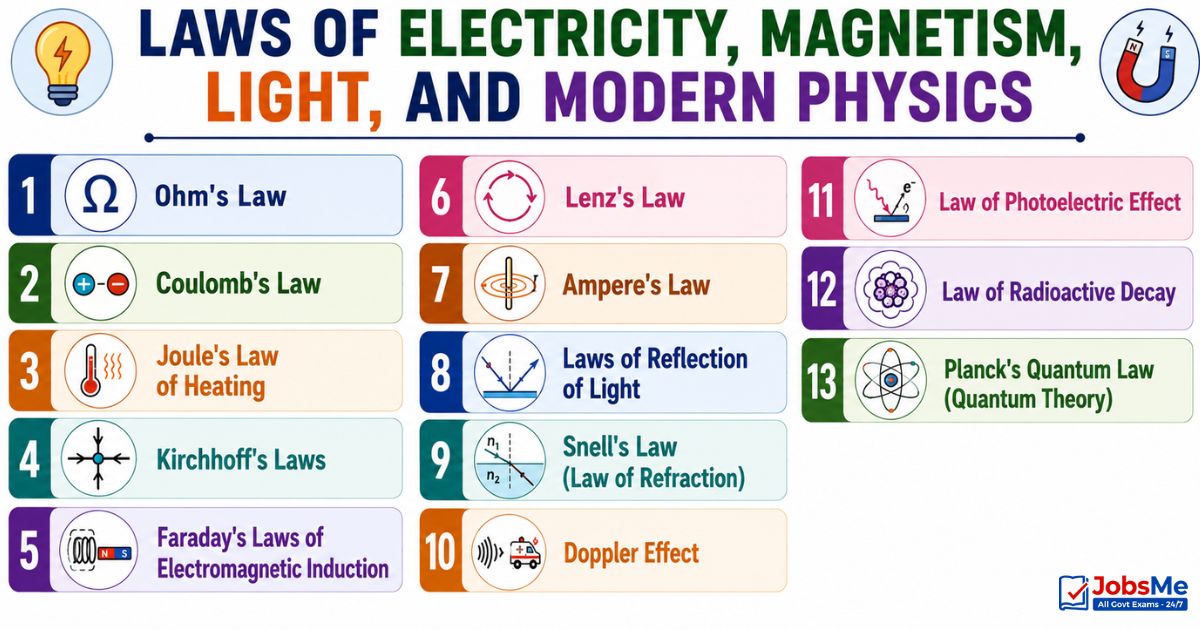
| Law / Principle | Scientist | Statement, Formula and Key Details |
|---|---|---|
| Ohm's Law | Georg Simon Ohm | At constant temperature, the current flowing through a conductor is directly proportional to the potential difference across its ends. Formula: V = I × R, where R is resistance measured in ohms. |
| Coulomb's Law | Charles-Augustin de Coulomb | The force between two point charges is directly proportional to the product of the charges and inversely proportional to the square of the distance between them. Formula: F = k(q1 × q2)/r². |
| Joule's Law of Heating | James Prescott Joule | The heat produced in a conductor is directly proportional to the square of the current, the resistance, and the time of flow. Formula: H = I²Rt. It is the principle behind electric heaters and bulbs. |
| Kirchhoff's Laws | Gustav Kirchhoff | The Current Law states the sum of currents entering a junction equals the sum leaving it; the Voltage Law states the sum of voltage changes around a closed loop is zero. Used to analyse electrical circuits. |
| Faraday's Laws of Electromagnetic Induction | Michael Faraday | A changing magnetic field through a coil induces an electromotive force (EMF); the induced EMF is proportional to the rate of change of magnetic flux. It is the principle behind electric generators and transformers. |
| Lenz's Law | Heinrich Lenz | The direction of an induced current is always such that it opposes the change in magnetic flux that produced it. It is a consequence of the law of conservation of energy. |
| Ampere's Law | Andre-Marie Ampere | The magnetic field created by an electric current is proportional to the magnitude of the current. It relates magnetic fields to the electric currents that produce them. |
| Laws of Reflection of Light | Established in classical optics | The angle of incidence equals the angle of reflection, and the incident ray, reflected ray, and normal all lie in the same plane. Explains the working of mirrors and periscopes. |
| Snell's Law (Law of Refraction) | Willebrord Snellius | The ratio of the sine of the angle of incidence to the sine of the angle of refraction is constant for a given pair of media. Formula: n1 sin i = n2 sin r. Explains bending of light in lenses and prisms. |
| Doppler Effect | Christian Doppler | The apparent change in frequency of a wave when there is relative motion between the source and the observer. Explains the change in pitch of a passing train horn and is used in radar and astronomy. |
| Law of Photoelectric Effect | Albert Einstein (explained) | When light of sufficient frequency falls on a metal surface, electrons are emitted. Einstein explained it using the quantum theory of light and won the Nobel Prize in Physics (1921) for it. |
| Law of Radioactive Decay | Ernest Rutherford / Frederick Soddy | The rate of decay of a radioactive substance is directly proportional to the number of undecayed nuclei present at that time. The time for half the sample to decay is called the half-life. |
| Planck's Quantum Law (Quantum Theory) | Max Planck | Energy is emitted or absorbed not continuously but in discrete packets called quanta. Formula: E = hν, where h is Planck's constant (6.626 × 10⁻³⁴ J·s). It marked the birth of quantum physics. |
Memory Tricks and Mnemonics
Trick 1: Newton's Three Laws — "I-F-R"
Remember the theme of each of Newton's three laws of motion with the acronym "IFR":
- I → First Law → Inertia (body stays at rest or in motion).
- F → Second Law → Force = mass × acceleration (F = ma).
- R → Third Law → Reaction (action and reaction are equal and opposite).
"Inertia, Force, Reaction — One, Two, Three."
Trick 2: The Three Gas Laws — "PVT Triangle"
Group the three basic gas laws by the quantity that is kept constant:
- Boyle's Law → Temperature constant → Pressure and Volume are inversely related (P ∝ 1/V).
- Charles's Law → Pressure constant → Volume and Temperature are directly related (V ∝ T).
- Gay-Lussac's Law → Volume constant → Pressure and Temperature are directly related (P ∝ T).
"Boyle hates heat (T constant), Charles loves heat (P constant), Gay-Lussac freezes volume (V constant)."
Trick 3: Laws of Thermodynamics — "Zero, One, Two"
- Zeroth Law → Defines temperature and thermal equilibrium.
- First Law → Conservation of energy (Q = ΔU + W).
- Second Law → Entropy increases; heat flows hot to cold.
"You must count to Zero before you understand heat."
Trick 4: Kepler's Three Laws — "O-A-P"
Remember Kepler's three laws of planetary motion as "OAP":
- O → First Law → Orbits (planets move in ellipses).
- A → Second Law → Areas (equal areas in equal time).
- P → Third Law → Periods (T² ∝ a³).
Trick 5: Fluid Laws — "Float, Press, Flow"
- Float → Archimedes' Principle → buoyancy and floating of ships.
- Press → Pascal's Law → pressure transmitted equally (hydraulic lift).
- Flow → Bernoulli's Principle → fast flow means low pressure (aircraft lift).
"Float, Press, Flow — three friends of fluids."
Trick 6: Electricity Laws — "OCK-FL"
String together the core electricity and magnetism laws:
- O → Ohm's Law → V = IR.
- C → Coulomb's Law → force between charges.
- K → Kirchhoff's Laws → circuit current and voltage.
- F → Faraday's Law → induced EMF from changing flux.
- L → Lenz's Law → induced current opposes the change.
Trick 7: Two Newton Laws Not About Motion — "Gravity and Cooling"
Newton gave laws beyond motion. Do not confuse them:
- Law of Universal Gravitation → attraction between masses (F ∝ m1m2/r²).
- Law of Cooling → rate of heat loss ∝ temperature difference.
"Newton pulled things together (gravity) and let them cool down (cooling)."
Additional Notes
Frequently Confused Facts
- Boyle's Law vs Charles's Law: Boyle's Law keeps temperature constant (pressure and volume inversely related); Charles's Law keeps pressure constant (volume and temperature directly related).
- Faraday's Law vs Lenz's Law: Faraday's Law tells the magnitude of induced EMF; Lenz's Law tells the direction of the induced current (it opposes the change).
- Pascal's Law vs Archimedes' Principle: Pascal's Law explains hydraulic lifts and brakes (equal pressure transmission); Archimedes' Principle explains floating and buoyancy (weight of displaced fluid).
- Ohm's Law vs Joule's Law: Ohm's Law relates voltage, current, and resistance (V = IR); Joule's Law gives the heat produced by current (H = I²Rt).
- Stefan-Boltzmann Law vs Wien's Displacement Law: Stefan-Boltzmann Law gives total radiated energy (∝ T⁴); Wien's Law gives the wavelength of maximum emission (inversely ∝ T).
- Newton's Second Law vs Conservation of Momentum: The Second Law defines force as rate of change of momentum; Conservation of Momentum follows from it when no external force acts.
- Reflection vs Refraction: The Laws of Reflection govern bouncing of light from mirrors; Snell's Law governs bending of light when passing between media.
- Kepler's Laws vs Newton's Gravitation: Kepler's Laws describe how planets move (observational); Newton's Law of Gravitation explains why they move that way (the underlying force).
- First Law of Thermodynamics vs Conservation of Energy: The First Law is simply the conservation of energy principle applied specifically to heat and work.
- Doppler Effect vs Bernoulli's Principle: Doppler Effect is about apparent change in frequency due to relative motion (sound and light); Bernoulli's Principle is about pressure changes in flowing fluids.
Repeating PYQ Patterns
Certain laws are asked repeatedly in competitive exams. Newton's Three Laws of Motion, Ohm's Law (V = IR), Archimedes' Principle, Pascal's Law, Boyle's Law and Charles's Law, the Laws of Thermodynamics, Coulomb's Law, Faraday's Laws of Electromagnetic Induction, Kepler's Laws, and the Law of Conservation of Energy appear most often in UPSC Prelims, SSC CGL, and RRB NTPC papers. Banking exams (IBPS PO, SBI Clerk) frequently focus on matching a law with its scientist and identifying the principle behind everyday devices like hydraulic brakes, electric generators, and rockets. SSC and Railways exams especially favour Ohm's Law, Newton's Laws, and the gas laws, often asking direct questions on formulas and units. UPSC Prelims tends to ask application-based questions, such as which law explains the lift of an aeroplane (Bernoulli's Principle) or the working of a rocket (Newton's Third Law).
Quick Insight
Laws of physics are not just textbook formulas — they power the modern world. Newton's Third Law lifts every ISRO rocket and satellite into orbit; Faraday's Law of induction runs every power generator and electric vehicle motor; Bernoulli's Principle keeps aircraft in the sky; and the Laws of Thermodynamics govern everything from refrigerators to power plants and the global push for clean energy. Each Nobel Prize in Physics, every space mission, and every advance in electronics traces back to one of these fundamental laws, which is why this topic is invaluable for both Prelims (direct matching and formula questions) and Mains (science and technology essays). For further reading on related Static GK topics, you can refer to the Static GK section and test yourself with the Static GK Quiz on Jobsme.in.
One-Liners for Quick Revision
- Newton's First Law of Motion → Law of Inertia → body stays at rest or in uniform motion unless acted upon by a force.
- Newton's Second Law of Motion → Force = mass × acceleration (F = ma) → defines force; SI unit Newton.
- Newton's Third Law of Motion → Every action has an equal and opposite reaction → explains rockets and recoil of guns.
- Newton's Law of Universal Gravitation → F = G(m1m2)/r² → attraction between any two masses.
- Law of Conservation of Momentum → Total momentum is constant if no external force acts → basis of rocket propulsion.
- Law of Conservation of Energy → Energy is neither created nor destroyed, only transformed.
- Hooke's Law → Stress is proportional to strain within the elastic limit → behaviour of springs.
- Kepler's First Law → Law of Orbits → planets move in elliptical orbits with the Sun at one focus.
- Kepler's Second Law → Law of Areas → equal areas swept in equal time.
- Kepler's Third Law → Law of Periods → T² ∝ a³.
- Archimedes' Principle → Buoyant force equals weight of displaced fluid → floating of ships.
- Pascal's Law → Pressure on an enclosed fluid is transmitted equally → hydraulic lifts and brakes.
- Bernoulli's Principle → High speed means low pressure in a fluid → lift of aircraft wings.
- Boyle's Law → At constant temperature, P ∝ 1/V (P₁V₁ = P₂V₂).
- Charles's Law → At constant pressure, V ∝ T.
- Gay-Lussac's Law → At constant volume, P ∝ T.
- Avogadro's Law → Equal volumes of gases at same temperature and pressure have equal molecules; Avogadro's number = 6.022 × 10²³.
- Zeroth Law of Thermodynamics → Basis of temperature; bodies in equilibrium with a third are in equilibrium with each other.
- First Law of Thermodynamics → Q = ΔU + W → conservation of energy for heat.
- Second Law of Thermodynamics → Heat flows hot to cold; entropy always increases.
- Stefan-Boltzmann Law → Radiated energy ∝ T⁴.
- Wien's Displacement Law → Peak wavelength ∝ 1/T (λmax = b/T).
- Newton's Law of Cooling → Rate of heat loss ∝ temperature difference with surroundings.
- Ohm's Law → V = I × R → current proportional to voltage at constant temperature.
- Coulomb's Law → Force between charges ∝ q1q2/r².
- Joule's Law of Heating → H = I²Rt → heat produced by current; principle of electric heaters.
- Kirchhoff's Laws → Current Law (junction) and Voltage Law (loop) → used to analyse circuits.
- Faraday's Laws of Electromagnetic Induction → Changing flux induces EMF → principle of generators and transformers.
- Lenz's Law → Induced current opposes the change that caused it → follows conservation of energy.
- Ampere's Law → Magnetic field is proportional to the current producing it.
- Laws of Reflection of Light → Angle of incidence equals angle of reflection → mirrors and periscopes.
- Snell's Law → n1 sin i = n2 sin r → bending of light through lenses and prisms.
- Doppler Effect → Apparent change in frequency due to relative motion → used in radar and astronomy.
- Photoelectric Effect → Light ejects electrons from metals → explained by Einstein, Nobel Prize 1921.
- Law of Radioactive Decay → Decay rate ∝ number of undecayed nuclei → defines half-life.
- Planck's Quantum Law → E = hν → energy comes in discrete quanta; birth of quantum physics.
For more Static GK topics like important scientific instruments, units, and discoveries, explore the Static GK section on Jobsme.in. You can also test your knowledge with the Static GK Quiz, brush up on daily science updates at Daily Current Affairs, and check out the latest exam notifications at Latest Government Job Notifications.
Free quiz • No signup required
Put this topic into practice with Indian Cultural Institutions – Static GK MCQ Quiz. It is the quickest way to reinforce what you just learned.
Frequently Asked Questions
Who gave the three laws of motion?
What is Ohm's Law and its formula?
Which principle explains why ships float on water?
Which law is the working principle of a hydraulic lift?
What does Boyle's Law state?
Which law explains the lift of an aeroplane wing?
What is the First Law of Thermodynamics?
Who discovered the law of electromagnetic induction?
What is the difference between Faraday's Law and Lenz's Law?
Who explained the photoelectric effect and won the Nobel Prize for it?

About the author