Climate of India and the Monsoon System – Static GK & General Awareness for Competitive Exams with Memory Tricks
This article presents a complete, exam-ready guide to the Climate of India and the Monsoon System, covering the factors that control India's climate, the four seasons, the mechanism of the Southwest and Northeast Monsoons, important local winds (Loo, Mango Showers, Kal Baisakhi), rainfall extremes, Koppen's climatic regions, and key phenomena like El Nino, La Nina, IOD, ITCZ, and jet streams. It includes memory tricks, frequently confused facts, and one-liners covering every major fact for quick revision. All content is arranged to help UPSC, SSC, IBPS, RRB, PSU, and State PCS aspirants score better in the Geography and General Awareness sections.
Jump to section
- Introduction
- Core Concepts: Climate, Weather, and the Monsoon
- Factors Controlling the Climate of India
- Seasons of India
- Mechanism of the Indian Monsoon
- Important Local Winds and Pre-Monsoon Showers
- Rainfall Distribution and Important Extremes
- Koppen's Climatic Regions of India
- Memory Tricks and Mnemonics
- Additional Notes
- One-Liners for Quick Revision
Introduction
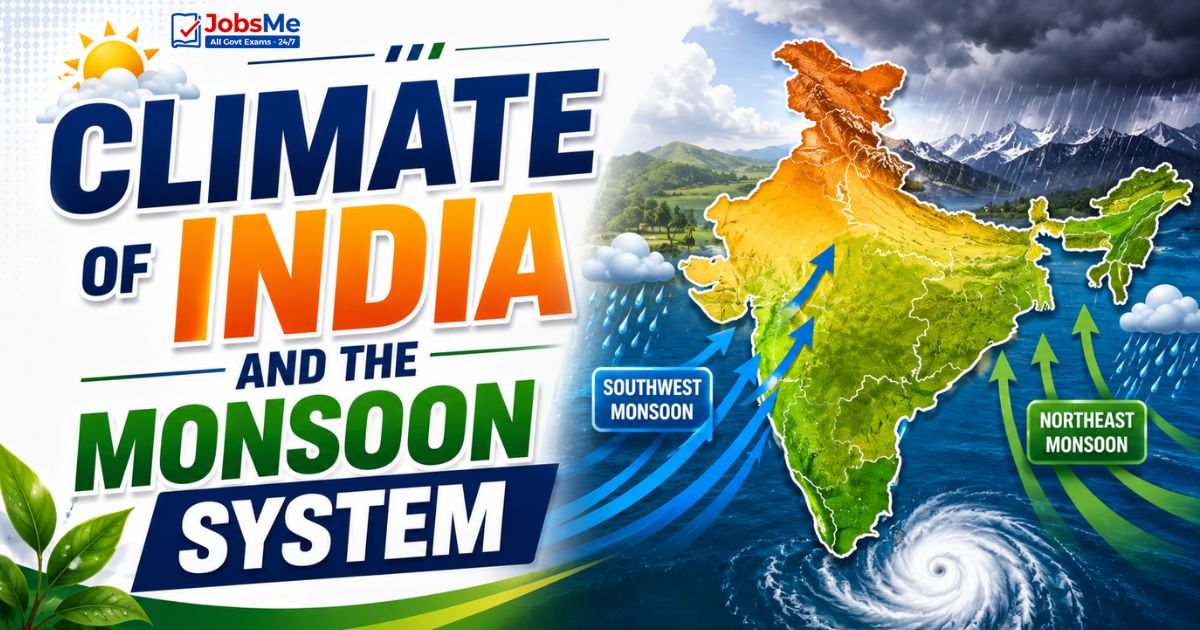
The Climate of India is best described as a tropical monsoon type, dominated by the seasonal reversal of winds that bring the life-giving rains every year. The word "Monsoon" is derived from the Arabic word "Mausim", which means season. India experiences four broad seasons — Winter, Summer, the Southwest (advancing) Monsoon, and the Retreating (Northeast) Monsoon — and the Southwest Monsoon alone delivers about 75-80% of India's total annual rainfall in just four months from June to September.
The Climate of India and the Monsoon System form one of the most frequently tested areas of Indian Geography in UPSC Prelims, SSC CGL, IBPS PO, RRB NTPC, SBI Clerk, State PCS, and various Insurance and Defence exams. Questions usually focus on the mechanism of the monsoon, the two branches of the Southwest Monsoon, local winds, rainfall extremes such as the wettest place in India, and modern factors like El Nino, La Nina, and the Indian Ocean Dipole. This article brings together every important fact in a structured, exam-ready format. To explore more topics in this area, you can refer to the Static GK section on Jobsme.in.
Climate and Monsoon are also closely tied to current affairs — the India Meteorological Department's seasonal forecasts, El Nino and La Nina warnings, monsoon onset dates, drought and flood news, and crop sowing patterns appear regularly in the headlines. This makes the topic doubly important for aspirants preparing for both objective papers and the descriptive Mains and Essay sections. You can keep up with related updates through the Daily Current Affairs page on Jobsme.in.
Core Concepts: Climate, Weather, and the Monsoon
Before studying the monsoon in detail, it is important to understand a few basic definitions that examiners often test directly.
- Climate: The long-term average of weather conditions of a place, usually measured over a period of about 30 years or more.
- Weather: The day-to-day state of the atmosphere of a place, including temperature, humidity, pressure, and rainfall.
- Monsoon: The seasonal reversal of wind direction over a region, bringing a distinct wet season and a distinct dry season.
- Tropical Monsoon Climate: India's overall climatic type, marked by high temperatures and heavy seasonal rainfall concentrated in the summer months.
- Equable (Maritime) Climate: A moderate climate with a small difference between summer and winter temperatures, found in India's coastal regions.
- Continental (Extreme) Climate: A climate with very hot summers and very cold winters, found in the interior regions of North India such as the Thar region.
Factors Controlling the Climate of India
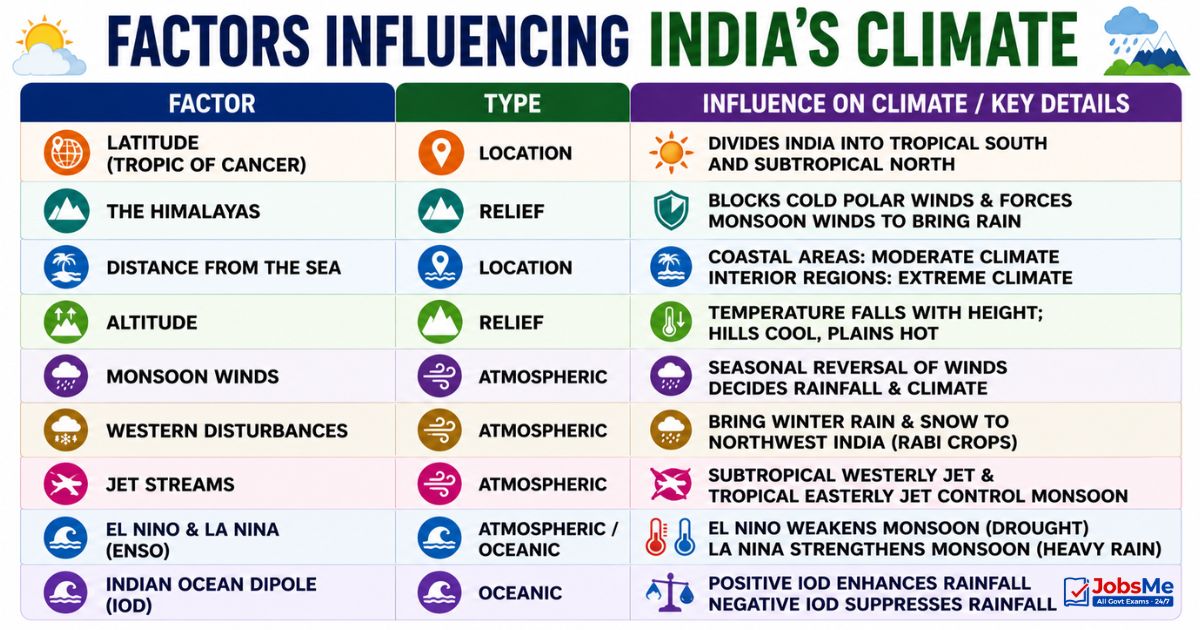
India's climate is shaped by several geographical and atmospheric factors. The following table lists the most exam-relevant factors along with how each one influences the climate.
| Factor | Type | Influence on Climate / Key Details |
|---|---|---|
| Latitude (Tropic of Cancer) | Location | The Tropic of Cancer (23.5 degrees N) passes roughly through the middle of India, dividing it into a tropical south and a subtropical north, which is why India has diverse climatic conditions. |
| The Himalayas | Relief | Act as a great climatic barrier that blocks the cold polar winds from Central Asia and forces the moisture-laden monsoon winds to shed their rain over India. |
| Distance from the Sea | Location | Coastal areas enjoy an equable (moderate) climate, while interior regions experience an extreme continental climate with very hot summers and cold winters. |
| Altitude | Relief | Temperature falls with height, so hill stations and high mountain areas remain cool even in summer, while plains become very hot. |
| Monsoon Winds | Atmospheric | The single most important control; the seasonal reversal of monsoon winds decides the rainfall and overall character of India's climate. |
| Western Disturbances | Atmospheric | Low-pressure systems originating near the Mediterranean Sea that bring winter rain and snow to Northwest India, important for the Rabi crop such as wheat. |
| Jet Streams | Atmospheric | Fast, high-altitude winds; the Subtropical Westerly Jet and the Tropical Easterly Jet control the onset and withdrawal of the monsoon. |
| El Nino and La Nina (ENSO) | Atmospheric / Oceanic | Pacific Ocean warming (El Nino) tends to weaken the monsoon and cause drought; cooling (La Nina) tends to strengthen the monsoon and cause heavy rain. |
| Indian Ocean Dipole (IOD) | Oceanic | A temperature difference between the western and eastern Indian Ocean; a positive IOD enhances monsoon rainfall, while a negative IOD suppresses it. |
Seasons of India
The India Meteorological Department recognises four main seasons. The following table summarises each season with its months and key features.
| Season | Months | Key Features |
|---|---|---|
| Winter Season (Cold Weather Season) | December to February | Clear skies, low temperatures, and dry conditions over most of India; Northwest India receives some rain from Western Disturbances, while Tamil Nadu gets rain from the Northeast Monsoon. |
| Summer Season (Hot Weather / Pre-Monsoon Season) | March to May | Rising temperatures and the development of low pressure over Northwest India; marked by hot local winds like the Loo and pre-monsoon showers such as Mango Showers and Kal Baisakhi. |
| Southwest Monsoon Season (Advancing / Rainy Season) | June to September | The main rainy season that brings about 75 to 80 percent of India's annual rainfall; the monsoon sets in over Kerala around 1 June and covers the whole country by mid-July. |
| Retreating Monsoon Season (Northeast Monsoon / Post-Monsoon) | October to November | The monsoon withdraws from the country; clear skies with high temperature and humidity cause "October Heat", and the Northeast Monsoon brings rain to Tamil Nadu and the southeast coast. |
Mechanism of the Indian Monsoon
The monsoon is caused mainly by the differential heating of land and sea. Understanding both the traditional and modern explanations helps in answering both Prelims matching questions and Mains analytical questions. To strengthen your General Awareness base further, you may also explore the Static GK Quiz on Jobsme.in.
Southwest Monsoon (June to September)
- In summer, intense heating creates a strong low-pressure area over Northwest India and the Thar Desert, while the Indian Ocean remains relatively cool with high pressure.
- Moist winds blow from the high-pressure ocean towards the low-pressure land, are deflected by the Coriolis force to become southwesterly, and bring heavy rainfall to India.
- The Tibetan Plateau acts as a high-altitude heat source, helping to form the Tropical Easterly Jet (TEJ) and pushing the Subtropical Westerly Jet north of the Himalayas, which triggers the monsoon "burst".
- The Inter-Tropical Convergence Zone (ITCZ) shifts northward in summer, drawing cross-equatorial winds and moisture into the subcontinent.
Two Branches of the Southwest Monsoon
| Branch | Path | Key Details |
|---|---|---|
| Arabian Sea Branch | Strikes the Western Ghats and Kerala coast | Hits the Kerala coast around 1 June, marking the official onset of the monsoon; causes very heavy rain on the windward Western Ghats and leaves a rain-shadow region over the Deccan Plateau. |
| Bay of Bengal Branch | Enters through Myanmar and Northeast India, then curves west along the Gangetic plains | Brings extremely heavy rainfall to the Northeast, including Mawsynram and Cherrapunji, before moving up the Ganga plains towards North India. |
Northeast Monsoon (October to December)
- As winter approaches, the land cools faster than the sea, reversing the pressure and wind pattern; winds now blow from land to sea as the Northeast Monsoon.
- These winds pick up moisture over the Bay of Bengal and bring rainfall mainly to Tamil Nadu and the southeast coast (coastal Andhra Pradesh), which receive the bulk of their annual rain during this season while the rest of India stays dry.
Important Local Winds and Pre-Monsoon Showers
Examiners frequently ask about the local winds and pre-monsoon showers of India. The following table covers the most important ones.
| Local Wind / Shower | Region | Key Details |
|---|---|---|
| Loo | North India (Rajasthan, Uttar Pradesh, and the plains) | A hot and dry, dusty wind that blows during the afternoons of May and June; temperatures can reach 45 to 50 degrees Celsius and exposure can be dangerous to health. |
| Mango Showers (Blossom Showers) | Kerala and Karnataka (and coastal South India) | Pre-monsoon showers in April and May that help in the early ripening of mangoes and are beneficial for coffee plantations in Karnataka. |
| Kal Baisakhi (Nor'westers) | West Bengal, Assam, and the Northeast | Violent pre-monsoon thunderstorms in April and May; called the "calamity of the month of Baisakh" and known as Bardoli Chheerha in Assam, useful for tea and jute. |
| Western Disturbances | Northwest India (Punjab, Haryana, J&K, Himachal Pradesh, Uttarakhand) | Mediterranean low-pressure systems that travel eastward and bring winter rain and snow; vital for the Rabi crop, especially wheat in North India. |
| October Heat | Northern Plains | The oppressive combination of high temperature and high humidity felt in October due to the retreating monsoon and clear skies. |
Rainfall Distribution and Important Extremes
Rainfall in India is highly uneven, both in space and in time. The following table lists the most commonly asked facts on rainfall extremes.
| Fact | Place / Value | Key Details |
|---|---|---|
| Highest rainfall in India (wettest place) | Mawsynram, Meghalaya | Receives the highest average annual rainfall in India and is often called the wettest place on Earth, located in the East Khasi Hills near Cherrapunji (Sohra). |
| Lowest rainfall in India (driest region) | Thar Desert / Western Rajasthan | Receives the least rainfall in India due to the absence of moisture-bearing winds and the rain-shadow effect. |
| Month of maximum rainfall | July | July generally records the highest rainfall across most of India during the peak of the Southwest Monsoon. |
| Share of Southwest Monsoon | About 75 to 80 percent | The Southwest Monsoon (June to September) provides the overwhelming majority of India's total annual rainfall. |
| Rain-shadow region | Deccan Plateau (leeward of Western Ghats) | The interior Deccan lies on the leeward side of the Western Ghats and receives much less rain than the windward coastal side. |
Koppen's Climatic Regions of India
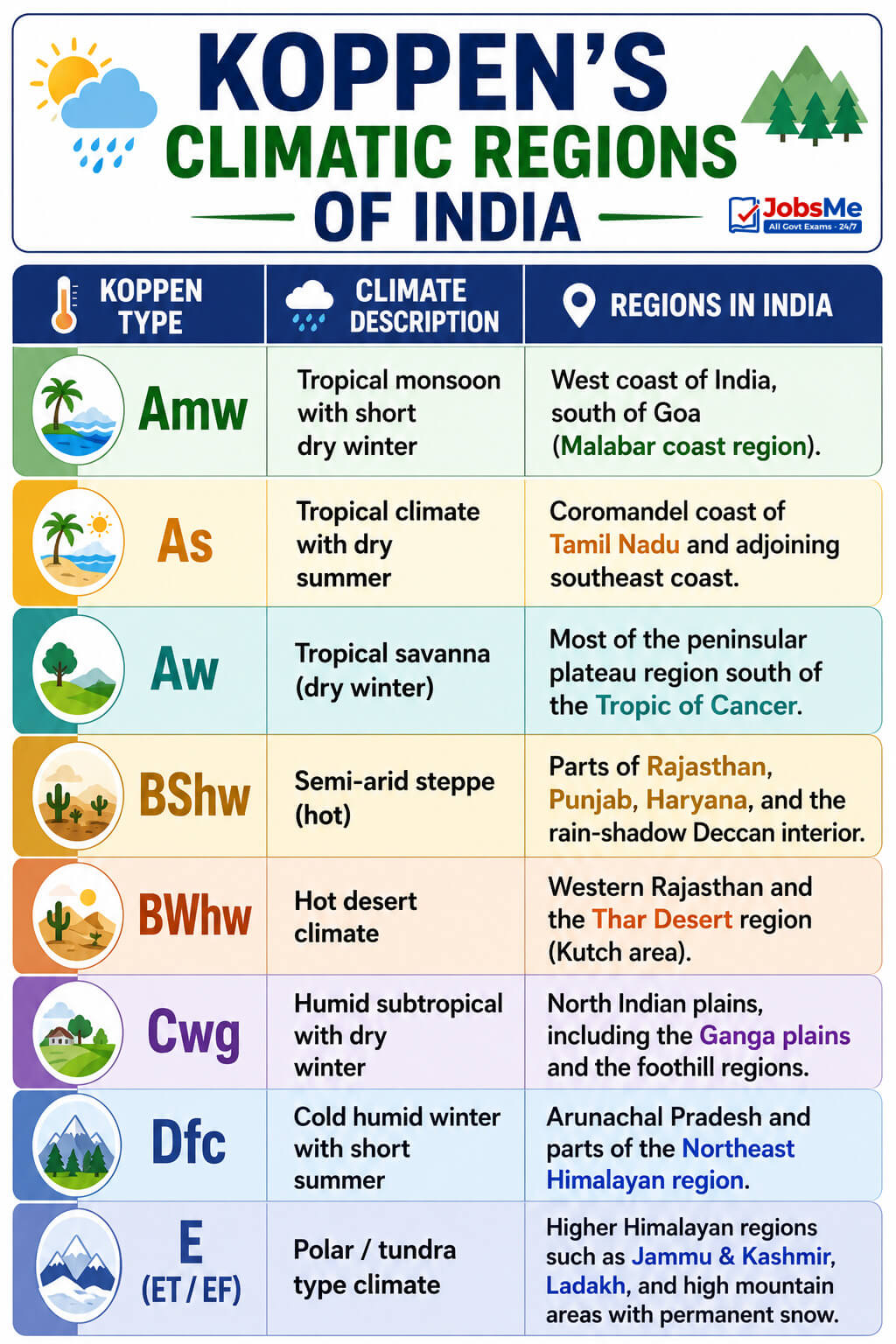
Wladimir Koppen developed a widely used climate classification based on temperature, rainfall, and natural vegetation. Under this scheme, India is divided into several climatic regions. The following table covers the major Koppen types found in India.
| Koppen Type | Climate Description | Regions in India |
|---|---|---|
| Amw | Tropical monsoon with short dry winter | West coast of India, south of Goa (Malabar coast region). |
| As | Tropical climate with dry summer | Coromandel coast of Tamil Nadu and adjoining southeast coast. |
| Aw | Tropical savanna (dry winter) | Most of the peninsular plateau region south of the Tropic of Cancer. |
| BShw | Semi-arid steppe (hot) | Parts of Rajasthan, Punjab, Haryana, and the rain-shadow Deccan interior. |
| BWhw | Hot desert climate | Western Rajasthan and the Thar Desert region (Kutch area). |
| Cwg | Humid subtropical with dry winter | North Indian plains, including the Ganga plains and the foothill regions. |
| Dfc | Cold humid winter with short summer | Arunachal Pradesh and parts of the Northeast Himalayan region. |
| E (ET / EF) | Polar / tundra type climate | Higher Himalayan regions such as Jammu & Kashmir, Ladakh, and high mountain areas with permanent snow. |
Memory Tricks and Mnemonics
Trick 1: Origin of the Word "Monsoon" — "Mausim = Season"
To remember the origin of the word, link it directly to its meaning:
- Monsoon comes from the Arabic word Mausim.
- Mausim means season.
"Monsoon = Mausim = Season = seasonal reversal of winds."
Trick 2: The Four Seasons — "WiSSR"
Use the acronym "WiSSR" to recall the four seasons in order:
- Wi → Winter (December to February).
- S → Summer / Pre-Monsoon (March to May).
- S → Southwest Monsoon (June to September).
- R → Retreating / Northeast Monsoon (October to November).
Trick 3: El Nino vs La Nina — "El = Less, La = Lots"
The two Pacific phenomena have opposite effects on the Indian monsoon:
- El Nino → Pacific warming → weak monsoon → drought (think "El = Less rain").
- La Nina → Pacific cooling → strong monsoon → floods (think "La = Lots of rain").
"El for Less, La for Lots."
Trick 4: Indian Ocean Dipole — "Positive is Plentiful"
- Positive IOD → enhances the monsoon → more rain (Positive = Plentiful).
- Negative IOD → suppresses the monsoon → less rain.
Trick 5: Two Branches of the Southwest Monsoon — "AB Branches"
The Southwest Monsoon splits into two branches; remember them as "AB":
- A → Arabian Sea branch → hits Kerala on 1 June and the Western Ghats.
- B → Bay of Bengal branch → enters through the Northeast and curves into the Gangetic plains.
Trick 6: Local Winds — "Loo is Hot, Showers are Sweet"
Group the pre-monsoon events by their nature:
- Hot and harmful: Loo (hot dry wind of North India) and Kal Baisakhi (violent thunderstorms of Bengal).
- Helpful showers: Mango Showers (ripen mangoes in Kerala and Karnataka) and Western Disturbances (winter rain for North Indian wheat).
"Loo burns, Mango Showers bless."
Trick 7: Rainfall Extremes — "Wet West, Dry Desert"
- Wettest: Mawsynram in Meghalaya (highest rainfall in India).
- Driest: Thar Desert in western Rajasthan (lowest rainfall in India).
- Peak month: July receives the maximum rainfall.
Additional Notes
Frequently Confused Facts
- Southwest Monsoon vs Northeast Monsoon: The Southwest Monsoon (June to September) brings rain to most of India; the Northeast Monsoon (October to December) brings rain mainly to Tamil Nadu and the southeast coast.
- Mawsynram vs Cherrapunji: Mawsynram currently records the highest average annual rainfall in India; the nearby Cherrapunji (Sohra) is also famous for very heavy rainfall and was historically considered the wettest.
- El Nino vs La Nina: El Nino (Pacific warming) weakens the monsoon and is linked to drought; La Nina (Pacific cooling) strengthens the monsoon and is linked to floods.
- Loo vs Mango Showers: The Loo is a hot, dry, harmful summer wind of North India; Mango Showers are beneficial pre-monsoon showers of South India.
- Western Disturbances vs Southwest Monsoon: Western Disturbances bring winter rain to Northwest India from the Mediterranean; the Southwest Monsoon brings summer rain from the Indian Ocean.
- Climate vs Weather: Climate is the long-term average condition of a place; weather is the short-term, day-to-day condition.
- Tropical Easterly Jet vs Subtropical Westerly Jet: The Tropical Easterly Jet forms in summer and aids the monsoon burst; the Subtropical Westerly Jet shifts north of the Himalayas in summer and dominates in winter.
- Equable vs Extreme Climate: Coastal regions of India have an equable (moderate) climate; interior regions have an extreme (continental) climate.
Repeating PYQ Patterns
Certain facts on the Climate of India and the Monsoon System are asked repeatedly in competitive exams. The origin of the word "Monsoon" (Mausim), the arrival of the Southwest Monsoon over Kerala on 1 June, the two branches of the Southwest Monsoon, the role of the Tibetan Plateau and jet streams, El Nino and La Nina effects, the Indian Ocean Dipole, the wettest place (Mawsynram), the Loo, Mango Showers, Kal Baisakhi, Western Disturbances, and the Northeast Monsoon over Tamil Nadu appear most often in UPSC Prelims, SSC CGL, and RRB NTPC papers. Banking exams (IBPS PO, SBI Clerk) frequently ask straightforward questions on seasons, local winds, and rainfall extremes. UPSC Mains has tested the mechanism of the monsoon and the role of the Tibetan Plateau as descriptive questions, so understanding the mechanism, not just the facts, is essential.
Quick Insight
The monsoon is often called the true finance minister of India, because the entire agricultural economy — crop sowing, river flows, reservoir levels, and rural demand — depends on it. A good monsoon year, often supported by La Nina and a positive Indian Ocean Dipole, brings prosperity, while a failed monsoon, frequently linked to El Nino, can trigger drought and distress for millions. This is why the India Meteorological Department's monsoon forecasts each year are major news events and why El Nino and La Nina warnings dominate current affairs. For aspirants, connecting these static concepts to live developments builds answers that work for both Prelims and Mains. You can revise related topics through the Static GK notes and stay current with the Daily Current Affairs updates on Jobsme.in.
One-Liners for Quick Revision
- Climate of India → Tropical Monsoon type → high temperatures with heavy seasonal rainfall.
- Word "Monsoon" → from Arabic "Mausim" → meaning season.
- Monsoon → seasonal reversal of wind direction → wet and dry seasons.
- Climate → long-term average of weather → measured over about 30 years.
- Weather → day-to-day atmospheric condition → short-term.
- Main control of India's climate → Monsoon winds.
- Tropic of Cancer → passes through middle of India → divides tropical south and subtropical north.
- Himalayas → climatic barrier → block cold Central Asian winds and force monsoon rain.
- Coastal regions → equable (moderate) climate; interior regions → extreme continental climate.
- Four seasons → Winter (Dec-Feb), Summer (Mar-May), Southwest Monsoon (Jun-Sep), Retreating/Northeast Monsoon (Oct-Nov).
- Southwest Monsoon → June to September → brings about 75-80% of annual rainfall.
- SW Monsoon onset → reaches Kerala around 1 June → covers whole country by mid-July.
- Cause of SW Monsoon → low pressure over heated Northwest India pulls moist ocean winds inland.
- Arabian Sea branch → hits Kerala and Western Ghats → leaves Deccan in rain-shadow.
- Bay of Bengal branch → enters Northeast India → curves west along Gangetic plains.
- Tibetan Plateau → high-altitude heat source → helps form the Tropical Easterly Jet and trigger monsoon burst.
- ITCZ → Inter-Tropical Convergence Zone → shifts north in summer to draw monsoon winds.
- Jet streams → high-altitude winds → control monsoon onset and withdrawal.
- Northeast Monsoon → October to December → brings rain mainly to Tamil Nadu and southeast coast.
- El Nino → Pacific warming → weak monsoon → drought.
- La Nina → Pacific cooling → strong monsoon → floods.
- Indian Ocean Dipole (IOD) → positive enhances monsoon; negative suppresses it.
- Loo → hot, dry, dusty wind of North India → blows in May-June.
- Mango Showers → pre-monsoon showers of Kerala and Karnataka → help ripen mangoes and coffee.
- Kal Baisakhi → violent pre-monsoon thunderstorms of West Bengal and Northeast → useful for tea and jute.
- Western Disturbances → originate near Mediterranean Sea → bring winter rain/snow to Northwest India, vital for wheat.
- October Heat → high temperature and humidity in October → due to retreating monsoon and clear skies.
- Highest rainfall in India → Mawsynram, Meghalaya → wettest place.
- Lowest rainfall in India → Thar Desert region of western Rajasthan.
- Month of maximum rainfall → July.
- Rain-shadow region → Deccan Plateau, leeward of the Western Ghats.
- Koppen classification → based on temperature, rainfall, and vegetation → divides India into several climatic regions.
- Koppen "Amw" → tropical monsoon with short dry winter → west coast south of Goa.
- Koppen "BWhw" → hot desert climate → western Rajasthan and Thar.
- Koppen "Cwg" → humid subtropical with dry winter → North Indian plains.
- Koppen "E" → polar/tundra type → higher Himalayas, Ladakh, and Jammu & Kashmir snow regions.
For more Static GK topics like Indian rivers, soils, and physical geography, explore the Static GK section on Jobsme.in. You can also test your knowledge with the Static GK Quiz, revise with the Daily Current Affairs Quiz, and check out the latest exam updates at Latest Government Job Notifications.
Free quiz • No signup required
Put this topic into practice with Indian Cultural Institutions – Static GK MCQ Quiz. It is the quickest way to reinforce what you just learned.
Frequently Asked Questions
What type of climate does India have?
From which word is the term Monsoon derived?
During which months does the Southwest Monsoon occur and how much rain does it bring?
When does the Southwest Monsoon reach Kerala?
What are the two branches of the Southwest Monsoon?
Which monsoon brings rainfall to Tamil Nadu?
What is the effect of El Nino and La Nina on the Indian monsoon?
What is the Loo?
Which place receives the highest rainfall in India?
What are Western Disturbances and why are they important?

About the author