List of Important Waterfalls of India – Static GK & General Awareness for Competitive Exams with Memory Tricks
This article presents a complete list of the important waterfalls of India, covering the tallest, widest, and most famous falls along with their rivers, states, and key features. It includes iconic falls like Kunchikal Falls (highest in India), Nohkalikai Falls (highest plunge waterfall), Jog Falls (Sharavathi River), Dudhsagar Falls (Sea of Milk), Chitrakote Falls (widest, Niagara of India), and Athirappilly Falls (Niagara of South India), with memory tricks and one-liners for quick revision. All facts are arranged in exam-ready format to help UPSC, SSC, IBPS, RRB, PSU, and State PCS aspirants score better in Geography and General Awareness sections.

Jump to section
Introduction
India's varied landscape, from the Western Ghats and the Eastern Ghats to the Meghalaya Plateau and the Chota Nagpur Plateau, is dotted with spectacular waterfalls that are both natural wonders and recurring favourites in competitive exams. The Kunchikal Falls in Karnataka is the highest waterfall in India; the Nohkalikai Falls in Meghalaya is the highest plunge (single-drop) waterfall; the Jog Falls on the Sharavathi River is one of India's most famous plunge waterfalls; and the Chitrakote Falls on the Indravati River is the widest waterfall in India, popularly called the "Niagara of India." Each of these waterfalls is linked to a specific river, state, and physical feature that examiners love to test.
Questions on waterfalls of India appear regularly in UPSC Prelims, SSC CGL, IBPS PO, RRB NTPC, SBI Clerk, State PCS, and various Insurance and Defence exams. Questions typically ask which waterfall is the highest, which river forms a particular fall, which state a waterfall is located in, or which waterfall carries a nickname like "Niagara of India" or "Sea of Milk." This article brings together every important waterfall in a structured, exam-ready format. To explore other related Static GK topics, you can refer to the Static GK notes section on Jobsme.in.
Waterfalls are also closely linked to current affairs themes such as hydroelectric power projects, monsoon and river-basin news, eco-tourism initiatives, biodiversity hotspots in the Western Ghats, and dam-related environmental debates like the proposed project on the Chalakudy River near Athirappilly — making this topic doubly important for aspirants preparing for both Prelims and Mains. For daily updates, you can follow the Daily Current Affairs page on Jobsme.in.
Core Concepts: How Waterfalls Form and How They Are Classified
A waterfall is formed when a river or stream flows over a steep drop or a vertical cliff, usually where hard rock lies over softer rock that erodes faster, or where a river crosses the edge of a plateau. Most of India's tallest and most powerful waterfalls are found in the Western Ghats and the Meghalaya Plateau, both of which receive very heavy southwest monsoon rainfall. Understanding the type of a waterfall helps students answer the conceptual and matching questions that frequently appear in exams.
Types of Waterfalls
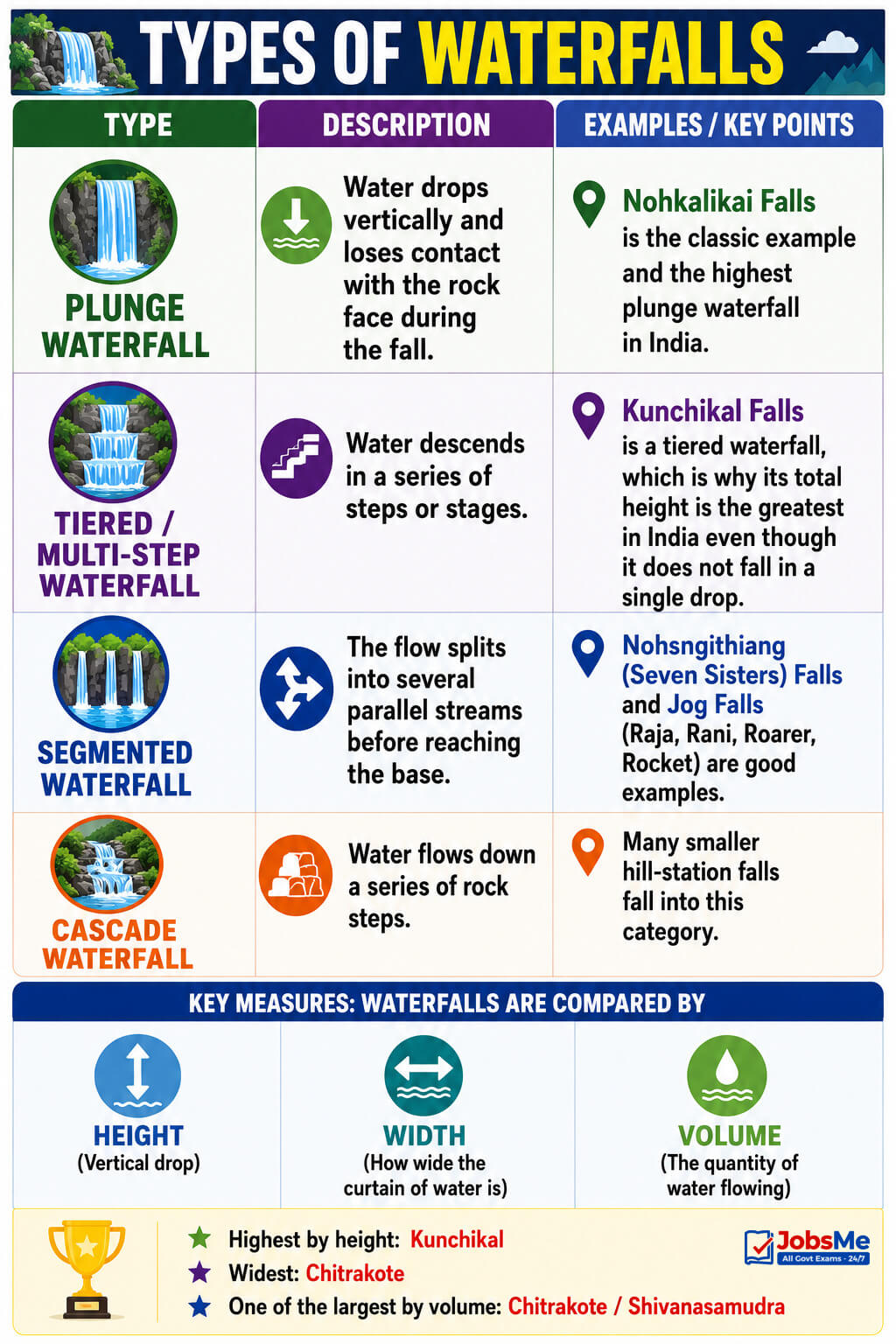
- Plunge Waterfall: Water drops vertically and loses contact with the rock face during the fall. Nohkalikai Falls is the classic example and the highest plunge waterfall in India.
- Tiered / Multi-step Waterfall: Water descends in a series of steps or stages. Kunchikal Falls is a tiered waterfall, which is why its total height is the greatest in India even though it does not fall in a single drop.
- Segmented Waterfall: The flow splits into several parallel streams before reaching the base. Nohsngithiang (Seven Sisters) Falls and Jog Falls (Raja, Rani, Roarer, Rocket) are good examples.
- Cascade Waterfall: Water flows down a series of rock steps. Many smaller hill-station falls fall into this category.
- Key Measures: Waterfalls are compared by height (vertical drop), width (how wide the curtain of water is), and volume (the quantity of water flowing). The highest by height is Kunchikal, the widest is Chitrakote, and one of the largest by volume is Chitrakote / Shivanasamudra.
Tallest Waterfalls of India
The following table lists the most exam-relevant waterfalls of India by height, along with the river that forms each fall, its state, and its key distinguishing feature.
| Waterfall | River | State | Key Features |
|---|---|---|---|
| Kunchikal Falls | Varahi River | Karnataka (Shimoga / Shivamogga district, near Agumbe) | Highest waterfall in India (around 455 metres / 1,493 feet) and among the tallest in Asia; a tiered waterfall located in the heavy-rainfall Agumbe valley; feeds a hydroelectric project. |
| Barehipani Falls | Budhabalanga River | Odisha (Simlipal National Park, Mayurbhanj district) | Second-highest waterfall in India (around 399 metres / about 1,300 feet); a two-tiered fall set inside dense forest in Simlipal National Park. |
| Nohkalikai Falls | Rainwater-fed stream | Meghalaya (East Khasi Hills, near Cherrapunji / Sohra) | Highest plunge (single-drop) waterfall in India (around 340 metres / 1,115 feet); located near Cherrapunji, one of the wettest places on Earth; famous turquoise-green plunge pool; named after the legend of Ka Likai. |
| Nohsngithiang Falls (Seven Sisters Falls) | Rainwater-fed streams | Meghalaya (East Khasi Hills, near Mawsmai) | A segmented waterfall that descends in seven separate streams, giving it the name "Seven Sisters"; best viewed just after the monsoon. |
| Dudhsagar Falls | Mandovi River | Goa (Goa-Karnataka border, Western Ghats) | A four-tiered fall (around 310 metres / 1,017 feet); name means "Sea of Milk" because the cascading water looks milky white; famous for the railway bridge running across its face. |
| Jog Falls (Gerosoppa Falls) | Sharavathi River | Karnataka (Shimoga / Uttara Kannada district border) | One of India's most famous plunge waterfalls (around 253 metres / 829 feet); falls in four distinct segments named Raja, Rani, Roarer, and Rocket; linked to the Linganamakki Dam. |
| Thalaiyar Falls (Rat Tail Falls) | Manjalar stream | Tamil Nadu (Palani Hills, Dindigul district) | The tallest waterfall in Tamil Nadu and among the highest in India; remote and difficult to access, resembling a thin "rat tail" from a distance. |
Famous Waterfalls and Their Nicknames
Several Indian waterfalls are better known by their popular nicknames than by their formal names. These nicknames are a favourite source of matching and one-word questions in exams. The table below covers the most important ones along with their rivers and states.
| Waterfall | Nickname / Title | River & State | Key Features |
|---|---|---|---|
| Chitrakote Falls | Niagara of India / Mini Niagara | Indravati River, Chhattisgarh (Bastar district, near Jagdalpur) | The widest waterfall in India, with a horseshoe-shaped curtain that can spread close to 300 metres in peak monsoon; the river swells dramatically during the rains. |
| Athirappilly Falls | Niagara of South India | Chalakudy River, Kerala (Thrissur district) | The largest waterfall in Kerala (around 80 feet high but very wide); set in a rich riparian forest known for hornbills; a popular film-shooting location; subject of a long-running hydroelectric dam controversy. |
| Hogenakkal Falls | Niagara of South India / Roaring waters of the Cauvery | Kaveri (Cauvery) River, Tamil Nadu-Karnataka border (Dharmapuri district) | Name comes from Kannada "hoge" (smoke) and "kal" (rock), referring to the mist that rises from the falls; famous for coracle (round-boat) rides and water with reputed medicinal value. |
| Dudhsagar Falls | Sea of Milk / Ocean of Milk | Mandovi River, Goa | The milky-white appearance of the falling water gives it the name; a four-tiered fall on the Western Ghats with the well-known railway bridge across it. |
| Dhuandhar Falls | Smoke Cascade | Narmada River, Madhya Pradesh (Bhedaghat, near Jabalpur) | The Narmada narrows through the famous Marble Rocks and plunges about 30 metres, creating a roaring mass of mist; "Dhuan" means smoke and "Dhar" means flow. |
| Shivanasamudra Falls (Gaganachukki & Bharachukki) | Shiva's Sea | Kaveri (Cauvery) River, Karnataka (Mandya district) | A segmented twin waterfall; site of Asia's first hydroelectric power station (1902); often described as the second-largest waterfall in India by volume. |
Other Important Waterfalls for Exams
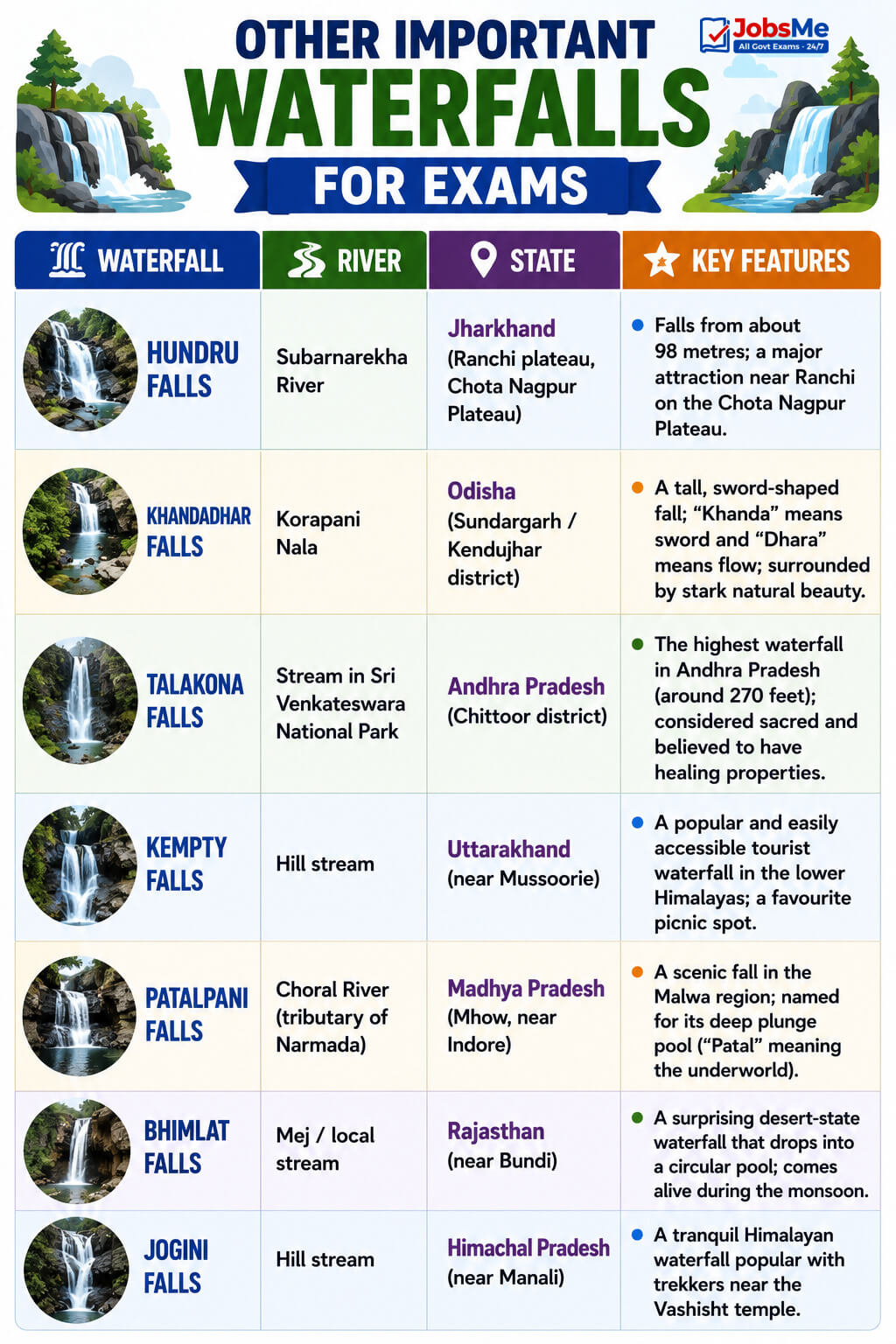
Beyond the tallest and most famous falls, several state-specific waterfalls appear in regional PCS exams and General Awareness sections. The table below groups them by river and state.
| Waterfall | River | State | Key Features |
|---|---|---|---|
| Hundru Falls | Subarnarekha River | Jharkhand (Ranchi plateau, Chota Nagpur Plateau) | Falls from about 98 metres; a major attraction near Ranchi on the Chota Nagpur Plateau. |
| Khandadhar Falls | Korapani Nala | Odisha (Sundargarh / Kendujhar district) | A tall, sword-shaped fall; "Khanda" means sword and "Dhara" means flow; surrounded by stark natural beauty. |
| Talakona Falls | Stream in Sri Venkateswara National Park | Andhra Pradesh (Chittoor district) | The highest waterfall in Andhra Pradesh (around 270 feet); considered sacred and believed to have healing properties. |
| Kempty Falls | Hill stream | Uttarakhand (near Mussoorie) | A popular and easily accessible tourist waterfall in the lower Himalayas; a favourite picnic spot. |
| Patalpani Falls | Choral River (tributary of Narmada) | Madhya Pradesh (Mhow, near Indore) | A scenic fall in the Malwa region; named for its deep plunge pool ("Patal" meaning the underworld). |
| Bhimlat Falls | Mej / local stream | Rajasthan (near Bundi) | A surprising desert-state waterfall that drops into a circular pool; comes alive during the monsoon. |
| Jogini Falls | Hill stream | Himachal Pradesh (near Manali) | A tranquil Himalayan waterfall popular with trekkers near the Vashisht temple. |
Memory Tricks and Mnemonics
Trick 1: The "Top Four by Height" — "KuBaNoDu"
Remember the four tallest waterfalls of India in descending order using "KuBaNoDu":
- Ku → Kunchikal (highest overall, Karnataka).
- Ba → Barehipani (second highest, Odisha).
- No → Nohkalikai (highest plunge, Meghalaya).
- Du → Dudhsagar (Goa).
"KuBaNoDu — from Karnataka to Goa, tallest to famous."
Trick 2: The Three "Niagaras" — "CAH Niagara"
Three Indian waterfalls are commonly compared to Niagara. Remember them as "CAH":
- C → Chitrakote → Niagara of India (widest, Chhattisgarh).
- A → Athirappilly → Niagara of South India (Kerala).
- H → Hogenakkal → Niagara of South India (Tamil Nadu-Karnataka border).
"CAH — three Niagaras, one in the centre and two in the south."
Trick 3: River-to-Waterfall Pairing — "Jog rides the Sharavathi"
Link each major waterfall to its river using a short phrase:
- Jog → Sharavathi River.
- Dudhsagar → Mandovi River.
- Chitrakote → Indravati River.
- Athirappilly → Chalakudy River.
- Hogenakkal & Shivanasamudra → Kaveri (Cauvery) River.
- Dhuandhar → Narmada River.
- Hundru → Subarnarekha River.
- Kunchikal → Varahi River.
Trick 4: "Smoke" and "Mist" Falls — Names That Mean Smoke
Two famous waterfalls get their names from the mist or smoke they create:
- Dhuandhar (Narmada, Madhya Pradesh) → "Dhuan" = smoke, "Dhar" = flow → Smoke Cascade.
- Hogenakkal (Kaveri, Tamil Nadu-Karnataka) → "Hoge" = smoke, "Kal" = rock → smoking rock.
"Both names mean smoke — one from the Narmada, one from the Kaveri."
Trick 5: The "Sea / Ocean" Falls — Sea of Milk vs Shiva's Sea
- Dudhsagar → "Sea of Milk" → Mandovi River, Goa.
- Shivanasamudra → "Shiva's Sea" → Kaveri River, Karnataka.
"Two seas: milk in Goa, Shiva in Karnataka."
Trick 6: Jog's Four Segments — "R-R-R-R"
Jog Falls drops in four named segments, all starting with R:
- R → Raja.
- R → Rani.
- R → Roarer (also spelt Rover).
- R → Rocket.
"Raja, Rani, Roarer, Rocket — the royal four of Jog."
Trick 7: "Plunge vs Tiered" — Why Kunchikal Beats Nohkalikai
A common confusion is whether Kunchikal or Nohkalikai is the "highest." Use this contrast trick:
- Kunchikal → highest overall waterfall (tiered, falls in steps).
- Nohkalikai → highest plunge waterfall (single vertical drop).
"Kunchikal is tallest by total height; Nohkalikai is tallest in a single jump."
Additional Notes
Frequently Confused Facts
- Highest waterfall vs highest plunge waterfall: Kunchikal Falls (Karnataka) is the highest waterfall in India by total height; Nohkalikai Falls (Meghalaya) is the highest plunge (single-drop) waterfall.
- Niagara of India vs Niagara of South India: Chitrakote Falls (Chhattisgarh) is the "Niagara of India"; Athirappilly Falls (Kerala) and Hogenakkal Falls (Tamil Nadu-Karnataka) are both called the "Niagara of South India."
- Widest vs tallest: Chitrakote is the widest waterfall in India; Kunchikal is the tallest. Do not confuse width with height.
- Jog Falls river: Jog Falls is on the Sharavathi River, not the Netravati or Kaveri. This is a very common trick in exams.
- Two falls in Karnataka on the Kaveri: Shivanasamudra (Gaganachukki and Bharachukki) is on the Kaveri in Karnataka; Hogenakkal is also on the Kaveri but on the Tamil Nadu-Karnataka border.
- Dudhsagar vs Dhuandhar: Dudhsagar ("Sea of Milk") is on the Mandovi River in Goa; Dhuandhar ("Smoke Cascade") is on the Narmada River at Bhedaghat in Madhya Pradesh.
- Barehipani location: Barehipani Falls is in Simlipal National Park, Odisha — often confused with other Odisha falls like Khandadhar (Sundargarh).
- Athirappilly height: Athirappilly is famous for its width and flow, not its height; it is only about 80 feet tall but is the largest waterfall in Kerala.
Repeating PYQ Patterns
Certain waterfall facts are asked repeatedly in competitive exams. Kunchikal Falls (highest in India), Nohkalikai Falls (highest plunge waterfall), Jog Falls (Sharavathi River), Dudhsagar Falls (Mandovi, Sea of Milk), Chitrakote Falls (widest, Niagara of India), Athirappilly Falls (Niagara of South India), Dhuandhar Falls (Narmada, Marble Rocks), and Shivanasamudra Falls (Asia's first hydroelectric station, 1902) appear most often in UPSC Prelims, SSC CGL, and RRB NTPC papers. Banking exams (IBPS PO, SBI Clerk) frequently use matching questions pairing waterfalls with rivers or states. State PCS exams add regional falls — Jharkhand PCS asks about Hundru Falls (Subarnarekha), Madhya Pradesh PCS about Dhuandhar and Bhedaghat, Andhra PCS about Talakona, and Odisha PCS about Barehipani and Khandadhar.
Quick Insight
Waterfalls are not just scenic attractions — they are tightly linked to India's rivers, plateaus, monsoon system, and hydroelectric power. Shivanasamudra hosted Asia's first hydroelectric power station in 1902; Jog Falls is tied to the Linganamakki Dam on the Sharavathi; and the proposed dam on the Chalakudy River above Athirappilly has been a long-running environmental debate. Most major falls lie in the heavy-rainfall belts of the Western Ghats and the Meghalaya Plateau, which is why they feature in both Geography and Environment sections. Understanding a waterfall's river, state, and type lets aspirants answer matching, map-based, and assertion-reason questions with confidence. For further reading on related Static GK topics, you can explore the Static GK section and test yourself with the Static GK Quiz on Jobsme.in.
One-Liners for Quick Revision
- Kunchikal Falls → Varahi River → Karnataka → highest waterfall in India (around 455 m).
- Barehipani Falls → Budhabalanga River → Odisha → second-highest in India; in Simlipal National Park.
- Nohkalikai Falls → rainwater-fed → Meghalaya → highest plunge waterfall in India; near Cherrapunji.
- Nohsngithiang (Seven Sisters) Falls → Meghalaya → segmented fall in seven streams.
- Dudhsagar Falls → Mandovi River → Goa → "Sea of Milk"; four-tiered fall with railway bridge.
- Jog Falls (Gerosoppa) → Sharavathi River → Karnataka → four segments: Raja, Rani, Roarer, Rocket.
- Thalaiyar Falls → Manjalar stream → Tamil Nadu → tallest waterfall in Tamil Nadu.
- Chitrakote Falls → Indravati River → Chhattisgarh → widest waterfall in India; "Niagara of India."
- Athirappilly Falls → Chalakudy River → Kerala → "Niagara of South India"; largest fall in Kerala.
- Hogenakkal Falls → Kaveri River → Tamil Nadu-Karnataka border → "smoking rock"; coracle rides.
- Dhuandhar Falls → Narmada River → Madhya Pradesh → "Smoke Cascade"; at Bhedaghat Marble Rocks.
- Shivanasamudra Falls → Kaveri River → Karnataka → Gaganachukki & Bharachukki; Asia's first hydro station (1902).
- Hundru Falls → Subarnarekha River → Jharkhand → on the Ranchi / Chota Nagpur plateau.
- Khandadhar Falls → Odisha → sword-shaped fall in Sundargarh / Kendujhar.
- Talakona Falls → Andhra Pradesh → highest fall in the state; in Sri Venkateswara National Park.
- Kempty Falls → Uttarakhand → popular tourist fall near Mussoorie.
- Patalpani Falls → Choral River (Narmada tributary) → Madhya Pradesh → near Indore.
- Bhimlat Falls → Rajasthan → desert-state waterfall near Bundi.
- Jogini Falls → Himachal Pradesh → Himalayan trekkers' fall near Manali.
For more Static GK topics like Indian rivers, lakes, and mountain passes, explore the Static GK section on Jobsme.in. You can also test your knowledge with the Static GK Quiz, stay updated with the Daily Current Affairs Quiz, and check the latest exam notifications at Latest Government Job Notifications.
Free quiz • No signup required
Put this topic into practice with Indian Cultural Institutions – Static GK MCQ Quiz. It is the quickest way to reinforce what you just learned.
Frequently Asked Questions
Which is the highest waterfall in India?
Which is the highest plunge waterfall in India?
On which river is Jog Falls located?
Which waterfall is known as the Niagara of India?
Why is Dudhsagar Falls called the Sea of Milk?
Which is the second-highest waterfall in India?
Which waterfall is called the Niagara of South India?
Where is the first hydroelectric power station in Asia located?
On which river is Dhuandhar Falls located and where?
In which regions are most of India's tallest waterfalls found?

About the author