Human Body Basics – Static GK & General Awareness Notes on Organs, Bones, Muscles and Systems for Competitive Exams with Memory Tricks
This article presents complete Human Body Basics for competitive exams, covering the major organ systems, important facts about bones, muscles, blood, the heart, brain, and key "largest, smallest, longest" anatomy records. It includes high-frequency facts like 206 bones in an adult, the femur as the longest bone, the stapes as the smallest bone, the skin as the largest organ, and the liver as the largest internal organ, along with memory tricks and one-liners for quick revision. All facts are arranged in exam-ready format to help UPSC, SSC, IBPS, RRB, PSU, and State PCS aspirants score better in General Awareness and General Science sections.
Jump to section
Introduction
The human body is one of the most frequently tested topics in the General Science and General Awareness sections of competitive exams. From the number of bones in an adult body to the largest and smallest organs, examiners love to ask direct, fact-based questions that reward students who have memorised the basics well. An adult human body has 206 bones, around 639 muscles, and is organised into several interconnected organ systems that work together to keep us alive and functioning.
Questions on Human Body Basics appear regularly in UPSC Prelims, SSC CGL, IBPS PO, RRB NTPC, SBI Clerk, State PCS, and various Insurance and Defence exams. Questions typically ask which is the longest bone, the smallest bone, the largest gland, the largest organ, which organ starts functioning first, or which body system performs a specific function. This article brings together every important fact about the human body in a structured, exam-ready format. To explore other related Static GK topics, you can refer to the Static GK section on Jobsme.in.
Human body facts are also closely linked to current affairs themes such as health schemes, organ donation drives, new medical discoveries, Nobel Prizes in Physiology or Medicine, and public-health campaigns — making this topic doubly important for aspirants preparing for both objective papers and descriptive General Studies questions.
Core Concepts: How the Human Body is Organised
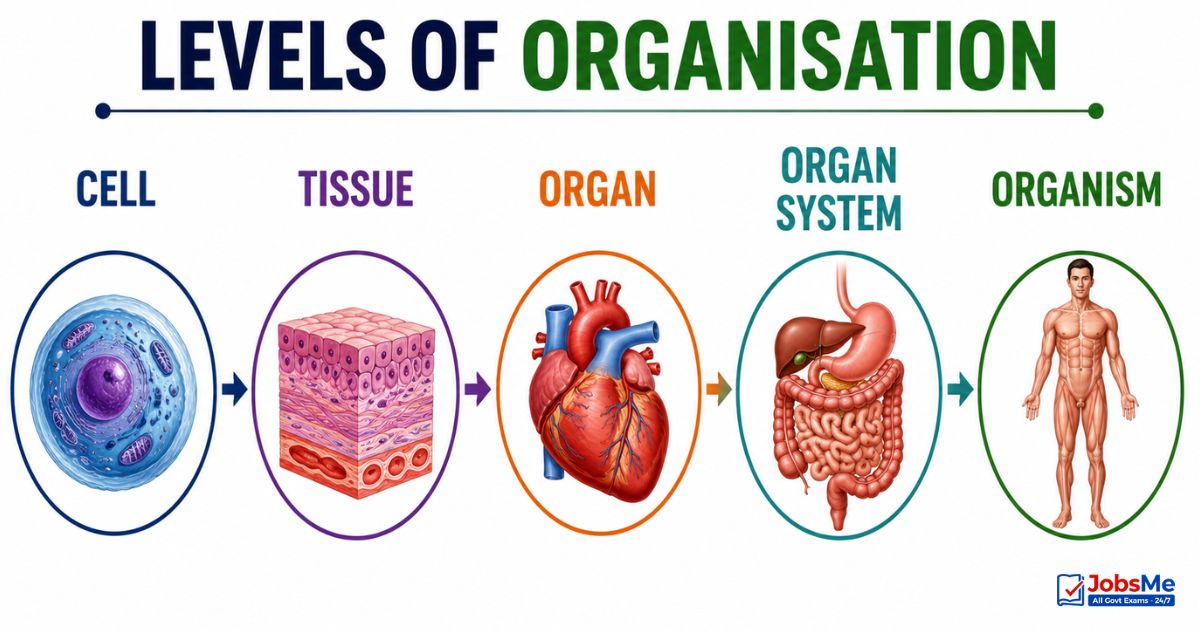
The human body is built up in levels of organisation, from the smallest unit of life to complete systems. Understanding this hierarchy helps students place every fact in the right context and answer related questions confidently.
Levels of Organisation
- Cell: The basic structural and functional unit of life. The ovum (egg cell) is the largest cell in the human body and the sperm is the smallest cell.
- Tissue: A group of similar cells performing a common function. The four main types are epithelial, connective, muscular, and nervous tissue.
- Organ: A structure made of different tissues working together, such as the heart, liver, or kidney.
- Organ System: A group of organs working together for a major function, such as the digestive or respiratory system.
- Organism: The complete living human being formed by all the systems working together.
Major Organ Systems of the Human Body
The following table lists the major organ systems of the human body, their main organs, and their primary functions as commonly asked in competitive exams.
| Organ System | Main Organs | Primary Function / Key Details |
|---|---|---|
| Skeletal System | Bones, cartilage, ligaments | Provides framework and shape, protects internal organs, supports movement, stores minerals like calcium and phosphorus, and produces blood cells in the bone marrow. An adult has 206 bones. |
| Muscular System | Skeletal, smooth, and cardiac muscles | Enables movement, maintains posture, and generates body heat. The body has around 639 muscles; muscles usually work in pairs pulling in opposite directions. |
| Circulatory (Cardiovascular) System | Heart, blood, blood vessels | Pumps and transports blood, oxygen, nutrients, and waste throughout the body. The heart is the first organ to start functioning in the body. |
| Respiratory System | Nose, trachea, lungs, diaphragm | Takes in oxygen and removes carbon dioxide through breathing; gas exchange happens in the tiny air sacs called alveoli. |
| Digestive System | Mouth, oesophagus, stomach, intestines, liver, pancreas | Breaks down food into nutrients, absorbs them, and removes solid waste. The small intestine is the longest part of the digestive tract. |
| Nervous System | Brain, spinal cord, nerves | Controls and coordinates all body activities, processes sensory information, and enables thinking and reflexes. The brain is the control centre of the body. |
| Excretory (Urinary) System | Kidneys, ureters, bladder, urethra | Filters waste from the blood and removes it as urine, and maintains the body's water and salt balance. |
| Endocrine System | Glands such as pituitary, thyroid, adrenal, pancreas | Produces hormones that regulate growth, metabolism, and reproduction. The pituitary is the master gland; the thyroid is the largest endocrine gland. |
| Reproductive System | Male and female reproductive organs | Responsible for producing offspring and continuing the species. |
| Integumentary System | Skin, hair, nails | Protects the body from injury and infection, regulates temperature, and senses touch. The skin is the largest organ of the human body. |
Important "Largest, Smallest and Longest" Facts of the Human Body
This is one of the most heavily tested areas in General Science. The table below lists the key superlative facts about the human body that appear repeatedly in exams.
| Feature | Answer | Key Details |
|---|---|---|
| Longest and strongest bone | Femur (thigh bone) | About 48 cm (nearly 50 cm) long in adults; makes up about one-quarter of a person's height; can support up to 30 times the body weight. |
| Smallest bone | Stapes (stirrup bone) | Located in the middle ear; about 3 millimetres long; one of the three ear ossicles along with the malleus (hammer) and incus (anvil). |
| Largest organ of the body | Skin | Covers and protects the whole body, regulates temperature, and contains touch receptors; part of the integumentary system. |
| Largest internal organ / largest gland | Liver | Produces bile, stores glycogen, and detoxifies harmful substances; it is the largest internal organ and the largest gland in the body. |
| Longest muscle | Sartorius | Runs from the hip across to the inside of the knee; also called the "tailor's muscle"; it rotates the thigh outward and bends the knee. |
| Smallest muscle | Stapedius | Located deep in the ear; about 5 mm long; associated with the stapes bone and protects hearing from loud sounds. |
| Largest muscle | Gluteus maximus | Located in the buttock; pulls the leg backward powerfully for walking, running, and climbing stairs. |
| Largest cell | Ovum (egg cell) | The female reproductive cell; it is the largest cell in the human body. |
| Smallest cell | Sperm cell | The male reproductive cell; it is the smallest cell in the human body. |
| First organ to start functioning | Heart | The heart is the first organ to develop and start working in the human embryo. |
| Hardest substance in the body | Tooth enamel | The outer covering of teeth; harder than bone and the hardest substance the body produces. |
| Largest and most complex joint | Knee joint | Connects the femur, tibia, and patella; supports body weight and enables walking and running. |
| Longest cranial nerve | Vagus nerve | The tenth cranial nerve; controls the heart, lungs, and digestive tract. |
| Master gland | Pituitary gland | Located at the base of the brain; controls other endocrine glands and regulates growth and metabolism. |
| Largest endocrine gland | Thyroid gland | Located in the neck; produces hormones that regulate body metabolism. |
Key Numerical Facts About the Human Body
Examiners often test exact numbers related to the human body. The table below summarises the most important figures for quick recall.
| Body Feature | Number / Value | Key Details |
|---|---|---|
| Bones in an adult | 206 | A baby is born with about 300 bones; many fuse as the child grows to give the adult count of 206. |
| Bones in each hand | 27 | The hands contain the most bones in the body, with 27 bones in each hand. |
| Muscles in the body | Around 639 | The human body has over 600 muscles that enable movement, posture, and heat production. |
| Pairs of ribs | 12 pairs (24 ribs) | Most humans have 12 pairs of ribs; about one percent of people have an extra (13th) pair. |
| Chambers in the heart | 4 | Two upper chambers (atria) and two lower chambers (ventricles). |
| Bone not attached to any other bone | Hyoid bone | A U-shaped bone in the throat that supports the base of the tongue and helps in speech; the only free-floating bone. |
| Normal human body temperature | About 37°C (98.6°F) | The body maintains a fairly constant internal temperature through the process of homeostasis. |
| Skeleton as a share of body weight | About 12% to 15% | For a 100-pound person, the skeleton weighs roughly 12 to 15 pounds, varying with body size and bone density. |
Memory Tricks and Mnemonics
Trick 1: Ear Bones Order — "MIS"
The three tiny bones (ossicles) of the middle ear, from outer to inner, can be remembered as "MIS":
- M → Malleus (Hammer).
- I → Incus (Anvil).
- S → Stapes (Stirrup) — the smallest bone in the body.
"Hammer hits the Anvil on the Stirrup — Malleus, Incus, Stapes."
Trick 2: The Two "Smallest in the Ear" — "Stapes and Stapedius"
Both the smallest bone and the smallest muscle sit in the ear and start with "Sta":
- Smallest bone → Stapes (about 3 mm).
- Smallest muscle → Stapedius (about 5 mm).
"Sta-pes and Sta-pedius — the tiny twins of the ear."
Trick 3: The "Largest" Frame — "Skin, Liver, Brain Order"
To avoid confusion among "largest" answers, fix these in your mind:
- Largest organ → Skin.
- Largest internal organ / largest gland → Liver.
- Largest endocrine gland → Thyroid.
- Largest muscle → Gluteus maximus.
- Largest cell → Ovum.
Trick 4: Bone Count Story — "300 to 206"
A simple story locks in the bone numbers:
- A baby is born with about 300 bones.
- As the baby grows, many bones fuse together.
- An adult is left with 206 bones.
"Grow up and you lose bones — 300 becomes 206."
Trick 5: Femur Facts — "Longest, Strongest, Quarter"
Three things to remember about the femur (thigh bone):
- Longest bone in the body.
- Strongest bone — can bear up to 30 times the body weight.
- Equal to about one-quarter of a person's height.
Trick 6: The Lonely Bone — "Hyoid Floats Alone"
The hyoid bone in the throat is the only bone not attached to any other bone. Picture it floating freely to support the tongue for speech.
"Hyoid is the loner — no joints, just floats in the throat."
Trick 7: Muscles to Smile vs Frown
A classic fact-pair often quoted in exams and interviews:
- It takes about 17 to 20 muscles to smile.
- It takes about 40 to 43 muscles to frown.
"Smiling is easier than frowning — fewer muscles, less effort."
Additional Notes
Frequently Confused Facts
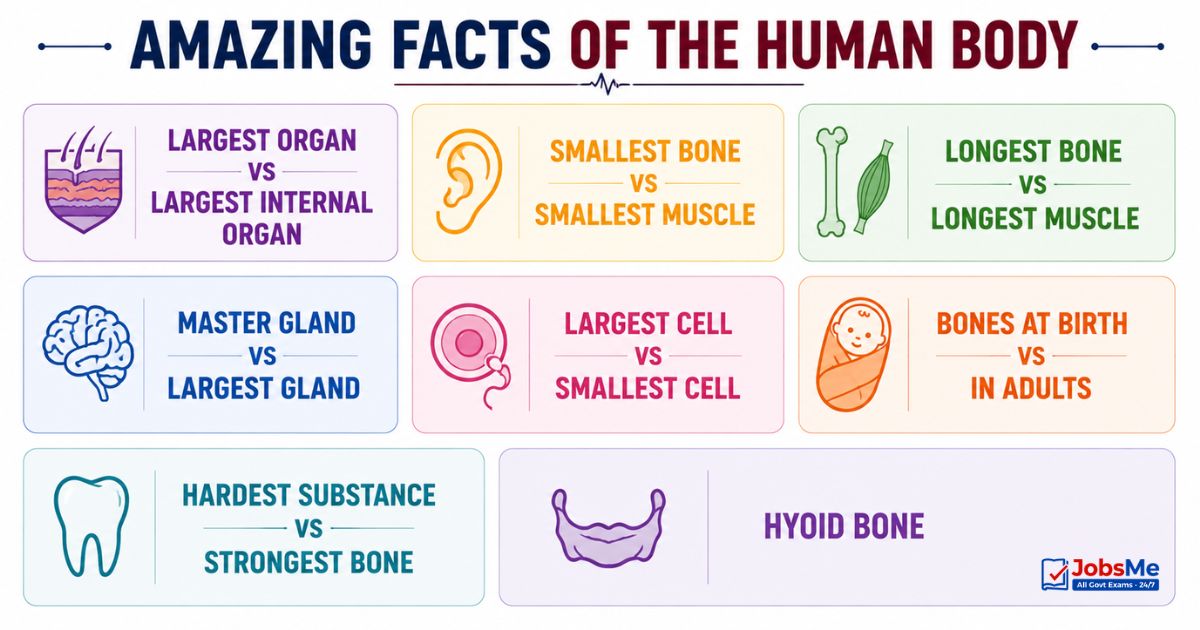
- Largest organ vs largest internal organ: The skin is the largest organ of the body; the liver is the largest internal organ and the largest gland.
- Smallest bone vs smallest muscle: Stapes is the smallest bone (about 3 mm); stapedius is the smallest muscle (about 5 mm). Both are in the ear.
- Longest bone vs longest muscle: Femur is the longest bone; sartorius is the longest muscle.
- Master gland vs largest gland: The pituitary is the master gland (it controls others); the liver is the largest gland, and the thyroid is the largest endocrine gland.
- Largest cell vs smallest cell: The ovum (egg) is the largest cell; the sperm is the smallest cell.
- Bones at birth vs in adults: A newborn has about 300 bones; an adult has 206 because many fuse during growth.
- Hardest substance vs strongest bone: Tooth enamel is the hardest substance the body produces; the femur is the strongest bone.
- Hyoid bone: It is the only bone not connected to any other bone, not a bone of the ear or limbs.
Repeating PYQ Patterns
Certain human body facts are asked repeatedly in competitive exams. Number of bones in an adult (206), longest bone (femur), smallest bone (stapes), largest organ (skin), largest internal organ and largest gland (liver), master gland (pituitary), largest endocrine gland (thyroid), first organ to function (heart), hardest substance (tooth enamel), and the only free-floating bone (hyoid) appear most often in UPSC Prelims, SSC CGL, and RRB NTPC papers. Banking exams (IBPS PO, SBI Clerk) frequently ask one-line General Science questions on organs, glands, and "largest/smallest" facts. State PCS exams add questions on organ systems and their functions, while Defence and Insurance exams test the numerical facts such as the number of ribs, heart chambers, and muscles.
Quick Insight
Human body basics are not just exam trivia — they connect directly to real-world health awareness and current affairs. Facts about the heart link to World Heart Day and cardiovascular health campaigns; facts about the kidney and liver connect to organ donation drives; and discoveries in physiology are recognised by the Nobel Prize in Physiology or Medicine each year. A strong grip on body basics helps aspirants answer both direct objective questions and health-related current affairs questions with confidence. For further reading on related Static GK and science topics, you can refer to the Static GK section and test yourself with the Static GK Quiz on Jobsme.in.
One-Liners for Quick Revision
- Bones in an adult body → 206 → a newborn has about 300 which fuse with growth.
- Bones in each hand → 27 → hands have the most bones in the body.
- Muscles in the body → around 639 → muscles often work in opposite pairs.
- Longest and strongest bone → Femur (thigh bone) → about 48 cm, supports 30 times body weight.
- Smallest bone → Stapes (stirrup) → about 3 mm, located in the middle ear.
- Three ear ossicles → Malleus, Incus, Stapes → hammer, anvil, stirrup.
- Longest muscle → Sartorius → also called the tailor's muscle.
- Smallest muscle → Stapedius → about 5 mm, deep in the ear.
- Largest muscle → Gluteus maximus → located in the buttock.
- Largest organ → Skin → part of the integumentary system.
- Largest internal organ and largest gland → Liver → produces bile and detoxifies blood.
- Master gland → Pituitary → controls other endocrine glands.
- Largest endocrine gland → Thyroid → regulates body metabolism.
- Largest cell → Ovum (egg cell) → female reproductive cell.
- Smallest cell → Sperm → male reproductive cell.
- First organ to start functioning → Heart → first to develop in the embryo.
- Hardest substance in the body → Tooth enamel → harder than bone.
- Largest and most complex joint → Knee joint → connects femur, tibia, and patella.
- Longest cranial nerve → Vagus nerve → the tenth cranial nerve.
- Only bone not attached to another bone → Hyoid bone → in the throat, supports the tongue.
- Pairs of ribs → 12 pairs (24 ribs) → about 1 percent of people have an extra rib.
- Chambers in the heart → 4 → two atria and two ventricles.
- Normal body temperature → about 37°C (98.6°F) → maintained by homeostasis.
- Skeleton as share of body weight → about 12% to 15% → varies with body size and density.
- Muscles to smile vs frown → about 17-20 to smile, 40-43 to frown → smiling needs fewer muscles.
- Gas exchange site in lungs → Alveoli → tiny air sacs where oxygen and carbon dioxide are exchanged.
- Control centre of the body → Brain → part of the nervous system.
- Filtering unit of the body → Kidneys → remove waste as urine and balance water and salts.
For more Static GK and General Science topics, explore the Static GK section on Jobsme.in. You can also test your knowledge with the Static GK Quiz, brush up your daily news with Daily Current Affairs, and check out the latest exam notifications at Latest Government Job Notifications.
Free quiz • No signup required
Put this topic into practice with Indian Cultural Institutions – Static GK MCQ Quiz. It is the quickest way to reinforce what you just learned.
Frequently Asked Questions
How many bones are there in an adult human body?
Which is the longest and strongest bone in the human body?
Which is the smallest bone in the human body?
Which is the largest organ of the human body?
Which is the largest internal organ and the largest gland in the body?
Which organ is the first to start functioning in the human body?
What is the master gland of the human body?
Which is the only bone in the body not attached to any other bone?
What are the longest and smallest muscles in the human body?
How many pairs of ribs and heart chambers does a human have?

About the author