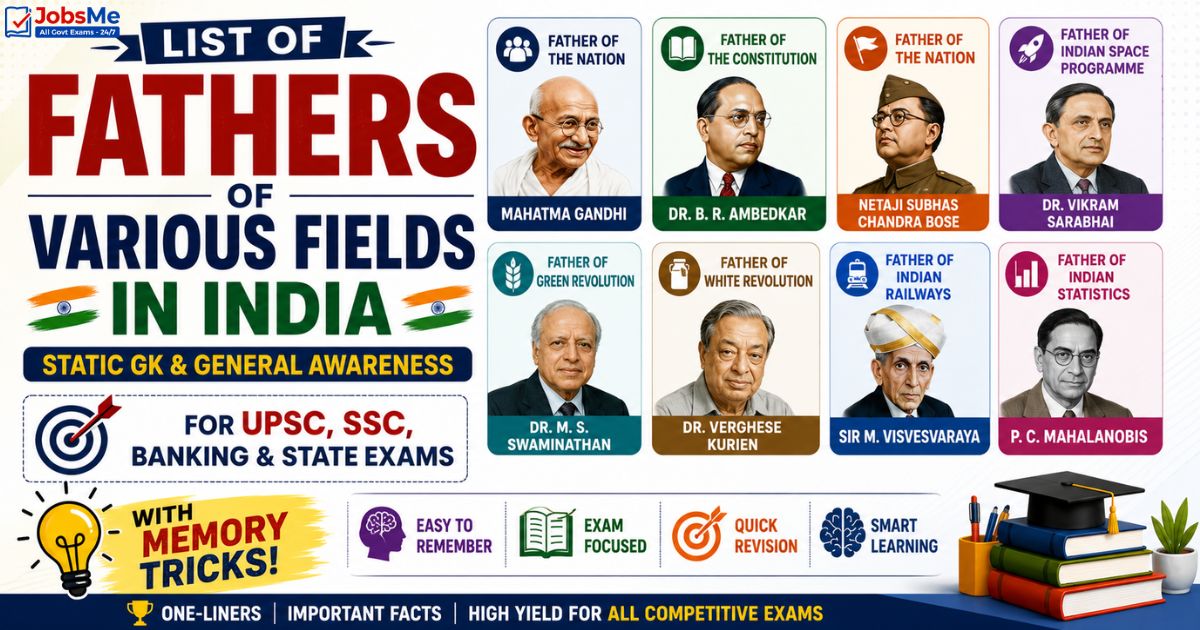
List of Fathers of Various Fields in India – Static GK & General Awareness for Competitive Exams with Memory Tricks
This article presents a complete list of the Fathers of Various Fields in India, covering politics, science, agriculture, defence, medicine, arts, literature, sports, and social sciences, along with the reasons behind each title. It includes iconic pioneers like Mahatma Gandhi (Father of the Nation), Dr. B. R. Ambedkar (Father of the Indian Constitution), Vikram Sarabhai (Father of Indian Space Programme), Homi J. Bhabha (Father of Indian Nuclear Programme), A. P. J. Abdul Kalam (Father of Indian Missile Programme), M. S. Swaminathan (Father of Green Revolution), Verghese Kurien (Father of White Revolution), and Major Dhyan Chand (Father of Indian Hockey), with memory tricks and one-liners for quick revision. All facts are arranged in exam-ready format to help UPSC, SSC, IBPS, RRB, PSU, and State PCS aspirants score better in General Awareness and Static GK sections.
Jump to section
Introduction
India's progress in every field — from the Constitution and the space programme to agriculture, defence, and cinema — owes a great deal to a small group of pioneers who laid the foundations of their respective disciplines. These pioneers are honoured with the title "Father of" a particular field. Mahatma Gandhi is the Father of the Nation; Dr. B. R. Ambedkar is the Father of the Indian Constitution; Vikram Sarabhai is the Father of the Indian Space Programme; Homi J. Bhabha is the Father of the Indian Nuclear Programme; A. P. J. Abdul Kalam is the Father of the Indian Missile Programme; M. S. Swaminathan is the Father of the Green Revolution; and Verghese Kurien is the Father of the White Revolution. Each of these titles is a shorthand for a complete chapter of India's modern story.
Questions on the Fathers of various fields appear almost every year in UPSC Prelims, SSC CGL, SSC CHSL, IBPS PO, IBPS Clerk, SBI PO, RRB NTPC, RRB Group D, State PCS, Defence (NDA, CDS, AFCAT), and Insurance exams. The questions are usually direct matching questions or "Who among the following is known as the Father of…" type one-liners. This article brings together every important entry in a structured, exam-ready format. To explore more such topics, you can refer to the Static GK section on Jobsme.in.
The topic is also closely linked with current affairs themes such as Bharat Ratna conferments, ISRO launches, agricultural policy announcements, and tributes paid in Parliament on death and birth anniversaries of national leaders — which means a student who masters this list automatically strengthens his or her preparation for both Prelims one-liners and Mains essay references.
Core Concept: Why Are They Called the "Fathers" of Their Fields?
In Indian competitive exams, the title "Father of" is given to the individual who is credited with founding, formally initiating, or transforming a particular field in India. The title is not always conferred by an official authority — in many cases, it is given by historians, government records, scientific institutions, or popular usage. Understanding the basis of each title makes it easier to remember.
Categories of "Father" Titles in India
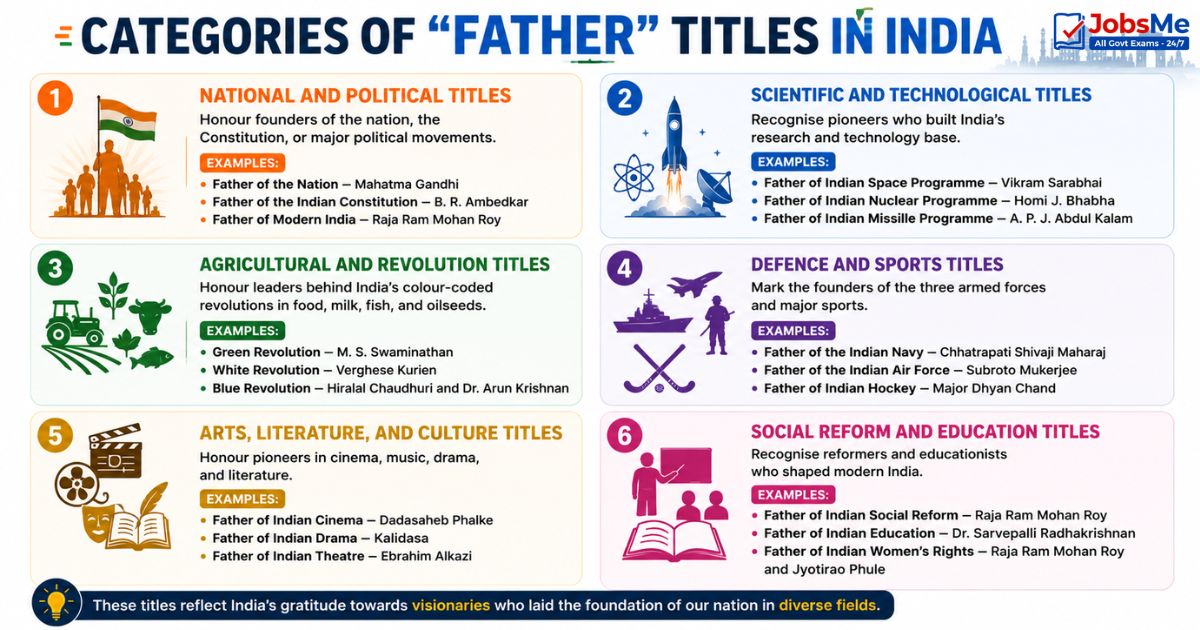
- National and Political Titles: Honour founders of the nation, the Constitution, or major political movements. Example: Father of the Nation (Gandhi), Father of the Indian Constitution (Ambedkar), Father of Modern India (Raja Ram Mohan Roy).
- Scientific and Technological Titles: Recognise pioneers who built India's research base. Example: Father of Indian Space Programme (Vikram Sarabhai), Father of Indian Nuclear Programme (Homi J. Bhabha), Father of Indian Missile Programme (A. P. J. Abdul Kalam).
- Agricultural and Revolution Titles: Honour leaders behind India's colour-coded revolutions in food, milk, fish, and oilseeds. Example: Green Revolution (M. S. Swaminathan), White Revolution (Verghese Kurien), Blue Revolution (Hiralal Chaudhuri and Dr. Arun Krishnan).
- Defence and Sports Titles: Mark the founders of the three armed forces and major sports. Example: Father of the Indian Navy (Chhatrapati Shivaji Maharaj), Father of the Indian Air Force (Subroto Mukerjee), Father of Indian Hockey (Major Dhyan Chand).
- Arts, Literature, and Culture Titles: Honour pioneers in cinema, music, drama, and literature. Example: Father of Indian Cinema (Dadasaheb Phalke), Father of Indian Drama (Kalidasa), Father of Indian Theatre (Ebrahim Alkazi).
- Social Reform and Education Titles: Recognise reformers and educationists. Example: Father of Indian Social Reform (Raja Ram Mohan Roy), Father of Indian Education (Dr. Sarvepalli Radhakrishnan), Father of Indian Women's Rights (Raja Ram Mohan Roy and Jyotirao Phule).
Fathers of Various Fields in India - Complete Topic-Wise List
The following tables group every exam-relevant "Father of" title in India under clear themes. Each entry carries the field, the personality, and a short note on the key contribution that earned them the title.
1. Politics, Constitution, and Freedom Movement
| Field | Father | Reason / Key Contribution |
|---|---|---|
| Father of the Nation | Mahatma Gandhi (Mohandas Karamchand Gandhi) | Led India's freedom struggle through non-violent resistance; the title "Father of the Nation" was popularised by Subhash Chandra Bose in his radio address from Singapore in 1944; born on 2 October 1869. |
| Father of the Indian Constitution / Father of the Republic of India | Dr. B. R. Ambedkar (Bhimrao Ramji Ambedkar) | Chairman of the Drafting Committee of the Constituent Assembly; chief architect of the Constitution of India adopted on 26 November 1949; first Law Minister of independent India; Bharat Ratna (1990). |
| Father of Modern India | Raja Ram Mohan Roy | Founder of the Brahmo Samaj (1828); led the campaign against Sati; pioneered modern education in English; known as the "Morning Star of the Indian Renaissance." |
| Father of Indian Unrest | Bal Gangadhar Tilak | Title given by the British journalist Valentine Chirol; founder of Kesari and Maratha newspapers; coined the slogan "Swaraj is my birthright and I shall have it." |
| Father of Linguistic Democracy | Potti Sreeramulu | Fasted unto death in 1952 demanding a separate Telugu-speaking Andhra State; his death led to the creation of Andhra Pradesh in 1953 and to the States Reorganisation Act of 1956. |
| Father of Hindutva | Vinayak Damodar Savarkar (Veer Savarkar) | Coined and propagated the political ideology of Hindutva through his 1923 work "Essentials of Hindutva"; revolutionary, author, and leader of the Hindu Mahasabha. |
| Father of the Trade Union Movement in India | Narayan Meghaji Lokhande | Pioneer of the labour rights movement; led mill workers in Bombay in the 1880s; secured the first weekly Sunday holiday for industrial workers in 1890. |
| Father of the Peasant Movement in India | N. G. Ranga (Gogineni Ranga Nayukulu) | Founder of the Indian Peasants Institute (1933); organised the All India Kisan Sabha; long-serving parliamentarian known as the "father of the peasant movement." |
| Father of Indian Railways | Lord Dalhousie | Governor-General who introduced the first passenger railway in India (Bombay to Thane, 1853) and laid the foundation of the Indian Railways network through his Railway Minute of 1853. |
| Father of Local Self-Government in India | Lord Ripon | Viceroy of India (1880-84); passed the Local Self-Government Resolution of 1882, which is considered the Magna Carta of local self-government in India. |
2. Science, Technology, and Industry
| Field | Father | Reason / Key Contribution |
|---|---|---|
| Father of the Indian Space Programme | Dr. Vikram Sarabhai | Founded the Indian National Committee for Space Research (INCOSPAR) in 1962, which became ISRO in 1969; established the Thumba Equatorial Rocket Launching Station; Padma Bhushan (1966); Padma Vibhushan (1972, posthumous). |
| Father of the Indian Nuclear Programme / Indian Atomic Programme | Dr. Homi Jehangir Bhabha | Founded the Tata Institute of Fundamental Research (TIFR, 1945) and the Atomic Energy Establishment Trombay (later BARC); first Chairman of the Atomic Energy Commission of India; Padma Bhushan (1954). |
| Father of the Indian Missile Programme | Dr. A. P. J. Abdul Kalam (Avul Pakir Jainulabdeen Abdul Kalam) | Led the Integrated Guided Missile Development Programme (IGMDP) that produced Agni, Prithvi, Akash, Trishul, and Nag missiles; 11th President of India (2002-07); Bharat Ratna (1997). |
| Father of Indian Physics | Sir C. V. Raman (Chandrasekhara Venkata Raman) | Discovered the Raman Effect on 28 February 1928 (celebrated as National Science Day); first Asian and first Indian to win the Nobel Prize in Physics (1930); Bharat Ratna (1954). |
| Father of Indian Chemistry | Acharya Prafulla Chandra Ray | Founder of Bengal Chemicals and Pharmaceutical Works Ltd. (1901), India's first pharmaceutical company; author of "A History of Hindu Chemistry." |
| Father of Indian Botany / Father of Radio Science in India | Sir Jagadish Chandra Bose (J. C. Bose) | Demonstrated that plants respond to stimuli using the crescograph; pioneer of radio and microwave optics; first Indian scientist to be elected Fellow of the Royal Society (1920). |
| Father of Indian Mathematics / Father of Indian Astronomy | Aryabhata | 5th-century mathematician-astronomer; author of "Aryabhatiya"; introduced the concept of zero and the place-value system; calculated the value of pi and the length of the solar year; India's first satellite (1975) was named after him. |
| Father of Indian Statistics | Prasanta Chandra Mahalanobis | Founder of the Indian Statistical Institute (ISI, 1931); designed the Second Five-Year Plan; his birthday (29 June) is celebrated as National Statistics Day; Padma Vibhushan (1968). |
| Father of Indian Meteorology | Meghnad Saha | Famous for the Saha Ionisation Equation (1920); founded the Saha Institute of Nuclear Physics; pioneer of astrophysics and atmospheric science research in India. |
| Father of Indian Palaeobotany / Father of Indian Geology | Birbal Sahni | Founder of the Birbal Sahni Institute of Palaeosciences, Lucknow (1946); pioneering work on fossil plants of the Indian subcontinent; Fellow of the Royal Society (1936). |
| Father of Indian Genetics | J. B. S. Haldane | British-born Indian scientist; settled in India in 1957 and joined the Indian Statistical Institute; pioneer of population genetics and human genetics studies in India. |
| Father of Indian Phycology / Father of Algology in India | M. O. P. Iyengar (Mandayam Osuri Parthasarathy Iyengar) | Pioneer of the study of algae in India; established algal research at the University of Madras; founder of the Indian Botanical Society. |
| Father of Indian Ecology | Ramdeo Misra | Established the first centre for ecological studies in India at Banaras Hindu University; member of the International Biological Programme. |
| Father of Indian Environment | Sunderlal Bahuguna | Leader of the Chipko Movement (1973) and the Anti-Tehri Dam Movement; lifelong environmentalist of the Himalayas; Padma Vibhushan (2009). |
| Father of Indian Oceanography | Dr. Harsh Kumar Gupta | Renowned earth scientist; former Director of the National Geophysical Research Institute (NGRI); pioneer of reservoir-induced seismicity studies and oceanographic research in India. |
| Father of the Indian IT Industry | Faqir Chand Kohli (F. C. Kohli) | First CEO of Tata Consultancy Services (TCS); led the establishment of India's software services industry from the late 1960s; widely credited with shaping the global Indian IT story. |
| Father of India's Communication Revolution | Sam Pitroda (Satyanarayan Gangaram Pitroda) | Founder of the Centre for Development of Telematics (C-DOT); led the telecom revolution under Rajiv Gandhi in the 1980s; also linked with the Yellow Revolution (oilseeds). |
| Father of the Pentium Chip | Vinod Dham | Led the team at Intel that developed the Pentium microprocessor in 1993; now a prominent Indian-American technology entrepreneur and investor. |
| Father of Indian Cybersecurity | Dr. Gulshan Rai | India's first National Cyber Security Coordinator (2015-19); set up the Indian Computer Emergency Response Team (CERT-In) and the National Critical Information Infrastructure Protection Centre. |
| Father of Indian Civil Engineering | Sir Mokshagundam Visvesvaraya | Designed the Krishna Raja Sagar Dam in Mysore; Diwan of Mysore (1912-18); his birthday (15 September) is celebrated as Engineer's Day in India; Bharat Ratna (1955). |
| Father of Indian Civil Aviation | J. R. D. Tata (Jehangir Ratanji Dadabhoy Tata) | First licensed pilot of India (1929); founder of Tata Airlines (1932), which became Air India; chairman of the Tata Group for over five decades; Bharat Ratna (1992). |
| Father of the Indian Banking Sector | Sir Osborne Smith | First Governor of the Reserve Bank of India (1 April 1935 to 30 June 1937); laid the institutional foundation of central banking in India. |
| Father of Indian Entrepreneurship | Jamsetji Nusserwanji Tata | Founder of the Tata Group (1868); established the first integrated steel plant in India (TISCO, 1907) and the Indian Institute of Science, Bengaluru (1909); widely regarded as the founding industrialist of modern India. |
| Father of Modern Economic Reforms in India | Dr. Manmohan Singh | As Union Finance Minister (1991-96), launched the Liberalisation, Privatisation, and Globalisation (LPG) reforms of 1991; later 13th Prime Minister of India (2004-14). |
| Father of Indian Economics | Mahadev Govind Ranade (M. G. Ranade) | Author of "Essays on Indian Economics" (1898); pioneer of the Indian economic thought school; founder of the Indian National Social Conference. |
3. Agriculture and Colour-Coded Revolutions in India
| Field | Father | Reason / Key Contribution |
|---|---|---|
| Father of the Green Revolution in India / Father of Indian Agriculture | Dr. M. S. Swaminathan (Mankombu Sambasivan Swaminathan) | Led the introduction of high-yielding wheat and rice varieties in the 1960s; founder of the M. S. Swaminathan Research Foundation; Bharat Ratna (2024, posthumous); Padma Vibhushan (1989). |
| Political Father of the Green Revolution | Chidambaram Subramaniam | Union Agriculture Minister (1964-67) who introduced policy support for high-yielding seed varieties under the Green Revolution; Bharat Ratna (1998). |
| Father of the Wheat Revolution in India | Dilbagh Singh Athwal | Plant breeder who developed the high-yielding wheat variety Kalyan Sona, which transformed Indian wheat production during the Green Revolution. |
| Father of the White Revolution / Father of Indian Rural Development | Dr. Verghese Kurien | Founder of the Amul cooperative model; led Operation Flood (launched 1970) that made India the world's largest milk producer; Padma Vibhushan (1999); Ramon Magsaysay Award (1963). |
| Father of the Blue Revolution in India | Dr. Hiralal Chaudhuri and Dr. Arun Krishnan | Pioneers of inland fish breeding and aquaculture; their work in the 1950s on induced breeding of Indian major carps laid the foundation for India's fisheries growth. |
| Father of the Pink Revolution | Durgesh Patel | Associated with India's growth in meat and poultry processing; the Pink Revolution refers to the modernisation of the Indian meat and poultry sector. |
| Father of the Yellow Revolution | Sam Pitroda | Yellow Revolution refers to the dramatic rise in oilseed production (especially mustard and sunflower) during 1986-94, under the Technology Mission on Oilseeds. |
| Father of the Gold Revolution | Nirpakh Tutaj | Gold Revolution refers to the rise in horticulture production, especially honey and fruits, between the late 1990s and the 2000s. |
| Father of the Red Revolution | Vishal Tewari | Red Revolution refers to the rise in meat and tomato production in India; tomato being the prominent symbol of the revolution. |
| Mother of the Silver Revolution | Indira Gandhi | Silver Revolution refers to the rapid growth in egg production in India during the 1970s and 1980s; under her tenure as PM, India became one of the largest egg producers in the world. |
| Father of Hybrid Sorghum (Jowar) in India | Dr. Neelamraju Ganga Prasada Rao | Plant breeder who developed the first hybrid sorghum varieties in India in the 1960s; transformed dryland agriculture. |
| Father of the Indian Seed Industry | Dr. B. R. Barwale | Founder of Mahyco (Maharashtra Hybrid Seeds Company); first Indian to receive the World Food Prize (1998) for his contribution to seed industry development. |
4. Medicine, Health, Ayurveda, and Pharmacy
| Field | Father | Reason / Key Contribution |
|---|---|---|
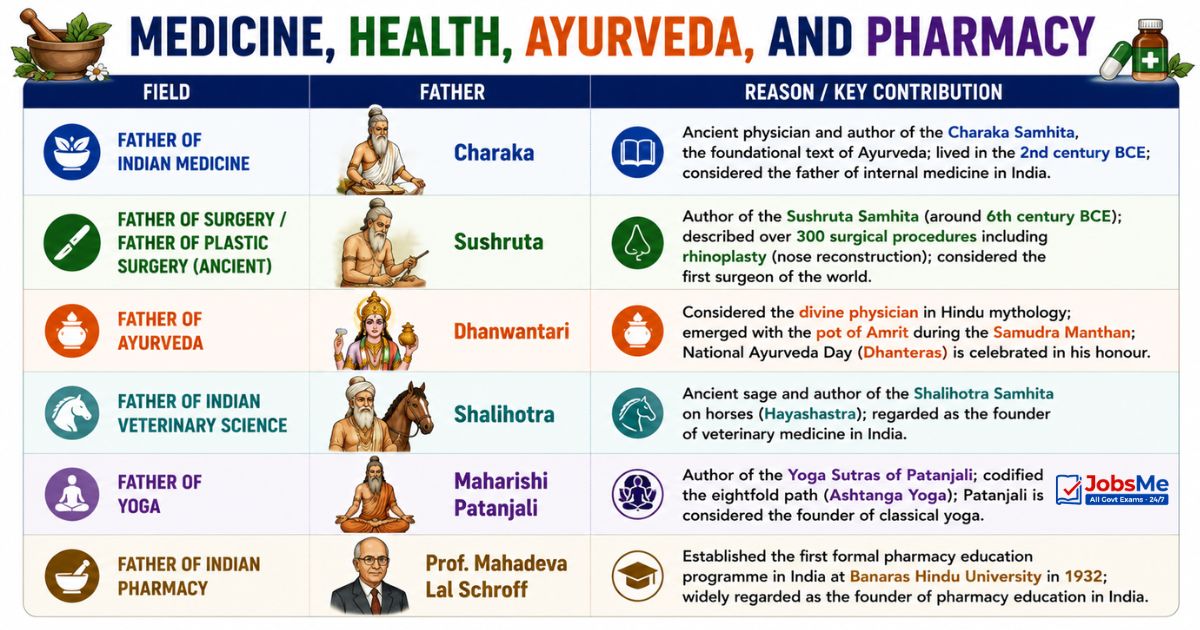
| Father of Indian Medicine | Charaka | Ancient physician and author of the Charaka Samhita, the foundational text of Ayurveda; lived in the 2nd century BCE; considered the father of internal medicine in India. |
| Father of Surgery / Father of Plastic Surgery (Ancient) | Sushruta | Author of the Sushruta Samhita (around 6th century BCE); described over 300 surgical procedures including rhinoplasty (nose reconstruction); considered the first surgeon of the world. |
| Father of Ayurveda | Dhanwantari | Considered the divine physician in Hindu mythology; emerged with the pot of Amrit during the Samudra Manthan; National Ayurveda Day (Dhanteras) is celebrated in his honour. |
| Father of Indian Veterinary Science | Shalihotra | Ancient sage and author of the Shalihotra Samhita on horses (Hayashastra); regarded as the founder of veterinary medicine in India. |
| Father of Yoga | Maharishi Patanjali | Author of the Yoga Sutras of Patanjali; codified the eightfold path (Ashtanga Yoga); Patanjali is considered the founder of classical yoga. |
| Father of Indian Pharmacy | Prof. Mahadeva Lal Schroff | Established the first formal pharmacy education programme in India at Banaras Hindu University in 1932; widely regarded as the founder of pharmacy education in India. |
5. Arts, Literature, Cinema, and Culture
| Field | Father | Reason / Key Contribution |
|---|---|---|
| Father of Indian Cinema / Father of the Indian Film Industry | Dadasaheb Phalke (Dhundiraj Govind Phalke) | Director of India's first full-length feature film "Raja Harishchandra" (1913); the highest Indian film honour, the Dadasaheb Phalke Award, is named after him. |
| Father of Indian Music (Modern) | Pandit Ravi Shankar | Legendary sitar maestro who popularised Indian classical music worldwide; Bharat Ratna (1999); won four Grammy Awards. |
| Father of Indian Art (Modern Painting) | Raja Ravi Varma | Pioneer of oil painting and lithography in India; famous for his depictions of Hindu deities and historical scenes; bridged Indian themes with European techniques. |
| Father of Indian Literature | Maharishi Valmiki | Author of the Ramayana, the first epic poem of India; revered as the "Adi Kavi" (First Poet) of Sanskrit literature. |
| Father of Indian Drama / Indian Classical Drama | Kalidasa | Classical Sanskrit playwright and poet; author of "Abhijnanasakuntalam" and "Meghaduta"; often called the "Shakespeare of India." |
| Father of Modern Indian Theatre | Ebrahim Alkazi | Director of the National School of Drama (NSD) from 1962 to 1977; trained legends like Naseeruddin Shah and Om Puri; Padma Vibhushan (2010). |
| Father of Indian Comics | Anant Pai | Founder of Amar Chitra Katha (1967) and Tinkle (1980); brought Indian mythology and history to generations of children through comics. |
| Father of Indian Journalism | James Augustus Hickey | Started India's first newspaper, the Bengal Gazette (also called Hickey's Gazette), in 1780 from Calcutta; pioneer of the free press in India. |
| Father of Library Science in India | Dr. S. R. Ranganathan (Shiyali Ramamrita Ranganathan) | Formulated the Five Laws of Library Science (1931); developed the Colon Classification system; his birthday (12 August) is celebrated as National Librarians' Day. |
| Father of Sanskrit Grammar / Father of Indian Linguistics | Panini | Ancient Sanskrit grammarian (around 5th-4th century BCE); author of the "Ashtadhyayi," the first comprehensive grammar in any language. |
6. Defence and Sports in India
| Field | Father | Reason / Key Contribution |
|---|---|---|
| Father of the Indian Army | Major Stringer Lawrence | British military officer (1697-1775); raised and trained the first regular regiments of the East India Company; called the "Father of the Indian Army." |
| Father of the Indian Air Force (IAF) | Air Marshal Subroto Mukerjee | First Indian Chief of the Air Staff (1954-60); his birthday is observed as Subroto Cup Day; instrumental in shaping the IAF after independence. |
| Father of the Indian Navy | Chhatrapati Shivaji Maharaj | Founder of the Maratha Navy in the 17th century; built coastal forts like Sindhudurg and Vijaydurg; first Indian ruler to recognise the strategic importance of sea power. |
| Father of Indian Defence | Field Marshal Sam Manekshaw | First Indian Army officer to be promoted to the rank of Field Marshal (1973); led the Indian Army to a decisive victory in the 1971 Indo-Pak War leading to the creation of Bangladesh; Padma Vibhushan (1972). |
| Father of Indian Hockey / Father of Indian Sports | Major Dhyan Chand | Led India to three consecutive Olympic gold medals in hockey (1928 Amsterdam, 1932 Los Angeles, 1936 Berlin); his birthday (29 August) is celebrated as National Sports Day in India; Padma Bhushan (1956). |
7. History, Geography, Education, and Social Sciences
| Field | Father | Reason / Key Contribution |
|---|---|---|
| Father of Indian History | Megasthenes | Greek ambassador to the court of Chandragupta Maurya (around 302 BCE); author of "Indica," the earliest detailed foreign account of India; considered the father of Indian history writing. |
| Father of Indian Archaeology | Sir Alexander Cunningham | First Director-General of the Archaeological Survey of India (ASI), established in 1861; surveyed Buddhist sites like Sarnath, Sanchi, and Bharhut. |
| Father of Indian Geography | Major James Rennell | First Surveyor-General of Bengal (1767); prepared the first comprehensive maps of India; his work "A Bengal Atlas" (1779) is considered the foundation of modern Indian cartography. |
| Father of Indian Sociology | Govind Sadashiv Ghurye (G. S. Ghurye) | Founder of the first Department of Sociology at the University of Bombay (1924); founded the Indian Sociological Society; author of "Caste and Race in India." |
| Father of Indian Anthropology | Dr. B. R. Ambedkar | His doctoral and post-doctoral work at Columbia University and LSE focused on castes in India from an anthropological perspective; founder of social anthropology in India. |
| Father of Indian Psychology | D. N. Majumdar | Anthropologist and psychologist; pioneered tribal psychology studies in India; founder of the Department of Anthropology at Lucknow University. |
| Father of Indian Education | Dr. Sarvepalli Radhakrishnan | First Vice-President (1952-62) and second President of India (1962-67); a renowned scholar of Indian philosophy; his birthday (5 September) is celebrated as Teachers' Day; Bharat Ratna (1954). |
| Father of Indian Political Science | Dr. S. Radhakrishnan | His scholarly work on Indian political thought and philosophy laid the basis for modern political science studies in Indian universities. |
| Father of Indian Philosophy | Adi Shankaracharya | 8th-century philosopher; founder of the Advaita Vedanta school of Hindu philosophy; established four mathas (monastic centres) across India. |
| Father of Indian Philosophy of Religion | Sarvepalli Radhakrishnan | His landmark works "Indian Philosophy" and "An Idealist View of Life" laid the academic foundation of Indian philosophy of religion in modern times. |
| Father of Indian Law | Justice H. R. Khanna | Supreme Court judge famous for his lone dissent in the ADM Jabalpur case (1976) defending civil liberties during the Emergency; symbol of judicial independence in India. |
| Father of Indian Social Reform / Father of Indian Renaissance | Raja Ram Mohan Roy | Founder of the Brahmo Samaj (1828); led the abolition of Sati (1829); pioneer of modern English education and press freedom in India. |
| Father of Indian Women's Rights | Raja Ram Mohan Roy and Jyotirao Phule | Raja Ram Mohan Roy fought against Sati and for widow remarriage; Jyotirao Phule, along with Savitribai Phule, founded the first girls' school in India at Pune in 1848. |
| Father of Indian Social Work | Maharshi Dhondo Keshav Karve | Founder of the first women's university in India (SNDT, 1916); championed widow remarriage and women's education; Bharat Ratna (1958). |
Memory Tricks and Mnemonics
Trick 1: The Big Three of Indian Science — "VHA"
India's three flagship strategic science programmes were each founded by a different pioneer. Remember them as "VHA":
- V → Vikram Sarabhai → Indian Space Programme (ISRO).
- H → Homi J. Bhabha → Indian Nuclear / Atomic Programme.
- A → A. P. J. Abdul Kalam → Indian Missile Programme.
"V comes first, then H, then A — Space, Atom, Missile, all in order."
Trick 2: The Rainbow of Indian Revolutions
India's agricultural revolutions are colour-coded. Group them by colour:
- Green Revolution (food grains, wheat/rice) → M. S. Swaminathan.
- White Revolution (milk) → Verghese Kurien.
- Blue Revolution (fisheries) → Hiralal Chaudhuri and Dr. Arun Krishnan.
- Yellow Revolution (oilseeds) → Sam Pitroda.
- Pink Revolution (meat / poultry) → Durgesh Patel.
- Red Revolution (tomato / meat) → Vishal Tewari.
- Gold Revolution (horticulture / honey) → Nirpakh Tutaj.
- Silver Revolution (eggs) → Indira Gandhi (Mother).
"GWBY PR-GS — Green White Blue Yellow, Pink Red, Gold Silver."
Trick 3: The Three Defence Fathers — "Sea, Air, Land"
Use this navy-to-army order to remember the three heads of the armed forces:
- Sea (Navy) → Chhatrapati Shivaji Maharaj.
- Air (IAF) → Subroto Mukerjee.
- Land (Army) → Stringer Lawrence.
"Shivaji at sea, Subroto in sky, Stringer on land — plus Sam Manekshaw for overall defence."
Trick 4: The Two Aryabhata Doubles
One man, two titles:
- Aryabhata → Father of Indian Mathematics.
- Aryabhata → Father of Indian Astronomy.
Also remember: India's first satellite (1975) is named Aryabhata.
Trick 5: The "Charaka-Sushruta-Dhanwantari" Medicine Trio
Three ancient Indian doctors, three different titles:
- Charaka → Father of Indian Medicine (internal medicine).
- Sushruta → Father of Surgery / Father of Indian Plastic Surgery.
- Dhanwantari → Father of Ayurveda (divine physician).
"Charaka cures, Sushruta cuts, Dhanwantari heals."
Trick 6: The "Three R's" — Roy, Ranade, Ranganathan
- Raja Ram Mohan Roy → Father of Modern India / Father of Indian Social Reform / Father of Indian Renaissance.
- Ranade (M. G. Ranade) → Father of Indian Economics.
- Ranganathan (S. R. Ranganathan) → Father of Library Science in India.
Trick 7: The Two B. R. Ambedkar Titles — "Constitution + Anthropology"
Dr. B. R. Ambedkar is the father of two fields. Remember as "Two BRs":
- BR-1 → Father of the Indian Constitution / Father of the Republic of India.
- BR-2 → Father of Indian Anthropology.
Trick 8: The "Cinema, Comic, Camera" Trio
For arts and media, group as follows:
- Cinema → Dadasaheb Phalke (Father of Indian Cinema).
- Comic → Anant Pai (Father of Indian Comics — Amar Chitra Katha).
- Camera (Modern Painting) → Raja Ravi Varma (Father of Indian Art).
Trick 9: The "Two Tatas" — JRD and Jamsetji
- Jamsetji Tata → Father of Indian Entrepreneurship / Industry.
- J. R. D. Tata → Father of Indian Civil Aviation.
"Older Tata built industry; younger Tata flew the planes."
Additional Notes
Frequently Confused Facts
- Father of the Nation vs Father of Modern India: Mahatma Gandhi is the Father of the Nation; Raja Ram Mohan Roy is the Father of Modern India and the Father of Indian Social Reform.
- Father of the Indian Constitution vs Father of the Republic of India: Both titles refer to Dr. B. R. Ambedkar — they mean the same thing.
- Father of Green Revolution (India) vs Father of Green Revolution (World): In India, M. S. Swaminathan; globally, Norman Borlaug.
- Father of Indian Banking Sector vs Father of Modern Economic Reforms: Sir Osborne Smith was the first RBI Governor (banking sector); Dr. Manmohan Singh led the 1991 LPG reforms.
- Father of Indian Hockey vs Father of Indian Sports: Both titles refer to Major Dhyan Chand; he is considered the father of organised hockey and, by extension, of Indian sports.
- Father of Surgery vs Father of Indian Medicine: Sushruta is the Father of Surgery (ancient); Charaka is the Father of Indian Medicine. Both are pillars of Ayurveda.
- Father of Indian Civil Engineering vs Father of Indian Civil Aviation: Sir M. Visvesvaraya (civil engineering, 15 September is Engineer's Day); J. R. D. Tata (civil aviation, India's first licensed pilot).
- Father of Indian Botany vs Father of Radio Science in India: Both titles refer to Sir Jagadish Chandra Bose.
- Father of Indian Geology vs Father of Indian Palaeobotany: Both titles refer to Birbal Sahni.
- Father of Indian Education vs Father of Indian Philosophy of Religion: Both titles refer to Dr. Sarvepalli Radhakrishnan.
- Father of the Indian Army vs Father of Indian Defence: Major Stringer Lawrence raised the first regular regiments (Father of the Indian Army); Field Marshal Sam Manekshaw is honoured as the Father of Indian Defence for his 1971 War leadership.
- Father of Indian Cinema vs Father of Indian Comics: Dadasaheb Phalke (cinema, "Raja Harishchandra," 1913); Anant Pai (Amar Chitra Katha, 1967).
- Father of Yellow Revolution vs Father of India's Communication Revolution: Both titles refer to Sam Pitroda — Yellow for oilseeds; Communication for the C-DOT telecom revolution.
- Mother of Silver Revolution: Note that this is "Mother" (not Father) — it refers to Indira Gandhi, not a male leader.
Repeating PYQ Patterns
Certain entries from this topic are asked almost every year in competitive exams. Mahatma Gandhi (Father of the Nation), Dr. B. R. Ambedkar (Father of the Indian Constitution), Vikram Sarabhai (Indian Space Programme), Homi J. Bhabha (Indian Nuclear Programme), A. P. J. Abdul Kalam (Indian Missile Programme), M. S. Swaminathan (Green Revolution), Verghese Kurien (White Revolution), Sushruta (Surgery), Charaka (Medicine), Major Dhyan Chand (Indian Hockey), Dadasaheb Phalke (Indian Cinema), Sir M. Visvesvaraya (Civil Engineering), J. R. D. Tata (Civil Aviation), and Sir Osborne Smith (Indian Banking Sector) are the most frequently asked in UPSC Prelims, SSC CGL, SSC CHSL, and RRB NTPC papers. Banking exams (IBPS PO, IBPS Clerk, SBI Clerk) tend to focus on the agricultural revolutions, the banking sector, and the economic reforms (Manmohan Singh, 1991 LPG reforms). Defence exams (NDA, CDS, AFCAT) add the three armed-forces fathers — Stringer Lawrence (Army), Subroto Mukerjee (IAF), and Chhatrapati Shivaji (Navy) — and Field Marshal Sam Manekshaw. State PCS exams add regional pioneers such as Potti Sreeramulu (Andhra), Chidambaram Subramaniam (Tamil Nadu), and Raja Ravi Varma (Kerala).
Quick Insight
The Fathers of various fields in India represent a compressed timeline of the nation's modernisation. Aryabhata gave India the zero in the 5th century, Sushruta operated with surgical instruments two thousand years before modern surgery, Raja Ram Mohan Roy abolished Sati in the 19th century, J. R. D. Tata flew India's first commercial flight in 1932, Dr. Bhabha set up Asia's first research reactor (Apsara) in 1956, Dr. Sarabhai launched India's first rocket from Thumba in 1963, and Dr. Kalam guided the Pokhran-II nuclear tests in 1998. Each "Father" is a milestone in a continuous national journey. For students, mastering this list is also useful for Mains essays on science, agriculture, and nation-building. For further study of related Static GK topics, browse the Static GK notes and check the latest Daily Current Affairs on Jobsme.in.
One-Liners for Quick Revision
- Father of the Nation → Mahatma Gandhi → Title popularised by Subhash Chandra Bose in 1944.
- Father of the Indian Constitution / Republic of India → Dr. B. R. Ambedkar → Chairman, Drafting Committee; Bharat Ratna (1990).
- Father of Modern India / Indian Renaissance / Indian Social Reform → Raja Ram Mohan Roy → Founder of Brahmo Samaj (1828).
- Father of Indian Unrest → Bal Gangadhar Tilak → Title given by Valentine Chirol.
- Father of Linguistic Democracy → Potti Sreeramulu → Fast unto death (1952); led to Andhra State.
- Father of Hindutva → V. D. Savarkar → "Essentials of Hindutva" (1923).
- Father of the Trade Union Movement → Narayan Meghaji Lokhande → Bombay mill workers in the 1880s.
- Father of the Peasant Movement → N. G. Ranga → Indian Peasants Institute (1933).
- Father of Indian Railways → Lord Dalhousie → First passenger rail (Bombay-Thane, 1853).
- Father of Local Self-Government → Lord Ripon → Resolution of 1882.
- Father of the Indian Space Programme → Dr. Vikram Sarabhai → Founder of ISRO (1969).
- Father of the Indian Nuclear Programme → Dr. Homi J. Bhabha → Founder of TIFR (1945) and BARC.
- Father of the Indian Missile Programme → Dr. A. P. J. Abdul Kalam → IGMDP; Bharat Ratna (1997).
- Father of Indian Physics → Sir C. V. Raman → Raman Effect; Nobel Prize (1930).
- Father of Indian Chemistry → Acharya Prafulla Chandra Ray → Founder of Bengal Chemicals (1901).
- Father of Indian Botany / Radio Science → Sir J. C. Bose → Crescograph; FRS (1920).
- Father of Indian Mathematics / Astronomy → Aryabhata → "Aryabhatiya"; 5th century CE.
- Father of Indian Statistics → P. C. Mahalanobis → Founder of ISI (1931); National Statistics Day (29 June).
- Father of Indian Meteorology → Meghnad Saha → Saha Ionisation Equation (1920).
- Father of Indian Palaeobotany / Indian Geology → Birbal Sahni → Birbal Sahni Institute, Lucknow (1946).
- Father of Indian Genetics → J. B. S. Haldane → Population genetics; ISI, 1957 onwards.
- Father of Indian Phycology / Algology → M. O. P. Iyengar → Pioneer of algae studies.
- Father of Indian Ecology → Ramdeo Misra → Ecological studies at BHU.
- Father of Indian Environment → Sunderlal Bahuguna → Chipko Movement (1973).
- Father of Indian Oceanography → Dr. Harsh Kumar Gupta → Former Director of NGRI.
- Father of the Indian IT Industry → F. C. Kohli → First CEO of TCS.
- Father of India's Communication Revolution → Sam Pitroda → C-DOT founder.
- Father of the Pentium Chip → Vinod Dham → Intel Pentium (1993).
- Father of Indian Cybersecurity → Dr. Gulshan Rai → First National Cyber Security Coordinator (2015).
- Father of Indian Civil Engineering → Sir M. Visvesvaraya → KRS Dam; Engineer's Day (15 September); Bharat Ratna (1955).
- Father of Indian Civil Aviation → J. R. D. Tata → First Indian pilot; Air India founder; Bharat Ratna (1992).
- Father of the Indian Banking Sector → Sir Osborne Smith → First RBI Governor (1935).
- Father of Indian Entrepreneurship → Jamsetji Tata → Founder of Tata Group; TISCO (1907); IISc (1909).
- Father of Modern Economic Reforms → Dr. Manmohan Singh → LPG Reforms (1991).
- Father of Indian Economics → M. G. Ranade → "Essays on Indian Economics" (1898).
- Father of the Green Revolution / Indian Agriculture → M. S. Swaminathan → Bharat Ratna (2024).
- Political Father of the Green Revolution → C. Subramaniam → Agriculture Minister (1964-67); Bharat Ratna (1998).
- Father of the Wheat Revolution → Dilbagh Singh Athwal → Developed Kalyan Sona wheat.
- Father of the White Revolution / Indian Rural Development → Verghese Kurien → Amul; Operation Flood (1970).
- Father of the Blue Revolution → Hiralal Chaudhuri and Dr. Arun Krishnan → Induced breeding of carps.
- Father of the Pink Revolution → Durgesh Patel → Meat and poultry sector.
- Father of the Yellow Revolution → Sam Pitroda → Oilseeds.
- Father of the Gold Revolution → Nirpakh Tutaj → Horticulture and honey.
- Father of the Red Revolution → Vishal Tewari → Tomato / meat.
- Mother of the Silver Revolution → Indira Gandhi → Egg production growth.
- Father of Hybrid Sorghum in India → N. G. P. Rao → First hybrid jowar varieties.
- Father of the Indian Seed Industry → Dr. B. R. Barwale → Founder of Mahyco; World Food Prize (1998).
- Father of Indian Medicine → Charaka → Author of "Charaka Samhita."
- Father of Surgery / Plastic Surgery (Ancient) → Sushruta → Author of "Sushruta Samhita"; rhinoplasty.
- Father of Ayurveda → Dhanwantari → Divine physician; Ayurveda Day (Dhanteras).
- Father of Indian Veterinary Science → Shalihotra → Author of "Shalihotra Samhita" on horses.
- Father of Yoga → Maharishi Patanjali → Author of "Yoga Sutras"; Ashtanga Yoga.
- Father of Indian Pharmacy → Prof. M. L. Schroff → First pharmacy course at BHU (1932).
- Father of Indian Cinema / Film Industry → Dadasaheb Phalke → "Raja Harishchandra" (1913).
- Father of Indian Music (Modern) → Pandit Ravi Shankar → Sitar maestro; Bharat Ratna (1999).
- Father of Indian Art (Modern Painting) → Raja Ravi Varma → Oil painting and lithography.
- Father of Indian Literature → Maharishi Valmiki → Author of the Ramayana; Adi Kavi.
- Father of Indian Drama → Kalidasa → "Abhijnanasakuntalam"; "Shakespeare of India."
- Father of Modern Indian Theatre → Ebrahim Alkazi → NSD Director (1962-77).
- Father of Indian Comics → Anant Pai → Founder of Amar Chitra Katha (1967).
- Father of Indian Journalism → James Augustus Hickey → Bengal Gazette (1780).
- Father of Library Science in India → Dr. S. R. Ranganathan → Five Laws of Library Science (1931).
- Father of Sanskrit Grammar / Indian Linguistics → Panini → "Ashtadhyayi."
- Father of the Indian Army → Major Stringer Lawrence → First regular regiments of the East India Company.
- Father of the Indian Air Force → Air Marshal Subroto Mukerjee → First Indian Chief of Air Staff (1954).
- Father of the Indian Navy → Chhatrapati Shivaji Maharaj → Maratha Navy; Sindhudurg and Vijaydurg forts.
- Father of Indian Defence → Field Marshal Sam Manekshaw → Won 1971 Indo-Pak War; first Field Marshal of India.
- Father of Indian Hockey / Indian Sports → Major Dhyan Chand → Olympic gold in 1928, 1932, 1936; National Sports Day (29 August).
- Father of Indian History → Megasthenes → Greek envoy of Chandragupta Maurya; author of "Indica."
- Father of Indian Archaeology → Sir Alexander Cunningham → First DG of ASI (1861).
- Father of Indian Geography → Major James Rennell → "A Bengal Atlas" (1779).
- Father of Indian Sociology → G. S. Ghurye → First Sociology Department, Bombay University (1924).
- Father of Indian Anthropology → Dr. B. R. Ambedkar → Doctoral work on castes in India.
- Father of Indian Psychology → D. N. Majumdar → Tribal psychology; Lucknow University.
- Father of Indian Education / Philosophy of Religion → Dr. Sarvepalli Radhakrishnan → Teachers' Day (5 September); Bharat Ratna (1954).
- Father of Indian Political Science → Dr. S. Radhakrishnan → Pioneer of political-philosophical scholarship.
- Father of Indian Philosophy → Adi Shankaracharya → Advaita Vedanta; four mathas.
- Father of Indian Law → Justice H. R. Khanna → Dissent in ADM Jabalpur case (1976).
- Father of Indian Women's Rights → Raja Ram Mohan Roy and Jyotirao Phule → Anti-Sati; first girls' school (1848).
- Father of Indian Social Work → Maharshi Dhondo Keshav Karve → SNDT Women's University (1916); Bharat Ratna (1958).
For more such Static GK topics like famous nicknames, important boundary lines, and Indian dynasties, explore the full Static GK section on Jobsme.in and test your knowledge with the Static GK Quiz.
You can also brush up on the related Banking Awareness notes and check the latest Government Job Notifications on Jobsme.in to stay updated with all upcoming exam announcements.
Free quiz • No signup required
Put this topic into practice with Indian Cultural Institutions – Static GK MCQ Quiz. It is the quickest way to reinforce what you just learned.
Frequently Asked Questions
Who is known as the Father of the Indian Constitution?
Who is the Father of the Indian Space Programme?
Who is called the Father of the Indian Nuclear Programme?
Who is the Father of the Indian Missile Programme?
Who is known as the Father of the Green Revolution in India?
Who is the Father of the White Revolution in India?
Who is regarded as the Father of Indian Hockey?
Who is called the Father of Indian Cinema?
Who is the Father of the Indian Air Force, Indian Navy, and Indian Army?
Who is known as the Father of Modern Economic Reforms in India?

About the author