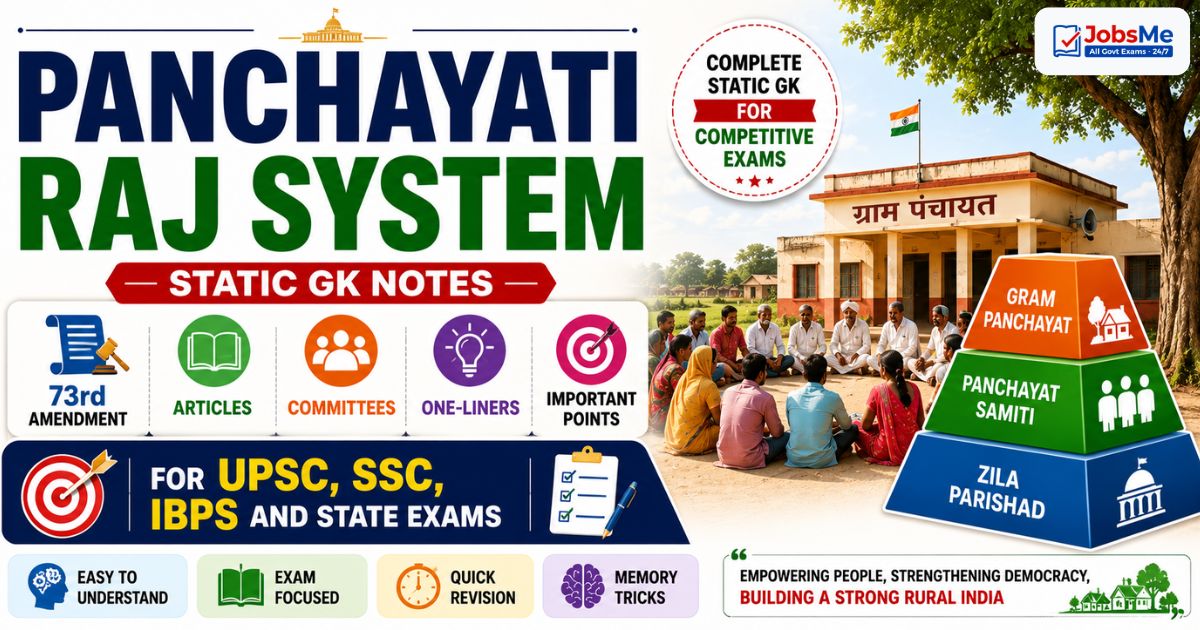
Panchayati Raj System Static GK Notes - 73rd Amendment, Articles, Committees and One-Liners for UPSC, SSC, IBPS and State Exams
This article gives a complete static GK package on the Panchayati Raj System covering its historical evolution, the 73rd Constitutional Amendment Act of 1992, all important articles (243 to 243-O), the Eleventh Schedule, key committees, reservations, finance and election bodies. It is designed for UPSC, SSC CGL, IBPS PO/Clerk, RRB NTPC, Insurance and State PCS aspirants and includes mnemonics, comparison tables and one-liners for fast revision.
Jump to section
- Introduction to the Panchayati Raj System
- Core Concepts: Panchayat, PRI and Three-Tier Structure
- Historical Evolution of Panchayati Raj in India
- The 73rd Constitutional Amendment Act, 1992
- Three-Tier Structure of Panchayati Raj
- Eleventh Schedule: 29 Subjects Devolved to Panchayats
- State Finance Commission and State Election Commission
- Exempted Areas and the PESA Act
- Reservation in Panchayats
- Famous Quotes and Personalities
- Memory Tricks and Mnemonics
- Additional Notes
- One-Liners for Quick Revision
Introduction to the Panchayati Raj System
The Panchayati Raj System is India's framework of rural local self-government, where elected village-level bodies manage local affairs, plan development and deliver public services at the grassroots. The system was given constitutional status by the 73rd Constitutional Amendment Act, 1992, which inserted Part IX (Articles 243 to 243-O) and the Eleventh Schedule into the Constitution of India.
For students preparing competitive exams, Panchayati Raj is a high-yield topic in Polity, Static GK and General Awareness sections of UPSC Prelims, SSC GK, IBPS, Insurance GK, Railways GK and State PCS. Questions repeatedly appear on the 73rd Amendment, committee names, articles, Eleventh Schedule subjects, reservation provisions and the State Finance Commission. You can sharpen polity revision alongside this topic through the Static GK notes hub on Jobsme.in.
This guide compiles every important fact - dates, committees, articles, exempt areas and one-liners - in one place so that revision before the exam day stays quick and focused.
Core Concepts: Panchayat, PRI and Three-Tier Structure
Before diving into facts, fix these definitions in memory:
- Panchayat - derived from the Sanskrit words "Pancha" (five) and "Ayat" (assembly). Traditionally a council of five elders chosen to settle disputes and run local affairs.
- Panchayati Raj Institution (PRI) - the constitutional system of rural local self-government in India, functioning as the third tier of government.
- Gram Sabha - a village assembly of all registered voters in the area of a village Panchayat; the foundational body of the Panchayati Raj system.
- Three-Tier System - Gram Panchayat (village) - Panchayat Samiti (block/intermediate) - Zilla Parishad (district).
- Local Self-Government - management of local affairs by bodies elected by local people, free from external interference.
The core objectives of the Panchayati Raj System are decentralisation of power, inclusive participation, empowerment of women and weaker sections, efficient service delivery, social justice, transparency and the nurturing of local leadership.
Historical Evolution of Panchayati Raj in India
Panchayats have existed in India since the Vedic age. The journey from the village councils of the Rigveda to the constitutional status of 1992 is a frequent exam question area.
Ancient and Medieval Period
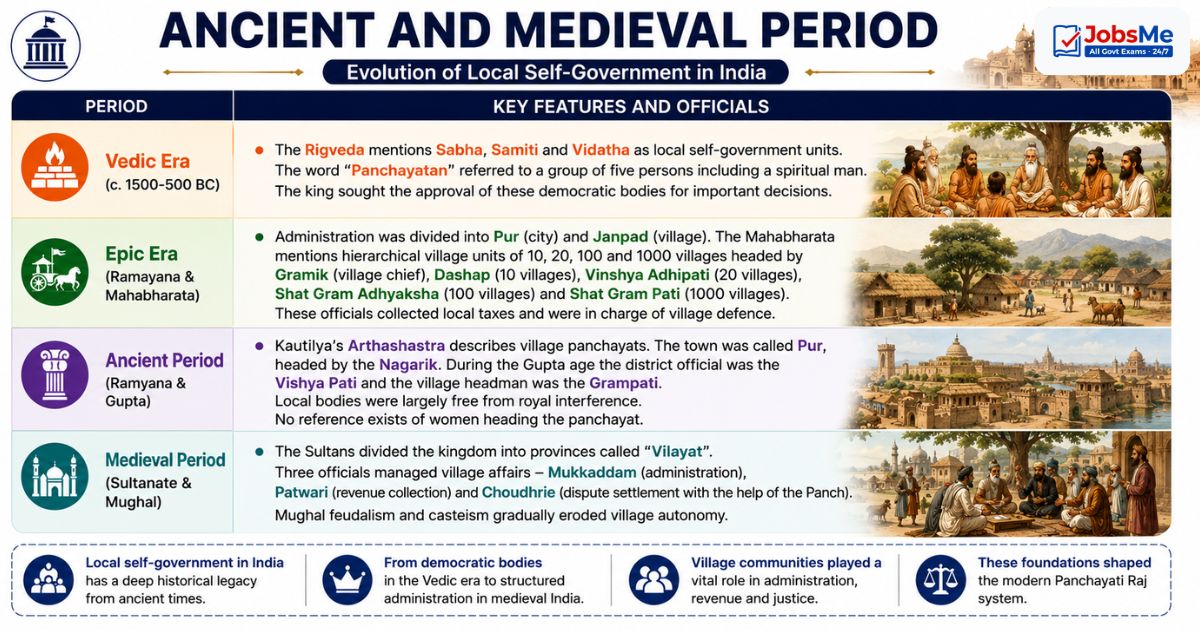
| Period | Key Features and Officials |
|---|---|
| Vedic Era (c. 1500-500 BC) | The Rigveda mentions Sabha, Samiti and Vidatha as local self-government units. The word "Panchayatan" referred to a group of five persons including a spiritual man. The king sought the approval of these democratic bodies for important decisions. |
| Epic Era (Ramayana & Mahabharata) | Administration was divided into Pur (city) and Janpad (village). The Mahabharata mentions hierarchical village units of 10, 20, 100 and 1000 villages headed by Gramik (village chief), Dashap (10 villages), Vinshya Adhipati (20 villages), Shat Gram Adhyaksha (100 villages) and Shat Gram Pati (1000 villages). These officials collected local taxes and were in charge of village defence. |
| Ancient Period (Mauryan & Gupta) | Kautilya's Arthashastra describes village panchayats. The town was called Pur, headed by the Nagarik. During the Gupta age the district official was the Vishya Pati and the village headman was the Grampati. Local bodies were largely free from royal interference. No reference exists of women heading the panchayat. |
| Medieval Period (Sultanate & Mughal) | The Sultans divided the kingdom into provinces called "Vilayat". Three officials managed village affairs - Mukkaddam (administration), Patwari (revenue collection) and Choudhrie (dispute settlement with the help of the Panch). Mughal feudalism and casteism gradually eroded village autonomy. |
British Period: From Mayo to Montagu-Chelmsford
| Year | Reform / Personality | Key Features |
|---|---|---|
| 1870 | Mayo's Resolution | First push toward decentralisation. Driven by fiscal compulsion after the 1857 revolt - local services had to be funded from local taxation. Introduced the concept of elected representatives in urban municipalities. |
| 1882 | Lord Ripon's Resolution | Called the "Magna Carta of local democracy in India". Lord Ripon is honoured as the "Father of Local Self-Government in India". All boards were mandated to have a two-thirds majority of non-officials, and chairpersons had to be elected non-officials. |
| 1907 | Royal Commission on Decentralisation | Chaired by C.E.H. Hobhouse. Recognised the importance of panchayats at the village level and recommended their revival. |
| 1919 | Montagu-Chelmsford Reforms | Local government became a "provincial subject". Recommended complete control to local bodies but organisational and fiscal constraints prevented them from becoming vibrant institutions. |
| 1925 | Provincial Panchayat Acts | By 1925, eight provinces had passed Panchayat Acts; by 1926 six native states had also passed similar laws. Powers and tax-imposing functions of local bodies were however reduced. |
Post-Independence: Key Committees on Panchayati Raj
| Year | Committee / Event | Recommendation or Significance |
|---|---|---|
| 2 Oct 1952 | Community Development Programme (CDP) | Launched on Gandhi Jayanti under the influence of the Etawah Project led by American expert Albert Mayer. Covered almost all rural development activities through village panchayats. |
| 1953 | National Extension Service (NES) | Introduced as a prologue to CDP. Did not yield significant results due to bureaucracy, lack of people's participation and poorly trained staff. |
| 1957 | Balwant Rai Mehta Committee | Constituted by the National Development Council. Recommended a three-tier PRI structure - Gram Panchayats (village), Panchayat Samitis (block) and Zilla Parishads (district). This is the foundation of the modern Panchayati Raj system. |
| 2 Oct 1959 | Rajasthan launches PRI | Rajasthan became the first state to implement Panchayati Raj. Inaugurated by Pandit Nehru in Nagaur district. |
| 1 Nov 1959 | Andhra Pradesh launches PRI | Andhra Pradesh became the second state to adopt the three-tier system in the same year. |
| 1977 | Ashok Mehta Committee | Recommended a two-tier system - Zilla Parishad and Mandal Panchayat. Suggested the district as the first point of decentralisation. Karnataka adopted these recommendations. |
| 1985 | G.V.K. Rao Committee | Recommended the "district as the basic unit of planning" with a District Development Commissioner, and regular elections to panchayats. |
| 1986 | L.M. Singhvi Committee | Recommended granting constitutional status and more financial resources to panchayats. Suggested judicial tribunals for PRI-related matters. |
| 1988 | Sarkaria Commission | Reviewed Centre-State relations and supported strengthening of local self-government. |
| 1989 | P.K. Thungan Committee | Recommended constitutional recognition of PRIs. |
| 1989 | 64th Amendment Bill (Rajiv Gandhi) | Introduced by PM Rajiv Gandhi to give constitutional status to PRIs. Failed in the Rajya Sabha. |
| 1990 | Harlal Singh Kharra Committee | Continued the push for stronger constitutional backing for PRIs. |
| 1991 | 72nd Amendment Bill (P.V. Narasimha Rao) | Introduced by PM P.V. Narasimha Rao in September 1991. Became the basis for the eventual 73rd Amendment. |
| Dec 1992 | 73rd and 74th Constitutional Amendments | Both passed by Parliament. The 73rd Amendment Act came into force on 24 April 1993 (Panchayats); the 74th Amendment Act came into force on 1 June 1993 (Municipalities). |
For exam-day refreshers on such polity facts, bookmark Jobsme.in daily current affairs and pair it with weekly polity revision.
The 73rd Constitutional Amendment Act, 1992
The 73rd CAA is the single most important law on Panchayati Raj. It added Part IX (Articles 243 to 243-O) and the Eleventh Schedule to the Constitution of India and gave PRIs constitutional status.
Important Articles under Part IX of the Constitution
| Article | Provision |
|---|---|
| Article 40 | (Original Constitution, DPSP) Directs the State to organise village panchayats and endow them with powers and authority to function as units of self-government. |
| Article 243 | Definitions related to Panchayats - village, intermediate, district, Gram Sabha, etc. |
| Article 243A | Gram Sabha - powers and functions to be determined by the State Legislature. |
| Article 243B | Constitution of Panchayats - mandates a three-tier system. States with population not exceeding 20 lakh may skip the intermediate (block) level. |
| Article 243C | Composition of Panchayats; direct election of all seats. |
| Article 243D | Reservation of seats for SCs, STs and women (one-third); reservation of chairperson posts. |
| Article 243E | Five-year term for panchayats. Fresh elections within six months of dissolution. |
| Article 243F | Disqualifications for membership. Minimum age to contest panchayat elections is 21 years. |
| Article 243G | Powers, authority and responsibilities of Panchayats - linked to the Eleventh Schedule. |
| Article 243H | Powers of Panchayats to impose taxes and their financial resources. |
| Article 243I | Constitution of the State Finance Commission by the Governor every five years. |
| Article 243J | Audit of accounts of Panchayats. |
| Article 243K | Constitution of the State Election Commission for superintendence, direction and control of panchayat elections. |
| Article 243L | Application to Union Territories. |
| Article 243M | Exemption clause - Part IX does not apply to certain Scheduled Areas, Nagaland, Meghalaya, Mizoram and Darjeeling hills. |
| Article 243N | Continuance of existing laws and panchayats until amended or repealed. |
| Article 243O | Bar to interference by courts in electoral matters of Panchayats. |
| Article 243ZD | (Added by 74th Amendment) Constitution of the District Planning Committee to consolidate plans prepared by Panchayats and Municipalities. |
| Article 246 | Empowers the State Legislature to legislate on any subject relating to local self-government. |
| Article 334 | Governs the duration of SC/ST reservation - presently extended till 2030. |
Salient Features of the 73rd Amendment
- Gram Sabha is the foundation of the Panchayati Raj system.
- Three-tier structure at village, intermediate and district levels (except in states with less than 20 lakh population).
- All members at every level to be elected by direct election.
- Chairpersons of intermediate and district panchayats elected indirectly by members; village chairperson elected as per State law.
- Reservation for SCs, STs in proportion to population; not less than one-third seats and chairperson posts for women; State Legislature may reserve for OBCs.
- Tenure of five years; fresh elections within six months of dissolution.
- Minimum age to contest panchayat elections is 21 years.
- Independent State Election Commission and State Finance Commission in each State.
- Eleventh Schedule lists 29 functional subjects for devolution to Panchayats.
- Bar on judicial interference in panchayat electoral matters.
Three-Tier Structure of Panchayati Raj
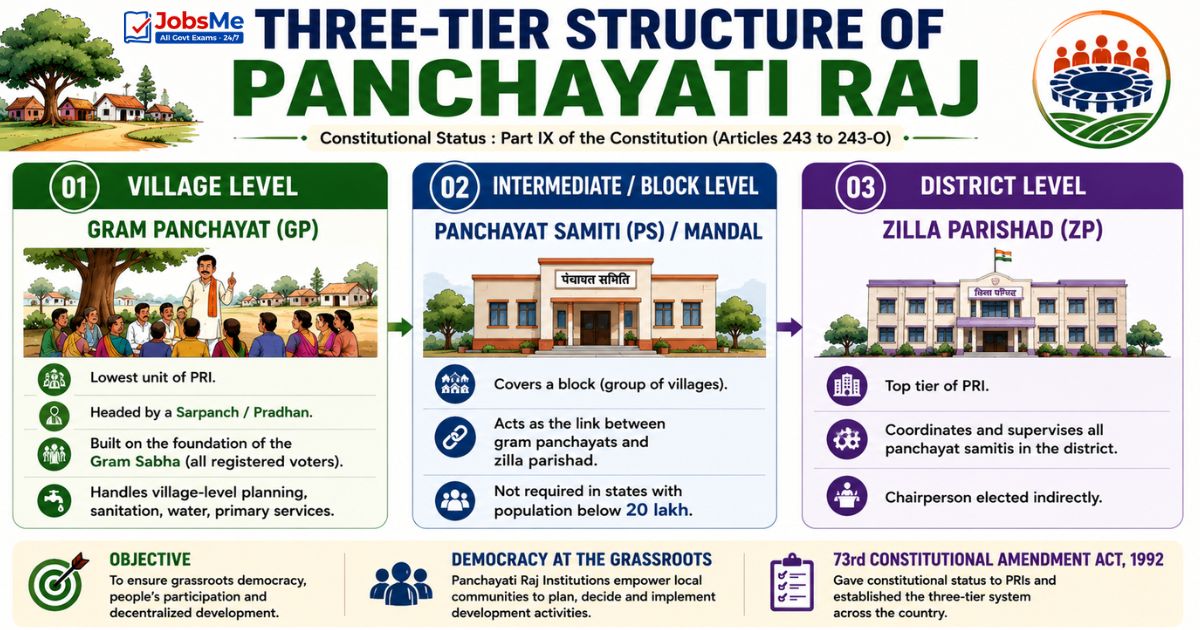
| Tier | Body | Key Features |
|---|---|---|
| Village Level | Gram Panchayat (GP) | Lowest unit of PRI. Headed by a Sarpanch / Pradhan. Built on the foundation of the Gram Sabha (all registered voters). Handles village-level planning, sanitation, water, primary services. |
| Intermediate / Block Level | Panchayat Samiti (PS) / Mandal | Covers a block (group of villages). Acts as the link between gram panchayats and the zilla parishad. Not required in states with population below 20 lakh. |
| District Level | Zilla Parishad (ZP) | Top tier of PRI. Coordinates and supervises all panchayat samitis in the district. Chairperson elected indirectly. |
Eleventh Schedule: 29 Subjects Devolved to Panchayats
The Eleventh Schedule, inserted by the 73rd CAA and linked to Article 243G, lists 29 functional items that State Legislatures may devolve to Panchayats. These cover almost the entire spectrum of rural life.
| No. | Subject under 11th Schedule |
|---|---|
| 1 | Agriculture, including agricultural extension |
| 2 | Land improvement, implementation of land reforms, land consolidation and soil conservation |
| 3 | Minor irrigation, water management and watershed development |
| 4 | Animal husbandry, dairying and poultry |
| 5 | Fisheries |
| 6 | Social forestry and farm forestry |
| 7 | Minor forest produce |
| 8 | Small-scale industries, including food processing industries |
| 9 | Khadi, village and cottage industries |
| 10 | Rural housing |
| 11 | Drinking water |
| 12 | Fuel and fodder |
| 13 | Roads, culverts, bridges, ferries, waterways and other means of communication |
| 14 | Rural electrification, including distribution of electricity |
| 15 | Non-conventional energy sources |
| 16 | Poverty alleviation programme |
| 17 | Education, including primary and secondary schools |
| 18 | Technical training and vocational education |
| 19 | Adult and non-formal education |
| 20 | Libraries |
| 21 | Cultural activities |
| 22 | Markets and fairs |
| 23 | Health and sanitation, including hospitals, primary health centres and dispensaries |
| 24 | Family welfare |
| 25 | Women and child development |
| 26 | Social welfare, including welfare of the handicapped and mentally retarded |
| 27 | Welfare of the weaker sections, particularly SCs and STs |
| 28 | Public distribution system |
| 29 | Maintenance of community assets |
State Finance Commission and State Election Commission
| Body | Key Features |
|---|---|
| State Election Commission (Article 243K) | A constitutional body at the state level. Consists of a State Election Commissioner appointed by the Governor. Cannot be removed except in the same manner as a judge of the State High Court. Conducts elections to all three tiers of PRIs. |
| State Finance Commission (Article 243I) | Constituted by the Governor every five years to review the financial position of panchayats. Recommends principles for sharing taxes, grants-in-aid from the Consolidated Fund of the State and measures to improve panchayat finances. Reports are placed before the State Legislature. |
| District Planning Committee (Article 243ZD) | Added by the 74th Amendment. Consolidates the development plans prepared by panchayats and municipalities at the district level. |
Exempted Areas and the PESA Act
- Scheduled Areas under the Fifth Schedule in Andhra Pradesh, Bihar (now Jharkhand), Gujarat, Himachal Pradesh, Madhya Pradesh (including Chhattisgarh), Maharashtra, Odisha and Rajasthan.
- States of Nagaland, Meghalaya and Mizoram - excluded from Part IX.
- Hill areas of Darjeeling district in West Bengal, where the Darjeeling Gorkha Hill Council functions.
- PESA Act, 1996 - the Provisions of Panchayats (Extension to the Scheduled Areas) Act, 1996, extends Part IX with modifications to the Fifth Schedule areas, recognising tribal customs and the Gram Sabha as the central body.
- 83rd Constitutional Amendment Act, 2000 - exempted Arunachal Pradesh from SC reservation in panchayats as the state has no Scheduled Castes.
Reservation in Panchayats
- Seats for SCs and STs reserved in proportion to their population at every level.
- One-third of total seats reserved for women (including women within SC and ST quota).
- One-third of chairperson posts reserved for women at every level.
- State Legislature may reserve seats and chairperson posts for OBCs.
- SC/ST reservation governed by Article 334, presently extended till 2030.
- SC reservation does not apply to Arunachal Pradesh (83rd Amendment, 2000).
Famous Quotes and Personalities
| Personality | Significance |
|---|---|
| Lord Ripon (1882) | "Father of Local Self-Government in India". His resolution is called the Magna Carta of local democracy. |
| Mahatma Gandhi | Famously said: "When the panchayat raj is established, public opinion will do what violence can never do." Strong advocate of village self-rule (Gram Swaraj). |
| Dr. B.R. Ambedkar | Opposed inclusion of village panchayats in the Constitution, calling Indian villages "a den of ignorance and casteism". Panchayats finally entered as Article 40 (DPSP) - a non-binding directive. |
| Albert Mayer | American expert behind the Etawah Project, the inspiration for the Community Development Programme (1952). |
| Balwant Rai Mehta | Architect of the modern three-tier Panchayati Raj system (1957). |
| Ashok Mehta | Recommended a two-tier system (Zilla Parishad and Mandal Panchayat) in 1977. |
| Rajiv Gandhi | Introduced the 64th Amendment Bill (1989) to give constitutional status to PRIs; the Bill failed in the Rajya Sabha. |
| P.V. Narasimha Rao | Prime Minister under whom the comprehensive 72nd Amendment Bill (1991) was introduced, leading to the 73rd CAA. |
Memory Tricks and Mnemonics
Trick 1: The "GBA" Three-Tier Hierarchy
To remember the three tiers from top to bottom, use "GBA - Gram, Block, District = Sarpanch, Pradhan, Adhyaksh":
- Gram Panchayat = Village level
- Panchayat Samiti = Block / Intermediate
- Zilla Parishad = District level
Trick 2: "73 - Rural, 74 - Urban"
Two amendments came together. Remember: 73rd is Rural (Panchayats - Part IX) and 74th is Urban (Municipalities - Part IXA). The smaller number for the smaller settlement-type (village comes first historically).
Trick 3: "BAGS" of Committees
Remember the four most-asked committees in order using "BAGS":
- B - Balwant Rai Mehta (1957) - 3-tier system
- A - Ashok Mehta (1977) - 2-tier system
- G - G.V.K. Rao (1985) - district as planning unit
- S - Singhvi (L.M. Singhvi, 1986) - constitutional status
Trick 4: "21-5-6-29-20" Number String
One number string covers the most-asked PRI numbers:
- 21 = minimum age to contest panchayat elections
- 5 = years - tenure of panchayats
- 6 = months - maximum gap for elections after dissolution
- 29 = subjects in the Eleventh Schedule
- 20 = lakh population - states below this need not have intermediate tier
Trick 5: "RA-AP" for First Two States
The first two states to adopt PRI were RA-AP:
- RA = Rajasthan (2 October 1959) - Nagaur district, first state
- AP = Andhra Pradesh (1 November 1959) - second state
Trick 6: "NMM Three Sisters Excluded"
Three north-eastern sister states are excluded from Part IX - remember as "NMM": Nagaland, Meghalaya, Mizoram. Add Arunachal Pradesh exemption from SC reservation (83rd Amendment) for the bonus mark.
Trick 7: "Ripon Wrote the Magna Carta of Local India"
Lord Ripon (1882) = Father of Local Self-Government. His resolution is the Magna Carta of Local Democracy in India. Mayo started, Ripon defined, Hobhouse strengthened, Montagu-Chelmsford provincialised.
Additional Notes
Frequently Confused Facts
- Article 40 vs Article 243 - Article 40 is the DPSP (non-binding) on village panchayats; Article 243 onward (added in 1992) is the binding constitutional framework.
- Lord Mayo vs Lord Ripon - Mayo (1870) initiated decentralisation due to fiscal compulsion; Ripon (1882) is the actual Father of Local Self-Government.
- Balwant Rai Mehta vs Ashok Mehta - Balwant Rai Mehta (1957) recommended a three-tier system; Ashok Mehta (1977) recommended a two-tier system.
- 11th Schedule vs 12th Schedule - 11th Schedule (29 subjects) belongs to Panchayats (Rural, 73rd CAA); 12th Schedule (18 subjects) belongs to Municipalities (Urban, 74th CAA).
- State Election Commission vs Election Commission of India - SEC handles only panchayat and municipality elections; ECI handles Parliament, State Legislature, President and Vice-President.
- State Finance Commission vs Finance Commission of India - SFC is constituted by the Governor every 5 years for panchayat finances; the central Finance Commission (Article 280) is constituted by the President.
- 24 April vs 1 June - 24 April 1993 is when the 73rd CAA came into force (now National Panchayati Raj Day); 1 June 1993 is when the 74th CAA came into force.
Repeating PYQ Patterns
- UPSC Prelims - heavily tests Article numbers (243B for three-tier, 243D for reservation, 243K for SEC), the Eleventh Schedule and PESA Act, 1996.
- SSC CGL / CHSL - asks the first state to adopt PRI (Rajasthan, 1959), Father of Local Self-Government (Lord Ripon) and the three-tier names.
- IBPS PO / Clerk - focuses on minimum age (21), tenure (5 years) and reservation for women (one-third).
- Railways (RRB NTPC, Group D) - asks about the 73rd and 74th Amendments, the number of subjects in the 11th Schedule (29) and Balwant Rai Mehta Committee.
- State PCS - tests state-specific facts like Nagaur (Rajasthan), Karnataka's adoption of the Ashok Mehta model and exempted areas.
Quick Insight
The Panchayati Raj System is the world's largest experiment in grassroots democracy - India has nearly 2.5 lakh PRIs and urban local bodies and over 3 million elected representatives, of which around 1.4 million are women, the highest count in any country. The SVAMITVA scheme (Survey of Villages and Mapping with Improvised Technology in Village Areas) launched on National Panchayati Raj Day (24 April) is a major modern initiative aimed at issuing property cards to rural households. Aspirants are advised to read Panchayati Raj alongside related topics like Static GK polity notes and Banking Awareness for cross-subject preparation.
One-Liners for Quick Revision
- Panchayati Raj System - System of rural local self-government in India, third tier of government.
- Panchayat (etymology) - From Sanskrit "Pancha" (five) and "Ayat" (assembly), originally a council of five elders.
- Article 40 - DPSP directing the State to organise village panchayats.
- Article 246 - Empowers State Legislature to legislate on local self-government.
- 73rd Constitutional Amendment Act - Passed in December 1992, came into force on 24 April 1993, gave PRIs constitutional status.
- 74th Constitutional Amendment Act - Passed in December 1992, came into force on 1 June 1993, deals with urban local bodies.
- Part IX of Constitution - Titled "The Panchayats", contains Articles 243 to 243-O, added by 73rd CAA.
- Part IXA - Titled "The Municipalities", added by 74th CAA.
- Eleventh Schedule - Lists 29 functional subjects for Panchayats; added by 73rd CAA; linked to Article 243G.
- Twelfth Schedule - Lists 18 subjects for Municipalities; added by 74th CAA.
- Three-tier system - Gram Panchayat (village), Panchayat Samiti (block), Zilla Parishad (district).
- 20 lakh rule (Article 243B) - States with population not exceeding 20 lakh need not have an intermediate (block) level panchayat.
- Article 243A - Provides for Gram Sabha as the foundation of the panchayati raj system.
- Article 243D - Reservation of seats for SCs, STs and women (one-third).
- Article 243E - Five-year tenure; elections within six months of dissolution.
- Article 243F - Minimum age to contest panchayat elections is 21 years.
- Article 243G - Powers, authority and responsibilities of panchayats.
- Article 243I - State Finance Commission constituted by the Governor every five years.
- Article 243K - State Election Commission - constitutional body, commissioner appointed by Governor, removable like a High Court judge.
- Article 243O - Bar on court interference in panchayat electoral matters.
- Article 243ZD - District Planning Committee (added by 74th Amendment).
- Article 334 - Governs duration of SC/ST reservation; extended till 2030.
- Lord Ripon (1882) - Father of Local Self-Government in India; his resolution is the Magna Carta of local democracy.
- Mayo's Resolution (1870) - First step toward decentralisation under British rule.
- Royal Commission on Decentralisation (1907) - Chaired by C.E.H. Hobhouse.
- Montagu-Chelmsford Reforms (1919) - Made local government a provincial subject.
- Community Development Programme - Launched on 2 October 1952; inspired by the Etawah Project of Albert Mayer.
- National Extension Service - Introduced in 1953 as a prologue to CDP.
- Balwant Rai Mehta Committee (1957) - Recommended the three-tier PRI system (GP, PS, ZP).
- Rajasthan - First state to launch Panchayati Raj on 2 October 1959 in Nagaur district.
- Andhra Pradesh - Second state to launch PRI on 1 November 1959.
- Ashok Mehta Committee (1977) - Recommended a two-tier system (Zilla Parishad and Mandal Panchayat); adopted by Karnataka.
- Hanumantha Rao Committee (1983) - On strengthening district-level planning.
- G.V.K. Rao Committee (1985) - Recommended "district as the basic unit of planning".
- L.M. Singhvi Committee (1986) - Recommended constitutional status and more financial resources for panchayats.
- Sarkaria Commission (1988) - Reviewed Centre-State relations.
- P.K. Thungan Committee (1989) - Recommended constitutional recognition of PRIs.
- 64th Amendment Bill (1989) - Introduced by Rajiv Gandhi; failed in Rajya Sabha.
- Harlal Singh Kharra Committee (1990) - Continued push for stronger PRIs.
- 72nd Amendment Bill (1991) - Introduced by P.V. Narasimha Rao; basis of the 73rd CAA.
- Gram Sabha - Body of all registered voters within a village panchayat area.
- Direct election - Compulsory for all members of all three tiers.
- Indirect election - For chairpersons at intermediate and district levels.
- Reservation for women - One-third of total seats and one-third of chairperson posts.
- OBC reservation - At the discretion of the State Legislature.
- PESA Act, 1996 - Extends Part IX provisions with modifications to Scheduled (Fifth Schedule) areas.
- Excluded states from Part IX - Nagaland, Meghalaya and Mizoram.
- Excluded area - Hill areas of Darjeeling (Darjeeling Gorkha Hill Council).
- 83rd Constitutional Amendment Act, 2000 - Exempted Arunachal Pradesh from SC reservation in panchayats.
- Compulsory provisions - 3-tier panchayats, direct elections, Gram Sabha, 21-year minimum age, reservations.
- Voluntary provisions - Devolution of additional powers, greater financial autonomy, representation of MPs and MLAs.
- National Panchayati Raj Day - 24 April every year (anniversary of 73rd CAA's commencement).
- SVAMITVA Scheme - Launched on National Panchayati Raj Day; aims at distribution of e-property cards in rural areas using drone mapping.
- Gandhi quote - "When the panchayat raj is established, public opinion will do what violence can never do."
- B.R. Ambedkar - Opposed the inclusion of village panchayats in the Constitution.
- Vedic Sabha-Samiti-Vidatha - Three local self-government bodies mentioned in the Rigveda.
- Mahabharata officials - Gramik (village), Dashap (10 villages), Vinshya Adhipati (20), Shat Gram Adhyaksha (100), Shat Gram Pati (1000).
- Gupta period officials - Vishya Pati (district), Grampati (village headman).
- Sultanate village officials - Mukkaddam (administration), Patwari (revenue), Choudhrie (disputes).
- Sultanate provinces - Called "Vilayat".
Practice these one-liners through quick MCQs on the Static GK quiz section and pair Polity revision with daily current affairs quizzes. For exam alerts and direct application forms, keep checking the latest govt jobs notifications page on Jobsme.in.
Free quiz • No signup required
Put this topic into practice with Indian Cultural Institutions – Static GK MCQ Quiz. It is the quickest way to reinforce what you just learned.
Frequently Asked Questions
What is the Panchayati Raj System in India?
Which Constitutional Amendment gave constitutional status to Panchayati Raj Institutions?
Who is known as the Father of Local Self-Government in India?
Which was the first state in India to adopt the Panchayati Raj System?
What did the Balwant Rai Mehta Committee recommend?
How many subjects are there in the Eleventh Schedule of the Constitution?
What is the minimum age to contest Panchayat elections in India?
What is the tenure of a Panchayat under the 73rd Amendment?
Which states are excluded from the application of Part IX of the Constitution?
What is the role of the State Election Commission for Panchayats?

About the author