Emergency Provisions of Constitution Static GK: Articles 352 to 360 Notes for UPSC, SSC and Banking Exams
This article explains the Emergency Provisions of the Indian Constitution under Articles 352 to 360, covering National Emergency, President's Rule, and Financial Emergency in a simple exam-oriented way. Students preparing for UPSC, SSC, IBPS, RRB, and State PCS exams will find detailed tables, memory tricks, landmark cases, and one-liner notes to revise the topic quickly. It is one of the most repeated Static GK and Polity topics across competitive exams.
Jump to section
- Introduction to Emergency Provisions of the Indian Constitution
- Core Concept: What Are Emergency Provisions?
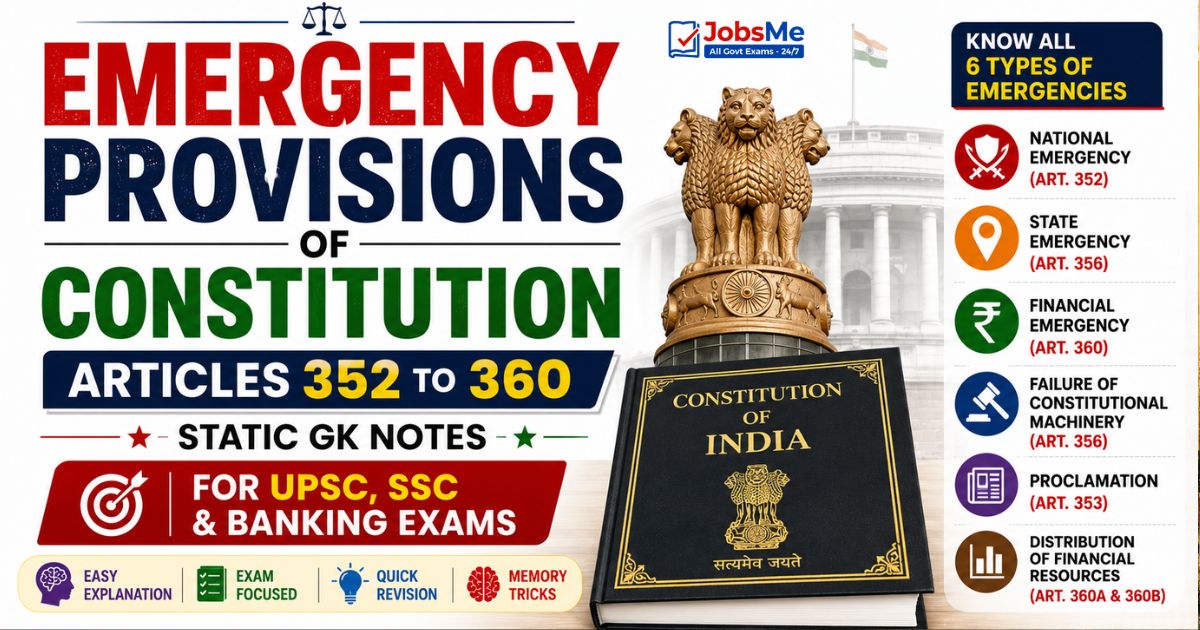
- Articles 352 to 360: Complete List of Emergency Provisions
- Types of Emergencies in the Indian Constitution
- Effects of Emergency on Fundamental Rights
- Landmark Cases and Constitutional Amendments
- Memory Tricks and Mnemonics for Emergency Provisions
- Additional Notes for Quick Revision
- One-Liners for Quick Revision
Introduction to Emergency Provisions of the Indian Constitution
The Emergency Provisions of Constitution are one of the most important Static GK and Indian Polity topics asked in almost every government exam. These provisions are contained in Part XVIII (Articles 352 to 360) of the Constitution and empower the President of India to act decisively when the country faces situations like war, external aggression, armed rebellion, breakdown of constitutional machinery in a state, or financial instability. For students preparing for UPSC Prelims, SSC GK, IBPS, RRB NTPC, Insurance, Defence, and State PCS exams, knowing these articles and their effects is a guaranteed scoring area.
The Emergency Provisions in the Indian Constitution have been borrowed from the Weimar Constitution of Germany and the Government of India Act, 1935. They are designed to safeguard the sovereignty, unity, integrity, and democratic political system of India during extraordinary situations. Aspirants often see direct questions on articles, grounds of declaration, parliamentary approval, and landmark cases like the S.R. Bommai Case and the Minerva Mills Case.
If you are revising Polity along with daily updates, you can also explore our daily current affairs section to stay updated with constitutional debates and Supreme Court verdicts that often connect with this static topic.
Core Concept: What Are Emergency Provisions?
A state of Emergency in India refers to a period of governance proclaimed by the President of India during certain crisis situations. Under the advice of the Council of Ministers, the President can overrule many constitutional provisions, including some Fundamental Rights, to handle the crisis effectively.
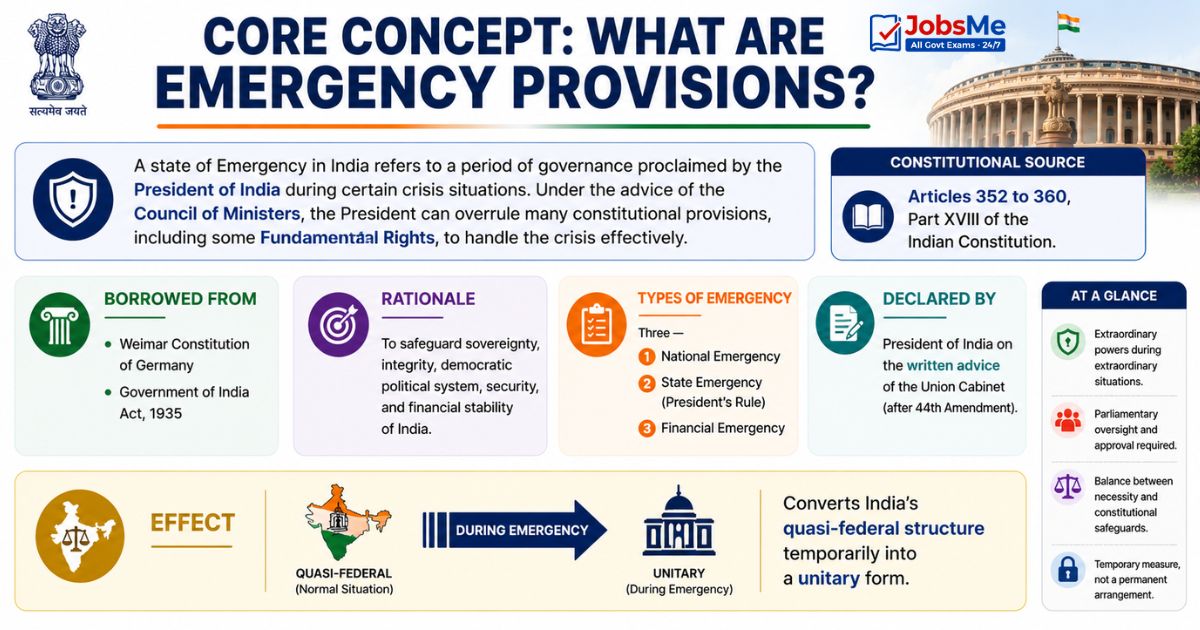
- Constitutional Source: Articles 352 to 360, Part XVIII of the Indian Constitution.
- Borrowed From: Weimar Constitution of Germany and Government of India Act, 1935.
- Rationale: To safeguard sovereignty, integrity, democratic political system, security, and financial stability of India.
- Types of Emergency: Three — National Emergency, State Emergency (President's Rule), and Financial Emergency.
- Declared By: President of India on the written advice of the Union Cabinet (after 44th Amendment).
- Effect: Converts India's quasi-federal structure temporarily into a unitary form.
Articles 352 to 360: Complete List of Emergency Provisions
Articles 352 to 360 form the legal framework for declaring and managing all three types of emergencies. The table below lists every article with its detailed subject-matter — a must-memorise table for UPSC Prelims, SSC GK, and Banking Awareness aspirants.
List of Articles Dealing with Emergency Provisions
| Article | Subject-Matter | Key Features and Exam Notes |
|---|---|---|
| Article 352 | Proclamation of Emergency | Empowers the President to declare a National Emergency on grounds of war, external aggression, or armed rebellion. Invoked three times — 1962, 1971, and 1975. Most-asked article in Polity GK. |
| Article 353 | Effect of Proclamation of Emergency | Centre gets the power to give executive directions to any state on any matter. Parliament gets the power to legislate on subjects in the State List. |
| Article 354 | Application of provisions relating to distribution of revenues | President can modify the constitutional distribution of revenues between the Centre and the states while a Proclamation of Emergency is in operation. |
| Article 355 | Duty of the Union to protect States | It is the duty of the Centre to protect every state against external aggression and internal disturbance and to ensure governance as per the Constitution. |
| Article 356 | Failure of constitutional machinery in States | Empowers the President to impose President's Rule when the constitutional machinery in a state fails. Popularly called State Emergency. Invoked more than 115 times in India. |
| Article 357 | Exercise of legislative powers under Article 356 | Parliament can confer law-making powers on the President or any other authority to make laws for the state under President's Rule. |
| Article 358 | Suspension of Article 19 during Emergencies | Automatically suspends the six Fundamental Rights under Article 19 during External Emergency (war or external aggression). Not applicable to armed rebellion after the 44th Amendment. |
| Article 359 | Suspension of enforcement of rights under Part III | President can suspend the right to move any court for the enforcement of Fundamental Rights through a Presidential Order. Articles 20 and 21 cannot be suspended after the 44th Amendment. |
| Article 360 | Provisions as to Financial Emergency | Empowers the President to declare a Financial Emergency when the financial stability or credit of India is threatened. Never declared in India till date. |
| Article 365 | Failure to comply with Centre's directions | If a state fails to comply with directions of the Centre, the President can hold that the constitutional machinery has failed and impose President's Rule under Article 356. |
Types of Emergencies in the Indian Constitution
The Indian Constitution envisages three types of emergencies, each meant to handle a different kind of crisis. The table below summarises their grounds, approval procedure, duration, and judicial review — the exact format SSC, IBPS, and RRB exams love to ask.
Comparison of National, State, and Financial Emergency
| Basis | National Emergency | State Emergency (President's Rule) | Financial Emergency |
|---|---|---|---|
| Article | Article 352 | Article 356 (also Article 365) | Article 360 |
| Grounds of Declaration | War, External Aggression, Armed Rebellion | Failure of constitutional machinery in a state; or state's failure to comply with Centre's directions | Threat to financial stability or credit of India |
| Parliamentary Approval | Within 1 month, by Special Majority of both Houses | Within 2 months, by Simple Majority of both Houses | Within 2 months, by Simple Majority of both Houses |
| Initial Duration | 6 months at a time; extendable indefinitely with approval every 6 months | 6 months at a time; maximum 3 years | Continues indefinitely until revoked; no repeated approval needed |
| Revocation | By the President OR by a resolution of the Lok Sabha (simple majority disapproval) | By the President at any time; no parliamentary approval needed | By the President at any time |
| Times Invoked | Three times — 1962, 1971, 1975 | More than 115 times (over 90 times between 1950 and 1990 alone) | Never invoked, not even in the 1991 financial crisis |
| Judicial Review | Allowed (after Minerva Mills Case, 1980) | Allowed (after S.R. Bommai Case, 1994) | Allowed |
| Effect on Fundamental Rights | Article 19 suspended automatically (only on war/external aggression); other rights under Article 359 (except 20 and 21) | Not affected | Not affected |
National Emergency (Article 352)
A National Emergency is declared by the President when the security of India or any part of it is threatened by war, external aggression, or armed rebellion. Originally the term used was "internal disturbance," which was replaced by "armed rebellion" through the 44th Constitutional Amendment Act, 1978. When declared on grounds of war or external aggression, it is called an External Emergency; when declared on grounds of armed rebellion, it is called an Internal Emergency.
The President can declare a National Emergency even before the actual occurrence of war, armed rebellion, or external aggression. The 42nd Amendment Act, 1976 allowed emergency to be declared in the whole of India or a part of it. The 44th Amendment added safeguards including the requirement of a written recommendation from the Cabinet and approval by both Houses within one month.
| Feature | Detail |
|---|---|
| Article | Article 352 |
| Grounds | War, External Aggression, Armed Rebellion (the term "armed rebellion" replaced "internal disturbance" via the 44th Amendment) |
| Approval | Both Houses of Parliament must approve within 1 month by Special Majority |
| Duration | 6 months at a time; can be extended indefinitely with approval every 6 months |
| Revocation | By President anytime; Lok Sabha can also pass a disapproval resolution by simple majority. 1/10th of Lok Sabha members can demand a special sitting. |
| Effect on Legislature | Parliament can legislate on the State List; President can issue ordinances on State subjects. Lok Sabha and State Assembly tenures can be extended by 1 year at a time. |
| Effect on Executive | Centre can give executive directions to states on any matter |
| Effect on Finance | President can alter the Centre-State financial distribution and reduce grants to states |
| Effect on Fundamental Rights | Article 19 automatically suspended (Article 358) — only during war/external aggression. Article 359 allows suspension of enforcement of other FRs except Articles 20 and 21. |
| Times Declared | 1962 (Chinese aggression in NEFA), 1971 (Indo-Pak War), 1975 (Internal Emergency under Indira Gandhi). No emergency declared after 1977. |
President's Rule / State Emergency (Article 356)
President's Rule, also called State Emergency, is imposed when the constitutional machinery in a state fails. The Constitution itself does not use the word "emergency" for this provision. Article 355 imposes a duty on the Centre to ensure that every state's government is carried on according to the Constitution, and Article 356 is the tool used to fulfil this duty.
Under Article 356, the President can issue a proclamation if satisfied that the state government cannot be carried on according to the Constitution. Under Article 365, if a state fails to comply with directions from the Centre, the President can hold that the constitutional machinery has failed. Both grounds lead to the same outcome — imposition of President's Rule.
| Feature | Detail |
|---|---|
| Article | Article 356 (also Article 365) |
| Grounds | Failure of constitutional machinery in the state OR failure to comply with directions of the Centre |
| Approval | Both Houses of Parliament must approve within 2 months by Simple Majority |
| Duration | 6 months at a time, with a maximum total of 3 years. Extension beyond 1 year is allowed only if National Emergency is in operation OR the Election Commission certifies difficulty in holding elections. |
| Revocation | By President at any time; no parliamentary approval needed for revocation |
| Consequences | State Council of Ministers dismissed; Governor administers the state in the name of the President; State Legislative Assembly is either suspended or dissolved; Parliament makes laws for the state. |
| Effect on FRs | No effect — Fundamental Rights remain in force |
| Times Invoked | More than 115 times (frequently misused; over 90 times between 1950 and 1990) |
| Key Cases | K.K. Aboo v UOI (1965), State of Rajasthan v UOI (1977), S.R. Bommai Case (1994 — landmark) |
| Key Commissions | Sarkaria Commission (1987) — use sparingly with prior warning; Punchhi Commission (2008) — prefer localised emergency with duration not exceeding 3 months |
Financial Emergency (Article 360)
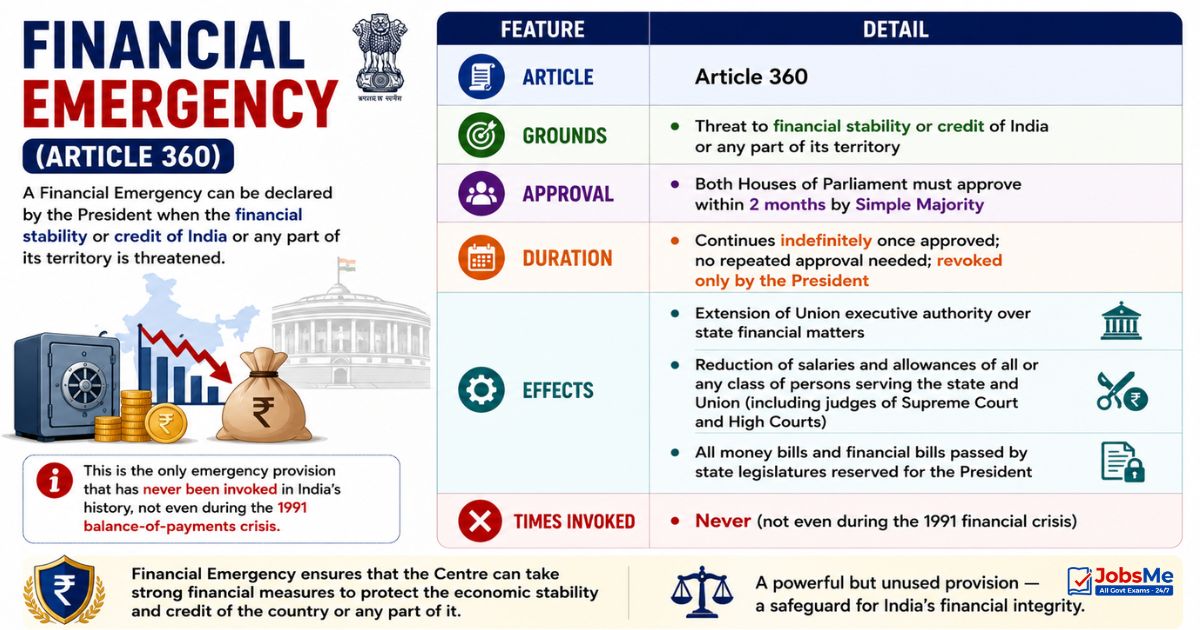
A Financial Emergency can be declared by the President when the financial stability or credit of India or any part of its territory is threatened. This is the only emergency provision that has never been invoked in India's history, not even during the 1991 balance-of-payments crisis. Once approved, it continues indefinitely until revoked and does not need repeated parliamentary approval.
| Feature | Detail |
|---|---|
| Article | Article 360 |
| Grounds | Threat to financial stability or credit of India or any part of its territory |
| Approval | Both Houses of Parliament must approve within 2 months by Simple Majority |
| Duration | Continues indefinitely once approved; no repeated approval needed; revoked only by the President |
| Effects | Extension of Union executive authority over state financial matters; reduction of salaries and allowances of all or any class of persons serving the state and Union (including judges of Supreme Court and High Courts); all money bills and financial bills passed by state legislatures reserved for the President. |
| Times Invoked | Never (not even during the 1991 financial crisis) |
Effects of Emergency on Fundamental Rights
Emergency provisions have a direct impact on Fundamental Rights, especially during a National Emergency. Articles 358 and 359 describe these effects clearly. This is a high-priority area for static GK revision in UPSC, SSC and Banking exams.
| Article | Provision | Key Details for Exams |
|---|---|---|
| Article 358 | Automatic suspension of Article 19 | The six rights under Article 19 are suspended automatically the moment a National Emergency is declared. After the 44th Amendment, this happens only when the emergency is declared on grounds of war or external aggression, not on armed rebellion. Article 19 revives automatically once the emergency ends. |
| Article 359 | Suspension of enforcement of other Fundamental Rights | The President, by an order, can suspend the right to move any court for the enforcement of Fundamental Rights. It suspends the remedy, not the rights themselves. Articles 20 and 21 cannot be suspended after the 44th Amendment. The order must be laid before Parliament. |
Landmark Cases and Constitutional Amendments
Several landmark cases and amendments have shaped the modern interpretation of emergency provisions. These are frequently tested in UPSC Prelims and Mains as well as State PCS exams.
| Case / Amendment | Year | Key Outcome |
|---|---|---|
| 38th Amendment Act | 1975 | Made the declaration of National Emergency immune from judicial review. Later removed by the 44th Amendment. |
| 42nd Amendment Act | 1976 | Allowed the President to declare emergency in a part of the country also, not just the whole. |
| 44th Amendment Act | 1978 | Replaced "internal disturbance" with "armed rebellion"; required written Cabinet recommendation; made Articles 20 and 21 non-suspendable; restored judicial review. |
| K.K. Aboo v UOI | 1965 | Early case dealing with the validity of President's Rule. |
| State of Rajasthan v UOI | 1977 | Dealt with the scope of Article 356 and judicial review of President's Rule. |
| Minerva Mills Case | 1980 | Supreme Court held that the proclamation of National Emergency can be challenged on grounds of malafide or wholly extraneous and irrelevant facts. |
| S.R. Bommai Case | 1994 | Landmark judgment. Held that judicial review of President's Rule is allowed; the assembly cannot be dissolved before parliamentary approval; and secularism is part of the basic structure of the Constitution. |
| Sarkaria Commission | 1987 | Recommended that Article 356 should be used sparingly and only as a last resort, with prior warning to the state. |
| Punchhi Commission | 2008 | Suggested localised emergency in a part of the state and limiting the duration of President's Rule to three months. |
Memory Tricks and Mnemonics for Emergency Provisions
Emergency Provisions are easy to remember with the right mnemonics. Below are some popular memory tricks used by exam aspirants to lock in articles, grounds, and timelines.
1. Mnemonic for the Three Types of Emergency: "NSF"
NSF = National - State - Financial
- N - National Emergency (Article 352)
- S - State Emergency / President's Rule (Article 356)
- F - Financial Emergency (Article 360)
Just remember "No Student Fails" if you remember NSF.
2. Mnemonic for Grounds of National Emergency: "WEA"
WEA = War, External aggression, Armed rebellion
Think of WEA as "We're Always Ready." This covers all three grounds under Article 352.
3. Trick for Articles 352 to 360: The "3-5-6-0 Pattern"
- 352 → National (3 wars: 1962, 1971, 1975)
- 356 → State Emergency (close to 360, in between)
- 360 → Financial (zero ending = zero invocations)
Remember: 360 ends in zero — and Financial Emergency has been invoked exactly zero times.
4. Approval Time Trick: "1 Special, 2 Simple"
- National Emergency → 1 month, Special majority
- President's Rule → 2 months, Simple majority
- Financial Emergency → 2 months, Simple majority
One National needs Special; the other Two need Simple.
5. Story-Based Trick for Years of National Emergency: "62-71-75"
"62 saw China, 71 saw Pakistan, 75 saw Indira."
- 1962 - Chinese aggression in NEFA
- 1971 - Indo-Pak war
- 1975 - Internal Emergency under Indira Gandhi
6. Article 358 vs 359 Contrast Trick
"358 = Automatic; 359 = Approval needed."
- Article 358 - Article 19 suspended automatically, only on War / External Aggression.
- Article 359 - Suspension of enforcement of FRs by Presidential Order; Articles 20 and 21 always protected.
7. Mnemonic for Bommai Case Highlights: "JAS"
JAS = Judicial review, Assembly cannot be dissolved before approval, Secularism is basic structure.
Think of "JAS = Just A Safeguard" against misuse of Article 356.
Additional Notes for Quick Revision
Frequently Confused Facts
- Article 358 vs Article 359: Article 358 suspends Article 19 automatically and only during war or external aggression. Article 359 needs a Presidential Order and can cover any FR except Articles 20 and 21.
- National Emergency vs President's Rule: In a National Emergency, the state executive and legislature continue; in President's Rule, the state ministry is dismissed and the assembly is suspended or dissolved.
- Article 356 vs Article 365: Article 356 is invoked when the constitutional machinery in a state fails. Article 365 is invoked when a state fails to comply with directions from the Centre — but both lead to President's Rule.
- External Emergency vs Internal Emergency: External Emergency is declared on war or external aggression; Internal Emergency is declared on armed rebellion.
- Special Majority vs Simple Majority: National Emergency needs special majority; President's Rule and Financial Emergency need only simple majority.
- Sarkaria vs Punchhi Commission: Sarkaria (1987) — use Article 356 sparingly. Punchhi (2008) — go for localised emergency and limit duration to three months.
Repeating PYQ Patterns
- UPSC Prelims: Articles 352, 356, and 360; effects on Fundamental Rights; 44th Amendment changes; Minerva Mills and Bommai cases.
- SSC CGL and CHSL: Number of times National Emergency declared; grounds of declaration; which constitution emergency provisions are borrowed from (Weimar Constitution of Germany).
- IBPS PO/Clerk and RRB NTPC: Article numbers; duration of each emergency; parliamentary approval timeline.
- State PCS: President's Rule, Sarkaria and Punchhi Commission recommendations.
- Insurance and Defence: Articles 358 and 359 distinctions; Articles 20 and 21 being non-suspendable.
Quick Insight
Emergency Provisions remain highly relevant in current affairs whenever there is a political crisis in a state, a major Supreme Court judgement on federalism, or a national security situation. The S.R. Bommai Case continues to be cited in nearly every dispute involving the imposition of President's Rule. Aspirants who want to stay ahead of the curve should track such developments through our daily current affairs updates and revise this topic alongside static GK notes for a balanced preparation.
One-Liners for Quick Revision
- Emergency Provisions → Part XVIII of the Indian Constitution → Articles 352 to 360.
- Source of Emergency Provisions → Weimar Constitution of Germany and Government of India Act, 1935.
- Three Types of Emergency → National (Article 352), State / President's Rule (Article 356), Financial (Article 360).
- Article 352 → Proclamation of National Emergency by the President.
- Article 353 → Effect of Proclamation of Emergency on Centre-State relations.
- Article 354 → Modification of constitutional distribution of revenues during emergency.
- Article 355 → Duty of the Union to protect every state against external aggression and internal disturbance.
- Article 356 → President's Rule in case of failure of constitutional machinery in a state.
- Article 357 → Exercise of legislative powers under a proclamation issued under Article 356.
- Article 358 → Automatic suspension of Article 19 during a National Emergency on war/external aggression.
- Article 359 → Suspension of enforcement of Fundamental Rights by Presidential Order; Articles 20 and 21 are non-suspendable.
- Article 360 → Financial Emergency on threat to financial stability or credit of India.
- Article 365 → State fails to comply with Centre's directions → grounds for President's Rule.
- Grounds for National Emergency → War, External Aggression, Armed Rebellion.
- "Armed Rebellion" → Replaced "internal disturbance" through the 44th Amendment Act, 1978.
- External Emergency → Declared on grounds of war or external aggression.
- Internal Emergency → Declared on grounds of armed rebellion.
- Parliamentary Approval for National Emergency → Within 1 month by special majority of both Houses.
- Duration of National Emergency → 6 months at a time, extendable indefinitely.
- National Emergency Revocation → By President or by Lok Sabha simple majority resolution.
- National Emergency Declared → Three times — 1962, 1971, 1975.
- 1962 Emergency → Due to Chinese aggression in NEFA.
- 1971 Emergency → Due to Indo-Pak war.
- 1975 Emergency → Internal Emergency under PM Indira Gandhi.
- 42nd Amendment, 1976 → Allowed emergency to be declared in part of India.
- 44th Amendment, 1978 → Multiple safeguards including written Cabinet advice and non-suspendability of Articles 20 and 21.
- Effect on Lok Sabha during Emergency → Tenure can be extended by 1 year at a time (max 6 months after emergency ends).
- President's Rule → Imposed under Article 356; the term "emergency" is not used in the Constitution for this.
- Parliamentary Approval for President's Rule → Within 2 months by simple majority of both Houses.
- Duration of President's Rule → 6 months at a time, maximum 3 years.
- Extension of President's Rule Beyond 1 Year → Possible only if a National Emergency is in operation or the Election Commission certifies difficulty in holding elections.
- President's Rule Revocation → By the President at any time without parliamentary approval.
- Number of Times President's Rule Imposed → More than 115 times in India.
- Bommai Case, 1994 → Judicial review of President's Rule allowed; secularism is part of the basic structure.
- Minerva Mills Case, 1980 → National Emergency can be challenged on the grounds of malafide.
- Sarkaria Commission, 1987 → Recommended sparing use of Article 356.
- Punchhi Commission, 2008 → Recommended localised emergency and three-month limit.
- Financial Emergency → Declared under Article 360; never invoked in India.
- 1991 Financial Crisis → Financial Emergency was not imposed.
- Parliamentary Approval for Financial Emergency → Within 2 months by simple majority.
- Duration of Financial Emergency → Indefinite once approved; revoked only by the President.
- Effects of Financial Emergency → Centre controls state finances; salaries of all government servants (including SC and HC judges) can be reduced; money bills reserved for the President.
- Effect on Fundamental Rights — Article 358 → Article 19 suspended automatically only during war/external aggression.
- Effect on Fundamental Rights — Article 359 → Presidential order can suspend enforcement of other FRs except Articles 20 and 21.
- K.K. Aboo v UOI, 1965 → Early case on validity of President's Rule.
- State of Rajasthan v UOI, 1977 → Dealt with scope of Article 356.
- 38th Amendment, 1975 → Made emergency declaration immune from judicial review; later deleted by 44th Amendment.
- Effect of National Emergency on Federalism → Quasi-federal structure becomes temporarily unitary.
- Power of Parliament during National Emergency → Can legislate on State List; laws cease to operate 6 months after emergency ends.
- Demand for Special Lok Sabha Sitting on Emergency → Can be made by 1/10th of Lok Sabha members.
Practise these one-liners regularly with our static GK quizzes and stay updated with constitutional news through our daily current affairs quizzes. Aspirants looking for fresh openings can also explore our latest government job notifications page for upcoming UPSC, SSC, IBPS, RRB, and PSU exams.
Free quiz • No signup required
Put this topic into practice with Indian Cultural Institutions – Static GK MCQ Quiz. It is the quickest way to reinforce what you just learned.
Frequently Asked Questions
Which articles deal with the Emergency Provisions in the Indian Constitution?
From which country has India borrowed the concept of Emergency Provisions?
How many types of emergencies are mentioned in the Indian Constitution?
On what grounds can a National Emergency be declared in India?
How many times has a National Emergency been declared in India?
Has a Financial Emergency ever been declared in India?
What is the difference between Article 358 and Article 359?
What is the maximum duration of President's Rule in a state?
What is the significance of the S.R. Bommai Case of 1994?
Which Fundamental Rights cannot be suspended even during a National Emergency?

About the author