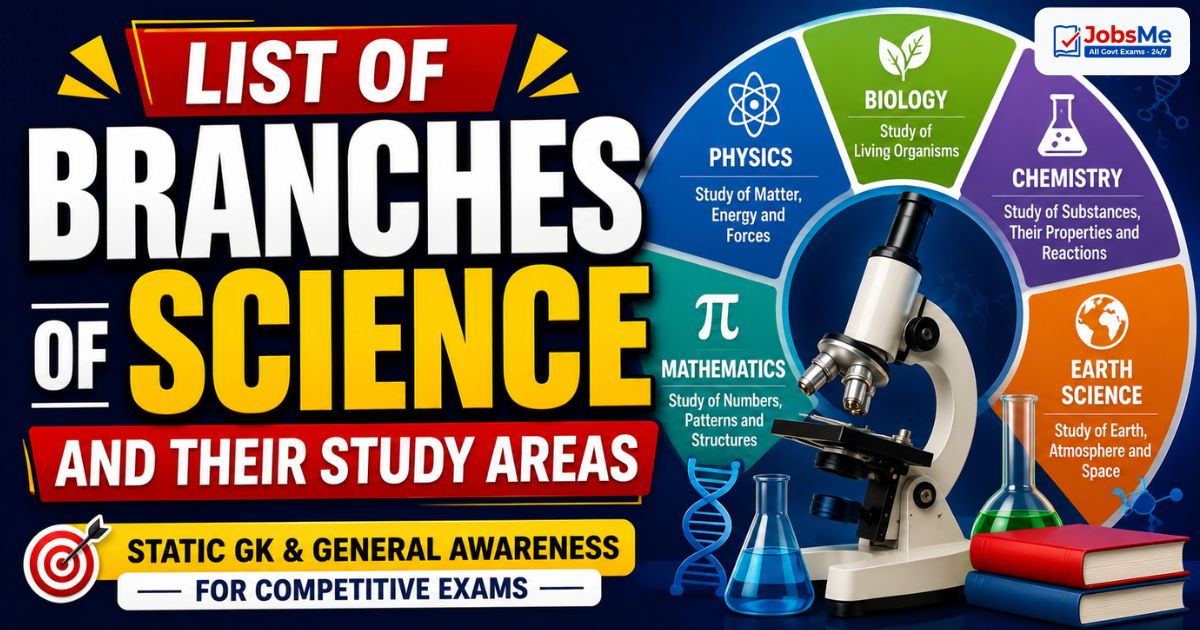
List of Branches of Science and Their Study Areas – Static GK & General Awareness for Competitive Exams with Memory Tricks
This article presents a complete list of the important branches of science and what each one studies, covering branches of Biology, Physics, Chemistry, Earth Science, Medical Science, Social Science, and the special "-culture" agricultural sciences, along with their meanings and exam-ready descriptions. It includes high-frequency terms like Ornithology (birds), Entomology (insects), Seismology (earthquakes), Cardiology (heart), Pedology (soil), Sericulture (silkworms), and Numismatics (coins), with memory tricks and one-liners for quick revision. All facts are arranged in exam-ready format to help UPSC, SSC, IBPS, RRB, PSU, and State PCS aspirants score better in the General Awareness and General Science sections.
Jump to section
- Introduction
- Core Concepts: How Branches of Science Are Named
- Branches of Biology (Life Sciences) - Study Areas
- Branches of Medical Science - Study Areas
- Branches of Physics, Chemistry, and Earth Science - Study Areas
- "-Culture" Agricultural Sciences and Other Special Branches - Study Areas
- Memory Tricks and Mnemonics
- Additional Notes
- One-Liners for Quick Revision
Introduction
Science is a vast field divided into hundreds of specialised branches, each devoted to the study of a particular subject, organism, or phenomenon. The study of birds is called Ornithology, the study of insects is Entomology, the study of earthquakes is Seismology, the study of the heart is Cardiology, and the study of soil is Pedology. Most of these names come from Greek or Latin roots, with the common suffix "-logy" (study of), while a separate group of agricultural sciences uses the suffix "-culture" (cultivation of). Knowing these terms is essential because they form a recurring part of the General Science and General Awareness sections.
Questions on branches of science appear regularly in UPSC Prelims, SSC CGL, SSC CHSL, IBPS PO, IBPS Clerk, RRB NTPC, RRB Group D, SBI Clerk, State PCS, and various Insurance, Defence, and PSU exams. Questions typically ask which branch studies a given subject (for example, "the study of fungi is called ___"), or which subject is studied by a given branch (for example, "Herpetology is the study of ___"). This article brings together every important branch of science in a structured, exam-ready format. To explore other related Static GK topics, you can refer to the Static GK section on Jobsme.in.
Branches of science are also closely linked to current affairs themes such as space missions (Astronomy and Cosmology), pandemic and disease coverage (Virology, Epidemiology, Bacteriology), climate and weather reports (Meteorology and Climatology), and earthquake or volcano news (Seismology and Vulcanology) — making this topic doubly important for aspirants who must connect a news event to its scientific field. You can stay updated with the latest exam-relevant news on the Daily Current Affairs page.
Core Concepts: How Branches of Science Are Named
The names of scientific branches are not random — they are built from Greek or Latin word roots joined to a fixed suffix. Once you understand the root and the suffix, you can often work out the meaning of an unfamiliar term without memorising it. Understanding this naming logic helps students answer related questions confidently even when a term looks new.
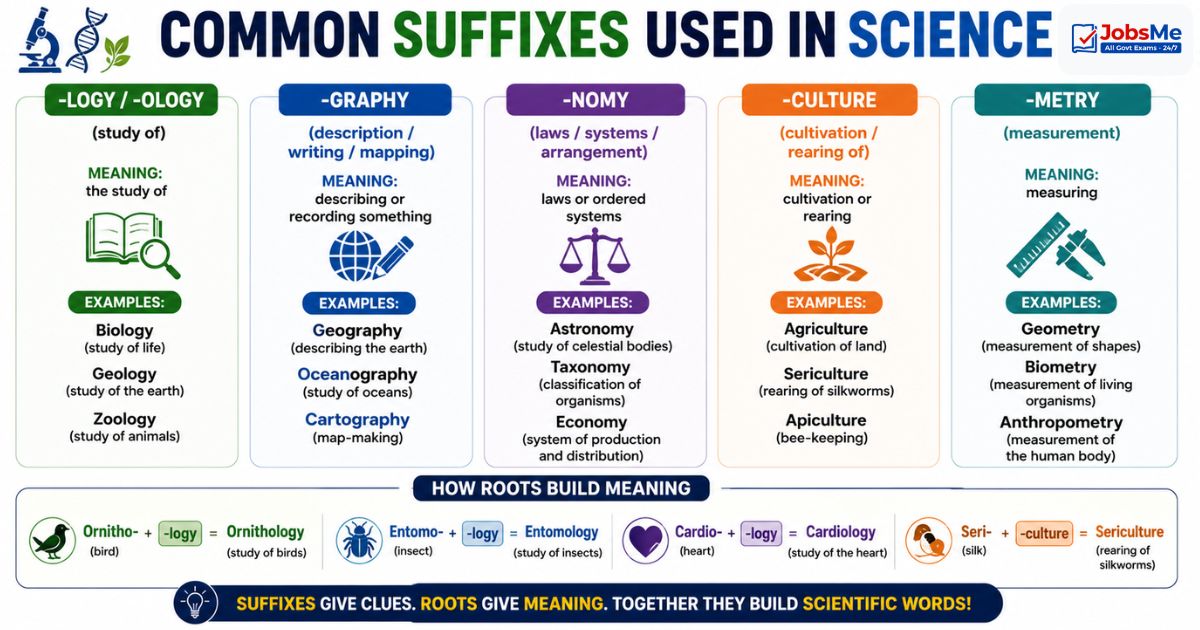
Common Suffixes Used in Science
- -logy / -ology (study of): The most common suffix, meaning "the study of." Example: Biology (study of life), Geology (study of the earth), Zoology (study of animals).
- -graphy (description / writing / mapping): Means describing or recording something. Example: Geography (describing the earth), Oceanography (study of oceans), Cartography (map-making).
- -nomy (laws / systems / arrangement): Refers to laws or ordered systems. Example: Astronomy (study of celestial bodies), Taxonomy (classification of organisms), Economy.
- -culture (cultivation / rearing of): Used for agricultural and rearing sciences. Example: Agriculture (cultivation of land), Sericulture (rearing of silkworms), Apiculture (bee-keeping).
- -metry (measurement): Means measuring. Example: Geometry, Biometry, Anthropometry (measurement of the human body).
How Roots Build Meaning
- Ornitho- (bird) + -logy = Ornithology (study of birds).
- Entomo- (insect) + -logy = Entomology (study of insects).
- Cardio- (heart) + -logy = Cardiology (study of the heart).
- Seri- (silk) + -culture = Sericulture (rearing of silkworms).
Branches of Biology (Life Sciences) - Study Areas
Biology has the largest number of sub-branches in competitive exams. The following table lists the most exam-relevant branches of biology along with what each one studies.
| Branch of Science | Study Area / Meaning | Key Details |
|---|---|---|
| Biology | Study of living organisms | The broad science of life; divided into Botany (plants) and Zoology (animals). Term coined by Lamarck and Treviranus. |
| Botany | Study of plants | Deals with plant structure, growth, reproduction, and classification; Theophrastus is called the Father of Botany. |
| Zoology | Study of animals | Covers animal life, behaviour, and classification; Aristotle is regarded as the Father of Zoology. |
| Ornithology | Study of birds | One of the most frequently asked terms; in India, Dr. Salim Ali is the famous ornithologist known as the "Bird Man of India." |
| Entomology | Study of insects | Includes the study of bees, ants, butterflies, and pests; important for agriculture and disease control. |
| Ichthyology | Study of fishes | Covers fish anatomy, behaviour, and classification; relevant to fisheries and aquaculture topics. |
| Herpetology | Study of reptiles and amphibians | Includes snakes, lizards, frogs, and crocodiles; often confused with Ophiology. |
| Ophiology | Study of snakes | A sub-branch of Herpetology dealing specifically with snakes. |
| Mammalogy | Study of mammals | Deals with warm-blooded vertebrates that nurse their young, such as tigers, whales, and humans. |
| Microbiology | Study of micro-organisms | Covers bacteria, viruses, fungi, and protozoa; Antonie van Leeuwenhoek is called the Father of Microbiology. |
| Bacteriology | Study of bacteria | A branch of microbiology; important for understanding diseases like tuberculosis and cholera. |
| Virology | Study of viruses | Gained major prominence during pandemics; covers viruses like influenza, HIV, and coronaviruses. |
| Mycology | Study of fungi | Includes mushrooms, yeasts, and moulds; relevant to antibiotics like penicillin. |
| Phycology (Algology) | Study of algae | Covers seaweeds and other algae; also called Algology. |
| Genetics | Study of heredity and genes | Gregor Mendel is called the Father of Genetics for his work on pea plants. |
| Cytology | Study of cells | Deals with cell structure and function; closely related to Histology. |
| Histology | Study of tissues | The microscopic study of the tissues of plants and animals. |
| Anatomy | Study of internal body structure | Deals with the structure of organisms; Andreas Vesalius is called the Father of Anatomy. |
| Physiology | Study of body functions | Examines how organs and systems of the body work. |
| Ecology | Study of organisms and their environment | Examines relationships between living things and their surroundings; key to environmental topics. |
| Taxonomy | Classification of organisms | Carolus Linnaeus is called the Father of Taxonomy; introduced binomial nomenclature. |
| Embryology | Study of embryos and their development | Covers the formation and growth of embryos before birth. |
| Palaeontology | Study of fossils | Reconstructs the history of life on earth through fossil remains. |
| Etiology | Study of the causes of disease | Identifies the origin or cause of diseases. |
| Pathology | Study of diseases | Examines the nature and effects of diseases on the body. |
| Anthropology | Study of human beings and cultures | Covers the origin, development, and behaviour of humans. |
Branches of Medical Science - Study Areas
Medical branches are frequently tested because they connect directly to health current affairs and everyday life. The table below covers the most exam-relevant medical sciences.
| Branch of Science | Study Area / Meaning | Key Details |
|---|---|---|
| Cardiology | Study of the heart | Deals with heart structure, function, and diseases; a high-frequency exam term. |
| Neurology | Study of the nervous system | Covers the brain, spinal cord, and nerves. |
| Nephrology | Study of the kidneys | Deals with kidney structure, function, and diseases. |
| Hepatology | Study of the liver | Covers the liver, gallbladder, and related organs. |
| Dermatology | Study of the skin | Deals with skin, hair, nails, and related diseases. |
| Ophthalmology | Study of the eyes | Covers eye structure and diseases; not to be confused with Otology (ear). |
| Otology | Study of the ear | Deals with the ear and hearing; part of ENT (Otorhinolaryngology). |
| Osteology | Study of bones | Covers the structure and function of bones. |
| Haematology | Study of blood | Deals with blood, blood-forming organs, and blood diseases. |
| Oncology | Study of cancer / tumours | Covers the diagnosis and treatment of tumours and cancer. |
| Gynaecology | Study of the female reproductive system | Deals with women's reproductive health. |
| Paediatrics | Study of child health and diseases | The branch of medicine dealing with infants and children. |
| Gerontology | Study of ageing and the elderly | Covers the biological and social aspects of old age. |
| Pharmacology | Study of drugs and medicines | Examines how drugs act on the body and how they are made. |
| Epidemiology | Study of the spread and control of diseases | Tracks how diseases occur and spread in populations; central to pandemic response. |
| Immunology | Study of the immune system | Covers the body's defence against infections; basis of vaccines. |
| Psychiatry | Study and treatment of mental disorders | A medical branch dealing with mental health conditions. |
| Orthopaedics | Study of bones, joints, and muscles | Deals with the musculoskeletal system and its disorders. |
Branches of Physics, Chemistry, and Earth Science - Study Areas
These branches frequently appear in the General Science section and connect to space, weather, and environment current affairs. The table below covers the most important entries.
| Branch of Science | Study Area / Meaning | Key Details |
|---|---|---|
| Astronomy | Study of celestial bodies | Covers stars, planets, comets, and galaxies; one of the oldest sciences. |
| Cosmology | Study of the origin and structure of the universe | Deals with theories like the Big Bang and the evolution of the universe. |
| Astrophysics | Study of the physics of celestial bodies | Applies the laws of physics to stars, galaxies, and the universe. |
| Acoustics | Study of sound | Covers the production, transmission, and effects of sound. |
| Optics | Study of light | Deals with the behaviour and properties of light. |
| Thermodynamics | Study of heat and energy | Examines the relationship between heat, work, and energy. |
| Mechanics | Study of motion and forces | Covers the behaviour of objects under the action of forces. |
| Nuclear Physics | Study of atomic nuclei | Deals with the components and behaviour of the atomic nucleus. |
| Biochemistry | Study of chemical processes in living organisms | Bridges biology and chemistry; covers enzymes, proteins, and metabolism. |
| Geology | Study of the earth and rocks | Covers the structure, composition, and history of the earth. |
| Seismology | Study of earthquakes | Deals with earthquakes and the movement of seismic waves; central to earthquake news. |
| Vulcanology (Volcanology) | Study of volcanoes | Covers volcanic eruptions, lava, and magma. |
| Meteorology | Study of weather and the atmosphere | Deals with weather forecasting and atmospheric conditions. |
| Climatology | Study of climate | Examines long-term weather patterns; key to climate change topics. |
| Oceanography | Study of oceans | Covers ocean currents, marine life, and the physical features of the sea. |
| Pedology | Study of soil | Examines the formation and classification of soil; important for agriculture. |
| Hydrology | Study of water | Covers the distribution, movement, and quality of water on earth. |
| Cartography | Study and making of maps | The science and art of map-making. |
| Geomorphology | Study of landforms | Examines the origin and evolution of the earth's surface features. |
| Speleology | Study of caves | Covers the structure, formation, and exploration of caves. |
"-Culture" Agricultural Sciences and Other Special Branches - Study Areas
This group uses the suffix "-culture" (cultivation or rearing) and is a favourite of SSC, RRB, and State PCS exams. A few non-science "study of" terms that are commonly tested are included at the end.
| Branch / Term | Study Area / Meaning | Key Details |
|---|---|---|
| Agriculture | Cultivation of land and crops | The science and practice of farming, including crop and livestock production. |
| Horticulture | Cultivation of garden plants | Covers fruits, vegetables, flowers, and ornamental plants. |
| Sericulture | Rearing of silkworms (for silk) | India is a leading silk producer; silkworms are fed on mulberry leaves. |
| Apiculture | Rearing of honey bees (bee-keeping) | Practised for the production of honey and beeswax. |
| Pisciculture | Rearing of fish (fish farming) | Commercial breeding of fish in tanks and ponds; part of aquaculture. |
| Aquaculture | Farming of aquatic plants and animals | Broad term covering fish, prawns, and aquatic plant cultivation. |
| Pomology | Cultivation and study of fruits | A branch of botany focused on fruit trees and their improvement. |
| Olericulture | Cultivation of vegetables | A branch of horticulture dealing with vegetable crops. |
| Floriculture | Cultivation of flowers | A commercial branch of horticulture for ornamental and edible flowers. |
| Viticulture | Cultivation of grapes | The science of growing grapes, especially for wine-making. |
| Silviculture | Cultivation of forest trees | The branch of forestry dealing with growing and managing forests. |
| Vermiculture | Rearing of earthworms | Used to produce vermicompost, an organic fertiliser. |
| Aviculture | Rearing of birds | The keeping and breeding of birds, especially in captivity. |
| Numismatics | Study of coins and currency | Covers the history and collection of coins and paper money. |
| Philately | Study and collection of postage stamps | Frequently asked alongside Numismatics as a "study/collection" term. |
| Epigraphy | Study of inscriptions | Examines ancient writing carved on stone, metal, or other surfaces. |
| Etymology | Study of the origin of words | Traces the history and development of words; often confused with Entomology. |
Memory Tricks and Mnemonics
Trick 1: The "Animal Study" Group — Birds, Bugs, Fish, Snakes
Group the animal-related branches together so you never confuse them:
- Ornithology → Birds (think "Ostrich" starts with O, Ornithology starts with O).
- Entomology → Insects ("ENTo" sounds like "ANT").
- Ichthyology → Fishes.
- Herpetology → Reptiles and amphibians (snakes, frogs).
- Mammalogy → Mammals.
"Birds, Bugs, Fish, Reptiles, Mammals — Orni, Ento, Ichthy, Herpet, Mammal."
Trick 2: Entomology vs Etymology — the Classic Trap
These two look almost identical but mean very different things:
- Entomology → study of insects (remember "ENT" = "ANT", and ants are insects).
- Etymology → study of words (remember "ETY" relates to "letters" and language).
"Ants in Entomology, Letters in Etymology."
Trick 3: The "-Culture" Family — "FISH AVS"
Use the theme of "rearing/cultivation" to group the -culture terms:
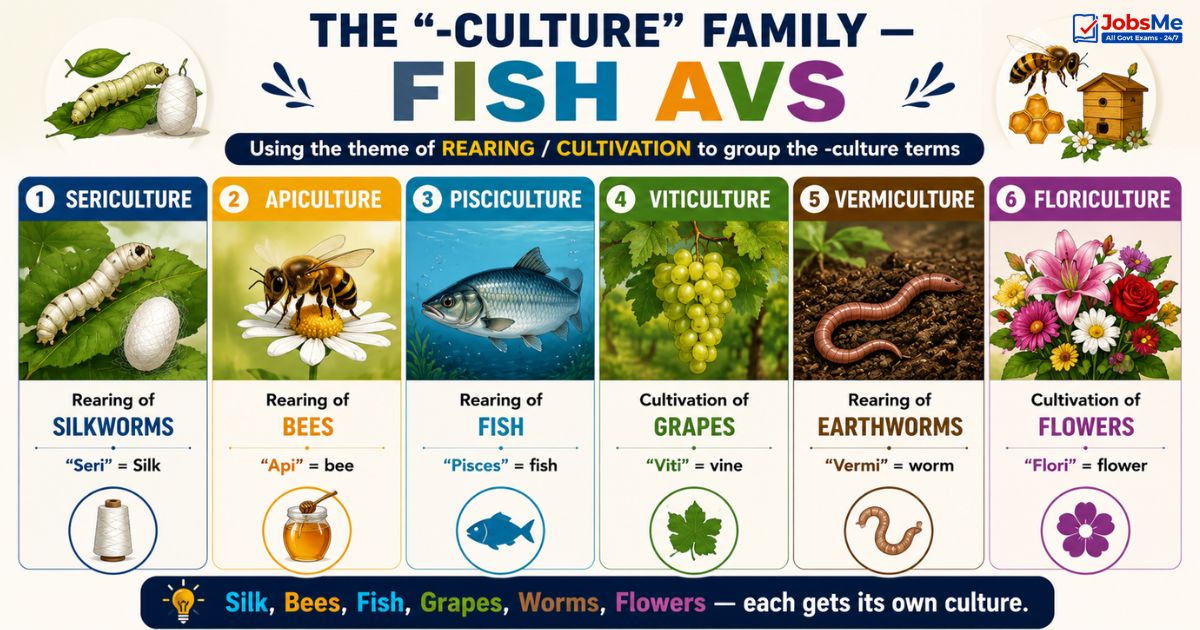
- Sericulture → Silkworms ("Seri" = Silk).
- Apiculture → Bees ("Api" = bee, as in Apis).
- Pisciculture → Fish ("Pisces" = fish).
- Viticulture → Grapes ("Viti" = vine).
- Vermiculture → Earthworms ("Vermi" = worm).
- Floriculture → Flowers ("Flori" = flower).
"Silk, Bees, Fish, Grapes, Worms, Flowers — each gets its own culture."
Trick 4: Earth Science "Disaster Trio" — "S-V-M"
Three earth sciences are linked to natural events seen in the news:
- S → Seismology → Earthquakes.
- V → Vulcanology → Volcanoes.
- M → Meteorology → Weather (and storms).
"Shaking, Volcano, Monsoon — S, V, M."
Trick 5: Medical Organs — Match the Root to the Body Part
- Cardio → Heart (Cardiology).
- Neuro → Nerves (Neurology).
- Nephro → Kidney (Nephrology).
- Hepato → Liver (Hepatology).
- Dermato → Skin (Dermatology).
- Osteo → Bones (Osteology).
"Learn the root once, and the organ comes free."
Trick 6: The Eye-Ear Pair — "Ophthal vs Oto"
Two sense-organ branches are easily swapped:
- Ophthalmology → Eyes (think "Optical" = eyes).
- Otology → Ear (think "Oto" sounds like "auto", and you hear your car).
Trick 7: The "Collector's Pair" — Coins and Stamps
Two collection-based study terms are almost always asked together:
- Numismatics → Coins and currency ("Numis" sounds like "money").
- Philately → Postage stamps.
"Coins are Numismatic, Stamps are Philatelic."
Additional Notes
Frequently Confused Facts
- Entomology vs Etymology: Entomology is the study of insects; Etymology is the study of the origin of words. The most common trap in exams.
- Ornithology vs Ophiology: Ornithology is the study of birds; Ophiology is the study of snakes. Do not confuse the two "O" terms.
- Herpetology vs Ophiology: Herpetology covers all reptiles and amphibians (snakes, lizards, frogs); Ophiology is specifically the study of snakes only.
- Ophthalmology vs Otology: Ophthalmology is the study of the eye; Otology is the study of the ear.
- Pedology vs Pedagogy: Pedology is the study of soil; Pedagogy is the art and science of teaching — completely different fields.
- Seismology vs Vulcanology: Seismology is the study of earthquakes; Vulcanology (Volcanology) is the study of volcanoes.
- Meteorology vs Climatology: Meteorology deals with short-term weather; Climatology deals with long-term climate patterns.
- Cytology vs Histology: Cytology is the study of cells; Histology is the study of tissues (groups of cells).
- Pomology vs Olericulture vs Floriculture: Pomology is fruit cultivation; Olericulture is vegetable cultivation; Floriculture is flower cultivation.
- Numismatics vs Philately: Numismatics is the study of coins; Philately is the study and collection of postage stamps.
- Etiology vs Etymology: Etiology is the study of the causes of disease; Etymology is the study of word origins.
- Phycology vs Mycology: Phycology (Algology) is the study of algae; Mycology is the study of fungi.
Repeating PYQ Patterns
Certain branches of science are asked repeatedly in competitive exams. Ornithology (birds), Entomology (insects), Ichthyology (fishes), Herpetology (reptiles), Seismology (earthquakes), Cardiology (heart), Nephrology (kidney), Pedology (soil), Sericulture (silkworms), Apiculture (bees), Numismatics (coins), and Etymology (words) appear most often in UPSC Prelims, SSC CGL, SSC CHSL, and RRB NTPC papers. Banking exams (IBPS PO, SBI Clerk) frequently use match-the-following formats pairing a branch with its study area. RRB and State PCS exams place heavy emphasis on the "-culture" group such as Sericulture, Apiculture, Pisciculture, and Viticulture because of their agricultural relevance. The Entomology-Etymology pair is the single most common trap question across all these exams.
Quick Insight
Branches of science are not just vocabulary — they connect directly to the news that aspirants read every day. When a vaccine is in the headlines, the relevant fields are Virology and Immunology; when an earthquake or volcano strikes, Seismology and Vulcanology come into play; when a space mission launches, Astronomy and Astrophysics are involved; and when monsoon or heatwave forecasts dominate the news, Meteorology and Climatology are at work. Recognising which branch studies a given subject lets aspirants instantly link any current event to its scientific field, which is invaluable for both Prelims (direct matching questions) and Mains or descriptive papers. For further reading on related Static GK topics, you can refer to the Static GK section and test yourself with the Static GK Quiz on Jobsme.in.
One-Liners for Quick Revision
- Biology → Study of living organisms → divided into Botany and Zoology.
- Botany → Study of plants → Father: Theophrastus.
- Zoology → Study of animals → Father: Aristotle.
- Ornithology → Study of birds → Salim Ali is the "Bird Man of India."
- Entomology → Study of insects → includes bees, ants, and pests.
- Ichthyology → Study of fishes → relevant to fisheries.
- Herpetology → Study of reptiles and amphibians → snakes, frogs, lizards.
- Ophiology → Study of snakes → sub-branch of Herpetology.
- Mammalogy → Study of mammals → warm-blooded vertebrates.
- Microbiology → Study of micro-organisms → Father: Antonie van Leeuwenhoek.
- Bacteriology → Study of bacteria → branch of microbiology.
- Virology → Study of viruses → key during pandemics.
- Mycology → Study of fungi → mushrooms, yeasts, moulds.
- Phycology (Algology) → Study of algae → includes seaweeds.
- Genetics → Study of heredity and genes → Father: Gregor Mendel.
- Cytology → Study of cells → cell structure and function.
- Histology → Study of tissues → microscopic study of tissues.
- Anatomy → Study of internal body structure → Father: Andreas Vesalius.
- Physiology → Study of body functions → how organs work.
- Ecology → Study of organisms and their environment → key environmental topic.
- Taxonomy → Classification of organisms → Father: Carolus Linnaeus.
- Embryology → Study of embryos → development before birth.
- Palaeontology → Study of fossils → history of life on earth.
- Etiology → Study of the causes of disease.
- Pathology → Study of diseases → nature and effects of disease.
- Anthropology → Study of human beings and cultures.
- Cardiology → Study of the heart.
- Neurology → Study of the nervous system.
- Nephrology → Study of the kidneys.
- Hepatology → Study of the liver.
- Dermatology → Study of the skin.
- Ophthalmology → Study of the eyes.
- Otology → Study of the ear.
- Osteology → Study of bones.
- Haematology → Study of blood.
- Oncology → Study of cancer and tumours.
- Gynaecology → Study of the female reproductive system.
- Paediatrics → Study of child health and diseases.
- Gerontology → Study of ageing and the elderly.
- Pharmacology → Study of drugs and medicines.
- Epidemiology → Study of the spread and control of diseases.
- Immunology → Study of the immune system → basis of vaccines.
- Psychiatry → Study and treatment of mental disorders.
- Orthopaedics → Study of bones, joints, and muscles.
- Astronomy → Study of celestial bodies → stars and planets.
- Cosmology → Study of the origin and structure of the universe.
- Astrophysics → Study of the physics of celestial bodies.
- Acoustics → Study of sound.
- Optics → Study of light.
- Thermodynamics → Study of heat and energy.
- Mechanics → Study of motion and forces.
- Nuclear Physics → Study of atomic nuclei.
- Biochemistry → Study of chemical processes in living organisms.
- Geology → Study of the earth and rocks.
- Seismology → Study of earthquakes.
- Vulcanology (Volcanology) → Study of volcanoes.
- Meteorology → Study of weather and the atmosphere.
- Climatology → Study of climate → long-term weather patterns.
- Oceanography → Study of oceans.
- Pedology → Study of soil.
- Hydrology → Study of water.
- Cartography → Study and making of maps.
- Geomorphology → Study of landforms.
- Speleology → Study of caves.
- Agriculture → Cultivation of land and crops.
- Horticulture → Cultivation of garden plants.
- Sericulture → Rearing of silkworms for silk.
- Apiculture → Rearing of honey bees (bee-keeping).
- Pisciculture → Rearing of fish (fish farming).
- Aquaculture → Farming of aquatic plants and animals.
- Pomology → Cultivation and study of fruits.
- Olericulture → Cultivation of vegetables.
- Floriculture → Cultivation of flowers.
- Viticulture → Cultivation of grapes.
- Silviculture → Cultivation of forest trees.
- Vermiculture → Rearing of earthworms for vermicompost.
- Aviculture → Rearing of birds.
- Numismatics → Study of coins and currency.
- Philately → Study and collection of postage stamps.
- Epigraphy → Study of inscriptions.
- Etymology → Study of the origin of words.
For more Static GK topics like important inventions, scientific instruments, and famous personalities, explore the Static GK section on Jobsme.in. You can also test your knowledge with the Static GK Quiz and check out the latest exam notifications at Latest Government Job Notifications.
Free quiz • No signup required
Put this topic into practice with Indian Cultural Institutions – Static GK MCQ Quiz. It is the quickest way to reinforce what you just learned.
Frequently Asked Questions
What is the study of birds called?
What is the difference between Entomology and Etymology?
What is the study of earthquakes called?
What is Sericulture?
What is the study of soil called?
Which branch of science deals with the heart?
What is the difference between Numismatics and Philately?
What does the suffix -culture mean in science?
What is the study of fungi called?
What is the study of insects, reptiles, and fishes called?

About the author