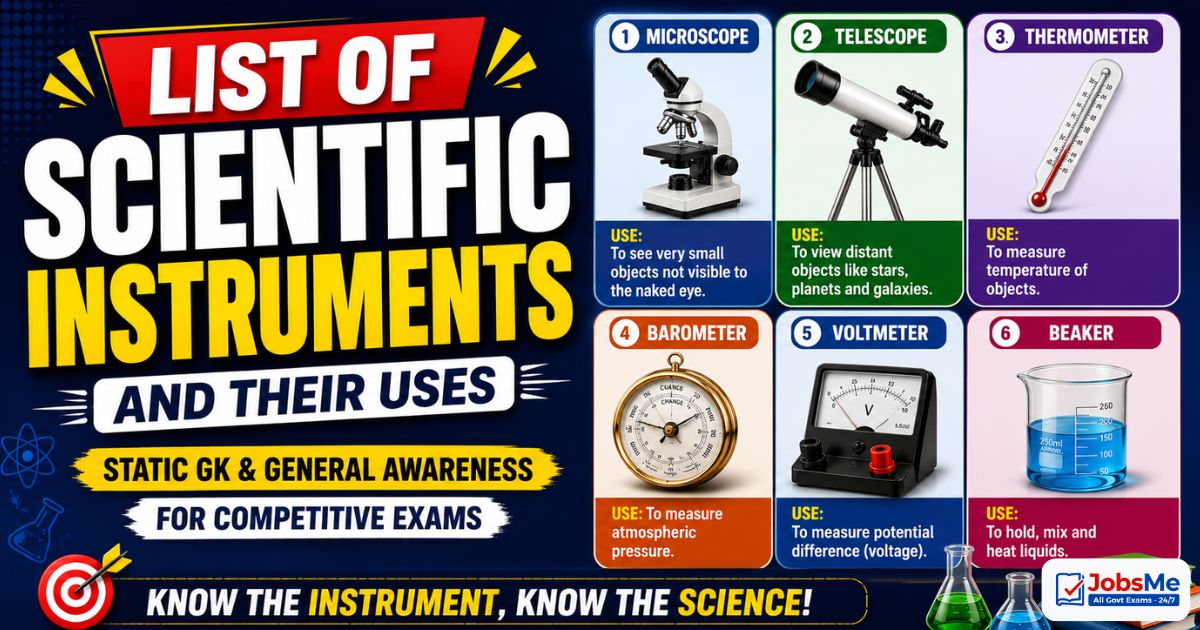
List of Scientific Instruments and Their Uses – Static GK & General Awareness for Competitive Exams with Memory Tricks
This article presents a complete list of scientific instruments and their uses, covering measuring devices used in physics, chemistry, biology, meteorology, medicine, navigation, and engineering, along with the quantity each instrument measures and its inventor wherever relevant. It includes commonly asked instruments like the barometer (atmospheric pressure), seismograph (earthquakes), anemometer (wind speed), sphygmomanometer (blood pressure), and ammeter (electric current), with memory tricks and one-liners for quick revision. All facts are arranged in exam-ready format to help UPSC, SSC, IBPS, RRB, PSU, and State PCS aspirants score better in the General Awareness and General Science sections.
Jump to section
- Introduction
- Core Concepts: How Scientific Instruments Are Classified
- Physics, Electrical and Mechanical Instruments - Uses
- Meteorological and Earth Science Instruments - Uses
- Navigation, Astronomical and Optical Instruments - Uses
- Medical, Biological and Acoustic Instruments - Uses
- Memory Tricks and Mnemonics
- Additional Notes
- One-Liners for Quick Revision
Introduction
Scientific instruments are tools and devices used to measure, detect, record, or analyse physical quantities such as pressure, temperature, electric current, wind speed, sound, and many more. From the barometer that measures atmospheric pressure to the seismograph that records the intensity of earthquakes, each instrument is designed for a specific scientific purpose. Knowing which instrument measures which quantity is one of the most reliable scoring areas in the General Awareness and General Science sections of competitive exams.
Questions on scientific instruments and their uses appear regularly in SSC CGL, SSC CHSL, IBPS PO, RRB NTPC, SBI Clerk, UPSC Prelims, State PCS, and various Insurance, Defence, and PSU exams. Questions typically ask which instrument is used to measure a particular quantity (such as "Which instrument measures blood pressure?"), or which quantity is measured by a named instrument (such as "What does a hygrometer measure?"). This article brings together every important scientific instrument in a structured, exam-ready format. To explore other related Static GK topics, you can refer to the Static GK section on Jobsme.in.
Scientific instruments are also linked to current affairs and general science themes such as space missions, weather forecasting, medical diagnostics, and disaster management. Devices like the seismograph and the radar feature in news on earthquakes and aviation, while instruments such as the spirometer and the ECG machine appear in health-related discussions — making this topic doubly useful for aspirants preparing for both objective papers and interviews.
Core Concepts: How Scientific Instruments Are Classified
Scientific instruments can be grouped by the field in which they are used or by the type of quantity they measure. Understanding this classification helps students remember instruments faster and answer related questions confidently, because most instrument names contain a clue (a Greek or Latin root) that hints at what they measure.
Categories of Scientific Instruments
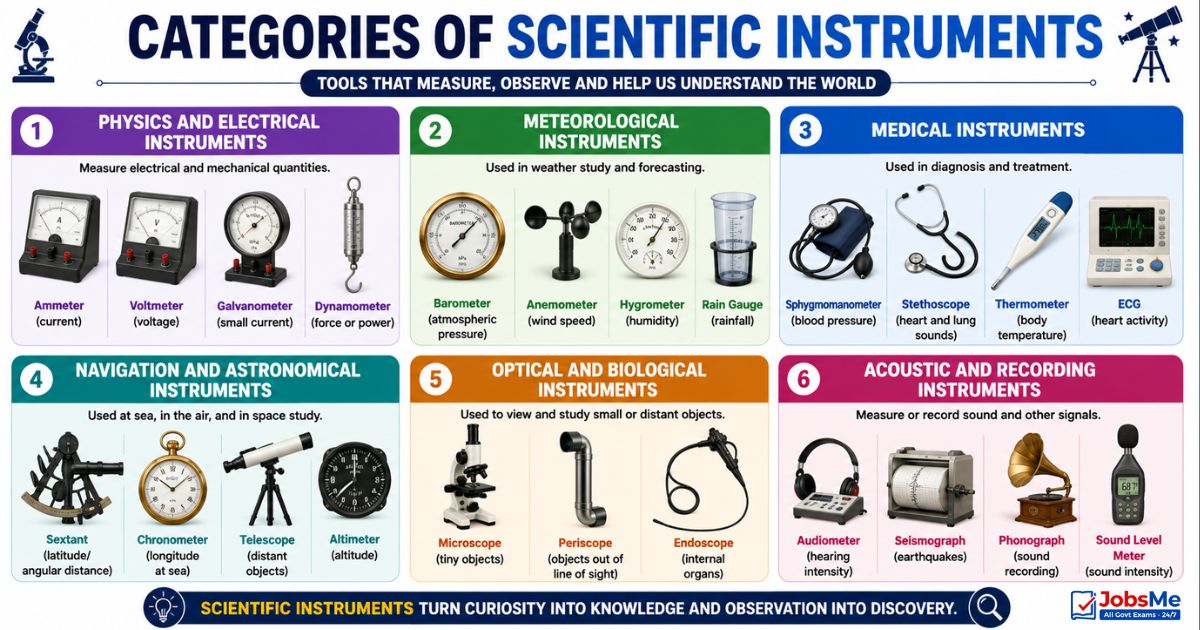
- Physics and Electrical Instruments: Measure electrical and mechanical quantities. Example: Ammeter (current), Voltmeter (voltage), Galvanometer (small current), Dynamometer (force or power).
- Meteorological Instruments: Used in weather study and forecasting. Example: Barometer (atmospheric pressure), Anemometer (wind speed), Hygrometer (humidity), Rain Gauge (rainfall).
- Medical Instruments: Used in diagnosis and treatment. Example: Sphygmomanometer (blood pressure), Stethoscope (heart and lung sounds), Thermometer (body temperature), ECG (heart activity).
- Navigation and Astronomical Instruments: Used at sea, in the air, and in space study. Example: Sextant (latitude/angular distance), Chronometer (longitude at sea), Telescope (distant objects), Altimeter (altitude).
- Optical and Biological Instruments: Used to view and study small or distant objects. Example: Microscope (tiny objects), Periscope (objects out of line of sight), Endoscope (internal organs).
- Acoustic and Recording Instruments: Measure or record sound and other signals. Example: Audiometer (hearing intensity), Seismograph (earthquakes), Phonograph (sound recording).
Physics, Electrical and Mechanical Instruments - Uses
The following table lists the most exam-relevant physics, electrical, and mechanical instruments along with the quantity each one measures and key details.
| Instrument | Used to Measure / Detect | Key Details |
|---|---|---|
| Ammeter | Electric current (in amperes) | Connected in series in a circuit; measures the flow of electric current. The name comes from "ampere," the SI unit of current. |
| Voltmeter | Electric potential difference (voltage) | Connected in parallel across two points of a circuit; measures the potential difference in volts. |
| Galvanometer | Small electric current | Detects and measures very small electric currents; basis for the ammeter and voltmeter. |
| Ohmmeter | Electrical resistance (in ohms) | Measures the resistance offered by a conductor to the flow of current. |
| Wattmeter | Electrical power (in watts) | Measures the power consumed in an electric circuit. |
| Electroscope | Presence of electric charge | Detects the presence and sign of an electric charge on a body, usually with diverging gold leaves. |
| Dynamometer | Force, torque, or power | Measures the force or power output of engines and motors. |
| Accelerometer | Acceleration or vibration | Measures acceleration and vibration; widely used in smartphones, vehicles, and aircraft. |
| Speedometer | Speed of a vehicle | Indicates the instantaneous speed of a vehicle; usually displayed on the dashboard. |
| Odometer | Distance travelled by a vehicle | Records the total distance covered by a wheeled vehicle. |
| Tachometer | Rotational speed (RPM) | Measures the rotation speed of a shaft or disc, expressed in revolutions per minute. |
| Manometer | Pressure of gases or liquids | Measures the pressure of confined gases and liquids using a column of liquid. |
| Calorimeter | Quantity of heat | Measures the amount of heat absorbed or released in physical and chemical changes. |
| Pyrometer | Very high temperatures | Measures high temperatures (such as in furnaces) without direct contact, using radiation. |
| Thermometer | Temperature | Measures temperature of a body or environment; commonly uses mercury, alcohol, or digital sensors. |
| Barometer | Atmospheric pressure | Measures atmospheric pressure; invented by Evangelista Torricelli; a sudden fall indicates an approaching storm. |
| Spectrometer | Spectrum of light / wavelengths | Measures properties of light over a portion of the electromagnetic spectrum; used in chemical analysis. |
| Bolometer | Radiant energy / heat radiation | Measures the energy of incident electromagnetic radiation, especially infrared and microwave. |
| Refractometer | Refractive index | Measures the refractive index of a substance; used in chemistry and the food industry. |
| Viscometer | Viscosity of a liquid | Measures the viscosity (thickness or resistance to flow) of fluids. |
| Hydrometer | Specific gravity / density of liquids | Measures the relative density of liquids; used to check the purity of milk and the charge of batteries. |
| Lactometer | Purity of milk | A type of hydrometer that measures the relative density of milk to detect adulteration with water. |
| Salinometer | Salinity of a solution | Measures the salt content (salinity) of a solution, especially seawater. |
| Polarimeter | Rotation of polarised light | Measures the angle by which a substance rotates plane-polarised light; used for sugar concentration. |
| Photometer | Intensity of light | Measures the intensity or brightness of light. |
| Pyranometer | Solar radiation | Measures solar radiation (sunlight) received on a flat surface. |
| Quadrant | Altitude and angles in astronomy | Measures the altitude of stars and other celestial bodies above the horizon. |
| Periscope | Objects out of direct line of sight | Allows viewing of objects above or around an obstacle; used in submarines and trenches. |
Meteorological and Earth Science Instruments - Uses
The following table lists instruments used in weather study, the atmosphere, the oceans, and earthquakes, frequently asked in competitive exams. You can practise related questions on the Static GK Quiz on Jobsme.in.
| Instrument | Used to Measure / Detect | Key Details |
|---|---|---|
| Anemometer | Wind speed and direction | Measures the force and velocity of wind; essential in meteorology and aviation. |
| Hygrometer | Humidity in the air | Measures the amount of water vapour (relative humidity) in the atmosphere. |
| Rain Gauge (Pluviometer) | Rainfall | Measures the amount of rainfall over a given area and period of time. |
| Barograph | Continuous record of atmospheric pressure | A self-recording barometer that traces changes in atmospheric pressure over time. |
| Thermograph | Continuous record of temperature | Automatically records temperature variations over a period of time. |
| Seismograph (Seismometer) | Earthquakes | Records the intensity, direction, and origin of earthquakes; earthquake magnitude is reported on the Richter scale. |
| Radar | Detection of distant objects | "Radio Detection and Ranging"; uses radio waves to detect the location and speed of aircraft, ships, and rain clouds. |
| Altimeter | Altitude / height | Measures the altitude of an aircraft or balloon above sea level. |
| Fathometer | Depth of the ocean | Measures the depth of the sea using sound waves (echo sounding). |
| Bathometer | Depth of water bodies | Measures the depth of seas, lakes, and other water bodies. |
| Tide Gauge | Rise and fall of tides | Records the level of the sea surface relative to a fixed reference point. |
Navigation, Astronomical and Optical Instruments - Uses
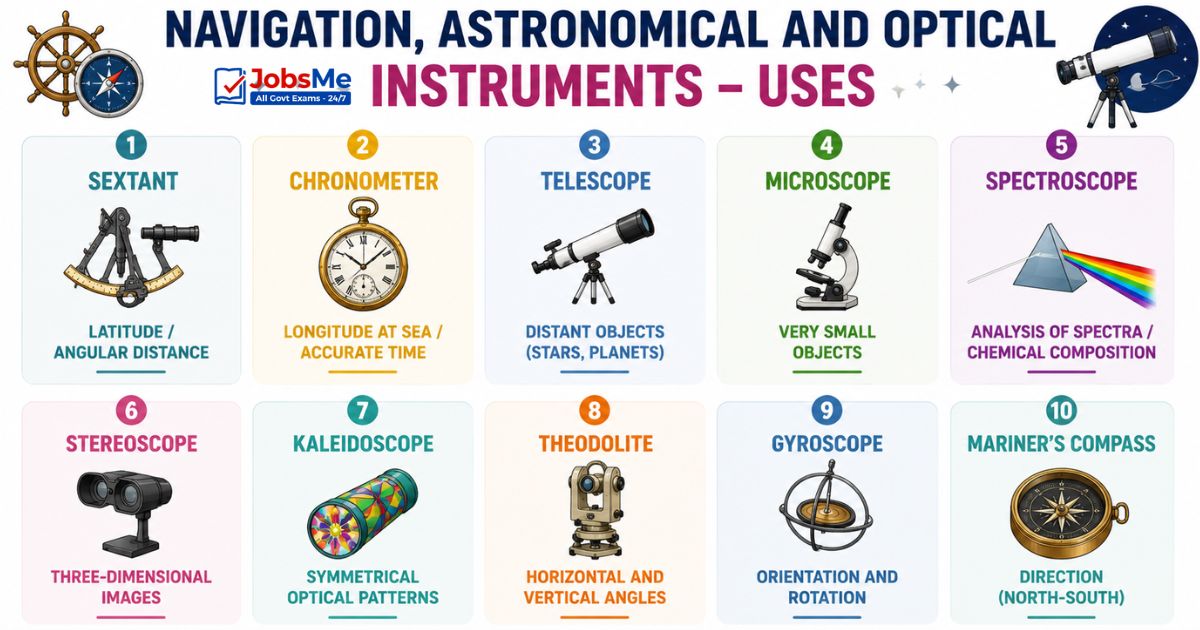
The following table covers instruments used in navigation, astronomy, and optics that are commonly tested in exams.
| Instrument | Used to Measure / Detect | Key Details |
|---|---|---|
| Sextant | Latitude / angular distance | Measures the angular distance between two visible objects; used by navigators to find latitude at sea. |
| Chronometer | Longitude at sea / accurate time | A very accurate clock used to determine the longitude of a vessel at sea. |
| Telescope | Distant objects (stars, planets) | Magnifies and views distant celestial and terrestrial objects; key tool in astronomy. |
| Microscope | Very small objects | Provides a magnified view of tiny objects and organisms not visible to the naked eye; types include optical and electron microscopes. |
| Spectroscope | Analysis of spectra / chemical composition | Splits light into its spectrum to study the composition of stars and chemical substances. |
| Stereoscope | Three-dimensional images | Views two photographs together to create a single three-dimensional image. |
| Kaleidoscope | Symmetrical optical patterns | Produces changing symmetrical patterns using mirrors and coloured pieces of glass. |
| Theodolite | Horizontal and vertical angles | Measures angles in surveying and civil engineering work. |
| Gyroscope | Orientation and rotation | Maintains and measures orientation; used in navigation systems of ships, aircraft, and spacecraft. |
| Mariner's Compass | Direction (north-south) | A magnetic instrument used by sailors to find geographical direction at sea. |
Medical, Biological and Acoustic Instruments - Uses
The following table lists instruments used in medicine, biology, and the study of sound, which are regularly asked in the General Science and General Awareness sections.
| Instrument | Used to Measure / Detect | Key Details |
|---|---|---|
| Sphygmomanometer | Blood pressure | Measures arterial blood pressure; readings are given as systolic over diastolic pressure. |
| Stethoscope | Heart and lung sounds | Used by doctors to listen to internal sounds of the heart, lungs, and intestines. |
| Cardiograph (ECG) | Electrical activity of the heart | Traces the movement and electrical activity of the heart; the recording is called an electrocardiogram. |
| Electroencephalograph (EEG) | Electrical activity of the brain | Records brain wave activity; used to diagnose epilepsy and other neurological conditions. |
| Spirometer | Lung capacity / volume of air | Measures the volume of air inhaled and exhaled by the lungs. |
| Endoscope | Internal organs of the body | Used to examine internal hollow organs and cavities of the body. |
| Audiometer | Intensity and sensitivity of hearing | Measures the intensity of sound and tests a person's ability to hear. |
| Audiophone | Aid for imperfect hearing | An instrument used to improve a defective sense of hearing. |
| Phonograph | Recording and reproducing sound | An early device for recording and playing back sound; invented by Thomas Edison. |
| Microphone | Conversion of sound into electrical signals | Converts sound waves into electrical signals for amplification or recording. |
| Carburettor | Mixing air with petrol vapour | Used in internal combustion engines to charge air with fuel vapour for combustion. |
| Seismoscope | Occurrence of an earthquake | Detects and indicates the occurrence of an earthquake without necessarily recording its magnitude. |
Memory Tricks and Mnemonics
Trick 1: The "-meter" Means Measure
Almost every instrument ending in "-meter" measures a quantity. Break the name to find the clue:
- Thermo + meter → heat → Thermometer (temperature).
- Baro + meter → weight/pressure → Barometer (atmospheric pressure).
- Hygro + meter → moisture → Hygrometer (humidity).
- Anemo + meter → wind → Anemometer (wind speed).
"If it ends in -meter, it measures something — read the first half."
Trick 2: The "-graph / -scope" Difference
Use the ending to decide whether the instrument records or views:
- -graph → writes or records → Seismograph (records earthquakes), Barograph (records pressure).
- -scope → views or examines → Microscope (views tiny objects), Telescope (views distant objects), Stethoscope (examines body sounds).
"Graph = record it; Scope = look at it."
Trick 3: Water and Liquid Instruments — "HLSV"
Group the four "liquid" instruments together:
- H → Hydrometer → density of liquids.
- L → Lactometer → purity of milk.
- S → Salinometer → salinity of water.
- V → Viscometer → viscosity of a liquid.
"HLSV — four instruments that all dip into liquids."
Trick 4: Sea and Sky Navigation — "Sextant for Latitude, Chronometer for Longitude"
A classic exam confusion solved with one line:
- Sextant → measures angles → finds Latitude.
- Chronometer → accurate clock → finds Longitude at sea.
"Time tells longitude (Chronometer); angle tells latitude (Sextant)."
Trick 5: Heart, Brain and Lungs — "C-E-S"
Remember the three body-recording instruments:
- C → Cardiograph → heart (ECG).
- E → Electroencephalograph → brain (EEG).
- S → Spirometer → lungs.
"CES — Cardio for heart, Encephalo for brain, Spiro for lungs."
Trick 6: Depth and Height — "ABF"
Group the instruments that go up and down:
- A → Altimeter → height (altitude) in the air.
- B → Bathometer → depth of water.
- F → Fathometer → depth of the ocean using sound.
"Altimeter goes up, Bathometer and Fathometer go down."
Trick 7: Electricity Trio — "AVO"
The three basic electrical instruments form the word AVO (also the name of a multimeter brand):
- A → Ammeter → current (amperes), in series.
- V → Voltmeter → voltage (volts), in parallel.
- O → Ohmmeter → resistance (ohms).
"AVO — Amperes, Volts, Ohms."
Additional Notes
Frequently Confused Facts
- Barometer vs Manometer: Barometer measures atmospheric (open-air) pressure; Manometer measures the pressure of confined or enclosed gases and liquids.
- Ammeter vs Voltmeter: Ammeter measures current and is connected in series; Voltmeter measures voltage and is connected in parallel.
- Hygrometer vs Hydrometer: Hygrometer measures humidity (water vapour in air); Hydrometer measures the density or specific gravity of liquids.
- Seismograph vs Seismoscope: Seismograph records the intensity and origin of an earthquake; Seismoscope only detects that an earthquake has occurred.
- Sextant vs Chronometer: Sextant is used to find latitude (using angles); Chronometer is used to find longitude (using accurate time).
- Microscope vs Telescope: Microscope magnifies very small nearby objects; Telescope magnifies very large distant objects.
- Lactometer vs Hydrometer: Lactometer is a special hydrometer used only to test the purity of milk; Hydrometer is the general instrument for liquid density.
- Pyrometer vs Thermometer: Pyrometer measures very high temperatures (like furnaces) without contact; Thermometer measures ordinary temperatures.
- Speedometer vs Odometer: Speedometer shows the current speed of a vehicle; Odometer shows the total distance travelled.
- Cardiograph vs Electroencephalograph: Cardiograph (ECG) records heart activity; Electroencephalograph (EEG) records brain activity.
Repeating PYQ Patterns
Certain instruments are asked repeatedly in competitive exams. Barometer (atmospheric pressure), Seismograph (earthquakes), Anemometer (wind speed), Hygrometer (humidity), Sphygmomanometer (blood pressure), Lactometer (purity of milk), Ammeter (current), Sextant (latitude), Chronometer (longitude), and Altimeter (altitude) appear most often in SSC CGL, SSC CHSL, and RRB NTPC papers. Banking exams (IBPS PO, SBI Clerk) frequently pair the instrument with the quantity it measures in match-the-following questions. UPSC Prelims and State PCS exams sometimes add the inventor — such as Torricelli for the barometer and Edison for the phonograph. RRB and Defence exams favour mechanical and navigation instruments like the tachometer, fathometer, and gyroscope.
Quick Insight
Scientific instruments connect directly to current affairs and everyday life. The seismograph is referenced whenever an earthquake makes the news; radar and the gyroscope are central to aviation and space missions; the sphygmomanometer, spirometer, and ECG machine appear in health awareness campaigns; and the anemometer and rain gauge are part of every weather report from the meteorological department. Understanding these instruments helps aspirants link a news event or a science topic to the correct device, which is valuable for both objective papers and interviews. For further reading on related Static GK and science topics, you can refer to the Computer Awareness notes and revise using the Banking Awareness Quiz on Jobsme.in.
One-Liners for Quick Revision
- Ammeter → measures electric current → connected in series.
- Voltmeter → measures voltage → connected in parallel.
- Galvanometer → detects and measures small electric current.
- Ohmmeter → measures electrical resistance in ohms.
- Wattmeter → measures electrical power in watts.
- Electroscope → detects the presence of electric charge.
- Dynamometer → measures force, torque, or power.
- Accelerometer → measures acceleration and vibration.
- Speedometer → measures the speed of a vehicle.
- Odometer → measures the distance travelled by a vehicle.
- Tachometer → measures rotational speed in RPM.
- Manometer → measures pressure of confined gases and liquids.
- Calorimeter → measures the quantity of heat.
- Pyrometer → measures very high temperatures without contact.
- Thermometer → measures temperature.
- Barometer → measures atmospheric pressure → invented by Torricelli.
- Spectrometer → measures the spectrum of light / wavelengths.
- Bolometer → measures radiant heat energy.
- Refractometer → measures the refractive index of a substance.
- Viscometer → measures the viscosity of a liquid.
- Hydrometer → measures specific gravity / density of liquids.
- Lactometer → measures the purity of milk.
- Salinometer → measures the salinity of a solution.
- Polarimeter → measures rotation of plane-polarised light.
- Photometer → measures the intensity of light.
- Pyranometer → measures solar radiation.
- Quadrant → measures the altitude of celestial bodies.
- Periscope → views objects out of the direct line of sight → used in submarines.
- Anemometer → measures wind speed and direction.
- Hygrometer → measures humidity in the air.
- Rain Gauge (Pluviometer) → measures rainfall.
- Barograph → continuously records atmospheric pressure.
- Thermograph → continuously records temperature.
- Seismograph → records the intensity and origin of earthquakes.
- Radar → detects distant objects using radio waves.
- Altimeter → measures altitude (height) of aircraft.
- Fathometer → measures ocean depth using sound waves.
- Bathometer → measures the depth of water bodies.
- Tide Gauge → records the rise and fall of tides.
- Sextant → measures latitude / angular distance at sea.
- Chronometer → determines longitude at sea using accurate time.
- Telescope → views distant celestial and terrestrial objects.
- Microscope → views very small objects and organisms.
- Spectroscope → analyses spectra and chemical composition.
- Stereoscope → produces three-dimensional images.
- Kaleidoscope → produces symmetrical optical patterns.
- Theodolite → measures horizontal and vertical angles in surveying.
- Gyroscope → measures and maintains orientation.
- Mariner's Compass → shows geographical direction at sea.
- Sphygmomanometer → measures blood pressure.
- Stethoscope → listens to heart and lung sounds.
- Cardiograph (ECG) → records the electrical activity of the heart.
- Electroencephalograph (EEG) → records the electrical activity of the brain.
- Spirometer → measures lung capacity / volume of air.
- Endoscope → examines internal organs of the body.
- Audiometer → measures the intensity and sensitivity of hearing.
- Audiophone → aids an imperfect sense of hearing.
- Phonograph → records and reproduces sound → invented by Edison.
- Microphone → converts sound waves into electrical signals.
- Carburettor → mixes air with petrol vapour in engines.
- Seismoscope → detects the occurrence of an earthquake.
For more Static GK topics like important inventions, units of measurement, and scientific discoveries, explore the Static GK section on Jobsme.in. You can also test yourself with the Computer Awareness Quiz and check out the latest exam updates at Latest Government Job Notifications.
Free quiz • No signup required
Put this topic into practice with Indian Cultural Institutions – Static GK MCQ Quiz. It is the quickest way to reinforce what you just learned.
Frequently Asked Questions
Which instrument is used to measure atmospheric pressure?
What is the difference between an ammeter and a voltmeter?
Which instrument is used to record earthquakes?
What does a lactometer measure?
Which instruments are used to determine latitude and longitude at sea?
What is the difference between a hygrometer and a hydrometer?
Which instrument is used to measure blood pressure?
What does an anemometer measure?
What is the difference between a microscope and a telescope?
Which instrument is used to measure altitude?

About the author