List of SI Units and Physical Quantities – Static GK & General Awareness for Competitive Exams with Memory Tricks
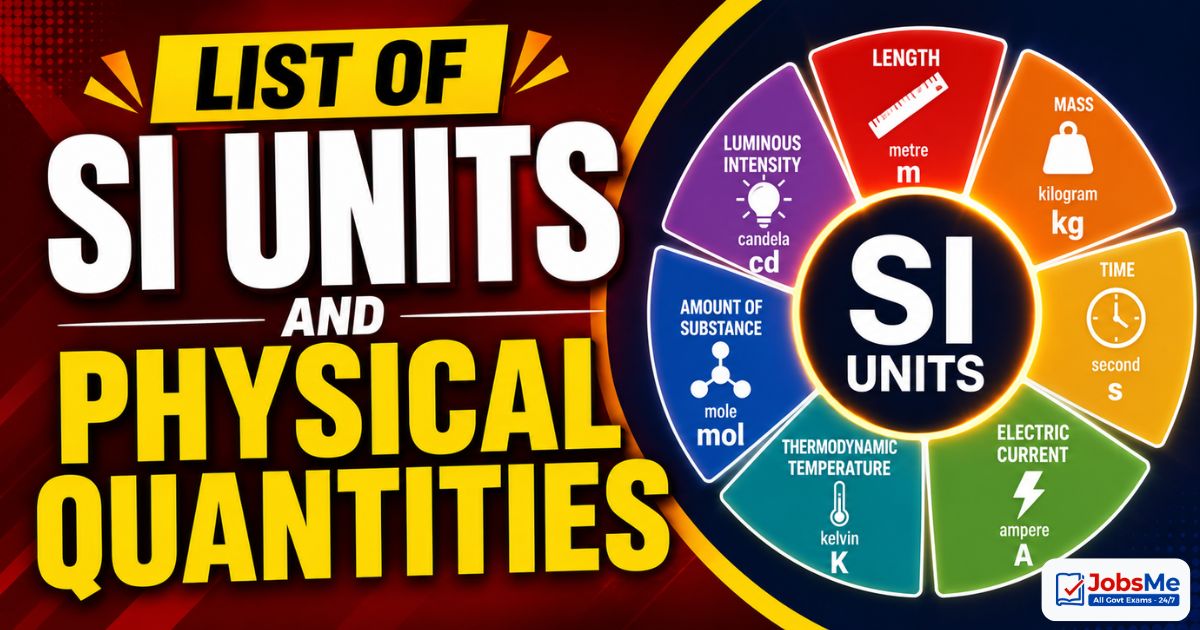
This article presents a complete list of physical quantities and their SI units, covering the seven SI base quantities (length, mass, time, electric current, temperature, amount of substance, luminous intensity), important derived units (force, energy, power, pressure, etc.), supplementary units, and commonly used non-SI and CGS units, along with their symbols and the scientists they are named after. It includes exam-favourites like the metre, kilogram, second, ampere, kelvin, mole, candela, newton, joule, watt, pascal, and hertz, with memory tricks and one-liners for quick revision. All facts are arranged in exam-ready format to help UPSC, SSC, IBPS, RRB, PSU, and State PCS aspirants score better in General Science and General Awareness sections.
Jump to section
Introduction
Measurement is the foundation of all of science, and to measure anything we need a fixed, universally accepted standard called a unit. The International System of Units (SI), from the French "Système International d'Unités", is the modern, globally accepted system of measurement. It is built on seven base units — the metre (m) for length, kilogram (kg) for mass, second (s) for time, ampere (A) for electric current, kelvin (K) for temperature, mole (mol) for amount of substance, and candela (cd) for luminous intensity. Every other unit, such as the newton, joule, or watt, is derived from these seven.
Questions on SI units and physical quantities appear regularly in UPSC Prelims, SSC CGL, IBPS PO, RRB NTPC, SBI Clerk, State PCS, and various Insurance and Defence exams. Questions typically ask for the SI unit of a given quantity (like the unit of force, pressure, or frequency), which scientist a unit is named after, or how to match a physical quantity with its correct unit and symbol. This article brings together every important physical quantity and its SI unit in a structured, exam-ready format. To explore other related General Science and Static GK topics, you can refer to the Static GK section on Jobsme.in.
SI units are also closely linked to current affairs and science themes such as World Metrology Day (20 May), the 2019 redefinition of the SI base units in terms of fundamental constants of nature, and discoveries in physics and chemistry — making this topic doubly important for aspirants preparing for UPSC Prelims (Science) and SSC General Awareness as well. You can stay updated with daily science and current affairs through the Daily Current Affairs section.
Core Concepts: Physical Quantities and Their Units
A physical quantity is any property of a material or system that can be measured and expressed as a number multiplied by a unit. Physical quantities are broadly divided into two types: fundamental (base) quantities, which are independent and not derived from others, and derived quantities, which are obtained by combining base quantities through multiplication or division. Understanding this division is the key to remembering the entire unit system.
Key Definitions
- Fundamental (Base) Quantity: An independent physical quantity that forms the basis of measurement. There are seven such quantities in SI — length, mass, time, electric current, temperature, amount of substance, and luminous intensity.
- Derived Quantity: A quantity obtained from one or more base quantities. Example: area (length x length), speed (length / time), force (mass x acceleration).
- SI Base Unit: The standard unit assigned to each fundamental quantity (metre, kilogram, second, ampere, kelvin, mole, candela).
- SI Derived Unit: A unit formed by combining base units. Many have special names honouring scientists, such as newton (N), joule (J), watt (W), pascal (Pa), and hertz (Hz).
- Supplementary Units: Two dimensionless geometric units — the radian (rad) for plane angle and the steradian (sr) for solid angle.
- Scalar Quantity: Has only magnitude (e.g., mass, time, speed, energy, temperature).
- Vector Quantity: Has both magnitude and direction (e.g., displacement, velocity, force, acceleration, momentum).
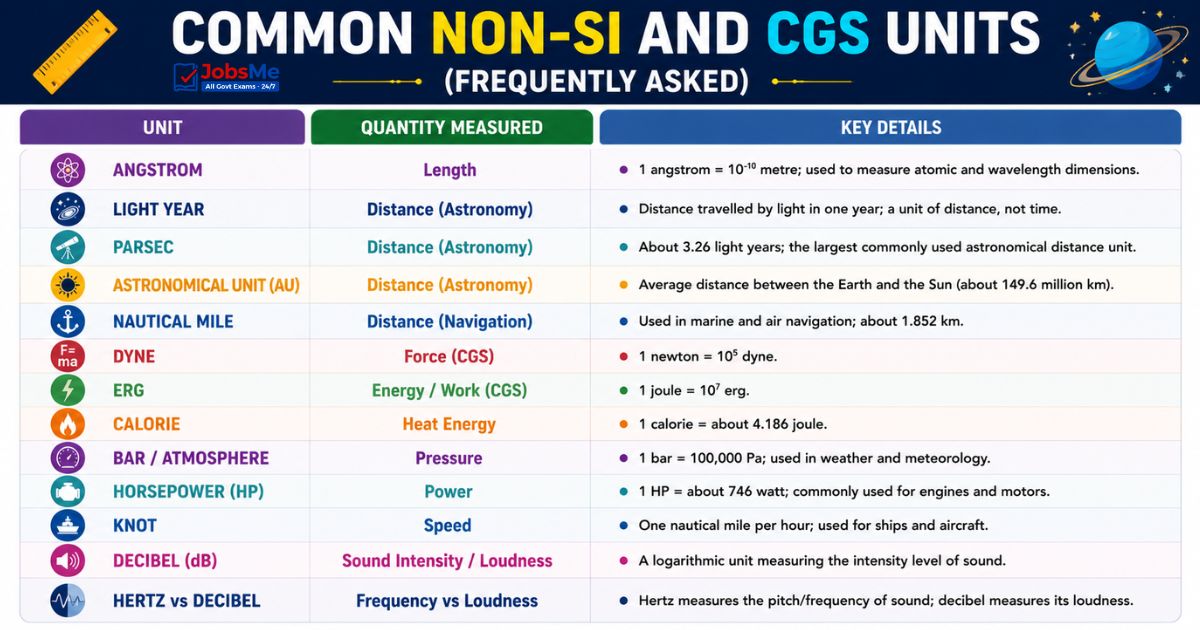
Systems of Units
- CGS System: Based on Centimetre, Gram, Second.
- FPS System: Based on Foot, Pound, Second (British system).
- MKS System: Based on Metre, Kilogram, Second — the direct forerunner of SI.
- SI System: The modern, internationally accepted system, an extended and refined form of the MKS system, adopted in 1960.
The Seven SI Base Quantities and Their Units
The following table lists the seven fundamental physical quantities, their SI base units, symbols, and key details. These seven are the most frequently asked items in every competitive exam.
| Physical Quantity | SI Base Unit | Symbol | Key Details |
|---|---|---|---|
| Length | Metre | m | Defined by the speed of light; the metre is the distance travelled by light in vacuum in 1/299,792,458 of a second. |
| Mass | Kilogram | kg | The only base unit with a prefix in its name; redefined in 2019 using the fixed value of the Planck constant (h), replacing the old platinum-iridium prototype cylinder kept in Paris. |
| Time | Second | s | Defined using the radiation period of the caesium-133 atom (9,192,631,770 cycles); the basis of atomic clocks. |
| Electric Current | Ampere | A | Named after French physicist Andre-Marie Ampere; redefined in 2019 using the fixed value of the elementary charge (e). |
| Temperature (Thermodynamic) | Kelvin | K | Named after Lord Kelvin (William Thomson); the only temperature scale with no degree sign; redefined in 2019 using the Boltzmann constant (k); 0 K is absolute zero. |
| Amount of Substance | Mole | mol | Redefined in 2019 using the fixed value of the Avogadro constant (6.02214076 x 10^23 entities per mole). |
| Luminous Intensity | Candela | cd | Measures the brightness of a light source in a given direction; the word comes from the Latin for "candle". |
Supplementary SI Units
In addition to the seven base units, the SI system has two supplementary (dimensionless) units used for measuring angles.
| Physical Quantity | Unit | Symbol | Key Details |
|---|---|---|---|
| Plane Angle | Radian | rad | The angle subtended at the centre of a circle by an arc equal in length to its radius. |
| Solid Angle | Steradian | sr | The three-dimensional equivalent of the radian; measures a cone-shaped solid angle at the centre of a sphere. |
Important SI Derived Units (With Special Names)
Derived units are formed by combining base units. Many of the most important ones carry special names honouring famous scientists. The table below covers the derived units most frequently tested in exams.
| Physical Quantity | SI Derived Unit | Symbol | Key Details / Named After |
|---|---|---|---|
| Force | Newton | N | Named after Isaac Newton; 1 N = 1 kg.m/s^2 — the force that gives a 1 kg mass an acceleration of 1 m/s^2. |
| Work / Energy / Heat | Joule | J | Named after James Prescott Joule; 1 J = 1 N.m — work done by a force of 1 newton over 1 metre. |
| Power | Watt | W | Named after James Watt; 1 W = 1 J/s — the rate of doing work; 1 horsepower is about 746 W. |
| Pressure / Stress | Pascal | Pa | Named after Blaise Pascal; 1 Pa = 1 N/m^2 — force of one newton over one square metre. |
| Frequency | Hertz | Hz | Named after Heinrich Hertz; 1 Hz = 1 cycle per second. |
| Electric Charge | Coulomb | C | Named after Charles-Augustin de Coulomb; 1 C = 1 ampere-second (A.s). |
| Electric Potential / Voltage | Volt | V | Named after Alessandro Volta, inventor of the electric battery. |
| Electrical Resistance | Ohm | (symbol omega) | Named after Georg Simon Ohm; given by Ohm's law, R = V/I. |
| Electrical Conductance | Siemens | S | Named after Werner von Siemens; the reciprocal of resistance. |
| Capacitance | Farad | F | Named after Michael Faraday. |
| Inductance | Henry | H | Named after Joseph Henry. |
| Magnetic Flux | Weber | Wb | Named after Wilhelm Weber. |
| Magnetic Flux Density | Tesla | T | Named after Nikola Tesla; 1 T = 1 Wb/m^2. |
| Radioactivity (Activity) | Becquerel | Bq | Named after Henri Becquerel; measures the number of nuclear decays per second. |
| Absorbed Dose of Radiation | Gray | Gy | Named after Louis Harold Gray. |
| Equivalent Dose of Radiation | Sievert | Sv | Named after Rolf Maximilian Sievert; measures biological effect of radiation. |
| Luminous Flux | Lumen | lm | Total visible light emitted by a source (candela x steradian). |
| Illuminance | Lux | lx | Luminous flux per unit area; 1 lx = 1 lm/m^2. |
| Catalytic Activity | Katal | kat | Used in biochemistry to measure catalytic activity of enzymes. |
| Celsius Temperature | Degree Celsius | (symbol degree C) | Named after Anders Celsius; 0 degree C = 273.15 K. |
Other Common Derived Units (Without Special Names)
| Physical Quantity | SI Unit | Key Details |
|---|---|---|
| Area | Square metre (m^2) | Derived as length x breadth. |
| Volume | Cubic metre (m^3) | Derived as length x breadth x height; 1 litre = 0.001 m^3. |
| Density | Kilogram per cubic metre (kg/m^3) | Mass per unit volume. |
| Speed / Velocity | Metre per second (m/s) | Distance per unit time; velocity is a vector, speed is a scalar. |
| Acceleration | Metre per second squared (m/s^2) | Rate of change of velocity. |
| Momentum | Kilogram metre per second (kg.m/s) | Product of mass and velocity; a vector quantity. |
| Impulse | Newton second (N.s) | Product of force and time; equals change in momentum. |
| Angular Velocity | Radian per second (rad/s) | Rate of change of angular displacement. |
| Surface Tension | Newton per metre (N/m) | Force per unit length acting on a liquid surface. |
| Specific Heat | Joule per kilogram kelvin (J/kg.K) | Heat needed to raise the temperature of 1 kg of a substance by 1 K. |
Common Non-SI and CGS Units (Frequently Asked)
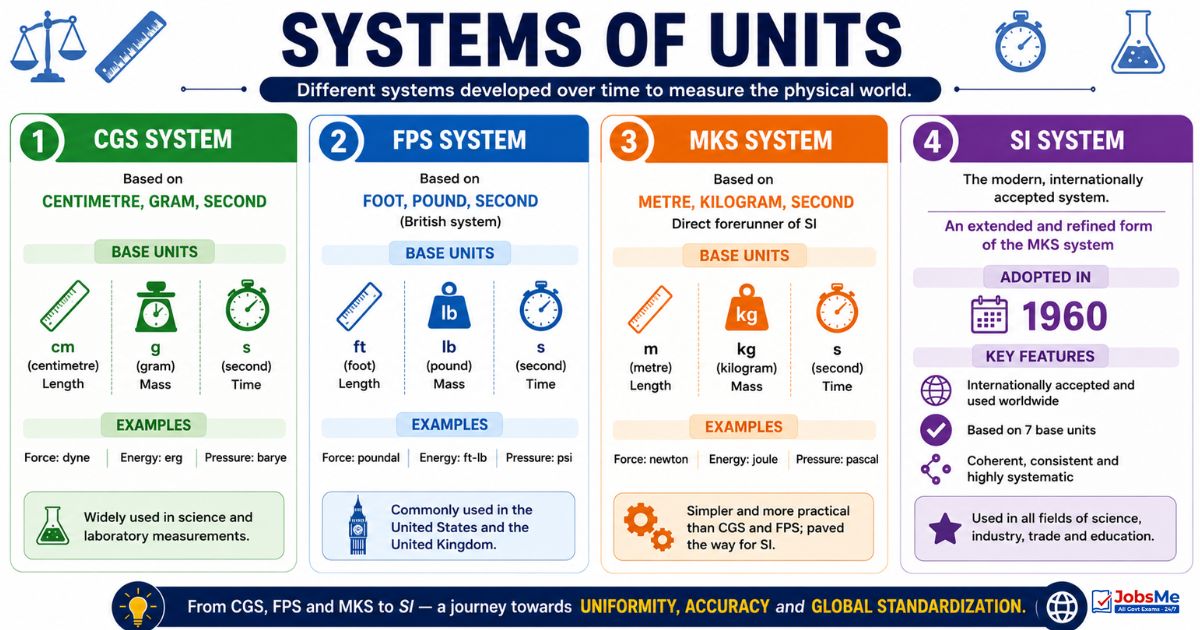
| Unit | Quantity Measured | Key Details |
|---|---|---|
| Angstrom | Length | 1 angstrom = 10^-10 metre; used to measure atomic and wavelength dimensions. |
| Light Year | Distance (Astronomy) | Distance travelled by light in one year; a unit of distance, not time. |
| Parsec | Distance (Astronomy) | About 3.26 light years; the largest commonly used astronomical distance unit. |
| Astronomical Unit (AU) | Distance (Astronomy) | Average distance between the Earth and the Sun (about 149.6 million km). |
| Nautical Mile | Distance (Navigation) | Used in marine and air navigation; about 1.852 km. |
| Dyne | Force (CGS) | 1 newton = 10^5 dyne. |
| Erg | Energy / Work (CGS) | 1 joule = 10^7 erg. |
| Calorie | Heat Energy | 1 calorie = about 4.186 joule. |
| Bar / Atmosphere | Pressure | 1 bar = 100,000 Pa; used in weather and meteorology. |
| Horsepower (HP) | Power | 1 HP = about 746 watt; commonly used for engines and motors. |
| Knot | Speed | One nautical mile per hour; used for ships and aircraft. |
| Decibel (dB) | Sound Intensity / Loudness | A logarithmic unit measuring the intensity level of sound. |
| Hertz vs Decibel | Frequency vs Loudness | Hertz measures the pitch/frequency of sound; decibel measures its loudness. |
Memory Tricks and Mnemonics
Trick 1: The Seven Base Units — "Mama Kept Six Apples, Kids Made Cake"
Use the first letters to recall all seven SI base units in order:
- M -> Metre (length).
- K -> Kilogram (mass).
- S -> Second (time).
- A -> Ampere (current).
- K -> Kelvin (temperature).
- M -> Mole (amount of substance).
- C -> Candela (luminous intensity).
"Mama Kept Six Apples, Kids Made Cake" = M-K-S-A-K-M-C."
Trick 2: The "Four Redefined in 2019" — "KAMK"
In 2019, four base units were redefined using constants of nature. Remember "KAMK":
- K -> Kilogram (Planck constant, h).
- A -> Ampere (elementary charge, e).
- M -> Mole (Avogadro constant, NA).
- K -> Kelvin (Boltzmann constant, k).
"KAMK got new constants; the Second, Metre and Candela stayed the same."
Trick 3: Force-Energy-Power Chain — "NJW"
Three of the most-asked derived units form a logical chain. Remember "NJW":
- N -> Newton -> Force.
- J -> Joule -> Work / Energy (Force x distance).
- W -> Watt -> Power (Energy / time).
"Newton pushes, Joule works, Watt times it."
Trick 4: Electricity Units — "VCR FOH"
Group the electrical units by what they measure:
- V -> Volt -> Potential / Voltage (Volta).
- C -> Coulomb -> Charge.
- R = Ohm -> Resistance (Ohm).
- F -> Farad -> Capacitance (Faraday).
- O -> Ohm -> Resistance again (anchor).
- H -> Henry -> Inductance.
"Volta, Coulomb and Ohm power the circuit; Faraday and Henry store and induce."
Trick 5: Magnetism Units — "Three T's and a Web"
- Tesla -> Magnetic flux density (named after Nikola Tesla).
- Weber (Web) -> Magnetic flux.
- Tesla = Weber per square metre -> links the two.
"A Web of flux spread over a metre gives you Tesla."
Trick 6: Radiation Units — "Big Boys Get Sick" (BGS)
The three radiation units in increasing "human relevance":
- Becquerel -> Activity (decays per second).
- Gray -> Absorbed dose (energy absorbed).
- Sievert -> Equivalent dose (biological harm).
"Becquerel counts, Gray absorbs, Sievert harms."
Trick 7: Light Units — "Candela Climbs the Ladder"
- Candela -> Luminous intensity (base unit).
- Lumen -> Luminous flux (candela x steradian).
- Lux -> Illuminance (lumen per square metre).
"Candela -> Lumen -> Lux: source, flux, surface."
Trick 8: CGS Conversions — "Power of Tens"
Remember the two big CGS-to-SI jumps using powers of ten:
- Force: 1 newton = 10^5 dyne.
- Energy: 1 joule = 10^7 erg.
"Force five zeros, energy seven zeros."
Additional Notes
Frequently Confused Facts
- Light Year vs Year: A light year is a unit of distance (how far light travels in a year), NOT a unit of time. This is one of the most common exam traps.
- Pascal vs Bar vs Atmosphere: The SI unit of pressure is the pascal (Pa); the bar and atmosphere are larger non-SI pressure units (1 bar = 100,000 Pa).
- Hertz vs Decibel: Hertz measures the frequency (pitch) of sound, while decibel measures its loudness (intensity level).
- Kelvin vs Celsius: Kelvin is the SI base unit and is written without a degree sign; 0 K is absolute zero, and 0 degree C = 273.15 K.
- Weight vs Mass: Mass (kilogram) is the amount of matter and is constant everywhere; weight is a force (newton) and changes with gravity.
- Newton vs Dyne: Newton is the SI unit of force; dyne is the CGS unit; 1 N = 10^5 dyne.
- Joule vs Calorie: Joule is the SI unit of heat/energy; calorie is a non-SI unit; 1 calorie = about 4.186 joule.
- Watt vs Horsepower: Watt is the SI unit of power; horsepower is a non-SI unit; 1 HP = about 746 W.
- Tesla vs Weber: Tesla measures magnetic flux density (per unit area); weber measures total magnetic flux.
- Ampere vs Coulomb: Ampere is the unit of electric current (base unit); coulomb is the unit of charge (1 C = 1 A.s).
- Scalar vs Vector: Speed, mass, energy and temperature are scalars (magnitude only); velocity, force, displacement and momentum are vectors (magnitude and direction).
- Radian vs Steradian: Radian is the unit of plane (2D) angle; steradian is the unit of solid (3D) angle.
Repeating PYQ Patterns
Certain physical-quantity and unit pairs are asked repeatedly in competitive exams. SI unit of force (newton), pressure (pascal), energy/work (joule), power (watt), frequency (hertz), electric current (ampere), resistance (ohm), magnetic flux density (tesla), and the seven base units with their scientists appear most often in UPSC Prelims (Science), SSC CGL, and RRB NTPC papers. Banking exams (IBPS PO, SBI Clerk) frequently ask "which quantity is measured in X unit" type questions and the light-year trap. The 2019 SI redefinition and World Metrology Day (20 May) are favourite current affairs linkages. You can practise these directly through the Static GK Quiz on Jobsme.in.
Quick Insight
SI units are more than dry definitions — they are the shared language that lets a scientist in India, a doctor in Japan, and an engineer in Germany all mean exactly the same thing when they say "one kilogram" or "one second". The 2019 redefinition was a historic milestone: for the first time, all units were defined entirely in terms of fixed constants of nature such as the speed of light and the Planck constant, ending centuries of dependence on physical artefacts like the platinum-iridium kilogram cylinder in Paris. Understanding these units helps aspirants answer not just direct Static GK questions but also reasoning-based General Science questions in Prelims. For more General Awareness topics, you can refer to the Static GK section and stay current with the Daily Current Affairs notes on Jobsme.in.
One-Liners for Quick Revision
- Length -> Metre (m) -> base unit, defined by the speed of light.
- Mass -> Kilogram (kg) -> base unit, redefined in 2019 using the Planck constant.
- Time -> Second (s) -> base unit, defined using the caesium-133 atom.
- Electric Current -> Ampere (A) -> base unit, named after Andre-Marie Ampere.
- Temperature -> Kelvin (K) -> base unit, named after Lord Kelvin; 0 K = absolute zero.
- Amount of Substance -> Mole (mol) -> base unit, linked to Avogadro constant.
- Luminous Intensity -> Candela (cd) -> base unit, brightness of a light source.
- Plane Angle -> Radian (rad) -> supplementary unit.
- Solid Angle -> Steradian (sr) -> supplementary unit.
- Force -> Newton (N) -> named after Isaac Newton; 1 N = 1 kg.m/s^2.
- Work / Energy / Heat -> Joule (J) -> named after James Prescott Joule.
- Power -> Watt (W) -> named after James Watt; 1 W = 1 J/s.
- Pressure / Stress -> Pascal (Pa) -> named after Blaise Pascal; 1 Pa = 1 N/m^2.
- Frequency -> Hertz (Hz) -> named after Heinrich Hertz; cycles per second.
- Electric Charge -> Coulomb (C) -> named after Charles-Augustin de Coulomb.
- Voltage / Potential -> Volt (V) -> named after Alessandro Volta.
- Resistance -> Ohm -> named after Georg Simon Ohm.
- Conductance -> Siemens (S) -> named after Werner von Siemens.
- Capacitance -> Farad (F) -> named after Michael Faraday.
- Inductance -> Henry (H) -> named after Joseph Henry.
- Magnetic Flux -> Weber (Wb) -> named after Wilhelm Weber.
- Magnetic Flux Density -> Tesla (T) -> named after Nikola Tesla.
- Radioactivity -> Becquerel (Bq) -> named after Henri Becquerel.
- Absorbed Radiation Dose -> Gray (Gy) -> named after Louis Harold Gray.
- Equivalent Radiation Dose -> Sievert (Sv) -> named after Rolf Sievert.
- Luminous Flux -> Lumen (lm) -> candela x steradian.
- Illuminance -> Lux (lx) -> lumen per square metre.
- Catalytic Activity -> Katal (kat) -> used in biochemistry.
- Celsius Temperature -> Degree Celsius -> named after Anders Celsius; 0 degree C = 273.15 K.
- Area -> Square metre (m^2) -> derived unit.
- Volume -> Cubic metre (m^3) -> derived; 1 litre = 0.001 m^3.
- Density -> Kilogram per cubic metre (kg/m^3) -> mass per unit volume.
- Speed / Velocity -> Metre per second (m/s) -> velocity is a vector.
- Acceleration -> Metre per second squared (m/s^2) -> rate of change of velocity.
- Momentum -> Kilogram metre per second (kg.m/s) -> mass x velocity (vector).
- Impulse -> Newton second (N.s) -> equals change in momentum.
- Surface Tension -> Newton per metre (N/m).
- Specific Heat -> Joule per kilogram kelvin (J/kg.K).
- Angstrom -> Length -> 10^-10 metre, used for atomic dimensions.
- Light Year -> Distance (not time) -> distance light travels in one year.
- Parsec -> Distance -> about 3.26 light years.
- Astronomical Unit (AU) -> Distance -> average Earth-Sun distance.
- Nautical Mile -> Distance -> navigation; about 1.852 km.
- Dyne -> Force (CGS) -> 1 N = 10^5 dyne.
- Erg -> Energy (CGS) -> 1 J = 10^7 erg.
- Calorie -> Heat -> 1 calorie = about 4.186 joule.
- Bar / Atmosphere -> Pressure -> 1 bar = 100,000 Pa.
- Horsepower (HP) -> Power -> 1 HP = about 746 watt.
- Knot -> Speed -> one nautical mile per hour.
- Decibel (dB) -> Sound loudness -> logarithmic unit of intensity.
- SI System -> adopted 1960 -> extended form of the MKS system.
- 2019 Redefinition -> kilogram, ampere, kelvin, mole redefined using constants of nature.
- World Metrology Day -> 20 May -> commemorates the Metre Convention.
For more Static GK topics like physical constants, inventions and discoveries, and important scientific instruments, explore the Static GK section on Jobsme.in. You can also test your knowledge with the Static GK Quiz, brush up on the Computer Awareness Quiz, and check out the latest exam notifications at Latest Government Job Notifications.
Free quiz • No signup required
Put this topic into practice with Indian Cultural Institutions – Static GK MCQ Quiz. It is the quickest way to reinforce what you just learned.
Frequently Asked Questions
How many base units are there in the SI system?
What is the SI unit of force?
Is a light year a unit of time or distance?
What is the SI unit of pressure?
Which four SI base units were redefined in 2019?
What is the difference between mass and weight?
What is the SI unit of frequency and how does it differ from decibel?
What are supplementary units in the SI system?
What is the SI unit of electrical resistance and who is it named after?
Why was the SI system created and when was it adopted?

About the author