European Arrival in India – Advent of Europeans: Static GK & General Awareness for Competitive Exams with Memory Tricks
This article presents a complete account of the European arrival in India, covering the Portuguese, Dutch, English, Danish, and French trading companies along with their dates of arrival, founders, key settlements, important governors, and the battles that decided European supremacy. It includes landmark facts like Vasco da Gama reaching Calicut in 1498, the Portuguese capture of Goa in 1510, the founding of the English East India Company in 1600, and the Battle of Plassey in 1757, with memory tricks and one-liners for quick revision. All facts are arranged in exam-ready format to help UPSC, SSC, IBPS, RRB, PSU, and State PCS aspirants score better in General Awareness and Modern History sections.
Jump to section
Introduction
The story of modern Indian history begins with the European arrival in India, a chapter that opened in 1498 when the Portuguese explorer Vasco da Gama reached the port of Calicut (present-day Kozhikode, Kerala) by sea. By discovering a direct maritime route to India via the Cape of Good Hope, the Europeans bypassed the Arab and Venetian middlemen who had long controlled the lucrative spice trade. Over the next two centuries, five major European powers — the Portuguese, Dutch, English, Danish, and French — set up trading companies and factories along the Indian coast, gradually turning commercial ambition into political conquest.
Questions on the Advent of Europeans appear regularly in UPSC Prelims, SSC CGL, IBPS PO, RRB NTPC, SBI Clerk, State PCS, and various Insurance and Defence exams. Aspirants are commonly asked about the chronological order of arrival, the founders and dates of each East India Company, the location of key settlements, and the decisive battles such as Plassey and Buxar. This article brings together every important fact in a structured, exam-ready format. To explore other related Static GK topics, you can refer to the Static GK section on Jobsme.in.
The European arrival in India is also closely linked to current affairs themes such as anniversaries of the founding of trading posts, heritage conservation in Goa, Puducherry and Tranquebar, and references in Parliament to colonial-era history — making this topic doubly important for aspirants preparing for UPSC Mains and Essay papers as well. For day-to-day updates connected to such themes, the Daily Current Affairs page is a useful companion resource.
Core Concepts: Why Europeans Came to India
The European arrival in India was driven primarily by economic motives, although it later transformed into a contest for political and territorial control. Understanding the reasons and the sequence of arrival helps students answer both factual matching questions and analytical questions confidently.
Key Reasons for the European Arrival
- Spice Trade: Europeans wanted direct access to Indian spices like pepper, cloves, cinnamon, and cardamom, which fetched enormous profits in European markets.
- Bypassing Middlemen: They sought to eliminate Arab and Venetian intermediaries who controlled the old land routes through Egypt, Syria, and the Persian Gulf.
- Disruption of Old Routes: The Arab conquests of the seventh century and later the Ottoman control of West Asia blocked the traditional overland trade routes to the East.
- Age of Geographical Discoveries: The fifteenth century saw great explorations — Christopher Columbus reached America in 1492 and Vasco da Gama opened the sea route to India in 1498.
- Demand for Indian Goods: Apart from spices, Indian textiles, indigo, saltpetre, and silk were in high demand across Europe.
- From Trade to Empire: What began as pure commerce gradually turned into a struggle for political mastery, with each power establishing fortified settlements and armies.
Chronological Order of Arrival
- The standard exam order of arrival is: Portuguese (1498) → Dutch (1602) → English (1600 charter, trade from 1608) → Danish (1616) → French (1664).
- A key exam fact: the Portuguese were the first to arrive and also the last to leave India — they held Goa until 1961.
- The French were the last major European power to arrive, with their company founded in 1664.
European Trading Companies in India - Overview
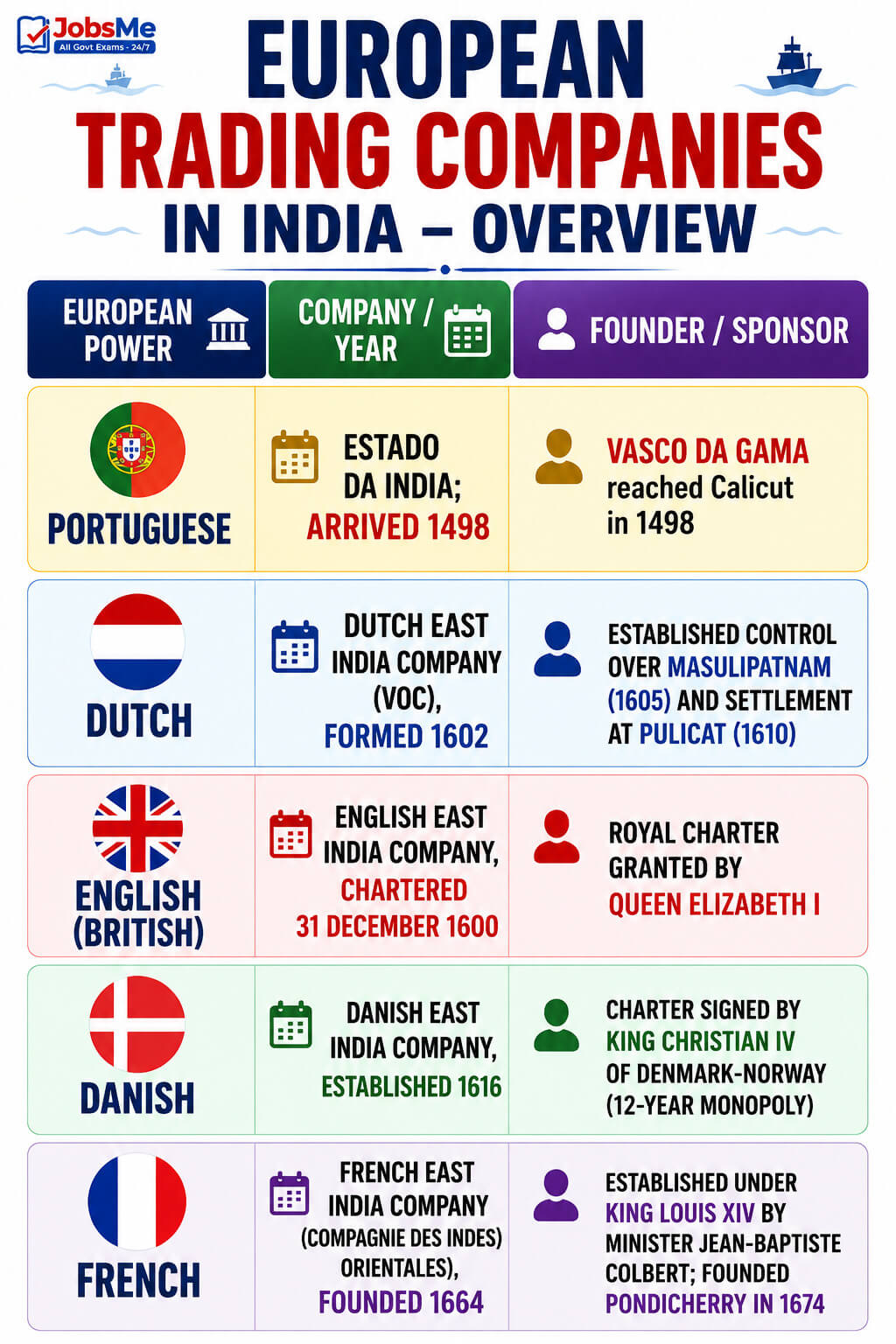
The following table summarises each European power, the year of arrival, the founder or sponsor, and key details. These facts are the most frequently tested in competitive exams.
| European Power | Company / Year | Reason / Key Details |
|---|---|---|
| Portuguese | Estado da India; arrived 1498 | Vasco da Gama reached Calicut in 1498 via the Cape of Good Hope; first Europeans to arrive and last to leave; captured Goa in 1510, which became their headquarters; held Goa, Daman, and Diu until 1961. |
| Dutch | Dutch East India Company (VOC), formed 1602 | Established control over Masulipatnam (1605) and settlement at Pulicat (1610, Fort Geldria); focused on spices and textiles; defeated by the English in the Battle of Bedara (1759); finally exited India after the Anglo-Dutch Treaty (1824), formally leaving in 1825. |
| English (British) | English East India Company, chartered 31 December 1600 | Royal charter granted by Queen Elizabeth I to "The Governor and Company of Merchants of London Trading into the East Indies"; first factory at Surat (1613); later set up Madras, Bombay, and Calcutta; emerged as the dominant power after Plassey (1757) and Buxar (1764). |
| Danish | Danish East India Company, established 1616 | Charter signed by King Christian IV of Denmark-Norway with a 12-year monopoly; first factory at Tranquebar (1620, Tamil Nadu); headquarters at Serampore (Bengal); too weak to compete, sold all settlements to the British in 1845. |
| French | French East India Company (Compagnie des Indes Orientales), founded 1664 | Established under King Louis XIV by Minister Jean-Baptiste Colbert; founded Pondicherry in 1674 as the nerve centre of French power; Dupleix led the Carnatic Wars; lost political ambitions after the Treaty of Paris (1763). |
The Portuguese in India
The Portuguese were the pioneers of the European arrival in India and built the first European empire in the East. Their facts about governors and policies are heavily tested.
Portuguese Arrival and Settlements
- Vasco da Gama reached Calicut in 1498 and was received by the local ruler, the Zamorin of Calicut.
- The Portuguese established their first trading post at Cochin, and later made Goa their capital after capturing it in 1510.
- Key Portuguese settlements included Goa, Daman, Diu, Salsette, Bassein, and Hooghly.
Important Portuguese Governors
| Governor | Period / Title | Key Contribution |
|---|---|---|
| Francisco de Almeida | First Governor / Viceroy (1505) | Introduced the Blue Water Policy (Cartaze system) to dominate the Indian Ocean through naval supremacy; aimed to destroy Muslim trade; involved in the Battle of Diu (1509) against the combined Egyptian-Gujarati fleet. |
| Alfonso de Albuquerque | Governor (1509 onwards) | Real founder of Portuguese power in the East; captured Goa in 1510 and made it the administrative headquarters; introduced a permit (cartaze) system for other ships; abolished sati in Portuguese areas. |
| Nino da Cunha | Governor (1529 onwards) | Transferred the Portuguese capital from Cochin to Goa in 1530; acquired Diu and Bassein. |
The Dutch, English, Danish, and French in India
After the Portuguese, the other four powers arrived in quick succession. The table below highlights their major settlements and decisive moments.
Major Settlements and Key Battles
| Power | Major Settlements | Key Battles / Events |
|---|---|---|
| Dutch | Pulicat (Fort Geldria), Masulipatnam, Nagapattinam, Chinsurah, Cochin, Surat | Battle of Colachel (1741) - defeated by Marthanda Varma of Travancore, the first Asian defeat of a European power; Battle of Bedara (1759) - defeated by the English under Colonel Forde, ending Dutch ambitions in India. |
| English | Surat (1613), Madras / Fort St. George (1639), Bombay (1668), Calcutta / Fort William (1690) | Battle of Swally (1612) - defeated the Portuguese; Battle of Plassey (1757) - Robert Clive defeated Siraj-ud-Daulah; Battle of Buxar (1764) - established firm control over Bengal, Bihar, and Odisha. |
| Danish | Tranquebar (1620, Tamil Nadu), Serampore (Bengal, headquarters), Nicobar Islands | Founded the Serampore Mission Press (1799); lacked military strength; sold all Indian settlements to the British in 1845. |
| French | Pondicherry (1674, capital), Chandernagore, Mahe, Karaikal, Yanam, Masulipatnam | Carnatic Wars (1746-1763) against the English under Dupleix; defeated in the Third Carnatic War (Battle of Wandiwash, 1760); lost political power by the Treaty of Paris (1763). |
Key Personalities of the European Arrival
| Personality | Power / Role | Significance |
|---|---|---|
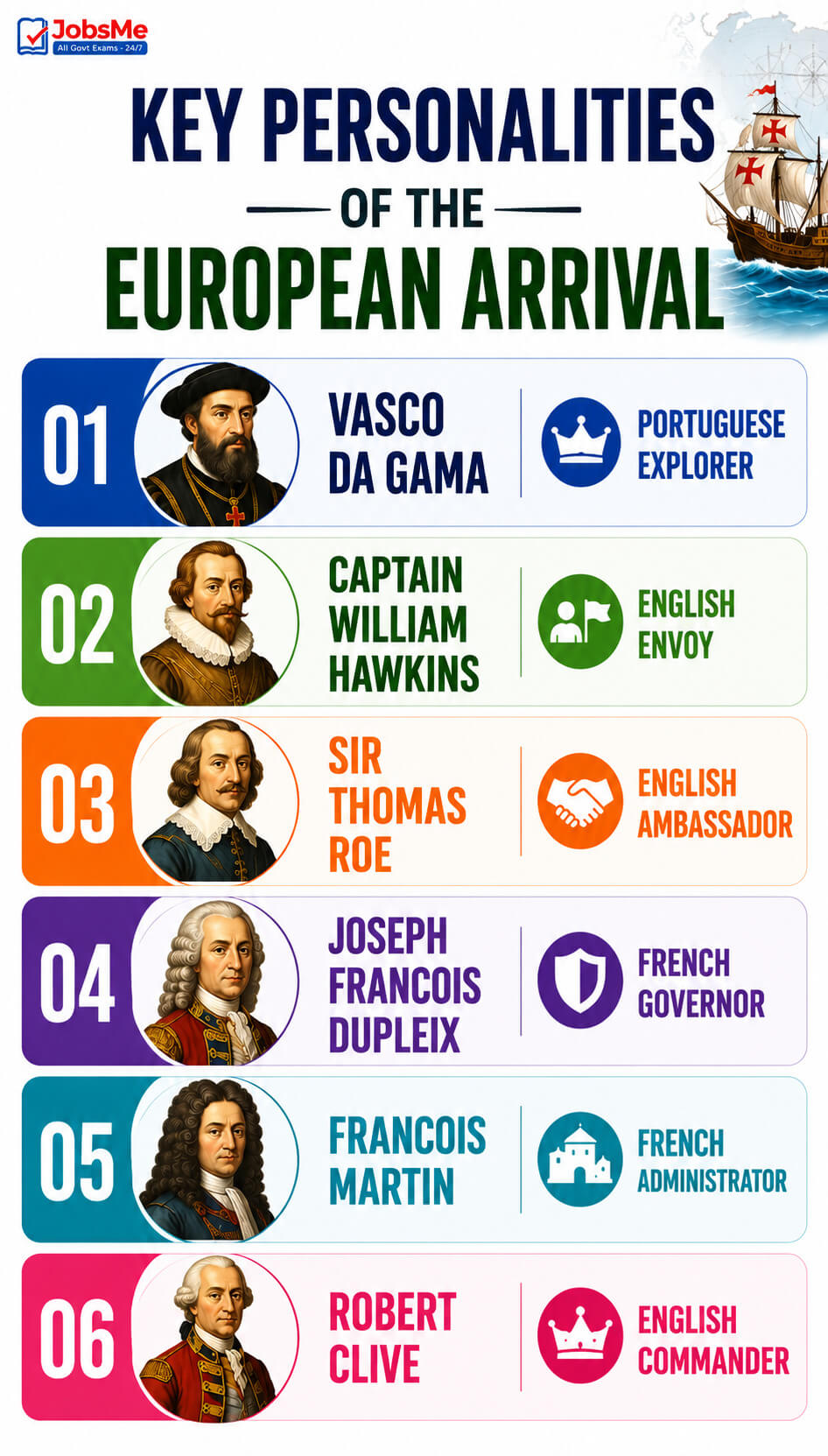
| Vasco da Gama | Portuguese explorer | First European to reach India by sea, landing at Calicut in 1498. |
| Captain William Hawkins | English envoy | Arrived at the court of Mughal Emperor Jahangir in 1609 to seek trading rights at Surat, but failed due to Portuguese opposition. |
| Sir Thomas Roe | English ambassador | Secured trading rights from Jahangir around 1615, paving the way for English factories. |
| Joseph Francois Dupleix | French Governor | Most ambitious French Governor; led the Carnatic Wars against the English from 1742. |
| Francois Martin | French administrator | Founded Pondicherry in 1674 and became its first French Governor. |
| Robert Clive | English commander | Won the Battle of Plassey (1757), laying the foundation of British rule in India. |
Memory Tricks and Mnemonics
Trick 1: Order of Arrival — "Portuguese Doctors English Drink Fruit"
To remember the chronological order of European arrival, use the sentence: "Portuguese Doctors English Drink Fruit."
- P → Portuguese (1498).
- D → Dutch (1602).
- E → English (1600 charter).
- D → Danish (1616).
- F → French (1664).
"First to come, last to leave — that is the Portuguese."
Trick 2: First and Last — "Portuguese Bookends"
Remember that the Portuguese both opened and closed the European chapter in India:
- First to arrive: Portuguese in 1498 (Vasco da Gama).
- Last to leave: Portuguese in 1961 (Goa, Daman, Diu liberated).
- Last to arrive: French in 1664.
"The Portuguese were the bookends of European India."
Trick 3: Two Almeida-Albuquerque Facts — "ABBA"
For the first two Portuguese governors, remember "A for Almeida, A for Albuquerque":
- Almeida → First governor, Blue Water Policy.
- Albuquerque → Real founder of Portuguese power, captured Goa (1510).
Trick 4: English Factory Cities — "SMBC"
The four major English settlements can be remembered as "SMBC":
- S → Surat (1613, first factory).
- M → Madras / Fort St. George (1639).
- B → Bombay (1668).
- C → Calcutta / Fort William (1690).
Trick 5: Two Dutch Defeats — "Colachel then Bedara"
The Dutch suffered two famous defeats; remember them in date order:
- Battle of Colachel (1741) → defeated by Marthanda Varma of Travancore.
- Battle of Bedara (1759) → defeated by the English.
"Colachel before Bedara — Travancore before the English."
Trick 6: French Settlements — "Pondi's Friends: CMKY"
Pondicherry was the French capital; remember the other settlements as "CMKY":
- C → Chandernagore.
- M → Mahe.
- K → Karaikal.
- Y → Yanam.
Trick 7: Treaties and Years — "63 ends France, 24 ends Holland"
- Treaty of Paris (1763) → ended French political ambitions in India.
- Anglo-Dutch Treaty (1824) → Dutch exchanged Indian holdings for British Indonesia; left India in 1825.
- 1845 → Danes sold all their settlements to the British.
Additional Notes
Frequently Confused Facts
- Year of arrival vs year of charter (English): The English East India Company received its royal charter on 31 December 1600, but English trade in India effectively began later, with the first factory at Surat in 1613.
- Dutch formation year: The Dutch East India Company (VOC) was formed in 1602; the Dutch established Masulipatnam in 1605 and Pulicat in 1610 — do not confuse the formation year with the settlement years.
- Battle of Colachel vs Battle of Bedara: Colachel (1741) was a Dutch defeat by Travancore; Bedara (1759) was a Dutch defeat by the English. Both involved the Dutch but against different opponents.
- Plassey vs Buxar: Battle of Plassey (1757) was against Siraj-ud-Daulah and began British dominance; Battle of Buxar (1764) consolidated it by granting Bengal, Bihar, and Odisha.
- Almeida vs Albuquerque: Almeida was the first Portuguese governor (Blue Water Policy); Albuquerque was the real founder of Portuguese power who captured Goa.
- First vs last to arrive: Portuguese arrived first (1498); French arrived last (1664). But the Portuguese were also the last to physically leave India (Goa, 1961).
- Pondicherry vs Goa: Pondicherry was the French capital; Goa was the Portuguese capital.
- Tranquebar vs Serampore: Tranquebar (Tamil Nadu) was the first Danish factory (1620); Serampore (Bengal) was the Danish headquarters.
Repeating PYQ Patterns
Certain facts about the European arrival in India are asked repeatedly in competitive exams. Vasco da Gama (1498, Calicut), the chronological order of arrival, the founding of the English East India Company (1600), the capture of Goa (1510), the Blue Water Policy of Almeida, the Battle of Plassey (1757), the Battle of Buxar (1764), the Treaty of Paris (1763), and the fact that the Portuguese were the first to arrive and last to leave appear most often in UPSC Prelims, SSC CGL, and RRB NTPC papers. Banking exams (IBPS PO, SBI Clerk) frequently ask matching questions linking each power with its capital settlement. State PCS exams add regional angles — Tamil Nadu PCS focuses on Tranquebar and Pondicherry, while West Bengal PCS asks about Chinsurah, Chandernagore, and Serampore.
Quick Insight
The European arrival in India was far more than a trade event — it reshaped the subcontinent's political destiny for over two centuries. What began as a quest for pepper and textiles ended in the establishment of British colonial rule. The Portuguese introduced new crops like potatoes, chillies, and cashew nuts; the Dutch brought their carrying trade; and the French and English fought the Carnatic Wars that decided the fate of South India. Understanding this period helps aspirants connect the dots between trade, military technology, and empire-building, which is invaluable for both Prelims (direct matching questions) and Mains (essays on colonialism and the freedom struggle). For further reading on related Static GK topics, you can explore the Static GK notes and test yourself with the Static GK Quiz on Jobsme.in.
One-Liners for Quick Revision
- Vasco da Gama → reached Calicut in 1498 → first European to arrive in India by sea via Cape of Good Hope.
- Portuguese → arrived 1498 → first to come and last to leave; held Goa till 1961.
- Francisco de Almeida → first Portuguese Governor (1505) → introduced the Blue Water Policy (Cartaze system).
- Alfonso de Albuquerque → real founder of Portuguese power → captured Goa in 1510; abolished sati.
- Nino da Cunha → Portuguese Governor → shifted capital from Cochin to Goa in 1530.
- Battle of Diu (1509) → Portuguese defeated combined Egyptian-Gujarati fleet → secured naval supremacy.
- Portuguese settlements → Goa, Daman, Diu, Salsette, Bassein, Hooghly.
- Dutch East India Company (VOC) → formed 1602 → focused on spices and textiles.
- Dutch settlements → Pulicat (Fort Geldria, 1610), Masulipatnam (1605), Nagapattinam, Chinsurah, Cochin.
- Battle of Colachel (1741) → Marthanda Varma of Travancore defeated the Dutch → first Asian defeat of a European power.
- Battle of Bedara (1759) → English defeated the Dutch → ended Dutch ambitions in India.
- Dutch exit → Anglo-Dutch Treaty (1824); left India in 1825.
- English East India Company → chartered 31 December 1600 by Queen Elizabeth I.
- Captain William Hawkins → arrived at Jahangir's court in 1609 → failed to get Surat factory due to Portuguese.
- Sir Thomas Roe → secured English trading rights from Jahangir around 1615.
- English settlements → Surat (1613), Madras/Fort St. George (1639), Bombay (1668), Calcutta/Fort William (1690).
- Battle of Swally (1612) → English defeated the Portuguese at sea near Surat.
- Battle of Plassey (1757) → Robert Clive defeated Siraj-ud-Daulah → beginning of British rule.
- Battle of Buxar (1764) → English victory → consolidated control over Bengal, Bihar, Odisha.
- Danish East India Company → established 1616 → charter by King Christian IV with 12-year monopoly.
- Danish settlements → Tranquebar (1620, first factory), Serampore (headquarters), Nicobar Islands.
- Serampore Mission Press → founded 1799 by Danish missionaries.
- Danish exit → sold all settlements to the British in 1845.
- French East India Company → founded 1664 → established by Colbert under King Louis XIV.
- Francois Martin → founded Pondicherry in 1674 → first French Governor of Pondicherry.
- French settlements → Pondicherry (capital), Chandernagore, Mahe, Karaikal, Yanam.
- Joseph Francois Dupleix → most ambitious French Governor → led the Carnatic Wars from 1742.
- Carnatic Wars (1746-1763) → Anglo-French conflict for control of South India.
- Battle of Wandiwash (1760) → English defeated the French in the Third Carnatic War.
- Treaty of Paris (1763) → ended French political ambitions in India.
- Christopher Columbus → discovered America in 1492 → part of the Age of Discoveries.
For more Static GK topics like Indian dynasties, battles, and governors, explore the Static GK section on Jobsme.in. You can also test your knowledge with the Static GK Quiz, brush up on current events at Daily Current Affairs, and check the latest openings at Latest Government Job Notifications.
Free quiz • No signup required
Put this topic into practice with Indian Cultural Institutions – Static GK MCQ Quiz. It is the quickest way to reinforce what you just learned.
Frequently Asked Questions
Who was the first European to arrive in India and when?
What is the correct chronological order of European arrival in India?
Why are the Portuguese said to be the first to come and the last to leave India?
When was the English East India Company established?
What was the Blue Water Policy and who introduced it?
Who was the real founder of Portuguese power in India?
What was the significance of the Battle of Colachel?
Which battles established British dominance in India?
Where was the headquarters of the French and the Danish in India?
Which treaty ended French political ambitions in India?

About the author