Bhakti and Sufi Movements – Static GK & General Awareness Notes for Competitive Exams with Saints, Silsilahs and Memory Tricks
This article presents complete, exam-ready notes on the Bhakti and Sufi Movements of medieval India, covering the Saguna and Nirguna schools, the Alvar and Nayanar saints of the South, the regional Bhakti saints of Maharashtra, Bengal, Assam and the North, and the major Sufi silsilahs such as Chishti, Suhrawardi, Qadiri, Naqshbandi and Firdausi along with their founders and famous saints. It includes the key works, regions, philosophies and nicknames of important figures like Kabir, Guru Nanak, Mirabai, Tulsidas, Chaitanya, Ramananda, Khwaja Moinuddin Chishti, Nizamuddin Auliya and Amir Khusrau, with memory tricks and one-liners for quick revision. All facts are arranged in a structured format to help UPSC, SSC, IBPS, RRB, PSU, Insurance and State PCS aspirants score better in General Awareness, Art and Culture, and Medieval History sections.
Jump to section
- Introduction
- Core Concepts: Bhakti and Sufi Movements Explained
- Bhakti Movement: Schools, Acharyas and South Indian Saints
- North Indian, Maharashtra, Bengal and Assam Bhakti Saints
- Sufi Movement: Major Silsilahs (Orders)
- Famous Sufi Saints of India
- Memory Tricks and Mnemonics
- Additional Notes
- One-Liners for Quick Revision
Introduction
The Bhakti and Sufi Movements were two parallel medieval spiritual currents that reshaped India's religious and social life between roughly the 7th and 17th centuries. Both rejected rigid ritualism, priestly domination and caste barriers, and both stressed a personal, loving bond with God expressed in simple, local languages rather than Sanskrit or Arabic. The Bhakti Movement grew within the Hindu tradition, beginning with the Alvars and Nayanars of Tamil Nadu and later flowering across North India through saints like Kabir, Guru Nanak, Mirabai and Tulsidas. The Sufi Movement was the mystical, liberal strand of Islam, organised into silsilahs (orders) such as the Chishti, Suhrawardi, Qadiri and Naqshbandi, led by saints like Khwaja Moinuddin Chishti and Nizamuddin Auliya.
This topic is a permanent favourite in UPSC Prelims and Mains (GS-I Art and Culture and Medieval History), SSC CGL, IBPS PO, RRB NTPC, State PCS and various Insurance and Defence exams. Questions typically ask about the founder of a particular silsilah, the difference between Saguna and Nirguna Bhakti, the saint associated with a regional language or work, or the order to which a Sufi saint belonged. To revise related Static GK themes, you can explore the Static GK section on Jobsme.in.
The Bhakti and Sufi traditions are also closely tied to current affairs themes such as the Urs festivals at Ajmer and Nizamuddin dargahs, anniversaries of Guru Nanak and Kabir, UNESCO recognition of Sufi music (qawwali), and debates on India's composite culture and communal harmony, making this topic doubly important for aspirants preparing for the Essay and GS papers.
Core Concepts: Bhakti and Sufi Movements Explained
Understanding a few key terms makes the entire topic far easier to remember and answer in the exam. The two movements share a common spirit of devotion (love for the divine) but emerged from two different religious traditions.
- Bhakti: Loving devotion and surrender to a chosen personal God as the path to salvation (moksha), bypassing rituals and priests.
- Saguna Bhakti: Devotion to God with form and attributes (Sa = with, Guna = qualities) such as Rama, Krishna or Vishnu; accepts idol worship. Saints: Ramananda, Tulsidas, Surdas, Mirabai, Chaitanya.
- Nirguna Bhakti: Devotion to a formless, attribute-less God (Nir = without); rejects idol worship, caste and rituals. Saints: Kabir, Guru Nanak, Ravidas, Dadu Dayal.
- Alvars: Twelve Tamil saint-poets devoted to Vishnu (South India, 6th-9th century).
- Nayanars: Sixty-three Tamil saint-poets devoted to Shiva (South India, 6th-9th century).
- Sufism (Tasawwuf): The mystical, inward branch of Islam seeking union with God through love and personal experience rather than mere law.
- Silsilah: A Sufi order or "chain" linking the Pir (teacher/murshid) to his murids (disciples).
- Khanqah: The Sufi hospice or centre where the Pir lived with disciples; became a hub of learning and preaching.
- Dargah: The tomb or shrine of a Sufi saint, which became a pilgrimage centre after his death.
- Ba-shara vs Be-shara: Ba-shara Sufis followed Islamic law (shara); Be-shara (wandering qalandars/malangs) did not.
- Wahdat-al-Wujud: The doctrine of "Unity of Being" — God and His creation are one — central to the Qadiri order.
Bhakti Movement: Schools, Acharyas and South Indian Saints
The Bhakti Movement began in the Tamil country around the 7th century with the Alvars and Nayanars and was later given a strong philosophical base by the great Acharyas of the South. The following tables cover the schools, founding philosophers and early saints most frequently tested in exams.
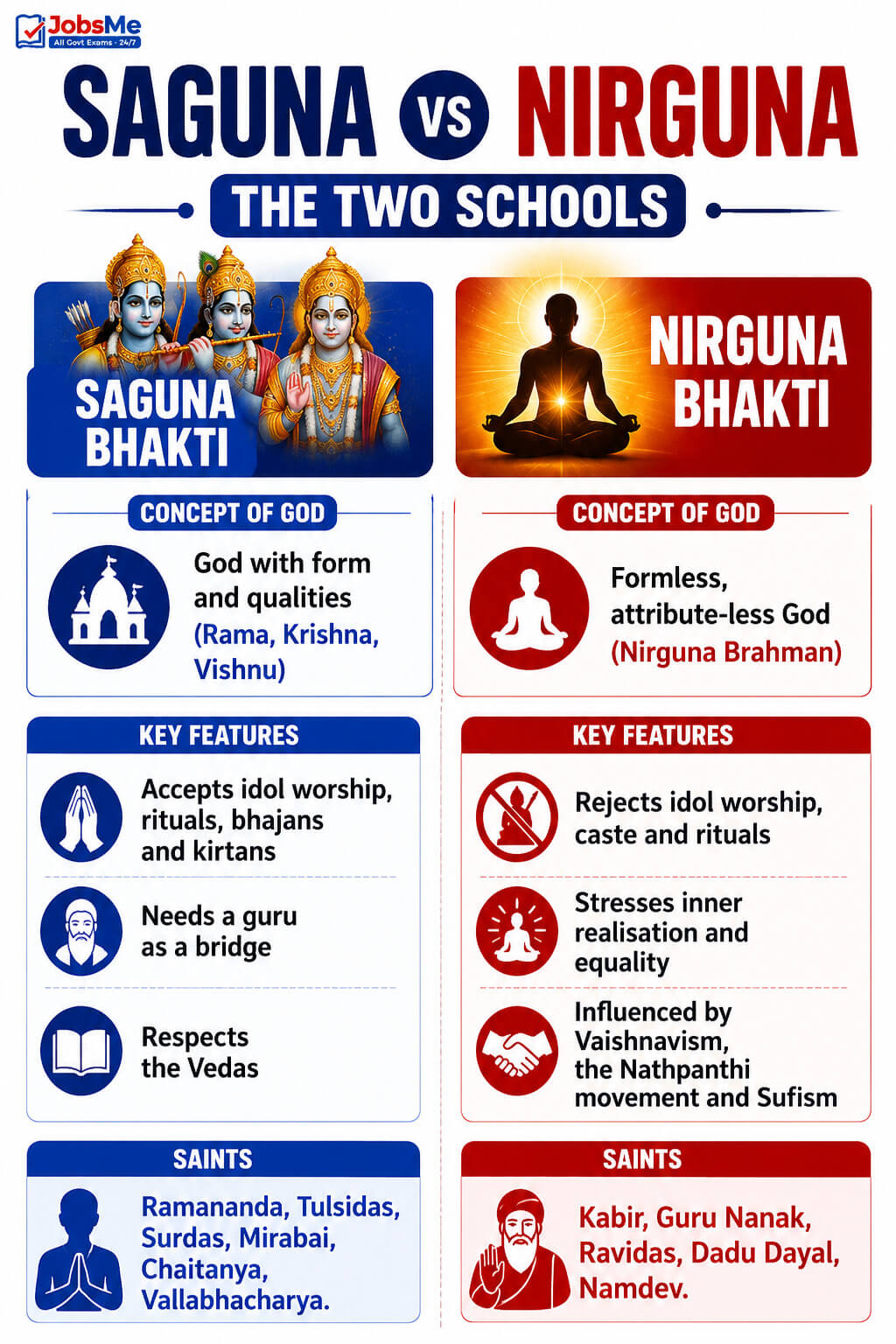
Saguna vs Nirguna - The Two Schools
| School | Concept of God | Key Features and Saints |
|---|---|---|
| Saguna Bhakti | God with form and qualities (Rama, Krishna, Vishnu) | Accepts idol worship, rituals, bhajans and kirtans; needs a guru as a bridge; respects the Vedas. Saints: Ramananda, Tulsidas, Surdas, Mirabai, Chaitanya, Vallabhacharya. |
| Nirguna Bhakti | Formless, attribute-less God (Nirguna Brahman) | Rejects idol worship, caste and rituals; stresses inner realisation and equality; influenced by Vaishnavism, the Nathpanthi movement and Sufism. Saints: Kabir, Guru Nanak, Ravidas, Dadu Dayal, Namdev. |
The Great Acharyas (Philosophical Base)
| Acharya | Philosophy | Key Details |
|---|---|---|
| Adi Shankaracharya (8th century) | Advaita (Monism) | Born at Kaladi, Kerala; preached Nirguna Brahman (God without attributes); held that Brahman alone is real and the world is illusion (Maya); founded four mathas. |
| Ramanujacharya (11th-12th century) | Vishishtadvaita (Qualified Monism) | Born at Sriperumbudur, Tamil Nadu; founder of Sri Vaishnavism; combined devotion to Vishnu with philosophy; the chief inspiration for the later North Indian Bhakti saints. |
| Madhvacharya (13th century) | Dvaita (Dualism) | Born in Karnataka; held that God (Vishnu) and the individual soul are eternally distinct; founder of the Brahma (Madhva) Sampradaya. |
| Vallabhacharya (1479-1531) | Shuddhadvaita (Pure Non-dualism) | Exponent of the Krishna cult; worshipped Krishna as "Srinathji"; founder of the Pushtimarg and Rudra Sampradaya. |
Early South Indian Saints
| Saint / Group | Region / Deity | Key Details |
|---|---|---|
| Alvars | Tamil Nadu / Vishnu | Twelve Vaishnava saint-poets (6th-9th century); their hymns are collected in the "Nalayira Divya Prabandham"; included the woman saint Andal. |
| Nayanars | Tamil Nadu / Shiva | Sixty-three Shaiva saint-poets (6th-9th century); their hymns are collected in the "Tevaram"; prominent figures include Appar, Sambandar and Sundarar. |
| Andal | Tamil Nadu / Vishnu | The only woman among the twelve Alvars; her devotion is expressed as bridal love for Vishnu. |
| Basavanna (Basava / Basaveswara) | Karnataka / Shiva | 12th-century founder of the Lingayat (Virashaiva) sect; rejected caste and temple ritual; wrote Vachana Sahitya in Kannada; also called Bhaktibhandari. |
| Allama Prabhu and Akka Mahadevi | Karnataka / Shiva | Leading Virashaiva mystics; Akka Mahadevi was a celebrated woman saint of the vachana tradition. |
North Indian, Maharashtra, Bengal and Assam Bhakti Saints
From the 14th century onwards, the Bhakti Movement reached its peak in North India and the regions. The table below lists the most exam-relevant saints, their region, devotional focus and major works.
| Saint (Period) | Region / School | Key Details and Works |
|---|---|---|
| Ramananda (14th-15th century) | North India (Banaras) / Saguna | "Bridge between the Bhakti movements of South and North"; worshipper of Rama; preached in local languages; accepted disciples of all castes — Kabir (weaver), Ravidas (cobbler), Sena (barber), Dhanna (Jat peasant), Sadhana (butcher) and Pipa (Rajput prince). |
| Kabir (15th century) | North India (Banaras) / Nirguna | Disciple of Ramananda; weaver by profession; blended Hindu and Sufi ideas; condemned caste, idol worship and ritualism; composed "Dohas"; his verses appear in the Guru Granth Sahib; followers are the Kabir Panthis; works include Bijak and Sakhi. |
| Guru Nanak (1469-1539) | Punjab / Nirguna | First Sikh Guru and founder of Sikhism; preached devotion to one formless God, equality and "Langar"; synthesised the best of Hinduism and Islam; his hymns form part of the Guru Granth Sahib. |
| Ravidas / Raidas (15th-16th century) | North India / Nirguna | Mystic poet-saint and leatherworker (Chamar); disciple of Ramananda; taught removal of caste and gender divisions; his songs are included in the Guru Granth Sahib; often used the term "Sahaj". |
| Dadu Dayal (1544-1603) | Rajasthan / Nirguna | Saint who preached Hindu-Muslim unity; his followers are known as the Dadu Panthis; compiled the Panchvani text. |
| Mirabai (1498-1546) | Rajasthan-Gujarat / Saguna | Rajput princess of Merta married into the Sisodia clan of Mewar; staunch devotee of Krishna; composed devotional bhajans in Hindi and Rajasthani; a leading woman voice of Bhakti. |
| Surdas (1483-1563) | North India (Braj) / Saguna | Blind poet-saint and disciple of Vallabhacharya; devoted to Radha and Krishna; works include "Sur Sagar" and "Sur Saravali" in Braj Bhasha. |
| Tulsidas (1532-1623) | North India / Saguna | Great devotee of Rama; wrote the "Ramcharitmanas" in Awadhi, the first and greatest Hindi epic; also wrote Vinaya Patrika and Hanuman Chalisa. |
| Jnaneshwar / Jnanadeva (1275-1296) | Maharashtra (Varkari) / Saguna | Earliest Varkari saint; wrote the "Jnaneshwari", a Marathi commentary on the Bhagavad Gita; devotee of Vithoba of Pandharpur. |
| Namdev (1270-1350) | Maharashtra (Varkari) / Nirguna leaning | Tailor by caste; devotee of Vithoba; preached equality and condemned idol worship; some of his songs are in the Guru Granth Sahib; composed in Marathi and Hindi. |
| Eknath (1533-1599) | Maharashtra (Varkari) / Saguna | Wrote the "Eknathi Bhagavat"; opposed caste discrimination; enriched Marathi devotional literature. |
| Tukaram (1608-1650) | Maharashtra (Varkari) / Saguna | Devotee of Vithoba; composed Marathi "Abhangas" collected as the "Tukaram Gatha"; a contemporary of Shivaji. |
| Samarth Ramdas (1608-1681) | Maharashtra / Saguna | Spiritual guru of Shivaji; wrote the "Dasbodh"; devotee of Rama and Hanuman. |
| Chaitanya Mahaprabhu (1486-1533) | Bengal / Saguna | Original name Vishwambhar Mishra; ardent Krishna devotee; founder of Gaudiya Vaishnavism; popularised the "Hare Rama Hare Krishna" chant and kirtan; taught Achintya Bheda-Abheda; spent his last years in Puri. |
| Shankaradeva (1449-1568) | Assam / Saguna | Devotee of Vishnu; started the neo-Vaishnavite "Ekasarana Dharma"; popularised Assamese; created the literary language Brajavali, the Sattriya dance, and the Namghar institution; wrote the Assamese Bhagavat. |
| Narsinh Mehta (15th century) | Gujarat / Saguna | Earliest poet-saint of Gujarat; devotee of Krishna; composer of "Vaishnava Jana To", the bhajan beloved of Mahatma Gandhi. |
Sufi Movement: Major Silsilahs (Orders)
By the 12th century the Sufis were organised into silsilahs. Abul Fazl's Ain-i-Akbari lists fourteen, but five or six became truly influential in India. The table below covers the founder, the saint who introduced the order in India, and its defining character.
| Silsilah (Order) | Founder / Introduced in India by | Key Features |
|---|---|---|
| Chishti | Introduced in India by Khwaja Moinuddin Chishti (c.1192) | Most popular order in India; stressed love, tolerance and service to humanity; avoided politics and royal patronage; popularised Sama (qawwali); active in Delhi, Rajasthan and the Deccan. |
| Suhrawardi | Founded by Shihabuddin Suhrawardi (Baghdad); introduced in India by Bahauddin Zakariya | Accepted grants and jagirs from rulers and took part in politics; the richest order; strong in Punjab and Sindh (Multan); Zakariya received the title "Sheikh-ul-Islam" from Iltutmish. |
| Firdausi | Branch of Suhrawardi; spread by Sharafuddin Yahya Maneri | The only major order founded and developed mainly within India; confined to Bihar; known for Maktubat and Malfuzat (Sufi literature). |
| Qadiri | Founded by Sheikh Abdul Qadir Jilani (Baghdad); spread in India by Shah Niamatullah and Makhdum Muhammad Jilani | Most liberal/secular order; popular in Punjab; believed in Wahdat-al-Wujud (Unity of Being); followed by Mughal prince Dara Shikoh and his sister Jahanara; Miyan Mir was a famous saint. |
| Naqshbandi | From the Khwajagan of Turkestan; introduced in India by Khwaja Baqi Billah | Most orthodox order; strict adherence to Shariat; opposed Sama and music; revitalised by Sheikh Ahmad Sirhindi (Mujaddid Alf-i-Thani); followed by Aurangzeb. |
| Rishi Order | Founded by Sheikh Nuruddin Wali (Nund Rishi) | A 15th-16th century rural order of Kashmir; influenced by the local Shaivite Bhakti tradition and Nath Panthi yogis; promoted cultural integration. |
Famous Sufi Saints of India
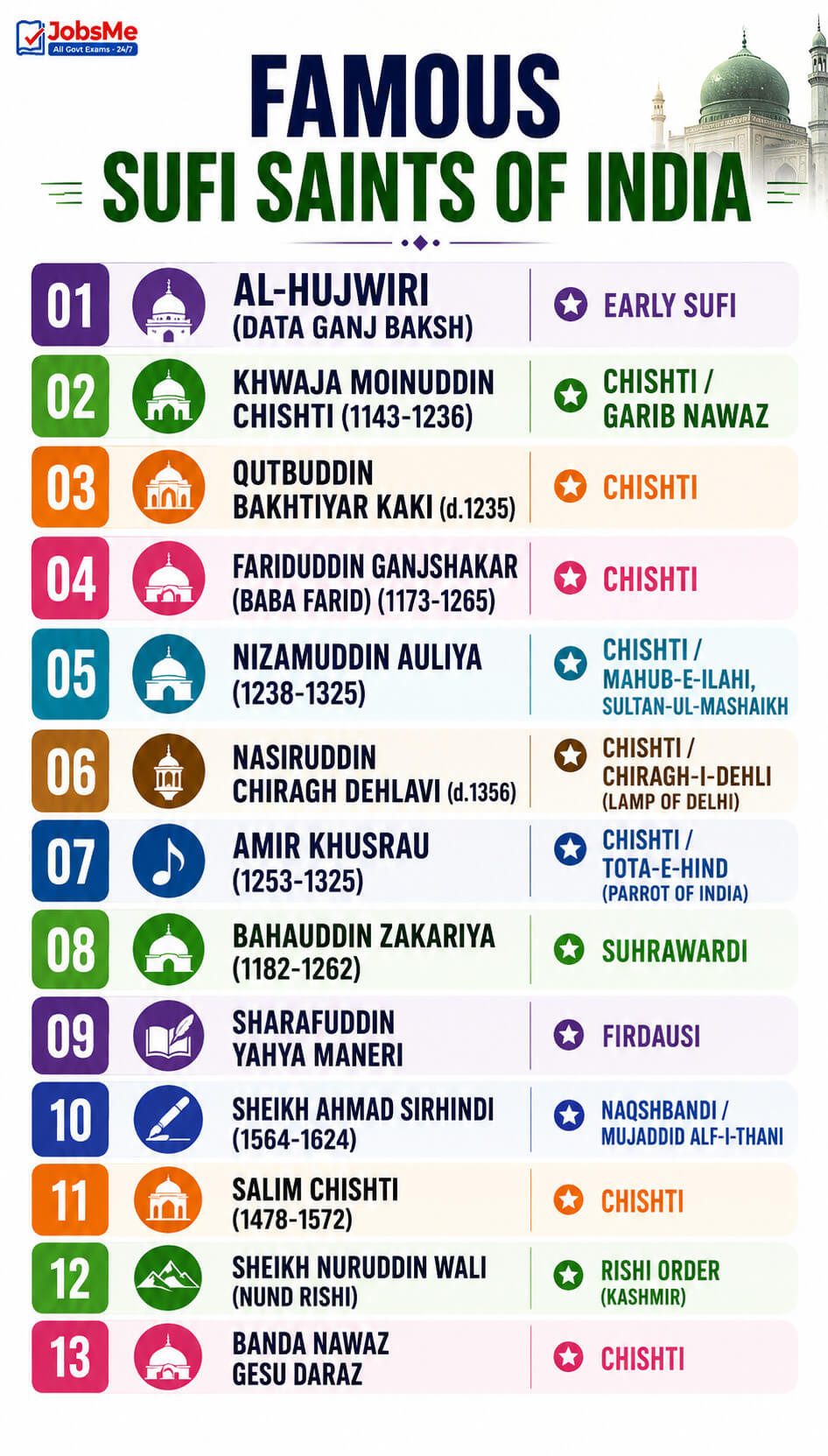
The following table lists the most exam-relevant Sufi saints, their order, popular titles and major contributions.
| Sufi Saint | Order / Title | Key Details |
|---|---|---|
| Al-Hujwiri (Data Ganj Baksh) | Early Sufi | Among the earliest Sufis in India; settled in Lahore in the 11th century; author of "Kashf-ul-Mahjub", the earliest Persian treatise on Sufism. |
| Khwaja Moinuddin Chishti (1143-1236) | Chishti / Gharib Nawaz | Founder of the Chishti order in India; settled in Ajmer; taught that the highest devotion is to relieve the distress of the helpless and feed the hungry; his dargah at Ajmer is visited by all faiths and was patronised by Akbar. |
| Qutbuddin Bakhtiyar Kaki (d.1235) | Chishti | Chief disciple of Moinuddin Chishti; established the Chishti order in Delhi; the Qutub Minar is associated with his name. |
| Fariduddin Ganjshakar (Baba Farid) (1173-1265) | Chishti | Spread the Chishti order in Punjab (Ajodhan/Pakpattan); his verses are included in the Guru Granth Sahib; spiritual master of Nizamuddin Auliya. |
| Nizamuddin Auliya (1238-1325) | Chishti / Mahbub-e-Ilahi, Sultan-ul-Mashaikh | Greatest Chishti saint of Delhi; disciple of Baba Farid; served seven Sultans without ever visiting a royal court; stressed love and religious pluralism; his conversations were compiled by Amir Hasan Sijzi in "Fawa'id-ul-Fu'ad". |
| Nasiruddin Chiragh Dehlavi (d.1356) | Chishti / Chiragh-i-Dehli (Lamp of Delhi) | Successor of Nizamuddin Auliya; last of the five great Chishti masters; said controlled breathing is the essence of Sufism. |
| Amir Khusrau (1253-1325) | Chishti / Tota-e-Hind (Parrot of India) | Favourite disciple of Nizamuddin Auliya; "Father of Qawwali"; credited with developing the sitar and tabla; court poet of the Delhi Sultanate; buried at Nizamuddin Dargah. |
| Bahauddin Zakariya (1182-1262) | Suhrawardi | Established the Suhrawardi order in India with his khanqah at Multan; received the title "Sheikh-ul-Islam" from Iltutmish; mingled with rulers. |
| Sharafuddin Yahya Maneri | Firdausi | Greatest saint of the Firdausi order in Bihar; prolific writer of mystic literature (Maktubat). |
| Sheikh Ahmad Sirhindi (1564-1624) | Naqshbandi / Mujaddid Alf-i-Thani | "Reformer of the Second Millennium"; opposed Akbar's liberal religious policies and emphasised strict Shariat; revitalised the Naqshbandi order. |
| Salim Chishti (1478-1572) | Chishti | Saint of Fatehpur Sikri; blessed Akbar with an heir (Jahangir, named Salim in his honour); Akbar built Fatehpur Sikri around his dwelling; his tomb is a UNESCO heritage structure. |
| Sheikh Nuruddin Wali (Nund Rishi) | Rishi Order (Kashmir) | Founder of the Rishi order of Kashmir; preached communal harmony and influenced by the Shaivite Bhakti of Lalleshwari (Lal Ded). |
| Banda Nawaz Gesu Daraz | Chishti | Disciple of Nasiruddin Chiragh Dehlavi; spread the Chishti order to the Deccan; established a khanqah at Gulbarga, Karnataka. |
Memory Tricks and Mnemonics
Trick 1: The Four Major Sufi Silsilahs — "CSQN"
Remember the four most important Sufi orders in India with the acronym "CSQN":
- C → Chishti (most popular, Ajmer).
- S → Suhrawardi (richest, Multan).
- Q → Qadiri (most liberal, Dara Shikoh).
- N → Naqshbandi (most orthodox, Aurangzeb).
"Come, See Quiet Nights — CSQN orders the four Sufi chains."
Trick 2: Saguna vs Nirguna — "Sa = Shape"
Use the first syllable to lock the meaning forever:
- Saguna = "Sa" sounds like "Shape" → God WITH form (Rama, Krishna). Saints: Tulsidas, Surdas, Mirabai, Chaitanya.
- Nirguna = "Nir" sounds like "Nil/Nothing" → God WITHOUT form. Saints: Kabir, Nanak, Ravidas.
Trick 3: The Five Great Chishti Masters — "MQF-NN"
Remember the chain of the five great Chishti masters of Delhi in order:
- M → Moinuddin Chishti (Ajmer).
- Q → Qutbuddin Bakhtiyar Kaki (Delhi).
- F → Fariduddin Ganjshakar / Baba Farid (Punjab).
- N → Nizamuddin Auliya (Delhi).
- N → Nasiruddin Chiragh Dehlavi (Delhi).
"My Quiet Friend Never Naps — the five Chishti masters in sequence."
Trick 4: Chishti vs Suhrawardi — The "Poor vs Rich" Contrast
- Chishti → avoided rulers and royal grants, lived simply, popularised qawwali (Ajmer, Delhi).
- Suhrawardi → accepted grants, jagirs and political posts, lived in comfort (Multan, Sindh).
"Chishti is Chaste (no money); Suhrawardi takes the Sultan's money."
Trick 5: The Varkari Saints of Maharashtra — "Jnana Nikita Ate Tasty"
Remember the main Maharashtra (Varkari) Bhakti saints of Pandharpur:
- Jnaneshwar → Jnaneshwari.
- Namdev → equality, songs in Guru Granth Sahib.
- Eknath → Eknathi Bhagavat.
- Tukaram → Tukaram Gatha (Abhangas).
- Ramdas → Dasbodh (guru of Shivaji).
"JNETR — all sang for Vithoba of Pandharpur."
Trick 6: Saint and Their Works — "Books to Authors"
- Ramcharitmanas → Tulsidas (Awadhi).
- Sur Sagar → Surdas (Braj).
- Jnaneshwari → Jnaneshwar (Marathi).
- Bijak → Kabir.
- Fawa'id-ul-Fu'ad → recorded sayings of Nizamuddin Auliya (by Amir Hasan Sijzi).
- Kashf-ul-Mahjub → Al-Hujwiri.
Trick 7: Titles of Sufi Saints — "Nicknames Net"
- Gharib Nawaz ("Helper of the Poor") → Moinuddin Chishti.
- Mahbub-e-Ilahi ("Beloved of God") → Nizamuddin Auliya.
- Chiragh-i-Dehli ("Lamp of Delhi") → Nasiruddin.
- Tota-e-Hind ("Parrot of India") → Amir Khusrau.
- Mujaddid Alf-i-Thani ("Reformer of the 2nd Millennium") → Ahmad Sirhindi.
- Data Ganj Baksh → Al-Hujwiri.
Additional Notes
Frequently Confused Facts
- Alvars vs Nayanars: Alvars were devotees of Vishnu (twelve saints, Nalayira Divya Prabandham); Nayanars were devotees of Shiva (sixty-three saints, Tevaram).
- Founder vs Introducer of Chishti order: The Chishti order began in Chisht (Afghanistan), but in India it was introduced and made famous by Khwaja Moinuddin Chishti at Ajmer.
- Chishti vs Suhrawardi: Chishtis kept away from rulers and lived simply; Suhrawardis accepted grants and took part in politics.
- Qadiri vs Naqshbandi: Qadiri was the most liberal (followed by Dara Shikoh); Naqshbandi was the most orthodox (revitalised by Ahmad Sirhindi, followed by Aurangzeb).
- Dara Shikoh vs Aurangzeb: Dara Shikoh followed the liberal Qadiri order; Aurangzeb leaned towards the orthodox Naqshbandi order.
- Khanqah vs Dargah: Khanqah is the living hospice of the Pir; Dargah is the tomb/shrine that becomes a pilgrimage centre after his death.
- Pir vs Murid: Pir (or Murshid) is the teacher; Murid is the disciple in a silsilah.
- Ba-shara vs Be-shara: Ba-shara Sufis followed Islamic law; Be-shara (qalandars) did not.
- Tulsidas vs Surdas: Tulsidas wrote on Rama (Ramcharitmanas, Awadhi); Surdas wrote on Krishna (Sur Sagar, Braj).
- Ramananda vs Ramanuja: Ramanuja was the South Indian Acharya (Vishishtadvaita); Ramananda was his North Indian successor who opened Bhakti to all castes.
- Firdausi order: The only major silsilah founded and developed mainly within India, confined to Bihar.
- Shankaradeva vs Chaitanya: Shankaradeva spread neo-Vaishnavism in Assam (Ekasarana Dharma); Chaitanya spread Gaudiya Vaishnavism in Bengal.
Repeating PYQ Patterns
Certain facts from this topic appear repeatedly across exams. Khwaja Moinuddin Chishti (Ajmer, Gharib Nawaz), Nizamuddin Auliya (Mahbub-e-Ilahi), Amir Khusrau (qawwali, Tota-e-Hind), the four silsilahs and their founders, Saguna vs Nirguna schools, Kabir and Guru Nanak (Nirguna), Tulsidas and Surdas and their works, and the Alvar-Nayanar distinction are the most frequent in UPSC Prelims, SSC CGL and RRB NTPC. Banking exams (IBPS PO, SBI Clerk) focus on matching saints with their works, languages and regions. State PCS exams add regional saints — Maharashtra PCS asks about the Varkari saints (Jnaneshwar, Tukaram, Namdev), West Bengal PCS about Chaitanya, Assam PCS about Shankaradeva, and Karnataka PCS about Basavanna and the Lingayats. For more such themes, try the Static GK Quiz on Jobsme.in.
Quick Insight
The Bhakti and Sufi Movements together form the foundation of India's "composite culture" or Ganga-Jamuni tehzeeb. Their shared message of love, equality and devotion beyond ritual continues to shape modern India — from the qawwalis sung at the Ajmer and Nizamuddin dargahs (whose Urs festivals make news every year) to the celebration of Guru Nanak Jayanti and Kabir Jayanti, and to debates on social harmony and inclusive nationalism. For aspirants, mastering these saints helps connect Prelims matching questions with Mains essays on social reform, religious tolerance and India's cultural heritage. To stay updated, follow the Daily Current Affairs section and read related notes in the Static GK library on Jobsme.in.
One-Liners for Quick Revision
- Bhakti Movement → Began 7th century in South India (Alvars and Nayanars) → peaked 15th-17th century in North India.
- Saguna Bhakti → Devotion to God with form (Rama, Krishna) → Ramananda, Tulsidas, Surdas, Mirabai, Chaitanya.
- Nirguna Bhakti → Devotion to formless God → Kabir, Guru Nanak, Ravidas, Dadu Dayal.
- Alvars → Twelve Tamil saints devoted to Vishnu → Nalayira Divya Prabandham.
- Nayanars → Sixty-three Tamil saints devoted to Shiva → Tevaram.
- Andal → Only woman among the twelve Alvars.
- Adi Shankaracharya → Advaita (Monism) → born at Kaladi, Kerala.
- Ramanujacharya → Vishishtadvaita (Qualified Monism) → founder of Sri Vaishnavism.
- Madhvacharya → Dvaita (Dualism).
- Vallabhacharya → Shuddhadvaita → Krishna as Srinathji → Pushtimarg.
- Basavanna → Founder of Lingayat (Virashaiva) sect → Vachana Sahitya in Kannada.
- Ramananda → Bridge between South and North Bhakti → opened Bhakti to all castes.
- Kabir → Disciple of Ramananda, weaver → Nirguna → Dohas, Bijak → Kabir Panthis.
- Guru Nanak → First Sikh Guru, founder of Sikhism → one formless God, Langar.
- Ravidas / Raidas → Leatherworker saint → songs in Guru Granth Sahib.
- Dadu Dayal → Hindu-Muslim unity → Dadu Panthis.
- Mirabai → Rajput princess of Mewar → Krishna devotee → bhajans in Hindi/Rajasthani.
- Surdas → Disciple of Vallabhacharya → Sur Sagar, Sur Saravali (Braj) → Krishna.
- Tulsidas → Ramcharitmanas (Awadhi) → Rama devotee → Hanuman Chalisa.
- Jnaneshwar → Jnaneshwari (Marathi) → earliest Varkari saint.
- Namdev → Tailor saint of Maharashtra → equality → songs in Guru Granth Sahib.
- Eknath → Eknathi Bhagavat → Marathi devotional literature.
- Tukaram → Tukaram Gatha (Abhangas) → devotee of Vithoba.
- Samarth Ramdas → Dasbodh → spiritual guru of Shivaji.
- Chaitanya Mahaprabhu → Gaudiya Vaishnavism in Bengal → Hare Rama Hare Krishna kirtan.
- Shankaradeva → Ekasarana Dharma in Assam → Sattriya dance, Namghar, Brajavali.
- Narsinh Mehta → Gujarat → composed "Vaishnava Jana To".
- Sufism → Mystical branch of Islam → union with God through love.
- Silsilah → Sufi order/chain → Pir (teacher) and Murid (disciple).
- Khanqah → Sufi hospice; Dargah → tomb/shrine of a saint.
- Al-Hujwiri (Data Ganj Baksh) → earliest Sufi in India → Kashf-ul-Mahjub.
- Chishti order → Most popular → introduced by Moinuddin Chishti at Ajmer.
- Khwaja Moinuddin Chishti → Gharib Nawaz → dargah at Ajmer → patronised by Akbar.
- Qutbuddin Bakhtiyar Kaki → Chishti order in Delhi → Qutub Minar named after him.
- Baba Farid (Fariduddin Ganjshakar) → Chishti in Punjab → verses in Guru Granth Sahib.
- Nizamuddin Auliya → Mahbub-e-Ilahi → served seven Sultans, never visited court.
- Nasiruddin Chiragh Dehlavi → Chiragh-i-Dehli → last of the five great Chishti masters.
- Amir Khusrau → Tota-e-Hind → Father of Qawwali → sitar and tabla.
- Suhrawardi order → Introduced by Bahauddin Zakariya at Multan → accepted royal grants.
- Firdausi order → Developed within India in Bihar → Sharafuddin Yahya Maneri.
- Qadiri order → Most liberal → followed by Dara Shikoh → Wahdat-al-Wujud.
- Naqshbandi order → Most orthodox → Khwaja Baqi Billah → Ahmad Sirhindi → Aurangzeb.
- Sheikh Ahmad Sirhindi → Mujaddid Alf-i-Thani → opposed Akbar's liberal policies.
- Salim Chishti → blessed Akbar with heir Jahangir → Fatehpur Sikri.
- Nuruddin Wali (Nund Rishi) → founder of Rishi order of Kashmir.
- Banda Nawaz Gesu Daraz → spread Chishti order to the Deccan (Gulbarga).
Test yourself on these saints and silsilahs with the Static GK Quiz, brush up on related themes in the Daily Current Affairs section, and check the latest openings at Latest Government Job Notifications on Jobsme.in.
Free quiz • No signup required
Put this topic into practice with Indian Cultural Institutions – Static GK MCQ Quiz. It is the quickest way to reinforce what you just learned.
Frequently Asked Questions
What is the difference between the Bhakti and Sufi Movements?
What is the difference between Saguna and Nirguna Bhakti?
Who were the Alvars and Nayanars?
Who founded the Chishti order in India and where is its main centre?
What are the four major Sufi silsilahs in India?
Why is Amir Khusrau important in the Sufi movement?
What is the difference between a khanqah and a dargah?
Which Sufi order did the Mughal prince Dara Shikoh follow?
Who was the founder of Sikhism and to which school of Bhakti did he belong?
Which Bhakti saint wrote the Ramcharitmanas, and which one is associated with Assam?

About the author