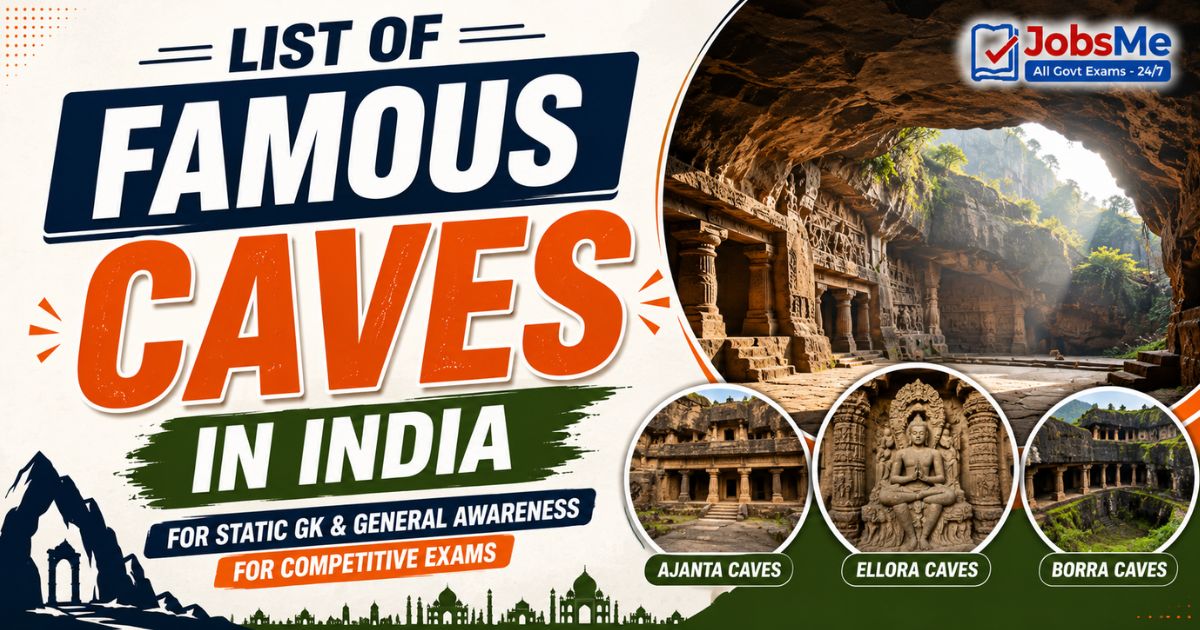
List of Famous Caves in India – Static GK & General Awareness for Competitive Exams with Memory Tricks
This article presents a complete list of famous caves in India along with their states, rivers/hills, religion, and key features, covering Buddhist, Hindu, and Jain rock-cut caves as well as natural limestone caves. It includes iconic sites like Ajanta and Ellora (Maharashtra), Elephanta (Mumbai), Bhimbetka (Madhya Pradesh), Udayagiri-Khandagiri (Odisha), Badami (Karnataka), Barabar (Bihar), Borra (Andhra Pradesh), and the longest cave Krem Liat Prah (Meghalaya), with memory tricks and one-liners for quick revision. All facts are arranged in exam-ready format to help UPSC, SSC, IBPS, RRB, PSU, and State PCS aspirants score better in General Awareness, Art & Culture, and Geography sections.
Jump to section
Introduction
India is home to some of the world's most remarkable caves, ranging from ancient rock-cut Buddhist, Hindu, and Jain temples to natural limestone caverns shaped over millions of years. The Ajanta and Ellora Caves of Maharashtra, the Elephanta Caves near Mumbai, the Bhimbetka rock shelters of Madhya Pradesh, and the Udayagiri-Khandagiri Caves of Odisha are not only major tourist attractions but also UNESCO-recognised treasures and exam favourites. These caves reflect India's rich spiritual heritage, with most natural cave temples dedicated to Hindu, Buddhist, and Jain worship.
Questions on famous caves and their locations appear regularly in UPSC Prelims, SSC CGL, IBPS PO, RRB NTPC, SBI Clerk, State PCS, and various Insurance and Defence exams. Questions typically ask which state a particular cave is located in, which religion a cave is associated with, which river or hill it stands on, or which cave is the oldest, longest, or deepest in India. This article brings together every important cave in a structured, exam-ready format. To explore other related Static GK topics, you can refer to the Static GK section on Jobsme.in.
Caves are also closely linked to current affairs themes such as UNESCO World Heritage listings, the annual Amarnath Yatra, archaeological discoveries of the longest and deepest caves, and tourism promotion in states like Meghalaya, Andhra Pradesh, and Maharashtra — making this topic doubly important for aspirants preparing for both Prelims and the General Studies papers in Mains.
Core Concepts: Understanding Caves of India
A cave is a naturally formed hollow large enough for a human to enter, while a rock-cut cave is a man-made structure carved out of solid rock. India's caves are broadly classified by their origin and the purpose they served, which helps students remember them in logical groups.
Types of Caves in India
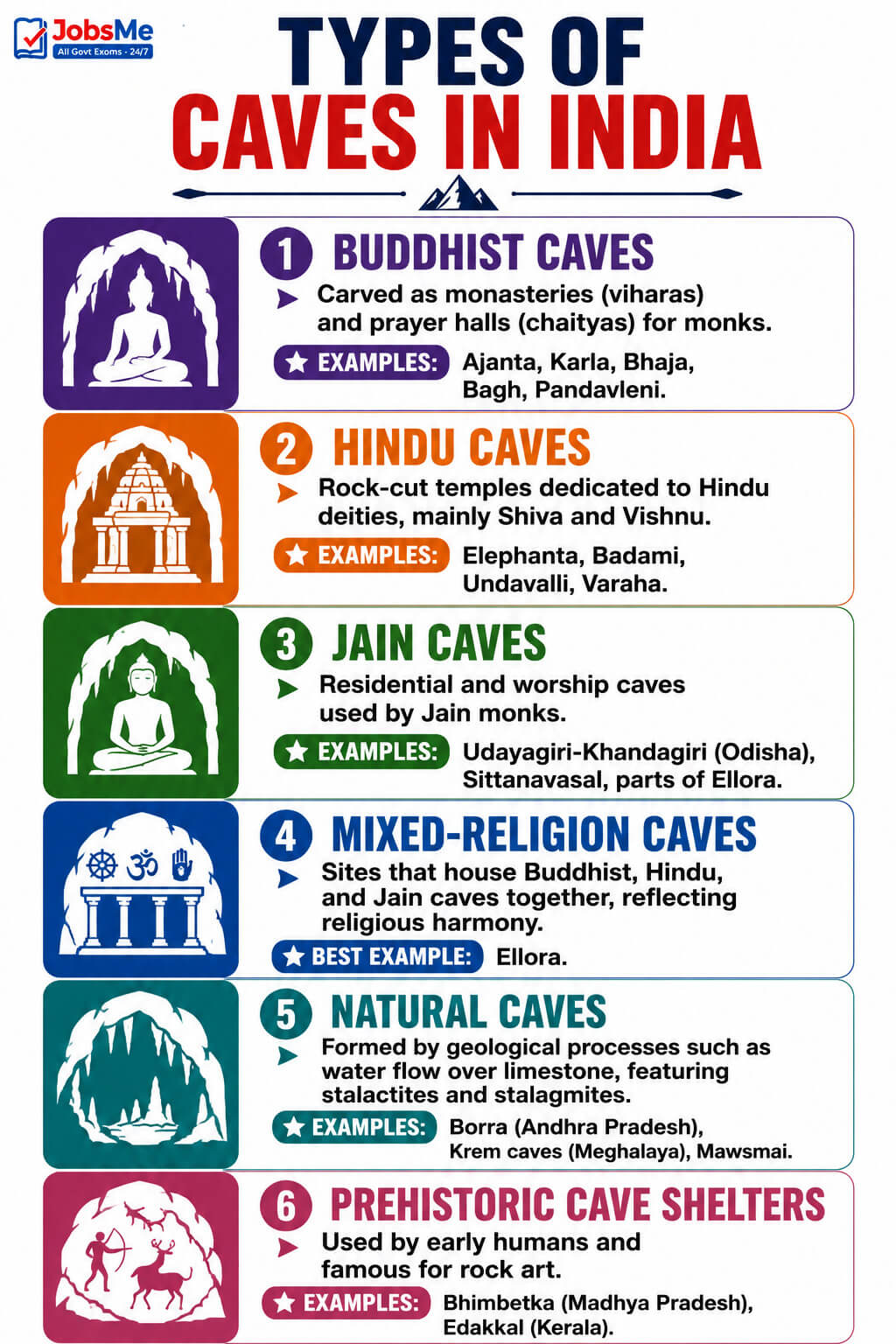
- Buddhist Caves: Carved as monasteries (viharas) and prayer halls (chaityas) for monks. Examples: Ajanta, Karla, Bhaja, Bagh, Pandavleni.
- Hindu Caves: Rock-cut temples dedicated to Hindu deities, mainly Shiva and Vishnu. Examples: Elephanta, Badami, Undavalli, Varaha.
- Jain Caves: Residential and worship caves used by Jain monks. Examples: Udayagiri-Khandagiri (Odisha), Sittanavasal, parts of Ellora.
- Mixed-Religion Caves: Sites that house Buddhist, Hindu, and Jain caves together, reflecting religious harmony. Best example: Ellora.
- Natural Caves: Formed by geological processes such as water flow over limestone, featuring stalactites and stalagmites. Examples: Borra (Andhra Pradesh), Krem caves (Meghalaya), Mawsmai.
- Prehistoric Cave Shelters: Used by early humans and famous for rock art. Examples: Bhimbetka (Madhya Pradesh), Edakkal (Kerala).
Famous Rock-Cut Caves of India - State, River/Hill and Key Details
The following table lists the most exam-relevant rock-cut caves of India along with their location, religion, and key features. To stay updated on related job openings, you can also check the latest government job notifications on Jobsme.in.
| Cave | State / Location | Religion / Type | Key Features |
|---|---|---|---|
| Ajanta Caves | Maharashtra (near Aurangabad / Jalgaon, on the Waghora River) | Buddhist | A group of 29 rock-cut caves dating from the 2nd century BCE to the 6th century CE; famous for Buddhist paintings and frescoes; mentioned by Chinese pilgrims Fa-Hien and Hieun Tsang; declared a UNESCO World Heritage Site in 1983. |
| Ellora Caves | Maharashtra (near Aurangabad, Sahyadri hills) | Buddhist, Hindu and Jain (mixed) | A set of 34 caves built between the 5th and 11th centuries CE — 12 Buddhist, 17 Hindu, and 5 Jain; home to the Kailasa Temple, the world's largest monolithic rock-cut structure; UNESCO World Heritage Site (1983). |
| Elephanta Caves | Maharashtra (Elephanta Island / Gharapuri, near Mumbai) | Hindu (Shaivite) | Carved from solid basalt rock; famous for the Trimurti (Maheshmurti) sculpture of Shiva; originally a Buddhist site later dominated by Shaivism; UNESCO World Heritage Site (1987). |
| Bagh Caves | Madhya Pradesh (on the bank of the Bagh / Baghani River, Vindhya ranges) | Buddhist | A group of nine rock-cut caves of the 5th-6th century CE; famous for mural paintings similar to Ajanta; their painted interiors are popularly called "Rang Mahal." |
| Bhimbetka Rock Shelters | Madhya Pradesh (Raisen district, Ratapani Wildlife Sanctuary) | Prehistoric (natural shelters) | Contain some of the earliest known prehistoric rock paintings in India; linked in legend to the Pandavas' exile; UNESCO World Heritage Site (2003). |
| Udayagiri Caves (Vidisha) | Madhya Pradesh (Vidisha district) | Hindu (Gupta period) | Built under the patronage of Chandragupta II in the early 5th century CE; famous for the Varaha (Vishnu's boar avatar) sculpture; key example of Gupta-era rock-cut art. |
| Udayagiri and Khandagiri Caves | Odisha (near Bhubaneswar) | Jain | A group of caves built under the Kalinga king Kharavela; served as residence for Jain monks; site of the famous Hathigumpha inscription in Brahmi script; Ananta Cave is the most notable. |
| Badami Cave Temples | Karnataka (Bagalkot district, capital of the Chalukyas) | Hindu, Buddhist and Jain | A complex of cave temples carved into sandstone cliffs by the Chalukya dynasty (6th century CE); blend of Dravidian and Nagara styles; dedicated mainly to Shiva, Vishnu, and Jain Tirthankaras. |
| Barabar Caves | Bihar (Gaya district, near Bodh Gaya) | Ajivika / Buddhist | The oldest surviving rock-cut caves in India, dating to the Mauryan period (3rd century BCE); a cluster of four — Lomas Rishi, Sudama, Karan Chaupar (Karna Chaupar), and Vishwakarma; donated by Emperor Ashoka to the Ajivika sect. |
| Karla Caves | Maharashtra (Lonavala, Pune region) | Buddhist | One of the oldest Buddhist cave shrines in India (around 2nd century BCE to 5th century CE); famous for the largest rock-cut chaitya (prayer hall) of its kind. |
| Bhaja Caves | Maharashtra (Lonavala, Pune district) | Buddhist (Hinayana) | Among the earliest Buddhist rock-cut caves in India, dating back to around 200 BCE; preserved as a national monument; known for its chaitya hall and stupas. |
| Pandavleni (Pandav Leni / Nasik) Caves | Maharashtra (Nashik) | Buddhist (Hinayana) | A group of 24 ancient Buddhist viharas carved from the 3rd century BCE onwards; contain inscriptions of the Satavahana and Kshatrapa rulers. |
| Aurangabad Caves | Maharashtra (Aurangabad / Chhatrapati Sambhajinagar) | Buddhist | A group of rock-cut Buddhist caves of around the 6th-7th century CE; noted for sculptures and Tantric Buddhist imagery. |
| Kanheri Caves | Maharashtra (Sanjay Gandhi National Park, Mumbai) | Buddhist | A large group of more than 100 rock-cut Buddhist caves cut from basalt; served as monasteries and a centre of Buddhist learning from the 1st century BCE. |
| Undavalli Caves | Andhra Pradesh (Guntur district, near Vijayawada) | Hindu (originally Jain) | Monolithic rock-cut caves of the 4th-5th century CE carved into sandstone during the Vishnukundina era; famous for a large reclining Vishnu statue; originally Jain, later Hindu. |
| Varaha Cave Temple | Tamil Nadu (Mahabalipuram) | Hindu | A rock-cut cave temple of the Pallava period (7th century CE); famous for the panel of Vishnu in his Varaha (boar) avatar; part of the Mahabalipuram UNESCO group. |
| Sittanavasal Caves | Tamil Nadu (Pudukkottai district) | Jain | A Jain cave complex famous for its fresco paintings and rock-cut beds (Eladipattam) used by Jain monks; one of the finest examples of Jain cave art. |
| Edakkal Caves | Kerala (Ambukuthi Hills, Wayanad district) | Prehistoric | Prehistoric caves containing Stone Age rock engravings (petroglyphs); among the oldest known human settlements discovered in India. |
| Amarnath Cave | Jammu and Kashmir (near Pahalgam, at about 12,756 ft / 3,888 m) | Hindu (natural) | A natural Himalayan cave dedicated to Lord Shiva; famous for the naturally forming ice Shivling; site of the annual Amarnath Yatra pilgrimage. |
Natural Caves and Record-Holding Caves of India
Apart from rock-cut temples, India has spectacular natural limestone caves with stalactite and stalagmite formations, along with several record-holding caves frequently asked in exams. You can test your knowledge of such facts with the Static GK Quiz on Jobsme.in.
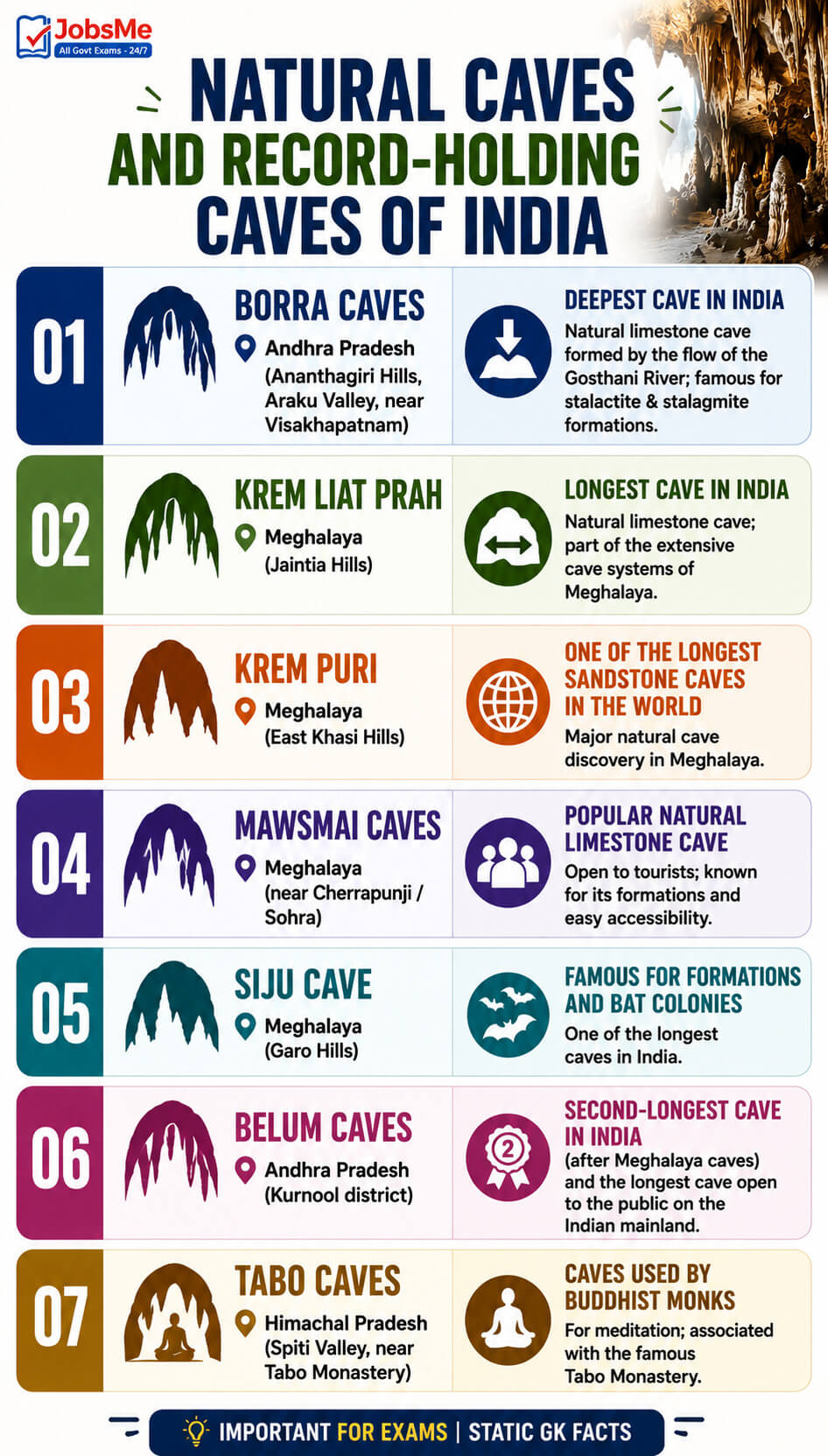
| Cave | State / Location | Key Features |
|---|---|---|
| Borra Caves | Andhra Pradesh (Ananthagiri Hills, Araku Valley, near Visakhapatnam) | The deepest cave in India; a natural limestone cave formed by the flow of the Gosthani River; famous for stalactite and stalagmite formations. |
| Krem Liat Prah | Meghalaya (Jaintia Hills) | The longest cave in India; a natural limestone cave; part of the extensive cave systems of Meghalaya. |
| Krem Puri | Meghalaya (East Khasi Hills) | One of the longest sandstone caves in the world; a major natural cave discovery in Meghalaya. |
| Mawsmai Caves | Meghalaya (near Cherrapunji / Sohra) | A popular natural limestone cave open to tourists; known for its formations and easy accessibility. |
| Siju Cave | Meghalaya (Garo Hills) | A limestone cave famous for its stalactite and stalagmite formations and bat colonies; one of the longest caves in India. |
| Belum Caves | Andhra Pradesh (Kurnool district) | The second-longest cave in India (after the Meghalaya caves) and the longest cave open to the public on the Indian mainland; a natural limestone cave. |
| Tabo Caves | Himachal Pradesh (Spiti Valley, near Tabo Monastery) | Caves in the cliffs above Tabo used by Buddhist monks for meditation; associated with the famous Tabo Monastery. |
Important "Records" Among Indian Caves
- Oldest rock-cut caves in India: Barabar Caves, Bihar (Mauryan period).
- Longest cave in India: Krem Liat Prah, Meghalaya (Jaintia Hills).
- Deepest cave in India: Borra Caves, Andhra Pradesh (Ananthagiri Hills).
- Largest monolithic rock-cut structure: Kailasa Temple at Ellora, Maharashtra.
- Longest cave in the world: Mammoth Cave, Kentucky, USA (for comparison-based questions).
Memory Tricks and Mnemonics
Trick 1: The Three UNESCO Cave Sites — "AEB"
Three cave sites in India are UNESCO World Heritage Sites. Remember them as "AEB":
- A → Ajanta Caves (Maharashtra, 1983).
- E → Ellora Caves (Maharashtra, 1983) and Elephanta Caves (Maharashtra, 1987).
- B → Bhimbetka Rock Shelters (Madhya Pradesh, 2003).
"Ajanta-Ellora-Elephanta sit in Maharashtra; Bhimbetka stands apart in Madhya Pradesh."
Trick 2: Religion of Ajanta vs Ellora — "Ajanta is All Buddhist"
Students often confuse the two neighbouring caves:
- Ajanta → only Buddhist (think "A for All Buddhist").
- Ellora → Mixed — Buddhist + Hindu + Jain (think "E for Everyone").
"Ajanta = All Buddhist; Ellora = Everyone (all three religions)."
Trick 3: Records of Caves — "Old in Bihar, Long in Meghalaya, Deep in Andhra"
- Oldest rock-cut → Barabar (Bihar).
- Longest → Krem Liat Prah (Meghalaya).
- Deepest → Borra (Andhra Pradesh).
"O-L-D: Old-Bihar, Long-Meghalaya, Deep-Andhra."
Trick 4: Caves on Rivers and Hills — "River-Cave Pairs"
- Ajanta → Waghora River (Maharashtra).
- Bagh → Bagh / Baghani River (Madhya Pradesh).
- Borra → Gosthani River, Ananthagiri Hills (Andhra Pradesh).
- Edakkal → Ambukuthi Hills (Kerala).
Trick 5: The Four Barabar Caves — "L-S-K-V"
To recall the four caves at Barabar Hills in Bihar, use "L-S-K-V":
- L → Lomas Rishi Cave.
- S → Sudama Cave.
- K → Karan Chaupar (Karna Chaupar) Cave.
- V → Vishwakarma Cave.
Trick 6: Lonavala's Twin Buddhist Caves — "Karla and Bhaja"
Two famous Buddhist caves sit close together near Lonavala in Maharashtra:
- Karla → famous for the largest rock-cut chaitya (prayer hall).
- Bhaja → among the earliest, dedicated to Hinayana Buddhism (about 200 BCE).
"Both near Lonavala — Karla for the big hall, Bhaja for being the oldest."
Trick 7: Andhra's Caves — "Borra, Belum, Undavalli"
Andhra Pradesh has three exam-favourite caves; remember them together:
- Borra → deepest cave (natural limestone, Araku Valley).
- Belum → longest cave open to public on the mainland.
- Undavalli → Hindu rock-cut cave with reclining Vishnu (Guntur).
"Triple-B-U of Andhra: Borra deep, Belum long, Undavalli Vishnu."
Additional Notes
Frequently Confused Facts
- Ajanta vs Ellora: Ajanta is purely Buddhist and famous for paintings; Ellora has Buddhist, Hindu, and Jain caves and is famous for the Kailasa Temple. Both are in Maharashtra and were inscribed by UNESCO in 1983.
- Elephanta vs Ellora: Elephanta is on an island near Mumbai (Shaivite, UNESCO 1987); Ellora is on the mainland near Aurangabad (mixed-religion, UNESCO 1983).
- Two Udayagiri Caves: One is in Vidisha, Madhya Pradesh (Hindu, Gupta period, Varaha sculpture); the other is near Bhubaneswar, Odisha (Jain, paired with Khandagiri). Exams test which state is meant.
- Oldest vs Longest vs Deepest: Oldest rock-cut caves are Barabar (Bihar); longest is Krem Liat Prah (Meghalaya); deepest is Borra (Andhra Pradesh).
- Bhimbetka vs Bagh: Bhimbetka (MP) is famous for prehistoric rock paintings and is a UNESCO site; Bagh (MP) is a Buddhist cave on the Bagh river famous for murals.
- Karla vs Bhaja: Both are Buddhist caves near Lonavala; Bhaja is older (about 200 BCE), while Karla has the largest chaitya hall.
- Kailasa Temple: Located at Ellora, it is the largest monolithic rock-cut structure in the world, carved from a single rock — not to be confused with Mount Kailash.
- Amarnath Cave: A natural Himalayan cave with a naturally forming ice Shivling, not a man-made rock-cut temple.
Repeating PYQ Patterns
Certain caves are asked repeatedly in competitive exams. Ajanta and Ellora (Maharashtra), Elephanta (Maharashtra), Bhimbetka (Madhya Pradesh), Udayagiri-Khandagiri (Odisha), Badami (Karnataka), Barabar as the oldest rock-cut caves (Bihar), Borra as the deepest (Andhra Pradesh), and Krem Liat Prah as the longest (Meghalaya) appear most often in UPSC Prelims, SSC CGL, and RRB NTPC papers. Banking exams (IBPS PO, SBI Clerk) frequently focus on matching caves with their states, while UPSC Art & Culture questions test the religion, dynasty, or special sculptures of a cave (such as the Trimurti at Elephanta or the Kailasa Temple at Ellora). State PCS exams add regional caves — Andhra PCS asks about Borra and Undavalli, Odisha PCS about Udayagiri-Khandagiri and the Hathigumpha inscription, and Meghalaya-related questions focus on Krem caves and Mawsmai.
Quick Insight
Caves are living chapters of India's history carved into stone. Each one preserves a slice of the past: the Ajanta paintings record Buddhist life from over two thousand years ago, the Kailasa Temple at Ellora shows the engineering genius of the Rashtrakutas, and the Bhimbetka shelters carry the earliest brushstrokes of human civilisation in India. In current affairs, caves remain relevant through UNESCO heritage listings, the Amarnath Yatra, and new discoveries of long caves in Meghalaya. Understanding the state, religion, and special features of each cave helps aspirants answer both direct Prelims questions and Art & Culture or Geography questions in Mains. For further reading on related Static GK topics, you can refer to the Static GK notes and stay updated with the daily current affairs section on Jobsme.in.
One-Liners for Quick Revision
- Ajanta Caves → Maharashtra → Buddhist → 29 caves on the Waghora River, famous for paintings, UNESCO 1983.
- Ellora Caves → Maharashtra → Buddhist + Hindu + Jain → 34 caves, home to the Kailasa Temple, UNESCO 1983.
- Elephanta Caves → Maharashtra (island near Mumbai) → Hindu/Shaivite → Trimurti sculpture of Shiva, UNESCO 1987.
- Bagh Caves → Madhya Pradesh → Buddhist → 9 caves on the Bagh river, murals called "Rang Mahal."
- Bhimbetka Rock Shelters → Madhya Pradesh → Prehistoric → earliest rock paintings, UNESCO 2003.
- Udayagiri Caves (Vidisha) → Madhya Pradesh → Hindu → built by Chandragupta II, famous Varaha sculpture.
- Udayagiri and Khandagiri Caves → Odisha → Jain → built by King Kharavela, Hathigumpha inscription.
- Badami Cave Temples → Karnataka → Hindu + Buddhist + Jain → built by the Chalukyas, capital Badami.
- Barabar Caves → Bihar → oldest rock-cut caves → Mauryan period, donated by Ashoka to the Ajivikas.
- Karla Caves → Maharashtra (Lonavala) → Buddhist → largest rock-cut chaitya hall.
- Bhaja Caves → Maharashtra (Lonavala) → Buddhist (Hinayana) → among the earliest, about 200 BCE.
- Pandavleni (Nasik) Caves → Maharashtra → Buddhist → 24 viharas with Satavahana inscriptions.
- Aurangabad Caves → Maharashtra → Buddhist → sculptures and Tantric Buddhist imagery.
- Kanheri Caves → Maharashtra (Mumbai) → Buddhist → 100+ caves, centre of Buddhist learning.
- Undavalli Caves → Andhra Pradesh (Guntur) → Hindu (originally Jain) → reclining Vishnu statue.
- Varaha Cave Temple → Tamil Nadu (Mahabalipuram) → Hindu → Pallava-era Varaha (boar avatar) panel.
- Sittanavasal Caves → Tamil Nadu → Jain → fresco paintings and rock-cut monk beds.
- Edakkal Caves → Kerala (Wayanad) → Prehistoric → Stone Age petroglyphs.
- Amarnath Cave → Jammu and Kashmir → Hindu (natural) → ice Shivling, Amarnath Yatra.
- Borra Caves → Andhra Pradesh (Araku Valley) → deepest cave in India, Gosthani river, stalactites.
- Krem Liat Prah → Meghalaya (Jaintia Hills) → longest cave in India.
- Krem Puri → Meghalaya → one of the longest sandstone caves in the world.
- Mawsmai Caves → Meghalaya (Cherrapunji) → natural limestone cave open to tourists.
- Siju Cave → Meghalaya (Garo Hills) → limestone cave with bat colonies.
- Belum Caves → Andhra Pradesh (Kurnool) → longest cave open to the public on the Indian mainland.
- Tabo Caves → Himachal Pradesh (Spiti) → Buddhist meditation caves near Tabo Monastery.
- Kailasa Temple → Ellora, Maharashtra → largest monolithic rock-cut structure in the world.
For more Static GK topics like UNESCO World Heritage Sites, rivers, and historical monuments, explore the Static GK section on Jobsme.in. You can also test yourself with the Static GK Quiz and check the latest government job notifications to stay exam-ready.
Free quiz • No signup required
Put this topic into practice with Indian Cultural Institutions – Static GK MCQ Quiz. It is the quickest way to reinforce what you just learned.
Frequently Asked Questions
Where are the Ajanta and Ellora Caves located?
What is the difference between Ajanta and Ellora Caves?
Which is the oldest rock-cut cave in India?
Which is the longest cave in India?
Which is the deepest cave in India?
For which sculpture are the Elephanta Caves famous?
Why are the Bhimbetka rock shelters important?
Who built the Udayagiri and Khandagiri Caves in Odisha?
Which dynasty built the Badami Cave Temples?
What is special about the Amarnath Cave?

About the author