Vedic Age and 16 Mahajanapadas – Static GK & General Awareness for Competitive Exams with Memory Tricks
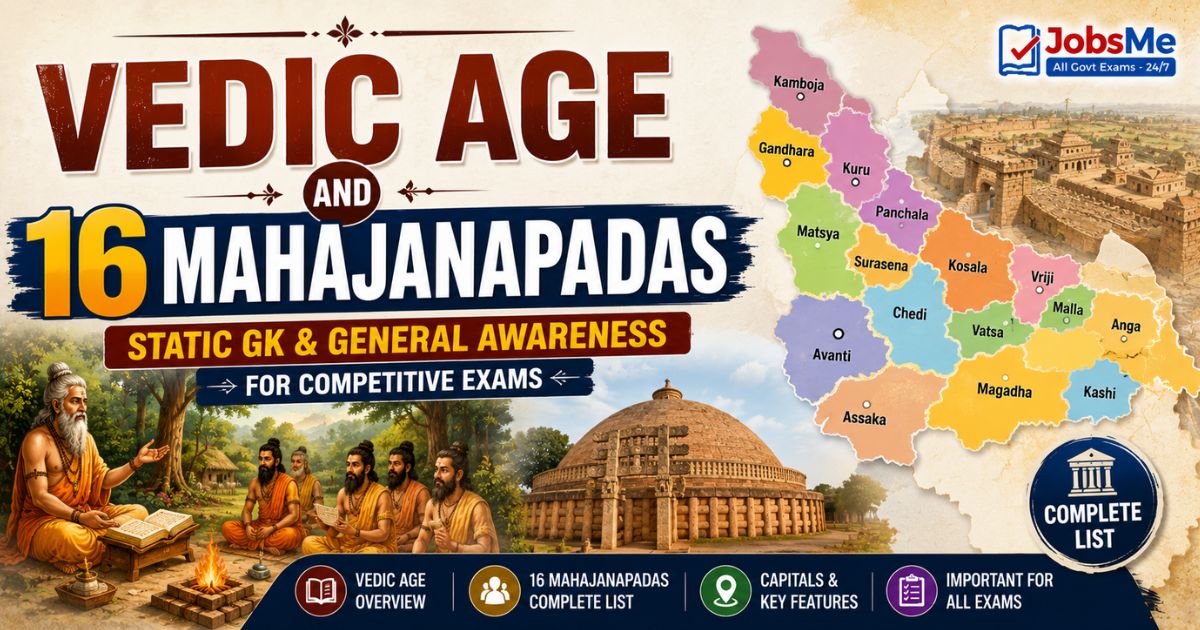
This article gives a complete, exam-ready overview of the Vedic Age (1500–600 BCE) and the 16 Mahajanapadas of ancient India, covering the Early and Later Vedic periods, Vedic literature, the Sapta Sindhu rivers, society, polity, and economy, along with the names, capitals, present-day locations, rulers, and key facts of all sixteen Mahajanapadas. It includes the four Vedas, important assemblies like Sabha and Samiti, the rise of Magadha, republics and monarchies, and the Second Urbanisation, presented with memory tricks and one-liners for quick revision. All facts are arranged in a structured format to help UPSC, SSC, IBPS, RRB, PSU, and State PCS aspirants score better in General Awareness and Ancient History sections.
Jump to section
Introduction
The Vedic Age and the rise of the 16 Mahajanapadas together form the foundation of ancient Indian history and one of the most heavily tested areas in competitive exams. The Vedic Age, spanning roughly 1500 BCE to 600 BCE, is named after the Vedas, the oldest scriptures of India, composed by the Indo-Aryans who first settled in the Sapta Sindhu (land of seven rivers) region. The word "Veda" comes from the Sanskrit root "vid", meaning "to know". As the Aryans moved eastward into the Ganga plains and began using iron tools, small tribal settlements (Janas) grew into territorial states (Janapadas) and finally into the sixteen great states known as Mahajanapadas by the 6th century BCE.
Questions on the Vedic Age and Mahajanapadas appear regularly in UPSC Prelims, SSC CGL, IBPS PO, RRB NTPC, SBI Clerk, State PCS, and various Insurance and Defence exams. Typical questions ask which river had which Vedic name, which Veda deals with music, which assembly performed judicial functions, the capital of a particular Mahajanapada, which was the only Mahajanapada south of the Vindhyas, or why Magadha became the most powerful state. This article brings together every important fact in a clear, exam-ready format. To explore more such topics, you can refer to the Static GK section on Jobsme.in.
This topic is also linked to current affairs themes such as archaeological discoveries, anniversaries of ancient sites, debates on the Aryan question, and references to ancient republics and democratic traditions in public discourse — making it doubly important for aspirants preparing for UPSC Mains and Essay papers as well as for daily General Awareness updates.
Core Concepts: Understanding the Vedic Age and Mahajanapadas
The Vedic Age is divided into two clear phases, and the Mahajanapada era follows it as the period of the Second Urbanisation. Understanding the difference between these phases helps students answer comparison-based and matching questions confidently.
- Early Vedic Period (Rigvedic Age): Roughly 1500 BCE to 1000 BCE, centred in the Sapta Sindhu region (Punjab, Haryana, north-west). Society was pastoral, semi-nomadic, tribal, and largely egalitarian, with cattle as the main measure of wealth.
- Later Vedic Period: Roughly 1000 BCE to 600 BCE, marked by an eastward shift into the Ganga-Yamuna Doab, eastern UP (Kosala), and north Bihar (Videha). The use of iron, settled agriculture, the rigid Varna system, and larger kingdoms emerged in this phase.
- Janapada to Mahajanapada: The word Janapada comes from "Jana" (people) and "Pada" (foot), meaning a place where a tribe set foot. Iron technology and agricultural surplus turned small Janapadas into sixteen large Mahajanapadas by the 6th century BCE.
- Second Urbanisation: The Mahajanapada era is called the Second Urbanisation of India (the Indus Valley Civilisation being the first), marked by fortified cities, coinage, and trade guilds.
- Two Types of States: Mahajanapadas were either Monarchies (Rajyas, ruled by hereditary kings) or Republics (Gana-Sanghas, governed by assemblies of clan elders).
The Vedic Age: Geography, Literature and Society
The following sub-sections cover the geography of the Vedic period, the four Vedas and related literature, the rivers of the Sapta Sindhu, and the major features of Vedic society and polity — all frequently asked in exams.
The Sapta Sindhu - Seven Rivers of the Rigveda
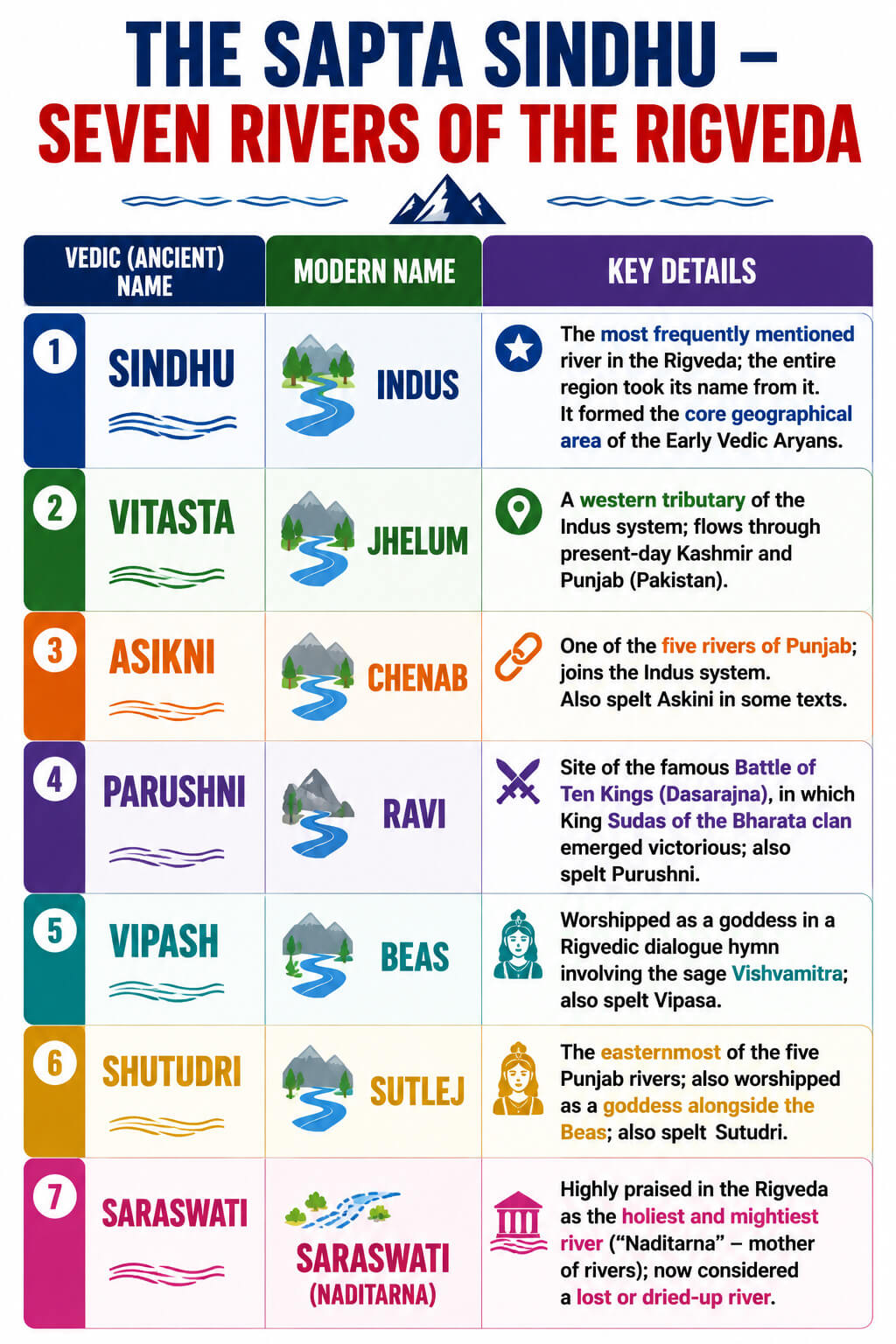
| Vedic (Ancient) Name | Modern Name | Key Details |
|---|---|---|
| Sindhu | Indus | The most frequently mentioned river in the Rigveda; the entire region took its name from it. It formed the core geographical area of the Early Vedic Aryans. |
| Vitasta | Jhelum | A western tributary of the Indus system; flows through present-day Kashmir and Punjab (Pakistan). |
| Asikni | Chenab | One of the five rivers of Punjab; joins the Indus system. Also spelt Askini in some texts. |
| Parushni | Ravi | Site of the famous Battle of Ten Kings (Dasarajna), in which King Sudas of the Bharata clan emerged victorious; also spelt Purushni. |
| Vipash | Beas | Worshipped as a goddess in a Rigvedic dialogue hymn involving the sage Vishvamitra; also spelt Vipasa. |
| Shutudri | Sutlej | The easternmost of the five Punjab rivers; also worshipped as a goddess alongside the Beas; also spelt Sutudri. |
| Saraswati | Saraswati (Naditarna) | Highly praised in the Rigveda as the holiest and mightiest river ("Naditarna" - mother of rivers); now considered a lost or dried-up river. |
Note: The Yamuna is mentioned three times and the Ganga only once in the Rigveda, while the seven Sapta Sindhu rivers are mentioned many times — a strong indicator that Early Vedic life was centred in the north-west.
Vedic Literature - The Four Vedas and Related Texts
| Text | Subject / Theme | Key Details |
|---|---|---|
| Rigveda | Hymns / Prayers | The oldest Veda and the oldest text in any Indo-European language; a collection of hymns in praise of gods. The famous Gayatri Mantra and Purusha Sukta (origin of the four Varnas) are from the Rigveda. |
| Samaveda | Music / Melodies | A collection of verses mostly drawn from the Rigveda, set to melody; considered the root of Indian classical music. |
| Yajurveda | Rituals / Sacrificial formulas | Deals with the procedures and formulae of sacrifices (yajnas); written in both prose and verse. |
| Atharvaveda | Magic / Charms / Daily life | The last Veda; contains charms, spells, medicine, and references to everyday life. It first mentions Gandhara among the regions. |
| Brahmanas | Ritual explanations (prose) | Prose texts explaining the meaning and procedure of Vedic rituals and sacrifices attached to each Veda. |
| Aranyakas | Forest treatises | The "forest books" meant for hermits and ascetics; bridge the gap between rituals and philosophy. |
| Upanishads | Philosophy | Philosophical texts exploring the nature of the soul (Atman) and ultimate reality (Brahman); also called Vedanta (end of the Vedas). "Satyameva Jayate" comes from the Mundaka Upanishad. |
Vedic Polity, Society and Economy
| Aspect | Early Vedic Period | Later Vedic Period |
|---|---|---|
| Chief / Ruler | Rajan - a tribal chief and protector of the Jana, not an absolute monarch. | King grew powerful and territorial; performed grand rituals like Rajasuya and Ashvamedha to legitimise power. |
| Assemblies | Sabha (council of elders/nobles) and Samiti (larger popular assembly); women could attend the Sabha. | Sabha and Samiti declined in importance as royal power increased. |
| Political Unit | Jana (tribe), based on people not territory; Grama (village) headed by Gramani. | Rashtra (territory) emerged; loyalty shifted from tribe (Jana) to land (Janapada). |
| Economy | Pastoral; cattle (especially the cow, called Aghanya - "not to be killed") were the main wealth; Yava meant barley; Pani were traders. | Settled agriculture with iron ploughshare; trade, taxation, and craft specialisation grew. |
| Society | Largely egalitarian; Varna system was flexible and based on occupation. | Rigid four-fold Varna system (Brahmana, Kshatriya, Vaishya, Shudra); rise of Brahmana dominance. |
| Pottery / Archaeology | Limited settled sites; associated with Ochre Coloured Pottery (OCP) in transition. | Painted Grey Ware (PGW) culture; sites like Hastinapur, Atranjikhera, Kaushambi. |
The 16 Mahajanapadas - Capitals, Locations and Rivers
According to the Buddhist text Anguttara Nikaya, there were sixteen great states (Mahajanapadas) in the 6th century BCE, stretching from Afghanistan in the north-west to the Godavari in the south. The Jain text Bhagavati Sutra also gives a list. The table below lists all sixteen with their capitals, present-day locations, and associated rivers.
| Mahajanapada | Capital(s) | Present-Day Location | River / Water Source & Key Details |
|---|---|---|---|
| Anga | Champa | Munger and Bhagalpur region, Bihar | Champa, Ganga, Kosi. A major commercial hub trading with Southeast Asia (Suvarnabhumi); Champa was a great river port. Later annexed by Bimbisara of Magadha. |
| Magadha | Rajagriha (Girivraja), later Pataliputra | South Bihar (Gaya, Patna) | Ganga, Son. The most powerful Mahajanapada; surrounded by hills and rivers (natural fortification); rich iron ore; centre of Buddha and Mahavira's activity; became the seat of the Mauryan Empire. |
| Vajji (Vrijji) | Vaishali | North Bihar (Vaishali) | Gandak. A famous republic and confederacy of 8 clans (Lichchhavis, Videhans, Jnatrikas, etc.); Mahavira was born nearby at Kundagrama; the courtesan Amrapali lived here. |
| Malla | Kushinagar and Pava | North-eastern UP (Gorakhpur region) | Gandak. A single-clan republic; site of the Mahaparinirvana (death) of Buddha at Kushinara and of Mahavira at Pava. |
| Kashi | Varanasi | Eastern UP (Varanasi) | Ganga, Varuna, Assi. Named after the Varuna and Asi rivers; the most powerful state before Magadha's rise; famous for fine cotton and silk; later absorbed by Kosala and then Magadha. |
| Kosala | Shravasti | North-central UP (Awadh region) | Sarayu (Ghaghara). Most powerful state during Buddha's time under King Prasenajit; included the Shakya republic of Kapilavastu (Buddha's clan; born at Lumbini) and the holy city of Ayodhya. |
| Vatsa | Kaushambi | Near Prayagraj, UP | Ganga, Yamuna. A major trade centre linking north and south; King Udayana made Buddhism the state religion and features in Sanskrit plays by Bhasa and Harsha. |
| Kuru | Indraprastha and Hastinapur | Delhi, Haryana, Western UP | Yamuna, Ganga. The heart of Later Vedic civilisation; the Mahabharata war was fought here; later shifted from monarchy to a republic. |
| Panchala | Ahichchhatra (North) and Kampilya (South) | Western and Central UP | Ganga, Yamuna. Divided into North and South Panchala by the Ganga; known for craft production and fortified cities; later became a republican Sangha. |
| Matsya | Viratanagara | Jaipur region, Rajasthan | Chambal. Covered Jaipur, Alwar and Bharatpur; had little political weight in Buddha's time and was later absorbed by Magadha. |
| Shurasena | Mathura | Mathura, UP | Yamuna. Capital Mathura is linked to the birth of Lord Krishna; located at the junction of the Uttarapatha and Dakshinapatha trade routes; King Avantipura was Buddha's disciple. |
| Chedi | Shuktimati | Bundelkhand region (UP, MP) | Ken. One of the most ancient tribes, mentioned in the Rigveda. |
| Avanti | Ujjayini (North) and Mahishmati (South) | Malwa region, Madhya Pradesh | Shipra, Narmada. Divided by the Vindhya Range; a major rival to Magadha with its own iron ore; King Pradyota was a contemporary of Buddha; Ujjain later became a prime meridian for Indian astronomers. |
| Gandhara | Taxila (Takshashila) | Rawalpindi, Peshawar (Pakistan) | Indus, Kabul. Taxila was a world-famous centre of learning (linked to Panini and Chanakya); mentioned in the Behistun Inscription of Darius I as conquered by the Persians; later a hub of Gandhara art. |
| Kamboja | Rajapura | NE Afghanistan, NW Pakistan, SW Kashmir | Kunar. Situated on the Uttarapatha; controlled the Hindukush passes; famous for an excellent breed of horses; described as a republic of warriors in Kautilya's Arthashastra. |
| Assaka (Ashmaka) | Potali (Potana / Paudanyapura) | Godavari Basin (Telangana, Maharashtra) | Godavari. The only Mahajanapada located south of the Vindhya Mountains; lay on the Dakshinapatha trade route and included the Paithan (Pratisthan) region. |
Why Magadha Became the Most Powerful Mahajanapada
- Strategic capitals: Rajagriha was surrounded by five hills, making it nearly impregnable — the earliest fortified capital in ancient India; the later capital Pataliputra sat at the confluence of the Ganga and Son rivers and acted as a water fort (Jaladurga).
- Iron ore: Abundant iron deposits nearby allowed superior weapons and tools.
- Fertile land: The middle Gangetic plain gave high agricultural surplus to support a large army and population.
- Ambitious rulers: Bimbisara (founder of the Haryanka dynasty), Ajatashatru (held the First Buddhist Council), Udayin (shifted the capital to Pataliputra), Shishunaga (defeated Avanti), and Mahapadma Nanda (called "Ekarat", the first non-Kshatriya ruler) expanded the kingdom relentlessly.
- Four contenders: Magadha, Kosala, Avanti, and Vatsa fought for supremacy, and Magadha finally won, paving the way for the Mauryan Empire.
Memory Tricks and Mnemonics
Trick 1: Sapta Sindhu Rivers — "Sister Vimala Asks Pretty Vinod Some Secret"
Use this sentence to recall the seven rivers in order (Vedic name → modern name):
- Sister → Sindhu (Indus).
- Vimala → Vitasta (Jhelum).
- Asks → Asikni (Chenab).
- Pretty → Parushni (Ravi).
- Vinod → Vipash (Beas).
- Some → Shutudri (Sutlej).
- Secret → Saraswati.
"Seven sisters of the north-west — from Sindhu to Saraswati."
Trick 2: The Four Vedas — "Ri-Sa-Ya-A" by Theme
Link each Veda to one keyword:
- Rigveda → Hymns (oldest, prayers).
- Samaveda → Songs (music — Sa for Sa-Re-Ga-Ma).
- Yajurveda → Yajna (rituals).
- Atharvaveda → Abracadabra (magic and charms).
"Pray, Sing, Sacrifice, and Cast a spell."
Trick 3: The Two Sites of Death — "Buddha at Kushinagar, Mahavira at Pava"
Both great teachers attained Mahaparinirvana in the Malla Mahajanapada, but at different towns:
- Buddha → died at Kushinara (Kushinagar).
- Mahavira → died at Pava.
"Malla holds two farewells — Kushinagar for Buddha, Pava for Mahavira."
Trick 4: Capitals in Pairs — "Two-Capital Clubs"
A few Mahajanapadas had two capitals; group them to avoid confusion:
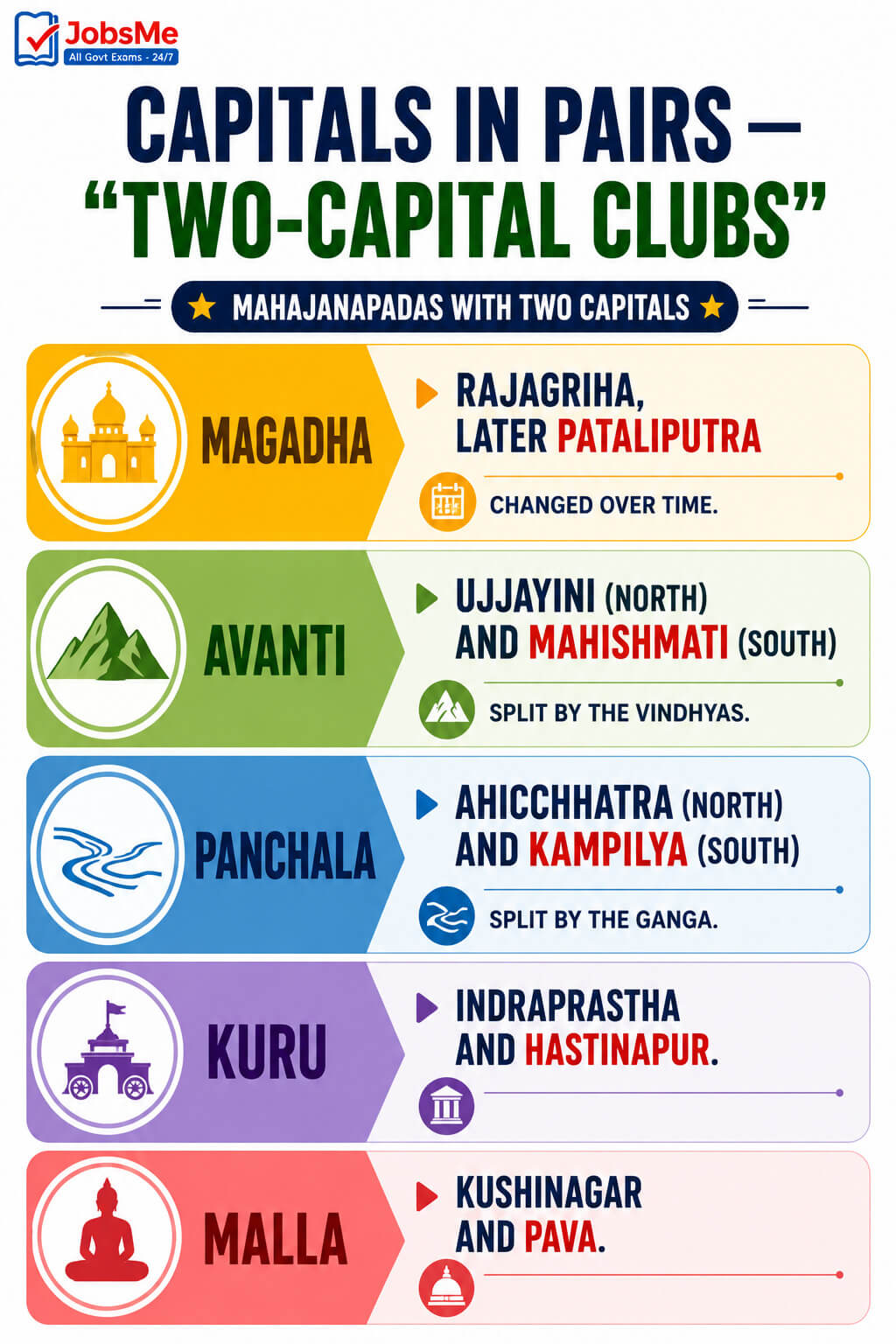
- Magadha → Rajagriha, later Pataliputra (changed over time).
- Avanti → Ujjayini (North) and Mahishmati (South), split by the Vindhyas.
- Panchala → Ahichchhatra (North) and Kampilya (South), split by the Ganga.
- Kuru → Indraprastha and Hastinapur.
- Malla → Kushinagar and Pava.
Trick 5: The Three Famous Republics — "VKM"
Remember the main Gana-Sangha (republican) Mahajanapadas as "VKM":
- V → Vajji (confederacy of 8 clans).
- K → Kamboja (republic of warriors).
- M → Malla (single-clan republic).
"VKM voted while kings ruled the rest."
Trick 6: The Only Southern One — "Assaka is Alone in the South"
Out of all sixteen Mahajanapadas, only Assaka (Ashmaka) lay south of the Vindhyas, on the banks of the Godavari in the Telangana-Maharashtra region. "South of the Vindhyas, only Assaka stands on the Godavari."
Trick 7: Capital-City Clues — "Name Tells the River"
Some capitals reveal their location through river or place names:
- Kashi → Varanasi, named after rivers Varuna + Asi.
- Anga → Champa, at the confluence of the Ganga and Champa rivers.
- Gandhara → Taxila, the famous university town on the Indus-Kabul route.
- Shurasena → Mathura, on the Yamuna, linked to Lord Krishna.
Additional Notes
Frequently Confused Facts
- Parushni vs Purushni: Both spellings refer to the river Ravi, the site of the Battle of Ten Kings (Dasarajna).
- Sabha vs Samiti: Sabha was a smaller council of elders/nobles (also linked to judicial functions); Samiti was the larger popular assembly that discussed major matters.
- Jana vs Janapada vs Mahajanapada: Jana is a tribe/people; Janapada is a tribe settled on a territory; Mahajanapada is a large, powerful Janapada (great state).
- Birthplace vs Death place of Buddha: Buddha was born at Lumbini (in the Shakya republic under Kosala) and died (Mahaparinirvana) at Kushinagar (in Malla).
- Mahavira's clan and birth: Mahavira belonged to the Jnatrika clan of the Vajji confederacy and was born near Vaishali at Kundagrama; he died at Pava.
- Magadha's two capitals: The first capital was Rajagriha (Girivraja); it was later shifted to Pataliputra by King Udayin — not by Bimbisara.
- Avanti vs Panchala division: Avanti was divided by the Vindhya Range; Panchala was divided by the Ganga river.
- First Veda vs First text on Mahajanapadas: The Rigveda is the oldest Veda; the list of 16 Mahajanapadas comes from the Buddhist Anguttara Nikaya, not from the Vedas.
- OCP vs PGW vs NBPW: Ochre Coloured Pottery (OCP) is associated with the late Harappan/early phase, Painted Grey Ware (PGW) with the Later Vedic period, and Northern Black Polished Ware (NBPW) with the Mahajanapada/Second Urbanisation era.
- Aghanya vs Yava: Aghanya ("not to be killed") refers to the cow; Yava refers to barley — both Rigvedic terms.
Repeating PYQ Patterns
Certain facts from this topic are asked repeatedly in competitive exams. The Sapta Sindhu rivers and their modern names, the four Vedas and their themes, Sabha and Samiti, the cow as the measure of wealth, the 16 Mahajanapadas list with capitals, the only southern Mahajanapada (Assaka), the republics (Vajji, Malla, Kamboja), the reasons for Magadha's rise, and the rulers Bimbisara, Ajatashatru, and Mahapadma Nanda appear most often in UPSC Prelims, SSC CGL, and RRB NTPC papers. Banking exams (IBPS PO, SBI Clerk) frequently ask direct matching questions on Mahajanapadas and their capitals. State PCS exams add regional links — UPPSC focuses on Kosala, Kashi, and Panchala; BPSC on Magadha, Anga, and Vajji; and MPPSC on Avanti, Chedi, and the Rigvedic Pani.
Quick Insight
The Vedic Age and the Mahajanapadas are not just dates and names — they trace India's journey from wandering pastoral tribes to organised cities, taxation, coinage, and even early republics. The Gana-Sanghas like Vajji are often cited in modern discussions as some of the world's earliest experiments in collective, assembly-based governance, while Magadha's rise shows how geography, iron, and ambition can build an empire. This makes the topic valuable for both Prelims (direct matching questions) and Mains (essays on ancient polity, urbanisation, and democratic traditions). For more related Static GK topics, you can refer to the Static GK notes on Jobsme.in and test yourself with the Static GK Quiz.
One-Liners for Quick Revision
- Vedic Age → 1500-600 BCE → composed by Indo-Aryans; "heroic age" of Indian civilisation.
- Early Vedic / Rigvedic Period → 1500-1000 BCE → centred in Sapta Sindhu (Punjab-Haryana).
- Later Vedic Period → 1000-600 BCE → eastward shift to Ganga-Yamuna Doab; PGW culture.
- Veda → from Sanskrit root "vid" → meaning "to know".
- Sapta Sindhu → land of seven rivers → core region of the Early Vedic Aryans.
- Sindhu → Indus → most mentioned river in the Rigveda.
- Vitasta → Jhelum; Asikni → Chenab; Parushni → Ravi (Battle of Ten Kings).
- Vipash → Beas; Shutudri → Sutlej; Saraswati → most praised, now lost river.
- Rigveda → hymns → oldest Veda; contains Gayatri Mantra and Purusha Sukta.
- Samaveda → music → root of Indian classical music.
- Yajurveda → rituals/sacrifices → prose and verse.
- Atharvaveda → magic and charms → last Veda; first mentions Gandhara.
- Upanishads → philosophy → also called Vedanta; source of "Satyameva Jayate".
- Rajan → tribal chief of the Early Vedic period.
- Sabha and Samiti → Vedic assemblies; Sabha linked to judicial functions.
- Aghanya → the cow ("not to be killed"); Yava → barley; Pani → traders.
- Second Urbanisation → the Mahajanapada era (IVC was the first urbanisation).
- 16 Mahajanapadas → listed in the Buddhist text Anguttara Nikaya.
- Anga → capital Champa → Bhagalpur (Bihar); annexed by Bimbisara.
- Magadha → Rajagriha then Pataliputra → South Bihar; the most powerful state.
- Vajji → capital Vaishali → North Bihar; republic of 8 clans.
- Malla → Kushinagar/Pava → death of Buddha and Mahavira.
- Kashi → Varanasi → named after Varuna and Asi rivers.
- Kosala → Shravasti → King Prasenajit; includes Lumbini and Ayodhya.
- Vatsa → Kaushambi → King Udayana made Buddhism the state religion.
- Kuru → Indraprastha/Hastinapur → site of the Mahabharata war.
- Panchala → Ahichchhatra and Kampilya → divided by the Ganga.
- Matsya → Viratanagara → Jaipur region, Rajasthan.
- Shurasena → Mathura → linked to Lord Krishna.
- Chedi → Shuktimati → Bundelkhand; mentioned in the Rigveda.
- Avanti → Ujjayini and Mahishmati → Malwa, MP; rival of Magadha.
- Gandhara → Taxila → Pakistan; famous centre of learning.
- Kamboja → Rajapura → Afghanistan/Kashmir; famous for horses.
- Assaka (Ashmaka) → Potali → on the Godavari; only Mahajanapada south of the Vindhyas.
- Magadha's strength → fortified capitals, iron ore, fertile land, and ambitious rulers.
- Bimbisara → founder of the Haryanka dynasty; contemporary of Buddha.
- Ajatashatru → held the First Buddhist Council at Rajagriha.
- Mahapadma Nanda → called "Ekarat"; first non-Kshatriya ruler of Magadha.
For more ancient history and Static GK topics, explore the Static GK section on Jobsme.in. You can also sharpen your preparation with the Static GK Quiz, stay updated through Daily Current Affairs, and check the latest openings at Latest Government Job Notifications.
Free quiz • No signup required
Put this topic into practice with Indian Cultural Institutions – Static GK MCQ Quiz. It is the quickest way to reinforce what you just learned.
Frequently Asked Questions
What is the time period of the Vedic Age in India?
What is Sapta Sindhu and which rivers does it include?
Which is the oldest Veda and what does it contain?
What was the difference between Sabha and Samiti in the Vedic period?
How many Mahajanapadas were there and which text mentions them?
Which was the only Mahajanapada located south of the Vindhyas?
Why did Magadha become the most powerful Mahajanapada?
Which Mahajanapadas were republics or Gana-Sanghas?
Where were Gautam Buddha and Mahavira born and where did they die?
What is meant by the Second Urbanisation in Indian history?

About the author