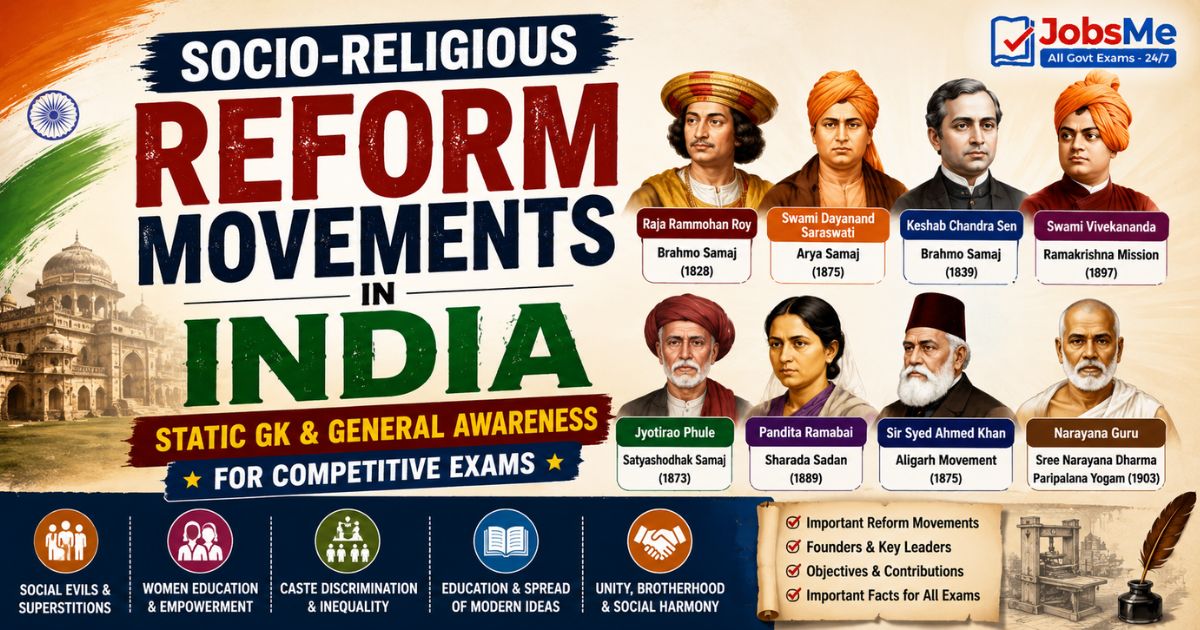
Socio-Religious Reform Movements in India – Static GK & General Awareness for Competitive Exams with Memory Tricks
This article presents a complete list of the major socio-religious reform movements of 19th and early 20th century India, covering Hindu, Muslim, Sikh, Parsi, and regional anti-caste reform movements along with their founders, founding years, headquarters, and key contributions. It includes landmark movements like the Brahmo Samaj (Raja Ram Mohan Roy), Arya Samaj (Swami Dayananda Saraswati), Ramakrishna Mission (Swami Vivekananda), Aligarh Movement (Sir Syed Ahmad Khan), and Satyashodhak Samaj (Jyotirao Phule), with memory tricks, a year-wise timeline, and one-liners for quick revision. All facts are arranged in exam-ready format to help UPSC, SSC, IBPS, RRB, PSU, and State PCS aspirants score better in General Awareness and Modern History sections.
Jump to section
- Introduction
- Core Concepts: Understanding Reform Movements
- Major Hindu Reform Movements - Founders and Details
- Muslim, Sikh, and Parsi Reform Movements - Founders and Details
- Anti-Caste and Regional Reform Movements - Founders and Details
- Memory Tricks and Mnemonics
- Additional Notes
- One-Liners for Quick Revision
Introduction
The socio-religious reform movements of 19th and early 20th century India form one of the most important chapters of Modern Indian History. Exposed to Western education, rationalism, and liberal ideas under British rule, a generation of reformers rose to challenge social evils such as Sati, child marriage, the purdah system, polygamy, untouchability, and caste discrimination, while purifying religion of superstition and ritualism. This churning of ideas is often called the Indian Renaissance, and it began with Raja Ram Mohan Roy, who founded the Brahmo Samaj in 1828 and is rightly called the "Father of Modern India."
Questions on reform movements and their founders appear regularly in UPSC Prelims, SSC CGL, IBPS PO, RRB NTPC, SBI Clerk, State PCS, and Insurance and Defence exams. They typically ask which reformer founded which organisation, the founding year and place of a movement, the social evil it targeted, or which movement was reformist versus revivalist. This article brings together every important movement in a structured, exam-ready format. To explore related topics, you can refer to the detailed notes in the Static GK section on Jobsme.in.
This topic is also closely tied to current affairs themes such as birth and death anniversaries of reformers, government commemorations, debates on social justice and women's rights, and references in Parliament and public speeches — making it doubly important for aspirants preparing for UPSC Mains and Essay papers, where the link between the Indian Renaissance and the rise of nationalism is a recurring theme.
Core Concepts: Understanding Reform Movements
The reform movements were not random social campaigns; they shared a common goal of modernising Indian society by attacking outdated customs and reinterpreting religion on rational lines. Understanding the broad classification and aims helps students remember the movements longer and answer matching questions confidently.
Why Reform Movements Emerged
- Spread of Western education: Exposure to liberalism, rationalism, and the idea of individual rights created a new English-educated middle class that questioned tradition.
- Degraded social conditions: Practices like Sati, child marriage, female infanticide, the purdah system, polygamy, and untouchability needed urgent reform.
- Influence of the press and printing: Newspapers, journals, and translated texts spread reformist ideas to the masses.
- Challenge from Christian missionaries: Conversion activity pushed many communities to reform and defend their own religions.
Two Main Streams of Reform
- Reformist Movements: Relied on reason and rationalism while accepting or rejecting a custom or tradition. Examples: Brahmo Samaj, Prarthana Samaj, and the Aligarh Movement.
- Revivalist Movements: Appealed more to tradition and the lost purity of religion than to pure reason. Examples: Arya Samaj, Ramakrishna Mission, and the Deoband Movement.
Both streams, however, appealed to the lost purity of the religion they sought to reform, and both contributed to the awakening of a national identity. For more foundational topics, see the Static GK notes on Jobsme.in.
Major Hindu Reform Movements - Founders and Details
The following table lists the most exam-relevant Hindu reform movements along with their founders, founding years, and key contributions.
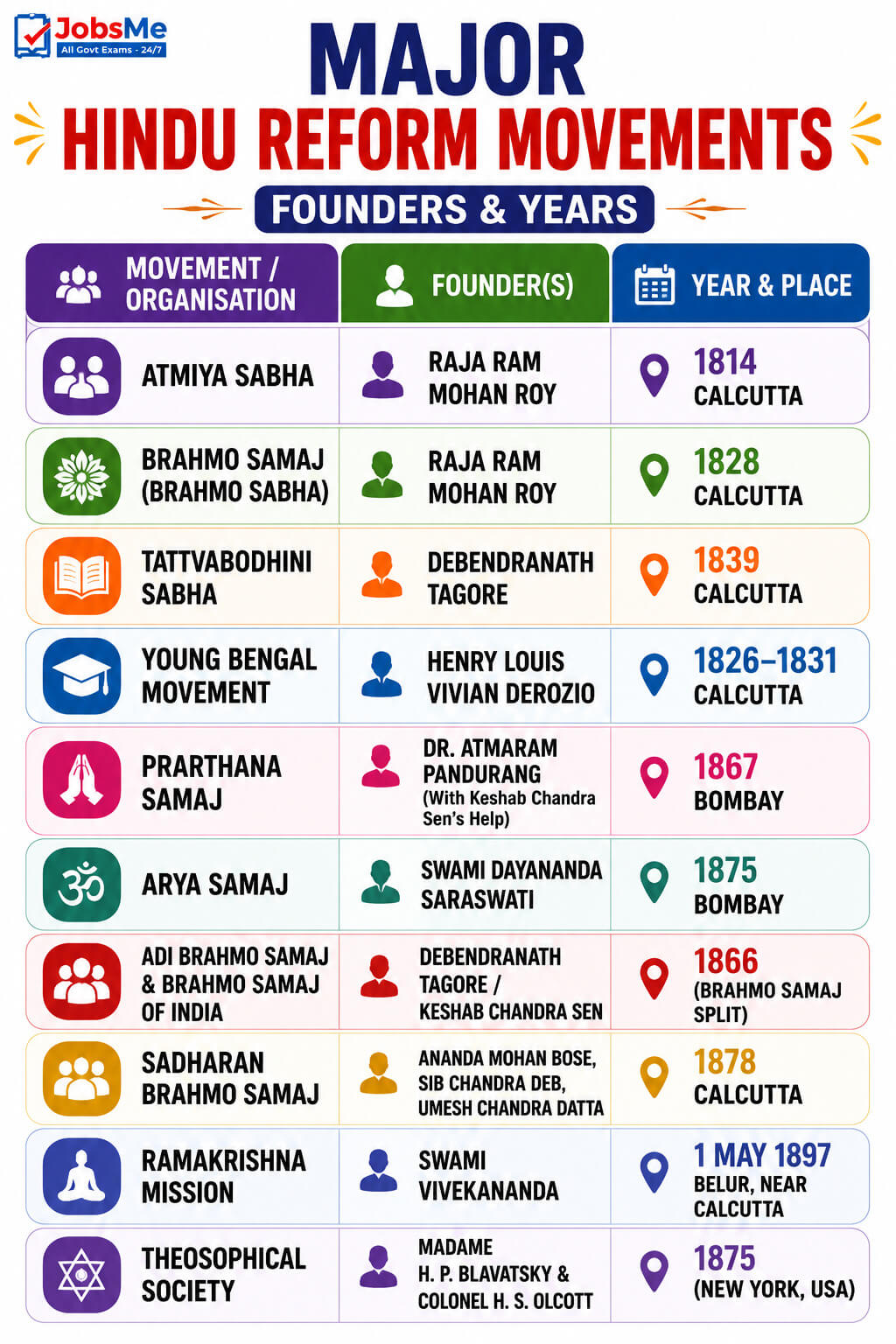
| Movement / Organisation | Founder(s) | Year & Place / Key Details |
|---|---|---|
| Atmiya Sabha | Raja Ram Mohan Roy | Founded in 1814 in Calcutta; an early forum that discussed social and religious questions and was the forerunner of the Brahmo Sabha. |
| Brahmo Samaj (Brahmo Sabha) | Raja Ram Mohan Roy | Founded as Brahmo Sabha in 1828 in Calcutta, later renamed Brahmo Samaj; advocated monotheism, opposed idolatry, polytheism, caste system and Sati; campaigned for the abolition of Sati, achieved through the 1829 Regulation. |
| Tattvabodhini Sabha | Debendranath Tagore | Founded in 1839 in Calcutta (initially called Tattvaranjini Sabha); a splinter group that revived and systematised Brahmo ideas; Debendranath later joined and reorganised the Brahmo Samaj in 1842 and wrote the Brahmo Covenant in 1843. |
| Young Bengal Movement | Henry Louis Vivian Derozio | Active in Calcutta from 1826 to 1831; Derozio taught at Hindu College and inspired the radical "Derozians" who attacked old customs and championed free thought, women's rights, and a free press. |
| Prarthana Samaj | Dr. Atmaram Pandurang (with Keshab Chandra Sen's help) | Founded in 1867 in Bombay as an offshoot of the Brahmo Samaj; M. G. Ranade joined later; attached to the Bhakti cult of Maharashtra; focused on social reform — opposing caste, promoting women's education, widow remarriage, and a higher age of marriage. |
| Arya Samaj | Swami Dayananda Saraswati | Founded in 1875 in Bombay (Lahore later became its main centre); gave the call "Back to the Vedas" and the motto "Krinvanto Vishvam Aryam"; opposed idolatry, polytheism, child marriage and caste by birth; started the Shuddhi (reconversion) movement and DAV schools; wrote Satyarth Prakash. |
| Adi Brahmo Samaj & Brahmo Samaj of India | Debendranath Tagore / Keshab Chandra Sen | The Brahmo Samaj split in 1866: Debendranath Tagore led the Adi Brahmo Samaj while Keshab Chandra Sen led the more radical Brahmo Samaj of India, which spread the movement beyond Bengal. |
| Sadharan Brahmo Samaj | Ananda Mohan Bose, Sib Chandra Deb, Umesh Chandra Datta | Founded in 1878 in Calcutta by members who broke away from Keshab Chandra Sen's faction; restored democratic functioning to the Brahmo movement. |
| Ramakrishna Mission | Swami Vivekananda | Founded on 1 May 1897, with its headquarters (Math) at Belur, near Calcutta; based on the teachings of Sri Ramakrishna Paramahansa; preached Vedanta, "service to man is service to God," and social service alongside spirituality; motto "Atmano Mokshartham Jagad-hitaya Cha." |
| Theosophical Society | Madame H. P. Blavatsky & Colonel H. S. Olcott | Founded in 1875 in New York (USA); shifted its headquarters to Adyar, Madras in 1882; later led in India by Annie Besant; promoted universal brotherhood, revival of ancient religions, and comparative study of religion and philosophy. |
Muslim, Sikh, and Parsi Reform Movements - Founders and Details
Reform was not limited to Hindu society; significant movements emerged among Muslims, Sikhs, and Parsis as well. The following table covers the most exam-relevant entries.
| Movement / Organisation | Founder(s) | Year & Community / Key Details |
|---|---|---|
| Aligarh Movement | Sir Syed Ahmad Khan | Began in 1875 with the founding of the Mohammedan Anglo-Oriental (MAO) College at Aligarh (later Aligarh Muslim University); a liberal, modern movement promoting Western education among Muslims and social reform on purdah, polygamy, and widow remarriage. |
| Deoband Movement | Muhammad Qasim Nanautawi & Rashid Ahmad Gangohi | Founded in 1866 at Deoband, Uttar Pradesh; a revivalist movement run by orthodox ulema to propagate the pure teachings of the Quran and Hadith; later took an anti-British stance and supported the national movement. |
| Ahmadiyya Movement | Mirza Ghulam Ahmad | Founded in 1889 at Qadian, Punjab; based on universal religion and liberal principles; described itself as the standard-bearer of the "Mohammedan Renaissance" and opposed jihad against non-Muslims. |
| Singh Sabha Movement | Sikh reformers (led at Amritsar) | Founded in 1873 at Amritsar with two aims — to spread modern education among Sikhs (through Khalsa schools) and to counter the proselytising of Christian missionaries, Arya Samajists, and Muslim maulvis. |
| Akali Movement (Gurudwara Reform Movement) | Sikh masses (offshoot of Singh Sabha) | Active in the early 1920s in Punjab; aimed at liberating Sikh gurudwaras from corrupt hereditary Udasi mahants; a non-violent regional (not communal) movement that led to the Gurdwaras Act of 1925 and control through the SGPC. |
| Rahnumai Mazdayasnan Sabha (Religious Reform Association) | Naoroji Furdonji, Dadabhai Naoroji, K. R. Cama, S. S. Bengalee | Founded in 1851 by English-educated Parsis to regenerate the social condition of the Parsis and restore the Zoroastrian religion to its original purity. |
Anti-Caste and Regional Reform Movements - Founders and Details
Some of the most radical reform movements targeted the caste system and worked for the upliftment of depressed classes and women. The following table covers the major anti-caste and regional movements frequently asked in exams.
| Movement / Organisation | Founder(s) | Year & Region / Key Details |
|---|---|---|
| Satyashodhak Samaj (Truth Seekers' Society) | Jyotirao Phule (with Savitribai Phule) | Founded in 1873 in Pune, Maharashtra; worked for the education and rights of the lower castes; rejected the caste system, priesthood, and Brahmanical supremacy; Phule opened the first girls' school at Bhidewada, Pune (1848) and wrote "Gulamgiri" (1873). |
| Widow Remarriage Association | Vishnu Shastri Pandit & M. G. Ranade | Founded in 1861 in Bombay; promoted widow remarriage and campaigned against child marriage, heavy marriage costs, and the shaving of widows' heads. (Ishwar Chandra Vidyasagar's efforts earlier led to the Widow Remarriage Act of 1856.) |
| Sri Narayana Dharma Paripalana (SNDP) Yogam | Sree Narayana Guru | Founded in 1902-03 in Kerala; led reform among the Ezhava community; gave the message "One Caste, One Religion, One God for Man"; built temples open to all castes and promoted education. |
| Self-Respect Movement | E. V. Ramasamy "Periyar" | Founded in the 1920s in Tamil Nadu; rejected Brahmanical supremacy and the caste system; promoted rationalism, women's rights, and Dravidian identity. |
| Arya Mahila Samaj | Pandita Ramabai | Founded in 1882 in Pune; aimed at elevating the position of women, promoting female education and freedom from child marriage; Ramabai also founded Sharada Sadan (1889) and Mukti Mission (1896) for destitute widows. |
| Servants of India Society | Gopal Krishna Gokhale | Founded in 1905; trained workers dedicated to the social and political service of the nation and the upliftment of the weaker sections. |
| Vaikom Satyagraha | Led by T. K. Madhavan, K. P. Kesava Menon (Kerala) | A temple-entry movement of 1924-25 in Travancore (Kerala) demanding the right of lower castes to use roads around the Vaikom temple; an early landmark in the anti-untouchability struggle. |
Memory Tricks and Mnemonics
Trick 1: The Two Brahmo Founders — "Roy then Tagore-Sen"
Remember the leadership chain of the Brahmo Samaj in order:
- Raja Ram Mohan Roy → founder (1828).
- Debendranath Tagore → revived it (1842) and later led the Adi Brahmo Samaj.
- Keshab Chandra Sen → radicalised it and led the Brahmo Samaj of India after the 1866 split.
"Roy founded, Tagore revived, Sen divided."
Trick 2: Reformist vs Revivalist — "Reason vs Revival"
Sort movements into two buckets using their first letters:
- Reformist (Reason): Brahmo Samaj, Prarthana Samaj, Aligarh Movement.
- Revivalist (Revival): Arya Samaj, Ramakrishna Mission, Deoband Movement.
"Brahmo-Prarthana-Aligarh reason it out; Arya-Ramakrishna-Deoband revive the past."
Trick 3: "1875 — The Triple Birth Year"
Three major movements were all founded in 1875. Remember them as "ATA — Arya, Theosophical, Aligarh":
- A → Arya Samaj (Dayananda Saraswati).
- T → Theosophical Society (Blavatsky & Olcott).
- A → Aligarh Movement / MAO College (Sir Syed Ahmad Khan).
Trick 4: The "Samaj Founders" Acronym — "Roy-Pandurang-Phule-Dayananda"
Match each "Samaj" to its founder quickly:
- Brahmo Samaj → Raja Ram Mohan Roy.
- Prarthana Samaj → Atmaram Pandurang.
- Satyashodhak Samaj → Jyotirao Phule.
- Arya Samaj → Swami Dayananda Saraswati.
Trick 5: The Year-Wise Timeline — "28-66-67-73-75"
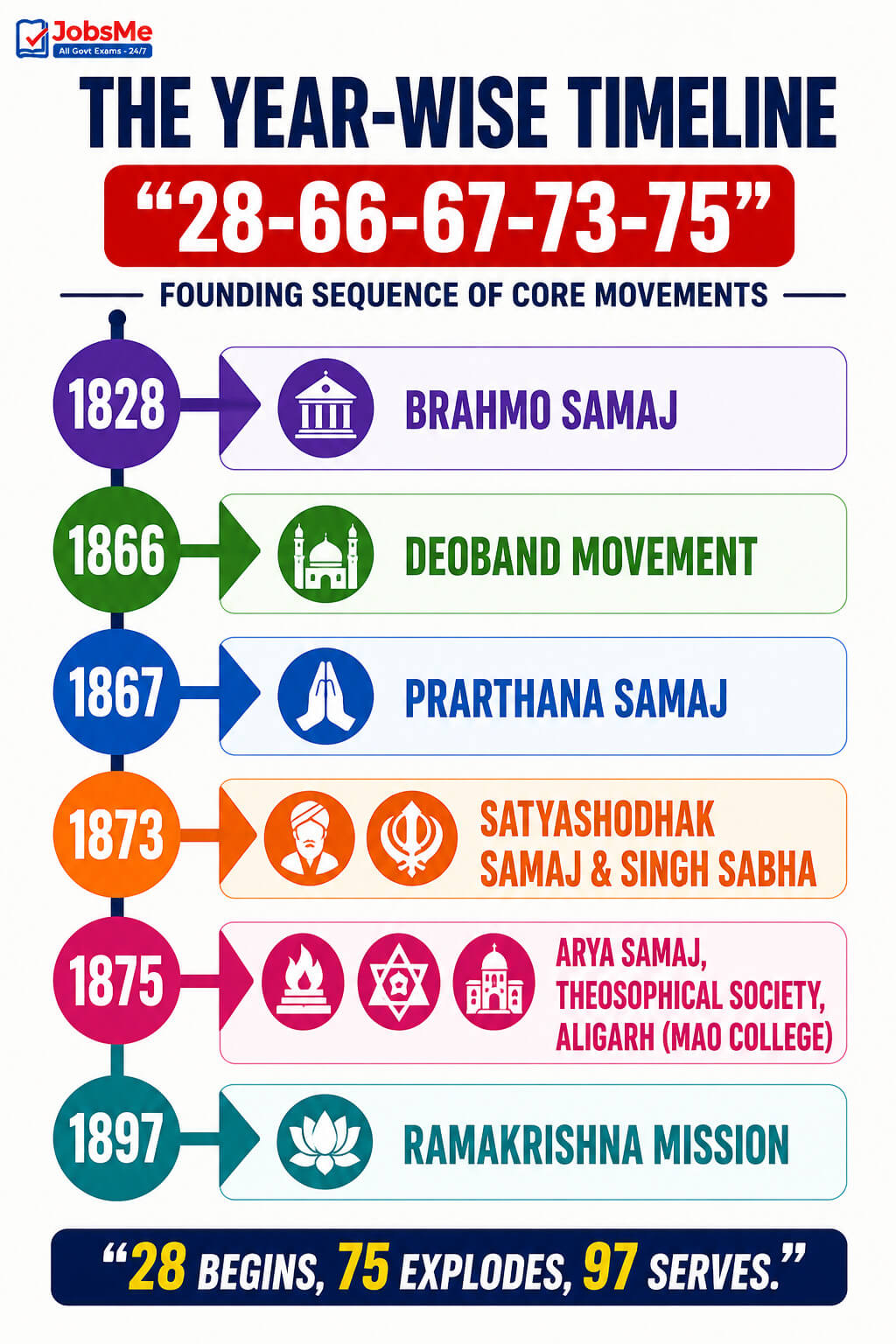
Memorise the founding sequence of the core movements with this number chain:
- 1828 → Brahmo Samaj.
- 1866 → Deoband Movement.
- 1867 → Prarthana Samaj.
- 1873 → Satyashodhak Samaj & Singh Sabha.
- 1875 → Arya Samaj, Theosophical Society, Aligarh (MAO College).
- 1897 → Ramakrishna Mission.
"28 begins, 75 explodes, 97 serves."
Trick 6: South Indian Anti-Caste Trio — "Phule-Narayana-Periyar"
Three reformers attacked caste at its roots:
- Jyotirao Phule → Satyashodhak Samaj (Maharashtra).
- Sree Narayana Guru → SNDP Yogam (Kerala).
- E. V. Ramasamy Periyar → Self-Respect Movement (Tamil Nadu).
"From Pune to Kerala to Tamil Nadu, caste was challenged."
Trick 7: "Three Communities, Three Reforms" — Muslim, Sikh, Parsi
- Muslim: Aligarh (Sir Syed), Deoband (Nanautawi), Ahmadiyya (Mirza Ghulam Ahmad).
- Sikh: Singh Sabha (1873), Akali / Gurudwara Reform (1920s).
- Parsi: Rahnumai Mazdayasnan Sabha (Dadabhai Naoroji & friends, 1851).
Additional Notes
Frequently Confused Facts
- Brahmo Samaj vs Arya Samaj: Brahmo Samaj (Roy, 1828) was Bengal-centred and Western-leaning; Arya Samaj (Dayananda, 1875) was strongest in Punjab and called for a "Back to the Vedas" revival.
- Ramakrishna vs Ramakrishna Mission: Sri Ramakrishna Paramahansa was the saint and inspiration; the Ramakrishna Mission (1897) was actually founded by his disciple Swami Vivekananda.
- Prarthana Samaj founder: Founded by Dr. Atmaram Pandurang in 1867 with Keshab Chandra Sen's help; M. G. Ranade is associated with it but joined later — he was not the founder.
- Theosophical Society origin: Founded in New York (1875) by Blavatsky and Olcott, not in India; its Indian headquarters at Adyar came later (1882), and Annie Besant led it in India.
- Satyashodhak Samaj vs Self-Respect Movement: Satyashodhak Samaj is Jyotirao Phule (Maharashtra, 1873); the Self-Respect Movement is Periyar (Tamil Nadu, 1920s).
- Deoband vs Aligarh: Deoband (1866) was orthodox and revivalist; Aligarh (1875) was liberal and modernist — both reformed Muslim society but with opposite outlooks.
- Sadharan Brahmo Samaj vs Brahmo Samaj of India: Brahmo Samaj of India (1866) was led by Keshab Chandra Sen; the Sadharan Brahmo Samaj (1878) broke away from him to restore democratic functioning.
- Widow Remarriage Act vs Widow Remarriage Association: The Act of 1856 is linked to Ishwar Chandra Vidyasagar; the Widow Remarriage Association (1861, Bombay) was founded by Vishnu Shastri Pandit and M. G. Ranade.
Repeating PYQ Patterns
Certain movement-founder pairs are asked repeatedly in competitive exams. Brahmo Samaj (Raja Ram Mohan Roy, 1828), Arya Samaj (Dayananda Saraswati, 1875), Ramakrishna Mission (Vivekananda, 1897), Prarthana Samaj (Atmaram Pandurang, 1867), Aligarh Movement (Sir Syed Ahmad Khan, 1875), Satyashodhak Samaj (Jyotirao Phule, 1873), and the Theosophical Society (Blavatsky & Olcott, 1875) appear most often in UPSC Prelims, SSC CGL, and RRB NTPC papers. Banking exams (IBPS PO, SBI Clerk) frequently focus on matching the movement with its founder and founding year. State PCS exams add regional movements — Maharashtra PCS asks about Phule and Ranade, Kerala PSC about Sree Narayana Guru and the Vaikom Satyagraha, Tamil Nadu PCS about Periyar's Self-Respect Movement, and Punjab PCS about the Singh Sabha and Akali movements. UPSC Mains has repeatedly asked about Young Bengal and Brahmo Samaj (2021), the link between the Indian Renaissance and national identity (2019), and the women's question in 19th century reform (2017).
Quick Insight
The socio-religious reform movements were far more than religious campaigns — they were the intellectual foundation of modern India. By attacking Sati, child marriage, untouchability, and the seclusion of women, reformers planted the ideas of equality, liberty, and rational thought that later fuelled the freedom struggle. Figures like Phule, Narayana Guru, and Periyar inspired the anti-caste politics carried forward by B. R. Ambedkar, while the rationalism of Roy and Vivekananda fed directly into the nationalist awakening. Understanding these movements helps aspirants connect any reference to a reformer, organisation, or social legislation to its central figure — invaluable for both Prelims (direct matching questions) and Mains (essays on social justice and the freedom struggle). For further reading on related Static GK topics, you can refer to the Static GK section and test yourself with the Static GK Quiz on Jobsme.in.
One-Liners for Quick Revision
- Atmiya Sabha → Raja Ram Mohan Roy → 1814, Calcutta; forerunner of Brahmo Sabha.
- Brahmo Samaj (Brahmo Sabha) → Raja Ram Mohan Roy → 1828, Calcutta; monotheism, anti-Sati, anti-idolatry.
- Tattvabodhini Sabha → Debendranath Tagore → 1839, Calcutta; splinter group of the Brahmo Samaj.
- Young Bengal Movement → Henry Vivian Derozio → 1826-31, Calcutta; radical free-thinkers called Derozians.
- Prarthana Samaj → Dr. Atmaram Pandurang → 1867, Bombay; offshoot of Brahmo Samaj, Bhakti-based social reform.
- Arya Samaj → Swami Dayananda Saraswati → 1875, Bombay; "Back to the Vedas," Shuddhi movement, DAV schools.
- Adi Brahmo Samaj → Debendranath Tagore → 1866; moderate faction after the Brahmo split.
- Brahmo Samaj of India → Keshab Chandra Sen → 1866; radical faction that spread beyond Bengal.
- Sadharan Brahmo Samaj → Ananda Mohan Bose & others → 1878, Calcutta; broke from Keshab Chandra Sen.
- Ramakrishna Mission → Swami Vivekananda → 1897, Belur; Vedanta and "service to man is service to God."
- Theosophical Society → Blavatsky & Olcott → 1875, New York; HQ at Adyar (1882), led in India by Annie Besant.
- Aligarh Movement → Sir Syed Ahmad Khan → 1875; MAO College, modern education for Muslims.
- Deoband Movement → Nanautawi & Gangohi → 1866, Uttar Pradesh; orthodox, revivalist, later anti-British.
- Ahmadiyya Movement → Mirza Ghulam Ahmad → 1889, Qadian; liberal, opposed jihad against non-Muslims.
- Singh Sabha Movement → Sikh reformers → 1873, Amritsar; modern education and counter-proselytisation.
- Akali Movement → Sikh masses → 1920s, Punjab; freed gurudwaras, led to the Gurdwaras Act and SGPC.
- Rahnumai Mazdayasnan Sabha → Dadabhai Naoroji & others → 1851; Parsi religious reform.
- Satyashodhak Samaj → Jyotirao Phule → 1873, Pune; anti-caste, lower-caste upliftment, "Gulamgiri."
- Widow Remarriage Association → Vishnu Shastri Pandit & M. G. Ranade → 1861, Bombay; widow remarriage, anti-child marriage.
- SNDP Yogam → Sree Narayana Guru → 1902-03, Kerala; "One Caste, One Religion, One God for Man."
- Self-Respect Movement → E. V. Ramasamy Periyar → 1920s, Tamil Nadu; rationalism, anti-caste, Dravidian identity.
- Arya Mahila Samaj → Pandita Ramabai → 1882, Pune; women's education and rights.
- Servants of India Society → Gopal Krishna Gokhale → 1905; social and political service to the nation.
- Vaikom Satyagraha → T. K. Madhavan, K. P. Kesava Menon → 1924-25, Travancore; temple-entry and anti-untouchability movement.
For more Static GK topics like Indian dynasties, important battles, and Governor-Generals, explore the Static GK section on Jobsme.in. You can also test your knowledge with the Static GK Quiz and check out the latest exam notifications at Latest Government Job Notifications.
Free quiz • No signup required
Put this topic into practice with Indian Cultural Institutions – Static GK MCQ Quiz. It is the quickest way to reinforce what you just learned.
Frequently Asked Questions
Who founded the Brahmo Samaj and in which year?
Who founded the Arya Samaj and what was its main slogan?
Who founded the Ramakrishna Mission and when?
What is the difference between reformist and revivalist movements?
Who founded the Satyashodhak Samaj and what was its aim?
Who started the Aligarh Movement?
Who founded the Prarthana Samaj?
Who founded the Theosophical Society and where?
Which reformer gave the message One Caste, One Religion, One God for Man?
Who led the Self-Respect Movement in Tamil Nadu?

About the author