Round Table Conferences (1930–1932) – First, Second & Third RTC – Static GK & General Awareness for Competitive Exams with Memory Tricks
This article covers the three Round Table Conferences (1930–1932) held in London between the British Government and Indian leaders to discuss constitutional reforms for India. It explains the dates, venue, chairman, key participants, agenda, major events like the Gandhi-Irwin Pact and the Communal Award, and the outcomes of each conference, including how the recommendations led to the Government of India Act 1935. All facts are arranged in exam-ready format with tables, memory tricks, and one-liners to help UPSC, SSC, IBPS, RRB, PSU, and State PCS aspirants score better in Modern History and General Awareness sections.
Jump to section
Introduction
The Round Table Conferences were a series of three peace conferences organised by the British Government between 1930 and 1932 to discuss constitutional reforms in India. They were held in London and were the first occasion on which the British and Indians met "as equals" to debate the political future of the country. The conferences were convened on the recommendation of the Simon Commission Report (1930) and against the backdrop of growing demands for Swaraj (self-rule) and the ongoing Civil Disobedience Movement.
This topic is a high-frequency area in UPSC Prelims, SSC CGL, IBPS PO, RRB NTPC, SBI Clerk, State PCS, and various Defence and Insurance exams. Questions usually test the dates of each conference, who chaired them, which conference was boycotted by the Congress, the role of Mahatma Gandhi and Dr. B. R. Ambedkar, and the link between these conferences and the Government of India Act 1935. To strengthen your Modern History preparation, you can refer to the Static GK section on Jobsme.in.
The Round Table Conferences are closely connected with other Modern History themes such as the Gandhi-Irwin Pact, the Communal Award, the Poona Pact, and the eventual framing of the Government of India Act 1935 — making this an essential topic for aspirants preparing for both Prelims and Mains. Staying updated with related events also helps in the General Awareness sections of bank and railway exams, which you can revise through the Daily Current Affairs page.
Core Concepts: Background and Significance of the Round Table Conferences
The Round Table Conferences emerged from the British review of the Government of India Act 1919, carried out by the Simon Commission (1927), whose report was published in 1930. Because the all-white Simon Commission had been boycotted across India, the British realised that any future constitution had to be discussed with Indian representatives directly. Understanding the purpose and outcome of each session helps students remember the chronology and answer related questions confidently.
Key Features of the Conferences

- Purpose: To discuss and frame constitutional reforms for India based on the Simon Commission Report.
- Venue: All three conferences were held in London.
- Chairman: British Prime Minister Ramsay MacDonald presided over all three sessions.
- Initiated by: The Labour Government of Ramsay MacDonald; later sessions were held under a Conservative-dominated National Government.
- Trigger: The slogan suggesting these talks was raised by Muhammad Ali Jinnah to Viceroy Lord Irwin and PM Ramsay MacDonald.
- Only leader to attend all three: Dr. B. R. Ambedkar, who represented the Depressed Classes.
- Final result: The recommendations formed the basis of the Government of India Act 1935.
The Three Round Table Conferences - Dates, Participants and Outcomes
The following table summarises the key details of all three Round Table Conferences, including their dates, the participation of the Indian National Congress, and their major outcomes.
| Conference | Dates | Key Details / Outcomes |
|---|---|---|
| First Round Table Conference | 12 November 1930 - 19 January 1931 | Officially inaugurated by King George V; chaired by PM Ramsay MacDonald. Boycotted by the Indian National Congress, as most Congress leaders were in jail during the Civil Disobedience Movement. Attended by the Princely States, Muslim League, Hindu Mahasabha, Justice Party, Liberals, and the Depressed Classes. First time Indians and the British met "as equals." Recommended an All-India Federation and a responsible government at the centre with safeguards. Achieved little without Congress participation. |
| Second Round Table Conference | 7 September 1931 - 1 December 1931 | Held after the Gandhi-Irwin Pact (March 1931). Mahatma Gandhi attended as the sole official representative of the Congress, accompanied by Sarojini Naidu and Madan Mohan Malaviya. Marked by the Gandhi-Ambedkar debate on separate electorates for the Depressed Classes. By now PM MacDonald headed a Conservative-dominated National Government (the Labour government had fallen). Ended in deadlock over the issue of minorities and separate electorates. |
| Third Round Table Conference | 17 November 1932 - 24 December 1932 | The shortest and least attended conference, with only about 46 delegates. The Indian National Congress was not invited (and did not attend), and the British Labour Party also stayed away. British India was represented mainly by Aga Khan III (Muslims) and Dr. B. R. Ambedkar (Depressed Classes). Its recommendations were published in a White Paper in March 1933 and formed the foundation of the Government of India Act 1935. |
Key Participants of the Round Table Conferences
Several Indian and British personalities played important roles across the three sessions. The table below lists the most exam-relevant participants and the groups they represented.
| Participant | Represented / Role | Key Details |
|---|---|---|
| Ramsay MacDonald | British Prime Minister / Chairman | Presided over all three conferences; later announced the Communal Award of 1932 granting separate electorates to the Depressed Classes. |
| Mahatma Gandhi | Indian National Congress (Sole Congress representative) | Attended only the Second Round Table Conference; claimed the Congress alone represented all of political India; opposed separate electorates for the Depressed Classes. |
| Dr. B. R. Ambedkar | Depressed Classes | The only leader to attend all three Round Table Conferences; demanded separate electorates for the Depressed Classes, which led to the Gandhi-Ambedkar conflict and the Poona Pact (1932). |
| Sarojini Naidu | Indian National Congress / Women | Accompanied Gandhi to the Second Round Table Conference. |
| Madan Mohan Malaviya | Indian National Congress / Hindu interests | Attended the Second Round Table Conference along with Gandhi. |
| Muhammad Ali Jinnah | Muslim League / Muslims | Suggested the idea of the conferences to the Viceroy and PM; represented Muslim interests in the talks. |
| Aga Khan III | Muslims (British India) | Leading representative of the Muslim community; principal British-Indian representative at the Third Round Table Conference. |
| Sir Tej Bahadur Sapru | Liberals | Prominent moderate/Liberal leader who played a key role in the negotiations. |
| V. S. Srinivasa Sastri | Liberals | Distinguished Liberal statesman and orator who participated in the conferences. |
| M. R. Jayakar | Hindu Mahasabha | Represented Hindu interests in the discussions. |
| K. T. Paul | Indian Christians | Represented the Christian community at the conferences. |
| Sir Muhammad Zafrulla Khan | Muslims | Key Muslim participant who later became a noted jurist and diplomat. |
| Mirabehn (Madeleine Slade) | Associate of Gandhi | British-born disciple of Gandhi who accompanied him during the Second Conference period. |
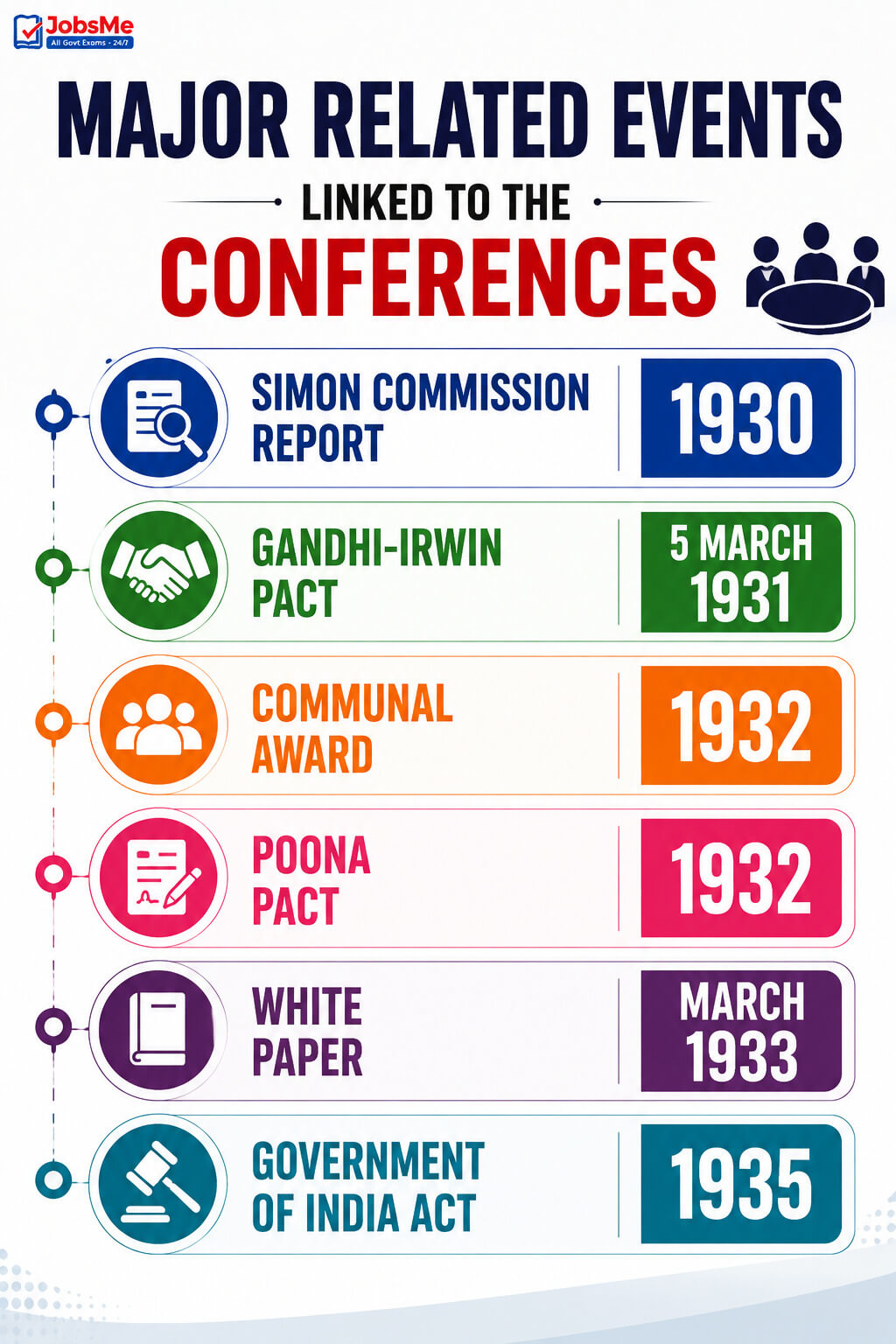
Major Related Events Linked to the Conferences
Several crucial events of the freedom struggle are directly tied to the Round Table Conferences. These are frequently asked in combination with the conferences themselves.
| Event | Year | Connection to the Conferences |
|---|---|---|
| Simon Commission Report | 1930 | Published in May 1930; its review of the 1919 Act led the British to convene the Round Table Conferences to discuss reforms. |
| Gandhi-Irwin Pact | 5 March 1931 | Signed between Mahatma Gandhi and Viceroy Lord Irwin; the Congress agreed to suspend the Civil Disobedience Movement and attend the Second Round Table Conference. |
| Communal Award | 1932 | Announced by PM Ramsay MacDonald; provided separate electorates for minorities including the Depressed Classes, which Gandhi strongly opposed. |
| Poona Pact | 1932 | Agreement between Gandhi and Ambedkar that replaced separate electorates with reserved seats for the Depressed Classes within the general electorate. |
| White Paper | March 1933 | Contained the recommendations of the Third Conference; examined by a Joint Select Committee and used to draft the Government of India Act 1935. |
| Government of India Act | 1935 | The final outcome of the Round Table Conferences; became a major source for the Constitution of India. |
Memory Tricks and Mnemonics
Trick 1: Remember the Years with "30-31-32"
The three conferences fall neatly in consecutive years.
- First = 1930, Second = 1931, Third = 1932. Just count 30, 31, 32 in order.
Trick 2: "Congress Came Only in the Middle"
The Indian National Congress boycotted the First and Third conferences but attended only the Second.
- Sandwich rule: Congress is the filling in the middle (2nd), absent on both outer slices (1st and 3rd).
Trick 3: "MacDonald Chaired All Three (M-M-M)"
Ramsay MacDonald presided over every session.
- MacDonald = the constant Man in the chair across all three conferences.
Trick 4: "Ambedkar Attended All — A for All"
Dr. B. R. Ambedkar was the only leader present at all three conferences.
- A for Ambedkar = A for All three.
Trick 5: "GIP before 2nd" (Gandhi-Irwin Pact)
The Gandhi-Irwin Pact (1931) opened the door for the Second Conference.
- No Pact, no Gandhi — the Pact is the ticket Gandhi used to enter the Second RTC.
Trick 6: "Award then Pact" (Communal Award → Poona Pact)
The Communal Award came first and the Poona Pact resolved it.
- Award sparks the fire, Pact puts it out — Communal Award (1932) leads to the Poona Pact (1932).
Trick 7: "Third gives the 1935 Act"
The Third Conference produced the White Paper that became the Government of India Act 1935.
- 3rd RTC → White Paper 1933 → GoI Act 1935. Think of the Third conference as the "draftsman" of the 1935 Act.
Additional Notes
Frequently Confused Facts
- First vs Second Conference: The First (1930) had no Congress; the Second (1931) had Gandhi as the sole Congress representative.
- Communal Award vs Poona Pact: The Communal Award (by MacDonald) granted separate electorates to the Depressed Classes; the Poona Pact (between Gandhi and Ambedkar) replaced them with reserved seats.
- Gandhi vs Ambedkar at the 2nd RTC: Ambedkar demanded separate electorates for the Depressed Classes; Gandhi opposed treating untouchables as a separate minority and insisted they were Hindus.
- Who inaugurated vs who chaired: King George V officially inaugurated the First Conference, while PM Ramsay MacDonald chaired all three.
- Boycott vs Not Invited: Congress boycotted the First Conference, but for the Third Conference it was not invited at all.
Repeating PYQ Patterns
- UPSC Prelims: Frequently links the Round Table Conferences with the Gandhi-Irwin Pact, Communal Award, and Poona Pact in chronological or matching questions.
- SSC CGL & State PCS: Direct factual questions on which conference Gandhi attended and who chaired the conferences.
- IBPS, SBI & RRB: One-mark General Awareness questions on the years of the conferences and the fact that Ambedkar attended all three.
- Defence & Insurance: Questions on the outcome — that the conferences led to the Government of India Act 1935.
Quick Insight
The Round Table Conferences remain relevant today because the Government of India Act 1935 — their final outcome — became one of the most important sources of the Constitution of India, contributing features like federalism and provincial autonomy. References to the Poona Pact and reservation for the Depressed Classes also frequently appear in current affairs debates around social justice. You can revise such Modern History and polity-linked topics through the Static GK notes and test yourself with the Static GK Quiz on Jobsme.in.
One-Liners for Quick Revision
- Round Table Conferences → Three conferences held 1930-1932 → organised by the British to discuss constitutional reforms in India.
- Venue → London → all three sessions held there.
- Chairman → Ramsay MacDonald → British PM who chaired all three conferences.
- Basis / Trigger → Simon Commission Report (1930) → review of the Government of India Act 1919.
- Idea suggested by → Muhammad Ali Jinnah → proposed the conferences to Viceroy Lord Irwin and PM MacDonald.
- First Round Table Conference → 12 November 1930 to 19 January 1931 → boycotted by the Indian National Congress.
- First RTC inaugurated by → King George V → at the Royal Gallery, House of Lords, London.
- First RTC attendees → Princely States, Muslim League, Hindu Mahasabha, Justice Party, Liberals, Depressed Classes → first time British and Indians met as equals.
- First RTC recommendation → All-India Federation and responsible government at the centre with safeguards.
- Gandhi-Irwin Pact → 5 March 1931 → paved the way for Congress to attend the Second Conference.
- Second Round Table Conference → 7 September 1931 to 1 December 1931 → attended by Mahatma Gandhi as sole Congress representative.
- Gandhi accompanied by → Sarojini Naidu and Madan Mohan Malaviya → during the Second Conference.
- Second RTC main conflict → Gandhi vs Ambedkar on separate electorates for the Depressed Classes.
- Government during Second RTC → Conservative-dominated National Government → the Labour government had fallen.
- Communal Award → 1932 → announced by Ramsay MacDonald, granting separate electorates to minorities and the Depressed Classes.
- Poona Pact → 1932 → between Gandhi and Ambedkar, replacing separate electorates with reserved seats for the Depressed Classes.
- Third Round Table Conference → 17 November 1932 to 24 December 1932 → shortest and least attended.
- Third RTC delegates → only about 46 → Congress not invited and British Labour Party absent.
- Third RTC British-Indian representatives → Aga Khan III (Muslims) and Dr. B. R. Ambedkar (Depressed Classes).
- Only leader to attend all three → Dr. B. R. Ambedkar → representing the Depressed Classes.
- White Paper → March 1933 → contained the recommendations of the Third Conference.
- Final outcome → Government of India Act 1935 → became a major source of the Constitution of India.
For more Modern History topics like the Civil Disobedience Movement, Gandhi-Irwin Pact, and Government of India Acts, explore the Static GK section on Jobsme.in. You can also test your preparation with the Daily Current Affairs Quiz and check the newest openings at Latest Government Job Notifications.
Free quiz • No signup required
Put this topic into practice with Indian Cultural Institutions – Static GK MCQ Quiz. It is the quickest way to reinforce what you just learned.
Frequently Asked Questions
How many Round Table Conferences were held and in which years?
Who chaired all three Round Table Conferences?
Why did the Indian National Congress boycott the First Round Table Conference?
Which Round Table Conference did Mahatma Gandhi attend?
What was the Gandhi-Irwin Pact and how is it linked to the conferences?
Who was the only leader to attend all three Round Table Conferences?
What was the main point of conflict between Gandhi and Ambedkar at the Second Conference?
Why was the Third Round Table Conference considered the least significant?
What were the Communal Award and the Poona Pact?
What was the final outcome of the Round Table Conferences?

About the author