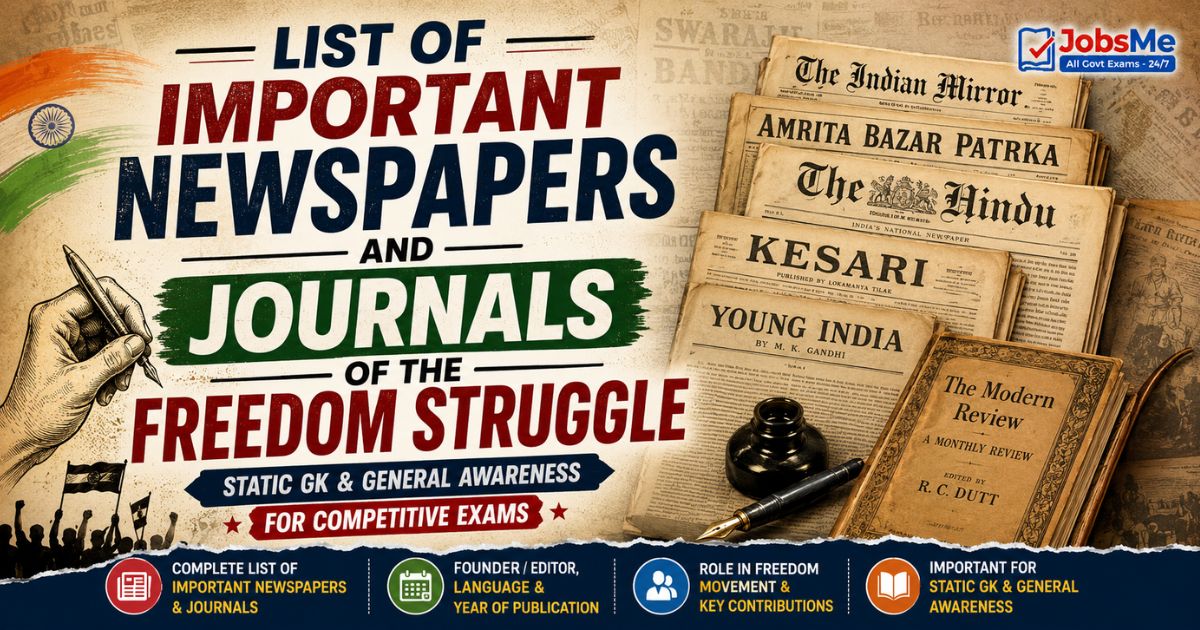
List of Important Newspapers and Journals of the Freedom Struggle – Static GK & General Awareness for Competitive Exams with Founders and Memory Tricks
This article presents a complete, exam-ready list of important newspapers and journals published during the Indian freedom struggle, along with their founders, languages, and year of publication. It covers landmark publications such as the Bengal Gazette (India's first newspaper), Kesari and Mahratta by Bal Gangadhar Tilak, Young India and Harijan by Mahatma Gandhi, Amrita Bazar Patrika, The Hindu, Al-Hilal by Abul Kalam Azad, and Mook Nayak by Dr. B. R. Ambedkar, with memory tricks and one-liners for quick revision. All facts are arranged in a structured format to help UPSC, SSC, IBPS, RRB, PSU, and State PCS aspirants score better in General Awareness and Modern History sections.
Jump to section
Introduction
During India's freedom struggle, newspapers and journals were among the most powerful weapons against British rule. Leaders such as Bal Gangadhar Tilak, Mahatma Gandhi, Maulana Abul Kalam Azad, Dadabhai Naoroji, and Dr. B. R. Ambedkar used the press to spread the ideas of freedom, equality, self-rule, and patriotism among the masses. India's first newspaper, the Bengal Gazette, was started by James Augustus Hicky in 1780, and from then on the Indian press grew into a fearless voice of nationalism that the colonial government repeatedly tried to suppress through laws like the Vernacular Press Act of 1878.
Questions on newspapers and journals of the freedom struggle appear almost every year in UPSC Prelims, SSC CGL, IBPS PO, RRB NTPC, SBI Clerk, State PCS, Defence, and Insurance exams. The most common pattern is matching a newspaper with its founder, identifying the language of a publication, or naming the person who started a particular journal. This article brings together every important publication in a structured, exam-ready format with founders and years. To explore other related Static GK topics, you can refer to the Static GK section on Jobsme.in.
This topic is also closely linked to current affairs themes such as National Press Day, Press Freedom rankings, anniversaries of national leaders who were also journalists, and debates on freedom of expression — making it doubly important for aspirants preparing for UPSC Mains and Essay papers as well. Regular practice through the Static GK Quiz helps lock these facts into long-term memory.
Core Concepts: The Role of the Press in the Freedom Struggle
The Indian press during British rule was not a profit-making business — it was a tool of national service and political awakening. Understanding why and how these newspapers were founded helps students remember the founder-newspaper pairs more easily and answer related questions with confidence.
Key Roles of Newspapers in the Freedom Movement
- Spreading Nationalism: Newspapers propagated ideas of democracy, equality, patriotism, and Swaraj, reaching not just cities but remote villages where editorials were read aloud in local libraries.
- Criticising Colonial Policies: Almost every British Act and policy was put under sharp scrutiny, making the press an "institution of opposition" to the government.
- Mobilising the Masses: Leaders like Tilak used the press to bring peasants, artisans, and workers into the national movement.
- Facing Repression: The press faced repressive laws such as the Censorship of Press Act (1799), Licensing Regulations (1823), Vernacular Press Act (1878), and the Newspaper (Incitement to Offences) Act (1908).
- First Indian Journalist Jailed: Surendranath Banerjea became the first Indian journalist to be imprisoned in 1883 for an editorial in The Bengalee.
Important "Firsts" to Remember
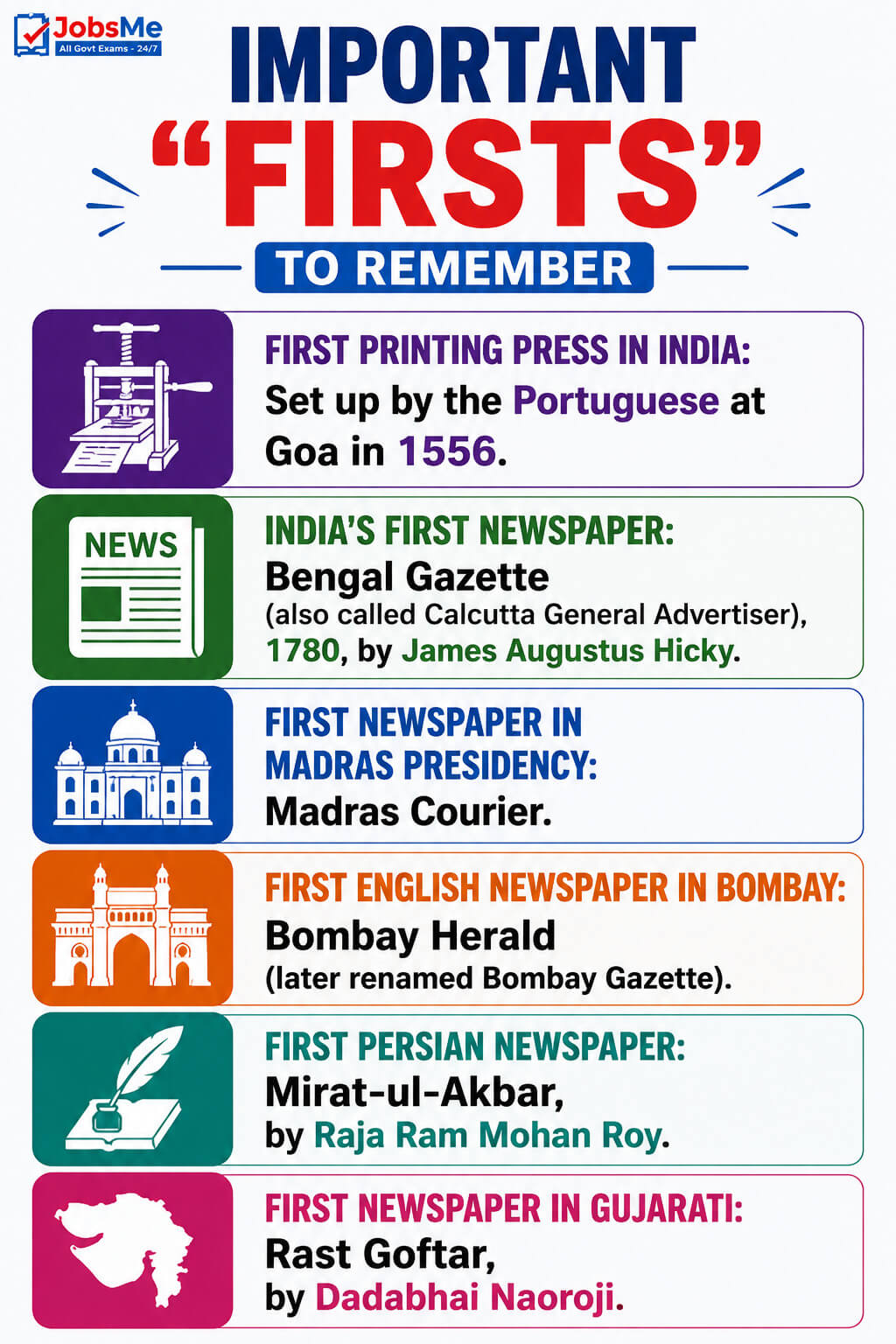
- First Printing Press in India: Set up by the Portuguese at Goa in 1556.
- India's First Newspaper: Bengal Gazette (also called Calcutta General Advertiser), 1780, by James Augustus Hicky.
- First Newspaper in Madras Presidency: Madras Courier.
- First English Newspaper in Bombay: Bombay Herald (later renamed Bombay Gazette).
- First Persian Newspaper: Mirat-ul-Akbar, by Raja Ram Mohan Roy.
- First Newspaper in Gujarati: Rast Goftar, by Dadabhai Naoroji.
Important Newspapers and Journals of the Freedom Struggle - With Founders and Years
The following table lists the most exam-relevant newspapers and journals of the freedom struggle, arranged in chronological order, along with their language/type, founder, and key details. To stay updated with related exam material, you can also check the Latest Government Job Notifications on Jobsme.in.
| Year | Newspaper / Journal | Founder / Editor | Language / Type and Key Details |
|---|---|---|---|
| 1780 | Bengal Gazette (Calcutta General Advertiser) | James Augustus Hicky | English weekly; India's first newspaper; seized by the government for its outspoken criticism of officials. |
| 1819 | Samvad Kaumudi | Raja Ram Mohan Roy | Bengali weekly newspaper; campaigned for social reforms including the abolition of Sati. |
| 1822 | Mirat-ul-Akbar | Raja Ram Mohan Roy | First Persian-language journal in India; raised social and political issues. |
| 1853 | Hindoo Patriot | Madhusudan Ray (later Harish Chandra Mukherjee) | English weekly; highlighted the plight of indigo cultivators and supported the Indigo Revolt. |
| 1854 | Rast Goftar | Dadabhai Naoroji | First newspaper in Gujarati; aimed at social reform among the Parsi community. |
| 1857 | Payam-e-Azadi (Message of Freedom) | Azimullah Khan (associated with Nana Saheb Peshwa) | Revolt-era publication that called on Indians to rise against British rule. |
| 1858 | Som Prakash | Ishwar Chandra Vidyasagar | Bengali weekly; one of the publications prosecuted under the Vernacular Press Act, 1878. |
| 1861 | Bombay Times / The Times of India | Robert Knight and Thomas Bennett | English daily formed by merging earlier Bombay papers; became one of India's leading English dailies. |
| 1862 | Indian Mirror | Devendra Nath Tagore (edited by N. N. Sen) | One of the first English daily newspapers run by Indians. |
| 1868 | Amrita Bazar Patrika | Sisir Kumar Ghosh and Motilal Ghosh | Started as a Bengali paper; turned overnight into an English newspaper to escape the Vernacular Press Act, 1878. |
| 1871 | Tahzib-ul-Akhlaq | Sir Syed Ahmed Khan | Journal promoting modern education and social reform among Muslims (Aligarh Movement). |
| 1875 | The Statesman | Robert Knight | English daily published from Calcutta; influential English-language newspaper. |
| 1877 | The Tribune | Dyal Singh Majithia | English newspaper from Lahore; propagated liberal nationalist views; started on the advice of Surendranath Banerjea. |
| 1878 | The Hindu | G. Subramania Iyer (with M. Veeraraghavachariar and others) | English newspaper from Madras; a fearless nationalist voice; still one of India's most respected dailies. |
| 1879 | The Bengalee | Surendranath Banerjea | English daily; its editor became the first Indian journalist to be imprisoned (1883) for contempt of court. |
| 1881 | Kesari | Bal Gangadhar Tilak | Marathi newspaper; fiery editorials promoting Swaraj; Tilak was jailed for sedition over its content. |
| 1881 | Mahratta (Maratha) | Bal Gangadhar Tilak | English newspaper; the English-language counterpart of Kesari, used to spread nationalist ideas. |
| 1882 | Swadesamitran | G. Subramania Iyer | One of the first Tamil newspapers; chronicled the freedom movement and inspired patriotism among Tamil readers. |
| 1883 | Sudharak | Gopal Ganesh Agarkar (associated with Gopal Krishna Gokhale) | Newspaper focused on social reform; campaigned against social evils and orthodox practices. |
| 1883 | Voice of India | Dadabhai Naoroji | English publication that exposed the economic exploitation of India under British rule. |
| 1888 | Sanjivani | Krishna Kumar Mitra | Bengali weekly; strongly supported the Swadeshi Movement and the boycott of British goods. |
| 1896 | Prabuddha Bharata | Started at the behest of Swami Vivekananda | English monthly journal of the Ramakrishna Order; spread Vedantic and reformist ideas. |
| 1899 | Udbodhan | Swami Vivekananda | Bengali magazine of the Ramakrishna Math; spiritual and cultural publication. |
| 1903 | Indian Opinion | Mahatma Gandhi | Newspaper started in South Africa to voice the concerns of the Indian community there. |
| 1905 | Bande Mataram | Aurobindo Ghosh (with Bipin Chandra Pal) | English newspaper; a powerful organ of the Extremist faction during the Swadeshi Movement. |
| 1906 | Yugantar | Barindra Kumar Ghosh and Bhupendranath Datta | Bengali revolutionary journal that openly advocated armed resistance against the British. |
| 1909 | The Leader | Madan Mohan Malaviya | English daily from Allahabad, started with Motilal Nehru; voiced nationalist opinion. |
| 1910 | Bombay Chronicle | Pherozeshah Mehta (edited by B. G. Horniman) | English newspaper; a strong nationalist voice in Bombay during the freedom movement. |
| 1911 | Comrade | Maulana Mohammad Ali | Weekly English newspaper; promoted Muslim political consciousness and nationalism. |
| 1912 | Al-Hilal | Maulana Abul Kalam Azad | Urdu weekly; preached revolutionary and anti-British ideas; later banned by the government. |
| 1913 | Al-Balagh | Maulana Abul Kalam Azad | Urdu weekly started after Al-Hilal was banned; continued the nationalist message. |
| 1913 | Pratap | Ganesh Shankar Vidyarthi | Hindi newspaper from Kanpur; raised issues of peasants, workers, and freedom. |
| 1913 | Ghadar | Lala Hardayal (Ghadar Party) | Journal of the Ghadar Party published from the USA; mobilised overseas Indians against British rule. |
| 1914 | New India | Annie Besant | English daily; used to promote the Home Rule Movement. |
| 1914 | Commonweal | Annie Besant | Weekly journal supporting the Home Rule League and self-government demands. |
| 1919 | Young India | Mahatma Gandhi | English weekly journal; Gandhi's main platform for spreading his ideas of non-violence and Satyagraha. |
| 1919 | The Independent | Motilal Nehru | English newspaper from Allahabad; voiced strong nationalist views. |
| 1920 | Mook Nayak | Dr. B. R. Ambedkar | Marathi fortnightly; the first journal by Ambedkar to fight for the rights of depressed classes. |
| 1924 | Hindustan Times | Sunder Singh Lyallpuri (Akali movement) | English daily; later supported and saved from closure by Madan Mohan Malaviya. |
| 1927 | Bahishkrit Bharat | Dr. B. R. Ambedkar | Marathi fortnightly; raised the voice of the depressed and excluded classes. |
| 1929 | Navjivan | Mahatma Gandhi | Weekly publication (in Gujarati and Hindi) used by Gandhi to communicate with the masses. |
| 1932 | Harijan | Mahatma Gandhi | Weekly journal focused on the upliftment of Harijans (Dalits) and social reform. |
| 1936 | Hindustan Dainik | Madan Mohan Malaviya | Hindi newspaper; promoted nationalist thought among Hindi-speaking readers. |
| 1936 | Free Hindustan | Tarak Nath Das | Revolutionary journal published abroad to support the Indian independence cause. |
Other Notable Newspapers and Journals
Apart from the major publications above, several other newspapers played important regional and ideological roles in the freedom struggle. These are listed below with their founders or associated leaders.
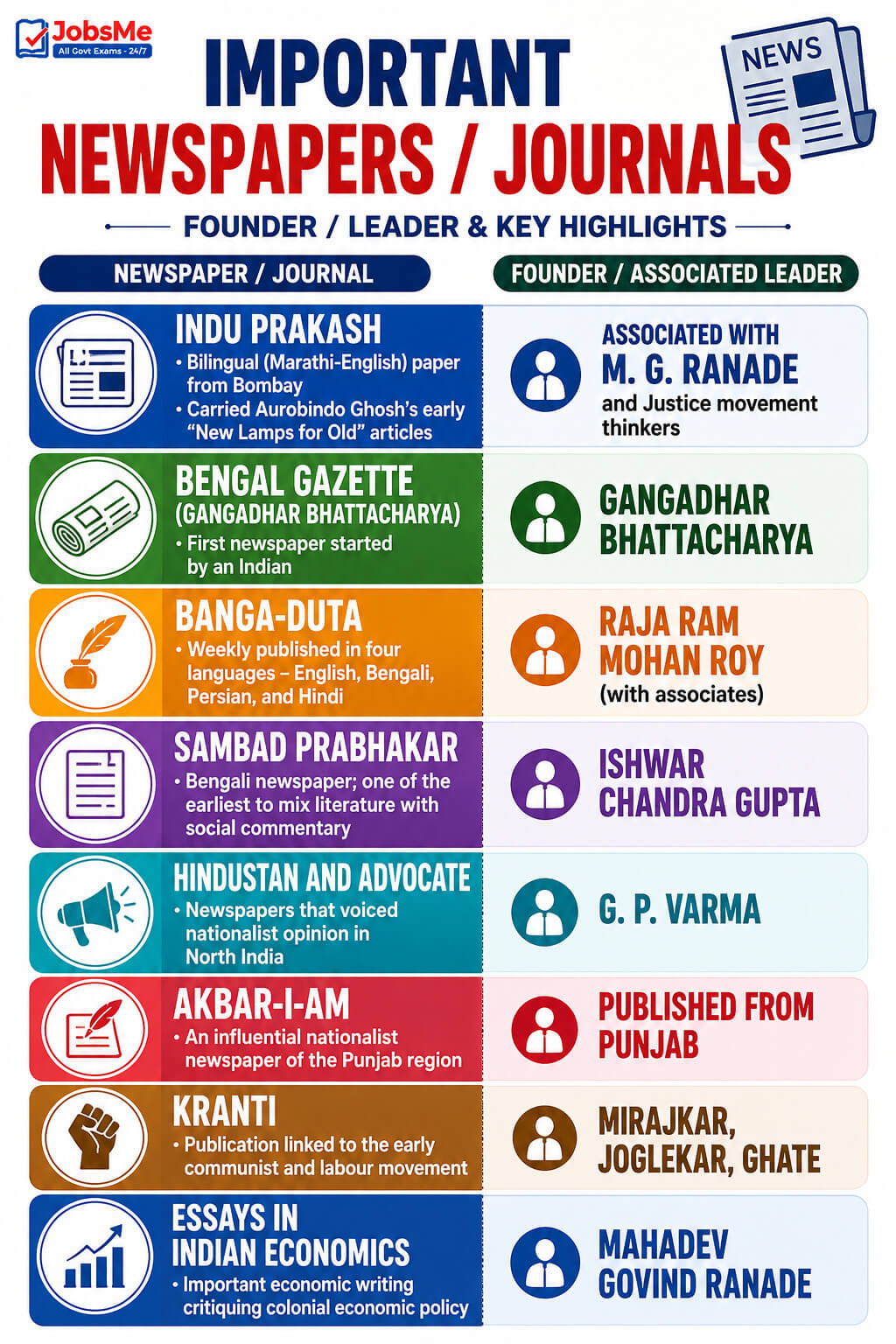
| Newspaper / Journal | Founder / Associated Leader | Language / Type and Key Details |
|---|---|---|
| Indu Prakash | Associated with M. G. Ranade and Justice movement thinkers | Bilingual (Marathi-English) paper from Bombay; carried Aurobindo Ghosh's early "New Lamps for Old" articles. |
| Bengal Gazette (Gangadhar Bhattacharya) | Gangadhar Bhattacharya | First newspaper started by an Indian (different from Hicky's Bengal Gazette). |
| Banga-Duta | Raja Ram Mohan Roy (with associates) | Weekly published in four languages — English, Bengali, Persian, and Hindi. |
| Sambad Prabhakar | Ishwar Chandra Gupta | Bengali newspaper; one of the earliest to mix literature with social commentary. |
| Hindustan and Advocate | G. P. Varma | Newspapers that voiced nationalist opinion in North India. |
| Akbar-i-Am | Published from Punjab | An influential nationalist newspaper of the Punjab region. |
| Kranti | Mirajkar, Joglekar, Ghate | Publication linked to the early communist and labour movement. |
| Essays in Indian Economics | Mahadev Govind Ranade | Important economic writing critiquing colonial economic policy. |
Memory Tricks and Mnemonics
Trick 1: Gandhi's Four Papers — "I Y N H"
Mahatma Gandhi started or edited four key publications. Remember them with "I Y N H" in chronological order:
- I → Indian Opinion (1903, South Africa).
- Y → Young India (1919).
- N → Navjivan (1929).
- H → Harijan (1932).
"I Yawn, Now Harijan" — the order I, Y, N, H is also the order of years."
Trick 2: Tilak's Twin Papers — "Kesari is Marathi, Mahratta is English"
Bal Gangadhar Tilak founded two papers in the same year (1881). Avoid the common mix-up:
- Kesari → Marathi (the regional, mass-reaching paper).
- Mahratta (Maratha) → English (the elite, English-reading audience).
"Ke-sari = K for the local crowd (Marathi); Mahratta = English for the rest."
Trick 3: Azad's Two Urdu Weeklies — "Hilal first, Balagh after the ban"
Maulana Abul Kalam Azad started two Urdu weeklies:
- Al-Hilal (1912) → came first; later banned by the government.
- Al-Balagh (1913) → started after Al-Hilal was banned.
"Hilal was Halted, so Balagh Began."
Trick 4: Ambedkar's Papers — "Mook before Bahishkrit"
Dr. B. R. Ambedkar's journals fought for the depressed classes:
- Mook Nayak (1920) → "Leader of the Voiceless"; came first.
- Bahishkrit Bharat (1927) → "Excluded India"; came later.
"The Voiceless (Mook) spoke before the Excluded (Bahishkrit)."
Trick 5: Ram Mohan Roy's Three Papers — "Three Languages, One Reformer"
Raja Ram Mohan Roy launched papers in three languages:
- Samvad Kaumudi → Bengali.
- Mirat-ul-Akbar → Persian (first Persian journal).
- Banga-Duta → four languages (English, Bengali, Persian, Hindi).
Trick 6: The "Ghosh" Papers — Two Different Ghoshes
Do not confuse the founders with the surname Ghosh:
- Amrita Bazar Patrika → Sisir Kumar Ghosh and Motilal Ghosh.
- Bande Mataram → Aurobindo Ghosh.
- Yugantar → Barindra Kumar Ghosh (Aurobindo's brother).
"Patrika = the Patriot Ghosh brothers; Bande Mataram = Aurobindo; Yugantar = his brother Barindra."
Trick 7: First Newspaper vs First by an Indian
A very common trap — distinguish these two "first" facts:
- India's First Newspaper → Bengal Gazette by James Augustus Hicky (1780), a Britisher.
- First Newspaper by an Indian → Bengal Gazette by Gangadhar Bhattacharya.
"Hicky was first overall; Gangadhar was the first Indian."
Trick 8: Home Rule Pair — "Annie Besant's NC"
Annie Besant ran two publications for the Home Rule Movement:
- N → New India (English daily).
- C → Commonweal (weekly journal).
Additional Notes
Frequently Confused Facts
- Kesari vs Mahratta: Both were founded by Tilak in 1881; Kesari was in Marathi and Mahratta (Maratha) was in English.
- Al-Hilal vs Al-Balagh: Both were Urdu weeklies of Abul Kalam Azad; Al-Hilal (1912) came first and Al-Balagh (1913) followed after Al-Hilal was banned.
- Young India vs Harijan: Both were Gandhi's journals; Young India (1919) was English and broadly nationalist, while Harijan (1932) focused on the upliftment of the depressed classes.
- Mook Nayak vs Bahishkrit Bharat: Both were Ambedkar's Marathi journals; Mook Nayak (1920) came first, Bahishkrit Bharat (1927) later.
- Amrita Bazar Patrika vs Bande Mataram: Amrita Bazar Patrika was founded by Sisir Kumar Ghosh and Motilal Ghosh; Bande Mataram was founded by Aurobindo Ghosh — different people despite the shared surname.
- The Hindu vs Swadesamitran: Both are linked to G. Subramania Iyer; The Hindu (1878) was in English and Swadesamitran (1882) was in Tamil.
- Bengal Gazette confusion: Hicky's Bengal Gazette (1780) was India's first newspaper; Gangadhar Bhattacharya's Bengal Gazette was the first started by an Indian.
- Indian Opinion vs Young India: Indian Opinion (1903) was started by Gandhi in South Africa; Young India (1919) was started in India.
- The Leader vs The Independent: The Leader (1909) was started by Madan Mohan Malaviya; The Independent (1919) was started by Motilal Nehru.
- Mirat-ul-Akbar vs Rast Goftar: Mirat-ul-Akbar was the first Persian journal (Ram Mohan Roy); Rast Goftar was the first Gujarati newspaper (Dadabhai Naoroji).
Repeating PYQ Patterns
Certain newspaper-founder pairs are asked repeatedly in competitive exams. Bengal Gazette (James Augustus Hicky), Kesari and Mahratta (Bal Gangadhar Tilak), Young India and Harijan (Mahatma Gandhi), Al-Hilal (Abul Kalam Azad), Amrita Bazar Patrika (Sisir Kumar Ghosh and Motilal Ghosh), Mook Nayak (Dr. B. R. Ambedkar), Bande Mataram (Aurobindo Ghosh), The Bengalee (Surendranath Banerjea), and Rast Goftar (Dadabhai Naoroji) appear most often in UPSC Prelims, SSC CGL, and RRB NTPC papers. Banking exams (IBPS PO, SBI Clerk) frequently use direct matching questions of newspaper with founder, while State PCS exams focus on regional papers — Maharashtra PCS asks about Kesari and Mook Nayak, Tamil Nadu PCS about The Hindu and Swadesamitran, and Bengal-based exams about Amrita Bazar Patrika and Yugantar.
Quick Insight
Newspapers of the freedom struggle were far more than sources of news — they were instruments of nation-building. A single editorial in Kesari could rouse all of Maharashtra; Young India and Harijan turned Gandhi's philosophy into a mass movement; and journals like Mook Nayak and Bahishkrit Bharat gave a voice to communities that had long been silenced. This is why National Press Day (16 November) and discussions on freedom of the press remain relevant in current affairs, connecting this Static GK topic to the present day. Understanding these publications helps aspirants answer Prelims matching questions and write strong Mains answers on the role of the press in the freedom movement. For further reading on related topics, you can refer to the Static GK notes and stay current with the Daily Current Affairs section on Jobsme.in.
One-Liners for Quick Revision
- Bengal Gazette (1780) → James Augustus Hicky → India's first newspaper (English weekly).
- Bengal Gazette (Indian) → Gangadhar Bhattacharya → first newspaper started by an Indian.
- Samvad Kaumudi (1819) → Raja Ram Mohan Roy → Bengali weekly for social reform.
- Mirat-ul-Akbar (1822) → Raja Ram Mohan Roy → first Persian journal in India.
- Banga-Duta → Raja Ram Mohan Roy → weekly in four languages (English, Bengali, Persian, Hindi).
- Sambad Prabhakar → Ishwar Chandra Gupta → early Bengali newspaper.
- Hindoo Patriot (1853) → Madhusudan Ray / Harish Chandra Mukherjee → supported the Indigo Revolt.
- Rast Goftar (1854) → Dadabhai Naoroji → first newspaper in Gujarati.
- Payam-e-Azadi (1857) → Azimullah Khan / Nana Saheb → Revolt-era call for freedom.
- Som Prakash (1858) → Ishwar Chandra Vidyasagar → Bengali weekly prosecuted under the Vernacular Press Act.
- Indian Mirror (1862) → Devendra Nath Tagore → early English daily run by Indians.
- Amrita Bazar Patrika (1868) → Sisir Kumar Ghosh and Motilal Ghosh → turned English to escape the Vernacular Press Act.
- Tahzib-ul-Akhlaq (1871) → Sir Syed Ahmed Khan → journal of the Aligarh Movement.
- The Statesman (1875) → Robert Knight → influential English daily from Calcutta.
- The Tribune (1877) → Dyal Singh Majithia → liberal nationalist paper from Lahore.
- The Hindu (1878) → G. Subramania Iyer → fearless nationalist English daily from Madras.
- The Bengalee (1879) → Surendranath Banerjea → editor was first Indian journalist jailed (1883).
- Kesari (1881) → Bal Gangadhar Tilak → Marathi newspaper promoting Swaraj.
- Mahratta / Maratha (1881) → Bal Gangadhar Tilak → English counterpart of Kesari.
- Swadesamitran (1882) → G. Subramania Iyer → one of the first Tamil newspapers.
- Sudharak (1883) → Gopal Ganesh Agarkar / Gokhale → social reform newspaper.
- Voice of India (1883) → Dadabhai Naoroji → exposed economic exploitation of India.
- Sanjivani (1888) → Krishna Kumar Mitra → backed the Swadeshi Movement.
- Prabuddha Bharata (1896) → started at the behest of Swami Vivekananda → English monthly of the Ramakrishna Order.
- Udbodhan (1899) → Swami Vivekananda → Bengali magazine of the Ramakrishna Math.
- Indian Opinion (1903) → Mahatma Gandhi → started in South Africa.
- Bande Mataram (1905) → Aurobindo Ghosh → Extremist organ during the Swadeshi Movement.
- Yugantar (1906) → Barindra Kumar Ghosh and Bhupendranath Datta → Bengali revolutionary journal.
- The Leader (1909) → Madan Mohan Malaviya → English daily from Allahabad.
- Bombay Chronicle (1910) → Pherozeshah Mehta → nationalist English paper, edited by B. G. Horniman.
- Comrade (1911) → Maulana Mohammad Ali → weekly English newspaper.
- Al-Hilal (1912) → Maulana Abul Kalam Azad → Urdu weekly, later banned.
- Al-Balagh (1913) → Maulana Abul Kalam Azad → Urdu weekly started after Al-Hilal was banned.
- Pratap (1913) → Ganesh Shankar Vidyarthi → Hindi newspaper from Kanpur.
- Ghadar (1913) → Lala Hardayal / Ghadar Party → published from the USA for overseas Indians.
- New India (1914) → Annie Besant → English daily for the Home Rule Movement.
- Commonweal (1914) → Annie Besant → weekly journal of the Home Rule League.
- Young India (1919) → Mahatma Gandhi → English weekly on non-violence and Satyagraha.
- The Independent (1919) → Motilal Nehru → nationalist English paper from Allahabad.
- Mook Nayak (1920) → Dr. B. R. Ambedkar → first journal for the depressed classes (Marathi).
- Hindustan Times (1924) → Sunder Singh Lyallpuri → English daily; later supported by Malaviya.
- Bahishkrit Bharat (1927) → Dr. B. R. Ambedkar → Marathi journal for excluded classes.
- Navjivan (1929) → Mahatma Gandhi → weekly in Gujarati and Hindi.
- Harijan (1932) → Mahatma Gandhi → weekly for the upliftment of Harijans.
- Hindustan Dainik (1936) → Madan Mohan Malaviya → Hindi nationalist newspaper.
- Free Hindustan (1936) → Tarak Nath Das → revolutionary journal published abroad.
- Essays in Indian Economics → Mahadev Govind Ranade → critique of colonial economic policy.
For more Static GK topics like freedom fighters, sessions of the Indian National Congress, and Governors-General, explore the Static GK section on Jobsme.in. You can also test your preparation with the Static GK Quiz and check the latest vacancies at Latest Government Job Notifications.
Free quiz • No signup required
Put this topic into practice with Indian Cultural Institutions – Static GK MCQ Quiz. It is the quickest way to reinforce what you just learned.
Frequently Asked Questions
Which was the first newspaper published in India?
Who founded the newspapers Kesari and Mahratta?
Which newspapers were started by Mahatma Gandhi?
Who started the Urdu weeklies Al-Hilal and Al-Balagh?
Who founded the Amrita Bazar Patrika?
Which journal was started by Dr. B. R. Ambedkar for the depressed classes?
Who was the first Indian journalist to be imprisoned during the freedom struggle?
Who founded the newspaper Bande Mataram?
What was the first newspaper in the Gujarati language?
Which newspaper was published by the Ghadar Party?

About the author