List of British Acts in India (1773–1947) – Static GK & General Awareness for Competitive Exams with Memory Tricks
This article presents a complete, exam-ready list of all major British Acts passed in India from the Regulating Act of 1773 to the Indian Independence Act of 1947, covering the East India Company Acts, Charter Acts, Government of India Acts, and Indian Councils Acts along with their key provisions and significance. It explains landmark laws such as the Regulating Act 1773, Pitt's India Act 1784, the Charter Acts of 1813, 1833 and 1853, the Government of India Act 1858, the Morley-Minto Reforms of 1909, the Montagu-Chelmsford Reforms of 1919, and the Government of India Act 1935, with memory tricks and one-liners for quick revision. All facts are arranged to help UPSC, SSC, IBPS, RRB, PSU, and State PCS aspirants score better in General Awareness, Polity, and Modern History sections.
Jump to section
Introduction
The political and administrative framework of modern India was shaped by a long series of laws passed by the British Parliament between 1773 and 1947. These laws, beginning with the Regulating Act of 1773 and ending with the Indian Independence Act of 1947, gradually transformed the rule of the East India Company into the direct rule of the British Crown and finally paved the way for independence. The early laws were known as East India Company Acts and Charter Acts, while the later ones were titled Government of India Acts.
Questions on British Acts in India appear regularly in UPSC Prelims, SSC CGL, IBPS PO, RRB NTPC, SBI Clerk, State PCS, and various Insurance and Defence exams. Questions typically ask which Act introduced a particular feature — such as the Board of Control, dyarchy, separate electorates, or the office of the Governor-General of India — or which Governor-General or Viceroy was in office when an Act was passed. This article brings together every important Act in a structured, exam-ready format. To explore other related topics, you can refer to the Static GK section on Jobsme.in.
British Acts are also closely linked with the constitutional development of India, since the Government of India Act 1935 served as a major source of the Indian Constitution. Understanding these Acts is therefore doubly important for aspirants preparing for the Polity and Modern History sections of UPSC Prelims and Mains, as well as for State PCS examinations.
Core Concepts: Phases of British Legislation in India
British laws in India can be divided into clear phases based on who controlled India and how power was distributed. Understanding these phases helps students place each Act in its correct context and answer related questions confidently.
Categories of British Acts
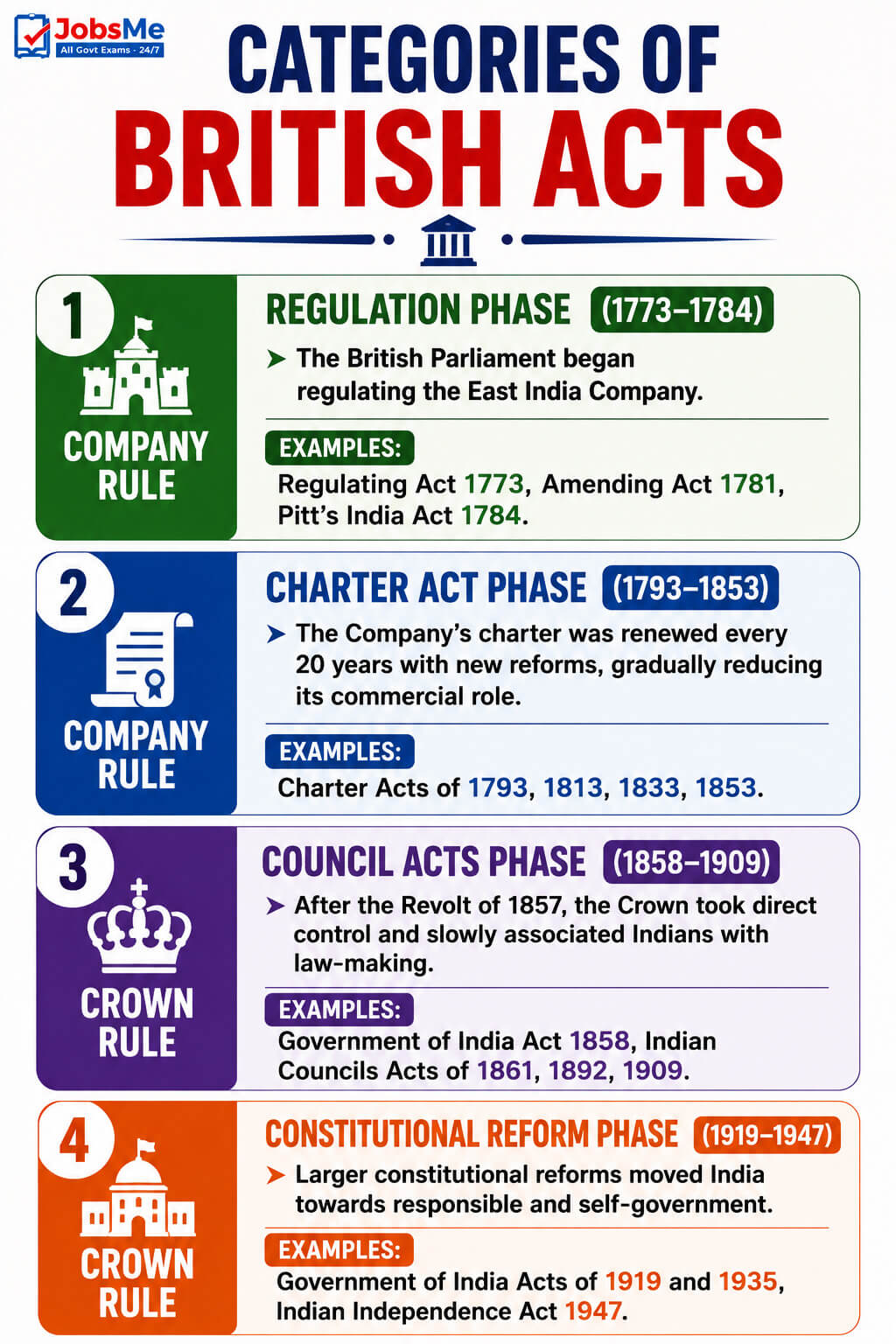
- Company Rule - Regulation Phase (1773-1784): The British Parliament began regulating the East India Company. Example: Regulating Act 1773, Amending Act 1781, Pitt's India Act 1784.
- Company Rule - Charter Act Phase (1793-1853): The Company's charter was renewed every 20 years with new reforms, gradually reducing its commercial role. Example: Charter Acts of 1793, 1813, 1833, 1853.
- Crown Rule - Council Acts Phase (1858-1909): After the Revolt of 1857, the Crown took direct control and slowly associated Indians with law-making. Example: Government of India Act 1858, Indian Councils Acts of 1861, 1892, 1909.
- Crown Rule - Constitutional Reform Phase (1919-1947): Larger constitutional reforms moved India towards responsible and self-government. Example: Government of India Acts of 1919 and 1935, Indian Independence Act 1947.
British Acts in India - Complete List with Provisions
The following tables list all major British Acts in chronological order along with their key provisions and significance. The Acts are grouped into Company Rule and Crown Rule for easier revision. For daily practice, you can also check the Static GK Quiz on Jobsme.in.
Acts During Company Rule (1773-1853)
| Act & Year | Key Provisions / Significance |
|---|---|
| Regulating Act, 1773 | First step by the British Parliament to control the East India Company. Created the post of Governor-General of Bengal (Warren Hastings was the first), with a Council of four. Madras and Bombay presidencies were made subordinate to Bengal. Provided for the establishment of the Supreme Court at Calcutta (set up in 1774) with Sir Elijah Impey as the first Chief Justice. Prohibited Company servants from private trade and accepting bribes or gifts from Indians. |
| Amending Act, 1781 (Act of Settlement) | Passed to remove the defects of the Regulating Act. Limited the jurisdiction of the Supreme Court at Calcutta and clearly separated it from the Governor-General-in-Council. Granted immunity to the Governor-General and Council for acts done in their official capacity; exempted revenue matters from the Court's jurisdiction. |
| Pitt's India Act, 1784 | Named after British PM William Pitt the Younger. Established a system of double government (dual control). Created the Board of Control to manage political affairs, while the Court of Directors looked after commercial matters. Brought the Company's affairs and its administration in India under the direct control of the British Government. For the first time, the Company's territories were called the "British Possessions in India." |
| Charter Act, 1793 | Renewed the Company's trade monopoly and charter for another 20 years. Strengthened the overriding powers of the Governor-General over his Council. Laid down that salaries of the Board of Control members were to be paid out of Indian revenues. |
| Charter Act, 1813 | Ended the trade monopoly of the East India Company in India, except for trade in tea and trade with China. Opened Indian trade to all British merchants. Asserted the sovereignty of the British Crown over the Company's Indian territories. Permitted Christian missionaries to preach in India and allotted Rs. 1 lakh annually for the promotion of education, science, and literature among Indians. |
| Charter Act, 1833 (Saint Helena Act / Government of India Act 1833) | Made the Governor-General of Bengal the Governor-General of India (Lord William Bentinck was the first). Centralised all legislative powers; Bombay and Madras lost their legislative authority. Ended the Company's commercial activities, making it a purely administrative body. Provided that no Indian should be denied office on grounds of religion, birth, descent, or colour. Added a Law Member to the Council (Lord Macaulay was the first) and set up the first Law Commission under Macaulay to codify Indian laws. |
| Charter Act, 1853 | The last of the Charter Acts. Separated the legislative and executive functions of the Governor-General's Council for the first time, creating a separate Central Legislative Council. Introduced an open competition system for recruiting civil servants, throwing the covenanted civil service open to Indians; the Macaulay Committee was formed in 1854. Renewed the Company's rule without specifying a time limit, signalling the approaching end of Company rule. Reduced the Court of Directors from 24 to 18 members. |
Acts During Crown Rule (1858-1947)
| Act & Year | Key Provisions / Significance |
|---|---|
| Government of India Act, 1858 (Act for the Good Government of India) | Passed after the Revolt of 1857. Abolished the East India Company and transferred the rule of India directly to the British Crown. Ended the system of double government by abolishing the Board of Control and Court of Directors. Created the office of the Secretary of State for India (a member of the British Cabinet) assisted by a Council of India. Changed the designation of the Governor-General of India to Viceroy of India; Lord Canning was the first Viceroy. |
| Indian Councils Act, 1861 | Began the process of associating Indians with law-making by allowing the Viceroy to nominate some Indians as non-official members of his expanded council. Restored legislative powers to the Bombay and Madras presidencies, starting decentralisation. Provided for new legislative councils in Bengal, North-Western Provinces, and Punjab. Gave statutory recognition to the portfolio system introduced by Lord Canning and empowered the Viceroy to issue ordinances during emergencies. |
| Indian Councils Act, 1892 | Increased the number of non-official members in the central and provincial legislative councils. Gave members limited powers to discuss the budget and ask questions on matters of public interest. Introduced a limited and indirect system of elections (though the word "election" was carefully avoided), marking an early step towards representative government. |
| Indian Councils Act, 1909 (Morley-Minto Reforms) | Named after Secretary of State Lord Morley and Viceroy Lord Minto. Increased the size of central and provincial legislative councils. For the first time, associated Indians with the executive councils of the Viceroy and Governors; Satyendra Prasad Sinha became the first Indian member of the Viceroy's Executive Council (as Law Member). Introduced separate electorates for Muslims, due to which Lord Minto is called the "Father of Communal Electorate." Gave members the right to ask supplementary questions and move resolutions on the budget. |
| Government of India Act, 1919 (Montagu-Chelmsford Reforms) | Named after Secretary of State Edwin Montagu and Viceroy Lord Chelmsford. Introduced dyarchy (dual government) in the provinces, dividing subjects into "transferred" (controlled by Indian ministers) and "reserved" (controlled by the Governor). Separated central and provincial subjects and introduced bicameralism at the centre (Council of State and Legislative Assembly) with direct elections. Extended separate electorates to Sikhs, Christians, Anglo-Indians, and Europeans. Created the office of the High Commissioner for India and provided for a separate Public Service Commission (set up in 1926). |
| Government of India Act, 1935 | The longest and most detailed Act, with 321 sections and 10 schedules. Provided for an All-India Federation of provinces and princely states (which never came into being). Abolished dyarchy in the provinces and introduced provincial autonomy, while introducing dyarchy at the centre. Divided powers into three lists — Federal, Provincial, and Concurrent. Provided for a Federal Court (established 1937) and the Reserve Bank of India, abolished the Council of India, and extended the franchise. It became a major source of the Indian Constitution. |
| Indian Independence Act, 1947 | Based on the Mountbatten Plan (3 June Plan). The last Act passed by the British Parliament for India. Ended British rule and partitioned British India into two independent dominions — India and Pakistan — from 15 August 1947. Abolished the office of the Secretary of State for India and the title "Emperor of India." Empowered the Constituent Assemblies of both dominions to frame and adopt their own constitutions. |
Memory Tricks and Mnemonics
Trick 1: Sequence of Major Acts — "Really Powerful Charters Govern Indian Councils"
Use this sentence to recall the broad order of the most important Acts:
- R → Regulating Act (1773).
- P → Pitt's India Act (1784).
- C → Charter Acts (1793, 1813, 1833, 1853).
- G → Government of India Act (1858).
- I → Indian Councils Acts (1861, 1892, 1909).
- C → Constitutional reforms (GoI Acts 1919, 1935; Independence Act 1947).
"Really Powerful Charters Govern Indian Councils."
Trick 2: Charter Act Years — "1793 + 20 + 20 + 20"
The Charter Acts came every 20 years because the Company's charter was renewed for 20-year periods:
- 1793 → renewed monopoly.
- 1813 (1793 + 20) → ended monopoly except tea and China.
- 1833 (1813 + 20) → ended commerce; Governor-General of India created.
- 1853 (1833 + 20) → open competition; no fixed time limit.
"Add 20 each time and you reach the next Charter Act."
Trick 3: "Trade to No-Trade" Charter Story
Track how the Company lost its trade rights step by step:
- 1813 → lost monopoly over Indian trade (kept tea and China).
- 1833 → lost all commercial activity (became administrative only).
"In 1813 the door opened a little, in 1833 the shop shut completely."
Trick 4: Two "Famous Pairs" of Reforms
- Morley-Minto (1909) → "M&M" → Separate electorates ("Minto = Communal electorate").
- Montagu-Chelmsford (1919) → "MC" → Dyarchy in provinces.
"Minto divides (separate electorates), Montagu doubles (dyarchy)."
Trick 5: "1858 — Company Out, Crown In"
Link the year 1858 with three big changes after the 1857 Revolt:
- East India Company abolished.
- Double government (Board of Control + Court of Directors) ended.
- Secretary of State for India created; Governor-General became Viceroy (Canning first).
Trick 6: Firsts to Remember — "First Five"
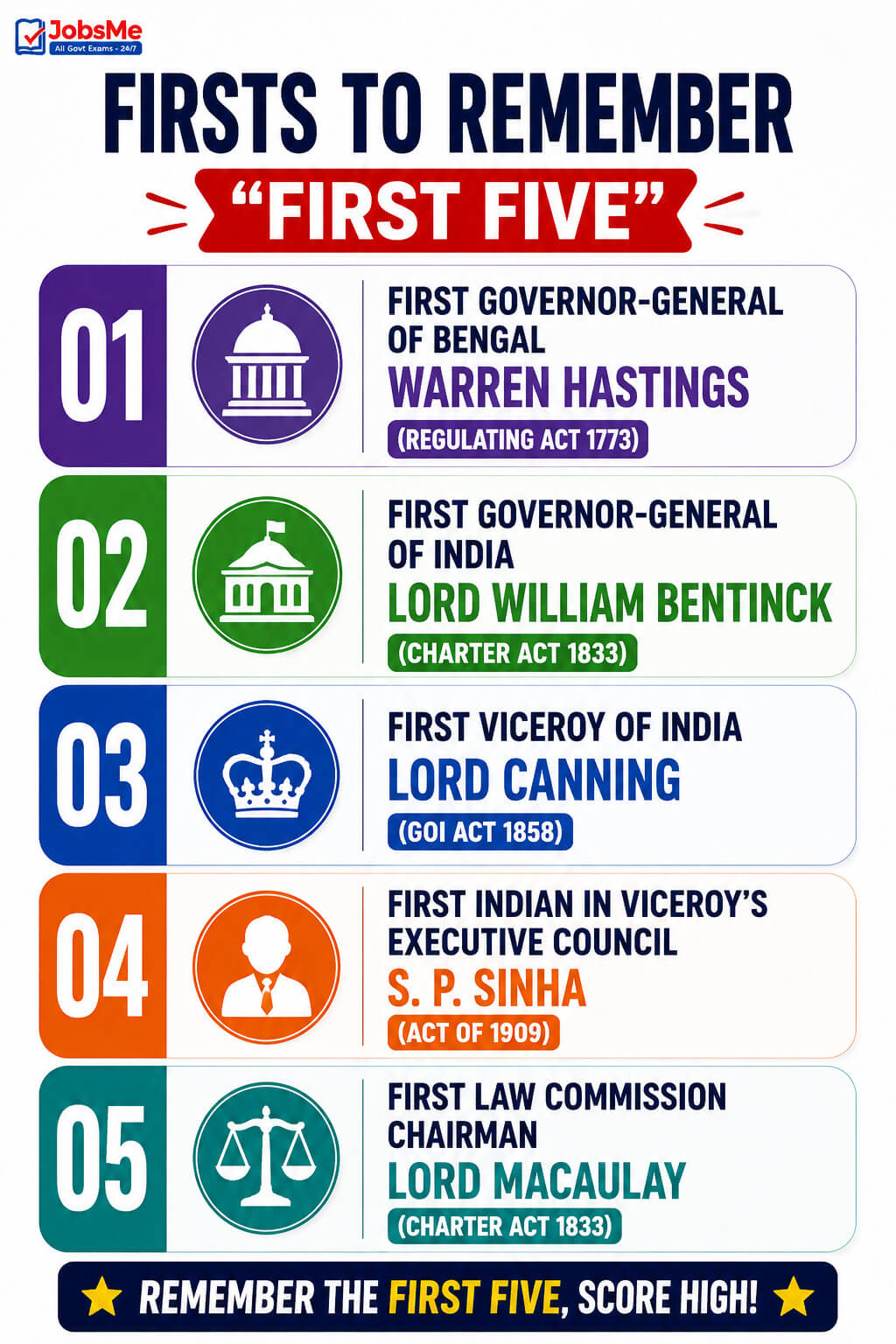
- First Governor-General of Bengal → Warren Hastings (Regulating Act 1773).
- First Governor-General of India → Lord William Bentinck (Charter Act 1833).
- First Viceroy of India → Lord Canning (GoI Act 1858).
- First Indian in Viceroy's Executive Council → S. P. Sinha (Act of 1909).
- First Law Commission Chairman → Lord Macaulay (Charter Act 1833).
Trick 7: 1935 Act Numbers — "321 & 10"
The Government of India Act 1935 had 321 sections and 10 schedules — the longest British Act on India. Remember it as "3-2-1, take off into the Constitution", since this Act became a major source of the Indian Constitution.
Additional Notes
Frequently Confused Facts
- Governor-General of Bengal vs Governor-General of India: The post of Governor-General of Bengal was created by the Regulating Act 1773 (Warren Hastings); it became Governor-General of India by the Charter Act 1833 (Lord William Bentinck).
- Governor-General vs Viceroy: The title changed from Governor-General of India to Viceroy of India under the Government of India Act 1858; Lord Canning was both the last Governor-General and the first Viceroy.
- Charter Act 1833 vs 1853 on Civil Services: The 1833 Act only "attempted" open competition (dropped after opposition); the 1853 Act actually introduced open competition for civil services.
- Separate Electorates vs Dyarchy: Separate electorates for Muslims were introduced by the Indian Councils Act 1909 (Morley-Minto); dyarchy in provinces was introduced by the Government of India Act 1919 (Montagu-Chelmsford).
- Board of Control vs Court of Directors: The Board of Control (created by Pitt's India Act 1784) handled political affairs; the Court of Directors handled commercial affairs. Both were abolished in 1858.
- 1919 vs 1935 Dyarchy: The 1919 Act introduced dyarchy in the provinces; the 1935 Act abolished provincial dyarchy and introduced it at the centre.
- Father of Communal Electorate: Lord Minto, not Lord Morley, is called the Father of Communal Electorate.
Repeating PYQ Patterns
Certain Acts and their features are asked repeatedly in competitive exams. Regulating Act 1773 (Governor-General of Bengal, Supreme Court at Calcutta), Pitt's India Act 1784 (Board of Control, double government), Charter Act 1833 (Governor-General of India, end of commerce, Law Commission), Charter Act 1853 (open competition for civil services), Government of India Act 1858 (Crown rule, Viceroy, Secretary of State), Indian Councils Act 1909 (separate electorates, S. P. Sinha), Government of India Act 1919 (dyarchy in provinces), and Government of India Act 1935 (provincial autonomy, three lists, Federal Court, RBI) appear most often in UPSC Prelims, SSC CGL, and RRB NTPC papers. Banking exams (IBPS PO, SBI Clerk) frequently match the Act with its year or its main reform, while State PCS exams add questions on which Governor-General or Viceroy was in office at the time.
Quick Insight
British Acts are not just historical curiosities — they form the backbone of India's constitutional development. Features like the federal structure, the division of powers into lists, the office of the Governor and the public services all trace back to these Acts, especially the Government of India Act 1935, which is one of the most important sources of the Indian Constitution. Understanding this chain of laws helps aspirants connect Modern History with Polity, which is invaluable for both Prelims (direct fact-based questions) and Mains (analytical answers on constitutional evolution). For further reading on related topics, you can refer to the Static GK notes and stay updated with the latest exam alerts at Latest Government Job Notifications on Jobsme.in.
One-Liners for Quick Revision
- Regulating Act, 1773 → First Parliamentary control over the Company → created Governor-General of Bengal (Warren Hastings) and Supreme Court at Calcutta.
- Amending Act, 1781 → Act of Settlement → limited the jurisdiction of the Supreme Court and protected officials acting in official capacity.
- Pitt's India Act, 1784 → Introduced double government → created the Board of Control for political affairs.
- Charter Act, 1793 → Renewed the Company's monopoly for 20 years → strengthened the Governor-General's powers.
- Charter Act, 1813 → Ended the Company's trade monopoly (except tea and China) → allowed Christian missionaries and Rs. 1 lakh for education.
- Charter Act, 1833 → Created the Governor-General of India (Lord William Bentinck) → ended the Company's commerce and set up the Law Commission under Macaulay.
- Charter Act, 1853 → Last Charter Act → introduced open competition for civil services and separated legislative and executive functions.
- Government of India Act, 1858 → Ended Company rule → began Crown rule, created the Secretary of State for India, and made the Governor-General the Viceroy (Lord Canning).
- Indian Councils Act, 1861 → Began Indian association with law-making → restored legislative powers to Bombay and Madras; recognised the portfolio system.
- Indian Councils Act, 1892 → Increased non-official members → introduced limited indirect elections and budget discussion.
- Indian Councils Act, 1909 → Morley-Minto Reforms → introduced separate electorates for Muslims (Minto = Father of Communal Electorate); S. P. Sinha first Indian in the Viceroy's Executive Council.
- Government of India Act, 1919 → Montagu-Chelmsford Reforms → introduced dyarchy in the provinces and bicameralism at the centre.
- Government of India Act, 1935 → 321 sections and 10 schedules → provincial autonomy, three lists, Federal Court and RBI; major source of the Constitution.
- Indian Independence Act, 1947 → Based on the Mountbatten Plan → partitioned India into India and Pakistan and ended British rule on 15 August 1947.
For more Static GK topics like Governors-General, important battles, and constitutional development, explore the Static GK section on Jobsme.in. You can also test your knowledge with the Static GK Quiz and check out the latest exam notifications at Latest Government Job Notifications.
Free quiz • No signup required
Put this topic into practice with Indian Cultural Institutions – Static GK MCQ Quiz. It is the quickest way to reinforce what you just learned.
Frequently Asked Questions
Which was the first British Act passed to regulate the East India Company in India?
Who was the first Governor-General of Bengal and the first Governor-General of India?
What was the double government system introduced by Pitt's India Act of 1784?
Which Charter Act ended the trade monopoly of the East India Company?
Which Act introduced open competition for the civil services in India?
What changes did the Government of India Act of 1858 bring?
Why is Lord Minto called the Father of Communal Electorate?
Which Act introduced dyarchy in the provinces of British India?
Why is the Government of India Act of 1935 considered important?
Which was the last Act passed by the British Parliament for India?

About the author