List of High Courts of India – Static GK & General Awareness for Competitive Exams with Memory Tricks
This article presents a complete and updated list of all 25 High Courts of India, covering their year of establishment, principal seat, benches, territorial jurisdiction, and the Act under which each was created. It includes key facts like the oldest High Court (Calcutta, 1862), the newest ones (Andhra Pradesh and Telangana, 2019), the smallest (Sikkim) and largest (Allahabad), along with memory tricks and one-liners for quick revision. All facts are arranged in exam-ready format to help UPSC, SSC, IBPS, RRB, PSU, and State PCS aspirants score better in General Awareness and Indian Polity sections.
Jump to section
Introduction
The High Court stands at the apex of the judicial system in every Indian state and union territory, sitting just below the Supreme Court of India in the judicial hierarchy. As of 2026, India has 25 High Courts, established under Part VI, Chapter V, Article 214 of the Constitution, which provides that there shall be a High Court for each state. The Calcutta High Court, set up on 14 May 1862, is the oldest, while the Andhra Pradesh and Telangana High Courts, both established on 1 January 2019, are the newest.
Questions on the High Courts of India appear regularly in UPSC Prelims, SSC CGL, IBPS PO, RRB NTPC, SBI Clerk, State PCS, and various Insurance and Defence exams. Questions typically ask which High Court is the oldest or newest, which High Court has jurisdiction over a particular state or union territory, the location of principal seats and benches, the retirement age of judges, or the constitutional articles related to High Courts. This article brings together every important fact in a structured, exam-ready format. To explore other related topics, you can refer to the Static GK section on Jobsme.in.
The topic is also closely tied to current affairs themes such as the elevation and transfer of judges, the ongoing Collegium versus NJAC debate, the renaming of High Courts, new benches sanctioned by the government, and landmark constitutional judgments — making this subject doubly important for aspirants preparing for UPSC Mains and Indian Polity papers as well.
Core Concepts: Structure and Powers of High Courts
A High Court is the highest court of appeal in civil and criminal matters within its territorial jurisdiction. It exercises original, appellate, and writ jurisdiction, and supervises all subordinate courts and tribunals under its territory. Understanding the constitutional framework behind High Courts helps students answer both factual and conceptual questions with confidence.
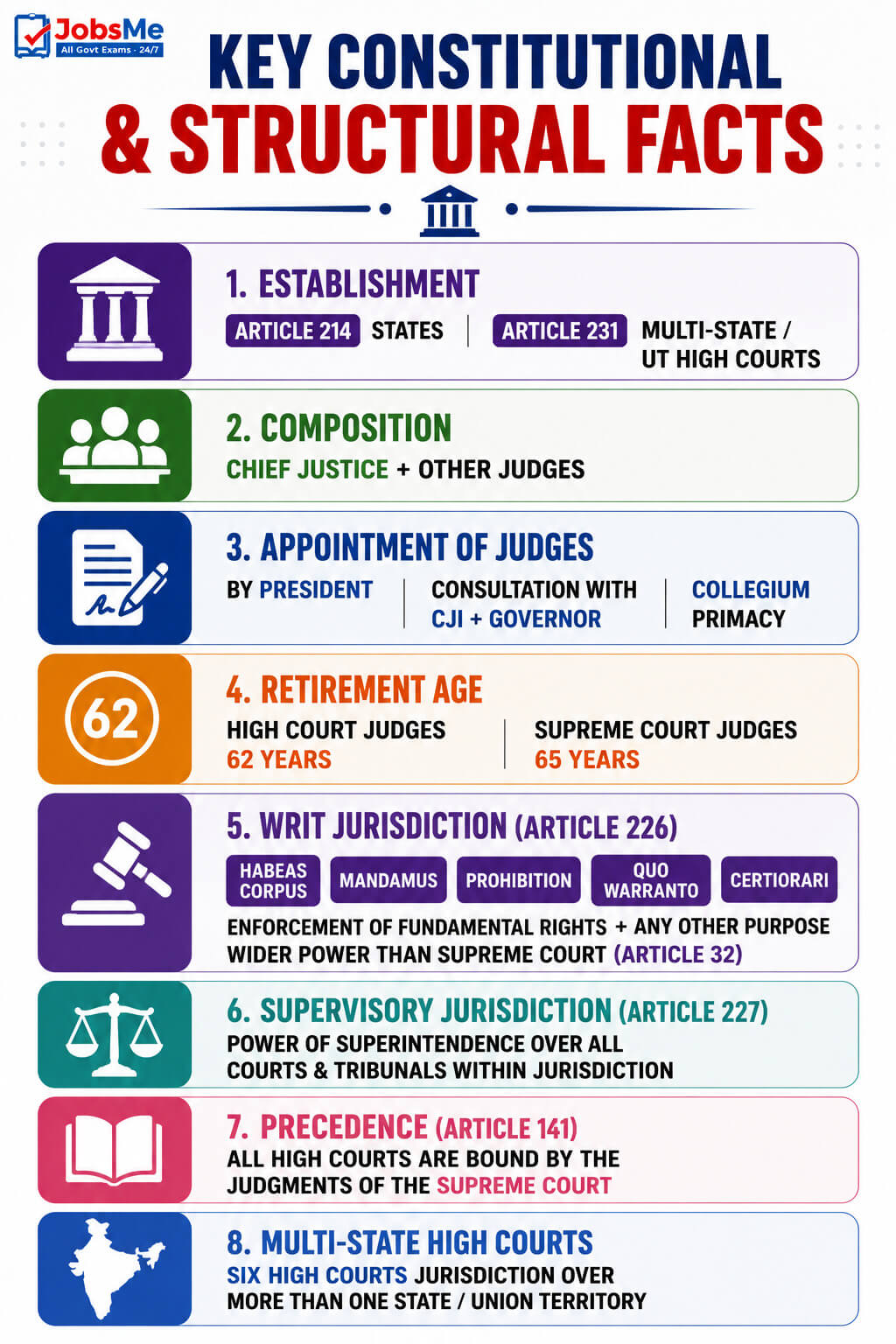
Key Constitutional and Structural Facts
- Establishment: High Courts are constitutional courts under Article 214 (High Courts for states) and Article 231 (a common High Court for two or more states or union territories).
- Composition: Each High Court consists of a Chief Justice and other judges appointed by the President of India.
- Appointment of Judges: Made by the President under Article 217, in consultation with the Chief Justice of India and the Governor of the state, with the Collegium having primacy.
- Retirement Age: High Court judges hold office until the age of 62 years (Supreme Court judges retire at 65).
- Writ Jurisdiction: Under Article 226, a High Court can issue writs — habeas corpus, mandamus, prohibition, quo warranto, and certiorari — for the enforcement of fundamental rights and for any other purpose, giving it wider writ powers than the Supreme Court's Article 32.
- Supervisory Jurisdiction: Under Article 227, every High Court has the power of superintendence over all courts and tribunals within its jurisdiction.
- Precedence: Under Article 141, all High Courts are bound by the judgments of the Supreme Court.
- Multi-State High Courts: Six High Courts exercise jurisdiction over more than one state or union territory.
Complete List of High Courts of India
The following table lists all 25 High Courts of India along with their year of establishment, principal seat, benches, and territorial jurisdiction. This is the most exam-relevant data and should be revised thoroughly. For daily updates on judicial appointments and polity news, you can follow the Daily Current Affairs page on Jobsme.in.
High Courts by Establishment Year
| High Court | Established | Principal Seat | Jurisdiction & Key Details |
|---|---|---|---|
| Calcutta High Court | 1862 | Kolkata | Oldest High Court in India, established on 14 May 1862 under the Indian High Courts Act 1861; jurisdiction over West Bengal and the Andaman and Nicobar Islands; bench at Port Blair (Jalpaiguri also). |
| Bombay High Court | 1862 | Mumbai | One of the first three High Courts; its building is a UNESCO World Heritage Site; jurisdiction over Maharashtra, Goa, and Dadra and Nagar Haveli and Daman and Diu; benches at Nagpur, Aurangabad, Panaji, and Kolhapur. |
| Madras High Court | 1862 | Chennai | One of the first three High Courts; jurisdiction over Tamil Nadu and Puducherry; bench at Madurai. |
| Allahabad High Court | 1866 | Prayagraj | Largest High Court of India with the highest sanctioned strength of judges (160); originally established at Agra and shifted to Allahabad in 1875; jurisdiction over Uttar Pradesh; bench at Lucknow. |
| Karnataka High Court | 1884 | Bengaluru | Originally the Mysore High Court, renamed Karnataka High Court in 1974; jurisdiction over Karnataka; benches at Dharwad and Kalaburagi. |
| Patna High Court | 1916 | Patna | Established by Letters Patent issued by the British Crown; jurisdiction over Bihar. |
| Jammu & Kashmir and Ladakh High Court | 1928 | Srinagar / Jammu | Established by Letters Patent of the Maharaja of Kashmir; renamed High Court of Jammu & Kashmir and Ladakh in July 2021 after reorganisation; common High Court for the union territories of Jammu and Kashmir and Ladakh. |
| Gauhati High Court | 1948 | Guwahati | Originally High Court of Assam, Arunachal Pradesh and Nagaland, renamed Gauhati High Court in 1971; jurisdiction over Assam, Arunachal Pradesh, Nagaland, and Mizoram; benches at Itanagar, Kohima, and Aizawl. |
| Orissa High Court | 1948 | Cuttack | Established by the Orissa High Court Ordinance, 1948; retained its original name even after the state was renamed Odisha in 2011; jurisdiction over Odisha. |
| Rajasthan High Court | 1949 | Jodhpur | Established by the Rajasthan High Court Ordinance, 1949; jurisdiction over Rajasthan; bench at Jaipur. |
| Madhya Pradesh High Court | 1936 (Jabalpur from 1956) | Jabalpur | Originally established at Nagpur under the Government of India Act 1935; shifted to Jabalpur in 1956; jurisdiction over Madhya Pradesh; benches at Gwalior and Indore. |
| Kerala High Court | 1956 | Kochi | Created by the States Reorganisation Act, 1956 (succeeding the Travancore-Cochin High Court of 1949); jurisdiction over Kerala and Lakshadweep. |
| Gujarat High Court | 1960 | Ahmedabad | Established by the Bombay Reorganisation Act, 1960; jurisdiction over Gujarat. |
| Delhi High Court | 1966 | New Delhi | Established by the Delhi High Court Act, 1966; the only union territory with its own dedicated High Court; jurisdiction over the National Capital Territory of Delhi. |
| Punjab and Haryana High Court | 1947 (renamed 1966) | Chandigarh | Established as Punjab High Court in 1947; renamed Punjab and Haryana High Court in 1966; its building is part of the UNESCO World Heritage Chandigarh Capitol Complex; jurisdiction over Punjab, Haryana, and Chandigarh. |
| Himachal Pradesh High Court | 1971 | Shimla | Established by the State of Himachal Pradesh Act, 1970; jurisdiction over Himachal Pradesh. |
| Sikkim High Court | 1975 | Gangtok | Smallest High Court of India with a sanctioned strength of only 3 judges; established by the 36th Constitutional Amendment; jurisdiction over Sikkim. |
| Chhattisgarh High Court | 2000 | Bilaspur | Established by the Madhya Pradesh Reorganisation Act, 2000; jurisdiction over Chhattisgarh. |
| Jharkhand High Court | 2000 | Ranchi | Established by the Bihar Reorganisation Act, 2000; jurisdiction over Jharkhand. |
| Uttarakhand High Court | 2000 | Nainital | Originally the Uttaranchal High Court, established by the Uttar Pradesh Reorganisation Act, 2000; renamed Uttarakhand High Court in 2007; jurisdiction over Uttarakhand. |
| Tripura High Court | 2013 | Agartala | Established by the North-Eastern Areas (Reorganisation) and Other Related Laws (Amendment) Act, 2012; jurisdiction over Tripura. |
| Manipur High Court | 2013 | Imphal | Established by the North-Eastern Areas (Reorganisation) and Other Related Laws (Amendment) Act, 2012; jurisdiction over Manipur. |
| Meghalaya High Court | 2013 | Shillong | Established by the North-Eastern Areas (Reorganisation) and Other Related Laws (Amendment) Act, 2012; jurisdiction over Meghalaya; one of the smallest High Courts. |
| Andhra Pradesh High Court | 2019 | Amaravati | Newest High Court along with Telangana; established on 1 January 2019 under the Andhra Pradesh Reorganisation Act, 2014; jurisdiction over Andhra Pradesh. |
| Telangana High Court | 2019 | Hyderabad | Established on 1 January 2019 under the Andhra Pradesh Reorganisation Act, 2014, after bifurcation of the common Hyderabad High Court; jurisdiction over Telangana; housed in a 1919 building, one of the oldest High Court buildings. |
Multi-State and Union Territory Jurisdiction
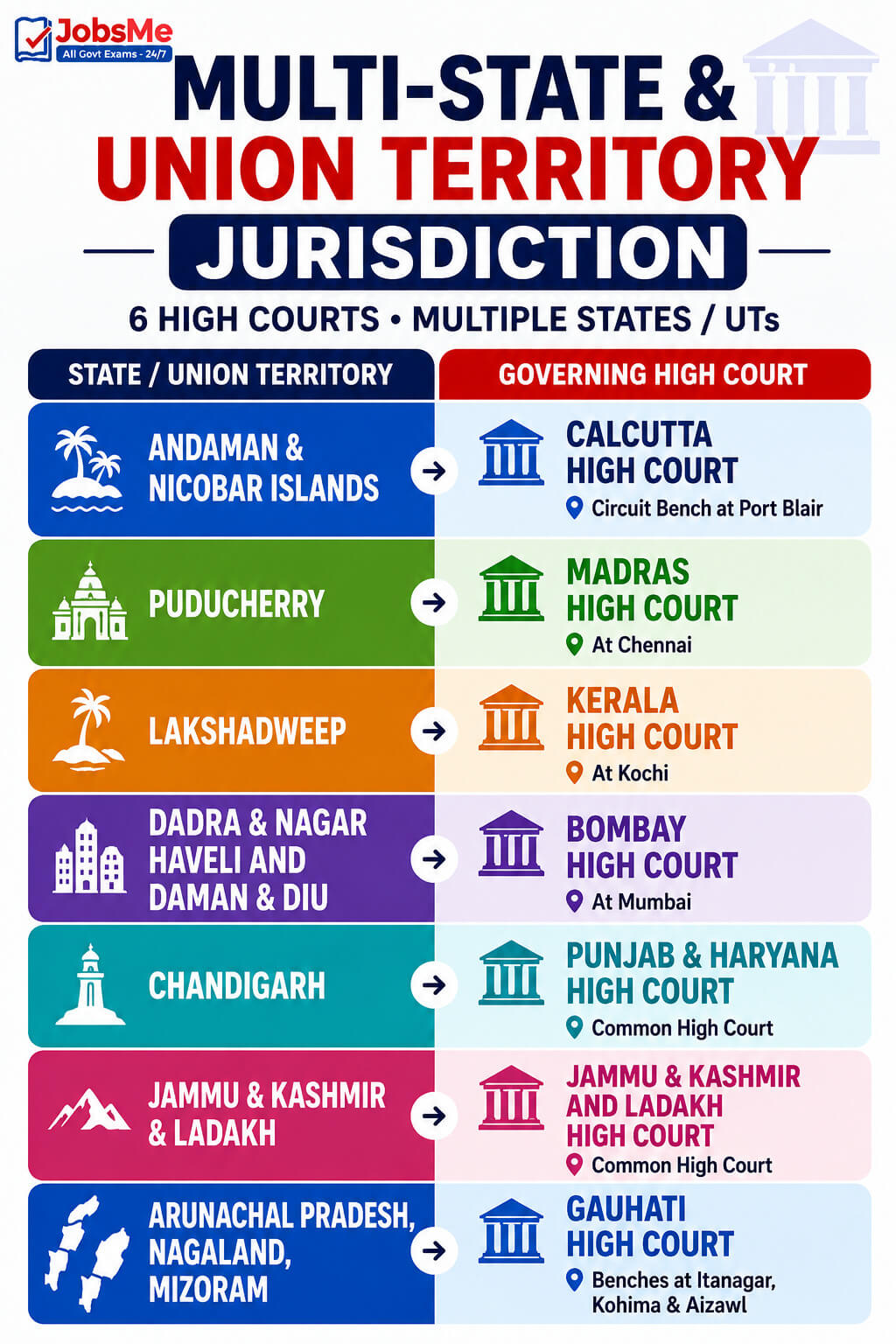
Six High Courts have jurisdiction over more than one state or union territory, and several union territories fall under the jurisdiction of a High Court located outside them. The table below clarifies this frequently asked area.
| State / Union Territory | Governing High Court | Key Details |
|---|---|---|
| Andaman and Nicobar Islands | Calcutta High Court | Falls under Calcutta High Court with a circuit bench at Port Blair. |
| Puducherry | Madras High Court | The union territory of Puducherry comes under the Madras High Court at Chennai. |
| Lakshadweep | Kerala High Court | The union territory of Lakshadweep is under the jurisdiction of the Kerala High Court at Kochi. |
| Dadra and Nagar Haveli and Daman and Diu | Bombay High Court | This union territory comes under the Bombay High Court at Mumbai. |
| Chandigarh | Punjab and Haryana High Court | The union territory of Chandigarh shares the common Punjab and Haryana High Court. |
| Jammu and Kashmir & Ladakh | Jammu & Kashmir and Ladakh High Court | A single common High Court serves both union territories after the 2019 reorganisation. |
| Arunachal Pradesh, Nagaland, Mizoram | Gauhati High Court | These northeastern states fall under the Gauhati High Court with benches at Itanagar, Kohima, and Aizawl. |
Memory Tricks and Mnemonics
Trick 1: The First Three High Courts (1862) — "CBM"
The first three High Courts of India were all established in 1862 under the Indian High Courts Act 1861. Remember them with "CBM":
- C → Calcutta (the oldest, 14 May 1862).
- B → Bombay.
- M → Madras.
"CBM came first in 1862 — Calcutta, Bombay, Madras."
Trick 2: The 2000 Trio — "CJU"
Three High Courts were created in the year 2000 after state reorganisation. Remember "CJU":
- C → Chhattisgarh (from Madhya Pradesh).
- J → Jharkhand (from Bihar).
- U → Uttarakhand / Uttaranchal (from Uttar Pradesh).
"CJU split from three big parent states in 2000."
Trick 3: The Northeast Three of 2013 — "TMM"
Three northeastern High Courts were carved out of the Gauhati High Court in 2013. Remember "TMM":
- T → Tripura.
- M → Manipur.
- M → Meghalaya.
Trick 4: Oldest vs Newest — "Calcutta vs the 2019 Twins"
- Oldest: Calcutta High Court (1862).
- Newest: Andhra Pradesh and Telangana High Courts (1 January 2019).
"The oldest is one (Calcutta); the newest are twins (AP and Telangana)."
Trick 5: Largest vs Smallest — "Big Allahabad, Tiny Sikkim"
- Largest: Allahabad High Court — highest sanctioned strength of 160 judges.
- Smallest: Sikkim High Court — only 3 judges.
"Allahabad is the giant; Sikkim is the smallest with just three judges."
Trick 6: Seat Not in the Capital — "Court Outside the Capital"
Several High Courts are located in cities that are not the state capital. Remember these exceptions:
- Uttar Pradesh → Allahabad (Prayagraj), not Lucknow.
- Madhya Pradesh → Jabalpur, not Bhopal.
- Chhattisgarh → Bilaspur, not Raipur.
- Uttarakhand → Nainital, not Dehradun.
- Rajasthan → Jodhpur, not Jaipur (Jaipur is a bench).
- Gujarat → Ahmedabad, not Gandhinagar.
- Kerala → Kochi, not Thiruvananthapuram.
Trick 7: World Heritage High Courts — "Two UNESCO Courts"
- Bombay High Court → part of the Victorian and Art Deco Ensemble of Mumbai.
- Punjab and Haryana High Court → part of the Chandigarh Capitol Complex (Le Corbusier).
"Mumbai and Chandigarh courts both wear a UNESCO crown."
Additional Notes
Frequently Confused Facts
- Oldest High Court vs First Act: The Calcutta High Court (14 May 1862) is the oldest, but all three of Calcutta, Bombay, and Madras were created under the same Indian High Courts Act 1861.
- Newest High Court: Andhra Pradesh and Telangana (2019) are the newest. The Jammu & Kashmir High Court is older (1928) and was only renamed, not newly created, in 2021.
- Largest vs Oldest: Allahabad is the largest by number of judges; Calcutta is the oldest by establishment date — these are different distinctions.
- Madhya Pradesh seat: The principal seat is Jabalpur (shifted from Nagpur in 1956), with benches at Gwalior and Indore — not at the capital Bhopal.
- Delhi vs other UTs: Delhi is the only union territory with its own exclusive High Court; Jammu and Kashmir and Ladakh share one common High Court.
- Karnataka vs Mysore: The Karnataka High Court was earlier the Mysore High Court, renamed in 1974.
- Orissa vs Odisha: The state is Odisha (since 2011) but the High Court still retains the name Orissa High Court.
- Article 226 vs Article 32: A High Court's writ power under Article 226 is wider than the Supreme Court's Article 32, as Article 226 covers both fundamental rights and "any other purpose."
- Retirement age: High Court judges retire at 62; Supreme Court judges retire at 65 — a commonly confused pair.
Repeating PYQ Patterns
Certain facts about the High Courts are asked repeatedly in competitive exams. The oldest High Court (Calcutta, 1862), the first three High Courts (Calcutta, Bombay, Madras), the newest High Courts (Andhra Pradesh and Telangana, 2019), the largest (Allahabad) and smallest (Sikkim), the retirement age of judges (62 years), and writ jurisdiction under Article 226 appear most often in UPSC Prelims, SSC CGL, and RRB NTPC papers. Banking exams (IBPS PO, SBI Clerk) frequently ask about seats and jurisdictions, especially multi-state High Courts like Gauhati and Bombay. State PCS exams focus on their own state's High Court — for example, the seat at Bilaspur for Chhattisgarh PCS, Jabalpur for Madhya Pradesh PCS, and Nainital for Uttarakhand PCS.
Quick Insight
The High Courts are not just historical institutions — they remain at the centre of India's living constitutional debates. Issues such as the elevation and transfer of judges through the Collegium system, the long-running Collegium versus NJAC controversy, pendency of cases, demands for new benches in remote regions, and the renaming of courts to match renamed states are recurring themes in current affairs. Understanding the structure, seats, and jurisdiction of every High Court helps aspirants connect a news report about a particular court directly to its state and powers — invaluable for both Prelims matching questions and Polity descriptive answers. For further reading on related topics, you can explore the Static GK notes and stay updated through the Daily Current Affairs section on Jobsme.in.
One-Liners for Quick Revision
- Calcutta High Court → Oldest in India → established 14 May 1862, jurisdiction over West Bengal and Andaman and Nicobar Islands.
- Bombay High Court → One of the first three (1862) → jurisdiction over Maharashtra, Goa, and Dadra and Nagar Haveli and Daman and Diu; UNESCO World Heritage building.
- Madras High Court → One of the first three (1862) → jurisdiction over Tamil Nadu and Puducherry; bench at Madurai.
- Allahabad High Court → Largest High Court (160 judges) → seat at Prayagraj, bench at Lucknow, jurisdiction over Uttar Pradesh.
- Karnataka High Court → Formerly Mysore High Court (renamed 1974) → seat at Bengaluru, benches at Dharwad and Kalaburagi.
- Patna High Court → Established 1916 → jurisdiction over Bihar.
- Jammu & Kashmir and Ladakh High Court → Established 1928, renamed 2021 → common court for the union territories of J&K and Ladakh.
- Gauhati High Court → Renamed 1971 → jurisdiction over Assam, Arunachal Pradesh, Nagaland, and Mizoram.
- Orissa High Court → Established 1948 → seat at Cuttack, jurisdiction over Odisha (name unchanged).
- Rajasthan High Court → Established 1949 → seat at Jodhpur, bench at Jaipur.
- Madhya Pradesh High Court → Seat at Jabalpur (shifted from Nagpur in 1956) → benches at Gwalior and Indore.
- Kerala High Court → Created by States Reorganisation Act 1956 → seat at Kochi, jurisdiction over Kerala and Lakshadweep.
- Gujarat High Court → Established 1960 → seat at Ahmedabad, jurisdiction over Gujarat.
- Delhi High Court → Established 1966 → only union territory with its own dedicated High Court.
- Punjab and Haryana High Court → Renamed 1966 → seat at Chandigarh, jurisdiction over Punjab, Haryana, and Chandigarh; UNESCO World Heritage building.
- Himachal Pradesh High Court → Established 1971 → seat at Shimla.
- Sikkim High Court → Smallest High Court (3 judges) → established 1975, seat at Gangtok.
- Chhattisgarh High Court → Established 2000 → seat at Bilaspur (not Raipur).
- Jharkhand High Court → Established 2000 → seat at Ranchi.
- Uttarakhand High Court → Formerly Uttaranchal (renamed 2007) → seat at Nainital (not Dehradun).
- Tripura High Court → Established 2013 → seat at Agartala.
- Manipur High Court → Established 2013 → seat at Imphal.
- Meghalaya High Court → Established 2013 → seat at Shillong.
- Andhra Pradesh High Court → Newest (1 January 2019) → seat at Amaravati.
- Telangana High Court → Newest (1 January 2019) → seat at Hyderabad.
- Total High Courts → 25 → six exercise jurisdiction over more than one state or union territory.
- Retirement age of High Court judges → 62 years → appointed by the President under Article 217.
- Writ jurisdiction → Article 226 → wider than the Supreme Court's Article 32.
- Supervisory jurisdiction → Article 227 → over all subordinate courts and tribunals.
For more Static GK topics like Indian Polity, constitutional articles, and important amendments, explore the Static GK section on Jobsme.in. You can also test your knowledge with the Static GK Quiz and check out the latest exam notifications at Latest Government Job Notifications.
Free quiz • No signup required
Put this topic into practice with Indian Cultural Institutions – Static GK MCQ Quiz. It is the quickest way to reinforce what you just learned.
Frequently Asked Questions
How many High Courts are there in India in 2026?
Which is the oldest High Court in India?
Which are the newest High Courts in India?
Which were the first three High Courts established in India?
Which is the largest and which is the smallest High Court in India?
What is the retirement age of a High Court judge in India?
Under which constitutional articles are the High Courts established and empowered?
Which High Courts have jurisdiction over more than one state or union territory?
Why is the writ jurisdiction of a High Court considered wider than that of the Supreme Court?
Which union territory has its own dedicated High Court?

About the author