
Biosphere Reserves in India – Static GK / General Awareness for Competitive Exams (With Memory Tricks)
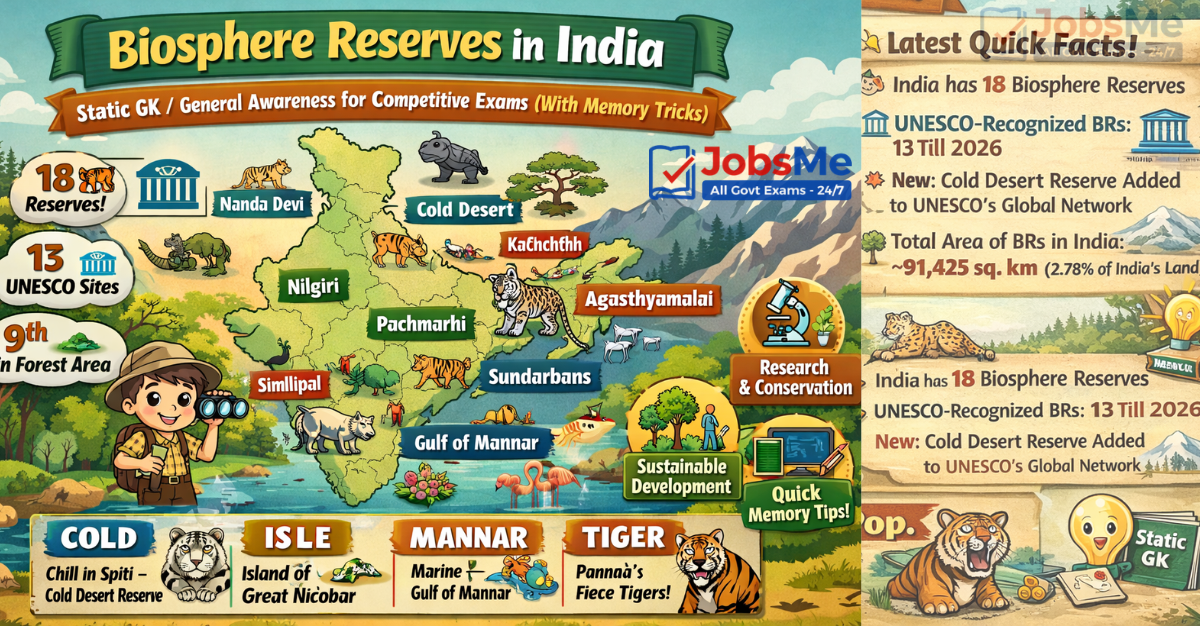
Biosphere Reserves in India are UNESCO-recognised protected areas aimed at conserving biodiversity while promoting sustainable development. This topic is highly important for SSC, UPSC Prelims, Banking, Railways, Defence, and State PCS exams due to its static nature and frequent repetition in PYQs.
Jump to section
- Introduction
- What is a Biosphere Reserve?
- Functions of Biosphere Reserves (Exam Favourite)
- Complete List of 18 Biosphere Reserves in India (Updated)
- UNESCO-Recognised Biosphere Reserves (13)
- The Sticky Memory Zone (Mnemonics)
- Don’t Confuse These!
- Key Exam-Oriented Features
- Important One-Liners for SSC / Banking / UPSC Prelims
- Previous Year Questions (PYQ) Analysis
Introduction
Biosphere Reserves are special protected areas recognised under UNESCO’s Man and the Biosphere (MAB) Programme (1971). They aim to balance biodiversity conservation, sustainable development, and scientific research.
This topic is frequently asked in SSC CGL/CHSL, UPSC Prelims, IBPS, SBI, Railways, Defence, and State PCS as:
- Direct factual questions
- Match the following
- Statement-based MCQs
What is a Biosphere Reserve?
A Biosphere Reserve is a large ecological area recognised by UNESCO to:
- Conserve plants, animals, and ecosystems
- Promote sustainable livelihood of local communities
- Act as living laboratories for research and education
Functions of Biosphere Reserves (Exam Favourite)
1. Conservation Function
- Protects genetic diversity, species, and ecosystems
- Includes endangered species
2. Development Function
- Encourages eco-friendly economic activities
- Balances human needs and nature
3. Logistic Support Function
- Supports research, monitoring, training
- Helps in climate & ecological studies
👉 Why asked? Frequently appears as “Which is NOT a function of BR?” in SSC & Banking.
Complete List of 18 Biosphere Reserves in India (Updated)
Eastern & North-Eastern India
- Sundarbans Biosphere Reserve – West Bengal
- Similipal Biosphere Reserve – Odisha
- Manas Biosphere Reserve – Assam
- Dibru Saikhowa Biosphere Reserve – Assam
- Nokrek Biosphere Reserve – Meghalaya
- Dihang Dibang Biosphere Reserve – Arunachal Pradesh
Northern & Himalayan Region
- Nanda Devi Biosphere Reserve – Uttarakhand
- Khangchendzonga Biosphere Reserve – Sikkim
- Cold Desert Biosphere Reserve – Himachal Pradesh
Central & Western India
- Pachmarhi Biosphere Reserve – Madhya Pradesh
- Achanakmar Amarkantak Biosphere Reserve – MP & Chhattisgarh
- Panna Biosphere Reserve – Madhya Pradesh
- Kachchh Biosphere Reserve – Gujarat
Southern & Coastal India
- Nilgiri Biosphere Reserve – TN, Kerala, Karnataka
- Gulf of Mannar Biosphere Reserve – Tamil Nadu
- Agasthyamalai Biosphere Reserve – Kerala & TN
- Seshachalam Hills Biosphere Reserve – Andhra Pradesh
Island Region
- Great Nicobar Biosphere Reserve – Andaman & Nicobar
UNESCO-Recognised Biosphere Reserves (13)
| Biosphere Reserve | State(s) | UNESCO Year |
|---|---|---|
| Nilgiri | TN, Kerala, Karnataka | 2000 |
| Gulf of Mannar | Tamil Nadu | 2001 |
| Sundarbans | West Bengal | 2001 |
| Nanda Devi | Uttarakhand | 2004 |
| Nokrek | Meghalaya | 2009 |
| Pachmarhi | Madhya Pradesh | 2009 |
| Similipal | Odisha | 2009 |
| Achanakmar–Amarkantak | MP, Chhattisgarh | 2012 |
| Great Nicobar | A&N Islands | 2013 |
| Agasthyamalai | Kerala, TN | 2016 |
| Khangchendzonga | Sikkim | 2018 |
| Panna | Madhya Pradesh | 2020 |
| Cold Desert | Himachal Pradesh | 2025 |
The Sticky Memory Zone (Mnemonics)
Mnemonic for Southern BRs:
👉 “N-GAS”
- Nilgiri
- Gulf of Mannar
- Agasthyamalai
- Seshachalam
UNESCO Year Trick (2009 Trio):
👉 “NPS = Nokrek–Pachmarhi–Similipal”
👉 N-N-S-P-G-A-K-C-A-S-P-G-C”
(Nilgiri, Nanda Devi, Sundarbans, Pachmarhi, Gulf of Mannar, Achanakmar, Khangchendzonga, Cold Desert, Agasthyamalai, Similipal, Panna, Great Nicobar, Nokrek) — useful for UPSC/SSC quick revision.
Don’t Confuse These!
- Wildlife Sanctuary ≠ Biosphere Reserve (BR is much larger & zoned)
- National Park ≠ Biosphere Reserve (Human activity allowed in BR buffer zones)
- Saddle Peak ≠ Biosphere Reserve (It is a National Park)
- Cold Desert BR ≠ Ladakh UT (Located in Himachal Pradesh)
Key Exam-Oriented Features
- Total area covered: ~91,425 sq. km
- Funding Pattern: 60:40 (Centre:State), 90:10 for NE & Himalayan states
- Linked with Project Tiger, Project Elephant, Green India Mission
Important One-Liners for SSC / Banking / UPSC Prelims
- Nilgiri is the first Biosphere Reserve in India.
- Gulf of Mannar is the largest and only marine BR.
- Great Nicobar is the only island BR.
- Sundarbans has the largest mangrove ecosystem.
- Cold Desert BR was added in 2025.
- India ranks 9th in forest area globally (FAO).
Previous Year Questions (PYQ) Analysis
- SSC: Match Biosphere Reserve with State
- UPSC Prelims: Statement-based (UNESCO year / location)
- Banking & Railways: One-liners (largest, first, only)
Quick-Summary Table (Revision Snapshot)
| Most Asked Point | Answer / Fact | Exam Relevance |
|---|---|---|
| Total Biosphere Reserves in India | 18 | SSC, UPSC |
| UNESCO-recognised BRs | 13 (as of 2025) | UPSC Prelims |
| First BR in India | Nilgiri (1986) | SSC, Railways |
| Largest BR | Gulf of Mannar (Marine) | SSC, Banking |
| Latest BR | Cold Desert (Himachal Pradesh) | Current Affairs |
| Only Island BR | Great Nicobar | SSC |
| Mangrove BR | Sundarbans | UPSC |
| High-altitude BR | Nanda Devi | Defence |
Free quiz • No signup required
Put this topic into practice with Indian Cultural Institutions – Static GK MCQ Quiz. It is the quickest way to reinforce what you just learned.
Frequently Asked Questions
How many Biosphere Reserves are there in India?
Which is the latest Biosphere Reserve in India?
Which Biosphere Reserve is marine in nature?
Which BR is famous for mangroves and tigers?
What is the main objective of Biosphere Reserves?
Which Biosphere Reserve is shared by the maximum number of states?
Which Biosphere Reserve is linked with coral reef conservation?

About the author