Computer Awareness – Fundamentals of Computer System | Important Concepts for Banking, SSC & Government Exams
This article covers core computer fundamentals including IPO cycle, hardware, software, memory, generations, and modern digital applications—essential for all government exam aspirants.
Jump to section
Introduction
Computer Awareness has become a core scoring subject in Banking, SSC, Railways, Insurance, and PSU exams. With digital governance initiatives like Digital Census 2027 and online financial systems, understanding computer fundamentals is essential for both exams and real-world applications.
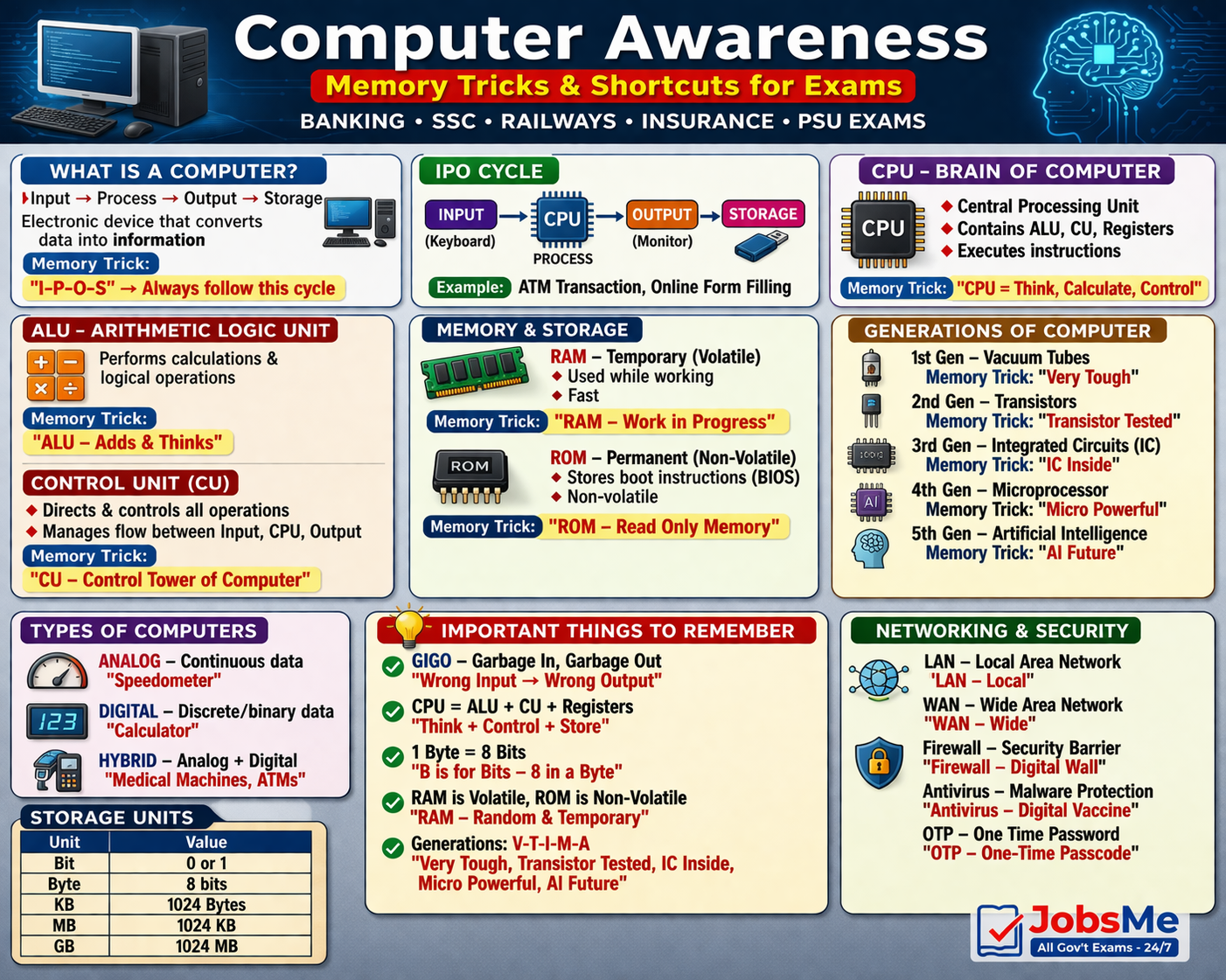
Key Highlights / Quick Revision
- Computer
Electronic device that processes data into information
Accepts input → processes → gives output
Works on binary (0,1) - IPO Cycle
Input → Process → Output → Storage
Core working model of every system
Used in ATM, banking, census apps - CPU (Central Processing Unit)
Brain of computer
Contains ALU + CU + Registers
Executes instructions - ALU (Arithmetic Logic Unit)
Performs calculations and logic
Handles comparisons and arithmetic - Control Unit (CU)
Directs operations
Controls data flow between components - RAM (Random Access Memory)
Volatile memory
Temporary storage
Faster than secondary memory - ROM (Read Only Memory)
Non-volatile
Stores boot instructions (BIOS) - Generations of Computer
1st: Vacuum Tubes
2nd: Transistors
3rd: IC
4th: Microprocessor
5th: AI - Types of Computers
Analog, Digital, Hybrid
Based on data handling - Storage Units
Bit → Byte → KB → MB → GB → TB
Detailed Explanation of Computer Awareness Topic
Basics of Computers
Why It Is Important
Questions from basic definitions, IPO cycle, and data vs information are frequently asked in SSC and Banking exams. These are scoring and concept-based.
Key Concepts
- Computer Definition:
A programmable electronic machine that processes data. - Data vs Information:
| Aspect | Data | Information |
|---|---|---|
| Meaning | Raw facts | Processed data |
| Example | 12345 | Salary = ₹12,345 |
- IPO Cycle:
| Stage | Function |
|---|---|
| Input | Enter data |
| Process | CPU processes |
| Output | Result display |
| Storage | Save data |
Input/Output Devices
Why It Is Important
Direct questions asked: identify device type (input/output).
Key Concepts
| Device Type | Examples | Function |
|---|---|---|
| Input | Keyboard, Mouse | Enter data |
| Output | Monitor, Printer | Display result |
| Both | Touchscreen | Input + Output |
Memory & Storage
Why It Is Important
Very high-weightage topic in Banking & SSC.
Key Concepts
| Memory Type | Nature | Example |
|---|---|---|
| Primary | Fast, temporary | RAM |
| Secondary | Permanent | HDD, SSD |
- RAM: Temporary, fast
- ROM: Permanent, boot instructions
- Cache: Ultra-fast memory
Storage Units Table
| Unit | Value |
|---|---|
| 1 Byte | 8 bits |
| 1 KB | 1024 bytes |
| 1 MB | 1024 KB |
| 1 GB | 1024 MB |
Software Concepts
Why It Is Important
Questions on OS, application software, and examples are common.
Key Concepts
| Type | Example | Use |
|---|---|---|
| System Software | OS | Controls hardware |
| Application Software | MS Word | User tasks |
- Operating System (OS):
Interface between user and hardware
Examples: Windows, Linux
Networking
Why It Is Important
Frequently asked in Banking exams.
Key Concepts
| Term | Meaning |
|---|---|
| LAN | Local network |
| WAN | Wide network |
| Internet | Global network |
- TCP/IP: Communication protocol
- URL: Web address
Internet & Security
Why It Is Important
Highly relevant due to digital banking.
Key Concepts
- Firewall: Protects system
- Antivirus: Removes malware
- OTP: One-time password (2FA)
Important Things to Remember
- GIGO: Garbage In, Garbage Out
- CPU = ALU + CU + Registers
- RAM is volatile, ROM is non-volatile
- 1 Byte = 8 Bits
- 5th Generation = Artificial Intelligence
Exam Tips: How to Remember Computer Awareness
- Use mnemonics:
IPO → “Input → Process → Output” Remember generations like:
V-T-I-M-A
(Vacuum, Transistor, IC, Microprocessor, AI)
Free quiz • No signup required
Put this topic into practice with Daily Current Affairs MCQ Quiz – 9 May 2026 | SSC, Banking, UPSC, Railways & Defence Exams. It is the quickest way to reinforce what you just learned.

About the author