Indian Budget – History and Important Terms: Static GK & General Awareness for Competitive Exams with Memory Tricks
This article covers the complete history of the Indian Budget from James Wilson's first budget in 1860 to the latest Union Budget, along with all important budget-related terms like fiscal deficit, revenue deficit, Annual Financial Statement, and Consolidated Fund of India. It explains famous budgets such as the Black Budget, Carrot and Stick Budget, Epochal Budget, and Dream Budget, key historic firsts, and the constitutional provisions (Article 112) governing the budget. All facts are arranged in exam-ready format with memory tricks and one-liners to help UPSC, SSC, IBPS, RRB, PSU, and State PCS aspirants score better in the Economy and General Awareness sections.
Jump to section
Introduction
The Union Budget is the most important annual financial exercise of the Government of India, and questions on its history, terminology, and constitutional basis appear almost every year in competitive exams. The story of the Indian Budget begins long before independence — the first budget of India was presented on 7 April 1860 by James Wilson, a Scottish economist, founder of The Economist magazine, and the Finance Member of the Indian Council under British rule. Wilson is also remembered for introducing income tax in India, a major source of government revenue even today.
Questions on the Indian Budget regularly appear in UPSC Prelims, SSC CGL, IBPS PO, RRB NTPC, SBI Clerk, State PCS, Insurance, and Defence exams. They typically ask who presented the first budget, what Article of the Constitution deals with the budget, the difference between fiscal deficit and revenue deficit, or the nicknames of famous budgets. This article brings together the complete history, important terms, and key facts in a structured, exam-ready format. To explore more related Static GK topics, you can refer to the Static GK section on Jobsme.in.
The Budget is also closely connected with current affairs themes such as fiscal deficit targets, new income tax slabs, the merger of the Railway Budget with the Union Budget, and the shift of the budget date to 1 February — making this topic doubly important for aspirants preparing for both objective papers and descriptive economy questions. For daily updates around budget announcements and economy news, you can follow the Daily Current Affairs page.
Core Concepts: What is the Union Budget
The Union Budget is a statement of the estimated receipts and expenditure of the Government of India for a financial year, which runs from 1 April to 31 March. It is constitutionally referred to as the Annual Financial Statement (AFS) under Article 112 of the Constitution of India. The Budget is broadly divided into two parts based on the nature of money flows.
- Revenue Budget: Deals with revenue receipts (tax revenue like income tax and GST, and non-tax revenue like fees, fines, and interest) and revenue expenditure (day-to-day running costs such as salaries, pensions, subsidies, and interest payments).
- Capital Budget: Deals with capital receipts (borrowings, loans from the public, RBI and foreign governments, and disinvestment proceeds) and capital expenditure (long-term spending that creates assets such as infrastructure, machinery, and buildings).
The Budget also reports key fiscal indicators such as the fiscal deficit, revenue deficit, and primary deficit, which help judge the financial health of the government. Understanding these basic terms makes it much easier to answer both Static GK and current-affairs questions on the economy.
History of the Indian Budget - Key Milestones
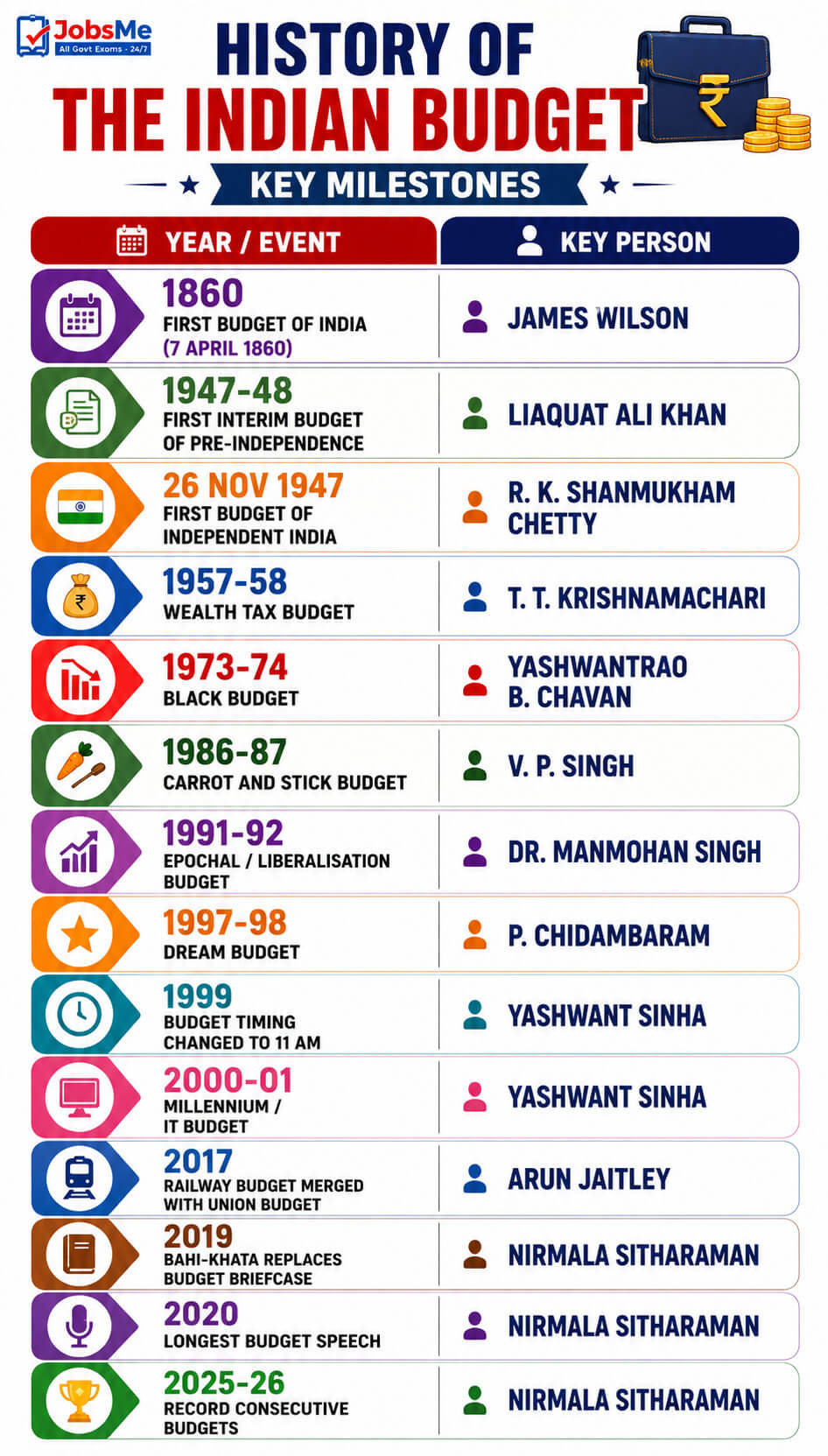
The following table lists the most exam-relevant milestones in the history of the Indian Budget, from the colonial era to the present day.
| Year / Event | Key Person | Reason / Key Details |
|---|---|---|
| First Budget of India (7 April 1860) | James Wilson | Founder of The Economist magazine and Finance Member of the Indian Council; sent to India by Queen Victoria after the Revolt of 1857; introduced income tax, paper currency, and an English-model audit system. |
| First Interim Budget of Pre-Independence (1947-48) | Liaquat Ali Khan | Presented as a member of the Interim Government before independence; later became the first Prime Minister of Pakistan. |
| First Budget of Independent India (26 November 1947) | R. K. Shanmukham Chetty | First Finance Minister of independent India; the budget focused on stabilising the economy after Partition. |
| Wealth Tax Budget (1957-58) | T. T. Krishnamachari | Introduced the wealth tax on the total value of personal assets; the tax remained part of the system until it was abolished in 2015 due to high cost and low yield. |
| Black Budget (1973-74) | Yashwantrao B. Chavan | Named "Black Budget" because of a record fiscal deficit of about Rs 550 crore during a period of severe financial difficulty, just before the Emergency. |
| Carrot and Stick Budget (1986-87) | V. P. Singh | First step in dismantling the Licence Raj; introduced MODVAT (Modified Value Added Tax) to reduce the cascading effect of taxes, while cracking down on smugglers, black marketers, and tax evaders. |
| Epochal / Liberalisation Budget (1991-92) | Dr. Manmohan Singh | Presented during a balance-of-payments crisis under P. V. Narasimha Rao; launched Liberalisation, Privatisation, and Globalisation (LPG), ended the Licence Raj, and cut import duties; called "a budget with a human face." |
| Dream Budget (1997-98) | P. Chidambaram | Sharply reduced personal income tax rates (top rate cut from 40% to 30%) and corporate tax rates to boost compliance and growth. |
| Budget timing changed to 11 AM (1999) | Yashwant Sinha | Ended the British-era tradition of presenting the budget at 5 PM; shifted it to 11 AM to suit Indian audiences and working hours. |
| Millennium / IT Budget (2000-01) | Yashwant Sinha | Boosted the IT and software sector by reducing customs duties on computers and peripherals. |
| Railway Budget merged with Union Budget (2017) | Arun Jaitley | Ended the 92-year-old practice of a separate Railway Budget; also shifted the budget date to 1 February for better fiscal planning. |
| Bahi-Khata replaces Budget Briefcase (2019) | Nirmala Sitharaman | India's first full-time woman Finance Minister; replaced the colonial budget briefcase with a traditional red cloth "bahi-khata" ledger. |
| Longest Budget Speech (2020) | Nirmala Sitharaman | Delivered the longest budget speech in Indian history at 2 hours and 40 minutes. |
| Record Consecutive Budgets (2025-26) | Nirmala Sitharaman | Presented a record eighth consecutive budget; announced nil income tax on annual income up to Rs 12 lakh under the new tax regime. |
Historic Firsts and Records in Indian Budget
| Record / First | Person | Key Details |
|---|---|---|
| First budget of British India | James Wilson | Presented on 7 April 1860; Wilson died in Kolkata in August 1860, only months after presenting it. |
| First Finance Minister of independent India | R. K. Shanmukham Chetty | Presented the first budget of free India on 26 November 1947. |
| Prime Ministers who presented the Budget | Nehru, Indira Gandhi, Rajiv Gandhi | Jawaharlal Nehru (1958), Indira Gandhi (1970), and Rajiv Gandhi (1987-88) presented budgets while holding the finance portfolio. |
| Only woman Finance Minister who was also PM | Indira Gandhi | Presented the budget in 1970 while serving as Prime Minister. |
| First full-time woman Finance Minister | Nirmala Sitharaman | Began presenting budgets in 2019 and introduced the bahi-khata in place of the briefcase. |
| Longest budget speech | Nirmala Sitharaman | 2 hours 40 minutes in 2020; her 2019 speech ran 2 hours 17 minutes. |
| 1950 Budget leak | — | The budget was leaked before presentation in 1950, leading to tighter security and printing arrangements. |
Important Budget Terms for Exams
The following table explains the most frequently tested budget and economy terms. These definitions are commonly asked in the Economy section of UPSC Prelims, banking awareness, and SSC exams.
| Term | Meaning / Key Details |
|---|---|
| Annual Financial Statement (AFS) | The constitutional name of the Union Budget under Article 112; a statement of estimated receipts and expenditure of the government for a financial year, laid before both Houses of Parliament. |
| Article 112 | The Article of the Constitution that mandates the President to cause the Annual Financial Statement to be laid before Parliament every financial year. |
| Financial Year | The accounting period for the budget in India, running from 1 April to 31 March of the next year. |
| Revenue Receipts | Income that does not create a liability or reduce assets; includes tax revenue (income tax, GST, customs, excise) and non-tax revenue (interest, dividends, fees, fines). |
| Capital Receipts | Receipts that create a liability or reduce assets; includes borrowings, loans from the public, RBI and foreign governments, and disinvestment proceeds. |
| Revenue Expenditure | Spending on the day-to-day running of government — salaries, pensions, subsidies, grants, and interest payments — that does not create assets. |
| Capital Expenditure | Long-term spending that creates assets or reduces liabilities, such as infrastructure, machinery, buildings, and loans to states and PSUs. |
| Fiscal Deficit | The gap between total expenditure and total receipts excluding borrowings; it shows the total borrowing requirement of the government. |
| Revenue Deficit | The excess of revenue expenditure over revenue receipts; indicates that the government is borrowing to meet routine expenses. |
| Primary Deficit | Fiscal deficit minus interest payments; shows the deficit caused by current-year decisions rather than past borrowings. |
| Consolidated Fund of India | The main account of the government into which all revenues and borrowings flow; no money can be withdrawn without parliamentary approval (Article 266). |
| Contingency Fund of India | A fund kept at the disposal of the President for meeting unforeseen and urgent expenditure, later recouped from Parliament (Article 267). |
| Public Account of India | The account holding money where the government acts as a banker, such as provident funds and small savings; does not need parliamentary authorisation for withdrawals. |
| Finance Bill | The bill presented under Article 110(1)(a) that gives effect to the government's taxation proposals (imposition, abolition, or alteration of taxes). |
| Vote on Account | Parliamentary approval to draw funds from the Consolidated Fund to meet expenditure for a short period until the full budget is passed. |
| Interim Budget | A budget presented in an election year by an outgoing government to cover expenses until a new government presents a full budget. |
| Direct Tax | A tax paid directly to the government by the person on whom it is levied, such as income tax and corporate tax. |
| Indirect Tax | A tax collected by an intermediary from the final consumer, such as GST and customs duty. |
| MODVAT | Modified Value Added Tax introduced in the 1986 budget to reduce the cascading effect of taxes; an early step towards the modern VAT and GST system. |
| Disinvestment | The sale of government stake in public sector undertakings to raise capital receipts. |
For more economy and banking concepts that often appear alongside budget questions, you can study the Banking Awareness notes on Jobsme.in.
Memory Tricks and Mnemonics
Trick 1: First Budget Firsts — "WC 1860-1947"
Remember the two big budget "firsts" using "WC" for the two presenters:
- W → Wilson (James Wilson) → First budget of India, 7 April 1860.
- C → Chetty (R. K. Shanmukham Chetty) → First budget of independent India, 26 November 1947.
"Wilson came first, Chetty came free."
Trick 2: Famous Budget Nicknames — "BCED"
Group the four most-asked budget nicknames as "BCED":
- B → Black Budget (1973-74) → Yashwantrao Chavan.
- C → Carrot and Stick Budget (1986-87) → V. P. Singh.
- E → Epochal Budget (1991-92) → Manmohan Singh.
- D → Dream Budget (1997-98) → P. Chidambaram.
"Black, Carrot, Epoch, Dream — the four most famous budgets."
Trick 3: Three Deficits — "FRP"
Remember the three deficits in increasing order of detail as "FRP":
- F → Fiscal Deficit → Total expenditure minus total receipts (excluding borrowings).
- R → Revenue Deficit → Revenue expenditure minus revenue receipts.
- P → Primary Deficit → Fiscal deficit minus interest payments.
"Primary = Fiscal minus interest — primary forgets the past."
Trick 4: Three Government Funds — "Article 266-267 CCP"
Link the three funds to their constitutional articles using "CCP":
- C → Consolidated Fund of India → Article 266 → needs parliamentary approval.
- C → Contingency Fund of India → Article 267 → at the disposal of the President for emergencies.
- P → Public Account → government acts only as a banker.
Trick 5: Timing and Date Changes — "5 to 11, Feb 1"
Two key reform years to remember together:
- 1999 → Yashwant Sinha shifted budget timing from 5 PM to 11 AM.
- 2017 → Arun Jaitley shifted the budget date to 1 February and merged the Railway Budget.
"Sinha changed the clock, Jaitley changed the calendar."
Trick 6: Sitharaman's Records — "BLR"
Remember Nirmala Sitharaman's three budget records as "BLR":
- B → Bahi-Khata (replaced the briefcase in 2019).
- L → Longest budget speech (2 hours 40 minutes in 2020).
- R → Record consecutive budgets (eighth in a row in 2025-26).
Trick 7: Wilson's Introductions — "PIA"
James Wilson introduced three key things in 1860 — remember as "PIA":
- P → Paper currency.
- I → Income tax.
- A → Audit system (English model).
Additional Notes
Frequently Confused Facts
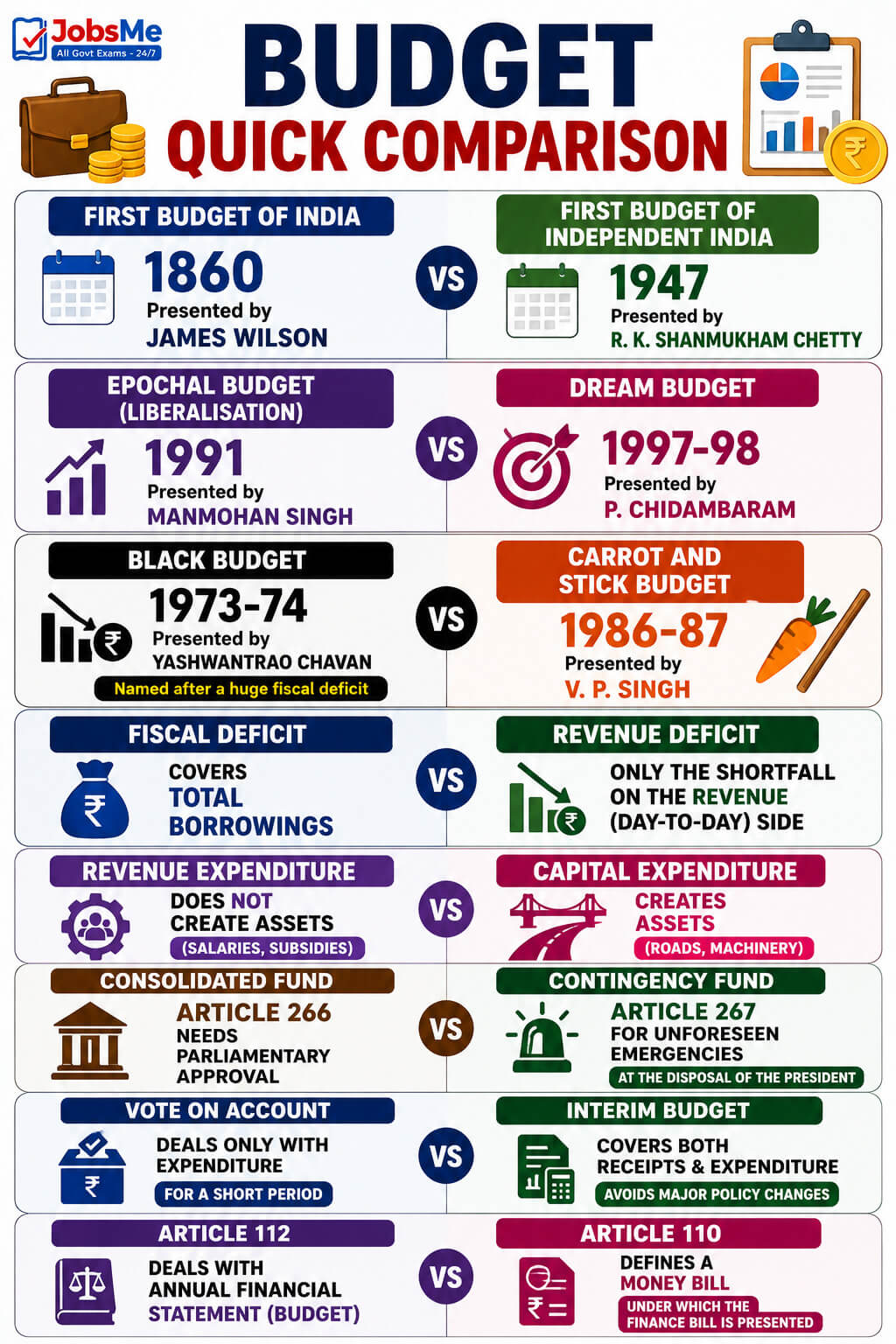
- First budget of India vs first budget of independent India: James Wilson presented the first-ever Indian budget (1860); R. K. Shanmukham Chetty presented the first budget of independent India (1947).
- Epochal Budget vs Dream Budget: The Epochal (Liberalisation) Budget was by Manmohan Singh in 1991; the Dream Budget was by P. Chidambaram in 1997-98.
- Black Budget vs Carrot and Stick Budget: Black Budget (1973-74) is by Yashwantrao Chavan and is named after a huge fiscal deficit; Carrot and Stick Budget (1986-87) is by V. P. Singh.
- Fiscal Deficit vs Revenue Deficit: Fiscal deficit covers total borrowings; revenue deficit is only the shortfall on the revenue (day-to-day) side.
- Revenue Expenditure vs Capital Expenditure: Revenue expenditure does not create assets (salaries, subsidies); capital expenditure creates assets (roads, machinery).
- Consolidated Fund vs Contingency Fund: Consolidated Fund (Article 266) needs parliamentary approval; Contingency Fund (Article 267) is for unforeseen emergencies and is at the disposal of the President.
- Vote on Account vs Interim Budget: A Vote on Account deals only with expenditure for a short period; an Interim Budget covers both receipts and expenditure but avoids major policy changes.
- Article 112 vs Article 110: Article 112 deals with the Annual Financial Statement (Budget); Article 110 defines a Money Bill, under which the Finance Bill is presented.
Repeating PYQ Patterns
Certain budget facts are asked again and again in competitive exams. James Wilson (first budget, 1860), R. K. Shanmukham Chetty (first budget of independent India, 1947), Article 112 (Annual Financial Statement), the financial year (1 April to 31 March), fiscal deficit, the merger of the Railway Budget in 2017, and the shift of the budget date to 1 February appear most often in UPSC Prelims, SSC CGL, and RRB NTPC. Banking exams (IBPS PO, SBI Clerk) frequently test the definitions of fiscal deficit, revenue deficit, direct and indirect taxes, and the Consolidated Fund of India. State PCS and Insurance exams often ask about famous budget nicknames such as the Black Budget, Epochal Budget, and Dream Budget, and about historic firsts like the first woman Finance Minister.
Quick Insight
The Indian Budget is not just an accounting document — it mirrors the economic journey of the nation. The 1860 budget laid the foundation of modern taxation; the 1991 Epochal Budget opened India to the world through liberalisation; and recent budgets focus on the middle class, infrastructure, and the goal of a developed India ("Viksit Bharat"). Understanding the history and terminology of the budget helps aspirants connect any economy-related news to its background, which is valuable for both objective papers and descriptive economy questions. For further study, refer to the Static GK section and test yourself with the Banking Awareness Quiz on Jobsme.in.
One-Liners for Quick Revision
- First budget of India → 7 April 1860 → presented by James Wilson under British rule.
- James Wilson → Founder of The Economist magazine → introduced income tax, paper currency, and audit in India.
- First Interim Budget (pre-independence) → Liaquat Ali Khan → later first PM of Pakistan.
- First budget of independent India → 26 November 1947 → R. K. Shanmukham Chetty.
- Wealth Tax Budget (1957-58) → T. T. Krishnamachari → wealth tax abolished in 2015.
- Black Budget (1973-74) → Yashwantrao Chavan → record fiscal deficit of about Rs 550 crore.
- Carrot and Stick Budget (1986-87) → V. P. Singh → introduced MODVAT, began ending Licence Raj.
- Epochal / Liberalisation Budget (1991-92) → Manmohan Singh → launched LPG reforms, "budget with a human face."
- Dream Budget (1997-98) → P. Chidambaram → top income tax rate cut from 40% to 30%.
- Budget timing change (1999) → Yashwant Sinha → shifted from 5 PM to 11 AM.
- Millennium / IT Budget (2000-01) → Yashwant Sinha → boosted the IT sector.
- Railway Budget merger (2017) → Arun Jaitley → ended 92-year separate Railway Budget; date shifted to 1 February.
- Bahi-Khata (2019) → Nirmala Sitharaman → replaced the colonial briefcase.
- Longest budget speech (2020) → Nirmala Sitharaman → 2 hours 40 minutes.
- Record consecutive budgets (2025-26) → Nirmala Sitharaman → eighth in a row; nil tax up to Rs 12 lakh under new regime.
- Constitutional name of Budget → Annual Financial Statement → Article 112.
- Finance Bill → presented under Article 110(1)(a) → gives effect to taxation proposals.
- Financial Year → 1 April to 31 March.
- Revenue Budget → revenue receipts and revenue expenditure.
- Capital Budget → capital receipts and capital expenditure.
- Fiscal Deficit → total expenditure minus total receipts (excluding borrowings).
- Revenue Deficit → revenue expenditure minus revenue receipts.
- Primary Deficit → fiscal deficit minus interest payments.
- Consolidated Fund of India → Article 266 → needs parliamentary approval for withdrawals.
- Contingency Fund of India → Article 267 → at the disposal of the President for emergencies.
- Public Account → government acts as a banker → no parliamentary authorisation needed.
- Vote on Account → approval to draw funds for a short period until full budget passes.
- Interim Budget → presented in election years by the outgoing government.
- Direct Tax → income tax, corporate tax.
- Indirect Tax → GST, customs duty.
- MODVAT → Modified Value Added Tax → introduced in the 1986 budget.
- Disinvestment → sale of government stake in PSUs to raise capital receipts.
- Only woman FM who was also PM → Indira Gandhi → presented the budget in 1970.
- PMs who presented budgets → Nehru (1958), Indira Gandhi (1970), Rajiv Gandhi (1987-88).
- 1950 Budget leak → led to tighter printing and security arrangements.
For more Static GK topics like Indian economy, banking, and constitutional articles, explore the Static GK section on Jobsme.in. You can also test your knowledge with the Static GK Quiz, brush up on the economy with the Banking Awareness Quiz, and check the latest exam updates at Latest Government Job Notifications.
Free quiz • No signup required
Put this topic into practice with Indian Cultural Institutions – Static GK MCQ Quiz. It is the quickest way to reinforce what you just learned.
Frequently Asked Questions
Who presented the first budget of India?
Who presented the first budget of independent India?
Which Article of the Constitution deals with the Union Budget?
What is the difference between fiscal deficit and revenue deficit?
Why was the 1973-74 budget called the Black Budget?
Which budget is known as the Epochal Budget or Liberalisation Budget?
When was the budget date shifted to 1 February and the Railway Budget merged?
Who was the first full-time woman Finance Minister of India?
What is the financial year for the Union Budget in India?
What is the Consolidated Fund of India?

About the author