Number of Players in Various Sports and Games – Static GK & General Awareness for Competitive Exams with Memory Tricks
This article presents a complete list of the number of players in various sports and games, covering popular team sports like Cricket, Football, Hockey, and Kabaddi, as well as individual and racquet games like Chess, Boxing, and Table Tennis. It includes the players per side, key facts, and singles/doubles formats, along with memory tricks and one-liners for quick revision. All facts are arranged in exam-ready format to help UPSC, SSC, IBPS, RRB, PSU, and State PCS aspirants score better in the General Awareness and Sports GK sections.

Jump to section
Introduction
One of the most frequently asked Static GK topics in competitive exams is the number of players in various sports and games. Whether it is Cricket (11 players), Football (11 players), Kabaddi (7 players), Basketball (5 players), or Volleyball (6 players), exam setters love testing whether aspirants can correctly match a sport with the number of players on each side. These questions are direct, scoring, and do not require any calculation — making them sure-shot marks if memorised correctly.
Questions on the number of players in sports appear regularly in SSC CGL, IBPS PO, RRB NTPC, SBI Clerk, UPSC Prelims, State PCS, and various Insurance and Defence exams. A typical question may ask how many players are there in a Hockey team, which game is played by 7 players on each side, or which sport has the highest number of players per team. This article compiles every important sport with its player count in a clean, exam-ready format. To explore other related topics, you can refer to the Static GK section on Jobsme.in.
The number of players is also linked to current affairs themes such as the Olympics, Commonwealth Games, Asian Games, Khelo India, and Pro Kabaddi League — making this topic doubly important for aspirants who also attempt the Daily Current Affairs section. A small effort in memorising these counts can convert directly into guaranteed marks.
Core Concept: How to Read "Number of Players"
The "number of players" in a sport usually refers to the number of players on each team or each side who are on the field or court at the same time during play. It does not include substitutes or reserves sitting on the bench. Understanding a few simple ideas helps avoid confusion in the exam.
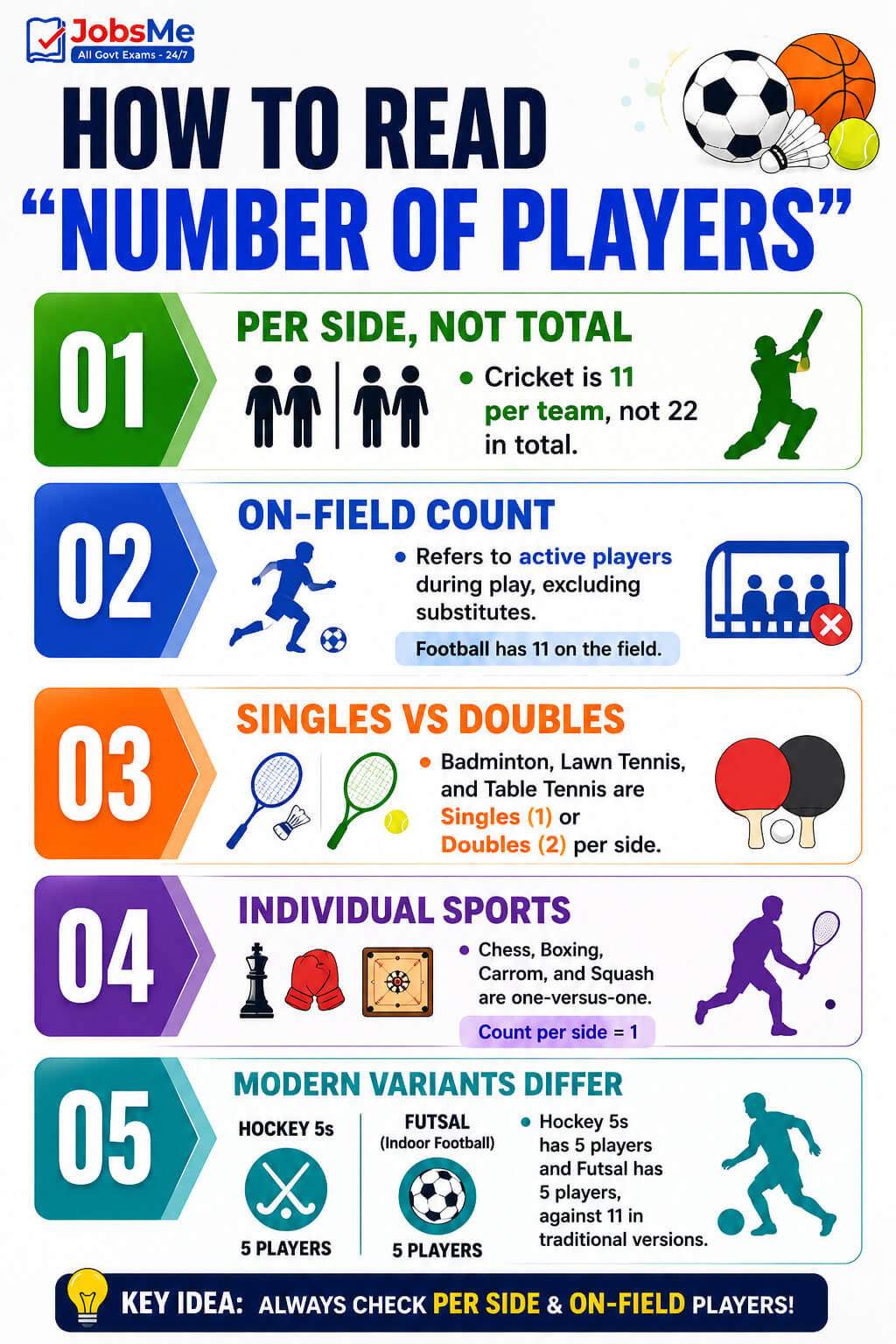
- Per side, not total: When an exam says "number of players in Cricket is 11," it means 11 per team, not 22 in total.
- On-field count: The number refers to active players during play, excluding substitutes. For example, Football has 11 on the field, even though a squad has more.
- Singles vs Doubles: Racquet and indoor games like Badminton, Lawn Tennis, and Table Tennis are played as Singles (1 player) or Doubles (2 players) per side.
- Individual sports: Games like Chess, Boxing, Carrom, and Squash are essentially one-versus-one, so the count per side is 1.
- Modern variants differ: Newer formats change the count — Hockey 5s has 5 players and Futsal (indoor football) has 5 players, against 11 in the traditional versions.
Number of Players in Team Sports
The following table lists the most exam-relevant team sports along with the number of players on each side and key facts that are commonly tested.
| Sport / Game | Players per Side | Key Features / Details |
|---|---|---|
| Cricket | 11 | Played between two teams of 11 players each; one of the most asked sports in exams; governed by the ICC. |
| Football (Soccer) | 11 | Two teams of 11 players each including the goalkeeper; world's most popular sport; governed by FIFA. |
| Hockey (Field Hockey) | 11 | Eleven players per side including the goalkeeper; India's most successful Olympic sport historically; governed by FIH. |
| Hockey 5s | 5 | A newer, faster five-a-side version of field hockey; played on a smaller pitch with no offside rule. |
| Baseball | 9 | Nine players per team in the field; popular in the USA, Japan, and Cuba. |
| Softball | 9 | Similar to baseball with nine players per side; uses a larger ball and underarm pitching. |
| Rugby Football | 15 | Has the highest number of players on each side among common team sports; Rugby Sevens is a 7-a-side variant. |
| Volleyball | 6 | Six players per side on the court; played to a points-based set system; governed by FIVB. |
| Beach Volleyball | 2 | Played by just 2 players per side on sand; an Olympic discipline distinct from indoor volleyball. |
| Basketball | 5 | Five players per team on the court at a time; high-scoring indoor game governed by FIBA. |
| Kabaddi | 7 | Seven players per side; national sport of Bangladesh; popularised in India through the Pro Kabaddi League. |
| Kho-Kho | 9 | Nine players take the field out of a team of twelve; a traditional Indian chasing-and-tagging sport. |
| Handball | 7 | Seven players per side including the goalkeeper; a fast indoor team sport. |
| Netball | 7 | Seven players per side; a non-contact game similar to basketball, popular in Commonwealth nations. |
| Water Polo | 7 | Seven players per team (6 field players and 1 goalkeeper) in the pool; a full-contact aquatic sport. |
| Water Basketball | 5 | Five players per side; combines elements of basketball and water polo played in a pool. |
| Polo | 4 | Four players per side, played on horseback with mallets and a ball. |
| Cycle Polo | 3 or 5 | Played on bicycles instead of horses; a variant of traditional polo. |
| Lacrosse | 10 | Ten players per side in men's field lacrosse including the goalkeeper; women's field lacrosse has 12. |
| Ice Hockey | 6 | Six players per side on the ice including the goaltender; played on a rink with a puck. |
| Bandy | 11 | Eleven players per side; a winter team sport played on ice with a ball, similar to field hockey. |
| Kickball | 10 | Ten players per side; resembles baseball but the ball is kicked instead of hit; also called soccer baseball. |
| Tug of War | 8 | Eight members per team in standard competition; a pure strength-and-coordination sport. |
| Futsal | 5 | Five players per side; the indoor five-a-side version of football. |
| Sepak Takraw | 3 | Three players per side; a Southeast Asian sport combining football and volleyball using a rattan ball. |
| Underwater Football | 5 | Five players per side; played at the bottom of a swimming pool. |
Number of Players in Racquet and Bat-and-Ball Games
These games are played either as Singles (one player per side) or Doubles (two players per side). They are very commonly asked in the exam as "Singles or Doubles" type questions.
| Game | Players per Side | Key Features / Details |
|---|---|---|
| Badminton | 1 (Singles) or 2 (Doubles) | Played with a shuttlecock; governed by the BWF; mixed doubles also uses 2 players per side. |
| Lawn Tennis | 1 (Singles) or 2 (Doubles) | Played on a court with rackets and a ball; Grand Slam events feature both singles and doubles. |
| Table Tennis | 1 (Singles) or 2 (Doubles) | Also called Ping Pong; played on a table; governed by the ITTF. |
| Squash | 1 (Singles) or 2 (Doubles) | Played inside a four-walled court with a small rubber ball; mostly contested as singles. |
Number of Players in Individual and Board Games
In these games, each side is represented by a single player. The count per side is therefore one.
| Game | Players per Side | Key Features / Details |
|---|---|---|
| Chess | 1 | A two-player strategy board game; one player per side; governed by FIDE. |
| Boxing | 1 | A one-versus-one combat sport contested in weight categories inside a ring. |
| Carrom (Carom) | 1 (Singles) or 2 (Doubles) | An indoor tabletop game; played as singles or doubles using striker and coins. |
| Billiards / Snooker | 1 | Cue sports played on a table; contested individually one against one. |
| Golf | 1 | An individual sport where several players play together but score individually. |
| Croquet | 2, 4 or 6 | A lawn game played with mallets and balls; number varies by format (singles or doubles). |
| Curling | 4 | Four players per team; a winter sport where stones are slid across ice toward a target. |
Memory Tricks and Mnemonics
Trick 1: The "Eleven Club" — Games with 11 Players
Several major sports have exactly 11 players per side. Group them together:
- C → Cricket.
- F → Football.
- H → Hockey (Field Hockey).
- B → Bandy.
"CFHB — all eleven a side."
Trick 2: The "Magnificent Seven" — Games with 7 Players
Remember the four well-known games that have 7 players per side:
- K → Kabaddi.
- H → Handball.
- N → Netball.
- W → Water Polo.
"KHNW — seven each, two on land, one in water, one without contact."
Trick 3: The "Famous Five" — Games with 5 Players
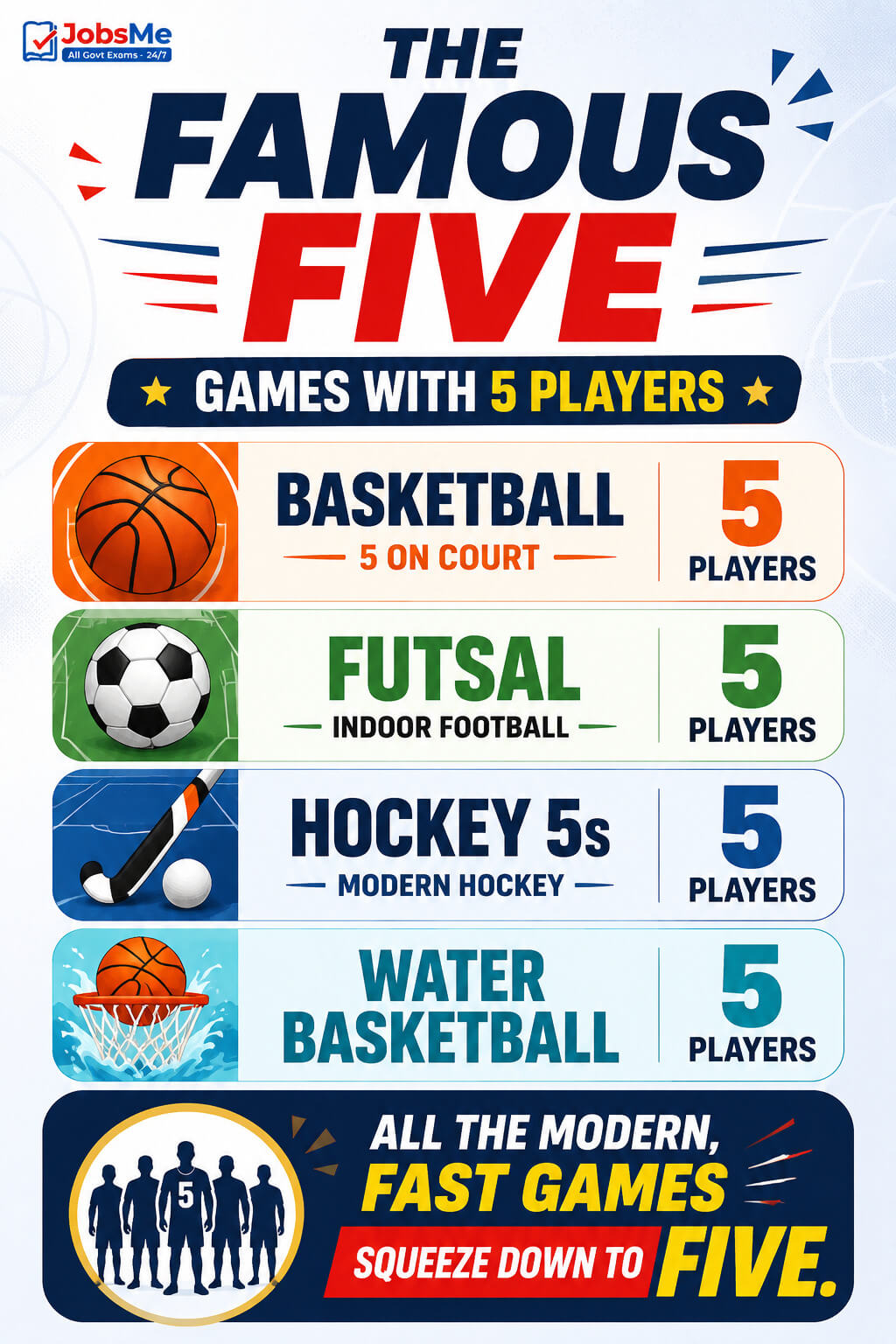
- Basketball → 5 on court.
- Futsal → 5 (indoor football).
- Hockey 5s → 5 (modern hockey).
- Water Basketball → 5.
"All the modern, fast games squeeze down to five."
Trick 4: Highest and Lowest — "15 to 1"
To recall the extremes asked most often:
- Highest: Rugby Football → 15 players per side (the most among common team sports).
- Lowest team sport: Beach Volleyball and Sepak Takraw → 2 and 3 players.
- Individual: Chess, Boxing, Squash → 1 player per side.
Trick 5: Singles or Doubles — "BLTS"
The games played as both Singles and Doubles can be remembered as "BLTS":
- B → Badminton.
- L → Lawn Tennis.
- T → Table Tennis.
- S → Squash.
"BLTS — one or two on each side."
Trick 6: The Nines — "Baseball Brings Nine"
- Baseball → 9.
- Softball → 9.
- Kho-Kho → 9 (on the field, out of 12).
"Bat, soft bat, and chase — all nines."
Trick 7: Water Games Count — "Polo Seven, Basket Five"
- Water Polo → 7 (6 field + 1 goalkeeper).
- Water Basketball → 5.
- Underwater Football → 5.
"In the pool, polo gets the extra two."
Additional Notes
Frequently Confused Facts
- Volleyball vs Water Polo: Volleyball has 6 players per side, while Water Polo has 7 players per side — do not mix the two.
- Kabaddi vs Kho-Kho: Kabaddi has 7 players on the field; Kho-Kho has 9 players on the field (from a 12-member squad). Both are traditional Indian sports but with different counts.
- Basketball vs Netball: Basketball has 5 players, while the similar-looking Netball has 7 players per side.
- Polo vs Water Polo: Polo (on horseback) has 4 players; Water Polo (in a pool) has 7 players.
- Hockey vs Hockey 5s vs Ice Hockey: Field Hockey has 11, the modern Hockey 5s has 5, and Ice Hockey has 6 players per side.
- Football vs Futsal: Traditional Football has 11 players; Futsal, the indoor version, has 5 players per side.
- Rugby Football vs Rugby Sevens: Standard Rugby has 15 players; the Olympic Rugby Sevens format has 7 players per side.
- Beach Volleyball vs Volleyball: Indoor Volleyball has 6 players; Beach Volleyball has only 2 players per side.
- Lacrosse Men vs Women: Men's field lacrosse has 10 players; women's field lacrosse has 12 players per side.
- Handball vs Netball vs Kabaddi: All three have 7 players per side, which is why they are often grouped together in mnemonics.
Repeating PYQ Patterns
Certain sports are asked repeatedly in competitive exams. Cricket (11), Football (11), Hockey (11), Kabaddi (7), Kho-Kho (9), Basketball (5), Volleyball (6), Rugby (15), Polo (4), and Water Polo (7) appear most often in SSC CGL, RRB NTPC, and UPSC Prelims papers. Banking exams (IBPS PO, SBI Clerk) frequently ask "which game has how many players" or "which sport has the maximum players." State PCS and Defence exams also test traditional Indian sports like Kabaddi and Kho-Kho, and the "highest number of players" question (Rugby — 15) is a recurring favourite across almost all exams.
Quick Insight
The number of players in a sport often reflects how the game is played — high-scoring fast games like Basketball and Futsal use fewer players (5) for speed, while territory-based field games like Rugby and Football use larger teams. With the rise of the Pro Kabaddi League, Khelo India, and India's growing Olympic presence in Hockey, Wrestling, and Athletics, this topic frequently overlaps with current affairs. Knowing the player counts helps aspirants quickly answer both static questions and sports-related current affairs items. For further preparation, you can refer to the Static GK notes and stay updated through the Daily Current Affairs page on Jobsme.in.
One-Liners for Quick Revision
- Cricket → 11 players per side → governed by the ICC.
- Football (Soccer) → 11 players per side → governed by FIFA.
- Hockey (Field Hockey) → 11 players per side → governed by the FIH.
- Hockey 5s → 5 players per side → modern fast version of hockey.
- Baseball → 9 players per side → popular in the USA and Japan.
- Softball → 9 players per side → uses underarm pitching and a larger ball.
- Rugby Football → 15 players per side → highest among common team sports.
- Volleyball → 6 players per side → governed by the FIVB.
- Beach Volleyball → 2 players per side → played on sand.
- Basketball → 5 players per side → governed by FIBA.
- Kabaddi → 7 players per side → national sport of Bangladesh.
- Kho-Kho → 9 players on field → traditional Indian chasing sport.
- Handball → 7 players per side → fast indoor team sport.
- Netball → 7 players per side → non-contact game like basketball.
- Water Polo → 7 players per side → 6 field players plus 1 goalkeeper.
- Water Basketball → 5 players per side → played in a pool.
- Polo → 4 players per side → played on horseback.
- Cycle Polo → 3 or 5 players per side → played on bicycles.
- Lacrosse → 10 players per side (men) → 12 for women's field lacrosse.
- Ice Hockey → 6 players per side → played on a rink with a puck.
- Bandy → 11 players per side → winter sport similar to field hockey.
- Kickball → 10 players per side → also called soccer baseball.
- Tug of War → 8 members per team → pure strength sport.
- Futsal → 5 players per side → indoor version of football.
- Sepak Takraw → 3 players per side → Southeast Asian kick-volleyball.
- Underwater Football → 5 players per side → played at the pool bottom.
- Badminton → 1 (Singles) or 2 (Doubles) → governed by the BWF.
- Lawn Tennis → 1 (Singles) or 2 (Doubles) → played with rackets and a ball.
- Table Tennis → 1 (Singles) or 2 (Doubles) → also called Ping Pong.
- Squash → 1 (Singles) or 2 (Doubles) → played in a four-walled court.
- Chess → 1 player per side → governed by FIDE.
- Boxing → 1 player per side → combat sport in weight categories.
- Carrom → 1 (Singles) or 2 (Doubles) → indoor tabletop game.
- Billiards / Snooker → 1 player per side → cue sports on a table.
- Golf → 1 player → individuals play together but score individually.
- Croquet → 2, 4 or 6 players → lawn game with mallets and balls.
- Curling → 4 players per team → winter ice sport with stones.
For more Static GK topics like national sports, cups and trophies, and sports terms, explore the Static GK section on Jobsme.in. You can also test your preparation with the Static GK Quiz and check out the latest exam updates at Latest Government Job Notifications.
Free quiz • No signup required
Put this topic into practice with Indian Cultural Institutions – Static GK MCQ Quiz. It is the quickest way to reinforce what you just learned.
Frequently Asked Questions
How many players are there in a Cricket team?
Which game has the highest number of players on each side?
How many players are there in Kabaddi and Kho-Kho?
How many players are there in a Volleyball team?
Which sports are played with 7 players on each side?
How many players are there in Basketball?
How many players are there in Hockey?
Which games are played as both singles and doubles?
How many players are there in a Polo team?
How many players are there in a Football team?

About the author