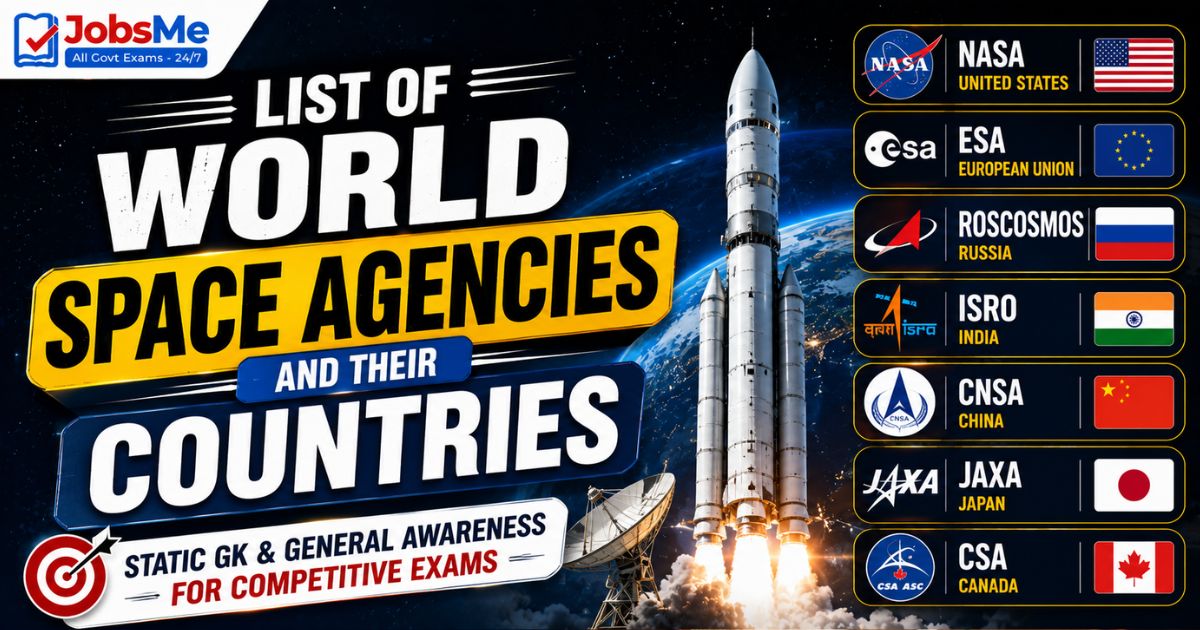
List of World Space Agencies and Their Countries – Static GK & General Awareness for Competitive Exams with Memory Tricks
This article presents a complete list of major space agencies of the world along with their country, headquarters, founding year, and key missions, covering NASA (USA), ESA (Europe), ISRO (India), Roscosmos (Russia), CNSA (China), JAXA (Japan), and many more. It includes the agencies' full forms, first satellites, landmark missions, and the most important one-liners with memory tricks for quick revision. All facts are arranged in exam-ready format to help UPSC, SSC, IBPS, RRB, PSU, and State PCS aspirants score better in the General Awareness and Science & Technology sections.
Jump to section
Introduction
Space agencies are government or regional organisations responsible for planning, developing, and executing a nation's space exploration, satellite, and research programmes. From the launch of the world's first satellite to lunar landings and Mars missions, these agencies have shaped humanity's reach into the cosmos. The most prominent among them are NASA of the United States, the European Space Agency (ESA), the Indian Space Research Organisation (ISRO), Russia's Roscosmos, the China National Space Administration (CNSA), and Japan's JAXA.
Questions on world space agencies, their full forms, countries, headquarters, and famous missions appear regularly in UPSC Prelims, SSC CGL, IBPS PO, RRB NTPC, SBI Clerk, State PCS, and various Insurance and Defence exams. Questions typically ask which agency belongs to which country, what an abbreviation stands for, where an agency is headquartered, or which agency carried out a particular mission such as Chandrayaan, Rosetta, or Hayabusa. This article brings together every important space agency in a structured, exam-ready format. To explore other related Static GK topics, you can refer to the Static GK section on Jobsme.in.
Space agencies are also closely tied to current affairs themes such as new satellite launches, lunar and interplanetary missions, India's Gaganyaan human spaceflight programme, the Artemis Moon programme, and international space cooperation — making this topic doubly important for aspirants who track daily news. You can keep up with the latest developments through the Daily Current Affairs page on Jobsme.in.
Core Concepts: Understanding Space Agencies
A space agency is an organisation set up by a government, or a group of governments, to carry out activities related to outer space — including satellite launches, space exploration, Earth observation, scientific research, and international collaboration. Understanding the structure and purpose of these agencies helps students remember their missions and answer related questions confidently.
Key Points to Remember
- National vs Regional Agencies: Most agencies belong to a single country (NASA, ISRO, JAXA), but ESA is a regional agency that coordinates more than 20 European member states.
- Civil in Nature: Most space agencies are civilian organisations focused on peaceful exploration, communication, navigation, and research, distinct from a country's military space wing.
- Launch Capability: Of the 70-plus space agencies in the world, only about 16 can independently conduct a space launch, and only a handful can send probes to the Moon, Mars, or deep space.
- ISS Partners: The International Space Station is run jointly by five agencies — NASA, Roscosmos, ESA, JAXA, and CSA (Canada).
- Private Players: Apart from government agencies, private companies such as SpaceX and Blue Origin (USA) have become major players in launches and space tourism.
Major Space Agencies of the World
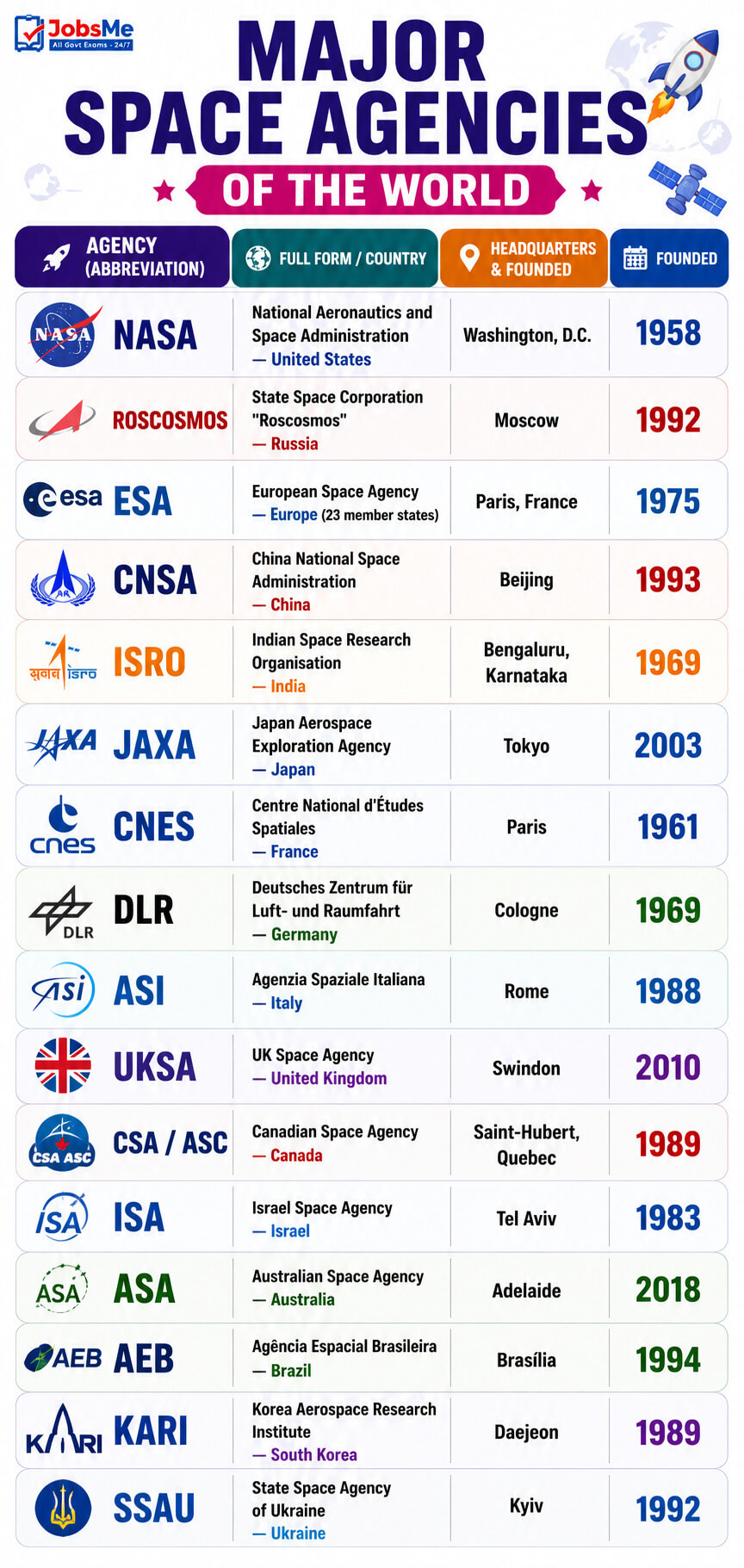
The following table lists the world's leading space agencies with their full form, country, headquarters, founding year, and key missions or achievements.
| Agency (Abbreviation) | Full Form / Country | Headquarters & Founded | Key Missions / Details |
|---|---|---|---|
| NASA | National Aeronautics and Space Administration — United States | Washington, D.C.; founded 1958 | Oldest and best-funded agency; Apollo Moon landings (1969), Hubble Space Telescope (1990), Mars rovers, and the ongoing Artemis programme to return humans to the Moon. |
| Roscosmos | State Space Corporation "Roscosmos" — Russia | Moscow; founded 25 February 1992 (successor to the Soviet space programme) | Launched the first artificial satellite Sputnik 1 (1957) and sent the first human, Yuri Gagarin, into space (1961); major ISS partner operating the Russian Orbital Segment. |
| ESA | European Space Agency — Europe (23 member states) | Paris, France; founded 1975 | Regional agency formed by merging ESRO and ELDO; Ariane rocket family, Rosetta comet landing (2014), ExoMars, and partnership in the ISS and Artemis programmes. |
| CNSA | China National Space Administration — China | Beijing; founded 1993 | Launched its first satellite Dong Fang Hong 1 (1970); Chang'e lunar programme (Chang'e 4 landed on the Moon's far side in 2019), Tianwen-1 Mars mission, and the Tiangong space station. |
| ISRO | Indian Space Research Organisation — India | Bengaluru (Bangalore), Karnataka; founded 15 August 1969 | Known for cost-effective missions; first satellite Aryabhata (1975), Chandrayaan Moon missions, Mars Orbiter Mission "Mangalyaan" (2013) making India the first Asian nation to reach Mars orbit, and the upcoming Gaganyaan human spaceflight programme. |
| JAXA | Japan Aerospace Exploration Agency — Japan | Tokyo; founded 1 October 2003 | Formed by merging ISAS, NAL, and NASDA; Hayabusa and Hayabusa2 asteroid sample-return missions, the Kibo module on the ISS, and the SLIM lunar lander; slogan "Explore to Realize." |
| CNES | Centre National d'Études Spatiales (National Centre for Space Studies) — France | Paris; founded 1961 | Third-oldest space agency in the world (after NASA and the Soviet/Russian programme); main participant in the Ariane rocket project and a key contributor to ESA. |
| DLR | Deutsches Zentrum für Luft- und Raumfahrt (German Aerospace Center) — Germany | Cologne; founded 1969 | Contributed to major missions like Rosetta and ExoMars; works on satellite technology and reusable launch vehicle research with France's CNES. |
| ASI | Agenzia Spaziale Italiana (Italian Space Agency) — Italy | Rome; founded 1988 | Contributed payloads to NASA and ESA missions including Cassini-Huygens (Saturn), Mars Express, and Venus Express; supports human spaceflight activities. |
| UKSA | UK Space Agency — United Kingdom | Swindon; founded 2010 | Coordinates the UK's space activities and represents the country on ESA governing bodies; partners on Earth observation and satellite navigation programmes. |
| CSA / ASC | Canadian Space Agency — Canada | Saint-Hubert, Quebec; founded March 1989 | Developed the famous Canadarm robotic arm used in space; one of the five ISS partner agencies. |
| ISA | Israel Space Agency — Israel | Tel Aviv; founded 1983 | One of the smallest countries with indigenous launch capability; launched its first satellite in 1988 using the Shavit launch vehicle; collaborates with NASA, ISRO, and others. |
| ASA | Australian Space Agency — Australia | Adelaide; founded 2018 | Re-established Australia's space role; partnering with NASA on a lunar rover project and aiming to expand the national space sector. |
| AEB | Agência Espacial Brasileira (Brazilian Space Agency) — Brazil | Brasília; founded 1994 | Launched its first rocket into space in 2004; operates the Alcântara Launch Centre near the equator, valued for fuel-efficient launches. |
| KARI | Korea Aerospace Research Institute — South Korea | Daejeon; founded 1989 | Developed the indigenous Nuri (KSLV-II) rocket and the Danuri lunar orbiter, making South Korea a growing space power. |
| SSAU | State Space Agency of Ukraine — Ukraine | Kyiv; founded 1992 (as NSAU, renamed 2010) | Manufactured many rockets for the former USSR; lacks its own launch facilities and partners with NASA and ESA. |
Memory Tricks and Mnemonics
Trick 1: The Six Big Agencies — "NICE RJ"
Remember the six most important space agencies with the phrase "NICE RJ":
- N → NASA (USA).
- I → ISRO (India).
- C → CNSA (China).
- E → ESA (Europe).
- R → Roscosmos (Russia).
- J → JAXA (Japan).
"NICE RJ runs the world's space race."
Trick 2: ISS Partners — "JERCN"
Only five agencies jointly run the International Space Station. Remember them as "JERCN":
- J → JAXA (Japan).
- E → ESA (Europe).
- R → Roscosmos (Russia).
- C → CSA (Canada).
- N → NASA (USA).
"Five flags, one station."
Trick 3: The "Three Oldest" Agencies
To recall the three oldest space agencies in order of founding:
- Soviet/Russian programme → launched Sputnik in 1957 (oldest space effort).
- NASA → 1958 (oldest formal agency still active by that name).
- CNES (France) → 1961 (third-oldest space agency in the world).
"Sputnik, then NASA, then France — 57, 58, 61."
Trick 4: First Satellites — "Match the First"
Link each major nation to the name of its first satellite:
- USSR/Russia → Sputnik 1 (1957) — world's first satellite.
- India → Aryabhata (1975).
- China → Dong Fang Hong 1 (1970).
- Japan → Ohsumi / Osumi (1970).
Trick 5: JAXA = "Three Became One"
JAXA was created in 2003 by merging three Japanese bodies. Remember the merger as "I-N-N":
- I → ISAS (Institute of Space and Astronautical Science).
- N → NAL (National Aerospace Laboratory).
- N → NASDA (National Space Development Agency).
"Three Japanese agencies became one JAXA in 2003."
Trick 6: Famous Missions — "Match the Mission to the Agency"
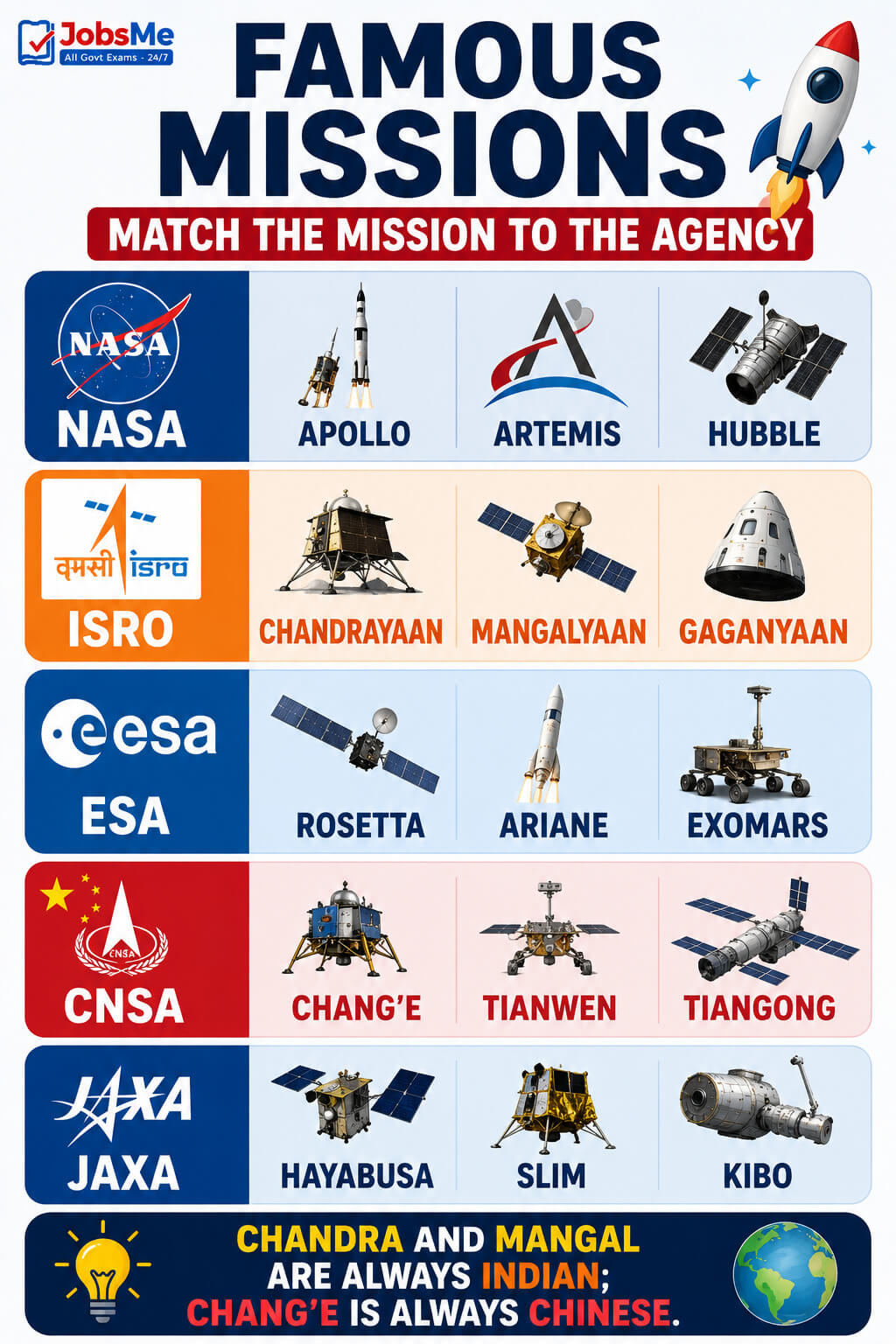
- Apollo / Artemis / Hubble → NASA.
- Chandrayaan / Mangalyaan / Gaganyaan → ISRO.
- Rosetta / Ariane / ExoMars → ESA.
- Chang'e / Tianwen / Tiangong → CNSA.
- Hayabusa / SLIM / Kibo → JAXA.
"Chandra and Mangal are always Indian; Chang'e is always Chinese."
Trick 7: Capital-City Headquarters
Several major agencies are headquartered in capital or famous cities — group them to recall faster:
- Paris → ESA and CNES (both French-based).
- Moscow → Roscosmos.
- Beijing → CNSA.
- Tokyo → JAXA.
- Bengaluru → ISRO (the only major one not in a national capital).
Additional Notes
Frequently Confused Facts
- ISRO founding year: ISRO was founded on 15 August 1969, while India's first satellite Aryabhata was launched later, in 1975. Do not confuse the two years.
- Roscosmos vs Soviet programme: Roscosmos as an agency was formed in 1992, but the space achievements like Sputnik (1957) and Gagarin (1961) belong to the earlier Soviet space programme that it succeeded.
- NASA vs CNES vs Soviet programme: NASA (1958) is the oldest agency by current name; CNES (1961) is the third-oldest agency; the Soviet programme that launched Sputnik in 1957 predates both.
- ESA vs EU: The European Space Agency (ESA) is an independent organisation and is not the same as the European Union; some ESA members are not EU members and vice versa.
- CNSA vs CMSA: China has two bodies — the China National Space Administration (CNSA) for civil space, and the smaller China Manned Space Agency (CMSA) for its human spaceflight programme.
- JAXA founding year: JAXA itself was formed in 2003, but its predecessor NASDA was founded in 1969 — questions sometimes test the predecessor's date.
- Dong Fang Hong vs Ohsumi: China's first satellite was Dong Fang Hong 1 and Japan's first was Ohsumi (Osumi); both were launched in 1970.
- Mangalyaan first: ISRO's Mars Orbiter Mission (Mangalyaan, 2013) made India the first Asian country to reach Mars orbit and the first nation to do so on its maiden attempt.
Repeating PYQ Patterns
Certain agency facts are asked repeatedly in competitive exams. NASA (USA, 1958), ISRO (India, 1969, Bengaluru), ESA (Europe, 1975, Paris), Roscosmos (Russia, 1992), CNSA (China, 1993, Beijing), and JAXA (Japan, 2003, Tokyo) appear most often in UPSC Prelims, SSC CGL, and RRB NTPC papers. Banking exams (IBPS PO, SBI Clerk) frequently focus on matching the agency to its country or full form, and on recent ISRO mission names like Chandrayaan-3 and Aditya-L1. State PCS and Defence exams add launch vehicles (PSLV, GSLV, Ariane, Falcon) and first-satellite names such as Aryabhata and Sputnik.
Quick Insight
Space agencies are at the centre of modern current affairs — India's Chandrayaan-3 soft landing near the Moon's south pole, the Aditya-L1 solar mission, the Gaganyaan human spaceflight programme, NASA's Artemis Moon missions, and China's Tiangong space station regularly feature in the news. Knowing which agency belongs to which country and what each is famous for helps aspirants instantly decode any space-related headline, which is invaluable for both Prelims (direct matching questions) and Mains/Interview (science and technology discussion). For regular updates and practice, you can use the Daily Current Affairs Quiz and revise core facts in the Static GK notes on Jobsme.in.
One-Liners for Quick Revision
- NASA → National Aeronautics and Space Administration → USA, founded 1958, HQ Washington D.C.; Apollo, Hubble, Artemis.
- Roscosmos → State Space Corporation → Russia, founded 1992, HQ Moscow; successor to the Soviet programme that launched Sputnik (1957) and Gagarin (1961).
- ESA → European Space Agency → Europe (23 members), founded 1975, HQ Paris; Ariane rockets, Rosetta comet landing.
- CNSA → China National Space Administration → China, founded 1993, HQ Beijing; Chang'e Moon programme, Tianwen-1 Mars, Tiangong station.
- ISRO → Indian Space Research Organisation → India, founded 1969, HQ Bengaluru; Aryabhata, Chandrayaan, Mangalyaan, Gaganyaan.
- JAXA → Japan Aerospace Exploration Agency → Japan, founded 2003, HQ Tokyo; Hayabusa asteroid missions, Kibo, SLIM.
- CNES → Centre National d'Études Spatiales → France, founded 1961, HQ Paris; third-oldest agency, Ariane project.
- DLR → German Aerospace Center → Germany, founded 1969, HQ Cologne; Rosetta and ExoMars contributions.
- ASI → Italian Space Agency → Italy, founded 1988, HQ Rome; Cassini-Huygens, Mars Express payloads.
- UKSA → UK Space Agency → United Kingdom, founded 2010, HQ Swindon; represents UK at ESA.
- CSA → Canadian Space Agency → Canada, founded 1989, HQ Saint-Hubert (Quebec); built the Canadarm; ISS partner.
- ISA → Israel Space Agency → Israel, founded 1983, HQ Tel Aviv; first satellite 1988 via Shavit rocket.
- ASA → Australian Space Agency → Australia, founded 2018, HQ Adelaide; NASA lunar rover partner.
- AEB → Brazilian Space Agency → Brazil, founded 1994, HQ Brasília; Alcântara equatorial launch centre.
- KARI → Korea Aerospace Research Institute → South Korea, founded 1989, HQ Daejeon; Nuri rocket, Danuri lunar orbiter.
- SSAU → State Space Agency of Ukraine → Ukraine, founded 1992, HQ Kyiv; built rockets for the USSR.
- ISS Partners → NASA, Roscosmos, ESA, JAXA, CSA — the five agencies running the International Space Station.
- First satellite ever → Sputnik 1, launched by the USSR in 1957.
- First human in space → Yuri Gagarin (USSR), 1961.
- India's first satellite → Aryabhata, 1975 (launched with Soviet help).
- China's first satellite → Dong Fang Hong 1, 1970.
- Japan's first satellite → Ohsumi (Osumi), 1970.
- Private players → SpaceX and Blue Origin (USA), leaders in reusable rockets and space tourism.
For more Static GK topics like Indian satellites, launch vehicles, and important scientific organisations, explore the Static GK section on Jobsme.in. You can also test your knowledge with the Static GK Quiz, sharpen your news sense with the Daily Current Affairs Quiz, and check out the latest exam notifications at Latest Government Job Notifications.
Free quiz • No signup required
Put this topic into practice with Indian Cultural Institutions – Static GK MCQ Quiz. It is the quickest way to reinforce what you just learned.
Frequently Asked Questions
Which is the oldest space agency in the world?
Where is the headquarters of ISRO located?
What is the full form of NASA and which country does it belong to?
How many countries are members of the European Space Agency?
Which agencies jointly operate the International Space Station?
What was the first artificial satellite and who launched it?
When was JAXA formed and which organisations merged to create it?
Which was India's first satellite and when was it launched?
What is the name of China's space agency and its first satellite?
Which space agency carried out the Mangalyaan mission?

About the author