List of Important Straits and Canals of the World – Static GK & General Awareness for Competitive Exams with Memory Tricks
This article presents a complete list of the important straits and canals of the world, covering the water bodies they connect, the landmasses they separate, and their strategic and economic significance. It includes major straits like Malacca, Hormuz, Gibraltar, Bab-el-Mandeb, Bosporus, Bering, and Palk Strait, along with key canals such as the Suez, Panama, Kiel, Corinth, and the Grand Canal of China, with memory tricks and one-liners for quick revision. All facts are arranged in exam-ready format to help UPSC, SSC, IBPS, RRB, PSU, and State PCS aspirants score better in Geography and General Awareness sections.
Jump to section
Introduction
Straits and canals are among the most important features in world geography and a favourite topic in competitive exams. A strait is a naturally formed narrow waterway that connects two larger water bodies (seas or oceans) while separating two landmasses, whereas a canal is an artificial, man-made waterway built to shorten shipping routes. The Strait of Malacca carries nearly a third of global trade; the Strait of Hormuz is the world's most important oil chokepoint; the Suez Canal links Europe to Asia without sailing around Africa; and the Panama Canal joins the Atlantic and Pacific oceans across the narrow Isthmus of Panama.
Questions on straits and canals appear regularly in UPSC Prelims, SSC CGL, IBPS PO, RRB NTPC, SBI Clerk, State PCS, and various Insurance and Defence exams. Questions typically ask which two water bodies a strait or canal connects, which two countries or landmasses it separates, or which waterway is the busiest or most strategic. This article brings together every important strait and canal in a structured, exam-ready format. To explore other related Static GK topics, you can refer to the Static GK section on Jobsme.in.
Straits and canals are also closely linked to current affairs themes such as the Red Sea shipping disruptions affecting the Suez Canal, drought-related transit limits on the Panama Canal, tensions in the Strait of Hormuz and Taiwan Strait, and India's strategic interest in the Malacca Strait and the Ten Degree Channel near the Andaman and Nicobar Islands — making this topic doubly important for aspirants preparing for UPSC Mains and Essay papers as well.
Core Concepts: Straits versus Canals
Understanding the basic difference between a strait and a canal is the first step to answering exam questions confidently. Both are narrow waterways that connect larger water bodies, but they differ in origin and purpose.
Key Definitions
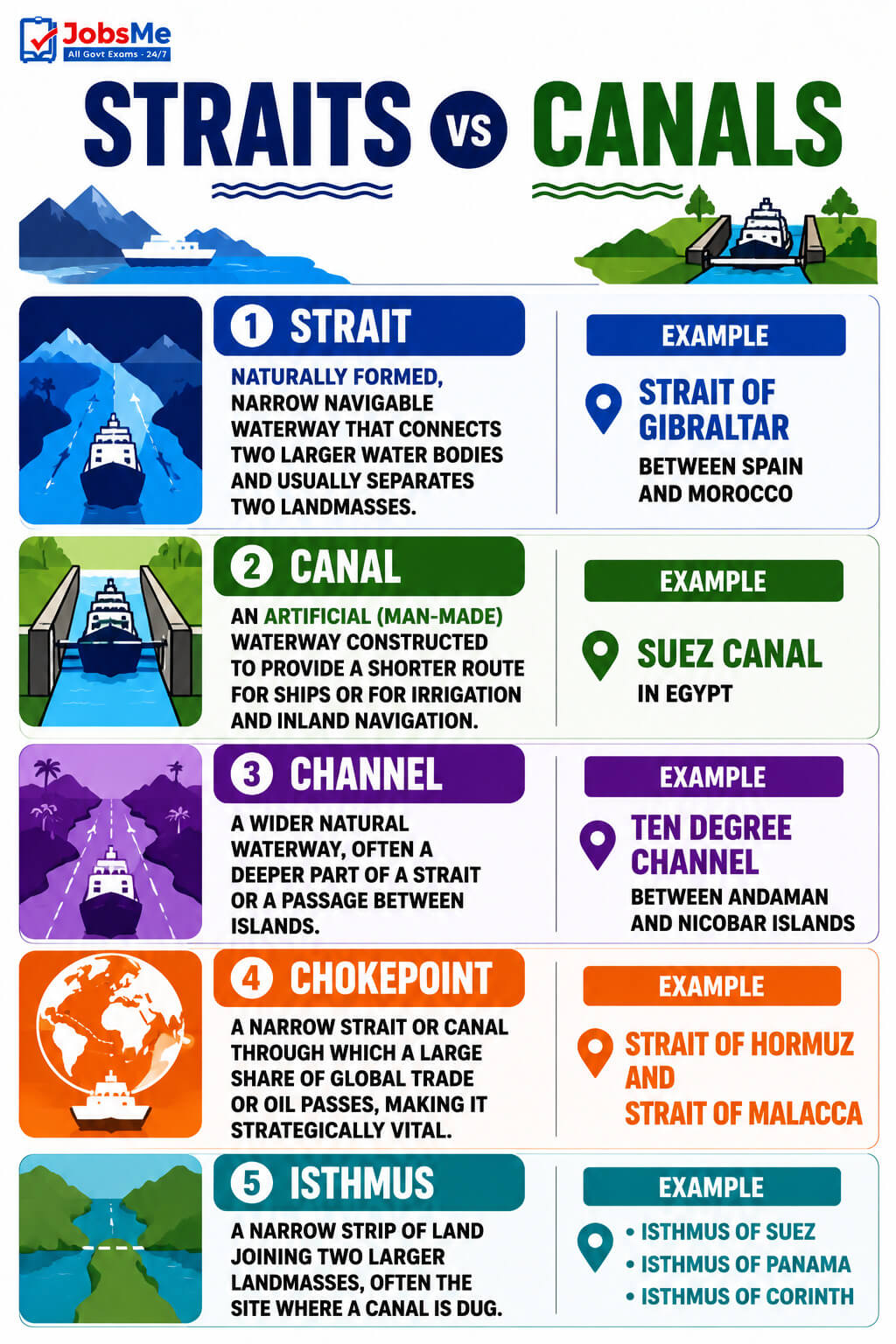
- Strait: A naturally formed, narrow navigable waterway that connects two larger water bodies and usually separates two landmasses. Example: Strait of Gibraltar between Spain and Morocco.
- Canal: An artificial (man-made) waterway constructed to provide a shorter route for ships or for irrigation and inland navigation. Example: Suez Canal in Egypt.
- Channel: A wider natural waterway, often a deeper part of a strait or a passage between islands. Example: Ten Degree Channel between the Andaman and Nicobar Islands.
- Chokepoint: A narrow strait or canal through which a large share of global trade or oil passes, making it strategically vital. Example: Strait of Hormuz and Strait of Malacca.
- Isthmus: A narrow strip of land joining two larger landmasses, often the site where a canal is dug. Example: Isthmus of Suez, Isthmus of Panama, Isthmus of Corinth.
For more foundational geography and general awareness topics, you can practise with the Static GK Quiz on Jobsme.in.
Important Straits of the World
The following table lists the most exam-relevant straits of the world, the water bodies they connect, the landmasses or countries they separate, and their strategic significance.
| Strait | Connects (Water Bodies) | Separates / Location | Key Details & Significance |
|---|---|---|---|
| Strait of Malacca | Andaman Sea (Indian Ocean) and South China Sea (Pacific Ocean) | Between the Malay Peninsula (Malaysia) and Sumatra (Indonesia) | The world's longest strait (about 800-900 km) and one of the busiest shipping routes, carrying roughly a quarter to a third of global trade; the shortest sea route between India and China. |
| Strait of Hormuz | Persian Gulf and Gulf of Oman (Arabian Sea) | Between Iran and Oman (UAE) | The only sea passage out of the Persian Gulf and the world's most important oil chokepoint; primary export route for petroleum from Iran, Iraq, Kuwait, Qatar, and the UAE. |
| Strait of Gibraltar | Atlantic Ocean and Mediterranean Sea | Between Spain (Europe) and Morocco (Africa) | The only natural entrance to the Mediterranean Sea; narrowest point about 13 km; historically a vital naval and commercial gateway between Europe and Africa. |
| Bab-el-Mandeb | Red Sea and Gulf of Aden (Arabian Sea) | Between Yemen (Asia) and Djibouti/Eritrea (Africa) | Means "Gate of Tears"; the southern gateway to the Suez Canal route; critical for ships moving between Europe and Asia. |
| Bosporus Strait | Black Sea and Sea of Marmara | In Turkey, dividing Europe (Thrace) from Asia (Anatolia) | Runs through Istanbul; often called one of the narrowest navigable straits; part of the Turkish Straits and a key oil-export route from the Black Sea region. |
| Dardanelles (Hellespont) | Aegean Sea and Sea of Marmara | In northwestern Turkey, between Europe and Asia | Along with the Bosporus, forms the Turkish Straits linking the Mediterranean with the Black Sea; historically defended Byzantium and the Ottoman Empire. |
| Bering Strait | Bering Sea (Pacific Ocean) and Chukchi Sea (Arctic Ocean) | Between Russia (Asia) and Alaska, USA (North America) | About 85 km wide; marks the closest point between Asia and North America; contains the Diomede Islands, split by the International Date Line. |
| Palk Strait | Bay of Bengal and Palk Bay (and Gulf of Mannar to the south) | Between India (Tamil Nadu) and Sri Lanka | The most important strait for India; near its southern end lies the chain of shoals known as Adam's Bridge or Ram Setu. |
| Sunda Strait | Java Sea and Indian Ocean | Between Java and Sumatra (Indonesia) | An alternative to the Malacca Strait; shallow with strong tidal currents; lies near the volcano Krakatoa. |
| Strait of Magellan | Atlantic Ocean and Pacific Ocean | In southern Chile, between mainland South America and Tierra del Fuego | Named after Ferdinand Magellan; the most important natural passage between the two oceans before the Panama Canal was built. |
| Strait of Messina | Tyrrhenian Sea and Ionian Sea (both in the Mediterranean) | Between Sicily and the Italian mainland | Associated with the mythical sea monsters Scylla and Charybdis; known for strong tidal currents. |
| Strait of Dover | English Channel and North Sea | Between Great Britain and France (Europe) | The narrowest part of the English Channel; one of the world's busiest shipping lanes; site of the Channel Tunnel. |
| Cook Strait | Tasman Sea and South Pacific Ocean | Between the North Island and South Island of New Zealand | Known for rough and unpredictable waters; a key domestic ferry route in New Zealand. |
| Bass Strait | Tasman Sea and Indian Ocean (Southern Ocean) | Between mainland Australia and Tasmania | A wide, shallow strait with strong winds and currents; rich in oil and gas reserves. |
| Torres Strait | Arafura Sea and Gulf of Papua (Coral Sea) | Between Australia and Papua New Guinea | A shallow strait dotted with islands and reefs; important for regional shipping and indigenous communities. |
| Mozambique Channel | Part of the Indian Ocean | Between Mozambique (mainland Africa) and Madagascar | One of the longest channels in the world; an important shipping route for large tankers around southern Africa. |
| Davis Strait | Labrador Sea (Atlantic Ocean) and Baffin Bay | Between Greenland and Baffin Island (Canada) | Named after explorer John Davis; crucial for Arctic navigation and the search for the Northwest Passage. |
| Denmark Strait | Greenland Sea (Arctic) and Atlantic Ocean | Between Greenland and Iceland | Site of the world's largest known underwater waterfall (the Denmark Strait cataract); strategic in North Atlantic naval history. |
| Florida Strait | Gulf of Mexico and Atlantic Ocean | Between Florida (USA) and Cuba | Carries the warm Gulf Stream current; a key route for shipping into and out of the Gulf of Mexico. |
| Yucatan Channel | Gulf of Mexico and Caribbean Sea | Between Mexico (Yucatan Peninsula) and Cuba | Feeds the Loop Current that becomes the Gulf Stream; an important gateway into the Gulf of Mexico. |
| Taiwan Strait (Formosa Strait) | South China Sea and East China Sea | Between Taiwan and mainland China | About 180-200 km wide; a major shipping route and a geopolitical flashpoint between China and Taiwan. |
| Strait of Otranto | Adriatic Sea and Ionian Sea | Between Italy and Albania | Connects the Adriatic to the wider Mediterranean; strategically important for southern Europe. |
| North Channel | Irish Sea and Atlantic Ocean | Between Northern Ireland and Scotland | A short but rough crossing; one of the toughest open-water swimming routes in the world. |
| Hudson Strait | Hudson Bay and Labrador Sea (Atlantic Ocean) | Between Baffin Island and mainland Quebec (Canada) | The main outlet of Hudson Bay; navigable only seasonally due to ice. |
| Lombok Strait | Bali Sea (and Java Sea) and Indian Ocean | Between the islands of Bali and Lombok (Indonesia) | A deep strait suitable for large vessels and submarines; the Wallace Line, separating Asian and Australian fauna, passes through it. |
| Makassar Strait | Celebes Sea and Java Sea | Between Borneo and Sulawesi (Indonesia) | A deep route used by large oil tankers; part of the Indonesian Throughflow current system that affects global climate. |
India-Specific Straits and Channels
India has several important straits and channels near its peninsular coast and island territories that are frequently asked in exams.
| Strait / Channel | Connects / Separates | Key Details |
|---|---|---|
| Palk Strait | Connects the Bay of Bengal with Palk Bay; separates India and Sri Lanka | India's most important strait; the Adam's Bridge (Ram Setu) shoals lie at its southern end near the Gulf of Mannar. |
| Ten Degree Channel | Separates the Andaman Islands from the Nicobar Islands in the Bay of Bengal | About 150 km wide; lies on the 10° N line of latitude; both island groups form the Union Territory of Andaman and Nicobar Islands. |
| Nine Degree Channel | Separates the Lakshadweep islands (Kalpeni and Suheli Par) from Minicoy Island (Maliku Atoll) | About 200 km wide; lies on the 9° N line of latitude; a busy merchant shipping route between Europe, the Middle East, and the Far East. |
| Eight Degree Channel | Separates Minicoy Island (India) from the Maldives (Maliku Atoll) | Lies on the 8° N line of latitude; an important international shipping lane in the Indian Ocean. |
| Duncan Passage | Separates South Andaman from Little Andaman in the Bay of Bengal | A narrow passage within the Andaman group; strategically located in the Bay of Bengal. |
| Gulf of Mannar (linked via Palk Strait) | Lies between southeastern India and western Sri Lanka, opening into the Bay of Bengal | Known for the Gulf of Mannar Biosphere Reserve and rich marine biodiversity; connected to Palk Bay through the Adam's Bridge shoals. |
Important Canals of the World
Canals are man-made waterways that shorten sea routes and link major water bodies. The following table covers the most exam-relevant canals, the water bodies they connect, their location, and their significance.
| Canal | Connects (Water Bodies) | Country / Location | Key Details & Significance |
|---|---|---|---|
| Suez Canal | Mediterranean Sea and Red Sea | Egypt (across the Isthmus of Suez) | Opened in 1869; a sea-level canal that separates Asia from Africa and lets ships travel between Europe and Asia without sailing around Africa; nationalised by Egypt in 1956; northern end at Port Said. |
| Panama Canal | Atlantic Ocean (Caribbean Sea) and Pacific Ocean | Panama (across the Isthmus of Panama) | Opened in 1914; about 82 km long; uses a system of locks and artificial lakes (Gatun Lake); managed by the Panama Canal Authority since 1999; dramatically shortened the journey between the east and west coasts of the Americas. |
| Kiel Canal | North Sea and Baltic Sea | Germany (Schleswig-Holstein) | Opened in 1895; about 98 km long; one of the world's busiest artificial waterways; saves ships the longer route around the Jutland Peninsula; formerly the Kaiser-Wilhelm Canal. |
| Corinth Canal | Gulf of Corinth (Ionian Sea) and Saronic Gulf (Aegean Sea) | Greece (across the Isthmus of Corinth) | Opened in 1893; only about 6.4 km long but very deep with steep rock walls; separates the Peloponnese from mainland Greece; too narrow for most modern ships, now mainly used by small vessels and tourist boats. |
| Grand Canal | Connects the Yellow River and Yangtze River basins, linking Beijing and Hangzhou | China | The world's longest canal at about 1,776 km; a UNESCO World Heritage Site; one of the oldest and largest engineering projects in history. |
| Welland Canal | Lake Erie and Lake Ontario | Canada (part of the St. Lawrence Seaway) | Bypasses the Niagara Falls using a series of locks that lift ships hundreds of feet; a critical link in the Great Lakes shipping system. |
| Erie Canal | Lake Erie (Great Lakes) and the Hudson River (Atlantic Ocean) | USA (New York State) | Opened in 1825; played a major role in the economic development of New York and the American Midwest by linking the Atlantic coast to the interior. |
| St. Lawrence Seaway | Atlantic Ocean and the Great Lakes | USA and Canada | A system of canals, locks, and channels along the St. Lawrence River; allows ocean-going ships to reach the interior Great Lakes ports. |
| Göta Canal | Baltic Sea and North Sea (via Swedish lakes) | Sweden | A historic inland canal crossing Sweden through lakes and locks; a major tourism and heritage route. |
| White Sea-Baltic Canal | White Sea (Arctic) and Baltic Sea | Russia | Opened in 1933; links the Arctic White Sea with the Baltic Sea; built largely by forced labour during the Soviet era. |
| Amsterdam-Rhine Canal | Amsterdam (port) and the Rhine River | Netherlands | A key inland navigation link connecting Amsterdam to Europe's industrial heartland along the Rhine. |
Memory Tricks and Mnemonics
Trick 1: The "Big Two" Canals — "SuMP, PaAP"
Remember the two most-asked canals and what they connect:
- SuMP → Suez connects Mediterranean and red sea (think "Med to red"), separating Asia and Africa.
- PaAP → Panama connects Atlantic and Pacific oceans.
"Suez sews two seas; Panama pairs two oceans."
Trick 2: Turkish Straits — "Black to White via Marmara"
Both Turkish straits pass through the Sea of Marmara. Remember the order from the Black Sea outward:
- Bosporus → Black Sea to Sea of Marmara (runs through Istanbul).
- Dardanelles → Sea of Marmara to Aegean Sea.
"Black → Bosporus → Marmara → Dardanelles → Aegean."
Trick 3: Oil and Trade Chokepoints — "HOT MALl"
The two biggest energy and trade chokepoints:
- HOT → Hormuz is the Oil Transit chokepoint (Persian Gulf to Gulf of Oman).
- MALl → Malacca is the trade MALl of the world (Indian Ocean to South China Sea).
"Hormuz for oil, Malacca for trade."
Trick 4: India's Degree Channels — "Andaman 10, Lakshadweep 9 and 8"
The numbered channels follow the lines of latitude:
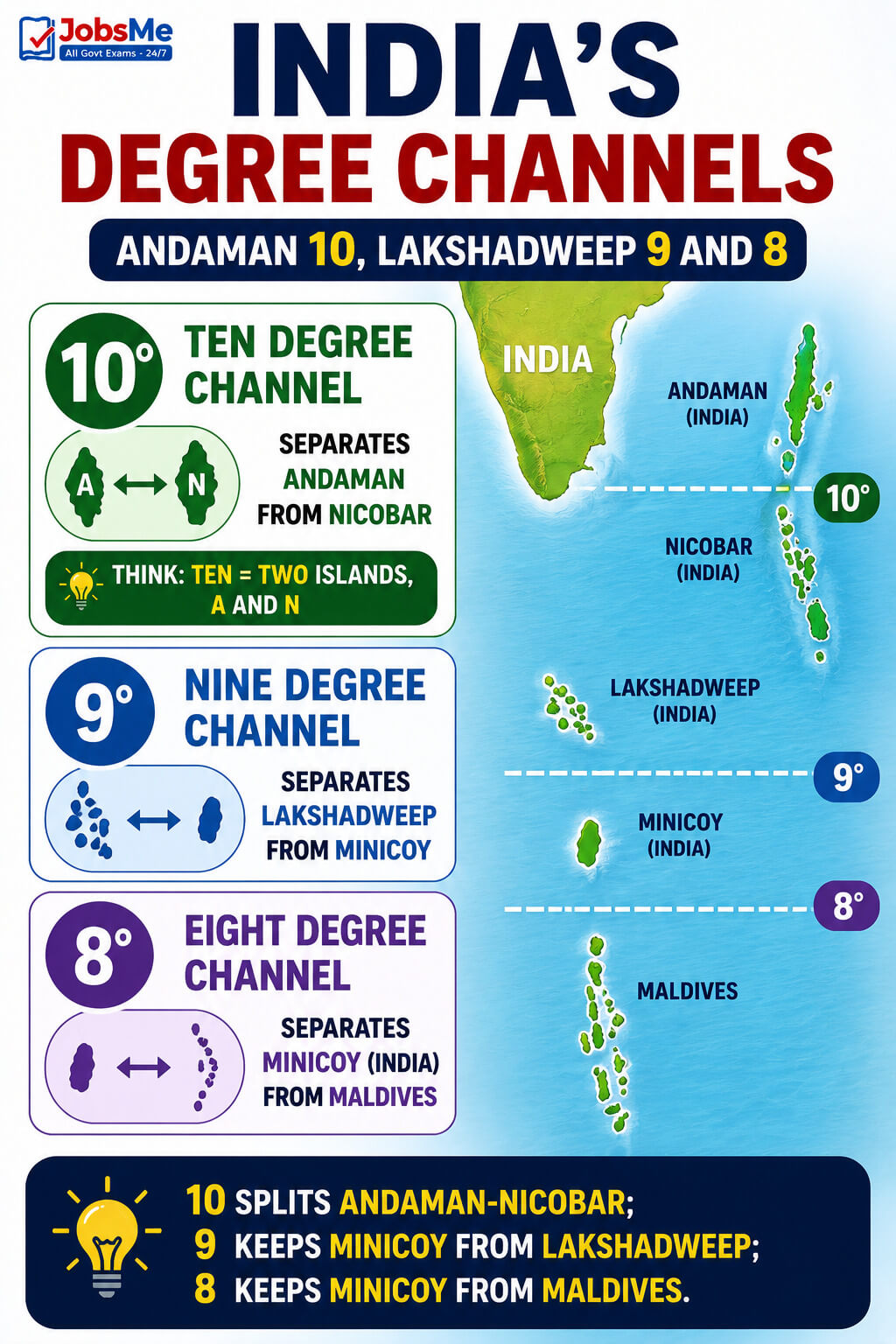
- Ten Degree Channel → separates Andaman from Nicobar (think "Ten = Two islands, A and N").
- Nine Degree Channel → separates Lakshadweep islands from Minicoy.
- Eight Degree Channel → separates Minicoy (India) from the Maldives.
"10 splits Andaman-Nicobar; 9 keeps Minicoy from Lakshadweep; 8 keeps Minicoy from Maldives."
Trick 5: Gibraltar versus Bab-el-Mandeb — "Two Gates of the Mediterranean Route"
Both are gateways on the Europe-to-Asia sea route:
- Gibraltar → western gate; Atlantic to Mediterranean (Spain-Morocco).
- Bab-el-Mandeb → southern gate; Red Sea to Gulf of Aden (Yemen-Djibouti), leading to the Suez Canal.
"Gibraltar lets you in from the west; Bab-el-Mandeb lets you out to the east."
Trick 6: Strait or Canal? — "Nature versus Man"
To avoid confusing the two terms:
- Strait → made by nature (Malacca, Hormuz, Gibraltar, Bosporus, Palk).
- Canal → made by man (Suez, Panama, Kiel, Corinth, Grand Canal).
"Straits are God-made, canals are man-made."
Trick 7: The Bering Bridge — "Russia Meets America"
The Bering Strait is the only place where two superpowers nearly touch:
- Connects Bering Sea (Pacific) and Chukchi Sea (Arctic).
- Separates Russia (Asia) and Alaska, USA (North America).
- Contains the Diomede Islands, split by the International Date Line.
"Bering = Russia and America almost shake hands."
Additional Notes
Frequently Confused Facts
- Strait versus Canal: A strait is natural (Strait of Malacca); a canal is man-made (Suez Canal). Many students wrongly call the Suez or Panama a "strait."
- Suez versus Panama: Suez connects the Mediterranean and Red Sea (Asia-Africa); Panama connects the Atlantic and Pacific (across the Americas). Suez is largely sea-level with no locks; Panama uses locks.
- Bosporus versus Dardanelles: Bosporus connects the Black Sea to the Sea of Marmara; Dardanelles connects the Sea of Marmara to the Aegean Sea. Both are in Turkey and together form the Turkish Straits.
- Hormuz versus Malacca: Hormuz is the key oil chokepoint (Persian Gulf to Gulf of Oman); Malacca is the busiest general trade route (Indian Ocean to South China Sea).
- Palk Strait versus Gulf of Mannar: Palk Strait connects the Bay of Bengal to Palk Bay; the Gulf of Mannar lies to its south. Both separate India from Sri Lanka and are linked by the Adam's Bridge shoals.
- Ten Degree versus Nine Degree Channel: The Ten Degree Channel separates the Andaman and Nicobar Islands; the Nine Degree Channel separates the Lakshadweep islands from Minicoy.
- Bab-el-Mandeb versus Gibraltar: Bab-el-Mandeb links the Red Sea and Gulf of Aden (Yemen-Djibouti); Gibraltar links the Atlantic and Mediterranean (Spain-Morocco).
- Magellan Strait versus Drake Passage: The Strait of Magellan is a sheltered passage through southern Chile; the Drake Passage is the open, rough sea between South America and Antarctica.
- Strait of Dover versus English Channel: The Strait of Dover is only the narrowest part of the wider English Channel, between Britain and France.
- Grand Canal versus Suez Canal: The Grand Canal of China is the world's longest canal (inland, about 1,776 km); the Suez Canal is the most strategically important sea-link canal.
Repeating PYQ Patterns
Certain straits and canals are asked repeatedly in competitive exams. Strait of Malacca, Strait of Hormuz, Strait of Gibraltar, Bab-el-Mandeb, Bosporus, Bering Strait, Palk Strait, Suez Canal, and Panama Canal appear most often in UPSC Prelims, SSC CGL, and RRB NTPC papers. Banking exams (IBPS PO, SBI Clerk) frequently ask which two water bodies a given strait or canal connects, while Insurance and PSU exams favour "Suez connects which two seas" and "Panama connects which two oceans" type questions. UPSC and State PCS exams often add map-based or current-affairs-linked questions on the Ten Degree Channel near the Andaman and Nicobar Islands, the Strait of Hormuz oil route, the Taiwan Strait, and the Red Sea-Bab-el-Mandeb-Suez disruptions affecting global shipping.
Quick Insight
Straits and canals are the arteries of world trade — narrow passages that control the flow of goods, oil, and naval power. A single blocked chokepoint can disrupt the global economy: the 2021 grounding of a container ship in the Suez Canal stalled billions of dollars of trade, while attacks in the Red Sea near Bab-el-Mandeb in recent years have forced ships to take the longer route around Africa. Drought has limited transits through the Panama Canal, and the Strait of Hormuz remains a flashpoint for oil security. For India, the Malacca Strait, the Ten Degree Channel, and the Andaman and Nicobar Islands are central to maritime strategy in the Indian Ocean. Understanding these waterways helps aspirants connect geography to current affairs in both Prelims and Mains. For further reading on related Static GK topics, you can refer to the Static GK notes and test yourself with the Static GK Quiz on Jobsme.in.
One-Liners for Quick Revision
- Strait of Malacca → Andaman Sea and South China Sea → between Malaysia and Indonesia; world's longest and busiest strait.
- Strait of Hormuz → Persian Gulf and Gulf of Oman → between Iran and Oman; world's top oil chokepoint.
- Strait of Gibraltar → Atlantic Ocean and Mediterranean Sea → between Spain and Morocco; only natural entrance to the Mediterranean.
- Bab-el-Mandeb → Red Sea and Gulf of Aden → between Yemen and Djibouti; "Gate of Tears."
- Bosporus Strait → Black Sea and Sea of Marmara → in Turkey; runs through Istanbul; divides Europe and Asia.
- Dardanelles (Hellespont) → Aegean Sea and Sea of Marmara → in Turkey; part of the Turkish Straits.
- Bering Strait → Bering Sea (Pacific) and Chukchi Sea (Arctic) → between Russia and Alaska (USA).
- Palk Strait → Bay of Bengal and Palk Bay → between India and Sri Lanka; near Adam's Bridge (Ram Setu).
- Sunda Strait → Java Sea and Indian Ocean → between Java and Sumatra (Indonesia); near Krakatoa.
- Strait of Magellan → Atlantic and Pacific Oceans → in southern Chile; key passage before the Panama Canal.
- Strait of Messina → Tyrrhenian Sea and Ionian Sea → between Sicily and mainland Italy.
- Strait of Dover → English Channel and North Sea → between Britain and France; site of the Channel Tunnel.
- Cook Strait → Tasman Sea and South Pacific Ocean → between New Zealand's North and South Islands.
- Bass Strait → Tasman Sea and Indian Ocean → between mainland Australia and Tasmania.
- Torres Strait → Arafura Sea and Gulf of Papua → between Australia and Papua New Guinea.
- Mozambique Channel → part of the Indian Ocean → between Mozambique and Madagascar.
- Davis Strait → Labrador Sea and Baffin Bay → between Greenland and Canada (Baffin Island).
- Denmark Strait → Greenland Sea and Atlantic Ocean → between Greenland and Iceland.
- Florida Strait → Gulf of Mexico and Atlantic Ocean → between Florida (USA) and Cuba.
- Yucatan Channel → Gulf of Mexico and Caribbean Sea → between Mexico and Cuba.
- Taiwan Strait (Formosa) → South China Sea and East China Sea → between Taiwan and China.
- Strait of Otranto → Adriatic Sea and Ionian Sea → between Italy and Albania.
- North Channel → Irish Sea and Atlantic Ocean → between Northern Ireland and Scotland.
- Hudson Strait → Hudson Bay and Labrador Sea → between Baffin Island and Quebec (Canada).
- Lombok Strait → Bali Sea and Indian Ocean → between Bali and Lombok; Wallace Line passes through it.
- Makassar Strait → Celebes Sea and Java Sea → between Borneo and Sulawesi (Indonesia).
- Ten Degree Channel → separates Andaman Islands and Nicobar Islands → lies on the 10° N latitude.
- Nine Degree Channel → separates Lakshadweep islands from Minicoy → lies on the 9° N latitude.
- Eight Degree Channel → separates Minicoy (India) from the Maldives → lies on the 8° N latitude.
- Duncan Passage → separates South Andaman from Little Andaman → in the Bay of Bengal.
- Gulf of Mannar → between southeastern India and Sri Lanka → biosphere reserve; linked to Palk Bay by Adam's Bridge.
- Suez Canal → Mediterranean Sea and Red Sea → in Egypt; separates Asia and Africa; opened 1869.
- Panama Canal → Atlantic Ocean and Pacific Ocean → in Panama; uses locks; opened 1914.
- Kiel Canal → North Sea and Baltic Sea → in Germany; opened 1895; busiest artificial waterway.
- Corinth Canal → Gulf of Corinth and Saronic Gulf → in Greece; very deep and narrow.
- Grand Canal → links Beijing and Hangzhou (Yellow and Yangtze rivers) → in China; world's longest canal.
- Welland Canal → Lake Erie and Lake Ontario → in Canada; bypasses Niagara Falls.
- Erie Canal → Lake Erie and the Hudson River → in the USA; opened 1825.
- St. Lawrence Seaway → Atlantic Ocean and the Great Lakes → USA and Canada.
- Göta Canal → Baltic Sea and North Sea → in Sweden; historic tourist route.
- White Sea-Baltic Canal → White Sea and Baltic Sea → in Russia; opened 1933.
- Amsterdam-Rhine Canal → Amsterdam port and the Rhine River → in the Netherlands.
For more Static GK topics like boundary lines, lakes, and mountain passes, explore the Static GK section on Jobsme.in. You can also test your knowledge with the Static GK Quiz and check out the latest exam notifications at Latest Government Job Notifications.
Free quiz • No signup required
Put this topic into practice with Indian Cultural Institutions – Static GK MCQ Quiz. It is the quickest way to reinforce what you just learned.
Frequently Asked Questions
What is the difference between a strait and a canal?
Which two seas does the Suez Canal connect?
Which oceans does the Panama Canal connect?
Which is the most important strait of India?
Why is the Strait of Hormuz so important?
Which strait is known as the busiest and longest in the world?
What do the Ten Degree and Nine Degree Channels separate?
Which two straits together form the Turkish Straits?
Which strait separates Asia from North America?
Which is the longest canal in the world?

About the author