List of Famous Foreign Authors and Their Works – Static GK & General Awareness for Competitive Exams with Memory Tricks
This article presents a complete list of famous foreign (international) authors and their most important works, covering English, American, Russian, French, and other world writers along with their nationality, genre, and famous literary titles. It includes iconic figures like William Shakespeare (Hamlet, Macbeth), Leo Tolstoy (War and Peace), Charles Dickens (Oliver Twist), Jane Austen (Pride and Prejudice), and Ernest Hemingway (The Old Man and the Sea), with memory tricks and one-liners for quick revision. All facts are arranged in exam-ready format to help UPSC, SSC, IBPS, RRB, PSU, and State PCS aspirants score better in General Awareness and Books & Authors sections.
Jump to section
Introduction
World literature is filled with celebrated foreign authors whose works have shaped human thought, culture, and imagination for centuries. William Shakespeare, the "Bard of Avon," gave the world Hamlet, Macbeth, and Romeo and Juliet; Leo Tolstoy wrote the monumental War and Peace and Anna Karenina; Charles Dickens immortalised Victorian England through Oliver Twist and A Tale of Two Cities; and Ernest Hemingway won the Nobel Prize for The Old Man and the Sea. Knowing which author wrote which book is one of the most reliably tested areas of static general knowledge.
Questions on famous foreign authors and their works appear regularly in UPSC Prelims, SSC CGL, IBPS PO, RRB NTPC, SBI Clerk, State PCS, and various Insurance and Defence exams. Questions typically ask who wrote a particular book, which author belongs to which country, or which famous title (like "Bard of Avon" or "Father of English Poetry") is linked to which writer. This article brings together every important foreign author and work in a structured, exam-ready format. To explore more such topics, you can refer to the Static GK section on Jobsme.in.
Books and authors are also closely linked to current affairs themes such as the Nobel Prize in Literature, the Booker Prize and International Booker Prize, death anniversaries and birth centenaries of legendary writers, and film and web-series adaptations of classic novels — making this topic doubly important for aspirants preparing for both objective papers and descriptive General Awareness sections.
Core Concepts: How Books and Authors Are Tested in Exams
The "Books and Authors" segment of static GK rewards accurate one-to-one matching. Most marks are lost not because a candidate has never heard of a book, but because two similar authors or similar titles get confused. Grouping authors by nationality, genre, and famous epithet makes recall faster and more reliable in the exam hall.
How to Approach This Topic
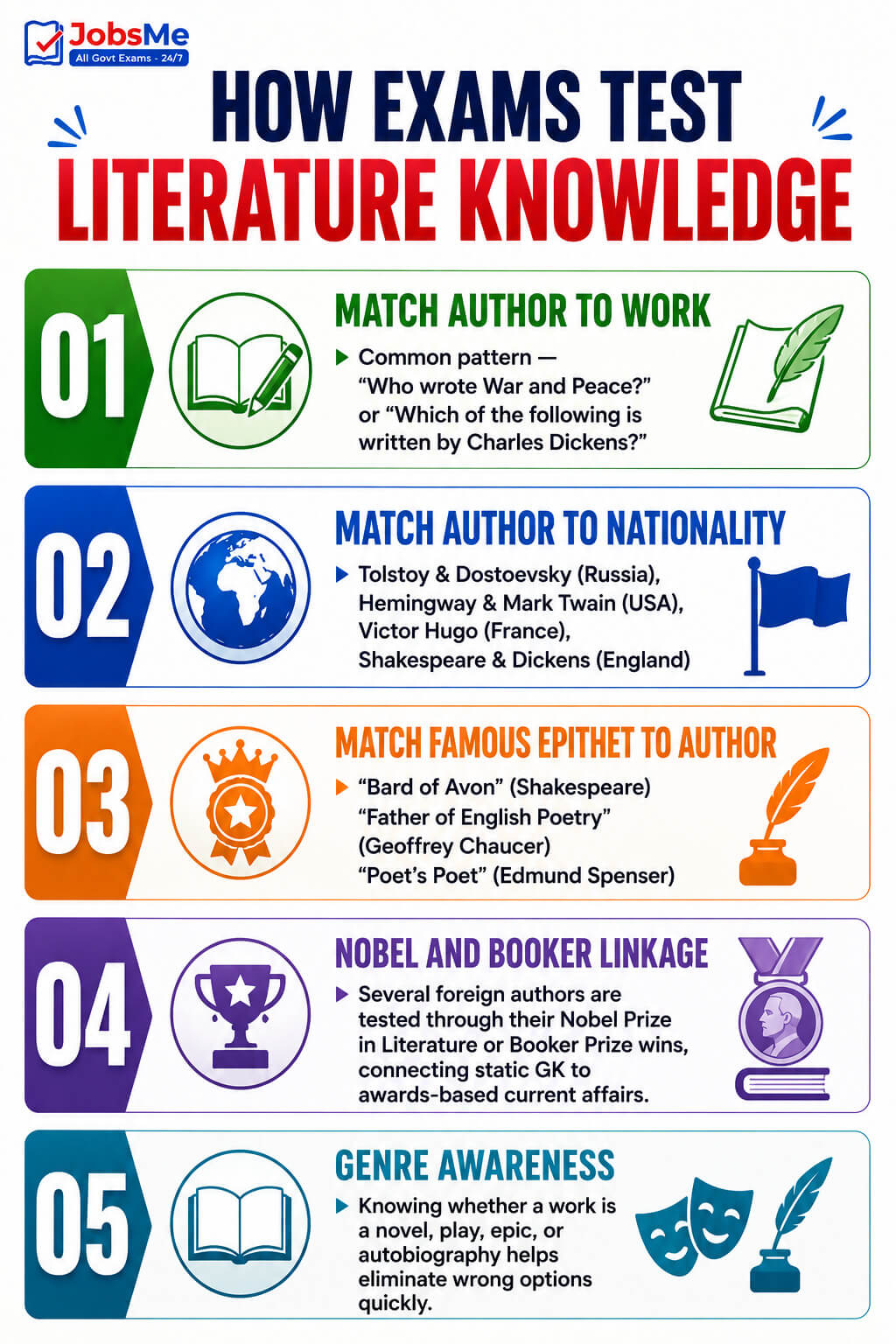
- Match author to work: The most common pattern — "Who wrote War and Peace?" or "Which of the following is written by Charles Dickens?"
- Match author to nationality: Exams often ask the country of an author — Tolstoy and Dostoevsky (Russia), Hemingway and Mark Twain (USA), Victor Hugo (France), and Shakespeare and Dickens (England).
- Match famous epithet to author: Titles like "Bard of Avon" (Shakespeare), "Father of English Poetry" (Geoffrey Chaucer), and "Poet's Poet" (Edmund Spenser) are frequently asked.
- Nobel and Booker linkage: Several foreign authors are tested through their Nobel Prize in Literature or Booker Prize wins, connecting static GK to awards-based current affairs.
- Genre awareness: Knowing whether a work is a novel, play, epic, or autobiography helps eliminate wrong options quickly.
Famous English and British Authors and Their Works
English-language authors from Britain dominate the Books and Authors section. The following table lists the most exam-relevant British authors, their major works, and key details.
| Author | Famous Works | Nationality / Key Details |
|---|---|---|
| William Shakespeare | Hamlet, Macbeth, Othello, King Lear, Romeo and Juliet, The Merchant of Venice, Julius Caesar, The Tempest | English; known as the "Bard of Avon" and the "Father of English Drama"; regarded as the greatest writer in the English language; wrote 37 plays and 154 sonnets. |
| Geoffrey Chaucer | The Canterbury Tales, Troilus and Criseyde | English; called the "Father of English Poetry / Literature"; first writer buried in Poets' Corner of Westminster Abbey. |
| John Milton | Paradise Lost, Paradise Regained, Areopagitica | English; called the "Blind Poet of England"; Paradise Lost is the most famous epic poem in English. |
| Charles Dickens | Oliver Twist, A Tale of Two Cities, Great Expectations, David Copperfield, Hard Times, A Christmas Carol | English; the leading novelist of the Victorian era; famous for portraying social inequality and poverty. |
| Jane Austen | Pride and Prejudice, Sense and Sensibility, Emma, Mansfield Park | English; celebrated for romantic fiction exploring 19th-century English society and manners. |
| William Wordsworth | The Prelude, Lyrical Ballads (with Coleridge), Daffodils (I Wandered Lonely as a Cloud) | English; leading Romantic poet; served as Poet Laureate of England. |
| Thomas Hardy | Tess of the d'Urbervilles, Far from the Madding Crowd, The Mayor of Casterbridge, Jude the Obscure | English; novelist and poet known for tragic rural settings in fictional "Wessex." |
| George Orwell | Animal Farm, 1984 (Nineteen Eighty-Four) | British (pen name of Eric Arthur Blair); famous for political satire and dystopian fiction; coined terms like "Big Brother." |
| Charlotte Bronte | Jane Eyre, Shirley, Villette | English; eldest of the three literary Bronte sisters. |
| Emily Bronte | Wuthering Heights | English; her only novel is a classic of English literature. |
| Daniel Defoe | Robinson Crusoe, Moll Flanders | English; Robinson Crusoe is often called the first English novel. |
| Jonathan Swift | Gulliver's Travels, A Modest Proposal | Anglo-Irish; master satirist of the 18th century. |
| Lewis Carroll | Alice's Adventures in Wonderland, Through the Looking-Glass | English (pen name of Charles Lutwidge Dodgson); pioneer of literary nonsense. |
| Arthur Conan Doyle | The Adventures of Sherlock Holmes, The Hound of the Baskervilles, A Study in Scarlet | British (Scottish); creator of the detective Sherlock Holmes. |
| Rudyard Kipling | The Jungle Book, Kim, Just So Stories, If— | British; first English-language writer to win the Nobel Prize in Literature (1907); born in Bombay (Mumbai). |
| Agatha Christie | Murder on the Orient Express, And Then There Were None, The Murder of Roger Ackroyd | English; the "Queen of Crime"; best-selling novelist of all time; created Hercule Poirot and Miss Marple. |
| J. K. Rowling | Harry Potter series (Philosopher's Stone, Chamber of Secrets, etc.) | British; one of the best-selling fiction authors in history. |
| J. R. R. Tolkien | The Hobbit, The Lord of the Rings | British; founder of modern fantasy fiction. |
| D. H. Lawrence | Sons and Lovers, Lady Chatterley's Lover, Women in Love | English; modernist novelist and poet. |
| Salman Rushdie | Midnight's Children, The Satanic Verses, Shame | British-Indian-born; Midnight's Children won the Booker Prize and the "Booker of Bookers." |
Famous American Authors and Their Works
American writers are equally important and frequently asked. The following table covers the leading authors of the United States and their best-known works.
| Author | Famous Works | Nationality / Key Details |
|---|---|---|
| Mark Twain | The Adventures of Tom Sawyer, The Adventures of Huckleberry Finn, The Prince and the Pauper | American (pen name of Samuel Langhorne Clemens); called the "Father of American Literature." |
| Ernest Hemingway | The Old Man and the Sea, A Farewell to Arms, For Whom the Bell Tolls | American; Nobel Prize in Literature (1954); famous for his terse, economical writing style. |
| John Steinbeck | The Grapes of Wrath, Of Mice and Men, East of Eden | American; Nobel Prize in Literature (1962); chronicled the Great Depression. |
| F. Scott Fitzgerald | The Great Gatsby, Tender Is the Night | American; defining voice of the "Jazz Age." |
| Harper Lee | To Kill a Mockingbird | American; Pulitzer Prize-winning novel on racial injustice. |
| Margaret Mitchell | Gone with the Wind | American; Pulitzer Prize winner set during the American Civil War. |
| Edgar Allan Poe | The Raven, The Tell-Tale Heart, The Fall of the House of Usher | American; pioneer of the detective and horror short story. |
| Walt Whitman | Leaves of Grass, O Captain! My Captain! | American; "Father of Free Verse." |
| Pearl S. Buck | The Good Earth | American; Nobel Prize in Literature (1938); wrote about Chinese village life. |
| Toni Morrison | Beloved, Song of Solomon, The Bluest Eye | American; first African-American woman to win the Nobel Prize in Literature (1993). |
| Dan Brown | The Da Vinci Code, Angels and Demons, The Lost Symbol, Inferno | American; best-selling author of mystery-thriller fiction. |
| Khaled Hosseini | The Kite Runner, A Thousand Splendid Suns | Afghan-American; novels set in Afghanistan. |
Famous Russian, French, and Other World Authors
Beyond English-language writers, exams frequently test major Russian, French, and other international authors. The following table groups these world classics for quick revision.
| Author | Famous Works | Nationality / Key Details |
|---|---|---|
| Leo Tolstoy | War and Peace, Anna Karenina, The Death of Ivan Ilyich | Russian; widely regarded as one of the greatest novelists of all time. |
| Fyodor Dostoevsky | Crime and Punishment, The Brothers Karamazov, The Idiot | Russian; master of psychological and philosophical fiction. |
| Maxim Gorky | Mother, The Lower Depths, My Childhood | Russian; founder of the Socialist Realism literary method. |
| Anton Chekhov | The Cherry Orchard, Three Sisters, The Seagull | Russian; one of the greatest writers of short stories and modern drama. |
| Boris Pasternak | Doctor Zhivago | Russian; Nobel Prize in Literature (1958). |
| Victor Hugo | Les Miserables, The Hunchback of Notre-Dame | French; leading figure of French Romanticism. |
| Alexandre Dumas | The Three Musketeers, The Count of Monte Cristo | French; famous for historical adventure novels. |
| Jules Verne | Around the World in Eighty Days, Twenty Thousand Leagues Under the Sea, Journey to the Centre of the Earth | French; "Father of Science Fiction." |
| Albert Camus | The Stranger (The Outsider), The Plague, The Myth of Sisyphus | French; Nobel Prize in Literature (1957); associated with absurdism. |
| Paulo Coelho | The Alchemist, Veronika Decides to Die, Eleven Minutes | Brazilian; The Alchemist is one of the best-selling books in history. |
| Gabriel Garcia Marquez | One Hundred Years of Solitude, Love in the Time of Cholera | Colombian; Nobel Prize in Literature (1982); master of "magic realism." |
| Franz Kafka | The Metamorphosis, The Trial, The Castle | Austro-Hungarian (Czech, German-language); gave rise to the term "Kafkaesque." |
| Homer | The Iliad, The Odyssey | Ancient Greek; author of the two foundational epics of Western literature. |
| Dante Alighieri | The Divine Comedy (Inferno, Purgatorio, Paradiso) | Italian; "Father of the Italian Language." |
| Miguel de Cervantes | Don Quixote | Spanish; Don Quixote is often called the first modern novel. |
| Niccolo Machiavelli | The Prince (Il Principe) | Italian; "Father of Modern Political Science." |
| Karl Marx | Das Kapital, The Communist Manifesto (with Friedrich Engels) | German; founder of modern communist theory. |
| Adam Smith | The Wealth of Nations | Scottish; "Father of Modern Economics." |
| Charles Darwin | On the Origin of Species, The Descent of Man | English (naturalist); proposed the theory of evolution by natural selection. |
Memory Tricks and Mnemonics
Trick 1: Russian Greats — "TooDoo, GoCha, Pasta"
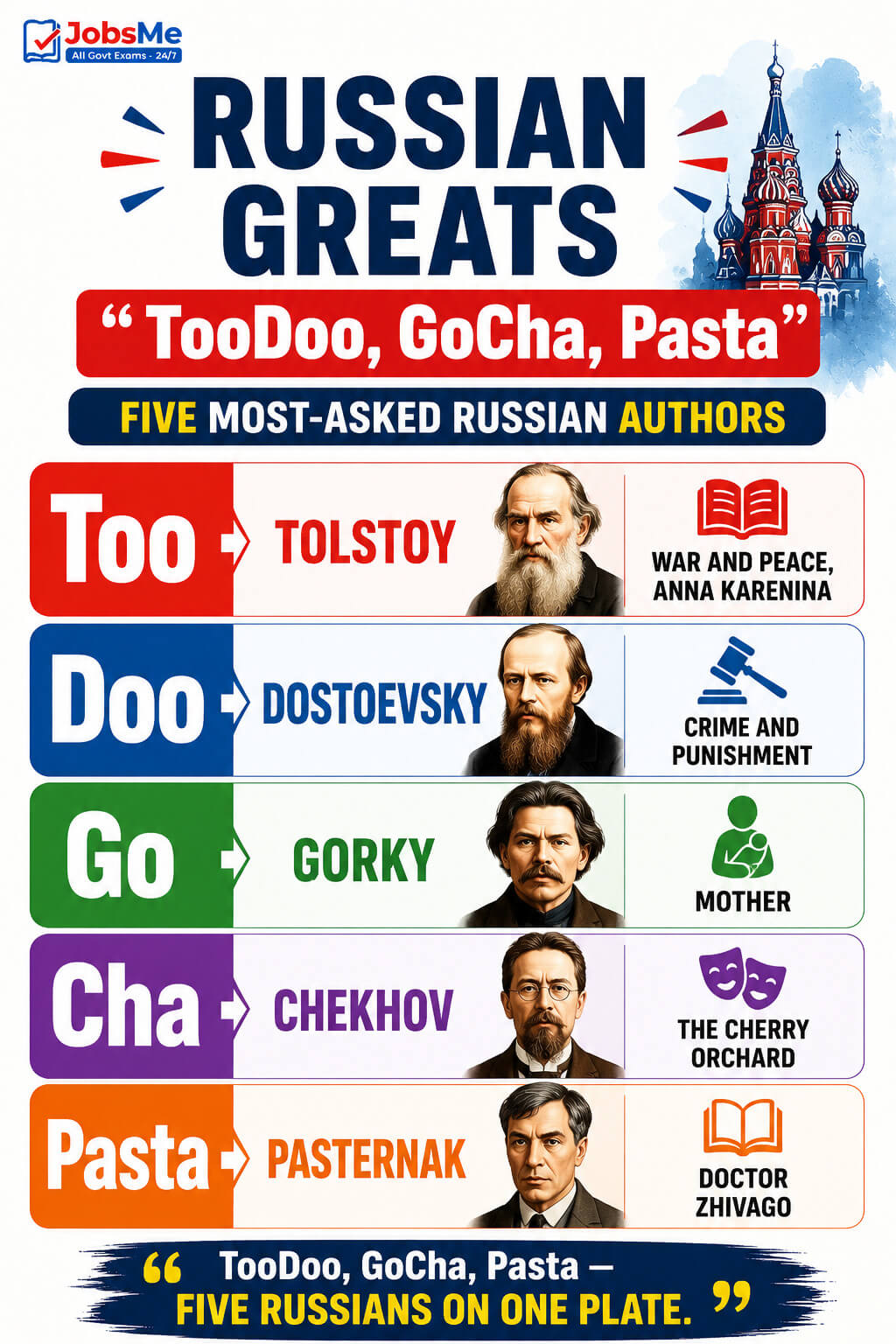
Group the five most-asked Russian authors with their first syllables:
- Too → Tolstoy (War and Peace, Anna Karenina).
- Doo → Dostoevsky (Crime and Punishment).
- Go → Gorky (Mother).
- Cha → Chekhov (The Cherry Orchard).
- Pasta → Pasternak (Doctor Zhivago).
"TooDoo, GoCha, Pasta — five Russians on one plate."
Trick 2: Shakespeare's Four Great Tragedies — "HOMK"
Remember Shakespeare's four major tragedies with "HOMK":
- H → Hamlet.
- O → Othello.
- M → Macbeth.
- K → King Lear.
Trick 3: "Father of…" Titles in World Literature
Many foreign authors carry a "Father of…" title — keep them together:
- Father of English Poetry / Literature → Geoffrey Chaucer.
- Father of English Drama → William Shakespeare.
- Father of American Literature → Mark Twain.
- Father of Science Fiction → Jules Verne.
- Father of Free Verse → Walt Whitman.
- Father of Modern Economics → Adam Smith.
- Father of Modern Political Science → Niccolo Machiavelli.
Trick 4: French Trio — "Hugo Dumas Verne"
Three French masters, three different flavours:
- Victor Hugo → Les Miserables (Romanticism / social epic).
- Alexandre Dumas → The Three Musketeers (historical adventure).
- Jules Verne → Around the World in Eighty Days (science fiction).
"Hugo for hearts, Dumas for swords, Verne for science."
Trick 5: Pen Names — "Real Name vs Pen Name"
- Mark Twain → real name Samuel Langhorne Clemens.
- George Orwell → real name Eric Arthur Blair.
- Lewis Carroll → real name Charles Lutwidge Dodgson.
"Twain, Orwell, Carroll — three masks, three men."
Trick 6: Nobel Laureates Among Foreign Authors
Several foreign authors are best remembered through their Nobel Prize in Literature win:
- Rudyard Kipling → 1907 (first English-language winner).
- Pearl S. Buck → 1938 (The Good Earth).
- Ernest Hemingway → 1954 (The Old Man and the Sea).
- Albert Camus → 1957.
- Boris Pasternak → 1958.
- John Steinbeck → 1962.
- Gabriel Garcia Marquez → 1982.
- Toni Morrison → 1993.
Trick 7: One-Book Wonders — "Single Famous Title"
Some authors are tested mainly for a single iconic work:
- Emily Bronte → Wuthering Heights.
- Harper Lee → To Kill a Mockingbird.
- Margaret Mitchell → Gone with the Wind.
- Miguel de Cervantes → Don Quixote.
- Paulo Coelho → The Alchemist (most famous of his works).
Additional Notes
Frequently Confused Facts
- War and Peace vs A Tale of Two Cities: War and Peace is by Leo Tolstoy (Russian); A Tale of Two Cities is by Charles Dickens (English).
- Crime and Punishment vs Crime fiction: Crime and Punishment is a serious psychological novel by Fyodor Dostoevsky, not a detective story; detective fiction is associated with Arthur Conan Doyle and Agatha Christie.
- The Old Man and the Sea vs The Grapes of Wrath: The Old Man and the Sea is by Ernest Hemingway; The Grapes of Wrath is by John Steinbeck — both American Nobel laureates, often interchanged.
- Animal Farm vs 1984: Both are by George Orwell; Animal Farm is an allegory using farm animals, while 1984 is a dystopian novel about surveillance.
- The Bronte Sisters: Charlotte wrote Jane Eyre; Emily wrote Wuthering Heights; Anne wrote The Tenant of Wildfell Hall — keep the works separate.
- Mark Twain vs Charles Dickens: Mark Twain is American (Tom Sawyer, Huckleberry Finn); Charles Dickens is English (Oliver Twist, Great Expectations).
- The Prince vs The Little Prince: The Prince is a political treatise by Niccolo Machiavelli; The Little Prince is a novella by Antoine de Saint-Exupery — completely different works.
- Father of English Poetry vs Bard of Avon: Geoffrey Chaucer is the Father of English Poetry; William Shakespeare is the Bard of Avon — both English, but different titles.
- Don Quixote vs Robinson Crusoe: Don Quixote (Cervantes, Spanish) is called the first modern novel; Robinson Crusoe (Daniel Defoe, English) is often called the first English novel.
- Das Kapital vs The Wealth of Nations: Das Kapital is by Karl Marx (communist theory); The Wealth of Nations is by Adam Smith (free-market economics) — opposite economic ideas.
Repeating PYQ Patterns
Certain author-work pairs are asked repeatedly in competitive exams. William Shakespeare (Hamlet, Macbeth), Leo Tolstoy (War and Peace), Charles Dickens (Oliver Twist, A Tale of Two Cities), Ernest Hemingway (The Old Man and the Sea), George Orwell (Animal Farm, 1984), Jane Austen (Pride and Prejudice), Jules Verne (Around the World in Eighty Days), Victor Hugo (Les Miserables), Paulo Coelho (The Alchemist), and Dan Brown (The Da Vinci Code) appear most often in SSC CGL, RRB NTPC, and Banking exams. UPSC Prelims focuses more on classical and ideological works such as The Prince (Machiavelli), The Wealth of Nations (Adam Smith), Das Kapital (Karl Marx), and On the Origin of Species (Charles Darwin). Nationality-based questions — matching Tolstoy and Dostoevsky to Russia, Hugo and Dumas to France, and Hemingway and Twain to the USA — are common in IBPS PO, SBI Clerk, and Insurance exams. To practise such questions, attempt the Static GK Quiz on Jobsme.in.
Quick Insight
Foreign authors and their works are far more than trivia — they map the intellectual history of the modern world. Marx's Das Kapital and Adam Smith's The Wealth of Nations still frame today's debates on capitalism and socialism; Orwell's 1984 returns to headlines whenever surveillance and privacy are discussed; and the Nobel Prize in Literature and the Booker Prize keep this topic alive in current affairs every single year. For aspirants, mastering this list means quick marks in objective papers and ready references for descriptive and essay writing. For related reading, explore the Static GK notes and stay updated with the latest exam alerts on the Latest Government Job Notifications page on Jobsme.in.
One-Liners for Quick Revision
- William Shakespeare → Hamlet, Macbeth, Othello, King Lear, Romeo and Juliet → English, "Bard of Avon."
- Geoffrey Chaucer → The Canterbury Tales → English, "Father of English Poetry."
- John Milton → Paradise Lost → English, the "Blind Poet of England."
- Charles Dickens → Oliver Twist, A Tale of Two Cities, Great Expectations, David Copperfield → English, Victorian-era novelist.
- Jane Austen → Pride and Prejudice, Sense and Sensibility, Emma → English, romantic fiction.
- William Wordsworth → The Prelude, Daffodils → English, Romantic poet and Poet Laureate.
- Thomas Hardy → Tess of the d'Urbervilles, Far from the Madding Crowd → English, tragic "Wessex" novels.
- George Orwell → Animal Farm, 1984 → British, real name Eric Arthur Blair.
- Charlotte Bronte → Jane Eyre → English, eldest Bronte sister.
- Emily Bronte → Wuthering Heights → English, her only novel.
- Daniel Defoe → Robinson Crusoe → English, often called the first English novel.
- Jonathan Swift → Gulliver's Travels → Anglo-Irish, master satirist.
- Lewis Carroll → Alice's Adventures in Wonderland → English, real name Charles Lutwidge Dodgson.
- Arthur Conan Doyle → Sherlock Holmes, The Hound of the Baskervilles → British, detective fiction.
- Rudyard Kipling → The Jungle Book, Kim → British, first English-language Nobel laureate (1907).
- Agatha Christie → Murder on the Orient Express → English, the "Queen of Crime."
- J. K. Rowling → Harry Potter series → British, best-selling fiction author.
- J. R. R. Tolkien → The Hobbit, The Lord of the Rings → British, modern fantasy.
- D. H. Lawrence → Sons and Lovers, Lady Chatterley's Lover → English, modernist novelist.
- Salman Rushdie → Midnight's Children → Booker Prize and "Booker of Bookers."
- Mark Twain → Tom Sawyer, Huckleberry Finn → American, "Father of American Literature," real name Samuel Clemens.
- Ernest Hemingway → The Old Man and the Sea, A Farewell to Arms → American, Nobel Prize (1954).
- John Steinbeck → The Grapes of Wrath, Of Mice and Men → American, Nobel Prize (1962).
- F. Scott Fitzgerald → The Great Gatsby → American, voice of the "Jazz Age."
- Harper Lee → To Kill a Mockingbird → American, Pulitzer Prize.
- Margaret Mitchell → Gone with the Wind → American, Pulitzer Prize.
- Edgar Allan Poe → The Raven, The Tell-Tale Heart → American, horror and detective fiction.
- Walt Whitman → Leaves of Grass → American, "Father of Free Verse."
- Pearl S. Buck → The Good Earth → American, Nobel Prize (1938).
- Toni Morrison → Beloved, Song of Solomon → American, first African-American woman Nobel laureate (1993).
- Dan Brown → The Da Vinci Code, Angels and Demons → American, mystery-thriller.
- Khaled Hosseini → The Kite Runner, A Thousand Splendid Suns → Afghan-American.
- Leo Tolstoy → War and Peace, Anna Karenina → Russian.
- Fyodor Dostoevsky → Crime and Punishment, The Brothers Karamazov → Russian.
- Maxim Gorky → Mother → Russian, founder of Socialist Realism.
- Anton Chekhov → The Cherry Orchard, Three Sisters → Russian, short stories and drama.
- Boris Pasternak → Doctor Zhivago → Russian, Nobel Prize (1958).
- Victor Hugo → Les Miserables, The Hunchback of Notre-Dame → French, Romanticism.
- Alexandre Dumas → The Three Musketeers, The Count of Monte Cristo → French, historical adventure.
- Jules Verne → Around the World in Eighty Days → French, "Father of Science Fiction."
- Albert Camus → The Stranger, The Plague → French, Nobel Prize (1957), absurdism.
- Paulo Coelho → The Alchemist → Brazilian, best-selling worldwide.
- Gabriel Garcia Marquez → One Hundred Years of Solitude → Colombian, "magic realism," Nobel Prize (1982).
- Franz Kafka → The Metamorphosis, The Trial → German-language, gave the word "Kafkaesque."
- Homer → The Iliad, The Odyssey → Ancient Greek epics.
- Dante Alighieri → The Divine Comedy → Italian, "Father of the Italian Language."
- Miguel de Cervantes → Don Quixote → Spanish, first modern novel.
- Niccolo Machiavelli → The Prince → Italian, "Father of Modern Political Science."
- Karl Marx → Das Kapital, The Communist Manifesto → German, communist theory.
- Adam Smith → The Wealth of Nations → Scottish, "Father of Modern Economics."
- Charles Darwin → On the Origin of Species → English, theory of evolution.
For more Static GK topics like famous personalities, important inventions, and award-winning books, explore the Static GK section on Jobsme.in. You can also test yourself with the Static GK Quiz and stay updated through Daily Current Affairs.
Free quiz • No signup required
Put this topic into practice with Indian Cultural Institutions – Static GK MCQ Quiz. It is the quickest way to reinforce what you just learned.
Frequently Asked Questions
Who wrote War and Peace?
Why is William Shakespeare called the Bard of Avon?
Who is known as the Father of English Poetry?
Which author wrote Animal Farm and 1984?
Who wrote The Old Man and the Sea?
Who is called the Father of Science Fiction?
What is the real name of the author Mark Twain?
Who wrote The Wealth of Nations and who wrote Das Kapital?
Which novel by Salman Rushdie won the Booker Prize?
Who wrote The Alchemist?

About the author