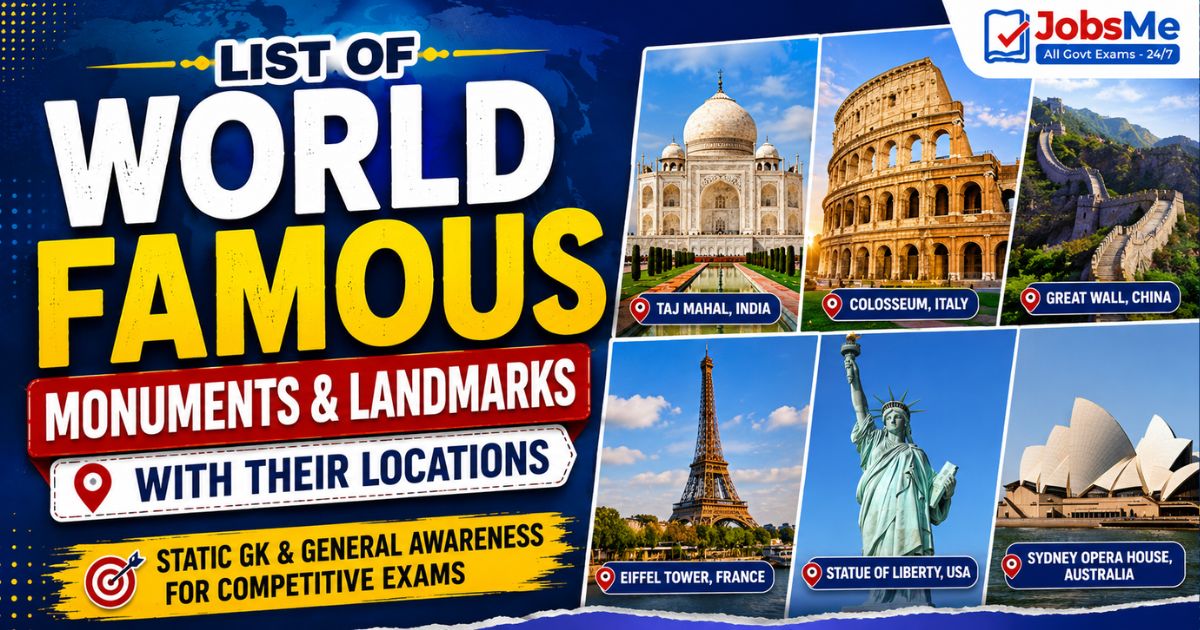
List of World Famous Monuments and Landmarks with Their Locations – Static GK & General Awareness for Competitive Exams with Memory Tricks
This article presents a complete list of world famous monuments and landmarks along with the countries and cities where they are located, the rulers or architects who built them, and their key historical and architectural features. It covers iconic structures like the Taj Mahal (Agra, India), the Eiffel Tower (Paris, France), the Great Wall of China, the Statue of Liberty (USA), the Colosseum (Rome, Italy), the Pyramids of Giza (Egypt), and Christ the Redeemer (Brazil), along with memory tricks and one-liners for quick revision. All facts are arranged in exam-ready format to help UPSC, SSC, IBPS, RRB, PSU, and State PCS aspirants score better in the General Awareness and Static GK sections.
Jump to section
Introduction
Monuments and landmarks are the most recognisable symbols of nations, cultures, and civilisations. The Taj Mahal in Agra represents Mughal grandeur, the Eiffel Tower stands for Paris and France, the Statue of Liberty symbolises freedom in the United States, and the Great Wall of China reflects the engineering might of ancient China. For competitive exam aspirants, knowing which monument is located in which country and who built it is among the most frequently tested areas of Static GK.
Questions on world famous monuments and landmarks appear regularly in UPSC Prelims, SSC CGL, IBPS PO, RRB NTPC, SBI Clerk, State PCS, and various Insurance and Defence exams. Questions typically ask in which country a monument is located, who built a particular structure, which city a landmark belongs to, or which monument is associated with a specific nickname (such as "The Pink City" or "The City of Canals"). This article brings together every important monument and landmark in a structured, exam-ready format. To explore other related Static GK topics, you can refer to the Static GK section on Jobsme.in.
Monuments are also closely linked to current affairs themes such as UNESCO World Heritage Site additions, restoration projects, G20 and summit venues, tourism campaigns, and references in news about international visits — making this topic doubly important for aspirants preparing for UPSC Prelims as well as the General Awareness sections of banking and railway exams. You can stay updated with related developments through the Daily Current Affairs section on Jobsme.in.
Core Concepts: Understanding Monuments and Landmarks
A monument is a structure created to commemorate a person, event, or idea, or one that has become important due to its age, architecture, or historical significance. A landmark is any prominent, easily recognisable feature — natural or man-made — used to identify a place. Understanding the type and purpose of each monument helps students remember its location and builder more easily.
Categories of Monuments and Landmarks
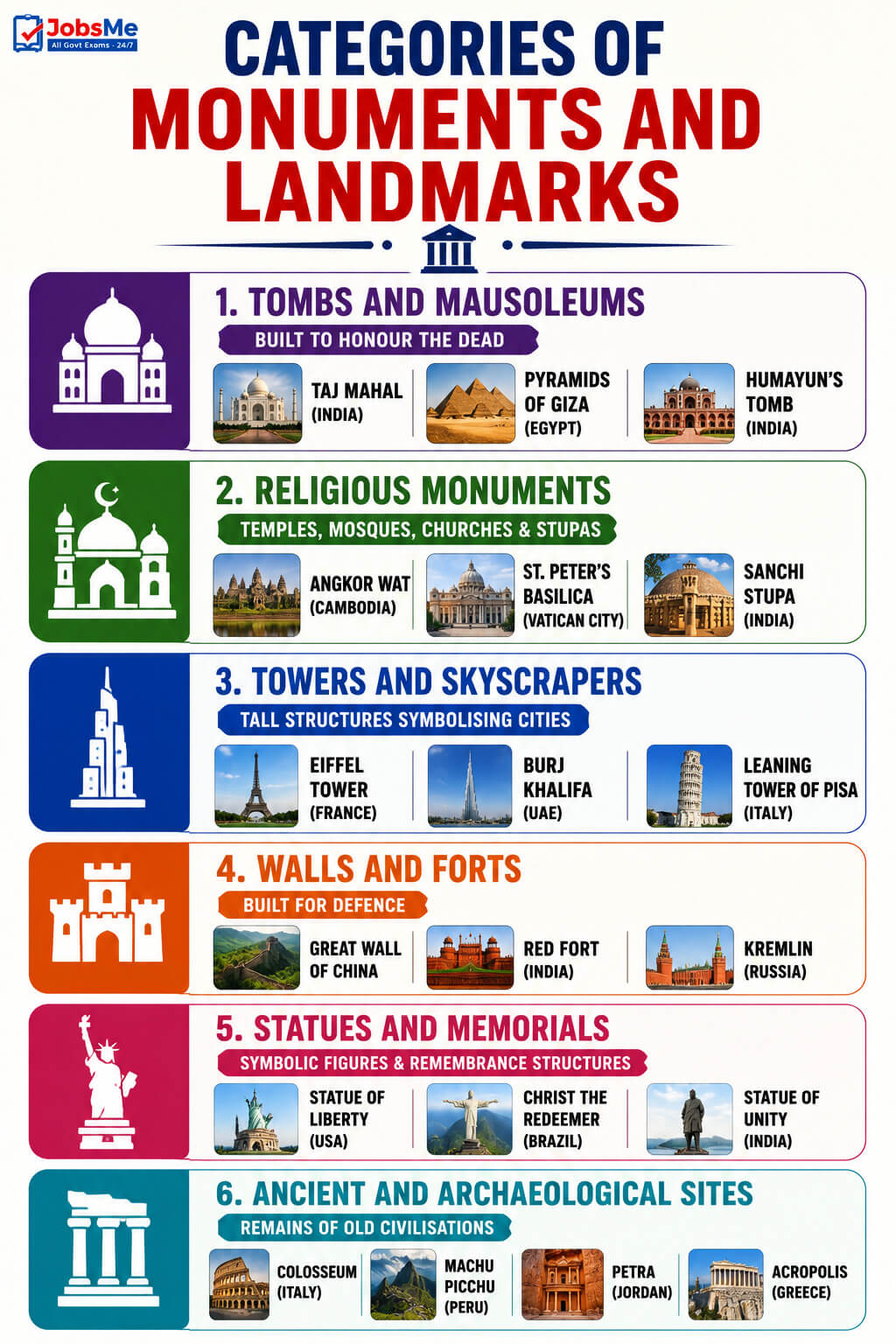
- Tombs and Mausoleums: Built to honour the dead. Example: Taj Mahal (India), Pyramids of Giza (Egypt), Humayun's Tomb (India).
- Religious Monuments: Temples, mosques, churches, and stupas. Example: Angkor Wat (Cambodia), St. Peter's Basilica (Vatican City), Sanchi Stupa (India).
- Towers and Skyscrapers: Tall structures symbolising cities. Example: Eiffel Tower (France), Burj Khalifa (UAE), Leaning Tower of Pisa (Italy).
- Walls and Forts: Built for defence. Example: Great Wall of China, Red Fort (India), Kremlin (Russia).
- Statues and Memorials: Symbolic figures and remembrance structures. Example: Statue of Liberty (USA), Christ the Redeemer (Brazil), Statue of Unity (India).
- Ancient and Archaeological Sites: Remains of old civilisations. Example: Colosseum (Italy), Machu Picchu (Peru), Petra (Jordan), Acropolis (Greece).
World Famous Monuments and Landmarks - Location and Key Details
The following table lists the most exam-relevant world monuments and landmarks along with their country, city, and key facts. These items are asked most frequently in the Static GK sections of competitive exams.
| Monument / Landmark | Country | City / Location | Key Features |
|---|---|---|---|
| Eiffel Tower | France | Paris | Iron lattice tower designed by engineer Gustave Eiffel; built for the 1889 World's Fair (Exposition Universelle); stands on the Champ de Mars and is the symbol of France. |
| Statue of Liberty | United States of America | New York | Gifted by France to the USA in 1886 to mark 100 years of American independence; designed by Frederic Auguste Bartholdi; symbol of freedom and democracy. |
| Great Wall of China | China | Northern China | The longest wall in the world (thousands of kilometres); built over centuries to protect against invasions; a UNESCO World Heritage Site. |
| Colosseum (Coliseum) | Italy | Rome | Largest ancient amphitheatre, built by the Roman Empire; hosted gladiator contests; one of the New Seven Wonders of the World. |
| Leaning Tower of Pisa | Italy | Pisa | Freestanding bell tower famous for its unintended tilt caused by soft ground; part of the Piazza dei Miracoli. |
| Big Ben | United Kingdom | London | The great bell of the clock tower (Elizabeth Tower) at the Palace of Westminster; an iconic symbol of London and the UK. |
| London Eye | United Kingdom | London | One of the world's tallest cantilevered observation wheels, located on the banks of the River Thames. |
| Buckingham Palace | United Kingdom | London | Official London residence of the British monarch; known for the Changing of the Guard ceremony. |
| Pyramids of Giza (Great Pyramid) | Egypt | Giza | The only surviving structure of the original Seven Wonders of the Ancient World; tombs of pharaohs; the Great Pyramid was built for Pharaoh Khufu (Cheops). |
| Great Sphinx of Giza | Egypt | Giza | Giant limestone statue with the body of a lion and the head of a human (pharaoh); located near the Pyramids of Giza. |
| Christ the Redeemer | Brazil | Rio de Janeiro | Giant Art Deco statue of Jesus Christ atop Corcovado Mountain; one of the New Seven Wonders of the World. |
| Machu Picchu | Peru | Cusco Region (Andes) | Ancient Inca citadel set high in the Andes mountains; "Lost City of the Incas"; one of the New Seven Wonders of the World. |
| Chichen Itza | Mexico | Yucatan | Ancient Mayan city; famous for the El Castillo (Kukulkan) step-pyramid; one of the New Seven Wonders of the World. |
| Petra | Jordan | Ma'an Governorate | Ancient "Rose City" carved into rose-coloured rock; capital of the Nabataeans; one of the New Seven Wonders of the World. |
| Angkor Wat | Cambodia | Siem Reap | The largest religious monument in the world; originally a Hindu temple dedicated to Vishnu, later Buddhist; appears on Cambodia's national flag. |
| Sydney Opera House | Australia | Sydney | Performing arts centre famous for its sail-shaped (shell) roof design; designed by Danish architect Jorn Utzon; a UNESCO World Heritage Site. |
| Burj Khalifa | United Arab Emirates (UAE) | Dubai | The tallest building/structure in the world (over 828 metres); a global icon of modern engineering. |
| Petronas Twin Towers | Malaysia | Kuala Lumpur | Twin skyscrapers connected by a sky bridge; were the tallest buildings in the world from 1998 to 2004. |
| Tokyo Tower | Japan | Tokyo | Communications and observation tower inspired by the Eiffel Tower; a major landmark of Tokyo. |
| Mount Fuji | Japan | Honshu Island | The highest mountain in Japan; an active volcano and a sacred natural landmark; a UNESCO World Heritage Site. |
| Acropolis (Parthenon) | Greece | Athens | Ancient citadel on a rocky hill; the Parthenon temple was dedicated to the goddess Athena; symbol of classical Greek civilisation. |
| Brandenburg Gate | Germany | Berlin | 18th-century neoclassical gate; a symbol of German unity and the end of the Cold War. |
| Neuschwanstein Castle | Germany | Bavaria | Fairy-tale hilltop castle built by King Ludwig II; said to have inspired Disney's castle. |
| Sagrada Familia | Spain | Barcelona | Large unfinished basilica designed by architect Antoni Gaudi; famous for its unique organic architecture. |
| St. Peter's Basilica | Vatican City | Vatican City | The largest church in the world; centre of the Roman Catholic Church; designed in part by Michelangelo. |
| Sistine Chapel | Vatican City | Vatican City | Famous for Michelangelo's ceiling frescoes including "The Creation of Adam"; site of the Papal conclave. |
| Leaning Statue / Moai Statues | Chile | Easter Island (Rapa Nui) | Giant monolithic human-faced stone statues carved by the Rapa Nui people; a UNESCO World Heritage Site. |
| Mount Rushmore | United States of America | South Dakota | Sculpture of the faces of four US Presidents — Washington, Jefferson, Theodore Roosevelt, and Lincoln — carved into a granite mountain. |
| Golden Gate Bridge | United States of America | San Francisco | Famous red suspension bridge spanning the Golden Gate strait; an icon of San Francisco and engineering. |
| White House | United States of America | Washington, D.C. | Official residence and workplace of the President of the United States. |
| Kremlin | Russia | Moscow | Fortified complex that is the official residence of the Russian President; overlooks Red Square. |
| Saint Basil's Cathedral | Russia | Moscow | Famous church with colourful onion-shaped domes; located in Red Square; built during the reign of Ivan the Terrible. |
| CN Tower | Canada | Toronto | Tall communications and observation tower; one of the tallest free-standing structures in the Western Hemisphere. |
| Niagara Falls | USA and Canada (border) | Ontario / New York | Group of three powerful waterfalls on the border between the USA and Canada; a major natural landmark. |
| Table Mountain | South Africa | Cape Town | Flat-topped mountain overlooking Cape Town; a New7Wonders of Nature site. |
| Mount Kilimanjaro | Tanzania | Kilimanjaro Region | The highest mountain in Africa and the tallest free-standing mountain in the world. |
| Hagia Sophia | Turkey | Istanbul | Originally a Byzantine cathedral, later a mosque, then a museum, and again a mosque; famous for its massive dome. |
| Blue Mosque (Sultan Ahmed Mosque) | Turkey | Istanbul | Historic mosque famous for its blue tiles and six minarets. |
| Stonehenge | United Kingdom | Wiltshire (England) | Prehistoric monument of standing stones arranged in a circle; purpose still debated by historians. |
| Merlion | Singapore | Singapore (Marina Bay) | Statue of a mythical creature with a lion's head and a fish's body; the national symbol of Singapore. |
| Arc de Triomphe | France | Paris | Triumphal arch honouring those who fought for France; stands at the centre of Place Charles de Gaulle. |
| Louvre Museum | France | Paris | The world's most-visited museum; home to the Mona Lisa; famous for its glass pyramid entrance. |
Famous Monuments and Landmarks of India
Indian monuments are among the most frequently asked items in Static GK, especially the builder, the dynasty, and the city. The following table covers the most exam-relevant Indian monuments and landmarks.
| Monument / Landmark | City / State | Built By / Key Details |
|---|---|---|
| Taj Mahal | Agra, Uttar Pradesh | Built by Mughal emperor Shah Jahan in memory of his wife Mumtaz Mahal; made of white marble; a UNESCO World Heritage Site and one of the New Seven Wonders of the World. |
| Red Fort (Lal Qila) | Delhi | Built by Shah Jahan when he shifted the capital from Agra to Delhi; made of red sandstone; the Prime Minister hoists the national flag here on Independence Day. |
| Qutub Minar | Delhi | The tallest brick minaret in the world; begun by Qutb-ud-din Aibak and completed by Iltutmish; a UNESCO World Heritage Site. |
| India Gate | New Delhi | War memorial designed by Sir Edwin Lutyens; dedicated to soldiers who died in the First World War; houses the Amar Jawan Jyoti tradition. |
| Humayun's Tomb | Delhi | Built by Humayun's wife Hamida Banu Begum (Haji Begum); first garden-tomb in India; inspired the design of the Taj Mahal. |
| Gateway of India | Mumbai, Maharashtra | Built to commemorate the visit of King George V and Queen Mary; overlooks the Arabian Sea. |
| Charminar | Hyderabad, Telangana | Built by Quli Qutb Shah; famous for its four grand arches and minarets; symbol of Hyderabad. |
| Hawa Mahal | Jaipur, Rajasthan | "Palace of Winds"; built by Maharaja Sawai Pratap Singh; famous for its 953 small windows (jharokhas). |
| Amer Fort (Amber Fort) | Jaipur, Rajasthan | Built by Raja Man Singh I; finest example of Rajput architecture; located on the Aravalli hills. |
| Golden Temple (Harmandir Sahib) | Amritsar, Punjab | The holiest shrine of Sikhism; founded by Guru Arjan Dev; known for its gold-plated dome and the world's largest community kitchen (langar). |
| Sanchi Stupa | Sanchi, Madhya Pradesh | One of the oldest stone structures in India; built by Emperor Ashoka; an important Buddhist monument and UNESCO World Heritage Site. |
| Konark Sun Temple | Konark, Odisha | Built by King Narasimhadeva I of the Eastern Ganga dynasty; designed as a giant chariot of the Sun God with stone wheels; a UNESCO World Heritage Site. |
| Khajuraho Temples | Khajuraho, Madhya Pradesh | Built by the Chandela dynasty; famous for intricate sculptures; a UNESCO World Heritage Site. |
| Mysore Palace (Amba Vilas Palace) | Mysuru, Karnataka | Royal residence of the Wodeyar dynasty; famous for its grand Dussehra illumination. |
| Victoria Memorial | Kolkata, West Bengal | White marble building built in memory of Queen Victoria; now a museum. |
| Statue of Unity | Kevadia, Gujarat | The tallest statue in the world (182 metres); dedicated to Sardar Vallabhbhai Patel; stands facing the Sardar Sarovar Dam on the Narmada. |
| Fatehpur Sikri (Buland Darwaza) | Agra district, Uttar Pradesh | Built by Akbar; made of red sandstone; the Buland Darwaza is the highest gateway in the world; a UNESCO World Heritage Site. |
| Ajanta and Ellora Caves | Aurangabad, Maharashtra | Rock-cut cave monuments with Buddhist, Hindu, and Jain art; UNESCO World Heritage Sites. |
| Bara Imambara | Lucknow, Uttar Pradesh | Built by Nawab Asaf-ud-Daula; famous for its central hall with no supporting beams and the Bhool Bhulaiya (labyrinth). |
Memory Tricks and Mnemonics
Trick 1: New Seven Wonders of the World — "GP-CT-MCC"
Use this group to remember the New Seven Wonders of the World (declared in 2007):
- G → Great Wall of China (China).
- P → Petra (Jordan).
- C → Colosseum (Italy).
- T → Taj Mahal (India).
- M → Machu Picchu (Peru).
- C → Chichen Itza (Mexico).
- C → Christ the Redeemer (Brazil).
"Great Petra Colosseum, Taj Machu Chichen Christ."
Trick 2: The Two Famous Towers — "Eiffel vs Pisa"
- Eiffel Tower → Paris, France → straight, iron, built by Gustave Eiffel.
- Leaning Tower of Pisa → Pisa, Italy → tilted, marble, bell tower.
"Eiffel stands tall in France; Pisa leans in Italy."
Trick 3: Country = City Anchors — "Capitals of Landmarks"
Link each landmark to its city so the country follows automatically:
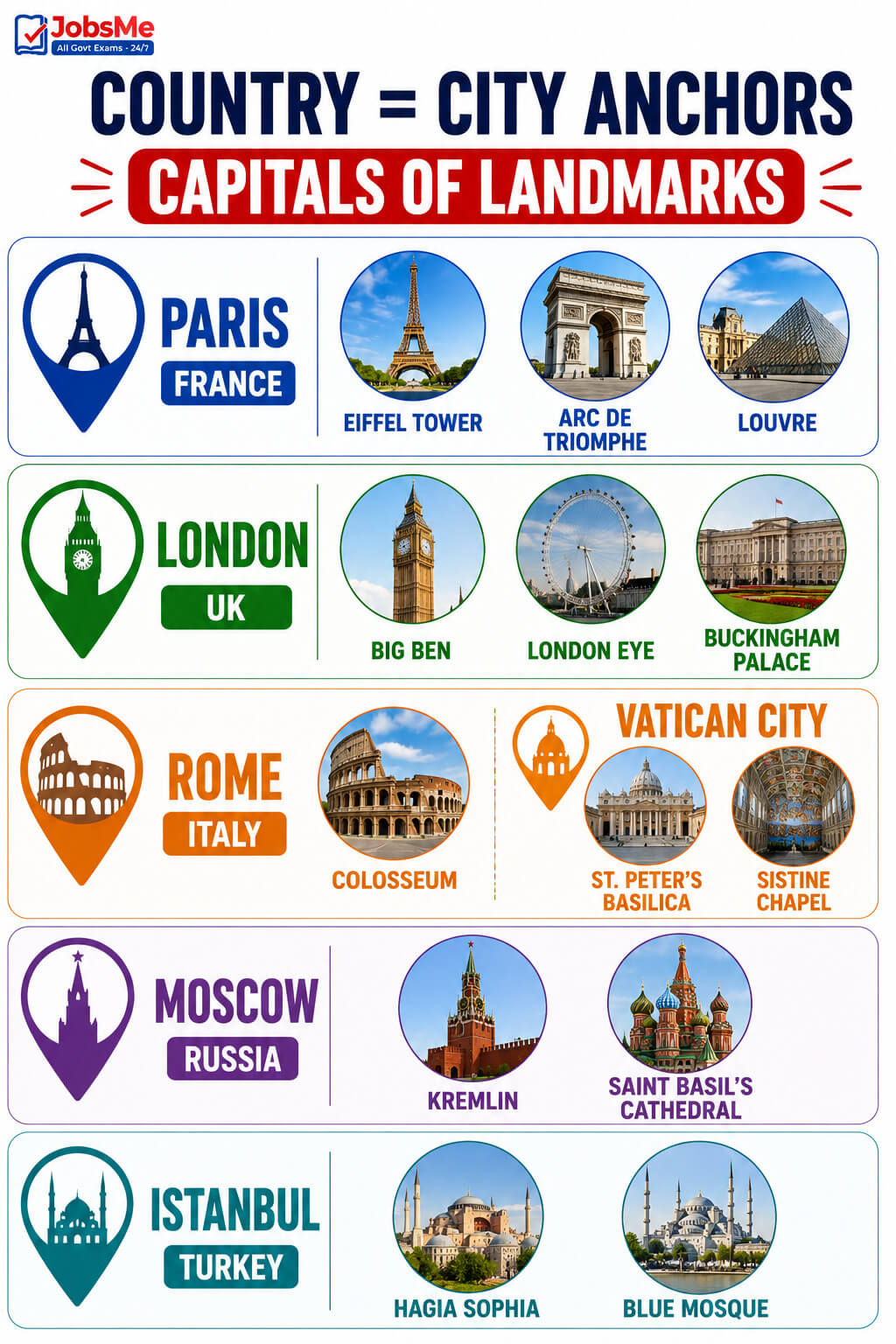
- Paris → Eiffel Tower, Arc de Triomphe, Louvre (France).
- London → Big Ben, London Eye, Buckingham Palace (UK).
- Rome → Colosseum (Italy); Vatican City → St. Peter's Basilica, Sistine Chapel.
- Moscow → Kremlin, Saint Basil's Cathedral (Russia).
- Istanbul → Hagia Sophia, Blue Mosque (Turkey).
Trick 4: Tallest Records — "Tall Trio"
- Tallest building/structure → Burj Khalifa (Dubai, UAE).
- Tallest statue → Statue of Unity (Gujarat, India).
- Tallest brick minaret → Qutub Minar (Delhi, India).
"For tallest, think Burj, Unity, Qutub."
Trick 5: Statue Story — "Liberty, Christ, Unity"
- Statue of Liberty → New York, USA → gift from France (1886).
- Christ the Redeemer → Rio de Janeiro, Brazil → on Corcovado Mountain.
- Statue of Unity → Gujarat, India → Sardar Patel, world's tallest.
Trick 6: Shah Jahan's Built Pair — "Taj and Red"
Two of India's most famous monuments share one builder — Mughal emperor Shah Jahan:
- Taj Mahal → Agra → white marble → for Mumtaz Mahal.
- Red Fort → Delhi → red sandstone → royal residence.
"Shah Jahan built one white in Agra, one red in Delhi."
Trick 7: Ashoka and the Buddhists — "Sanchi Story"
Group the monuments linked to Emperor Ashoka and Buddhism:
- Sanchi Stupa → Madhya Pradesh → built by Ashoka.
- Ajanta Caves → Maharashtra → Buddhist rock-cut art.
"Ashoka's stupa at Sanchi, Buddha's art at Ajanta."
Additional Notes
Frequently Confused Facts
- Eiffel Tower vs Tokyo Tower: The Eiffel Tower is in Paris, France; the Tokyo Tower in Japan was inspired by it but is a separate structure.
- Big Ben vs Elizabeth Tower: "Big Ben" is technically the great bell; the tower itself is called the Elizabeth Tower at the Palace of Westminster in London.
- Statue of Liberty vs Statue of Unity: Statue of Liberty is in New York, USA (a French gift); Statue of Unity is in Gujarat, India (Sardar Patel) and is taller — the world's tallest statue.
- Colosseum vs Leaning Tower of Pisa: Both are in Italy, but the Colosseum is in Rome and the Leaning Tower is in Pisa.
- Red Fort vs Agra Fort: The Red Fort is in Delhi (built by Shah Jahan); Agra Fort is a separate Mughal fort in Agra.
- Taj Mahal vs Humayun's Tomb: Both are Mughal tombs, but the Taj Mahal (Agra) was built by Shah Jahan, while Humayun's Tomb (Delhi) was built by Hamida Banu Begum and inspired the Taj.
- Qutub Minar vs Charminar: Qutub Minar is in Delhi (tallest brick minaret); Charminar is in Hyderabad (built by Quli Qutb Shah).
- Kremlin vs Saint Basil's Cathedral: Both are in Moscow's Red Square area; the Kremlin is the fortified government complex, while Saint Basil's is the colourful onion-domed church.
- Hawa Mahal vs Amer Fort: Both are in Jaipur, Rajasthan; Hawa Mahal is the "Palace of Winds" with many windows, while Amer Fort is a hilltop Rajput fort.
- Angkor Wat vs Borobudur: Angkor Wat is in Cambodia (largest religious monument, originally for Vishnu); Borobudur is the giant Buddhist temple in Indonesia.
Repeating PYQ Patterns
Certain monument-location pairs are asked repeatedly in competitive exams. Taj Mahal (Agra), Eiffel Tower (France), Statue of Liberty (USA), Great Wall of China, Colosseum (Italy), Pyramids of Giza (Egypt), Christ the Redeemer (Brazil), Leaning Tower of Pisa (Italy), Burj Khalifa (UAE), and Sydney Opera House (Australia) appear most often in UPSC Prelims, SSC CGL, and RRB NTPC papers. Banking exams (IBPS PO, SBI Clerk) frequently focus on matching monuments with their countries and on tallest/largest records like the Burj Khalifa and the Statue of Unity. State PCS exams add regional Indian monuments — Rajasthan PCS asks about Hawa Mahal and Amer Fort, Telangana PCS about Charminar, Odisha PCS about the Konark Sun Temple, and Uttar Pradesh PCS about the Bara Imambara and Fatehpur Sikri. You can practise these regularly through the Static GK Quiz on Jobsme.in.
Quick Insight
Monuments are condensed history and identity — a single image of the Eiffel Tower instantly says "France," and the Taj Mahal says "India." This is why monuments feature heavily in current affairs too: UNESCO World Heritage Site additions, restoration drives, tourism campaigns, summit venues, and even the backdrops of major international events. For aspirants, learning the monument, its city, its country, and its builder together makes it easy to answer direct matching questions in Prelims and to add depth to Mains answers on culture and heritage. For further reading on related Static GK topics, you can refer to the Static GK notes and keep up with heritage-related news through the Daily Current Affairs section on Jobsme.in.
One-Liners for Quick Revision
- Eiffel Tower → Paris, France → iron tower built by Gustave Eiffel for the 1889 World's Fair.
- Statue of Liberty → New York, USA → gifted by France in 1886.
- Great Wall of China → China → the longest wall in the world.
- Colosseum → Rome, Italy → largest ancient amphitheatre; New Seven Wonder.
- Leaning Tower of Pisa → Pisa, Italy → bell tower famous for its tilt.
- Big Ben → London, UK → great bell of the Elizabeth Tower.
- London Eye → London, UK → giant observation wheel on the Thames.
- Buckingham Palace → London, UK → residence of the British monarch.
- Pyramids of Giza → Giza, Egypt → only surviving Ancient Wonder; Great Pyramid built for Khufu.
- Great Sphinx → Giza, Egypt → lion body with a human head.
- Christ the Redeemer → Rio de Janeiro, Brazil → on Corcovado Mountain; New Seven Wonder.
- Machu Picchu → Peru → Inca citadel in the Andes; New Seven Wonder.
- Chichen Itza → Mexico → Mayan city with the Kukulkan pyramid; New Seven Wonder.
- Petra → Jordan → "Rose City" carved in rock; New Seven Wonder.
- Angkor Wat → Cambodia → largest religious monument; on the national flag.
- Sydney Opera House → Sydney, Australia → sail-shaped roof; designed by Jorn Utzon.
- Burj Khalifa → Dubai, UAE → tallest building in the world.
- Petronas Twin Towers → Kuala Lumpur, Malaysia → tallest buildings 1998-2004.
- Tokyo Tower → Tokyo, Japan → inspired by the Eiffel Tower.
- Mount Fuji → Japan → highest mountain in Japan; active volcano.
- Acropolis / Parthenon → Athens, Greece → temple of goddess Athena.
- Brandenburg Gate → Berlin, Germany → symbol of German unity.
- Neuschwanstein Castle → Bavaria, Germany → fairy-tale castle of King Ludwig II.
- Sagrada Familia → Barcelona, Spain → unfinished basilica by Antoni Gaudi.
- St. Peter's Basilica → Vatican City → largest church in the world.
- Sistine Chapel → Vatican City → Michelangelo's ceiling frescoes.
- Moai Statues → Easter Island, Chile → giant stone head statues.
- Mount Rushmore → South Dakota, USA → faces of four US Presidents.
- Golden Gate Bridge → San Francisco, USA → red suspension bridge.
- White House → Washington, D.C., USA → residence of the US President.
- Kremlin → Moscow, Russia → residence of the Russian President.
- Saint Basil's Cathedral → Moscow, Russia → colourful onion-domed church.
- CN Tower → Toronto, Canada → tall observation tower.
- Niagara Falls → USA-Canada border → major waterfall landmark.
- Table Mountain → Cape Town, South Africa → flat-topped mountain.
- Mount Kilimanjaro → Tanzania → highest mountain in Africa.
- Hagia Sophia → Istanbul, Turkey → cathedral-turned-mosque famous for its dome.
- Blue Mosque → Istanbul, Turkey → six minarets and blue tiles.
- Stonehenge → Wiltshire, UK → prehistoric circle of standing stones.
- Merlion → Singapore → lion-head, fish-body national symbol.
- Arc de Triomphe → Paris, France → triumphal arch.
- Louvre Museum → Paris, France → world's most-visited museum; home of the Mona Lisa.
- Taj Mahal → Agra, India → built by Shah Jahan for Mumtaz Mahal; New Seven Wonder.
- Red Fort → Delhi, India → built by Shah Jahan; Independence Day flag-hoisting site.
- Qutub Minar → Delhi, India → tallest brick minaret; begun by Qutb-ud-din Aibak.
- India Gate → New Delhi, India → war memorial designed by Edwin Lutyens.
- Humayun's Tomb → Delhi, India → first garden-tomb; built by Hamida Banu Begum.
- Gateway of India → Mumbai, India → built for King George V's visit.
- Charminar → Hyderabad, India → built by Quli Qutb Shah.
- Hawa Mahal → Jaipur, India → "Palace of Winds" with 953 windows.
- Amer Fort → Jaipur, India → built by Raja Man Singh I.
- Golden Temple → Amritsar, India → holiest Sikh shrine; founded by Guru Arjan Dev.
- Sanchi Stupa → Madhya Pradesh, India → built by Emperor Ashoka.
- Konark Sun Temple → Odisha, India → chariot-shaped temple by Narasimhadeva I.
- Khajuraho Temples → Madhya Pradesh, India → built by the Chandela dynasty.
- Mysore Palace → Karnataka, India → also called Amba Vilas Palace.
- Victoria Memorial → Kolkata, India → white marble memorial to Queen Victoria.
- Statue of Unity → Gujarat, India → tallest statue in the world; Sardar Patel.
- Fatehpur Sikri / Buland Darwaza → Agra district, India → built by Akbar; highest gateway.
- Ajanta and Ellora Caves → Maharashtra, India → rock-cut cave art.
- Bara Imambara → Lucknow, India → built by Asaf-ud-Daula; beam-less central hall.
For more Static GK topics like Indian dynasties, rivers, and national parks, explore the Static GK section on Jobsme.in. You can also test your knowledge with the Static GK Quiz, brush up on world facts through the Daily Current Affairs Quiz, and check the latest exam notifications at Latest Government Job Notifications.
Free quiz • No signup required
Put this topic into practice with Indian Cultural Institutions – Static GK MCQ Quiz. It is the quickest way to reinforce what you just learned.
Frequently Asked Questions
In which country is the Eiffel Tower located?
Who built the Taj Mahal and where is it located?
Which monuments are part of the New Seven Wonders of the World?
Where is the Statue of Liberty and who gifted it?
Which is the tallest statue in the world?
In which country is the Colosseum located?
Which is the only surviving structure of the Seven Wonders of the Ancient World?
Which is the tallest building in the world and where is it?
Where is the Christ the Redeemer statue located?
Which Indian monument has the tallest brick minaret in the world?

About the author