World War I and World War II – Complete Static GK & General Awareness Notes for Competitive Exams with Memory Tricks
This article presents complete, exam-ready notes on World War I (1914–1918) and World War II (1939–1945), covering their causes, alliances, major battles, important treaties and conferences, key leaders, India's role, and the aftermath of each war. It includes high-frequency facts such as the assassination of Archduke Franz Ferdinand, the Treaty of Versailles, the rise of Hitler, Pearl Harbor, D-Day, the atomic bombings of Hiroshima and Nagasaki, and the formation of the League of Nations and United Nations. All facts are arranged in a structured format with tables, memory tricks, and one-liners to help UPSC, SSC, IBPS, RRB, PSU, and State PCS aspirants score better in General Awareness and World History sections.
Jump to section
Introduction
The two World Wars of the twentieth century reshaped the map of the world, ended empires, created new nations, and gave birth to the institutions that govern international relations even today. World War I (1914-1918), also called the Great War, began with the assassination of Archduke Franz Ferdinand of Austria-Hungary and pitted the Allied Powers against the Central Powers. World War II (1939-1945), the deadliest conflict in human history, started with the German invasion of Poland and ended with the atomic bombings of Hiroshima and Nagasaki. Together they caused tens of millions of deaths and permanently shifted global power towards the United States and the Soviet Union.
Questions on the World Wars appear regularly in UPSC Prelims, SSC CGL, IBPS PO, RRB NTPC, SBI Clerk, State PCS, and various Insurance, Defence, and PSU exams. Examiners typically ask about start and end years, immediate causes, the alliance systems, important treaties like the Treaty of Versailles, major turning-point battles such as Stalingrad and Midway, and the international bodies formed afterwards. To explore other related Static GK topics, you can refer to the Static GK notes available on Jobsme.in.
The World Wars also connect closely to current affairs themes such as anniversaries of D-Day and Victory Day, the role of the United Nations Security Council, nuclear disarmament debates, and references in international diplomacy — making this topic doubly important for aspirants preparing for both Prelims and Mains. For daily updates linking history to news, aspirants can follow the Daily Current Affairs section.
Core Concepts: Understanding the Two World Wars
A world war is a large-scale conflict involving many of the world's most powerful nations across multiple continents. Both World Wars grew out of competing alliances, nationalism, militarism, and imperial rivalry. Understanding the underlying causes makes it far easier to remember the sequence of events and answer linked questions confidently.
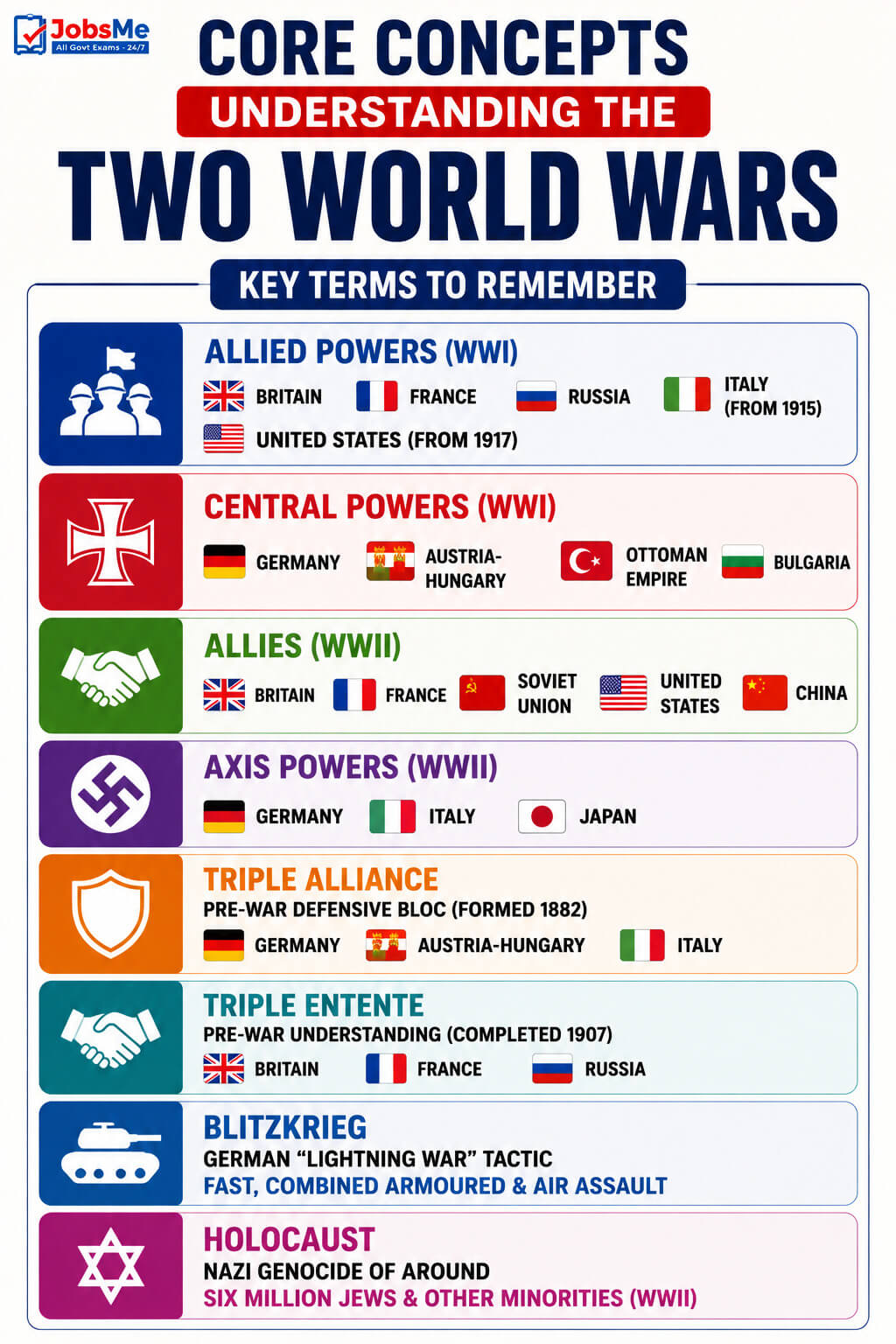
Key Terms to Remember
- Allied Powers (WWI): Mainly Britain, France, Russia, Italy (from 1915), and the United States (from 1917).
- Central Powers (WWI): Germany, Austria-Hungary, the Ottoman Empire, and Bulgaria.
- Allies (WWII): Britain, France, the Soviet Union, the United States, and China.
- Axis Powers (WWII): Germany, Italy, and Japan.
- Triple Alliance: Pre-war defensive bloc of Germany, Austria-Hungary, and Italy (formed 1882).
- Triple Entente: Pre-war understanding between Britain, France, and Russia (completed 1907).
- Blitzkrieg: German "lightning war" tactic of fast, combined armoured and air assault used in WWII.
- Holocaust: Nazi genocide of around six million Jews and other minorities during WWII.
World War I (1914-1918) - Key Facts
World War I was triggered by the assassination of Archduke Franz Ferdinand but had deeper roots in nationalism, militarism, imperialism, and the alliance system, often summarised by the acronym MAIN. The following table covers the most exam-relevant facts.
| Aspect | Detail | Key Features / Explanation |
|---|---|---|
| Duration | 28 July 1914 - 11 November 1918 | Also called the Great War; lasted just over four years; ended with the Armistice signed on 11 November 1918, observed today as Armistice Day / Remembrance Day. |
| Immediate Cause | Assassination of Archduke Franz Ferdinand | Heir to the Austro-Hungarian throne; assassinated at Sarajevo on 28 June 1914 by Gavrilo Princip, a Serbian nationalist of the Black Hand group. |
| Underlying Causes (MAIN) | Militarism, Alliances, Imperialism, Nationalism | Arms race and naval rivalry, the Triple Alliance vs Triple Entente system, competition for colonies, and aggressive nationalism in the Balkans (the "powder keg of Europe"). |
| Central Powers | Germany, Austria-Hungary, Ottoman Empire, Bulgaria | Originated from the Triple Alliance; Italy switched sides and did not join the Central Powers. |
| Allied Powers | Britain, France, Russia, Italy, USA, Japan | Italy joined the Allies in 1915; the USA entered in 1917 after the sinking of the Lusitania and the Zimmermann Telegram; Russia exited in 1917 after the Bolshevik Revolution. |
| Schlieffen Plan | German war strategy | Aimed to quickly defeat France in the west before turning to Russia in the east; failed at the First Battle of the Marne (1914), leading to trench warfare. |
| Russia's Exit | Treaty of Brest-Litovsk (March 1918) | Signed between Bolshevik Russia and Germany after the 1917 Russian Revolution; took Russia out of the war. |
| USA's Entry | 1917 | Prompted by unrestricted German submarine warfare (sinking of RMS Lusitania, 1915) and the intercepted Zimmermann Telegram; President Woodrow Wilson led the US into the war. |
| End of War | Armistice, 11 November 1918 | Germany signed the armistice; war formally ended with peace treaties in 1919-1920. |
| Casualties | Around 20 million deaths | Roughly 9-10 million soldiers and a similar number of civilians died; trench warfare and new weapons caused massive losses. |
Major Battles of World War I
| Battle | Year | Key Features / Significance |
|---|---|---|
| First Battle of the Marne | 1914 | Halted the German advance into France and ended the Schlieffen Plan; marked the start of trench warfare on the Western Front. |
| Battle of Tannenberg | 1914 | Major German victory over Russia on the Eastern Front; established the reputation of generals Hindenburg and Ludendorff. |
| Battle of Gallipoli | 1915-1916 | Failed Allied campaign against the Ottoman Empire; heavy ANZAC (Australian and New Zealand) casualties. |
| Battle of Verdun | 1916 | Longest battle of WWI between France and Germany; symbol of French resistance with enormous casualties on both sides. |
| Battle of the Somme | 1916 | One of the bloodiest battles in history; first major use of the tank in warfare by the British. |
| Battle of Jutland | 1916 | Largest naval battle of WWI, fought between the British Royal Navy and the German Imperial Navy in the North Sea. |
Treaties and Aftermath of World War I
| Treaty / Outcome | Year | Key Features / Significance |
|---|---|---|
| Treaty of Versailles | 1919 | Main peace treaty signed with Germany; imposed heavy war reparations, territorial losses, and the "war guilt clause"; its harsh terms sowed seeds of WWII. |
| Paris Peace Conference | 1919 | Where the victorious Allies decided post-war terms; dominated by the "Big Four" — Woodrow Wilson (USA), Lloyd George (UK), Georges Clemenceau (France), and Vittorio Orlando (Italy). |
| Wilson's Fourteen Points | 1918 | US President Woodrow Wilson's blueprint for peace; called for self-determination and an international organisation to prevent future wars. |
| League of Nations | 1920 | First international peacekeeping body, headquartered in Geneva; weakened because the USA never joined; failed to prevent WWII. |
| Fall of Empires | 1918-1922 | Collapse of the German, Austro-Hungarian, Russian (Tsarist), and Ottoman empires; redrew the map of Europe and the Middle East. |
World War II (1939-1945) - Key Facts
World War II grew out of the unresolved tensions of WWI, the economic devastation of the Great Depression, and the rise of aggressive dictatorships in Germany, Italy, and Japan. It began with Germany's invasion of Poland and ended with Japan's surrender after the atomic bombings. The following table covers the essential exam facts.
| Aspect | Detail | Key Features / Explanation |
|---|---|---|
| Duration | 1 September 1939 - 2 September 1945 | Began with Germany's invasion of Poland; ended with Japan's formal surrender aboard USS Missouri; deadliest conflict in human history. |
| Immediate Cause | German invasion of Poland | Hitler invaded Poland on 1 September 1939; Britain and France declared war on Germany on 3 September 1939. |
| Underlying Causes | Harsh Treaty of Versailles, rise of Fascism and Nazism, Great Depression, failure of the League of Nations | Economic ruin and national humiliation in Germany enabled Hitler's rise; the policy of appeasement allowed Axis aggression to go unchecked. |
| Axis Powers | Germany, Italy, Japan | Led by Adolf Hitler (Germany), Benito Mussolini (Italy), and Hideki Tojo (Japan); bound together by the Tripartite Pact of 1940. |
| Allied Powers | Britain, France, Soviet Union, USA, China | Led by Winston Churchill (UK), Joseph Stalin (USSR), Franklin D. Roosevelt and later Harry Truman (USA); these five later became the permanent members of the UN Security Council. |
| Pearl Harbor | 7 December 1941 | Surprise Japanese attack on the US naval base in Hawaii; brought the previously isolationist United States into the war. |
| Operation Barbarossa | 1941 | German invasion of the Soviet Union, breaking the Nazi-Soviet Non-Aggression Pact of 1939; opened the brutal Eastern Front. |
| Germany's Surrender | 8 May 1945 (V-E Day) | Hitler died by suicide on 30 April 1945; Germany surrendered unconditionally; celebrated as Victory in Europe Day. |
| Japan's Surrender | 2 September 1945 (V-J Day) | Followed the atomic bombings of Hiroshima (6 August) and Nagasaki (9 August) 1945 and the Soviet declaration of war; formally ended WWII. |
| Casualties | Around 60-80 million deaths | Most were civilians; included roughly 6 million Jews killed in the Holocaust; the deadliest war in history. |
Major Battles and Operations of World War II
| Battle / Operation | Year | Key Features / Significance |
|---|---|---|
| Battle of Britain | 1940 | Air battle between Germany's Luftwaffe and Britain's Royal Air Force; first major defeat for Hitler and saved Britain from invasion. |
| Battle of Stalingrad | 1942-1943 | Turning point of the war in Europe; the Soviet Union defeated and captured the German Sixth Army; one of the bloodiest battles in history. |
| Battle of Midway | 1942 | Decisive US naval victory over Japan in the Pacific; destroyed four Japanese aircraft carriers and turned the tide in the Pacific theatre. |
| Battle of El Alamein | 1942 | Allied victory in North Africa; halted the German-Italian advance towards Egypt and the Suez Canal. |
| Operation Overlord (D-Day) | 6 June 1944 | Massive Allied landing on the beaches of Normandy, France; opened the second front in Western Europe and began the liberation of France. |
| Battle of the Bulge | 1944-1945 | Germany's last major offensive in the west, in the Ardennes; its failure hastened the collapse of the Third Reich. |
| Battle of Iwo Jima / Okinawa | 1945 | Bloody Pacific island battles preceding the planned invasion of Japan; heavy casualties influenced the decision to use atomic bombs. |
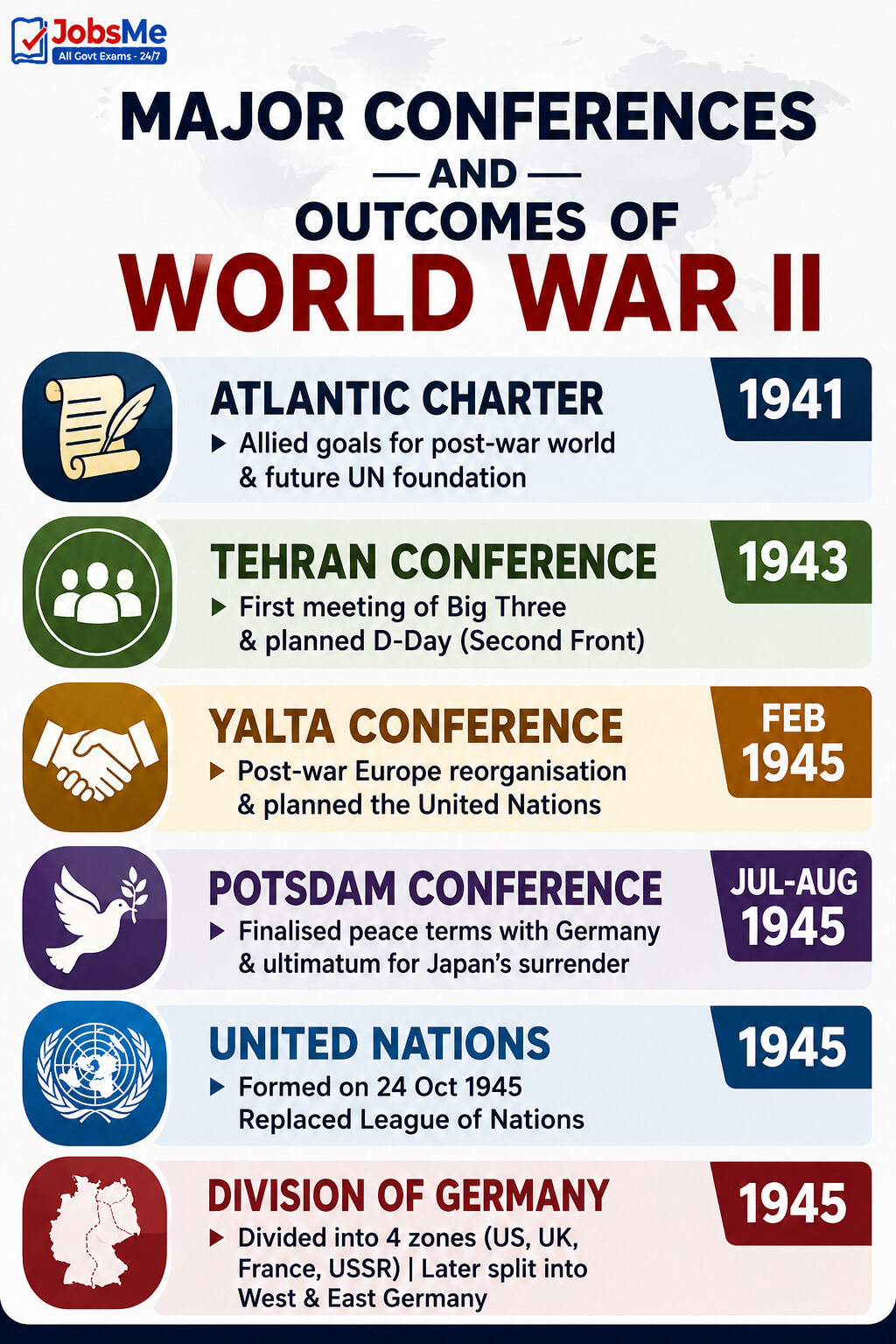
Major Conferences and Outcomes of World War II
| Conference / Outcome | Year | Key Features / Significance |
|---|---|---|
| Atlantic Charter | 1941 | Joint declaration by Roosevelt and Churchill setting out Allied goals for the post-war world; basis for the future United Nations. |
| Tehran Conference | 1943 | First meeting of the "Big Three" — Roosevelt, Churchill, and Stalin; planned the opening of the second front (D-Day). |
| Yalta Conference | February 1945 | Big Three discussed the post-war reorganisation of Europe and the division of Germany; planned the United Nations. |
| Potsdam Conference | July-August 1945 | Truman, Churchill (later Attlee), and Stalin finalised peace terms with Germany and issued the ultimatum for Japan's unconditional surrender. |
| United Nations | 1945 | Formed on 24 October 1945, replacing the failed League of Nations; headquartered in New York with the Security Council as its core body. |
| Division of Germany | 1945 | Germany was divided into four occupation zones (US, UK, France, USSR); later split into West and East Germany during the Cold War. |
India and the World Wars
| Aspect | Detail | Key Features / Significance |
|---|---|---|
| India in WWI | 1914-1918 | Over a million Indian soldiers served for Britain; their contribution fuelled demands for self-rule and led to the Government of India Act 1919 (Montagu-Chelmsford Reforms). |
| India in WWII | 1939-1945 | India was declared at war without consultation, triggering the resignation of Congress ministries and later the Quit India Movement of 1942. |
| Indian National Army (INA) | 1942-1945 | Azad Hind Fauj led by Subhash Chandra Bose fought alongside Japan against the British in Southeast Asia and at the India-Burma frontier. |
| Cripps Mission | 1942 | British proposal during WWII offering dominion status to gain Indian support; rejected by the Congress, leading to the Quit India Movement. |
Memory Tricks and Mnemonics
Trick 1: Causes of WWI — "MAIN"
Remember the four underlying causes of World War I with the acronym "MAIN":
- M → Militarism (arms and naval race).
- A → Alliances (Triple Alliance vs Triple Entente).
- I → Imperialism (race for colonies).
- N → Nationalism (especially in the Balkans).
"The MAIN reasons started the Great War."
Trick 2: Central Powers of WWI — "GATB"
The Central Powers in World War I can be recalled as "GATB":
- G → Germany.
- A → Austria-Hungary.
- T → Turkey (Ottoman Empire).
- B → Bulgaria.
"Germany And Turkey, plus Bulgaria — the Central four."
Trick 3: Axis Powers of WWII — "GIJ"
The three main Axis Powers in World War II are easy to remember as "GIJ":
- G → Germany (Hitler).
- I → Italy (Mussolini).
- J → Japan (Tojo).
"GIJ — the three dictators who started the Axis."
Trick 4: WWII Allied Leaders / UN Security Council — "FRUCB"
The five major Allied nations of WWII later became the permanent members (P5) of the UN Security Council. Remember them as "FRUCB":
- F → France.
- R → Russia (Soviet Union).
- U → United States (USA).
- C → China.
- B → Britain (UK).
Trick 5: The Three WWII Conferences — "TYP" (Big Three)
The three big wartime conferences of the "Big Three" leaders are remembered in order as "TYP":
- T → Tehran (1943) — planned D-Day.
- Y → Yalta (Feb 1945) — planned post-war Europe and the UN.
- P → Potsdam (Jul-Aug 1945) — final peace terms and the Japan ultimatum.
"TYP — Tehran, Yalta, Potsdam, in that order."
Trick 6: Start and End Dates — "Same September"
World War II started and effectively ended in September:
- Start: 1 September 1939 — Germany invades Poland.
- End: 2 September 1945 — Japan formally surrenders.
"September to September — six years apart."
Trick 7: Turning-Point Battles — "Stop the Axis with SMS"
The three turning-point battles that stopped Axis expansion can be grouped as "SMS":
- S → Stalingrad (1942-43) — turning point on the Eastern Front (Europe).
- M → Midway (1942) — turning point in the Pacific against Japan.
- S → El Alamein / North Africa (1942) — turning point in North Africa.
Additional Notes
Frequently Confused Facts
- WWI vs WWII start cause: WWI began with the assassination of Archduke Franz Ferdinand (1914); WWII began with Germany's invasion of Poland (1939).
- Triple Alliance vs Allied Powers: The Triple Alliance (Germany, Austria-Hungary, Italy) was the pre-war bloc; in WWI Italy switched sides, so the Central Powers were Germany, Austria-Hungary, Ottoman Empire, and Bulgaria.
- League of Nations vs United Nations: The League of Nations (1920) was formed after WWI and failed; the United Nations (1945) was formed after WWII to replace it.
- Treaty of Versailles vs Treaty of Brest-Litovsk: Versailles (1919) was the main peace treaty with Germany after WWI; Brest-Litovsk (1918) took Russia out of WWI.
- V-E Day vs V-J Day: Victory in Europe Day was 8 May 1945 (Germany's surrender); Victory over Japan Day was 2 September 1945 (Japan's surrender).
- Hiroshima vs Nagasaki: Hiroshima was bombed first on 6 August 1945 ("Little Boy"); Nagasaki was bombed second on 9 August 1945 ("Fat Man").
- Pearl Harbor vs Operation Barbarossa: Pearl Harbor (Dec 1941) was Japan's attack that brought in the USA; Operation Barbarossa (1941) was Germany's invasion of the USSR.
- D-Day vs V-E Day: D-Day (6 June 1944) was the Normandy landings; V-E Day (8 May 1945) was Germany's surrender almost a year later.
Repeating PYQ Patterns
Certain World War facts are asked repeatedly in competitive exams. The start and end years of both wars, the assassination of Archduke Franz Ferdinand, the Treaty of Versailles, the formation of the League of Nations and United Nations, Pearl Harbor, D-Day, the Battle of Stalingrad, and the atomic bombings of Hiroshima and Nagasaki appear most often in UPSC Prelims, SSC CGL, and RRB NTPC papers. Banking exams (IBPS PO, SBI Clerk) frequently ask one-line matching questions on leaders and treaties, while State PCS and Defence exams add questions on India's contribution, the Indian National Army, and the Quit India Movement. To practise these facts in quiz form, aspirants can use the Static GK Quiz on Jobsme.in.
Quick Insight
The World Wars are not just history — they shape today's headlines. The United Nations Security Council's five permanent members are still the WWII victors, debates on its reform appear regularly in current affairs, and anniversaries of D-Day and the Hiroshima bombing feature in news every year. Nuclear disarmament, the legacy of the Holocaust, and the post-war world order all trace directly back to 1939-1945. Understanding these wars helps aspirants connect static history to dynamic current events, which is invaluable for both Prelims matching questions and Mains essays on world order and international relations. For ongoing coverage, you can follow the Daily Current Affairs notes and the broader Static GK section on Jobsme.in.
One-Liners for Quick Revision
- World War I duration → 1914 to 1918 → also called the Great War.
- Immediate cause of WWI → Assassination of Archduke Franz Ferdinand → at Sarajevo on 28 June 1914 by Gavrilo Princip.
- Underlying causes of WWI → Militarism, Alliances, Imperialism, Nationalism (MAIN).
- WWI Central Powers → Germany, Austria-Hungary, Ottoman Empire (Turkey), Bulgaria.
- WWI Allied Powers → Britain, France, Russia, Italy (1915), USA (1917).
- Schlieffen Plan → German plan to defeat France quickly → failed at the First Battle of the Marne.
- USA entered WWI → 1917 → after the sinking of the Lusitania and the Zimmermann Telegram.
- Russia left WWI → Treaty of Brest-Litovsk (1918) → after the Bolshevik Revolution of 1917.
- WWI ended → Armistice on 11 November 1918.
- Treaty of Versailles → 1919 → main peace treaty with Germany; harsh terms led to WWII.
- Big Four at Paris Peace Conference → Wilson (USA), Lloyd George (UK), Clemenceau (France), Orlando (Italy).
- Fourteen Points → given by US President Woodrow Wilson (1918).
- League of Nations → formed 1920 → headquartered at Geneva; USA never joined; failed to stop WWII.
- Battle of Verdun → 1916 → longest battle of WWI (France vs Germany).
- Battle of the Somme → 1916 → first major use of tanks by Britain.
- Battle of Jutland → 1916 → largest naval battle of WWI.
- World War II duration → 1939 to 1945 → deadliest war in history.
- Immediate cause of WWII → German invasion of Poland on 1 September 1939.
- WWII Axis Powers → Germany (Hitler), Italy (Mussolini), Japan (Tojo).
- WWII Allied leaders → Churchill (UK), Stalin (USSR), Roosevelt/Truman (USA).
- Pearl Harbor → 7 December 1941 → Japan's attack that brought the USA into the war.
- Operation Barbarossa → 1941 → German invasion of the Soviet Union.
- Battle of Britain → 1940 → air battle; first major defeat for Hitler.
- Battle of Stalingrad → 1942-43 → turning point of the war in Europe.
- Battle of Midway → 1942 → turning point in the Pacific against Japan.
- D-Day (Operation Overlord) → 6 June 1944 → Allied landings at Normandy, France.
- Hitler's death → 30 April 1945 → by suicide in his Berlin bunker.
- V-E Day (Germany surrenders) → 8 May 1945.
- Atomic bomb on Hiroshima → 6 August 1945 → codenamed "Little Boy".
- Atomic bomb on Nagasaki → 9 August 1945 → codenamed "Fat Man".
- V-J Day (Japan surrenders) → 2 September 1945 → aboard USS Missouri.
- Wartime conferences → Tehran (1943), Yalta (1945), Potsdam (1945).
- United Nations → formed 24 October 1945 → replaced the League of Nations.
- UN Security Council P5 → USA, UK, France, Russia, China (WWII victors).
- India in WWI → over a million soldiers served → led to the Government of India Act 1919.
- India in WWII → declared at war without consultation → led to the Quit India Movement (1942).
- Indian National Army (INA) → Azad Hind Fauj led by Subhash Chandra Bose.
- Cripps Mission → 1942 → offered dominion status; rejected by Congress.
- Holocaust → Nazi genocide of around 6 million Jews during WWII.
For more Static GK topics like Indian freedom struggle, important treaties, and world geography, explore the Static GK section on Jobsme.in. You can also test yourself with the Daily Current Affairs Quiz and check the latest openings at Latest Government Job Notifications.
Free quiz • No signup required
Put this topic into practice with Indian Cultural Institutions – Static GK MCQ Quiz. It is the quickest way to reinforce what you just learned.
Frequently Asked Questions
When did World War I and World War II take place?
What was the immediate cause of World War I?
Who were the Central Powers and Allied Powers in World War I?
What was the Treaty of Versailles?
Why did the United States enter World War I?
What event started World War II?
Who were the Axis Powers in World War II?
What was the significance of the attack on Pearl Harbor?
Which battles were the turning points of World War II?
How did World War II end and what did it lead to?

About the author