List of Famous Quotations and Their Authors – Static GK & General Awareness for Competitive Exams with Memory Tricks
This article presents a complete, theme-wise collection of famous quotations and the personalities who said them, covering Indian leaders and thinkers (Gandhi, Ambedkar, Tagore, Vivekananda, Kalam, Bose, Nehru) as well as world figures (Mandela, Lincoln, Einstein, Churchill, Kofi Annan, Malala). It includes iconic lines like "Swaraj is my birthright" (Tilak), "Give me blood, and I shall give you freedom" (Bose), "Education is the most powerful weapon" (Mandela), and "An eye for an eye makes the whole world blind" (Gandhi), with memory tricks and one-liners for quick revision. All facts are arranged in exam-ready format to help UPSC, SSC, IBPS, RRB, PSU, and State PCS aspirants score better in General Awareness, Essay, and Ethics sections.

Jump to section
Introduction
Quotations are condensed wisdom — a single line that captures an entire philosophy, movement, or moment in history. From Mahatma Gandhi's "You must be the change you wish to see in the world" to Bal Gangadhar Tilak's "Swaraj is my birthright, and I shall have it," and from Subhas Chandra Bose's "Give me blood, and I shall give you freedom" to Nelson Mandela's "Education is the most powerful weapon which you can use to change the world," famous quotations are remembered as much for who said them as for what they say. Knowing the correct author of a quotation is a frequently tested area of General Awareness.
Questions on famous quotations and their authors appear regularly in UPSC Prelims and Mains, SSC CGL, IBPS PO, RRB NTPC, SBI Clerk, State PCS, and various Insurance and Defence exams. Objective papers usually ask which personality is associated with a particular quote, while UPSC Mains and Essay papers reward candidates who can open, pivot, and close with well-attributed lines from Indian and world thinkers. This article brings together every important quotation in a structured, theme-wise, exam-ready format. To explore other related topics, you can refer to the Static GK section on Jobsme.in.
Quotations are also closely linked to current affairs themes such as birth and death anniversaries of national leaders, International Days (Gender Equality, Environment, Education, Youth), Bharat Ratna conferments, and references made in Parliament and public speeches — making this topic doubly important for aspirants preparing for the Essay and Ethics (GS Paper IV) papers as well as objective General Awareness sections.
Core Concepts: Why Quotations Matter in Exams
A quotation is a memorable statement attributed to a specific person, text, or culture. In competitive exams, the skill being tested is correct attribution — matching the line to its true author. Misattribution is the single biggest mistake students make, so understanding the speaker's context and ideology helps lock the quote to the right name.
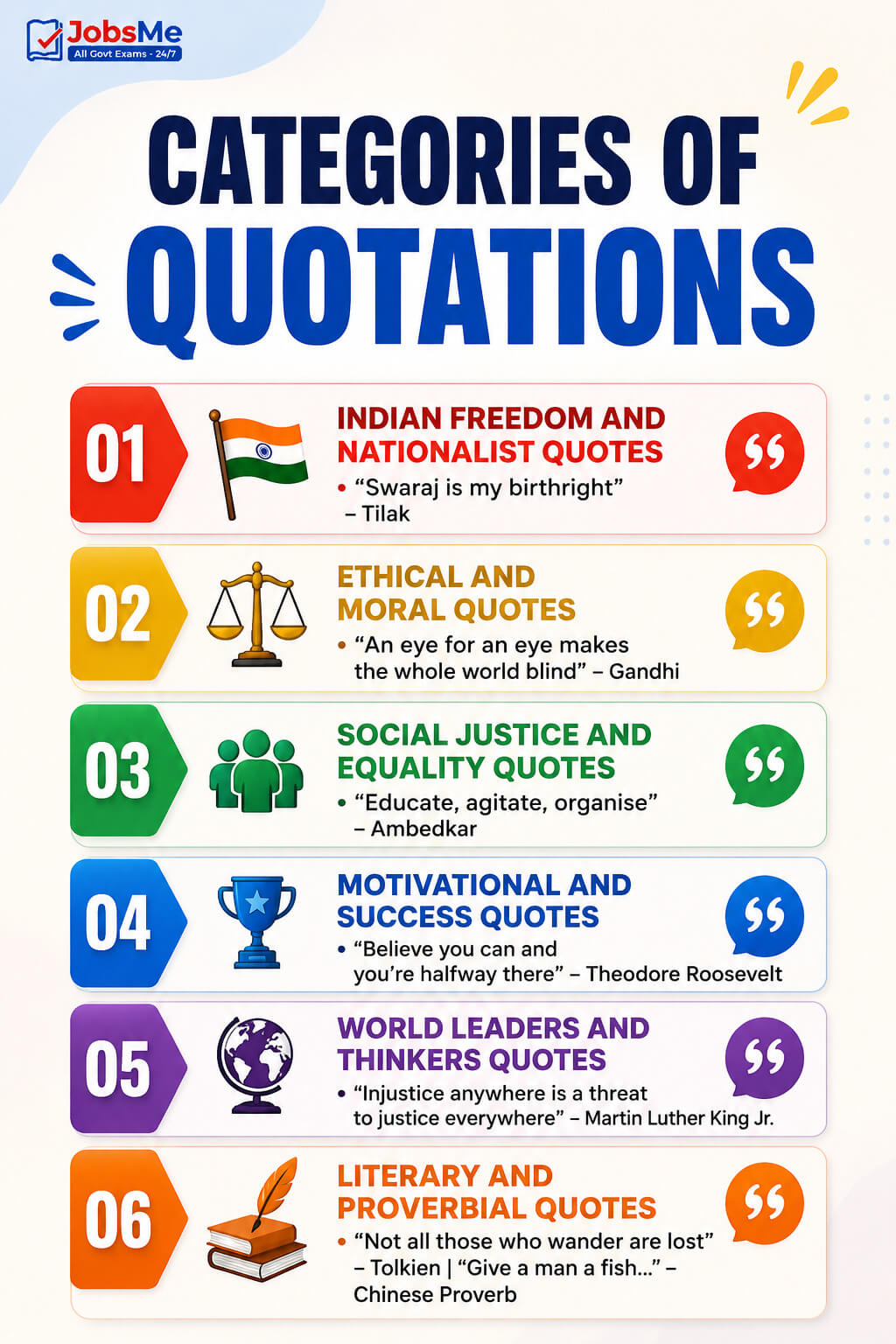
Categories of Quotations
- Indian Freedom and Nationalist Quotes: Lines from the freedom struggle. Example: "Swaraj is my birthright" (Tilak), "Give me blood, and I shall give you freedom" (Bose).
- Ethical and Moral Quotes: Statements on conduct, truth, and non-violence, useful for the Ethics paper. Example: "An eye for an eye makes the whole world blind" (Gandhi).
- Social Justice and Equality Quotes: Lines on caste, women, and dignity. Example: "Educate, agitate, organise" (Ambedkar).
- Motivational and Success Quotes: Inspirational lines from leaders, scientists, and entrepreneurs. Example: "Believe you can and you're halfway there" (Theodore Roosevelt).
- World Leaders and Thinkers Quotes: Lines from global statesmen and philosophers. Example: "Injustice anywhere is a threat to justice everywhere" (Martin Luther King Jr.).
- Literary and Proverbial Quotes: Famous lines from books, poets, and country proverbs. Example: "Not all those who wander are lost" (Tolkien), "Give a man a fish..." (Chinese proverb).
Famous Indian Quotations and Their Authors
The following table lists the most exam-relevant quotations by Indian leaders and thinkers, arranged by theme, along with the context behind each line.
| Quotation | Author | Theme / Key Details |
|---|---|---|
| "Give me blood, and I shall give you freedom." | Subhas Chandra Bose | Freedom and courage; rallying call to the Indian National Army (Azad Hind Fauj) during the freedom struggle. |
| "Swaraj is my birthright, and I shall have it." | Bal Gangadhar Tilak | Self-rule; the most famous slogan of the freedom movement, asserting the demand for self-government. |
| "Freedom is not worth having if it does not include the freedom to make mistakes." | Mahatma Gandhi | Freedom; links liberty with the right to err and learn. |
| "Arise, awake, and stop not till the goal is reached." | Swami Vivekananda | Courage and youth; one of his best-known calls to action, drawn from the Katha Upanishad. |
| "They may torture my body, break my bones, even kill me. Then they will have my dead body, not my obedience." | Mahatma Gandhi | Freedom and resistance; expresses the spirit of non-cooperation. |
| "Inquilab Zindabad — the revolution is of the idea, not the bomb." | Bhagat Singh | Freedom and revolution; clarifies that the slogan celebrated ideas, not violence. |
| "You must be the change you wish to see in the world." | Mahatma Gandhi | Truth and moral conduct; emphasises individual responsibility for social change. |
| "An eye for an eye only ends up making the whole world blind." | Mahatma Gandhi | Non-violence; warns against the cycle of revenge. |
| "The weak can never forgive. Forgiveness is the attribute of the strong." | Mahatma Gandhi | Moral strength; links forgiveness with inner power. |
| "Non-violence is the greatest force at the disposal of mankind." | Mahatma Gandhi | Non-violence (Ahimsa); central to Gandhian philosophy. |
| "In a gentle way, you can shake the world." | Mahatma Gandhi | Wisdom and reflection; gentle persistence as a force for change. |
| "Live as if you were to die tomorrow. Learn as if you were to live forever." | Mahatma Gandhi | Life and learning; balances urgency of living with lifelong learning. |
| "Happiness is when what you think, what you say, and what you do are in harmony." | Mahatma Gandhi | Ethics; defines integrity as harmony of thought, word, and deed. |
| "The best way to find yourself is to lose yourself in the service of others." | Mahatma Gandhi | Service and ethics; self-realisation through selfless service. |
| "Strength does not come from physical capacity. It comes from an indomitable will." | Mahatma Gandhi | Inner strength; willpower over physical might. |
| "It is health that is real wealth and not pieces of gold and silver." | Mahatma Gandhi | Health; values well-being over material riches. |
| "A nation's culture resides in the hearts and in the soul of its people." | Mahatma Gandhi | Culture and civilisation; locates culture in the people, not monuments. |
| "Seven Dangers to Human Virtue: Wealth without work; Pleasure without conscience; Knowledge without character; Business without ethics; Science without humanity; Religion without sacrifice; Politics without principle." | Mahatma Gandhi | Ethics (GS Paper IV favourite); a seven-point list of moral pitfalls, very frequently quoted in essays. |
| "I measure the progress of a community by the degree of progress which women have achieved." | B. R. Ambedkar | Gender equality and social justice; links community progress to women's progress. |
| "Caste is not just a division of labour; it is a division of labourers." | B. R. Ambedkar | Caste and social justice; a sharp critique of the caste system. |
| "Educate, agitate, organise." | B. R. Ambedkar | Social movement; the rallying mantra for social empowerment. |
| "Cultivation of mind should be the ultimate aim of human existence." | B. R. Ambedkar | Education; sets intellectual growth as life's highest goal. |
| "Real education enhances the dignity of a human being." | B. R. Ambedkar | Education; education as a means to human dignity. |
| "The Constitution is not a mere lawyers' document; it is a vehicle of life, and its spirit is always the spirit of age." | B. R. Ambedkar | Governance and law; describes the Constitution as a living document. |
| "Democracy is not a form of government, it is a form of social organisation." | B. R. Ambedkar | Democracy; democracy as a social, not merely political, idea. |
| "The sanctity of law can be maintained only so long as it is the expression of the will of the people." | B. R. Ambedkar | Law and justice; ties legitimacy of law to popular will. |
| "Where the mind is without fear and the head is held high." | Rabindranath Tagore | Freedom and wisdom; opening line of his poem in Gitanjali envisioning a free nation. |
| "The earth has music for those who listen." | Rabindranath Tagore | Nature; celebrates harmony with the natural world. |
| "Trees are the earth's endless effort to speak to the listening heaven." | Rabindranath Tagore | Environment; poetic image of nature reaching upward. |
| "I slept and dreamt that life was joy. I awoke and saw that life was service. I acted, and behold, service was joy." | Rabindranath Tagore | Service and inner life; finds joy in selfless action. |
| "Don't read success stories, you will only get a message. Read failure stories, you will get some ideas to get success." | A. P. J. Abdul Kalam | Education and success; learning more from failure than success. |
| "Dream, dream, dream. Dreams transform into thoughts and thoughts result in action." | A. P. J. Abdul Kalam | Dreams and youth; the famous "dream" chain from thought to action. |
| "You cannot change your future, but you can change your habits, and surely your habits will change your future." | A. P. J. Abdul Kalam | Self-improvement; the power of habit in shaping destiny. |
| "Science is a beautiful gift to humanity; we should not distort it." | A. P. J. Abdul Kalam | Science and ethics; calls for responsible use of science. |
| "All of us do not have equal talent. But all of us have an equal opportunity to develop our talents." | A. P. J. Abdul Kalam | Equality of opportunity; distinguishes talent from opportunity. |
| "India will awaken when every Indian is awake." | Swami Vivekananda | Nation and civilisation; national awakening through individual awareness. |
| "Strength is life, weakness is death." | Swami Vivekananda | Inner strength; equates strength with life itself. |
| "You cannot believe in God until you believe in yourself." | Swami Vivekananda | Self-belief; self-confidence as the foundation of faith. |
| "There is no chance of the welfare of the world unless the condition of women is improved. It is not possible for a bird to fly on one wing." | Swami Vivekananda | Women and society; gender equality as essential to progress. |
| "We want the education by which character is formed, strength of mind is increased, the intellect is expanded, and by which one can stand on one's own feet." | Swami Vivekananda | Education; defines true, character-building education. |
| "At the stroke of the midnight hour, when the world sleeps, India will awake to life and freedom." | Jawaharlal Nehru | Independence; from the "Tryst with Destiny" speech of 15 August 1947. |
| "Children are like buds in a garden and should be carefully and lovingly nurtured, as they are the future of the Nation." | Jawaharlal Nehru | Children; Nehru's affection for children (Children's Day, 14 November). |
| "You have the right to work, but never to the fruit of work." | Bhagavad Gita | Wisdom and duty (Nishkama Karma); act without attachment to results. |
| "Awake, O India! Your daughters will lead you." | Sarojini Naidu | Women; the Nightingale of India on women's leadership. |
| "We are unnecessarily wasting our precious resources in wars... if we must wage war, we have to do it on unemployment, disease, poverty, and backwardness." | Atal Bihari Vajpayee | Governance and development; redirecting the idea of "war" to social problems. |
| "Good governance depends on the ability to take responsibility by both administration as well as people." | Narendra Modi | Governance; shared responsibility between state and citizens. |
| "Progress is more plausibly judged by the reduction of deprivation than by the further enrichment of the opulent." | Amartya Sen | Development economics; defines real progress as reducing deprivation. |
| "The foundation of a nation's greatness is in the homes of its people." | Gopal Krishna Gokhale | Nation; greatness rooted in the family and home. |
| "If agriculture fails, everything else will fail." | M. S. Swaminathan | Agriculture; the Father of India's Green Revolution on the primacy of farming. |
Famous World Quotations and Their Authors
The following table covers globally celebrated quotations by world leaders, thinkers, scientists, and writers that are frequently asked in exams and used in essays.
| Quotation | Author | Theme / Key Details |
|---|---|---|
| "Education is the most powerful weapon which you can use to change the world." | Nelson Mandela | Education; one of the most quoted lines in Indian essays. |
| "May your choices reflect your hopes, not your fears." | Nelson Mandela | Courage; encourages hope-driven decisions. |
| "No man is good enough to govern another man without that other's consent." | Abraham Lincoln | Democracy and consent; foundational idea of democratic government. |
| "Nearly all men can stand adversity, but if you want to test a man's character, give him power." | Abraham Lincoln | Ethics and power; power as the true test of character. |
| "Injustice anywhere is a threat to justice everywhere." | Martin Luther King Jr. | Justice; the interconnectedness of justice worldwide. |
| "Darkness cannot drive out darkness; only light can do that. Hate cannot drive out hate; only love can do that." | Martin Luther King Jr. | Peace and love; love as the antidote to hate. |
| "Peace cannot be kept by force; it can only be achieved by understanding." | Albert Einstein | Peace; understanding over coercion. |
| "The true sign of intelligence is not knowledge but imagination." | Albert Einstein | Science and creativity; imagination above mere knowledge. |
| "In the middle of every difficulty lies opportunity." | Albert Einstein | Motivation; opportunity hidden within difficulty. |
| "I fear the day when technology will suppress human interaction and the world will have a generation of idiots." | Albert Einstein | Science and technology; caution against losing human connection. |
| "Success is walking from failure to failure with no loss of enthusiasm." | Winston Churchill | Success; resilience through repeated failure. |
| "The price of greatness is responsibility." | Winston Churchill | Leadership; greatness demands responsibility. |
| "Keep calm and carry on." | Winston Churchill | Resilience; the famous wartime morale line. |
| "Leadership and learning are indispensable to each other." | John F. Kennedy | Leadership; links leading with continuous learning. |
| "Victory has a thousand fathers, but defeat is an orphan." | John F. Kennedy | Success and accountability; everyone claims success, none claims failure. |
| "Literacy is a bridge from misery to hope." | Kofi Annan | Education; literacy as a path out of poverty. |
| "Gender equality is more than a goal in itself. It is a precondition for meeting the challenge of reducing poverty." | Kofi Annan | Gender equality; equality as a precondition for development. |
| "We may have different religions, different languages, different colored skin, but we all belong to one human race." | Kofi Annan | Humanity; unity of the human race. |
| "Climate change is simply the greatest collective challenge we face as a human family." | Ban Ki-moon | Environment and climate change; frames climate as a shared challenge. |
| "Sustainable development is the pathway to the future we want for all." | Ban Ki-moon | Sustainable development; SDGs as a framework for the future. |
| "One child, one teacher, one book and one pen can change the world." | Malala Yousafzai | Education; the transformative power of basic education. |
| "We cannot all succeed when half of us are held back." | Malala Yousafzai | Gender equality; success needs the participation of all. |
| "Success is not about how much money you make, it's about the difference you make in people's lives." | Michelle Obama | Success and service; impact over income. |
| "The measure of any society is how it treats its women and girls." | Michelle Obama | Women and society; society judged by its treatment of women. |
| "When women do better, economies do better." | Christine Lagarde | Women and economy; women's empowerment drives growth. |
| "You educate a man, you educate a man. You educate a woman, you educate a generation." | Brigham Young | Women and education; educating women benefits whole generations. |
| "Women are the largest untapped reservoir of talent in the world." | Hillary Clinton | Women; women as undervalued human capital. |
| "The mind is everything. What you think, you become." | Buddha | Wisdom; thoughts shape character and destiny. |
| "Three things cannot be long hidden: the sun, the moon, and the truth." | Buddha | Truth; truth eventually prevails. |
| "The only true wisdom is in knowing you know nothing." | Socrates | Wisdom; humility as the basis of knowledge. |
| "The unexamined life is not worth living." | Socrates | Reflection; the value of self-examination. |
| "Educating the mind without educating the heart is no education at all." | Aristotle | Education and ethics; education must include values. |
| "If you tell the truth, you don't have to remember anything." | Mark Twain | Truth; honesty simplifies life. |
| "India is the cradle of the human race, the birthplace of human speech, the mother of history." | Mark Twain | India and civilisation; widely used by Indian essayists. |
| "The best time to plant a tree was 20 years ago. The second best time is now." | Chinese Proverb | Action and timing; it is never too late to begin. |
| "Give a man a fish, and you feed him for a day. Teach a man to fish, and you feed him for a lifetime." | Chinese Proverb | Self-reliance and capacity building; teaching over giving. |
| "Fall seven times and stand up eight." | Japanese Proverb | Resilience; perseverance after repeated falls. |
| "Examine what is said, not who speaks." | Arab Proverb | Reason; judge the argument, not the person. |
| "Believe you can and you're halfway there." | Theodore Roosevelt | Motivation; self-belief as half the battle. |
| "Two roads diverged in a wood, and I took the one less traveled by, and that has made all the difference." | Robert Frost | Choice and individuality; the value of the unconventional path. |
| "Not all those who wander are lost." | J. R. R. Tolkien (The Lord of the Rings) | Literary; wandering is not the same as being lost. |
| "The truth is rarely pure and never simple." | Oscar Wilde | Truth; complexity of truth. |
| "War is what happens when language fails." | Margaret Atwood | War; war as the breakdown of communication. |
Memory Tricks and Mnemonics
Trick 1: Gandhi's Big Lines — "Change, Eye, Health"
Lock Mahatma Gandhi's most-asked quotes with three keywords:
- Change → "You must be the change you wish to see in the world."
- Eye → "An eye for an eye makes the whole world blind."
- Health → "It is health that is real wealth."
"When in doubt, it's probably Gandhi — Change, Eye, Health."
Trick 2: Ambedkar's "ECDC" — Educate, Caste, Democracy, Constitution
Remember Dr. B. R. Ambedkar's four signature ideas with "ECDC":
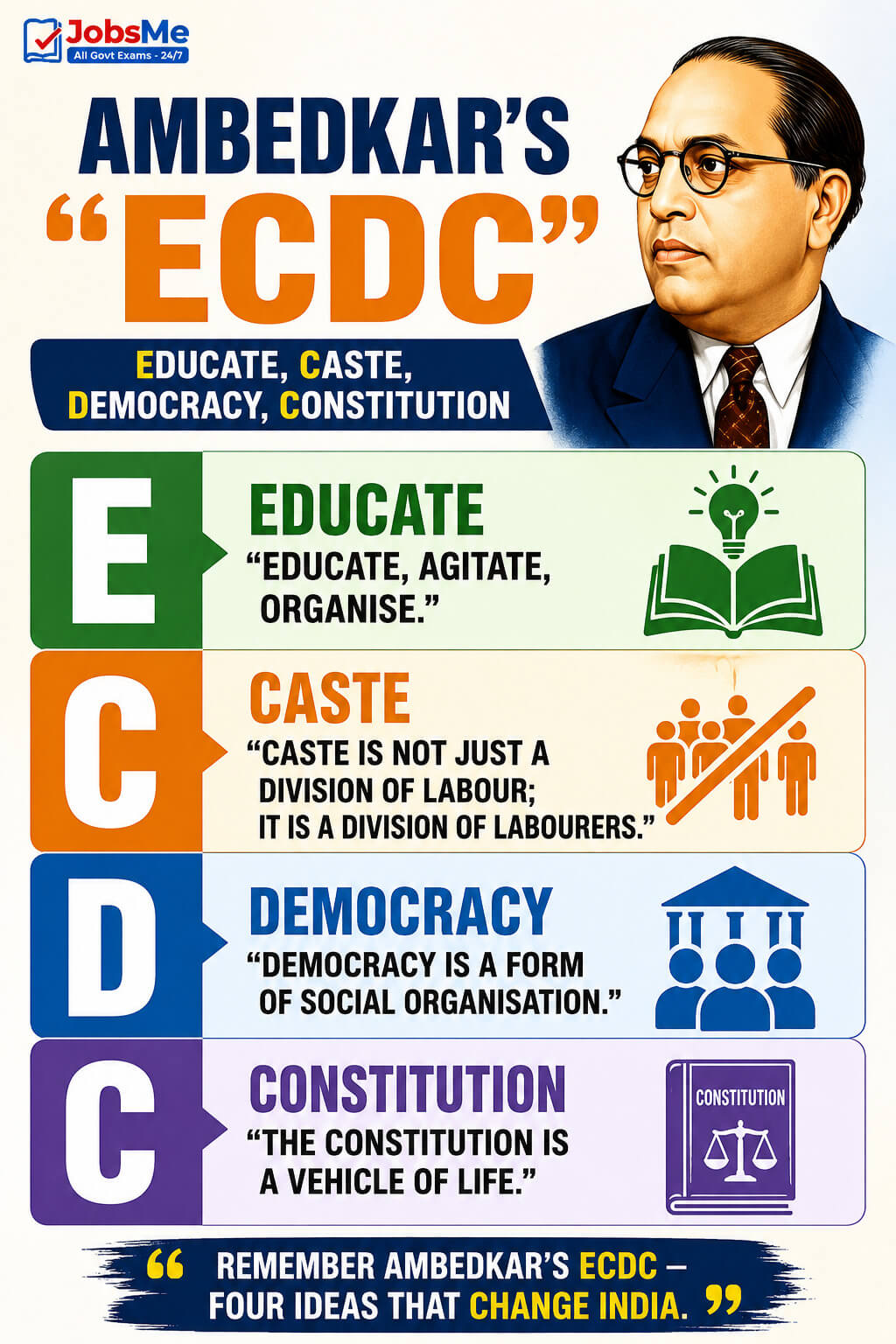
- E → "Educate, agitate, organise."
- C → "Caste is not just a division of labour; it is a division of labourers."
- D → "Democracy is a form of social organisation."
- C → "The Constitution is a vehicle of life."
Trick 3: Freedom Slogans — "Blood, Birthright, Inquilab"
Match the three fiery freedom lines to their authors:
- Blood → "Give me blood, and I shall give you freedom." → Subhas Chandra Bose.
- Birthright → "Swaraj is my birthright." → Bal Gangadhar Tilak.
- Inquilab → "Inquilab Zindabad." → Bhagat Singh.
"Bose bleeds, Tilak claims his birthright, Bhagat shouts the revolution."
Trick 4: Kalam's "3D" — Dream, Don't, Develop
A. P. J. Abdul Kalam's most popular quotes start with these cues:
- Dream → "Dream, dream, dream. Dreams transform into thoughts..."
- Don't → "Don't read success stories... read failure stories."
- Develop → "All of us have an equal opportunity to develop our talents."
Trick 5: The "UN Trio" for Global Themes — Annan, Ban, Malala
For essay quotes on global issues, remember the United Nations connection:
- Kofi Annan → Education, gender equality, humanity ("Literacy is a bridge from misery to hope").
- Ban Ki-moon → Climate change and sustainable development.
- Malala Yousafzai → Girls' education ("One child, one teacher, one book and one pen...").
"Annan = Education, Ban = Climate, Malala = Girl Child."
Trick 6: Education Quotes Web — "Mandela, Malala, Ambedkar"
The most quoted education lines come from three names:
- Mandela → "Education is the most powerful weapon..."
- Malala → "One child, one teacher, one book and one pen..."
- Ambedkar → "Real education enhances the dignity of a human being."
Trick 7: Wisdom from the Ancients — "Buddha, Socrates, Aristotle"
Group the philosophers by their core idea:
- Buddha → Mind ("The mind is everything. What you think, you become").
- Socrates → Knowing nothing ("The only true wisdom is in knowing you know nothing").
- Aristotle → Heart ("Educating the mind without educating the heart is no education").
Additional Notes
Frequently Confused Facts
- "You must be the change..." : Attributed to Mahatma Gandhi; do not confuse with Ambedkar's "Educate, agitate, organise," which is about social action, not personal change.
- "Education is the most powerful weapon" : Nelson Mandela, not Gandhi or Kalam — a very common trap in objective papers.
- "Swaraj is my birthright" vs "Give me blood..." : "Swaraj is my birthright" is Bal Gangadhar Tilak; "Give me blood, and I shall give you freedom" is Subhas Chandra Bose.
- "An eye for an eye..." : Mahatma Gandhi; it appears in the reference both as a war/peace quote and an ethics quote — same author, same line.
- "The mind is everything..." : Buddha; do not attribute it to Vivekananda or Gandhi.
- "At the stroke of the midnight hour..." : Jawaharlal Nehru's "Tryst with Destiny" speech (1947), not a freedom-era slogan.
- Kofi Annan vs Ban Ki-moon: Both UN Secretaries-General — Annan is linked to education, gender, and humanity quotes; Ban Ki-moon to climate change and sustainable development.
- "India is the cradle of the human race" : Mark Twain, an American writer, adopted widely by Indian essayists — not an Indian author.
- Churchill's two lines: "Success is walking from failure to failure..." and "The price of greatness is responsibility" are both Winston Churchill.
Repeating PYQ Patterns
Certain quotation-author pairs are asked repeatedly. "Swaraj is my birthright" (Tilak), "Give me blood, and I shall give you freedom" (Bose), "You must be the change you wish to see" (Gandhi), "Educate, agitate, organise" (Ambedkar), "Education is the most powerful weapon" (Mandela), "Arise, awake, and stop not till the goal is reached" (Vivekananda), and "At the stroke of the midnight hour" (Nehru) appear most often in SSC CGL, RRB NTPC, and State PCS papers. For UPSC Mains, Essay, and Ethics (GS Paper IV), examiners reward correctly attributed lines from Gandhi, Ambedkar, Tagore, Kalam, and Amartya Sen on themes of justice, education, women, and governance. Banking exams (IBPS PO, SBI Clerk) usually test simple matching of a quote with its author, while the Ethics paper rewards Gandhi's "Seven Dangers to Human Virtue." You can practise these in the Static GK Quiz section.
Quick Insight
Quotations are condensed history and philosophy — a single attributed line can frame an entire argument. In UPSC essays, the established convention is to open with a quote that frames rather than summarises the topic, place one quote mid-essay as a pivot between dimensions, and close with a line that resonates with the prompt — while never clustering two quotes in the same paragraph and always attributing correctly, since misattribution costs credibility. For aspirants, memorising 40-50 well-chosen Indian and world quotes and deploying three to five per essay is far more effective than quoting at random. For more exam preparation material, you can refer to the Daily Current Affairs notes and the Static GK section on Jobsme.in.
One-Liners for Quick Revision
- Subhas Chandra Bose → "Give me blood, and I shall give you freedom" → freedom and the Indian National Army.
- Bal Gangadhar Tilak → "Swaraj is my birthright, and I shall have it" → self-rule slogan.
- Mahatma Gandhi → "Freedom is not worth having if it does not include the freedom to make mistakes" → freedom.
- Mahatma Gandhi → "You must be the change you wish to see in the world" → moral conduct.
- Mahatma Gandhi → "An eye for an eye only ends up making the whole world blind" → non-violence.
- Mahatma Gandhi → "Non-violence is the greatest force at the disposal of mankind" → Ahimsa.
- Mahatma Gandhi → "The weak can never forgive. Forgiveness is the attribute of the strong" → moral strength.
- Mahatma Gandhi → "In a gentle way, you can shake the world" → quiet persistence.
- Mahatma Gandhi → "Live as if you were to die tomorrow. Learn as if you were to live forever" → life and learning.
- Mahatma Gandhi → "Happiness is when what you think, what you say, and what you do are in harmony" → integrity.
- Mahatma Gandhi → "The best way to find yourself is to lose yourself in the service of others" → service.
- Mahatma Gandhi → "It is health that is real wealth and not pieces of gold and silver" → health.
- Mahatma Gandhi → "Seven Dangers to Human Virtue" → wealth without work, pleasure without conscience, knowledge without character, business without ethics, science without humanity, religion without sacrifice, politics without principle.
- Bhagat Singh → "Inquilab Zindabad — the revolution is of the idea, not the bomb" → revolution.
- B. R. Ambedkar → "I measure the progress of a community by the degree of progress which women have achieved" → women and progress.
- B. R. Ambedkar → "Caste is not just a division of labour; it is a division of labourers" → caste critique.
- B. R. Ambedkar → "Educate, agitate, organise" → social empowerment mantra.
- B. R. Ambedkar → "Real education enhances the dignity of a human being" → education.
- B. R. Ambedkar → "The Constitution is not a mere lawyers' document; it is a vehicle of life" → living Constitution.
- B. R. Ambedkar → "Democracy is not a form of government, it is a form of social organisation" → democracy.
- Rabindranath Tagore → "Where the mind is without fear and the head is held high" → vision of a free nation.
- Rabindranath Tagore → "The earth has music for those who listen" → nature.
- Rabindranath Tagore → "Trees are the earth's endless effort to speak to the listening heaven" → environment.
- A. P. J. Abdul Kalam → "Dream, dream, dream. Dreams transform into thoughts and thoughts result in action" → dreams.
- A. P. J. Abdul Kalam → "You cannot change your future, but you can change your habits" → habits shape destiny.
- A. P. J. Abdul Kalam → "Science is a beautiful gift to humanity; we should not distort it" → ethics of science.
- Swami Vivekananda → "Arise, awake, and stop not till the goal is reached" → courage and youth.
- Swami Vivekananda → "Strength is life, weakness is death" → inner strength.
- Swami Vivekananda → "India will awaken when every Indian is awake" → national awakening.
- Jawaharlal Nehru → "At the stroke of the midnight hour, when the world sleeps, India will awake to life and freedom" → independence ("Tryst with Destiny").
- Jawaharlal Nehru → "Children are like buds in a garden" → children, the future of the nation.
- Bhagavad Gita → "You have the right to work, but never to the fruit of work" → Nishkama Karma.
- Sarojini Naidu → "Awake, O India! Your daughters will lead you" → women's leadership.
- Atal Bihari Vajpayee → "War on unemployment, disease, poverty, and backwardness" → development.
- Narendra Modi → "Good governance depends on responsibility by both administration and people" → governance.
- Amartya Sen → "Progress is judged by the reduction of deprivation, not the enrichment of the opulent" → development.
- Gopal Krishna Gokhale → "The foundation of a nation's greatness is in the homes of its people" → nation.
- M. S. Swaminathan → "If agriculture fails, everything else will fail" → agriculture.
- Nelson Mandela → "Education is the most powerful weapon which you can use to change the world" → education.
- Abraham Lincoln → "No man is good enough to govern another without that other's consent" → democracy.
- Abraham Lincoln → "If you want to test a man's character, give him power" → ethics and power.
- Martin Luther King Jr. → "Injustice anywhere is a threat to justice everywhere" → justice.
- Martin Luther King Jr. → "Hate cannot drive out hate; only love can do that" → peace and love.
- Albert Einstein → "Peace cannot be kept by force; it can only be achieved by understanding" → peace.
- Albert Einstein → "The true sign of intelligence is not knowledge but imagination" → creativity.
- Winston Churchill → "Success is walking from failure to failure with no loss of enthusiasm" → success.
- Winston Churchill → "The price of greatness is responsibility" → leadership.
- John F. Kennedy → "Leadership and learning are indispensable to each other" → leadership.
- Kofi Annan → "Literacy is a bridge from misery to hope" → education.
- Ban Ki-moon → "Climate change is the greatest collective challenge we face as a human family" → climate change.
- Malala Yousafzai → "One child, one teacher, one book and one pen can change the world" → education.
- Michelle Obama → "The measure of any society is how it treats its women and girls" → women and society.
- Christine Lagarde → "When women do better, economies do better" → women and economy.
- Buddha → "The mind is everything. What you think, you become" → wisdom.
- Socrates → "The only true wisdom is in knowing you know nothing" → humility.
- Aristotle → "Educating the mind without educating the heart is no education at all" → education and ethics.
- Mark Twain → "India is the cradle of the human race... the mother of history" → India and civilisation.
- Chinese Proverb → "Teach a man to fish, and you feed him for a lifetime" → self-reliance.
- Japanese Proverb → "Fall seven times and stand up eight" → resilience.
- Theodore Roosevelt → "Believe you can and you're halfway there" → motivation.
- Robert Frost → "Two roads diverged in a wood, and I took the one less traveled" → choice.
For more Static GK topics like famous personalities, boundary lines, and battles, explore the Static GK section on Jobsme.in. You can also test your knowledge with the Daily Current Affairs Quiz and check out the latest exam notifications at Latest Government Job Notifications.
Free quiz • No signup required
Put this topic into practice with Indian Cultural Institutions – Static GK MCQ Quiz. It is the quickest way to reinforce what you just learned.
Frequently Asked Questions
Who said 'Swaraj is my birthright, and I shall have it'?
Who gave the quote 'Give me blood, and I shall give you freedom'?
Who said 'Education is the most powerful weapon which you can use to change the world'?
Which famous quote on social empowerment is associated with Dr. B. R. Ambedkar?
Who said 'You must be the change you wish to see in the world'?
What is meant by Gandhi's 'Seven Dangers to Human Virtue'?
Who delivered the words 'At the stroke of the midnight hour, when the world sleeps, India will awake to life and freedom'?
Who said 'Arise, awake, and stop not till the goal is reached'?
Which UN leaders are commonly quoted on global issues like climate change and education?
Who said 'Injustice anywhere is a threat to justice everywhere'?

About the author