Branches of Biology – Static GK & General Awareness for Competitive Exams with Memory Tricks
This article presents a complete list of the important branches of biology along with what each one studies, covering core divisions like botany, zoology, and microbiology as well as specialised fields such as ornithology (birds), entomology (insects), ichthyology (fishes), cardiology (heart), and palaeontology (fossils). It includes the "-logy", "-graphy", and study-of-organism branches most frequently tested, with memory tricks and one-liners for quick revision. All facts are arranged in exam-ready format to help UPSC, SSC, IBPS, RRB, PSU, and State PCS aspirants score better in General Science and General Awareness sections.
Jump to section
Introduction
Biology is the scientific study of living organisms, and over time it has expanded into dozens of specialised branches, each focusing on a particular group of organisms, a body system, a process, or a level of life. From Botany (study of plants) and Zoology (study of animals) to highly focused fields like Ornithology (study of birds), Entomology (study of insects), and Cardiology (study of the heart), knowing which branch studies what is a high-frequency General Science topic.
Questions on branches of biology appear regularly in UPSC Prelims, SSC CGL, IBPS PO, RRB NTPC, SBI Clerk, State PCS, and various Insurance and Defence exams. Questions typically ask "what is the study of X called", "which branch deals with the study of Y", or match-the-following pairs between a branch and its subject. This article brings together every important branch of biology in a structured, exam-ready format. To explore other related General Science and Static GK topics, you can refer to the Static GK section on Jobsme.in.
Branches of biology are also closely linked to current affairs themes such as new disease outbreaks (virology, epidemiology), genetic research and gene editing (genetics, genetic engineering), conservation of endangered species (ecology, wildlife biology), and Nobel Prizes in Physiology or Medicine — making this topic doubly important for aspirants preparing for the General Awareness and Science & Technology sections.
Core Concepts: How Branches of Biology Are Classified
The branches of biology are not random labels — they follow a logical pattern. Most are formed from Greek or Latin root words combined with the suffix "-logy" (meaning "study of"). Understanding the root word makes it easy to guess the meaning of an unfamiliar branch. For deeper General Science preparation, you can also browse the Static GK notes on Jobsme.in.
Categories of Biology Branches
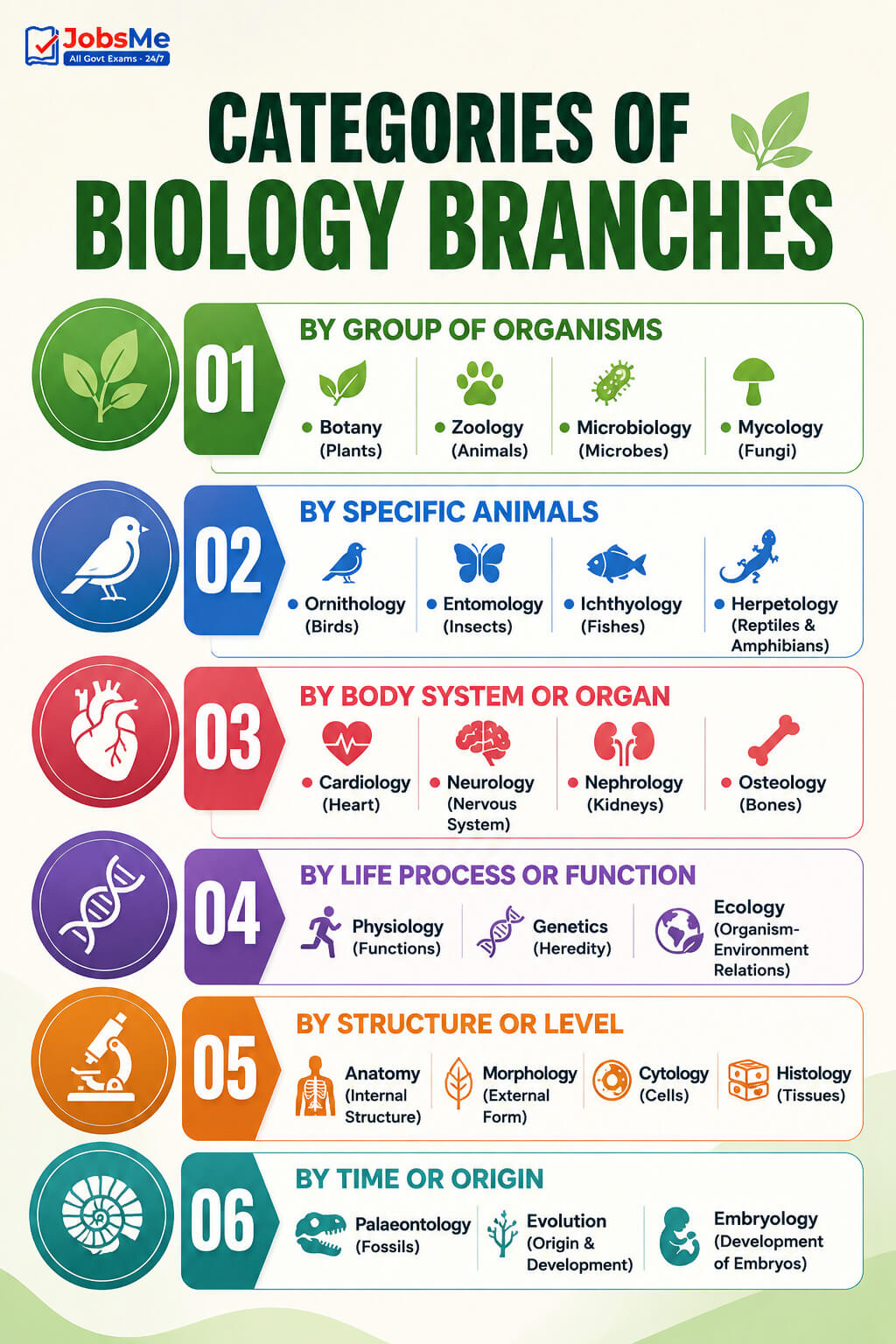
- By Group of Organisms: Branches that study a specific kind of living thing. Example: Botany (plants), Zoology (animals), Microbiology (microbes), Mycology (fungi).
- By Specific Animals: Narrow branches focused on one animal group. Example: Ornithology (birds), Entomology (insects), Ichthyology (fishes), Herpetology (reptiles and amphibians).
- By Body System or Organ: Branches dealing with parts of the body, often medical. Example: Cardiology (heart), Neurology (nervous system), Nephrology (kidneys), Osteology (bones).
- By Life Process or Function: Branches studying how organisms work. Example: Physiology (functions), Genetics (heredity), Ecology (organism-environment relations).
- By Structure or Level: Branches studying form and internal organisation. Example: Anatomy (internal structure), Morphology (external form), Cytology (cells), Histology (tissues).
- By Time or Origin: Branches dealing with the past and development of life. Example: Palaeontology (fossils), Evolution (origin and development), Embryology (development of embryos).
Major Branches of Biology and What They Study
The following table lists the most exam-relevant branches of biology along with the subject each branch studies and useful key details.
| Branch | Subject of Study | Key Details |
|---|---|---|
| Botany | Plants | Study of plant life including structure, growth, reproduction, and classification; Theophrastus is called the "Father of Botany." |
| Zoology | Animals | Study of animal life, behaviour, structure, and classification; Aristotle is called the "Father of Zoology." |
| Microbiology | Microorganisms | Study of microscopic organisms such as bacteria, viruses, fungi, and protozoa; Antonie van Leeuwenhoek is the "Father of Microbiology." |
| Anatomy | Internal structure of organisms | Study of the internal structural organisation of plants and animals; Andreas Vesalius is the "Father of Modern Anatomy." |
| Morphology | External form and structure | Study of the shape, size, and external features of organisms. |
| Physiology | Functions of body parts | Study of the normal functions and processes of living organisms and their organs. |
| Cytology | Cells | Study of the structure and function of cells; also called cell biology; Robert Hooke discovered the cell. |
| Histology | Tissues | Study of the microscopic structure of tissues; Marie Francois Bichat is the "Father of Histology." |
| Genetics | Heredity and variation | Study of genes, heredity, and how traits pass from parents to offspring; Gregor Mendel is the "Father of Genetics." |
| Ecology | Organisms and their environment | Study of the relationship between organisms and their surroundings; Eugene Odum is a key figure; the term was coined by Ernst Haeckel. |
| Embryology | Embryos and their development | Study of the formation and development of embryos from fertilisation to birth. |
| Evolution | Origin and development of life | Study of how species change over time; Charles Darwin proposed the theory of natural selection. |
| Taxonomy | Classification of organisms | Study of identifying, naming, and classifying living things; Carolus Linnaeus is the "Father of Taxonomy." |
| Palaeontology | Fossils | Study of prehistoric life through fossils; Leonardo da Vinci is regarded as an early founder; closely linked to evolution. |
| Biotechnology | Use of organisms in technology | Application of living systems to make useful products; includes genetic engineering, vaccines, and fermentation. |
Branches That Study Specific Animals
These narrow branches focus on a single group of animals and are extremely popular in objective exams.
| Branch | Animal Studied | Key Details |
|---|---|---|
| Ornithology | Birds | Study of birds; Dr. Salim Ali is the "Birdman of India." |
| Entomology | Insects | Study of insects; one of the largest fields as insects form the biggest animal group. |
| Ichthyology | Fishes | Study of fishes, their structure, behaviour, and classification. |
| Herpetology | Reptiles and amphibians | Study of snakes, lizards, frogs, and similar cold-blooded animals. |
| Mammalogy | Mammals | Study of mammals, the warm-blooded, milk-producing class of animals. |
| Apiculture | Honey bees (bee-keeping) | Rearing and management of honey bees for honey and beeswax. |
| Sericulture | Silkworms (silk production) | Rearing of silkworms for the production of raw silk. |
| Pisciculture | Fish farming | Breeding and rearing of fish in controlled conditions for food. |
| Malacology | Molluscs | Study of snails, slugs, mussels, octopuses, and other molluscs. |
| Arachnology | Spiders and scorpions | Study of arachnids — spiders, scorpions, ticks, and mites. |
| Helminthology | Parasitic worms | Study of worms, especially parasitic worms like tapeworms and roundworms. |
| Conchology | Shells of molluscs | Study of the shells of molluscs, a sub-field of malacology. |
Branches That Study Plants and Other Organisms
| Branch | Subject of Study | Key Details |
|---|---|---|
| Mycology | Fungi | Study of mushrooms, moulds, and yeasts. |
| Phycology (Algology) | Algae | Study of algae, including seaweeds and microscopic forms. |
| Bacteriology | Bacteria | Study of bacteria; a key sub-field of microbiology. |
| Virology | Viruses | Study of viruses and viral diseases; highly relevant in pandemic-related current affairs. |
| Pomology | Fruits | Study and cultivation of fruits. |
| Olericulture | Vegetables | Study and cultivation of vegetables. |
| Floriculture | Flowers | Cultivation of flowers and ornamental plants. |
| Horticulture | Garden crops | Cultivation of fruits, vegetables, flowers, and ornamental plants. |
| Silviculture | Forest trees | Cultivation and management of forest trees. |
| Agrostology | Grasses | Study of grasses, including their classification and management. |
| Dendrology | Trees and shrubs | Study of woody plants such as trees and shrubs. |
| Pteridology | Ferns | Study of ferns and related seedless vascular plants. |
| Bryology | Mosses and liverworts | Study of bryophytes — mosses, liverworts, and hornworts. |
| Palynology | Pollen and spores | Study of pollen grains and spores, useful in forensics and climate research. |
Medical and Human-Body Branches
| Branch | Subject of Study | Key Details |
|---|---|---|
| Cardiology | Heart | Study of the heart and its diseases. |
| Neurology | Nervous system | Study of the brain, spinal cord, and nerves, and their disorders. |
| Nephrology | Kidneys | Study of the kidneys and kidney-related diseases. |
| Hepatology | Liver | Study of the liver, gall bladder, and bile ducts. |
| Dermatology | Skin | Study of the skin, hair, nails, and their diseases. |
| Osteology | Bones | Study of the structure and function of bones. |
| Myology | Muscles | Study of the muscular system. |
| Haematology | Blood | Study of blood, blood-forming organs, and blood diseases. |
| Ophthalmology | Eyes | Study of the eye and its diseases. |
| Otology | Ears | Study of the ear, hearing, and related disorders. |
| Gynaecology | Female reproductive system | Study of the female reproductive organs and their health. |
| Paediatrics | Children's health | Branch of medicine dealing with infants, children, and adolescents. |
| Gerontology | Old age and ageing | Study of the ageing process and problems of the elderly. |
| Pathology | Diseases | Study of the causes, nature, and effects of diseases. |
| Oncology | Cancer and tumours | Study of the diagnosis and treatment of cancer. |
| Endocrinology | Hormones and glands | Study of hormones and the endocrine (ductless) glands. |
| Immunology | Immune system | Study of the body's defence mechanisms against disease. |
Specialised and Applied Branches
| Branch | Subject of Study | Key Details |
|---|---|---|
| Etiology | Causes of diseases | Study of the origin and causes of diseases. |
| Epidemiology | Spread of diseases | Study of the distribution, patterns, and control of diseases in populations. |
| Pharmacology | Drugs and medicines | Study of the action of drugs on the body. |
| Toxicology | Poisons | Study of poisons and their effects on living organisms. |
| Anthropology | Human beings and cultures | Study of human origin, development, culture, and society. |
| Eugenics | Improvement of human race | Study of improving the genetic quality of the human population. |
| Euthenics | Improvement through environment | Study of improving humans by improving their living conditions. |
| Biochemistry | Chemical processes in organisms | Study of the chemistry of living things and life processes. |
| Biophysics | Physics of biological processes | Application of physics principles to biological systems. |
| Molecular Biology | Molecules of life | Study of biological activity at the molecular level, including DNA and proteins. |
| Genetic Engineering | Manipulation of genes | Artificial modification of an organism's DNA; basis of GM crops and gene therapy. |
| Ethology | Animal behaviour | Study of animal behaviour in natural conditions. |
| Parasitology | Parasites | Study of parasites and their relationship with their hosts. |
| Saurology | Lizards | Study of lizards, a sub-field of herpetology. |
| Phenology | Seasonal biological events | Study of periodic life-cycle events like flowering and migration in relation to climate. |
| Anthropogeny | Origin of human beings | Study of the origin and evolution of the human species. |
| Craniology | Skull | Study of the shape, size, and features of the skull. |
| Phrenology | Mind and skull shape | Old study linking skull shape to mental traits, now largely outdated. |
Memory Tricks and Mnemonics
Trick 1: The "Big Three" Core Branches — "BZM"
Remember the three foundational branches of biology with "BZM":
- B → Botany → Plants.
- Z → Zoology → Animals.
- M → Microbiology → Microorganisms.
"BZM — plants, animals, and the tiny ones."
Trick 2: Animal Branches — "Birds, Bugs, Bones, Fish"
Group the most-asked animal branches by their subject:
- Ornithology → Birds (think "Ornith" sounds like a bird call).
- Entomology → Insects (an "ant" hides inside "Ento-mology").
- Ichthyology → Fishes ("Ich" → think "fishy itch").
- Herpetology → Reptiles/amphibians (a snake "herps" along).
"OEIH — Ornitho, Ento, Ichthyo, Herpeto."
Trick 3: The "-Culture" Rearing Branches — "ASP"
The "-culture" branches all deal with rearing or farming something:
- A → Apiculture → Honey bees.
- S → Sericulture → Silkworms.
- P → Pisciculture → Fish.
Bonus plant ones: Horticulture (garden), Floriculture (flowers), Silviculture (forests).
Trick 4: Body-Organ Branches — "Heart to Toe"
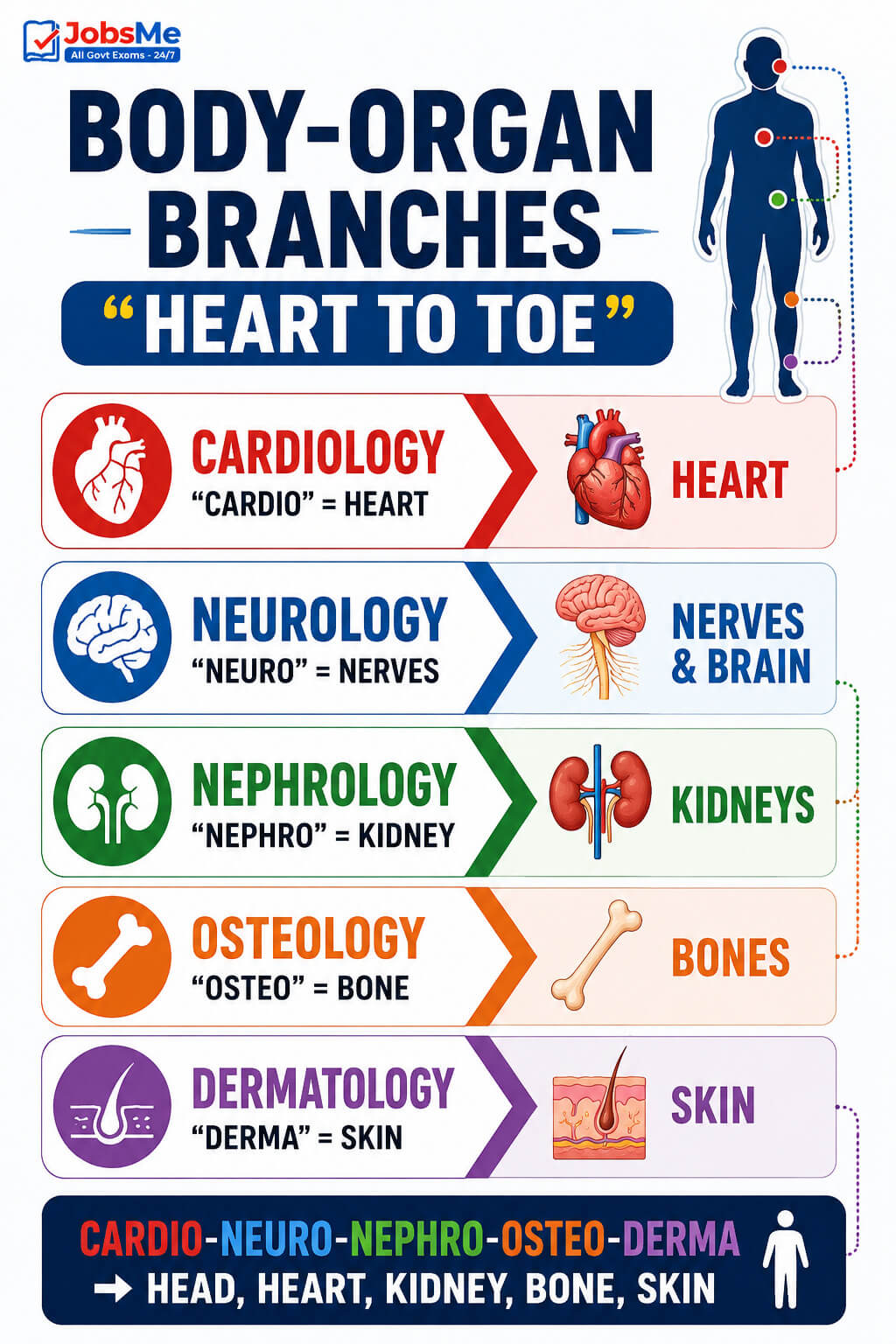
- Cardiology → Heart ("Cardio" = heart, like cardio exercise).
- Neurology → Nerves and brain ("Neuro" = nerves).
- Nephrology → Kidneys ("Nephro" = kidney).
- Osteology → Bones ("Osteo" = bone, like osteoporosis).
- Dermatology → Skin ("Derma" = skin).
"Cardio-Neuro-Nephro-Osteo-Derma — head, heart, kidney, bone, skin."
Trick 5: Plant-Group Branches — "FAME"
Remember the four classic plant-group branches with "FAME":
- F → Phycology → Algae (also called algology).
- A → Agrostology → Grasses.
- M → Mycology → Fungi.
- E → Bryology → Mosses (remember as the "Earthy green carpet").
Trick 6: Disease-Related Branches — "EEPT"
The disease-focused branches sound similar — separate them clearly:
- E → Etiology → Causes of disease.
- E → Epidemiology → Spread of disease in populations.
- P → Pathology → Nature and effects of disease.
- T → Toxicology → Poisons.
"Cause, Spread, Effect, Poison."
Trick 7: "Improvement of Humans" Pair — Eugenics vs Euthenics
These two are constantly confused. Use the spelling clue:
- Eu-GEN-ics → improvement through GENES (heredity).
- Eu-THEN-ics → improvement through environment ("then" comes after birth, i.e., surroundings).
Additional Notes
Frequently Confused Facts
- Ornithology vs Ichthyology: Ornithology is the study of birds; Ichthyology is the study of fishes — do not mix them up.
- Entomology vs Etymology: Entomology is the study of insects; Etymology is the study of word origins (a language subject, not biology).
- Eugenics vs Euthenics: Eugenics is improvement of the human race through genetics; Euthenics is improvement through better environment and living conditions.
- Cytology vs Histology: Cytology is the study of cells; Histology is the study of tissues (groups of cells).
- Anatomy vs Morphology: Anatomy deals with internal structure; Morphology deals with external form and shape.
- Mycology vs Phycology: Mycology is the study of fungi; Phycology (algology) is the study of algae.
- Apiculture vs Sericulture vs Pisciculture: Apiculture is bee-keeping; Sericulture is silkworm rearing; Pisciculture is fish farming.
- Nephrology vs Neurology: Nephrology is the study of kidneys; Neurology is the study of the nervous system.
- Osteology vs Myology: Osteology is the study of bones; Myology is the study of muscles.
- Pomology vs Olericulture: Pomology is the study of fruits; Olericulture is the cultivation of vegetables.
- Palaeontology vs Anthropology: Palaeontology is the study of fossils; Anthropology is the study of human beings and cultures.
Repeating PYQ Patterns
Certain branches of biology are asked repeatedly in competitive exams. Ornithology (birds), Entomology (insects), Ichthyology (fishes), Herpetology (reptiles), Cardiology (heart), Nephrology (kidneys), Osteology (bones), Apiculture (bees), Sericulture (silkworms), Pisciculture (fish), Mycology (fungi), Genetics (heredity), Palaeontology (fossils), and Eugenics vs Euthenics appear most often in UPSC Prelims, SSC CGL, and RRB NTPC papers. Banking exams (IBPS PO, SBI Clerk) frequently include simple match-the-following questions linking a branch to its subject. State PCS and Defence exams add applied branches like Horticulture, Silviculture, and Agrostology. The "Father of" pairs — such as Aristotle (Zoology), Theophrastus (Botany), Gregor Mendel (Genetics), and Carolus Linnaeus (Taxonomy) — are also heavily tested. You can practise these in the Static GK Quiz on Jobsme.in.
Quick Insight
Branches of biology stay in the news through real-world events: virology and epidemiology gain importance during disease outbreaks, genetics and genetic engineering feature whenever gene-editing or GM-crop debates arise, ecology and ethology appear in wildlife conservation drives, and oncology and immunology are highlighted during cancer-awareness campaigns and vaccine developments. Keeping up with these themes through Daily Current Affairs helps connect static biology facts to current events, which is exactly how UPSC and SSC frame their toughest questions.
One-Liners for Quick Revision
- Botany → Study of plants → "Father of Botany" is Theophrastus.
- Zoology → Study of animals → "Father of Zoology" is Aristotle.
- Microbiology → Study of microorganisms → bacteria, viruses, fungi, protozoa.
- Anatomy → Study of internal structure of organisms.
- Morphology → Study of external form and structure.
- Physiology → Study of functions of body parts.
- Cytology → Study of cells → also called cell biology.
- Histology → Study of tissues.
- Genetics → Study of heredity and variation → "Father of Genetics" is Gregor Mendel.
- Ecology → Study of organisms and their environment → term coined by Ernst Haeckel.
- Embryology → Study of embryos and their development.
- Evolution → Study of origin and development of life → Charles Darwin's natural selection.
- Taxonomy → Study of classification of organisms → "Father of Taxonomy" is Carolus Linnaeus.
- Palaeontology → Study of fossils → linked to evolution.
- Biotechnology → Use of living organisms to make useful products.
- Ornithology → Study of birds → Dr. Salim Ali is the "Birdman of India."
- Entomology → Study of insects.
- Ichthyology → Study of fishes.
- Herpetology → Study of reptiles and amphibians.
- Mammalogy → Study of mammals.
- Apiculture → Bee-keeping → rearing of honey bees.
- Sericulture → Rearing of silkworms for silk.
- Pisciculture → Fish farming.
- Malacology → Study of molluscs.
- Arachnology → Study of spiders and scorpions.
- Helminthology → Study of parasitic worms.
- Conchology → Study of shells of molluscs.
- Mycology → Study of fungi.
- Phycology (Algology) → Study of algae.
- Bacteriology → Study of bacteria.
- Virology → Study of viruses.
- Pomology → Study and cultivation of fruits.
- Olericulture → Cultivation of vegetables.
- Floriculture → Cultivation of flowers.
- Horticulture → Cultivation of garden crops.
- Silviculture → Cultivation of forest trees.
- Agrostology → Study of grasses.
- Dendrology → Study of trees and shrubs.
- Pteridology → Study of ferns.
- Bryology → Study of mosses and liverworts.
- Palynology → Study of pollen and spores.
- Cardiology → Study of the heart.
- Neurology → Study of the nervous system.
- Nephrology → Study of the kidneys.
- Hepatology → Study of the liver.
- Dermatology → Study of the skin.
- Osteology → Study of bones.
- Myology → Study of muscles.
- Haematology → Study of blood.
- Ophthalmology → Study of the eyes.
- Otology → Study of the ears.
- Gynaecology → Study of the female reproductive system.
- Paediatrics → Branch of medicine for children's health.
- Gerontology → Study of old age and ageing.
- Pathology → Study of diseases.
- Oncology → Study of cancer and tumours.
- Endocrinology → Study of hormones and glands.
- Immunology → Study of the immune system.
- Etiology → Study of causes of diseases.
- Epidemiology → Study of the spread of diseases.
- Pharmacology → Study of drugs and medicines.
- Toxicology → Study of poisons.
- Anthropology → Study of human beings and cultures.
- Eugenics → Study of improving the human race through genetics.
- Euthenics → Study of improving humans through environment.
- Biochemistry → Study of chemical processes in organisms.
- Biophysics → Study of physics of biological processes.
- Molecular Biology → Study of molecules of life like DNA and proteins.
- Genetic Engineering → Manipulation of genes; basis of GM crops.
- Ethology → Study of animal behaviour.
- Parasitology → Study of parasites.
- Saurology → Study of lizards.
- Phenology → Study of seasonal biological events.
- Anthropogeny → Study of the origin of human beings.
- Craniology → Study of the skull.
- Phrenology → Old study linking skull shape to mental traits.
For more General Science and Static GK topics like scientific instruments, units of measurement, and important discoveries, explore the Static GK section on Jobsme.in. You can also test your knowledge with the Static GK Quiz and check out the latest exam notifications at Latest Government Job Notifications.
Free quiz • No signup required
Put this topic into practice with Indian Cultural Institutions – Static GK MCQ Quiz. It is the quickest way to reinforce what you just learned.
Frequently Asked Questions
What is the study of birds called?
What is the difference between Botany and Zoology?
What is the study of insects known as?
What is the difference between Eugenics and Euthenics?
Which branch of biology deals with the study of fishes?
What is the study of the kidneys called?
What are Apiculture, Sericulture and Pisciculture?
Who is called the Father of Genetics?
What is the difference between Cytology and Histology?
What is the study of fossils called?

About the author