
English – Grammar, Vocabulary & Comprehension for Competitive Exams
Latest posts and quizzes curated for the English track.
Latest Posts & Quizzes
Page 1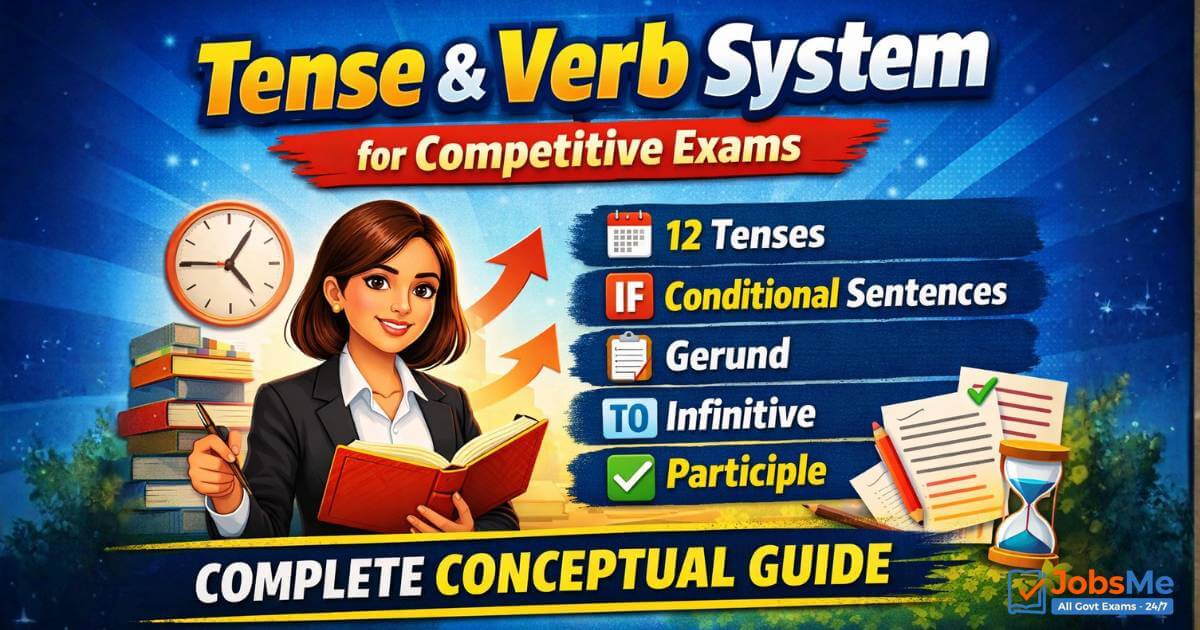
Tense & Verb System for Competitive Exams: Complete Guide on Tenses, Conditionals, Gerund, Infinitive & Participle
The Tense & Verb System is one of the most important and high-scoring topics in UPSC, SSC, Banking, Railways, Defence, and State PSC exams. It covers 12 Tenses, Sequence of Tenses, Conditional Sentences, Gerund, Infinitive, and Participle, which are frequently asked in error detection, sentence correction, and comprehension.
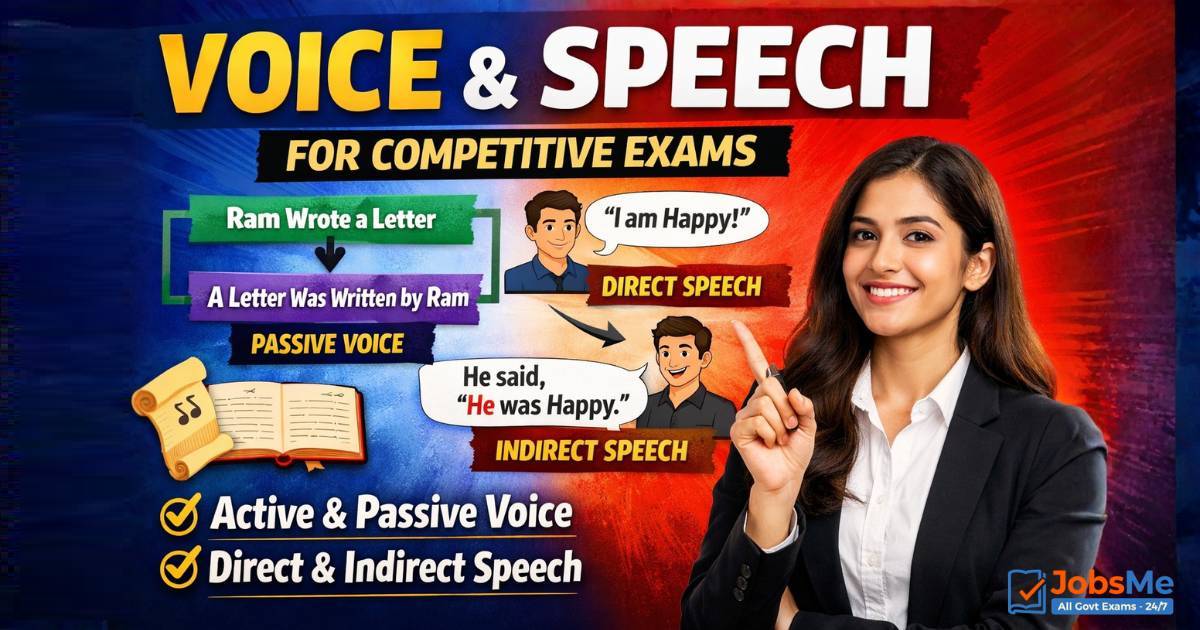
Voice & Speech for Competitive Exams: Complete Guide on Active-Passive Voice & Direct-Indirect Speech
The Voice & Speech section is a highly important topic in UPSC, SSC, Banking, Railways, Defence, and State PSC exams. It includes Active & Passive Voice and Direct & Indirect Speech (Narration), which are frequently asked in error detection, sentence correction, and transformation questions.
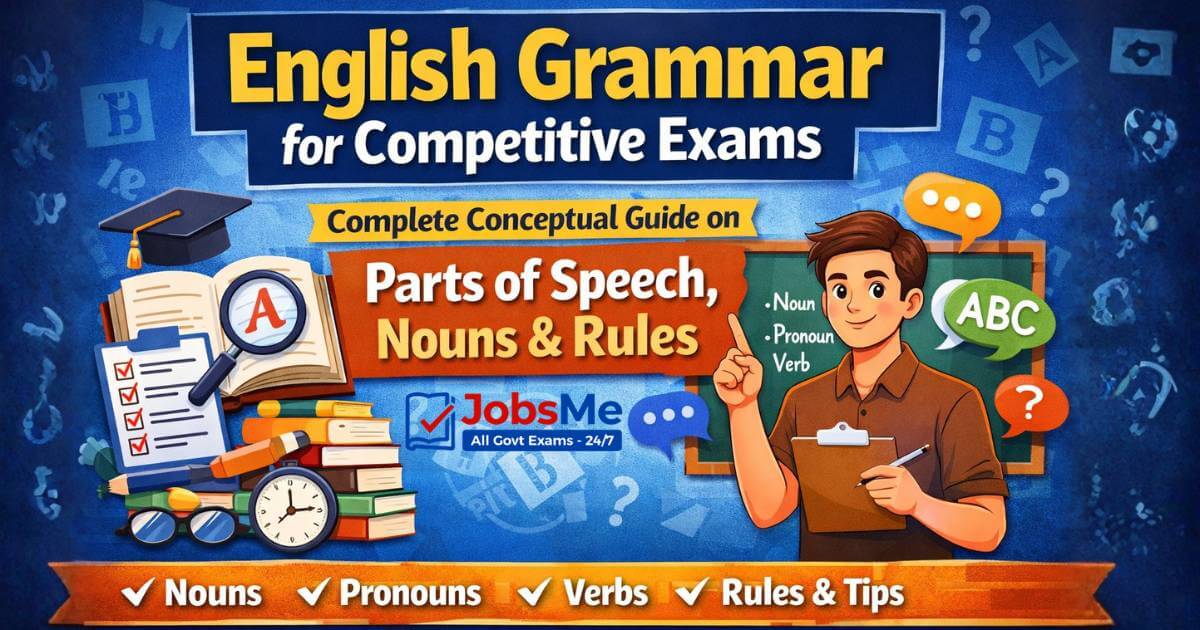
English Grammar for Competitive Exams: Complete Conceptual Guide on Parts of Speech, Nouns & Rules
English Grammar is a foundational subject for UPSC, SSC, Banking, Railways, Defence, and State PSC exams. Topics like Parts of Speech, Nouns, Sentence Structure, and Tenses are frequently asked in objective and descriptive sections, making grammar mastery essential for scoring high.
Introduction
JobsMe's English section is your complete, structured preparation resource for the English Language and Comprehension sections of all major government competitive examinations. This combined archive brings together topic-wise English grammar notes, vocabulary guides, comprehension strategies, and interactive quizzes - covering everything from reading comprehension, cloze tests, error spotting, and para jumbles to synonyms and antonyms, one word substitution, idioms and phrases, fill in the blanks, active and passive voice, tenses, and sentence correction. Every topic is written with a single purpose: to help you score higher in the English section of IBPS PO, IBPS Clerk, SBI PO, SBI Clerk, SSC CGL, SSC CHSL, RRB NTPC, RBI Assistant, and all other government examinations where English Language is a tested section.
Every post is paired with a free interactive quiz - attempt it, get your instant score, read the detailed explanation for every answer, and if you are a logged-in user, access your full performance history to track topic-wise improvement over time.
📖 Browse English Posts → 🧩 Attempt English Quizzes → 🏦 Banking Awareness → 💻 Computer Awareness → 📅 Daily Current Affairs →
Why English Is the Most Rewarding Section to Improve
Among all competitive exam sections, English has a unique characteristic: it is the most transferable skill you can build. Unlike banking awareness facts that are exam-specific, or computer knowledge terms that serve a narrow purpose - improving your English simultaneously boosts your score in every exam you sit, improves your descriptive writing for bank Mains, strengthens your ability to read and process questions faster across all sections, and prepares you for interviews and group discussions.
English is also consistently one of the sections with the highest variation in candidate scores. Some aspirants treat it casually, scoring 50–60% and dragging down their overall rank. Others who prepare systematically achieve 85–95%, which becomes a significant advantage in merit lists where overall scores are tightly bunched. The difference is not natural talent - it is structured preparation with the right topics, the right rules, and consistent quiz practice.
English Section in Major Competitive Exams
IBPS PO and SBI PO (Prelims): English Language carries 30 questions for 30 marks with a 20-minute sectional time limit. The section tests Reading Comprehension, Error Detection/Spotting, Cloze Test, Para Jumbles, Sentence Fillers, and Vocabulary. Clearing the sectional cutoff in English is mandatory - candidates who neglect it risk disqualification regardless of overall score.
IBPS Clerk and SBI Clerk (Prelims): Same 30-question structure as PO Prelims. The English section in Clerk exams is slightly more formula-based and less analytical than PO level, making it highly learnable with systematic preparation.
IBPS PO (Mains): English Language is tested as both an objective section (35 questions, 40 marks) and a descriptive test. The descriptive paper (letter writing + essay) carries 25 marks and is evaluated manually - writing quality and grammar directly impact the score.
SSC CGL (Tier 1): English Language and Comprehension carries 25 questions for 50 marks. Topics include Synonyms and Antonyms, Cloze Test, One Word Substitution, Sentence Improvement, Error Detection, Idioms and Phrases, Para Jumbles, Spelling Correction, and Reading Comprehension. High scorer territory for prepared aspirants.
SSC CGL (Tier 2): English Language and Comprehension carries 40 questions for 120 marks - the highest-weighted English section in SSC exams. Advanced Reading Comprehension, grammar, and vocabulary are tested at a greater depth.
SSC CHSL, SSC CPO, SSC GD: English Language sections follow similar patterns to SSC CGL, with vocabulary and grammar being the primary focus.
RRB NTPC: General English section includes grammar, vocabulary, and reading comprehension with a focus on sentence correction and error identification.
RBI Assistant (Mains): English Language is a dedicated Mains section testing grammar, vocabulary, RC, and verbal ability at a moderate difficulty level.
UPSC Mains (English Compulsory Paper): A 300-mark qualifying paper testing Essay Writing, Reading Comprehension, Precis Writing, and Grammar. Candidates must score at least 75 marks to qualify - the paper is not counted in merit but failure means elimination.
Three Pillars of English Preparation
Every English section in every competitive exam tests some combination of the same three core competencies. Understanding these pillars helps you structure your preparation efficiently.
Pillar 1 - Grammar
Grammar is the rule-based foundation of the English language. Competitive exam grammar questions test whether you can identify rule violations (error spotting), choose the grammatically correct form (sentence improvement, fill in the blanks), and transform sentence structures (active-passive, direct-indirect). Grammar is the most learnable pillar - the rules are finite, well-defined, and applicable consistently across all question types.
Key grammar topics: Tenses | Subject-Verb Agreement | Articles (a, an, the) | Parts of Speech | Prepositions | Conjunctions | Modifiers | Clauses | Active and Passive Voice | Direct and Indirect Speech | Question Tags | Degrees of Comparison
Pillar 2 - Vocabulary
Vocabulary questions test your knowledge of word meanings - through Synonyms and Antonyms, One Word Substitutions, Idioms and Phrases, Cloze Tests, Word Usage, and Spelling. A strong vocabulary is built gradually over time through daily reading, active word collection, and regular revision. It cannot be crammed in a week - but with a consistent 3–4 month vocabulary building plan, aspirants can transform their performance in vocabulary-heavy exams like SSC CGL.
Key vocabulary topics: Synonyms and Antonyms | One Word Substitution | Idioms and Phrases | Confusable Words (commonly confused pairs) | Spelling Correction | Root Words and Word Families | Phrasal Verbs
Pillar 3 - Verbal Ability and Comprehension
This pillar tests your ability to understand and work with text at a passage or multi-sentence level. Reading Comprehension tests whether you can extract meaning, identify tone, and draw inferences from a passage. Cloze Tests test contextual understanding. Para Jumbles test your ability to identify logical sentence order. These skills improve primarily through reading practice - daily exposure to well-written prose trains the mind to process complex text quickly and accurately.
Key topics: Reading Comprehension | Cloze Test | Para Jumbles / Sentence Rearrangement | Sentence Completion | Paragraph Connectors | Odd Sentence Out | Theme Detection
Topics Covered in JobsMe English Section
Grammar Topics
- Tenses - all 12 tenses with rules, common errors, and exam application
- Subject-Verb Agreement - rules, exceptions, and common exam traps
- Articles (A, An, The) - rules for definite and indefinite articles, common errors
- Parts of Speech - nouns, pronouns, verbs, adjectives, adverbs, prepositions, conjunctions
- Active and Passive Voice - conversion rules, tense-wise transformations
- Direct and Indirect Speech - reporting verb changes, pronoun shifts, time and place expressions
- Modifiers - dangling modifiers, misplaced modifiers, exam question patterns
- Clauses - noun, adjective, adverbial clauses; subordinate vs main clauses
- Prepositions - common prepositions and their correct usage
- Degrees of Comparison - positive, comparative, superlative; irregular forms
- Question Tags - rules for tag formation with different auxiliary verbs
Vocabulary Topics
- Synonyms and Antonyms - high-frequency word pairs tested in SSC and Banking exams
- One Word Substitution - commonly tested single-word replacements for phrases
- Idioms and Phrases - meaning and usage of frequently asked idioms
- Spelling Correction - commonly misspelled words in competitive exam options
- Confusable Words - pairs like affect/effect, principal/principle, complement/compliment
- Phrasal Verbs - meaning and usage of common phrasal verbs
- Root Words and Word Families - prefixes, suffixes, Latin and Greek roots
Question-Type Skill Topics
- Reading Comprehension - strategy, passage types (factual, inferential, analytical), question types (direct, inference, tone, title, vocabulary in context)
- Cloze Test - strategy for grammar-based and vocabulary-based cloze tests
- Error Spotting / Error Detection - grammar rules applied to sentence error identification
- Sentence Improvement / Sentence Correction - identifying and replacing incorrect phrases
- Fill in the Blanks / Fillers - single blanks, double fillers, contextual word choice
- Para Jumbles - sentence rearrangement strategies, connecting words, logical flow
- Sentence Rearrangement in Passage - paragraph-level arrangement
- Odd Sentence Out - identifying the sentence that does not belong in a paragraph
Descriptive English (for Mains Exams)
- Letter Writing - formal and informal letters, format, tone, sample letters
- Essay Writing - structure, argumentation, common themes (economy, environment, social issues, governance), vocabulary for essays
- Precis Writing - rules for condensing a passage to one-third while retaining key ideas
Exam-Wise Preparation Guide
For Banking Exams (IBPS PO/Clerk, SBI PO/Clerk, RBI)
The English section in banking Prelims is purely objective and moderately difficult at PO level, slightly easier at Clerk level. Prioritise Reading Comprehension (typically 10 questions per passage set), Error Detection, Cloze Test, and Para Jumbles - these four question types account for approximately 80% of all banking English questions. Vocabulary-based questions (fillers, word usage) are also common. For IBPS PO Mains, additionally prepare the Descriptive English section - practise letter writing and essay writing with a timer.
For SSC Exams (SSC CGL, CHSL, CPO, GD)
SSC English is more vocabulary-heavy than banking English. Synonyms-Antonyms, Idioms-Phrases, One Word Substitution, and Spelling Correction together account for 40–50% of SSC CGL Tier 1 English questions. Grammar topics (Error Detection, Sentence Improvement) account for most of the rest. Reading Comprehension in SSC Tier 1 is shorter and more straightforward than banking RC. SSC CGL Tier 2 English is more demanding - longer RC passages, advanced grammar, and deeper vocabulary are tested.
For Railways (RRB NTPC, RRB Group D)
Railway General English is the most accessible of all competitive exam English sections. Grammar fundamentals (tenses, subject-verb agreement, articles) and basic vocabulary (synonyms, antonyms, OWS) are the primary focus. Regular error spotting and sentence correction practice builds the accuracy needed to score well within the time constraints of RRB exams.
For UPSC Mains (English Compulsory)
The UPSC English Compulsory Paper tests functional literacy, not literary analysis. It requires clear writing, comprehension of complex passages, and accurate grammar. The qualifying threshold is 75 out of 300 marks. Focus on: Essay writing (two pages on a general topic), Reading Comprehension (extracting key information accurately), Precis writing (condensing a passage to one-third), and Grammar/Usage (sentence correction, fill in the blanks). Reading editorial content daily in newspapers like The Hindu or The Indian Express is the most effective preparation strategy.
Interactive Quizzes with Performance History
Every English topic on JobsMe has a corresponding free interactive quiz with instant scoring, detailed answer explanations, and - for logged-in users - a complete performance history across all topics and attempts. This means you can identify exactly which grammar rules you keep getting wrong, which vocabulary topics need more work, and how your Reading Comprehension speed and accuracy are improving over time. Sign up free to activate your personal performance dashboard.
Exams Covered
IBPS PO | IBPS Clerk | IBPS RRB PO/Clerk | SBI PO | SBI Clerk | RBI Grade B | RBI Assistant | NABARD | LIC AAO | NIACL AO | SSC CGL | SSC CHSL | SSC CPO | SSC GD | SSC MTS | RRB NTPC | RRB Group D | Delhi Police Constable | DSSSB | UPSC Mains (Compulsory English) | State PSC Exams | All Banking & Government Exams