Voice & Speech for Competitive Exams: Complete Guide on Active-Passive Voice & Direct-Indirect Speech
The Voice & Speech section is a highly important topic in UPSC, SSC, Banking, Railways, Defence, and State PSC exams. It includes Active & Passive Voice and Direct & Indirect Speech (Narration), which are frequently asked in error detection, sentence correction, and transformation questions.
Jump to section
Introduction
The Voice & Speech section is an essential part of English Grammar because it focuses on how a sentence is structured and how meaning is conveyed. In competitive exams like SSC CGL, IBPS PO, SBI PO, RBI Grade B, UPSC IAS, questions are often asked to convert sentences from Active to Passive Voice or Direct to Indirect Speech.
These topics test a candidate’s understanding of sentence structure, verb forms, and grammatical accuracy. Even a small mistake in tense, pronoun, or auxiliary verb can make the answer incorrect.
To strengthen your grammar basics, refer:
👉 English Grammar Complete Guide
https://jobsme.in/posts/english/english-grammar-for-competitive-exams-complete-conceptual-guide-on-parts-of-speech-nouns-rules
Active and Passive Voice
The concept of Voice refers to how the action of a verb is expressed in relation to the subject and object of a sentence. There are two types of voice: Active Voice and Passive Voice.
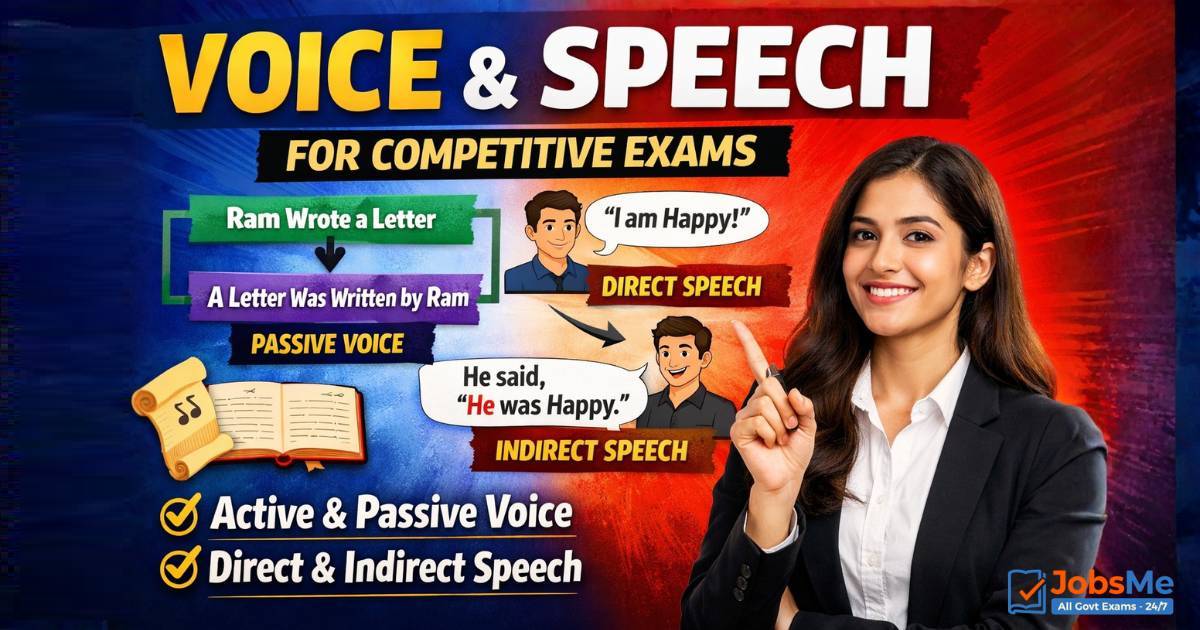
In Active Voice, the subject performs the action. For example, “Ram wrote a letter” clearly shows that Ram is the doer of the action. In Passive Voice, the focus shifts to the object receiving the action, such as “A letter was written by Ram.”
The purpose of using Passive Voice is to emphasize the action or the object rather than the subject. It is commonly used in formal writing, reports, and official communication.
Understanding voice is important because exam questions often test whether candidates can correctly transform a sentence without changing its meaning.
🔹 Key Points / Exam Tips
- Active → Subject performs action
- Passive → Object receives action
- Structure: Object + helping verb + V3 + by + subject
- Only transitive verbs can be converted
- Common error: wrong tense conversion
Rules for Active to Passive Conversion
When converting a sentence from Active Voice to Passive Voice, several grammatical changes take place. The object of the active sentence becomes the subject of the passive sentence, and the verb changes into its third form (V3) with an appropriate helping verb.
The tense of the sentence must remain the same, but the structure changes. For example, “She is writing a letter” becomes “A letter is being written by her.”
Pronouns also change according to their position, and the preposition “by” is usually used before the doer.
Understanding these transformations is crucial because many exam questions are based on sentence transformation.
🔹 Key Points / Exam Tips
- Object → becomes subject
- Verb → changes to V3 form
- Add correct helping verb (is/was/has been, etc.)
- Pronoun changes (him → he, her → she)
- “By” is used for doer (optional in some cases)
When to Use Passive Voice
Passive Voice is not just a grammatical transformation; it is used in specific situations where the focus is on the action rather than the subject.
It is commonly used when:
- The doer is unknown
- The doer is not important
- The focus is on the result or action
For example, “The work has been completed” focuses on the result rather than who completed it.
In exams, understanding when to use passive voice helps in choosing the correct sentence form.
🔹 Key Points / Exam Tips
- Use when doer is unknown
- Use for formal and official tone
- Focus on action/result
- Avoid unnecessary use of “by”
- Common in report writing questions
Direct and Indirect Speech (Narration)
Direct and Indirect Speech, also known as Narration, refers to how we report someone’s words. This is a very important topic in competitive exams because it tests understanding of tense, pronouns, and sentence structure.
In Direct Speech, the exact words of the speaker are quoted. For example:
He said, “I am tired.”
In Indirect Speech, the meaning is conveyed without quoting exact words:
He said that he was tired.
The transformation involves changes in tense, pronouns, and sentence structure, depending on the reporting verb and context.
Rules for Direct to Indirect Speech
When converting Direct Speech to Indirect Speech, several rules must be followed. The tense usually shifts backward if the reporting verb is in the past tense. Pronouns change according to the subject, and time expressions are also modified.
For example:
- “I am happy” → He said that he was happy
- “Today” → “That day”
- “Now” → “Then”
Understanding these changes is essential because narration questions are commonly asked in exams.
🔹 Key Points / Exam Tips
- Present → Past (tense change)
- Pronouns change according to subject/object
- Remove quotation marks
- Add “that” (in statements)
- Time words change (now → then, today → that day)
Types of Sentences in Narration
Different types of sentences require different structures when converting into indirect speech. These include assertive, interrogative, imperative, and exclamatory sentences.
For example, questions change into statements, and commands use words like “told” or “asked.” Exclamatory sentences are converted using words like “exclaimed” or “expressed.”
Understanding these variations is important for solving narration-based questions correctly.
🔹 Key Points / Exam Tips
- Assertive → use “that”
- Interrogative → remove question form
- Imperative → use to + verb
- Exclamatory → use exclaimed with
- Focus on sentence type before converting
Impact and Importance for Exams
The Voice & Speech section is a high-scoring area in competitive exams. Questions from this topic are usually direct and can be solved quickly if concepts are clear.
Mastering this section helps candidates:
- Improve accuracy
- Save time
- Avoid common grammatical errors
Practice regularly using:
👉 Daily Current Affairs Free Quizzes
https://jobsme.in/quizzes/daily-current-affairs
Additional Notes
Candidates should not study Voice & Speech in isolation. It must be combined with tenses, sentence structure, and verb forms for better understanding.
Stay updated with:
👉 Weekly Current Affairs
https://jobsme.in/category/weekly-current-affairs
👉 Monthly Current Affairs
https://jobsme.in/category/monthly-current-affairs
Key Points for Quick Revision
- Active → subject does action
- Passive → object receives action
- Use V3 in passive
- Narration changes tense & pronoun
- Remove quotes in indirect speech
- Time words change
Conclusion
The Voice & Speech topic is an essential part of English Grammar for competitive exams. A strong understanding of Active-Passive Voice and Direct-Indirect Speech helps candidates solve questions quickly and accurately.
For complete grammar revision, refer:
👉 English Grammar Complete Guide
https://jobsme.in/posts/english/english-grammar-for-competitive-exams-complete-conceptual-guide-on-parts-of-speech-nouns-rules
Keep practicing regularly and you will master this topic with confidence 🚀
Free quiz • No signup required
Put this topic into practice with Current Affairs Quiz 20 June 2026 | UPSC, SSC, Banking, Railways & State PSC MCQs with Answers. It is the quickest way to reinforce what you just learned.
Frequently Asked Questions
1. What is Active Voice?
2. What is Passive Voice?
3. What is Direct Speech?
4. What is Indirect Speech?
5. Why is Voice important for exams?

About the author