English Grammar for Competitive Exams: Complete Conceptual Guide on Parts of Speech, Nouns & Rules
English Grammar is a foundational subject for UPSC, SSC, Banking, Railways, Defence, and State PSC exams. Topics like Parts of Speech, Nouns, Sentence Structure, and Tenses are frequently asked in objective and descriptive sections, making grammar mastery essential for scoring high.
Jump to section
- Introduction
- Background of English Grammar in Competitive Exams
- Understanding Parts of Speech (Core Foundation)
- Sentence Structure and Its Importance
- Noun Rules (Important for Exams)
- Subject-Verb Agreement (Important Rules)
- Articles (A, An, The)
- Tenses (Quick Overview)
- Common Error Detection (Exam Based)
- Grammar Tricks for Exams
- Impact and Significance for Exams
- Additional Notes for Aspirants
- Key Points for Quick Revision
- Conclusion
Introduction
English Grammar plays a crucial role in almost every competitive examination such as UPSC IAS, SSC CGL, SSC CHSL, IBPS PO, SBI PO, RBI Grade B, RRB NTPC, CDS, NDA, CAPF, and State PSC exams. Questions from grammar are designed to test how well a candidate understands the structure of the English language and applies rules in real situations.
In modern exam patterns, simple memorization is not enough. Candidates are expected to understand concepts like Parts of Speech, sentence formation, and grammatical rules and apply them to solve questions such as error detection, sentence correction, and comprehension passages.
Along with grammar preparation, candidates should regularly follow 👉Current Affairs to ensure complete exam readiness.
Background of English Grammar in Competitive Exams
English Grammar forms the backbone of the Verbal Ability section, which is included in almost all government exams. This section evaluates a candidate’s ability to read, understand, and communicate effectively.
Over the years, the difficulty level has increased. Earlier, direct rule-based questions were asked, but now questions are more application-based and contextual. For example, instead of asking “What is a noun?”, exams ask candidates to identify errors or choose the correct usage in a sentence.
The grammar syllabus generally includes:
- Parts of Speech
- Sentence Structure
- Tenses
- Voice (Active & Passive)
- Punctuation
- Vocabulary
A strong foundation in these topics ensures better performance across all sections.
Understanding Parts of Speech (Core Foundation)
Parts of Speech are the basic building blocks of English Grammar. Every word in a sentence belongs to a particular category based on its function. Understanding these categories helps candidates analyze sentence structure and identify errors quickly.
For example, in a sentence, a noun acts as the subject, a verb shows action, and an adjective describes the noun. Without understanding these roles, it becomes difficult to solve grammar questions in exams.
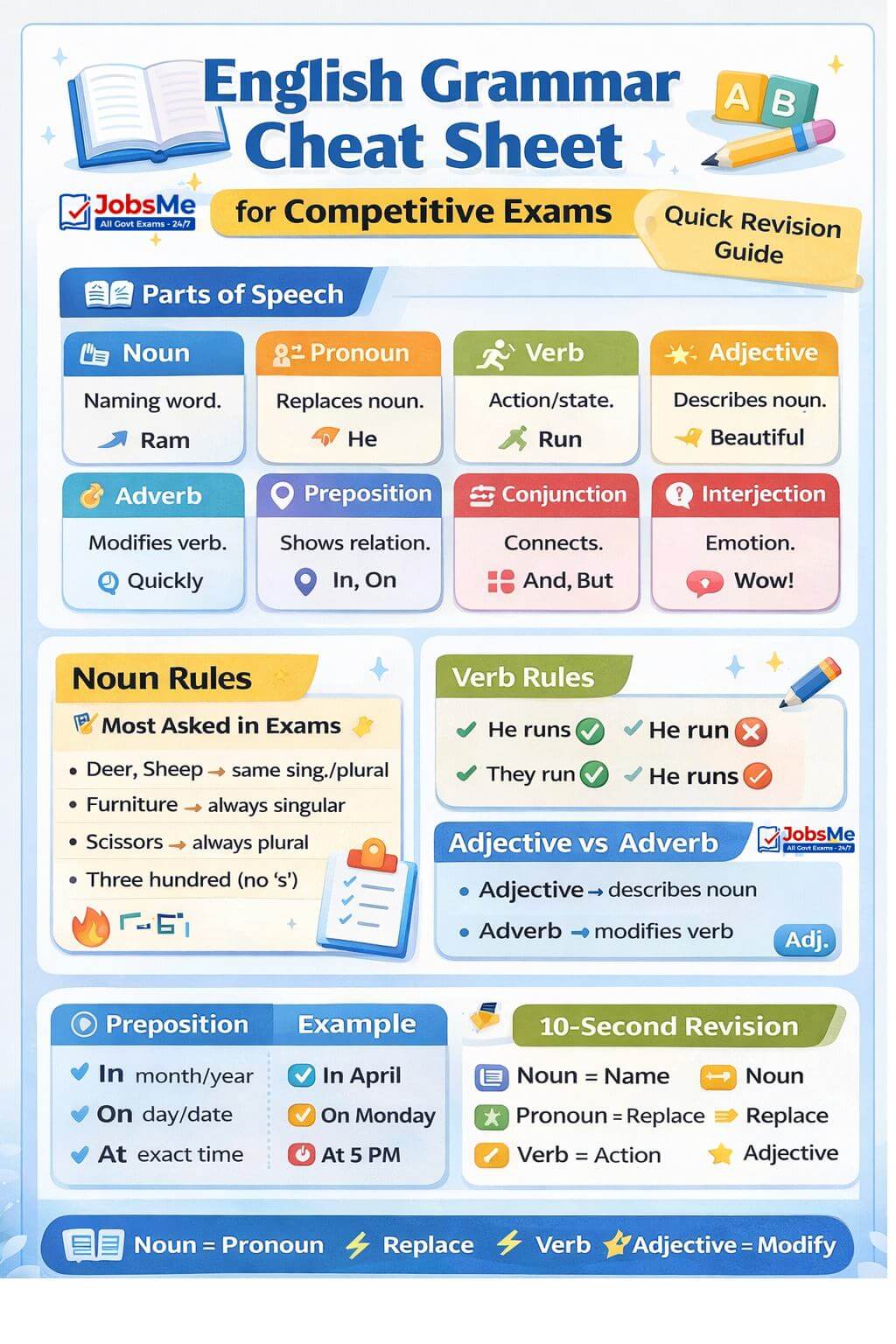
Thus, mastering Parts of Speech is the first and most important step in grammar preparation.
Noun (Naming Word)
A noun is a word that names a person, place, animal, thing, or idea. It is one of the most important parts of speech because every sentence revolves around a noun, either as a subject or an object.
For example, in the sentence “The boy is playing in the park”, the words boy and park are nouns. Without nouns, it would be impossible to form meaningful sentences.
Nouns are classified into different types such as:
- Proper Noun – specific names (Delhi, India)
- Common Noun – general names (city, boy)
- Collective Noun – group names (team, herd)
- Abstract Noun – ideas (love, happiness)
- Material Noun – substances (gold, water)
Understanding these types is important because many exam questions test whether candidates can correctly identify and use nouns.
👉 Exam Insight: Questions often appear in error detection, sentence correction, and fill in the blanks based on noun rules.
Pronoun (Replacement Word)
A pronoun is a word used in place of a noun to avoid repetition and make sentences more natural and less repetitive. Without pronouns, sentences would sound awkward and lengthy.
For example:
❌ Ram is a good boy. Ram studies well.
✅ Ram is a good boy. He studies well.
Pronouns must agree with the nouns they replace in terms of number, gender, and person. Incorrect usage of pronouns is one of the most common errors in competitive exams.
For instance, using “he” instead of “they” or “it” incorrectly can change the meaning of a sentence.
👉 Exam Insight: Focus on pronoun agreement, correct case (subject/object), and error detection.
Verb (Action or State)
A verb is a word that expresses an action or a state of being. It is the heart of a sentence, because without a verb, a sentence cannot be complete.
For example:
- She runs fast (action)
- He is happy (state)
Verbs change their form depending on tense, subject, and context, which makes them very important for exams. Questions often test whether the verb agrees with the subject and whether the correct tense is used.
👉 Exam Insight: Focus on subject-verb agreement, tense usage, and verb forms.
Adjective (Describing Word)
An adjective is a word that describes or modifies a noun. It gives additional information about the noun, such as its quality, quantity, number, or condition.
For example:
- She is a beautiful girl
- He has three books
Adjectives make sentences more informative and meaningful. Without adjectives, sentences would lack detail.
In exams, questions are often asked on degrees of comparison:
- Positive (tall)
- Comparative (taller)
- Superlative (tallest)
👉 Exam Insight: Pay attention to comparison rules and correct adjective usage.
Adverb (Modifying Word)
An adverb modifies a verb, adjective, or another adverb. It provides additional information about how, when, where, or to what extent an action occurs.
For example:
- She runs quickly
- He is very intelligent
Adverbs are important because they add clarity and precision to sentences. However, many students confuse adverbs with adjectives, which leads to mistakes.
👉 Exam Insight: Focus on adverb placement and common errors (e.g., using adjective instead of adverb).
Preposition (Relationship Word)
A preposition shows the relationship between a noun or pronoun and another word in the sentence. It often indicates position, direction, time, or cause.
For example:
- The book is on the table
- He is going to school
Prepositions may seem simple, but they are frequently tested in exams because incorrect usage can completely change the meaning of a sentence.
👉 Exam Insight: Practice commonly used prepositions like in, on, at, by, for, with.
Conjunction (Joining Word)
A conjunction is a word that connects words, phrases, or clauses. It helps in forming complex and meaningful sentences.
For example:
- Ram and Shyam are friends
- I was tired, but I continued working
Conjunctions are important for sentence structure and are commonly tested in sentence correction and joining questions.
👉 Exam Insight: Focus on conjunctions like and, but, because, although.
Interjection (Emotion Word)
An interjection is a word used to express sudden emotions or feelings, such as surprise, joy, or anger.
For example:
- Wow! That’s amazing
- Oh! I forgot
Interjections are usually followed by an exclamation mark and are more common in spoken English.
👉 Exam Insight: Less frequently asked but important for understanding tone.
Sentence Structure and Its Importance
A sentence is made up of two main parts: subject and predicate. The subject tells us who or what the sentence is about, while the predicate tells us what the subject does.
Additional components include:
- Object – receives action
- Complement – completes meaning
- Modifier – adds description
Understanding sentence structure is essential for solving error detection and sentence correction questions, which are very common in exams.
Noun Rules (Important for Exams)
Noun rules are frequently tested in competitive exams. Some important concepts include:
- Some nouns have the same singular and plural form (deer, sheep)
- Words like hundred, thousand, dozen do not take plural when used with numbers
- Some nouns are always singular (information, furniture)
- Some nouns are always plural (scissors, trousers)
- Some nouns change meaning in plural form
Understanding these rules helps in solving tricky questions quickly.
Table: Important Noun Rules
| Rule Type | Explanation | Example |
|---|---|---|
| Same Form | No change in singular/plural | Deer |
| Always Singular | Uncountable nouns | Furniture |
| Always Plural | Used with plural verb | Scissors |
| Number Rule | No ‘s’ with number | Three hundred |
| Without Number | Takes plural | Hundreds of people |
Subject-Verb Agreement (Important Rules)
Subject-Verb Agreement is one of the most important topics in SSC, Banking, and UPSC exams. It ensures that the verb matches the subject in number and person.
A singular subject takes a singular verb, while a plural subject takes a plural verb. However, many tricky rules are frequently asked in exams.
Some important rules include:
- A singular subject takes a singular verb
Example: He runs fast - A plural subject takes a plural verb
Example: They run fast - Words like everyone, someone, each, anyone are always singular
Example: Everyone is happy - “A number of” takes plural verb
Example: A number of students are present - “The number of” takes singular verb
Example: The number of students is increasing
👉 Exam Tip: Always identify the subject first before choosing the verb.
Articles (A, An, The)
Articles are small but very important words used before nouns. Questions from articles are common in Banking and SSC exams.
There are two types of articles:
- Indefinite Articles (A, An) → used for general things
- Definite Article (The) → used for specific things
Examples:
- A boy is playing
- The boy is playing
Rules:
- Use “A” before consonant sound → a boy
- Use “An” before vowel sound → an apple
- Use “The” when referring to something specific
👉 Exam Tip: Focus on sound (not spelling) while choosing a/an.
Tenses (Quick Overview)
Tenses indicate the time of an action and are important for sentence correctness.
There are three main types of tenses:
| Tense | Example |
|---|---|
| Present | He plays |
| Past | He played |
| Future | He will play |
Understanding tenses helps in solving error detection and sentence correction questions.
👉 Exam Tip: Look for time indicators like yesterday, now, tomorrow.
Common Error Detection (Exam Based)
Error detection is one of the most scoring sections in competitive exams.
Some common examples include:
- ❌ He go to school
- ✅ He goes to school
- ❌ She have a pen
- ✅ She has a pen
- ❌ They is playing
- ✅ They are playing
- ❌ Informations are useful
- ✅ Information is useful
👉 Exam Tip: Focus on subject-verb agreement and noun rules.
Grammar Tricks for Exams
Some quick tricks to solve questions faster:
- “Everyone” → always singular
- “Scissors” → always plural
- “Furniture” → always singular
- “A number of” → plural
- “The number of” → singular
👉 Exam Tip: Memorize these for quick elimination.
Impact and Significance for Exams
English Grammar directly affects accuracy, speed, and confidence in exams. Candidates who understand grammar concepts can solve questions faster and avoid common mistakes.
Grammar is especially important in exams like SSC and Banking, where it is a scoring section.
To strengthen preparation, practice regularly with
👉 Daily Current Affairs Free Quizzes
👉 Start Typing Test
Additional Notes for Aspirants
Grammar should be studied along with reading, vocabulary, and practice tests. Regular revision is essential to retain concepts.
Stay updated with
👉Daily Current Affairs
https://jobsme.in/category/daily-current-affairs
👉 Latest Government Jobs Notifications
https://jobsme.in/jobs
This ensures a balanced and effective preparation strategy.
Key Points for Quick Revision
- Noun = naming word
- Pronoun = replaces noun
- Verb = action/state
- Adjective = describes noun
- Adverb = modifies verb
- Preposition = shows relation
- Conjunction = connects words
- Interjection = expresses emotion
Conclusion
English Grammar is a high-scoring and essential section for all competitive exams. A clear understanding of Parts of Speech and Noun rules helps candidates improve both accuracy and confidence.
For complete preparation, stay updated with
Daily Current Affairs
https://jobsme.in/category/daily-current-affairs
Daily Current Affairs Free Quizzes
https://jobsme.in/quizzes/daily-current-affairs
Weekly Current Affairs
https://jobsme.in/category/weekly-current-affairs
Monthly Current Affairs
https://jobsme.in/category/monthly-current-affairs
Latest Government Jobs Notifications
https://jobsme.in/jobs
Static GK for Competitive Exams
https://jobsme.in/category/static-gk
Practice Typing Test Now
https://jobsme.in/typing-tests/ssc-chsl-ldc-jsa
and continue consistent practice to succeed in competitive exams. 🚀
Free quiz • No signup required
Put this topic into practice with Current Affairs Quiz 17 June 2026 MCQs for UPSC, SSC, Banking, Railways, Defence & State PSC Exams. It is the quickest way to reinforce what you just learned.
Frequently Asked Questions
1. What is English Grammar?
2. Why is grammar important for competitive exams?
3. What are Parts of Speech?
4. What is a noun?
5. Which exams include English Grammar?
6. What is the most important topic in English Grammar for exams?
7. What is subject-verb agreement?
8. What is the difference between adjective and adverb?
9. What are common grammar mistakes in exams?
10. What is an abstract noun?
11. What is a collective noun?
12. How to improve English Grammar for competitive exams?
13. How many questions are asked from grammar in exams?
14. What is the role of tenses in grammar?
15. What is error detection in exams?
16. What is the difference between countable and uncountable nouns?
17. What is the use of apostrophe (‘s) in grammar?
18. Why are prepositions important in exams?
19. What is active and passive voice?
20. How to score high in English Grammar section?

About the author