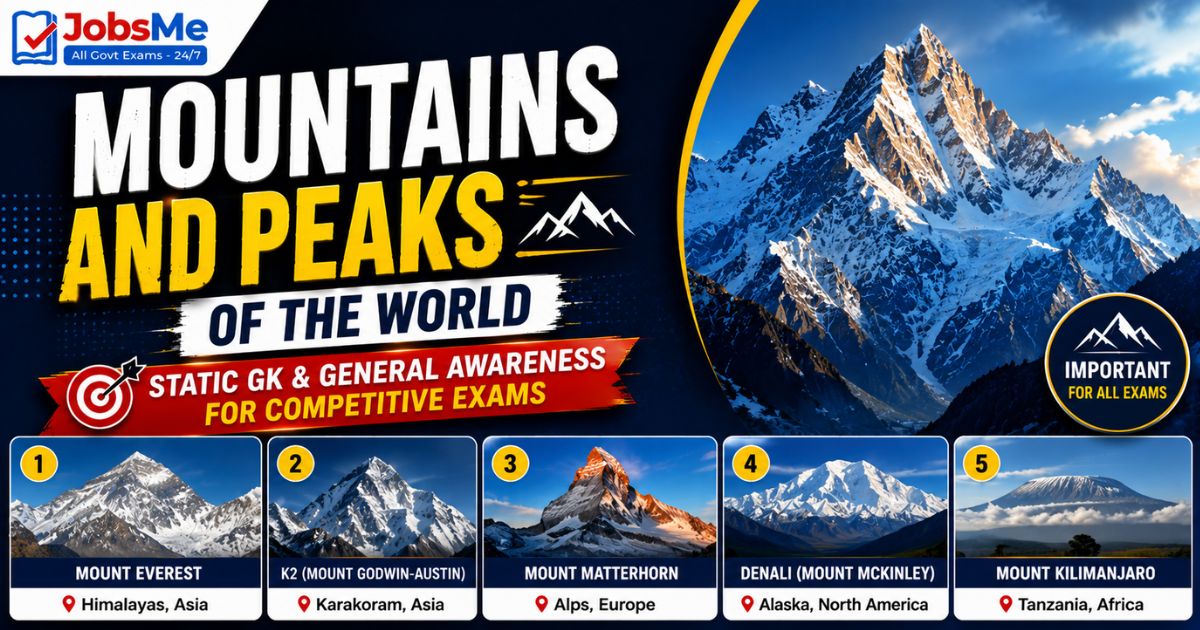
Mountains and Peaks of the World – Static GK & General Awareness for Competitive Exams with Memory Tricks
This article presents a complete guide to the important mountains and peaks of the world, covering the Seven Summits (highest peak of each continent), all 14 eight-thousanders, the world's major and longest mountain ranges, and the highest peaks of India state-wise. It includes key facts like Mount Everest (Asia's and the world's highest at 8,849 m), Aconcagua (highest outside Asia), Kangchenjunga (highest peak in India), Nanda Devi (highest peak entirely within India), and the Andes (world's longest continental range), along with memory tricks and one-liners for quick revision. All facts are arranged in exam-ready format to help UPSC, SSC, IBPS, RRB, PSU, and State PCS aspirants score better in General Awareness and Geography sections.
Jump to section
- Introduction
- Core Concepts: Understanding Mountains, Peaks and Ranges
- The Seven Summits - Highest Peak of Each Continent
- The 14 Eight-Thousanders - Peaks Above 8,000 Metres
- Major and Longest Mountain Ranges of the World
- Highest Peaks of India - State-Wise
- Memory Tricks and Mnemonics
- Additional Notes
- One-Liners for Quick Revision
Introduction
Mountains and peaks are one of the most frequently tested topics in the Geography and General Awareness sections of competitive exams. From the towering Mount Everest at 8,849 metres on the Nepal-China border to Kangchenjunga, the highest peak in India, candidates are expected to know the names, heights, locations, and mountain ranges of the world's most important summits. The famous Seven Summits — the highest peak on each of the seven continents — and the 14 eight-thousanders (peaks above 8,000 metres) are particularly high-yield areas for objective questions.
Questions on mountains and peaks appear regularly in UPSC Prelims, SSC CGL, IBPS PO, RRB NTPC, SBI Clerk, State PCS, and various Insurance and Defence exams. Typical questions ask which is the highest peak of a particular continent, which is the highest peak in India, which range a given peak belongs to, or which is the longest mountain range in the world. This article brings together every important mountain fact in a structured, exam-ready format. To explore other related Static GK topics, you can refer to the Static GK section on Jobsme.in.
Mountain topics are also closely linked to current affairs themes such as mountaineering expeditions, glacier melt and climate change, the Char Dham and Himalayan pilgrimage routes, border infrastructure in the Karakoram and Ladakh region, and ecological zones like the Western Ghats — making this topic doubly important for aspirants preparing for UPSC Mains and Essay papers as well.
Core Concepts: Understanding Mountains, Peaks and Ranges
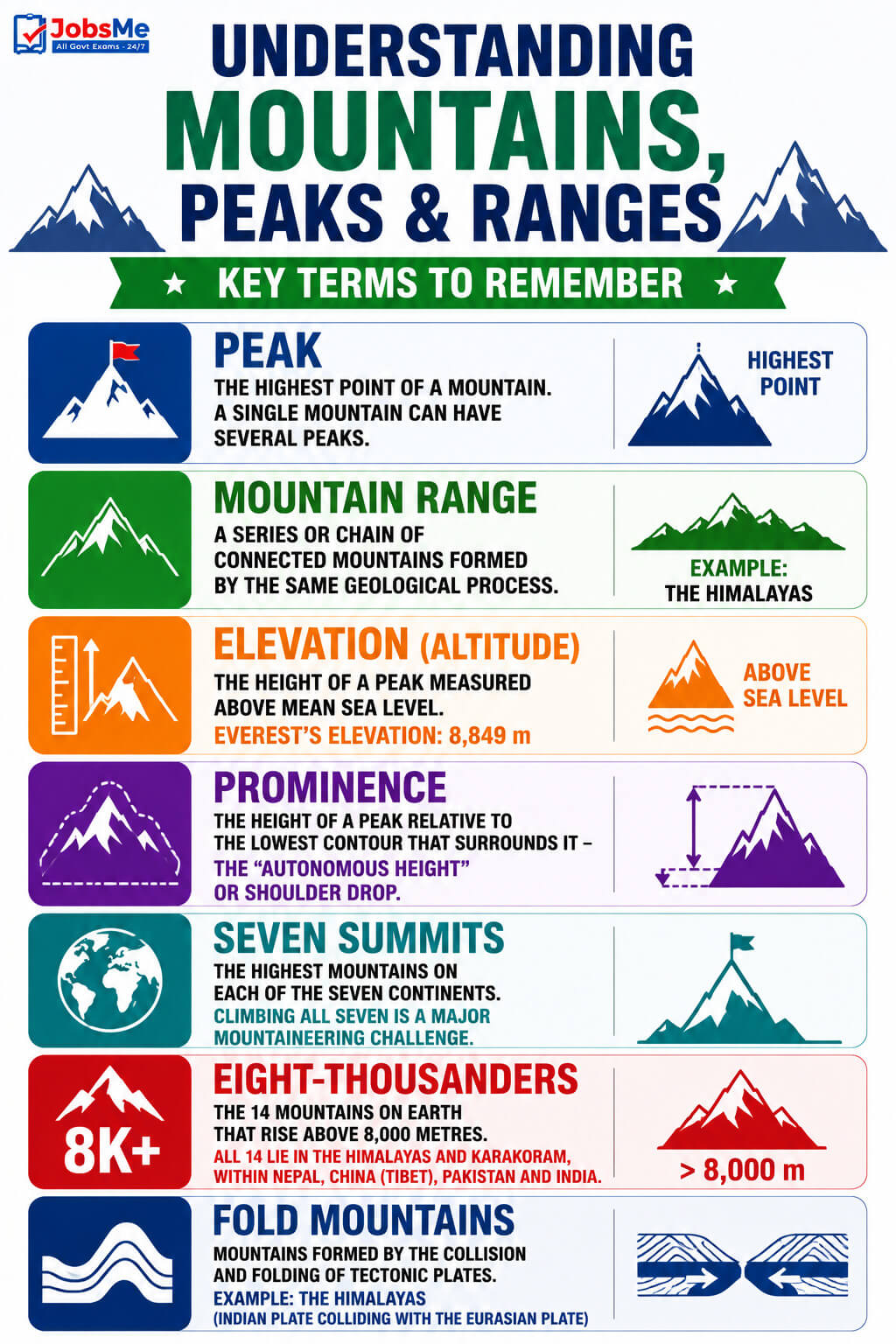
Before memorising the data, it helps to understand the basic terms used in physical geography. A clear grasp of these definitions makes it easier to answer tricky questions that test concepts rather than plain facts.
Key Terms to Remember
- Peak: The highest point of a mountain. A single mountain can have several peaks, but usually only the highest is called "the peak."
- Mountain Range: A series or chain of connected mountains formed by the same geological process. Example: the Himalayas, the Andes, the Rockies.
- Elevation (Altitude): The height of a peak measured above mean sea level. Everest's elevation is 8,849 m.
- Prominence: The height of a peak relative to the lowest contour that surrounds it — the "autonomous height" or shoulder drop. It helps distinguish a true independent peak from a small bump on a larger mountain.
- Seven Summits: The highest mountains on each of the seven continents. Climbing all seven is a major mountaineering challenge.
- Eight-Thousanders: The 14 mountains on Earth that rise above 8,000 metres. All 14 lie in the Himalayas and the Karakoram, within Nepal, China (Tibet), Pakistan and India.
- Fold Mountains: Mountains formed by the collision and folding of tectonic plates, like the Himalayas (Indian Plate colliding with the Eurasian Plate).
The Seven Summits - Highest Peak of Each Continent
The Seven Summits are the highest mountains on each of the seven continents and form one of the most frequently asked sets of facts in competitive exams. Note that there are two versions of the list — the Bass list (using Mount Kosciuszko for Australia) and the Messner list (using Puncak Jaya / Carstensz Pyramid for Oceania).
| Continent | Highest Peak | Height & Key Details |
|---|---|---|
| Asia | Mount Everest | 8,849 m; world's highest peak; on the Nepal-China (Tibet) border in the Himalayas; called Sagarmatha in Nepali and Chomolungma in Tibetan; first climbed in 1953 by Edmund Hillary and Tenzing Norgay. |
| South America | Aconcagua | 6,961 m; located in Argentina in the Andes; the highest peak outside Asia and the highest in both the Southern and Western Hemispheres. |
| North America | Denali (formerly Mount McKinley) | 6,190 m; located in Alaska, USA, in the Alaska Range; often called the coldest mountain in the world due to its subarctic location. |
| Africa | Mount Kilimanjaro | 5,895 m; located in Tanzania; the world's highest freestanding mountain and a dormant stratovolcano; lies close to the equator yet is permanently snow-capped. |
| Europe | Mount Elbrus | 5,642 m; located in the Caucasus range in Russia; a dormant volcano and Europe's highest peak. (In the Messner list, Mont Blanc at 4,810 m is treated as Europe's highest.) |
| Antarctica | Vinson Massif | 4,892 m; the highest peak of Antarctica, located in the Ellsworth Mountains; extremely remote and cold. |
| Australia / Oceania | Puncak Jaya (Carstensz Pyramid) / Mount Kosciuszko | Puncak Jaya in Indonesia (4,884 m) is the highest in Oceania per the Messner list; Mount Kosciuszko in Australia (2,228 m) is used in the Bass list for the Australian mainland. |
The 14 Eight-Thousanders - Peaks Above 8,000 Metres
The eight-thousanders are the 14 mountains on Earth that rise above 8,000 metres. All of them lie in Asia, within the Himalayas and the Karakoram, across Nepal, China (Tibet), Pakistan and India. Climbing all 14 is called the "Crown of the Earth." For more current affairs on mountaineering records, you can check the Daily Current Affairs section on Jobsme.in.
| Peak | Height | Location & Key Details |
|---|---|---|
| Mount Everest | 8,849 m | Nepal-China (Tibet); world's highest peak; first ascent 1953 by Hillary and Tenzing Norgay. |
| K2 (Godwin-Austen) | 8,611 m | Pakistan-China, in the Karakoram; world's second highest; far more dangerous to climb than Everest due to severe weather; lies in the Pakistan-occupied Kashmir region. |
| Kangchenjunga | 8,586 m | India (Sikkim)-Nepal border; world's third highest and the highest peak in India; of great religious importance to the people of Sikkim. |
| Lhotse | 8,516 m | Nepal-China; world's fourth highest; connected to Everest by the South Col. |
| Makalu | 8,485 m | Nepal-China; world's fifth highest; known for its distinctive four-sided pyramid shape. |
| Cho Oyu | 8,188 m | Nepal-China; considered the easiest eight-thousander and a popular "warm-up" peak before Everest. |
| Dhaulagiri I | 8,167 m | Nepal; the name means "White Mountain"; was considered the world's tallest known peak from 1808 to 1838. |
| Manaslu | 8,163 m | Nepal; the name means "Mountain of the Spirit"; popular for commercial expeditions. |
| Nanga Parbat | 8,126 m | Pakistan; nicknamed the "Killer Mountain" for its high death toll before the first successful ascent in 1953. |
| Annapurna I | 8,091 m | Nepal; the first eight-thousander ever climbed (1950, by a French team led by Maurice Herzog); has one of the highest fatality rates of all peaks. |
| Gasherbrum I (Hidden Peak) | 8,080 m | Pakistan-China, in the Karakoram; very remote, hence the name "Hidden Peak." |
| Broad Peak | 8,051 m | Pakistan-China, in the Karakoram; located close to K2. |
| Gasherbrum II | 8,035 m | Pakistan-China, in the Karakoram; regarded as the easiest of the Karakoram eight-thousanders and a good training peak for Everest. |
| Shishapangma | 8,027 m | China (Tibet); the lowest of the 14 eight-thousanders and the only one located entirely within China; last to be first climbed (1964). |
Major and Longest Mountain Ranges of the World
Apart from individual peaks, exams frequently test knowledge of the world's major mountain ranges — their length, location, highest peak, and how they were formed. The mid-ocean ridge is technically the world's longest range, but it lies entirely underwater; among land ranges, the Andes is the longest.
| Range | Location & Length | Highest Peak & Key Details |
|---|---|---|
| Andes | South America; about 7,000 km; world's longest continental range | Highest peak: Aconcagua (6,961 m); spans seven countries — Venezuela, Colombia, Ecuador, Peru, Bolivia, Chile and Argentina; home to Ojos del Salado, the world's highest volcano, and the lithium-rich "Lithium Triangle." |
| Rocky Mountains (Rockies) | North America; about 4,800 km | Highest peak: Mount Elbert (4,401 m) in Colorado, USA; runs from British Columbia (Canada) to New Mexico (USA); forms the Continental Divide. |
| Great Dividing Range | Australia (east coast); about 3,500 km | Highest peak: Mount Kosciuszko (2,228 m); also called the Eastern Highlands; separates the fertile coast from the arid interior. |
| Himalayas | Asia; about 2,400 km | Highest peak: Mount Everest (8,849 m); the world's highest and youngest major range; formed by the collision of the Indian Plate and the Eurasian Plate; spans India, Nepal, Bhutan, China (Tibet) and Pakistan; still growing each year. |
| Karakoram | Asia (Pakistan, China, India) | Highest peak: K2 (8,611 m); contains four of the 14 eight-thousanders; one of the most heavily glaciated regions outside the polar areas. |
| Hindu Kush | Asia (Afghanistan, Pakistan, Tajikistan) | Highest peak: Tirich Mir (7,708 m); strategically important range to the northwest of the Indian subcontinent. |
| Alps | Europe | Highest peak: Mont Blanc (4,810 m); located across France, Italy, Switzerland, Austria and others; major tourism and skiing region. |
| Atlas Mountains | Africa (Morocco, Algeria, Tunisia) | Highest peak: Toubkal (4,167 m); separates the Mediterranean and Atlantic coasts from the Sahara Desert. |
| Appalachian Mountains | North America (eastern USA and Canada) | Highest peak: Mount Mitchell (2,037 m); one of the oldest ranges on Earth (around 480 million years); the Appalachian Trail runs its length. |
| Mid-Ocean Ridge | Global, underwater; about 65,000 km | The longest mountain range on Earth overall, but it lies entirely beneath the oceans; formed at divergent tectonic plate boundaries. |
Highest Peaks of India - State-Wise
India's highest peaks are concentrated in the Karakoram, Garhwal Himalaya and Kangchenjunga ranges. A key exam point: although K2 is taller, it lies in the Pakistan-occupied Kashmir region, so Kangchenjunga is treated as the highest peak in India, while Nanda Devi is the highest peak lying entirely within Indian territory. To revise more Indian geography, you can also explore the Static GK notes on Jobsme.in.
| Peak | Height & Range | State / Region & Key Details |
|---|---|---|
| Kangchenjunga | 8,586 m; Himalayas | Sikkim, on the India-Nepal border; highest peak in India and the world's third highest; sacred to the people of Sikkim. |
| Nanda Devi | 7,816 m; Garhwal Himalayas | Chamoli district, Uttarakhand; the highest peak lying entirely within Indian territory; second highest peak in India. |
| Kamet | 7,756 m; Zaskar range | Garhwal region, Chamoli district, Uttarakhand; second highest peak in the Garhwal Himalayas. |
| Saltoro Kangri | 7,742 m; Saltoro range (Karakoram) | Located in the Ladakh region; one of the highest peaks of the Karakoram on the Indian side. |
| Saser Kangri | 7,672 m; Saser Muztagh (Karakoram) | Located in Ladakh; among the major peaks of the eastern Karakoram. |
| K2 (Godwin-Austen) | 8,611 m; Karakoram | Located in the Pakistan-occupied Kashmir region; the world's second highest peak, but not counted as a peak within Indian states. |
| Anamudi | 2,695 m; Western Ghats | Kerala; the highest peak in the Western Ghats and the highest in South India. |
| Doddabetta | 2,637 m; Nilgiri Hills | Tamil Nadu; the highest peak of the Nilgiris in the Western Ghats. |
| Mahendragiri | 1,501 m; Eastern Ghats | Odisha; one of the highest peaks of the Eastern Ghats. (Deomali, also in Odisha, is the highest peak of the Eastern Ghats.) |
| Guru Shikhar | 1,722 m; Aravalli Range | Mount Abu, Rajasthan; the highest peak of the Aravalli Range, the oldest mountain range in India. |
| Sandakphu | 3,636 m; Singalila Ridge | West Bengal, in the Eastern Himalayas; the highest point in West Bengal. |
Memory Tricks and Mnemonics
Trick 1: Seven Summits Order — "Eat An Apple, Drink Kilo Volume"
To remember the Seven Summits from highest to lowest, link the first letters to a silly phrase:
- E → Everest (Asia, 8,849 m).
- A → Aconcagua (South America, 6,961 m).
- D → Denali (North America, 6,190 m).
- K → Kilimanjaro (Africa, 5,895 m).
- E → Elbrus (Europe, 5,642 m).
- V → Vinson Massif (Antarctica, 4,892 m).
- P → Puncak Jaya (Oceania, 4,884 m).
"Everest Always Defeats Kilimanjaro, Even Vinson and Puncak."
Trick 2: Top Three Highest Peaks — "Every King Knows"
The three highest peaks in the world all begin with sounds that fit "Every King Knows":
- E → Everest (8,849 m) — 1st.
- K → K2 (8,611 m) — 2nd.
- K → Kangchenjunga (8,586 m) — 3rd (and highest in India).
"E-K-K: Everest, K2, Kangchenjunga."
Trick 3: India's Highest vs India's "Entirely Within" Peak
Students often confuse the two. Remember the contrast:
- Kangchenjunga → Highest peak in India (but on the India-Nepal border).
- Nanda Devi → Highest peak lying entirely within Indian territory.
- K2 → Taller than both, but in Pakistan-occupied Kashmir, so not counted as India's highest.
"Kangchenjunga is highest in India; Nanda Devi is highest inside India."
Trick 4: Longest Land Ranges — "All Rivers Go High"
The four longest land mountain ranges in order can be linked as "ARGH":
- A → Andes (~7,000 km) — longest continental range.
- R → Rockies (~4,800 km).
- G → Great Dividing Range (~3,500 km).
- H → Himalayas (~2,400 km) — shortest of these four but the highest.
"ARGH — Andes, Rockies, Great Dividing, Himalayas."
Trick 5: The Four Karakoram Eight-Thousanders — "GG BK"
Of the 14 eight-thousanders, exactly four are in the Karakoram (the rest are in the Himalayas):
- G → Gasherbrum I (Hidden Peak).
- G → Gasherbrum II.
- B → Broad Peak.
- K → K2.
"Karakoram holds Two Gasherbrums, one Broad Peak and the mighty K2."
Trick 6: Nicknamed Peaks — "Killer, Hidden, White, Spirit"
Several eight-thousanders carry exam-friendly nicknames or meanings:
- Killer Mountain → Nanga Parbat.
- Hidden Peak → Gasherbrum I.
- White Mountain → Dhaulagiri I.
- Mountain of the Spirit → Manaslu.
- Most dangerous / highest fatality → Annapurna I.
Trick 7: Continental Highest Volcano & Freestanding Mountain
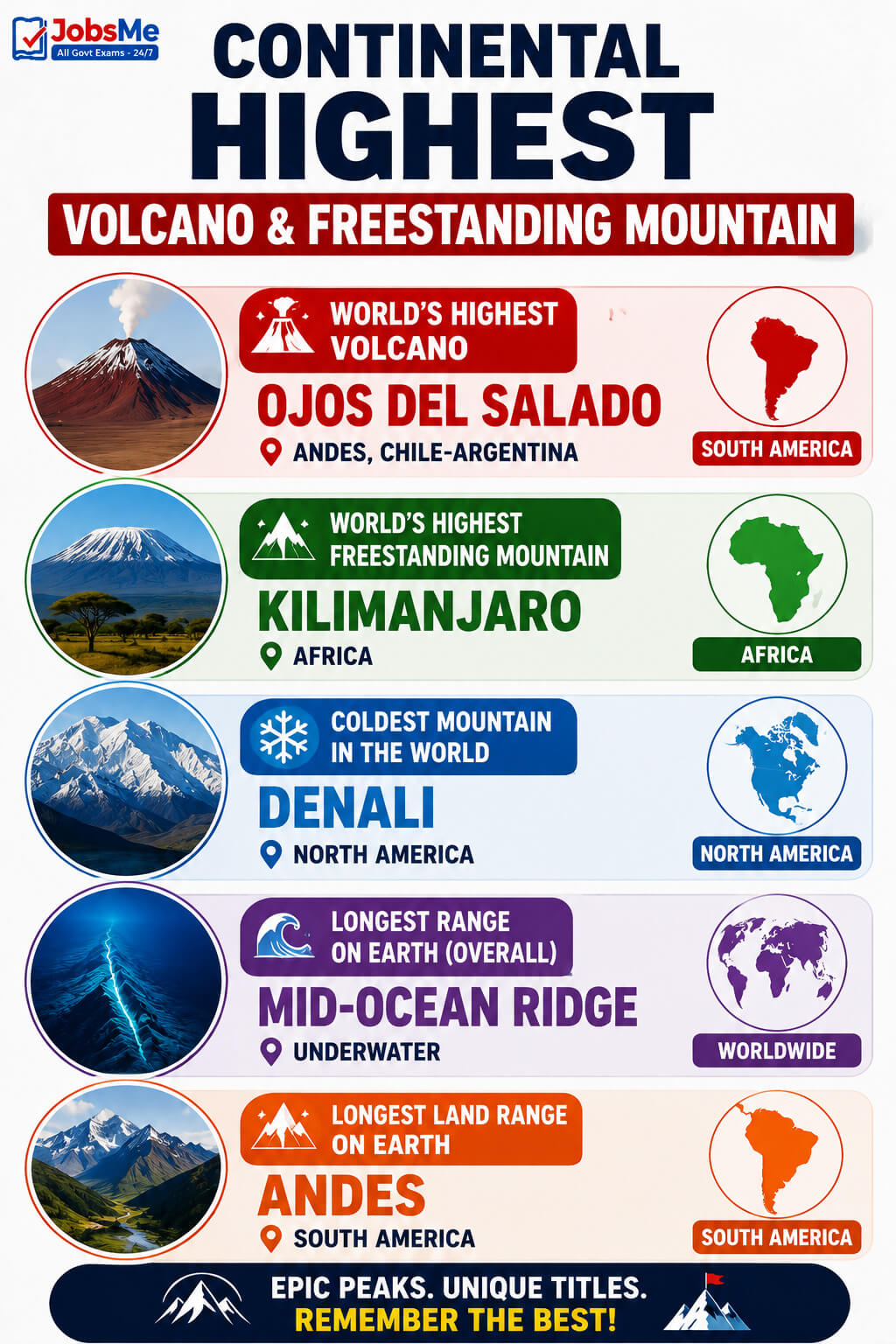
Group the "special title" peaks to avoid confusion:
- World's highest volcano → Ojos del Salado (Andes, Chile-Argentina).
- World's highest freestanding mountain → Kilimanjaro (Africa).
- Coldest mountain in the world → Denali (North America).
- Longest range on Earth (overall) → Mid-Ocean Ridge (underwater).
- Longest land range → Andes.
Additional Notes
Frequently Confused Facts
- Highest in India vs Entirely within India: Kangchenjunga is the highest peak in India (on the India-Nepal border); Nanda Devi is the highest peak lying entirely within Indian territory.
- K2 vs Kangchenjunga: K2 (8,611 m) is taller than Kangchenjunga (8,586 m), but K2 lies in Pakistan-occupied Kashmir, so Kangchenjunga is treated as India's highest peak.
- Everest's height: Officially 8,849 m as per the 2020 China-Nepal joint survey; older sources may state 8,848 m or 8,848.86 m.
- Highest peak outside Asia: Aconcagua (6,961 m) in the Andes — not Kilimanjaro or Denali.
- Europe's highest peak: Mount Elbrus (Caucasus) in the Bass list; Mont Blanc (Alps) in the Messner list — the answer depends on which list the exam follows.
- Longest range overall vs longest land range: The Mid-Ocean Ridge is the longest range overall but is underwater; the Andes is the longest continental (land) range.
- Youngest vs oldest range: The Himalayas are the youngest major fold mountains; the Appalachians (and India's Aravallis) are among the oldest.
- First climbed vs most deadly eight-thousander: Annapurna I was the first eight-thousander ever climbed (1950) and also has one of the highest fatality rates.
- Number of eight-thousanders in each range: 10 lie in the Himalayas and 4 in the Karakoram.
- Anamudi vs Doddabetta: Anamudi (Kerala) is the highest peak in the Western Ghats and South India; Doddabetta (Tamil Nadu) is the highest peak of the Nilgiri Hills.
Repeating PYQ Patterns
Certain mountain facts are asked repeatedly in competitive exams. Mount Everest (world's highest, 8,849 m), K2 (world's second highest), Kangchenjunga (highest in India), Nanda Devi (highest entirely within India), Aconcagua (highest outside Asia), Kilimanjaro (highest in Africa, world's highest freestanding mountain), Denali (highest in North America), the Andes (world's longest land range), and Annapurna (first eight-thousander climbed, most deadly) appear most often in UPSC Prelims, SSC CGL, and RRB NTPC papers. Banking exams (IBPS PO, SBI Clerk) frequently focus on matching peaks with their continents or countries, and on the longest and oldest ranges. State PCS exams add region-specific peaks — Uttarakhand PCS asks about Nanda Devi and Kamet, Kerala PSC about Anamudi, Sikkim and West Bengal exams about Kangchenjunga and Sandakphu, and Rajasthan PSC about Guru Shikhar in the Aravallis.
Quick Insight
Mountains are not just exam facts — they shape climate, rivers, borders and economies. The Himalayas act as a climatic barrier that blocks cold Central Asian winds and feeds India's great river systems, while the Karakoram and Ladakh peaks have strategic and defence significance along India's northern frontier. Mountaineering current affairs — record speed ascents of the 14 eight-thousanders, glacier-melt studies linked to climate change, and Himalayan disaster management — regularly feature in the news, so linking static facts with current events gives aspirants an edge in both Prelims and Mains. For further reading on related Static GK topics, you can refer to the Static GK guide and stay updated with the Daily Current Affairs notes on Jobsme.in.
One-Liners for Quick Revision
- Mount Everest → World's highest peak (8,849 m) → Nepal-China border, Himalayas; called Sagarmatha and Chomolungma.
- K2 (Godwin-Austen) → World's second highest (8,611 m) → Karakoram, in Pakistan-occupied Kashmir; most dangerous to climb.
- Kangchenjunga → World's third highest (8,586 m) → highest peak in India; Sikkim, India-Nepal border.
- Lhotse → World's fourth highest (8,516 m) → Nepal-China; connected to Everest.
- Makalu → World's fifth highest (8,485 m) → Nepal-China; pyramid-shaped peak.
- Cho Oyu → 8,188 m → easiest eight-thousander, Everest "warm-up" peak.
- Dhaulagiri I → 8,167 m → "White Mountain"; world's tallest known peak from 1808 to 1838.
- Manaslu → 8,163 m → "Mountain of the Spirit"; Nepal.
- Nanga Parbat → 8,126 m → "Killer Mountain"; Pakistan.
- Annapurna I → 8,091 m → first eight-thousander ever climbed (1950); highest fatality rate.
- Gasherbrum I → 8,080 m → "Hidden Peak"; Karakoram.
- Broad Peak → 8,051 m → Karakoram, near K2.
- Gasherbrum II → 8,035 m → easiest Karakoram eight-thousander.
- Shishapangma → 8,027 m → lowest eight-thousander; only one entirely in China.
- Aconcagua → 6,961 m → highest peak in South America and outside Asia; Andes, Argentina.
- Denali → 6,190 m → highest peak in North America; Alaska Range; coldest mountain in the world.
- Kilimanjaro → 5,895 m → highest in Africa; world's highest freestanding mountain; Tanzania.
- Mount Elbrus → 5,642 m → highest in Europe (Bass list); Caucasus, Russia.
- Vinson Massif → 4,892 m → highest peak in Antarctica.
- Puncak Jaya (Carstensz Pyramid) → 4,884 m → highest in Oceania (Messner list); Indonesia.
- Mount Kosciuszko → 2,228 m → highest peak of mainland Australia (Bass list).
- Mont Blanc → 4,810 m → highest in the Alps; Europe's highest in the Messner list.
- Andes → ~7,000 km → world's longest continental range; highest peak Aconcagua; seven countries.
- Rocky Mountains → ~4,800 km → North America; highest peak Mount Elbert (4,401 m); forms the Continental Divide.
- Great Dividing Range → ~3,500 km → eastern Australia; highest peak Mount Kosciuszko.
- Himalayas → ~2,400 km → youngest and highest major range; highest peak Everest; fold mountains.
- Karakoram → contains 4 eight-thousanders; highest peak K2.
- Hindu Kush → highest peak Tirich Mir (7,708 m); Afghanistan-Pakistan-Tajikistan.
- Alps → Europe; highest peak Mont Blanc (4,810 m).
- Atlas Mountains → Africa; highest peak Toubkal (4,167 m); borders the Sahara.
- Appalachian Mountains → one of the oldest ranges; highest peak Mount Mitchell.
- Mid-Ocean Ridge → ~65,000 km → longest mountain range on Earth; entirely underwater.
- Nanda Devi → 7,816 m → highest peak entirely within India; Garhwal Himalayas, Uttarakhand.
- Kamet → 7,756 m → Zaskar range, Uttarakhand; second highest in the Garhwal Himalayas.
- Saltoro Kangri → 7,742 m → Karakoram, Ladakh region.
- Saser Kangri → 7,672 m → eastern Karakoram, Ladakh.
- Anamudi → 2,695 m → highest peak in the Western Ghats and South India; Kerala.
- Doddabetta → 2,637 m → highest peak of the Nilgiri Hills; Tamil Nadu.
- Guru Shikhar → 1,722 m → highest peak of the Aravalli Range; Mount Abu, Rajasthan.
- Mahendragiri / Deomali → highest peaks of the Eastern Ghats; Odisha.
- Sandakphu → 3,636 m → highest point in West Bengal; Singalila Ridge, Eastern Himalayas.
- Ojos del Salado → world's highest volcano; Andes, Chile-Argentina border.
- Aravalli Range → oldest mountain range in India.
For more Static GK topics like rivers, ranges and physical geography of India, explore the Static GK section on Jobsme.in. You can also test your knowledge with the Static GK Quiz and check out the latest exam notifications at Latest Government Job Notifications.
Free quiz • No signup required
Put this topic into practice with Indian Cultural Institutions – Static GK MCQ Quiz. It is the quickest way to reinforce what you just learned.
Frequently Asked Questions
Which is the highest mountain peak in the world?
Which is the highest peak in India?
Why is K2 not considered the highest peak in India?
Which is the highest peak lying entirely within India?
What are the Seven Summits?
How many eight-thousanders are there and where are they located?
Which is the longest mountain range in the world?
Which is the highest peak outside Asia?
Which was the first eight-thousander to be climbed?
Which is the highest peak in the Western Ghats?

About the author