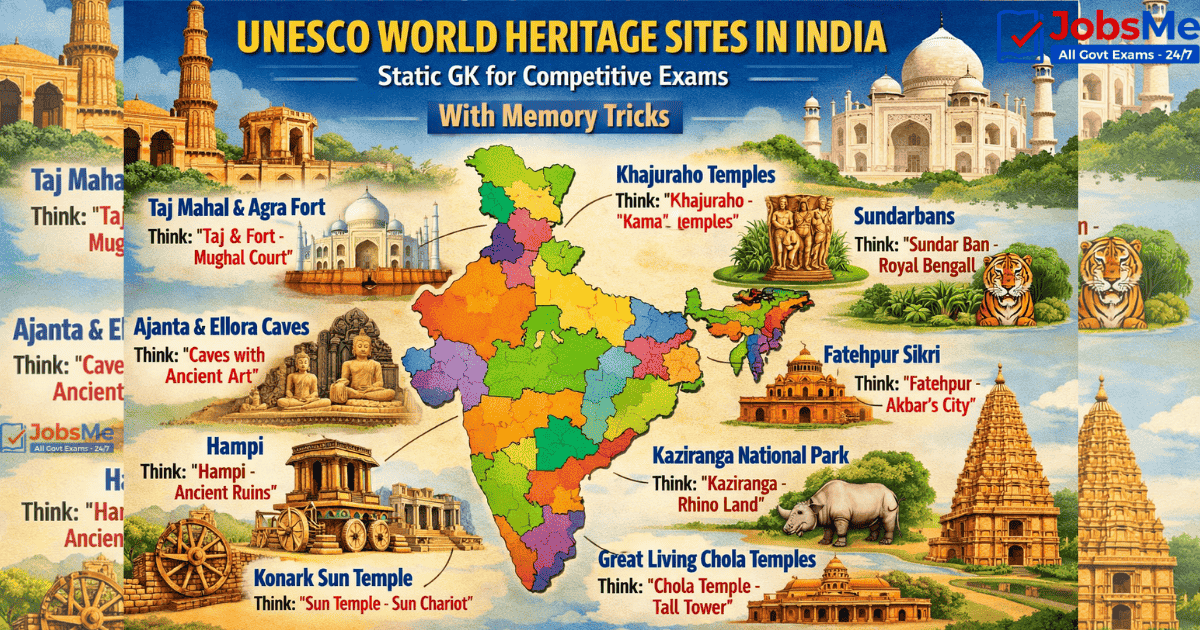
UNESCO World Heritage Sites in India Static GK for Competitive Exams with Memory Tricks
UNESCO World Heritage Sites in India are places recognized for their outstanding cultural, natural, or mixed value to humanity. As of 2026, India has 44 World Heritage Sites (36 Cultural, 7 Natural, 1 Mixed). This topic is extremely important for SSC GK, UPSC Prelims, Banking Awareness, Railways, Defence, and State PCS exams because questions are frequently asked about site names, locations, and categories.
Jump to section
Introduction
UNESCO World Heritage Sites are locations recognized by the United Nations Educational, Scientific and Cultural Organization (UNESCO) for their outstanding cultural, historical, scientific, or natural importance.
The concept emerged after World War II to protect global heritage, leading to the 1972 World Heritage Convention. India signed the convention on 14 November 1977.
For government exams like SSC CGL, UPSC Prelims, IBPS PO, SBI Clerk, Railways NTPC, CDS, CAPF, and State PCS, this topic appears frequently in match-the-following, location-based, and category-based questions.
India ranks among the top countries globally for World Heritage Sites, reflecting its rich civilization, architecture, biodiversity, and cultural diversity.
UNESCO World Heritage Sites in India – Category Wise
India’s 44 UNESCO World Heritage Sites (2026) are divided into three major categories:
| Category | Number |
|---|---|
| Cultural Sites | 36 |
| Natural Sites | 7 |
| Mixed Sites | 1 |
Cultural UNESCO World Heritage Sites in India (36)
Cultural sites represent architecture, monuments, cities, archaeological remains, and cultural landscapes.
Ancient & Medieval Architectural Sites
These reflect India’s temple architecture, cave art, and dynastic history.
| Site | State | Key Feature |
|---|---|---|
| Ajanta Caves (1983) | Maharashtra | Ancient Buddhist cave paintings |
| Ellora Caves (1983) | Maharashtra | Rock-cut caves of Buddhist, Hindu, Jain faiths |
| Sun Temple Konark (1984) | Odisha | Temple dedicated to Sun God Surya |
| Khajuraho Temples (1986) | Madhya Pradesh | Famous for erotic sculptures |
| Elephanta Caves (1987) | Maharashtra | Shiva cave temples |
| Buddhist Monuments at Sanchi (1989) | Madhya Pradesh | Oldest stone structures from 3rd century BCE |
Why asked in exams
Many questions ask dynasty + architecture style combinations.
Example
SSC: Ajanta Caves belong to which religion? → Buddhism
Mughal & Medieval Forts and Cities
These sites showcase Indo-Islamic architecture and Mughal urban planning.
| Site | State | Highlight |
|---|---|---|
| Taj Mahal (1983) | Uttar Pradesh | Mughal mausoleum built by Shah Jahan |
| Agra Fort (1983) | Uttar Pradesh | Mughal palace fort |
| Fatehpur Sikri (1986) | Uttar Pradesh | Capital of Akbar |
| Humayun’s Tomb (1993) | Delhi | First garden tomb in India |
| Qutub Minar Complex (1993) | Delhi | Built by Qutubuddin Aibak |
| Red Fort Complex (2007) | Delhi | Mughal imperial palace |
Why important
These sites represent Mughal architecture evolution frequently asked in UPSC History and SSC GK.
Temple Architecture Heritage
These temples represent different Indian architectural styles: Dravidian, Nagara, Vesara.
| Site | State | Dynasty |
|---|---|---|
| Great Living Chola Temples (1987, 2004) | Tamil Nadu | Chola dynasty |
| Pattadakal Monuments (1987) | Karnataka | Chalukya dynasty |
| Ramappa Temple (2021) | Telangana | Kakatiya dynasty |
| Sacred Ensembles of the Hoysalas (2023) | Karnataka | Hoysala dynasty |
Examples included in Hoysala site
- Belur
- Halebidu
- Somanathapura
Historic Cities & Urban Heritage
| Site | State | Feature |
|---|---|---|
| Historic City of Ahmedabad (2017) | Gujarat | India’s first UNESCO World Heritage city |
| Jaipur City (2019) | Rajasthan | Planned city by Maharaja Sawai Jai Singh II |
| Victorian Gothic & Art Deco Ensemble (2018) | Maharashtra | Colonial architecture |
Archaeological & Ancient Civilization Sites
| Site | State | Importance |
|---|---|---|
| Dholavira (2020) | Gujarat | Major Indus Valley Civilization city |
| Nalanda Mahavihara (2016) | Bihar | Ancient Buddhist university |
| Champaner-Pavagadh (2004) | Gujarat | Pre-Mughal Islamic city |
Colonial and Modern Heritage
| Site | State | Highlight |
|---|---|---|
| Churches and Convents of Goa (1986) | Goa | Portuguese architecture |
| Chhatrapati Shivaji Terminus (2004) | Maharashtra | Victorian Gothic railway station |
| Le Corbusier Architectural Works (2016) | Chandigarh | Modern architecture |
Cultural Sites Added Recently
| Site | Year | State |
|---|---|---|
| Santiniketan | 2023 | West Bengal |
| Hoysala Temples | 2023 | Karnataka |
| Moidams of Ahom Dynasty | 2024 | Assam |
| Maratha Military Landscapes | 2025 | Maharashtra & Tamil Nadu |
Maratha site includes forts like:
- Raigad
- Rajgad
- Shivneri
- Pratapgad
- Sindhudurg
- Gingee Fort (Tamil Nadu)
Natural UNESCO World Heritage Sites in India (7)
These sites represent unique ecosystems, wildlife, and biodiversity hotspots.
| Site | State | Special Feature |
|---|---|---|
| Kaziranga National Park (1985) | Assam | Largest population of one-horned rhinoceros |
| Keoladeo National Park (1985) | Rajasthan | Bird sanctuary |
| Manas Wildlife Sanctuary (1985) | Assam | Tiger reserve |
| Sundarbans National Park (1987) | West Bengal | Largest mangrove forest |
| Nanda Devi & Valley of Flowers (1988/2005) | Uttarakhand | Alpine biodiversity |
| Western Ghats (2012) | 4 states | Biodiversity hotspot |
| Great Himalayan National Park (2014) | Himachal Pradesh | Himalayan ecosystem |
Mixed World Heritage Site in India
India has only one mixed site.
| Site | State | Significance |
|---|---|---|
| Khangchendzonga National Park (2016) | Sikkim | Cultural + Natural importance |
Features
- Sacred mountain in Sikkimese culture
- Rich Eastern Himalayan biodiversity
The Sticky Memory Zone – Mnemonics
Mnemonics help aspirants remember long lists easily.
Mnemonic for Natural Sites
“K2M SNGW”
| Letter | Site |
|---|---|
| K – Kaziranga | |
| K – Keoladeo | |
| M – Manas | |
| S – Sundarbans | |
| N – Nanda Devi | |
| G – Great Himalayan NP | |
| W – Western Ghats |
Mnemonic for Famous Mughal Sites
“TAFQHR”
T – Taj Mahal
A – Agra Fort
F – Fatehpur Sikri
Q – Qutub Minar
H – Humayun Tomb
R – Red Fort
Common Confusions in UNESCO Sites
Students often mix similar sites.
- Don’t confuse Ajanta Caves (Buddhist paintings) with Ellora Caves (3 religions)
- Don’t confuse Kaziranga (Rhinos) with Manas (Tiger reserve)
- Don’t confuse Jaipur City (2019) with Jantar Mantar Jaipur (2010)
- Don’t confuse Hampi (Karnataka) with Khajuraho (Madhya Pradesh)
- Don’t confuse Dholavira (Indus Valley city) with Nalanda (Buddhist university)
Key Features of UNESCO World Heritage Convention
Important exam facts:
- Convention adopted in 1972
- Came into force in 1975
- Sites must show Outstanding Universal Value (OUV)
- Evaluated by:
- ICOMOS – Cultural sites
- IUCN – Natural sites
- At least 1 of 10 criteria must be satisfied.
Important One-Liners for SSC / Banking / UPSC Prelims
- India has 44 UNESCO World Heritage Sites (2026).
- 36 are Cultural, 7 Natural, 1 Mixed.
- Khangchendzonga National Park is India’s only mixed site.
- Kaziranga National Park hosts the world’s largest population of one-horned rhinos.
- Dholavira is an important Indus Valley Civilization city.
- Santiniketan was founded by Rabindranath Tagore.
- Great Living Chola Temples belong to the Chola dynasty.
- Ajanta Caves represent Buddhist cave art.
- Western Ghats is a biodiversity hotspot.
- Maratha Military Landscapes (2025) includes 12 historic forts.
Ultra-short revision bullets
- First cultural site → Ajanta Caves (1983)
- Only mixed site → Khangchendzonga
- Rhino park → Kaziranga
- IVC site → Dholavira
Previous Year Questions (PYQ) Analysis
SSC CGL
Match the following:
Ajanta – Maharashtra
Hampi – Karnataka
Khajuraho – Madhya Pradesh
UPSC Prelims
Statement-based question example:
Which of the following are UNESCO sites?
- Hampi
- Dholavira
- Kaziranga
Correct answer → All three
Quick Summary Table – Most Asked Facts
| Most Asked Point | Answer | Exam Relevance |
|---|---|---|
| Total UNESCO Sites in India | 44 (2026) | SSC / UPSC |
| Cultural Sites | 36 | SSC |
| Natural Sites | 7 | UPSC |
| Mixed Site | Khangchendzonga | SSC |
| First UNESCO sites in India | Ajanta, Ellora, Taj Mahal (1983) | UPSC |
| Rhino habitat | Kaziranga National Park | Banking |
| Indus Valley site | Dholavira | UPSC |
Free quiz • No signup required
Put this topic into practice with Indian Cultural Institutions – Static GK MCQ Quiz. It is the quickest way to reinforce what you just learned.
Frequently Asked Questions
What are UNESCO World Heritage Sites?
How many UNESCO World Heritage Sites are in India in 2026?
Which is the only mixed World Heritage Site in India?
Which Indian site belongs to the Indus Valley Civilization?
Which UNESCO site is famous for one-horned rhinoceroses?
When did India sign the UNESCO World Heritage Convention?
Which UNESCO sites were added recently in India?
Which organization evaluates cultural and natural sites?

About the author