Types of Soil in India – Static GK / General Awareness for Competitive Exams (with Memory Tricks)
Soil is the foundation of agriculture and ecology in India. Questions on Types of Soil in India are repeatedly asked in SSC, UPSC Prelims, Banking, Railways, Defence, and State PCS. This post gives you exam-oriented notes, tables, mnemonics, PYQ trends, and one-liners for fast and accurate revision.
Jump to section
- Introduction
- Soil Formation – Exam-Oriented Explanation
- Major Types of Soil in India (Exam Classification)
- Sticky Memory Zone (Mnemonics)
- Don’t Confuse These in Exams
- Key Exam-Oriented Features
- Soil Profile (Horizon-Based Questions)
- Important One-Liners for SSC / Banking / UPSC Prelims
- Previous Year Questions (PYQ) Analysis
Introduction
Soil is the loose upper layer of the Earth’s crust that supports plant life. It is formed by weathering of rocks, organic activity, climate, relief, and time.
In government exams, soil questions appear as match-the-following, statement-based, and location-based MCQs—especially in SSC GK, UPSC Prelims, IBPS, Railways, and Defence exams.
Soil Formation – Exam-Oriented Explanation
Soil is formed through pedogenesis, influenced by 5 classic factors (very important for UPSC):
👉 C-L-O-R-P
- Climate (rainfall, temperature)
- Living organisms (vegetation, microbes)
- Original parent rock
- Relief (slope, altitude)
- Period (time)
Major Types of Soil in India (Exam Classification)
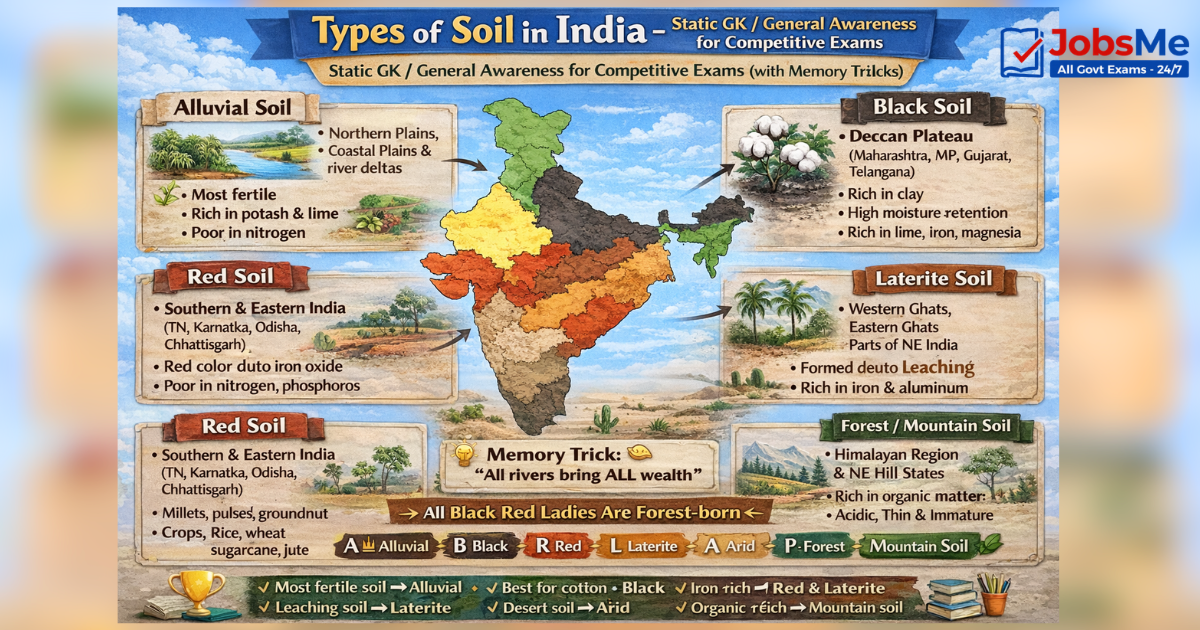
1. Alluvial Soil (Most Important)
Where found
- Northern Plains, river valleys
- Deltas of east coast
- Extends to Gujarat via Rajasthan corridor
Key Features
- Deposited by rivers & streams
- Texture: sandy loam → clay
- Rich in potash, poor in phosphorus
- Two types:
- Khadar – new alluvium (floodplains)
- Bhangar – old alluvium (uplands)
- Contains kankar (calcareous nodules)
Why asked in exams?
Largest coverage + agriculture link (rice, wheat, sugarcane).
2. Black Soil (Regur / Black Cotton Soil)
Where found
- Deccan Plateau: Maharashtra, MP, Gujarat, AP, TN
Key Features
- Clayey, deep, impermeable
- Swells when wet, cracks when dry (self-ploughing)
- Rich in lime, iron, magnesia
- Poor in nitrogen & phosphorus
Why famous?
Best for cotton cultivation → repeated SSC & State PCS questions.
3. Red and Yellow Soil
Where found
- Eastern & southern Deccan Plateau
- Parts of Odisha, Chhattisgarh
- Southern Middle Ganga Plain
Key Features
- Red due to iron oxide
- Yellow when hydrated
- Poor in nitrogen, humus, phosphorus
- Fine-grained = more fertile
Exam Tip:
Red ≠ fertile by default (often asked as a trap).
4. Laterite Soil
Meaning
- From Latin Later = brick
Where found
- High rainfall & temperature areas
- Karnataka, Kerala, TN, MP, Odisha hills
Key Features
- Formed due to intense leaching
- Rich in iron & aluminium
- Poor in nitrogen, lime, humus
- Used as building bricks
Why asked?
Conceptual + geography crossover (UPSC favorite).
5. Arid (Desert) Soil
Where found
- Western Rajasthan
Key Features
- Sandy, saline
- Poor in humus & moisture
- Contains kankar layer below
- Becomes productive with irrigation
Exam Angle:
Desert soil ≠ completely useless.
6. Saline Soil (Usara Soil)
Where found
- Western Gujarat
- East coast deltas
- Sundarbans, Rann of Kutch
Key Features
- Excess sodium, potassium, magnesium
- Infertile, poor drainage
- Treated with gypsum
Why in news/exams?
Linked with irrigation & Green Revolution issues.
7. Peaty Soil
Where found
- North Bihar
- South Uttarakhand
- Coastal WB, Odisha, TN
Key Features
- High organic matter (40–50%)
- Heavy, black, acidic/alkaline
- Formed in high rainfall & humidity
8. Forest Soil
Where found
- Mountain & forest regions, especially Himalayas
Key Features
- Loamy in valleys, coarse on slopes
- Acidic in snow-bound regions
- Fertile in lower valleys
Sticky Memory Zone (Mnemonics)
| Mnemonic | Helps Remember | Facts |
|---|---|---|
| ABR-LASPF | 8 soil types | Alluvial, Black, Red, Laterite, Arid, Saline, Peaty, Forest |
| KBNP | Alluvial nutrients | Khadar–Bhangar, Nitrogen low, Potash high |
| C-SwCr | Black soil nature | Clayey–Swells–Cracks |
| IRON-BRICK | Laterite | Iron rich, Brick use |
| SALT = Usara | Saline soil | Sodium excess |
Don’t Confuse These in Exams
- Don’t confuse Khadar (new alluvium) with Bhangar (old alluvium)
- Don’t confuse Black soil fertility with nitrogen content (it is low)
- Don’t confuse Red soil color with high fertility
- Don’t confuse Laterite soil with Red soil
- Don’t confuse Saline soil with Arid soil
Key Exam-Oriented Features
- Alluvial soil = maximum area
- Black soil = self-ploughing
- Laterite soil = leaching
- Arid soil = kankar layer
- Saline soil = gypsum treatment
Soil Profile (Horizon-Based Questions)
Many exams ask about soil layers, not just soil types.
| Horizon | Name | Exam Relevance |
|---|---|---|
| A | Topsoil | Rich in humus |
| B | Subsoil | Mineral accumulation |
| C | Parent rock | Weathered material |
| R | Bedrock | Solid rock |
📌 Trick:
- Humus → A Horizon
- Leaching → B Horizon
Important One-Liners for SSC / Banking / UPSC Prelims
- Alluvial soil covers ~40% of India.
- Regur soil is ideal for cotton.
- Laterite soil is rich in iron oxide.
- Saline soil is also called Usara soil.
- Peaty soil has maximum humus.
- Forest soil fertility increases down the slope.
- Arid soil improves with irrigation.
- Kankar is calcium carbonate.
Previous Year Questions (PYQ) Analysis
- SSC: Match soil with crops (cotton–black soil)
- UPSC Prelims: Statement-based questions on leaching & nutrients
- Railways: Location-based MCQs
- State PCS: Soil vs rainfall concepts
Quick-Summary Table (Most Asked Facts First)
| Most Asked Point | Answer / Fact | Exam Relevance |
|---|---|---|
| Most widespread soil | Alluvial Soil (~40% area) | SSC, UPSC |
| Cotton soil | Black (Regur) Soil | SSC, State PCS |
| Brick-like soil | Laterite Soil | UPSC |
| Desert region soil | Arid Soil | Railways |
| High humus soil | Peaty Soil | SSC |
| Usara soil | Saline Soil | Banking |
| Mountain soil | Forest Soil | UPSC |
Free quiz • No signup required
Put this topic into practice with Indian Cultural Institutions – Static GK MCQ Quiz. It is the quickest way to reinforce what you just learned.
Frequently Asked Questions
Which soil covers the largest area in India?
Why is black soil called Regur soil?
Which soil is rich in iron oxide?
Which soil needs gypsum treatment?
Which soil has the highest organic matter?

About the author