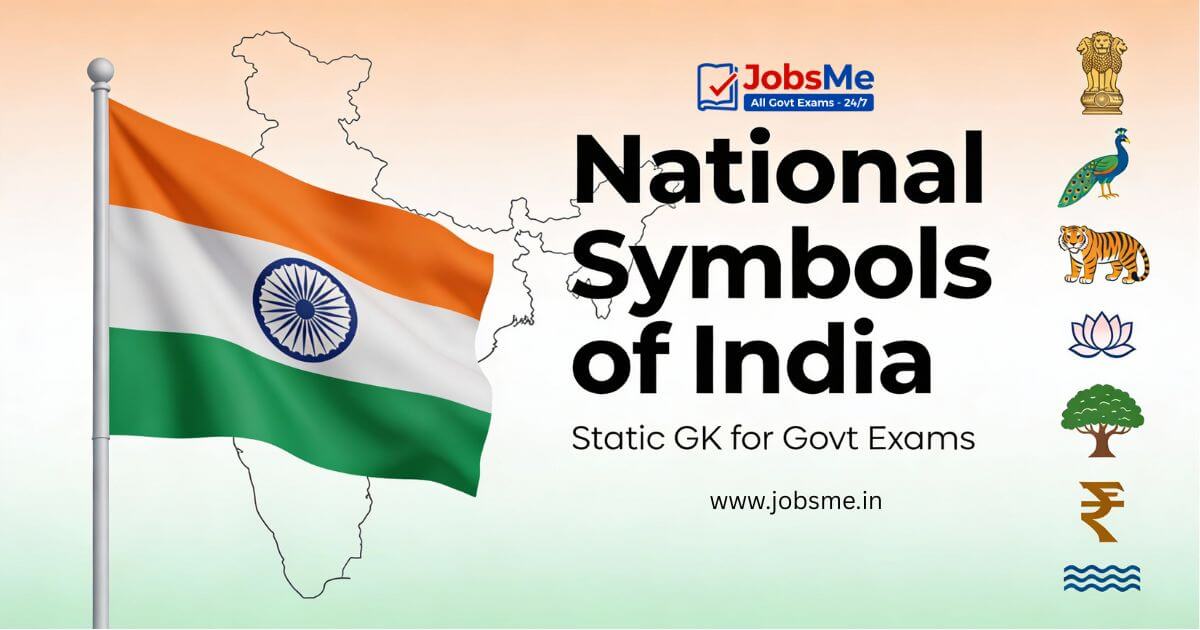
National Symbols of India – Static GK Notes for Government Exams (UPSC, SSC, Banking & More)
National Symbols of India are high‑weightage Static GK for UPSC, SSC, Banking, Insurance, Railways, Defence and other government exams, with frequent direct one‑liner questions in prelims and mains objective sections. This article covers all 17 official national symbols, their facts, adoption years and exam‑oriented one‑liners in a concise, revision‑friendly format. Aspirants can quickly memorize and revise this topic for scoring easy marks in General Awareness and Static GK sections.
Jump to section
- 1. Introduction
- 2. Explanation – List & Details
- 2.1 Complete List of 17 National Symbols of India
- 2.2 National Flag – Tiranga
- 2.3 National Emblem – Lion Capital of Ashoka
- 2.4 National Anthem & National Song
- 2.5 Flora & Fauna Symbols with Scientific Names
- 2.6 Other Important National Symbols
- 2.7 National Currency, Calendar and Pledge
- 3. Important Points (Exam-Oriented)
- 4. Notes
- 5. One-Liner Revision Points
1. Introduction
National Symbols of India are officially recognized emblems that represent the country’s identity, culture, unity and heritage at the national and international level. These include the national flag, emblem, anthem, song, animal, bird, flower, tree, river, currency, calendar and more.
Questions from this topic are commonly asked in:
- UPSC (CSE, CDS, CAPF), State PSC exams
- SSC (CGL, CHSL, CPO, MTS), Railway exams (RRB NTPC, Group D)
- Banking & Insurance (IBPS, SBI, RBI, LIC, NIACL), Defence and other PSU exams.
For competitive exams, most questions are direct one-liners like “National Aquatic Animal of India is?” or “Who designed the Indian Rupee symbol?”.
2. Explanation – List & Details
2.1 Complete List of 17 National Symbols of India
Official National Symbols of India (Exam Table)
| S.No | Title | National Symbol |
|---|---|---|
| 1 | National Flag | Tiranga (Tricolour) |
| 2 | National Emblem | Lion Capital of Ashoka |
| 3 | National Anthem | Jana Gana Mana |
| 4 | National Song | Vande Mataram |
| 5 | National Animal | Royal Bengal Tiger |
| 6 | National Bird | Indian Peacock |
| 7 | National Flower | Lotus |
| 8 | National Tree | Indian Banyan |
| 9 | National Fruit | Mango |
| 10 | National River | Ganga (Ganges) |
| 11 | National Currency | Indian Rupee |
| 12 | National Calendar | Saka Calendar |
| 13 | National Aquatic Animal | Ganges River Dolphin |
| 14 | National Heritage Animal | Indian Elephant |
| 15 | National Reptile | King Cobra |
| 16 | National Vegetable | Pumpkin |
| 17 | Oath of Allegiance | National Pledge |
There is also a commonly asked point that India’s national game is often mentioned as Hockey in many exam-oriented GK sources, although it is not notified as an official national game by the Government.
2.2 National Flag – Tiranga
- The National Flag is a horizontal tricolour of deep saffron (top), white (middle) and India green (bottom), with a navy blue Ashoka Chakra (24 spokes) in the centre of the white band.
- The flag was adopted by the Constituent Assembly of India on 22 July 1947 and is popularly called Tiranga (tricolour).
Key exam facts:
- Designer: Pingali Venkayya.
- Flag Code of India allows the national flag to be flown day and night if properly illuminated.
- Saffron stands for courage and sacrifice; white for peace and truth; green for faith, fertility and prosperity.
2.3 National Emblem – Lion Capital of Ashoka
- The National Emblem is an adaptation of the Lion Capital of Ashoka at Sarnath, showing four Asiatic lions standing back to back (only three visible in two-dimensional representation).
- Below the lions is a circular abacus with figures of horse, bull, lion and elephant separated by Dharmachakras.
Important points:
- Motto: Satyameva Jayate (Truth alone triumphs) taken from the Mundaka Upanishad.
- The State Emblem was adopted on 26 January 1950 as the official seal of the Republic of India.
2.4 National Anthem & National Song
National Anthem vs National Song (Exam Table)
| Item | Details |
|---|---|
| National Anthem | Jana Gana Mana |
| Author | Rabindranath Tagore |
| Adopted | 24 January 1950 (official anthem) |
| Full duration | About 52 seconds |
| Short version | About 20 seconds |
| National Song | Vande Mataram |
| Author | Bankim Chandra Chattopadhyay (Chatterjee) |
| First sung | 1896 session of Indian National Congress |
These are regular questions in UPSC, SSC and Banking exams, including “Who wrote Vande Mataram?” and “What is the duration of the national anthem?”.
2.5 Flora & Fauna Symbols with Scientific Names
Flora & Fauna National Symbols (High-Yield for SSC/RRB)
| Category | Symbol | Scientific Name | Key Fact |
|---|---|---|---|
| National Animal | Royal Bengal Tiger | Panthera tigris tigris | Adopted as national animal in 1973 (Project Tiger year) |
| National Bird | Indian Peacock | Pavo cristatus | Adopted in 1963 |
| National Flower | Lotus | Nelumbo nucifera | Symbol of purity |
| National Tree | Indian Banyan | Ficus benghalensis | Symbol of immortality |
| National Fruit | Mango | Mangifera indica | Known as “King of Fruits” |
Exams often ask scientific names of Tiger, Peacock, Mango and Lotus, especially in SSC and Railway exams.
2.6 Other Important National Symbols
- National River: Ganga (Ganges) – regarded as the holiest river of India and a lifeline for millions.
- National Aquatic Animal: Ganges River Dolphin – declared in 2009 to promote conservation of freshwater biodiversity.
- National Heritage Animal: Indian Elephant – notified in 2010 to highlight the need for its protection.
- National Reptile: King Cobra – symbolizes the rich reptilian diversity of India.
- National Vegetable: Pumpkin – recognized to represent a commonly used traditional vegetable.
2.7 National Currency, Calendar and Pledge
- National Currency: Indian Rupee (INR); the ₹ symbol was designed by Udaya Kumar and adopted in 2010.
- National Calendar: Saka Calendar; officially adopted in 1957 and used alongside the Gregorian calendar for official purposes, starting with the month of Chaitra.
- Oath of Allegiance: National Pledge, commonly recited in schools and official functions as a solemn promise to the nation.
3. Important Points (Exam-Oriented)
- There are 17 recognized national symbols of India, frequently asked as direct one-liners in exams.
- Flag: Tiranga – adopted on 22 July 1947; Ashoka Chakra has 24 spokes.
- Emblem: Lion Capital of Ashoka – motto “Satyameva Jayate”.
- Anthem: Jana Gana Mana (Rabindranath Tagore), about 52 seconds.
- Song: Vande Mataram (Bankim Chandra Chattopadhyay), first sung in 1896.
- Animal: Royal Bengal Tiger; Bird: Indian Peacock; Tree: Indian Banyan; Flower: Lotus; Fruit: Mango.
- River: Ganga; Aquatic Animal: Ganges River Dolphin (2009); Heritage Animal: Indian Elephant (2010).
- Reptile: King Cobra; Vegetable: Pumpkin.
- Currency symbol ₹ designed by Udaya Kumar, adopted in 2010.
- Saka Calendar adopted in 1957; used for official calendars along with Gregorian system.
4. Notes
- Many school and exam books refer to Hockey as the “national game” of India, but there is no officially notified national game, so use this fact carefully in higher-level exams.
- Static GK on national symbols usually appears in:
- General Awareness / General Knowledge section
- History / Polity / Culture MCQs
- Picture-based or match-the-following questions.
- For Banking and Insurance exams, questions are mostly factual and memory-based, so tables and one-liners are very useful for last-day revision.
- UPSC and State PSC prelims can frame questions around symbolism (e.g., meaning of colours in the flag or animals shown on the emblem).
5. One-Liner Revision Points
- National Flag of India is Tiranga, adopted on 22 July 1947.
- National Emblem is the Lion Capital of Ashoka with motto “Satyameva Jayate”.
- National Anthem is Jana Gana Mana written by Rabindranath Tagore (52 seconds).
- National Song is Vande Mataram by Bankim Chandra Chattopadhyay, first sung in 1896.
- National Animal is the Royal Bengal Tiger; National Bird is the Indian Peacock.
- National Flower is Lotus; National Tree is Indian Banyan.
- National Fruit is Mango, popularly called the “King of Fruits”.
- National River is Ganga (Ganges).
- National Aquatic Animal is Ganges River Dolphin (declared in 2009).
- National Heritage Animal is the Indian Elephant (notified in 2010).
- National Reptile is King Cobra; National Vegetable is Pumpkin.
- National Currency is Indian Rupee; ₹ symbol designed by Udaya Kumar (adopted 2010).
- National Calendar is the Saka Calendar, adopted in 1957, starting with month Chaitra.
- Oath of Allegiance is the National Pledge recited in schools and ceremonies.
- Flag can be hoisted day and night if properly illuminated, as per updated Flag Code.
Free quiz • No signup required
Put this topic into practice with Indian Cultural Institutions – Static GK MCQ Quiz. It is the quickest way to reinforce what you just learned.
Frequently Asked Questions
How many official national symbols does India have?
What is the national animal and national bird of India?
Who designed the Indian national flag?
What is the duration of the Indian national anthem?
Who wrote Vande Mataram and when was it first sung?
Which river is the National River of India?
What is the National Aquatic Animal and when was it declared?
Who designed the Indian Rupee symbol ₹ and in which year was it adopted?
What is the National Calendar of India?
Is Hockey officially the national game of India?

About the author