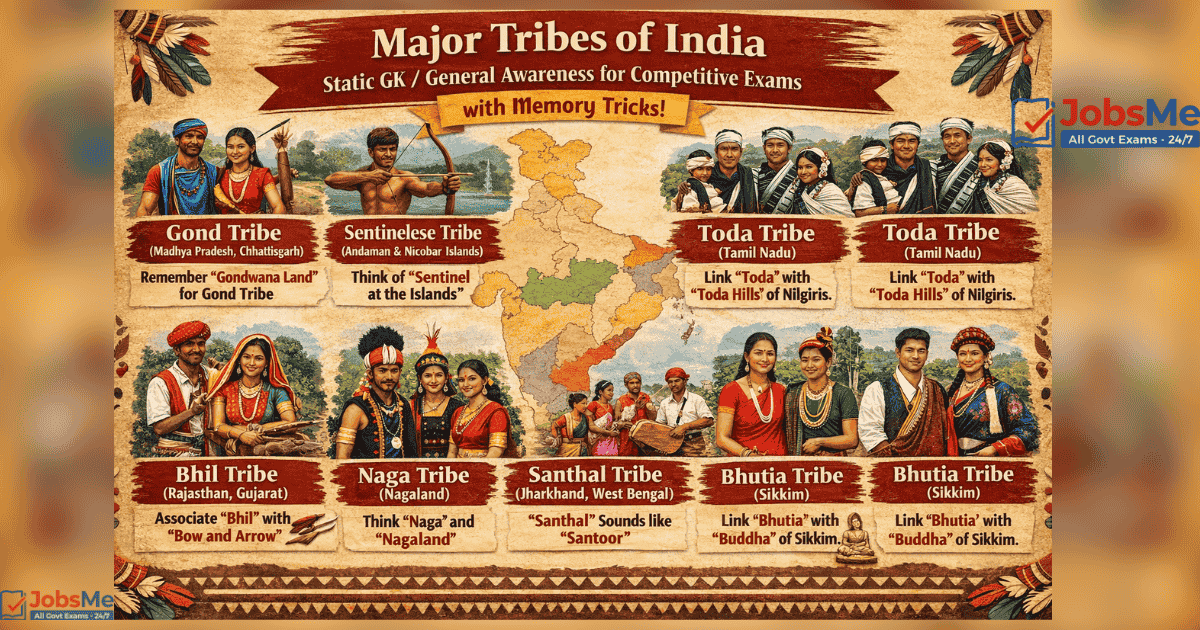
Major Tribes of India – Static GK / General Awareness for Competitive Exams (with Memory Tricks)
India is home to one of the largest tribal populations in the world, making Major Tribes of India – Static GK a highly scoring and repeatedly asked topic in SSC, UPSC Prelims, Banking, Railways, Defence, and State PCS exams. This post gives you exam-oriented notes, tables, mnemonics, PYQ patterns, and quick one-liners for fast revision and perfect accuracy.
Jump to section
- Introduction
- Definition of Tribe in India (Exam Standard)
- Nomenclature Used for Tribes in India
- Major Tribes of India – Region-wise Classification (Very Important)
- Particularly Vulnerable Tribal Groups (PVTGs)
- Forest Dwellers & FRA, 2006
- Denotified Tribes (DNTs)
- Nomadic & Semi-Nomadic Tribes
- Contributions of Tribal Communities (High-Value UPSC Area)
- The Sticky Memory Zone (Mnemonics)
- Don’t Confuse These in Exams
- Important One-Liners for SSC / Banking / UPSC Prelims
- Previous Year Questions (PYQ) Analysis
Introduction
Major Tribes of India form a core part of Indian Static GK / General Awareness. Questions are often asked in match the following, statement-based, or direct fact formats in SSC CGL, CHSL, UPSC Prelims, IBPS, RRB, CDS, AFCAT, and State PCS.
India, after Africa, has the second-largest tribal population globally. Understanding their distribution, classification, constitutional status, and contributions is crucial for scoring full marks in Static GK sections.
Definition of Tribe in India (Exam Standard)
According to the Imperial Gazetteer of India, a tribe is:
“A collection of families bearing a common name, speaking a common dialect, and occupying a common territory.”
Nomenclature Used for Tribes in India
Adivasis (Indigenous People)
- Means original inhabitants of India
- Deep knowledge of local ecology and resources
- Mostly forest and hill dwellers
Why asked? Meaning-based one-liners in SSC & State exams.
Scheduled Tribes (STs)
- Defined under Article 366(25) of the Constitution of India
- Identified as per Article 342
- Characteristics:
- Primitive traits
- Geographical isolation
- Distinct culture
- Economic backwardness
Major Tribes of India – Region-wise Classification (Very Important)
North-East India (Highest Diversity)
| Tribe | State |
|---|---|
| Abor | Arunachal Pradesh, Assam |
| Adi, Apatani | Arunachal Pradesh |
| Angami, Sema, Ao | Nagaland |
| Garo, Khasi, Jaintia | Meghalaya |
| Lushai | Mizoram |
| Lepcha, Bhutia | Sikkim |
| Chakma | Tripura |
Why famous? NE India questions dominate UPSC & SSC match-the-following.
Central India (Largest Tribal Belt)
| Tribe | State |
|---|---|
| Gond | MP, Chhattisgarh, Odisha |
| Baiga | MP, Chhattisgarh |
| Bhil | Rajasthan, MP, Gujarat |
| Kol | MP |
| Muria | Bastar region |
| Kamar | MP |
Why asked? Known as “Tribal Heartland of India”.
South India
| Tribe | State |
|---|---|
| Toda, Kota, Badaga | Nilgiri (TN) |
| Irula | Tamil Nadu |
| Chenchu | Andhra Pradesh, Odisha |
| Kani | Kerala |
Andaman & Nicobar Islands (Highly Sensitive)
| Tribe | Location |
|---|---|
| Jarawa | Little Andaman |
| Onge | Andaman |
| Sentinelese | Sentinel Island |
| Shompen | Nicobar |
Particularly Vulnerable Tribal Groups (PVTGs)
- Earlier called Primitive Tribal Groups (PTGs)
- Renamed on recommendation of Dhebar Commission
- Total: 75 PVTGs across 17 States + 1 UT
Identification Criteria (Very Important)
- Pre-agricultural technology
- Low literacy
- Economic backwardness
- Declining population
Examples of PVTGs
| State/UT | PVTGs |
|---|---|
| Odisha | Bonda, Dongria Khond |
| Gujarat | Kathodi |
| WB | Toto |
| A&N Islands | Jarawa, Onge, Sentinelese |
| Karnataka | Jenu Kuruba |
Forest Dwellers & FRA, 2006
- Forest dwellers depend on forests for livelihood & culture
- Rights recognized under Forest Rights Act, 2006
Why asked in UPSC? Law + society + environment integration.
Denotified Tribes (DNTs)
- Earlier labeled “Criminal Tribes” under Criminal Tribes Act, 1871
- Act repealed after independence
- Still face social stigma
Nomadic & Semi-Nomadic Tribes
- Move seasonally for livelihood
- Examples: Banjara, Rabari, Raika, Gaddi
Contributions of Tribal Communities (High-Value UPSC Area)
Environmental Conservation
- Sustainable use of forests
- Example: Chenchus of Nallamala Hills
Economic Contribution
- Agriculture, handicrafts, metal work
- Gond paintings & metal crafts
Indigenous Knowledge
- Medicinal plants, beekeeping
- Example: Siddi tribe
Political Contribution
- Droupadi Murmu – First tribal woman President of India
The Sticky Memory Zone (Mnemonics)
- “BAG-GK” for NE Tribes
- Bhutia – Sikkim
- Apatani – Arunachal
- Garo – Meghalaya
- Gond – MP
- Khasi – Meghalaya
- “JOB-S” for Andaman Tribes
- Jarawa
- Onge
- Bhutias (No – trick!)
- Sentinelese
Don’t Confuse These in Exams
- Don’t confuse PVTGs (most vulnerable) with STs (constitutional category)
- Don’t confuse Adivasi (socio-cultural term) with Scheduled Tribe (legal term)
- Don’t confuse Bhil (Rajasthan belt) with Bonda (Odisha)
Important One-Liners for SSC / Banking / UPSC Prelims
- India has the second-largest tribal population globally.
- Article 342 deals with Scheduled Tribes.
- 75 PVTGs exist in India.
- Sentinelese are among the most isolated tribes in the world.
- Gond is the largest tribal group in India.
- FRA, 2006 protects forest dwellers’ rights.
Previous Year Questions (PYQ) Analysis
- SSC CGL: Match tribe with state
- UPSC Prelims: Statement-based on PVTGs
- Railways: Direct one-liners on Andaman tribes
- State PCS: Article-based questions (342, 366)
Quick-Summary Table (For Rapid Revision)
| Most Asked Point | Answer / Fact | Exam Relevance |
|---|---|---|
| % of tribal population | ~8.9% (Census 2011) | SSC, UPSC |
| Constitutional Article | Article 342 | Polity + Static GK |
| Term Adivasi means | Original inhabitants | SSC, State PCS |
| PVTGs count | 75 groups | UPSC, State PCS |
| FRA year | 2006 | UPSC, SSC |
| Famous NE tribes | Naga, Khasi, Garo | SSC, Railways |
| Andaman tribes | Jarawa, Onge, Sentinelese | UPSC |
| Nomadic tribe example | Banjara | SSC |
| Tribal President | Droupadi Murmu | Current + Static |
Free quiz • No signup required
Put this topic into practice with Indian Cultural Institutions – Static GK MCQ Quiz. It is the quickest way to reinforce what you just learned.
Frequently Asked Questions
Who are called Adivasis in India?
Which Article defines Scheduled Tribes?
How many PVTGs are there in India?
Which tribe is found on Sentinel Island?
Why are tribes important for UPSC?

About the author