
History of Banking in India – Complete Banking Awareness Notes for IBPS, SBI, RBI & SSC Exams
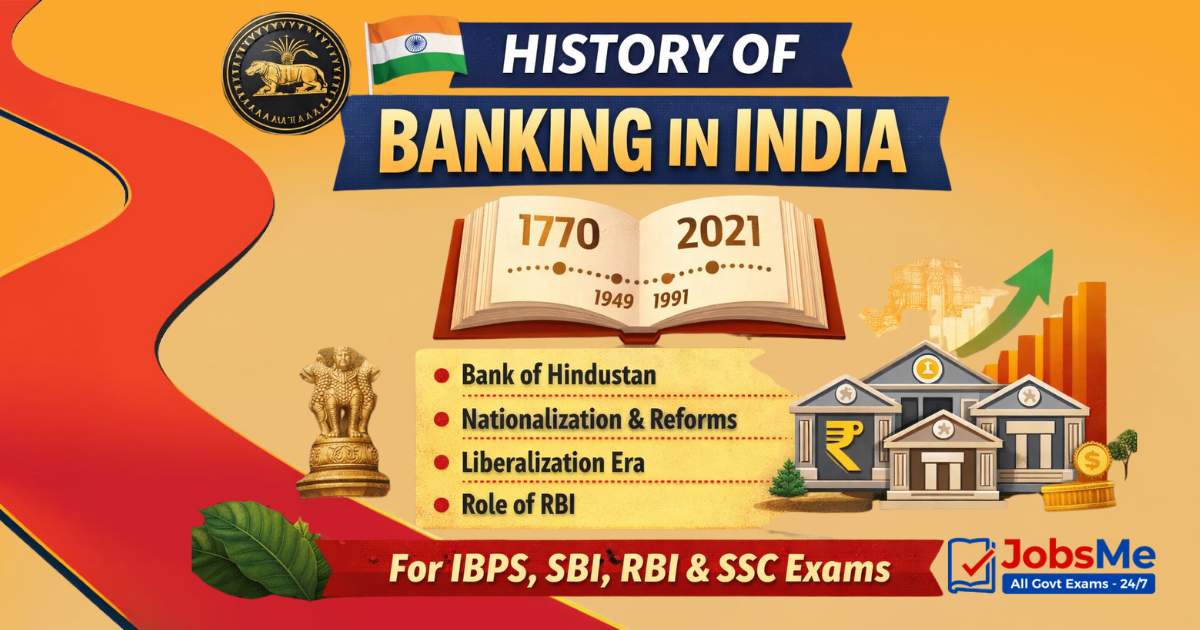
History of Banking in India covers the evolution from ancient financial practices to modern banking reforms, including nationalization and liberalization—an essential topic for Banking Awareness and competitive exams.
Jump to section
- Introduction
- Key Highlights / Quick Revision
- Detailed Explanation of History of Banking in India
- Key Concepts
- Types / Classification
- Important Facts / First in Banking
- Reforms / Committees
- Real-Life Application
- Example / Case Study
- Important Tables for Exam
- Important Terms to Remember
- Important Points for Exams
- Exam Tips: How to Remember
Introduction
The History of Banking in India is a fundamental topic in Banking Awareness that helps candidates understand how the financial system evolved over time. It explains the transition from informal money lending systems to a regulated banking structure under the RBI. This topic is highly relevant for exams because many questions are asked from timelines, reforms, and key developments. It also helps in understanding current banking trends and policies.
Key Points
- Important for IBPS, SBI, RBI, SSC exams
- Covers evolution of Indian financial system
- Helps understand role of RBI
- Frequently asked in General Awareness
- Connects history with modern banking
- Important for static GK revision
Key Highlights / Quick Revision
This section provides a quick overview of the most important facts that are repeatedly asked in exams. It helps in last-minute revision and quick recall of key events and milestones in banking history. Candidates should revise these highlights regularly for better retention.
Key Points
- Banking started in Vedic period
- First bank: Bank of Hindustan (1770)
- RBI established in 1935
- RBI nationalized in 1949
- SBI formed in 1955
- Nationalization in 1969 & 1980
Detailed Explanation of History of Banking in India
Definition / Overview
Banking is defined under the Banking Regulation Act, 1949 as accepting deposits for lending or investment purposes. Banks act as intermediaries between depositors and borrowers, ensuring smooth flow of money in the economy. They also provide services like payments, credit, and investments, making them essential for economic growth.
Key Points
- Accepts deposits from public
- Provides loans and advances
- Acts as financial intermediary
- Supports economic development
- Facilitates transactions and payments
- Regulated by RBI
History / Background
Ancient & Medieval Banking
Banking in ancient India was based on informal systems where traders and moneylenders played a key role. Instruments like Hundi were widely used for transactions and credit. Though unorganized, this system laid the foundation for modern banking practices.
Key Points
- Origin in Vedic period
- Use of Hundi system
- Role of Sahukars and merchants
- No formal banking structure
- Temple-based financial activities
- Early form of credit system
British Era Banking
The British introduced organized banking in India with the establishment of formal institutions. Presidency banks played a major role in shaping the banking structure. This period also saw the creation of RBI, which brought regulation and stability.
Key Points
- First bank: Bank of Hindustan (1770)
- Presidency Banks established
- Imperial Bank formed in 1921
- RBI established in 1935
- Introduction of modern banking system
- Beginning of bank regulation
Key Concepts
Pre-Independence Banking (Before 1947)
This phase was characterized by the growth of banks but lacked proper regulation, leading to frequent failures. Despite this, many important banks were established during this time.
Key Points
- Over 600 banks existed
- Lack of regulatory control
- Frequent bank failures
- Dominance of Presidency Banks
- Establishment of major banks
- Weak public confidence
Post-Independence Banking (1947-1991)
After independence, the government focused on strengthening the banking system and ensuring financial inclusion. Nationalization played a key role in expanding banking services across the country.
Key Points
- RBI nationalized in 1949
- SBI formed in 1955
- Bank nationalization in 1969 & 1980
- Focus on rural banking
- Introduction of priority sector lending
- Expansion of banking network
Post-Liberalization Era (1991-Present)
The 1991 reforms transformed the banking sector by introducing competition and technology. Private banks entered the market, and digital banking became popular.
Key Points
- Liberalization in 1991
- Entry of private sector banks
- Introduction of ATM & internet banking
- Growth of digital payments (UPI)
- Increased competition
- Global integration of banking
Types / Classification
Banks in India are classified based on their functions and regulatory status. This classification helps in understanding how different banks serve various sectors of the economy.
Key Points
- Scheduled Banks - Listed under RBI Act
- Non-Scheduled Banks - Not listed
- Public Sector Banks - Govt owned
- Private Sector Banks - Private ownership
- RRBs - Rural development
- Cooperative Banks - Community-based banking
Important Facts / First in Banking
These facts highlight major milestones in Indian banking and are frequently asked in exams. Candidates should memorize these for quick scoring.
Key Points
- First bank: Bank of Hindustan
- First ATM: HSBC (1987)
- First internet banking: ICICI
- First ISO bank: Canara Bank
- First RRB: Prathama Bank
- First digital bank: Digibank
Reforms / Committees
Banking reforms were introduced to improve efficiency, transparency, and stability. Committees like Narasimham played a crucial role in modernizing the banking sector.
Key Points
- Narasimham Committee (1991 & 1998)
- Focus on reducing NPAs
- Introduction of capital adequacy norms
- Entry of private banks
- Implementation of Basel norms
- Strengthening banking regulation
Real-Life Application
Banking plays a crucial role in everyday life by supporting individuals, businesses, and the government. It helps in savings, investments, and financial transactions.
Key Points
- Loans for business and agriculture
- Savings and deposits
- Digital payments (UPI, mobile banking)
- Government scheme implementation
- Financial inclusion
- Economic development support
Example / Case Study
Banking reforms have made it easier for people to access financial services. For example, farmers and small businesses now get loans easily through banks.
Key Points
- Farmer loans via RRBs
- MSME funding through banks
- Digital payment adoption
- Easy credit availability
- Startup financing support
- Increased financial access
Important Tables for Exam
This section helps in quick comparison and revision of important concepts. Tables are useful for remembering classifications and timelines.
Key Points
- Focus on phases of banking
- Remember nationalization years
- Revise classification tables
- Practice comparison questions
- Important for quick revision
- Helps in last-minute preparation
Important Terms to Remember
Understanding key banking terms is essential for solving exam questions and improving conceptual clarity.
Key Points
- RBI - Central bank
- CRR & SLR - Reserve ratios
- Repo Rate - Lending rate
- NPA - Bad loans
- UPI - Digital payment
- CBS - Core banking system
Important Points for Exams
This section includes direct facts that are frequently asked in exams. Candidates should revise these regularly.
Key Points
- RBI established: 1935
- RBI nationalized: 1949
- SBI formed: 1955
- RRB established: 1975
- NABARD: 1982
- Liberalization: 1991
Exam Tips: How to Remember
Proper revision strategy is important to retain information for exams. Using tricks and mnemonics helps in quick recall.
Key Points
- Use timeline method
- Divide into 3 phases
- Revise “firsts” regularly
- Practice MCQs daily
- Focus on years & facts
- Use short notes for revision
Practice here:
https://jobsme.in/quizzes
Also refer:
https://jobsme.in/category/banking-awareness
https://jobsme.in/category/static-gk
https://jobsme.in/jobs
Free quiz • No signup required
Put this topic into practice with Daily Current Affairs MCQ Quiz – 30 March 2026 (Exam Ready). It is the quickest way to reinforce what you just learned.
Frequently Asked Questions
What are the phases of banking in India?
What is bank nationalization?
Bank nationalization is the process of transferring private banks into government ownership.
What is the role of RBI?
What is financial inclusion?

About the author