Five-Year Plans in India Static GK / General Awareness for Competitive Exams with Memory Tricks
The Five-Year Plans were India’s centralized economic planning strategy from 1951 to 2017. They are extremely important for UPSC, SSC, Banking, Railways, and Defence exams because questions are frequently asked on timelines, objectives, and outcomes.
Jump to section
- INTRODUCTION
- WHAT IS A FIVE-YEAR PLAN?
- ORIGIN OF FIVE-YEAR PLANS
- CONCEPT OF FIVE-YEAR PLANS
- EVOLUTION OF PLANNING IN INDIA
- COMPLETE FIVE-YEAR PLANS CLASSIFICATION
- EXAM-FRIENDLY COMPARISON TABLE
- THE “STICKY” MEMORY ZONE (MNEMONICS)
- DON’T CONFUSE THESE
- KEY FEATURES / IMPORTANT POINTS
- ADDITIONAL NOTES (EXAM TRICKS)
- IMPORTANT ONE-LINERS FOR SSC / BANKING / UPSC PRELIMS
- PREVIOUS YEAR QUESTIONS (PYQ) ANALYSIS
- QUICK-SUMMARY TABLE (Most Important Facts at a Glance)
INTRODUCTION
India adopted planned economic development after independence in 1950, inspired by socialist models like the Soviet Union. These plans were implemented by the Planning Commission and later replaced by the NITI Aayog.
👉 This topic is highly important for:
- UPSC Prelims & Mains
- SSC CGL / CHSL
- IBPS / SBI Banking Exams
- Railways & Defence Exams
Questions are often asked on:
- Years of plans
- Objectives
- Growth rates
- Important events
WHAT IS A FIVE-YEAR PLAN?
A Five-Year Plan is a centralized economic planning method where targets (quotas) are set for development over five years.
Key Features:
- Started on April 1
- Covered 5 financial years
- Focused on economic growth, poverty reduction, self-reliance
ORIGIN OF FIVE-YEAR PLANS
Global Origin
- First implemented by Joseph Stalin in Soviet Union (1928)
Indian Background
Bombay Plan (1944)
- Proposed by leading industrialists
- Suggested planned economic development
Post-Independence Need
- Poverty, unemployment, weak infrastructure
- Planning seen as essential for nation-building
👉 Why asked in exams?
Because it connects history + economy + policy evolution
CONCEPT OF FIVE-YEAR PLANS
Basic Idea
- Government prepares 5-year economic blueprint
- Divided into:
- Plan Budget → Development projects
- Non-Plan Budget → Routine expenses
Key Features:
- Focus on priority sectors
- Centralized planning by Planning Commission
- Duration: 1951-2017
👉 Why asked in exams?
Because it connects economy + history + polity, making it a favorite for static GK + current affairs mix questions.
EVOLUTION OF PLANNING IN INDIA
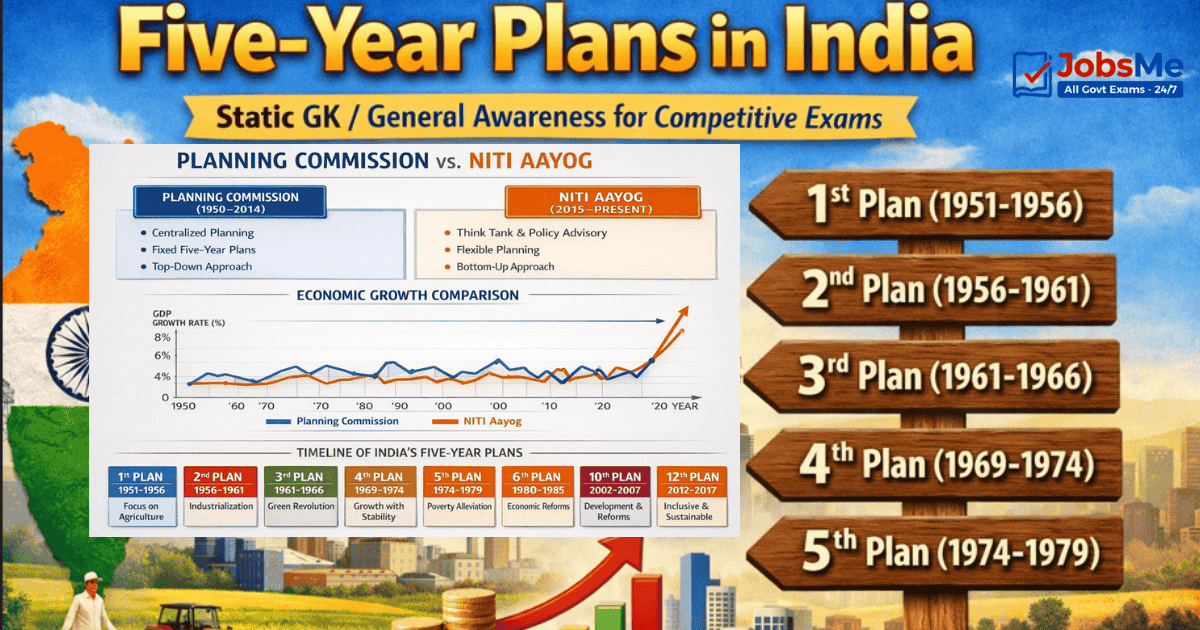
Planning Commission Era (1950-2014)
- Established in 1950
- Headed by Prime Minister
- Focus: centralized planning
NITI Aayog Era (2015-Present)
- Replaced Planning Commission in 2015
- Introduced:
- 3-Year Action Agenda
- 7-Year Strategy
- 15-Year Vision
👉 Why important?
Direct UPSC & Banking Awareness question area.
COMPLETE FIVE-YEAR PLANS CLASSIFICATION
EARLY PLANS (1951-1966)
| Plan | Years | Focus | Result |
|---|---|---|---|
| 1st | 1951-56 | Agriculture | Success (3.6%) |
| 2nd | 1956-61 | Industry | Moderate |
| 3rd | 1961-66 | Self-reliance | Failed |
Key Facts:
- 1st Plan → Based on Harrod-Domar Model
- 2nd Plan → Industrialization
- 3rd Plan → Affected by wars (1962, 1965)
👉 Why famous?
Wars + economic failure = repeated exam question
PLAN HOLIDAY (1966-1969)
- No Five-Year Plan
- Only Annual Plans
- Reason: Economic crisis & wars
👉 Frequently asked in SSC
MIDDLE PHASE (1969-1990)
| Plan | Key Highlight |
|---|---|
| 4th | Green Revolution |
| 5th | Garibi Hatao |
| Rolling Plan | Flexibility introduced |
| 6th | Economic liberalization |
| 7th | Private sector boost |
Key Events:
- Bank nationalization
- Green Revolution
- Emergency period impact
LIBERALIZATION ERA (1991-2017)
| Plan | Focus |
|---|---|
| 8th | Human development |
| 9th | Social justice |
| 10th | Income doubling |
| 11th | Inclusive growth |
| 12th | Sustainable growth |
👉 Most important:
- 8th Plan → Highest growth (6.8%)
- 12th Plan → Last plan
EXAM-FRIENDLY COMPARISON TABLE
| Feature | Planning Commission | NITI Aayog |
|---|---|---|
| Established | 1950 | 2015 |
| Nature | Centralized | Cooperative federalism |
| Approach | Top-down | Bottom-up |
| Plans | Five-Year Plans | Strategy documents |
THE “STICKY” MEMORY ZONE (MNEMONICS)
1. For First 3 Plans:
👉 "AGRO-INDIA-SELF"
- 1st → Agriculture
- 2nd → Industry
- 3rd → Self-reliance
2. Plan Holiday:
👉 "WAR = NO PLAN"
- Wars → No Five-Year Plan
3. Last 3 Plans:
👉 "SOCIAL-INCOME-INCLUSIVE"
- 9th → Social justice
- 10th → Income
- 11th → Inclusive growth
DON’T CONFUSE THESE
- Don’t confuse Planning Commission (1950) with NITI Aayog (2015)
- Don’t confuse Rolling Plan with Five-Year Plan
- Don’t confuse Plan Holiday (1966-69) with Annual Plans (1990-92)
- Don’t confuse 8th Plan (highest growth) with 10th Plan (income doubling goal)
KEY FEATURES / IMPORTANT POINTS
- First Plan → Agriculture focused
- Second Plan → Industrialization
- Green Revolution → 4th Plan
- Garibi Hatao → 5th Plan
- Economic reforms → 8th Plan
- Last Plan → 12th (2012-2017)
👉 MOST IMPORTANT FOR EXAMS:
✔ Plan years + objectives + outcomes
ADDITIONAL NOTES (EXAM TRICKS)
- IITs established during 1st Plan
- Rupee devaluation → Plan Holiday period
- Private sector focus started in 7th Plan
- Economic reforms (1991) → Before 8th Plan
IMPORTANT ONE-LINERS FOR SSC / BANKING / UPSC PRELIMS
- First Five-Year Plan started in 1951
- Planning Commission established in 1950
- Jawaharlal Nehru was first chairman
- 2nd Plan based on Mahalanobis Model
- Plan Holiday lasted 1966-1969
- Rolling Plan introduced in 1978
- Highest growth → 8th Plan
- Last Plan → 12th Plan
- NITI Aayog formed in 2015
- 12th Plan theme → Sustainable growth
Ultra-Quick Revision Points
- 1951 → First Plan
- 1966 → Plan Holiday
- 1991 → Economic reforms
- 2017 → End of Plans
PREVIOUS YEAR QUESTIONS (PYQ) ANALYSIS
How questions are asked:
- Match the Following
- Plan vs Objective
- Example: 2nd Plan → Industrialization
- Statement-Based Questions
- “Green Revolution started in 4th Plan” → TRUE
- Direct Fact Questions
- “Which plan had highest growth?” → 8th Plan
- Chronology Questions
- Arrange plans in order
👉 UPSC trend: Concept + elimination-based questions
QUICK-SUMMARY TABLE (Most Important Facts at a Glance)
| Most Asked Point | Answer / Fact | Exam Relevance |
|---|---|---|
| First Five-Year Plan | 1951-1956 | SSC, UPSC |
| Last Five-Year Plan | 12th Plan (2012-2017) | Banking, SSC |
| Planning Body | Planning Commission (1950-2014) | UPSC |
| Replacement Body | NITI Aayog (2015) | All exams |
| First Plan Focus | Agriculture | SSC |
| Second Plan Model | Mahalanobis Model | UPSC |
| Plan Holiday Period | 1966-1969 | Railways |
| Highest Growth Plan | 8th Plan (6.8%) | Banking |
| Rolling Plan Period | 1978-1980 (approx.) | SSC |
| Current Strategy | 3-year, 7-year, 15-year vision | UPSC |
Free quiz • No signup required
Put this topic into practice with Indian Cultural Institutions – Static GK MCQ Quiz. It is the quickest way to reinforce what you just learned.
Frequently Asked Questions
What is a Five-Year Plan in India?
When did the First Five-Year Plan start in India?
Which plan had the highest growth rate?
What replaced the Planning Commission in India?
What is Plan Holiday in India?
Which plan focused on Garibi Hatao?
Which plan introduced economic liberalization?
When did Five-Year Plans end in India?

About the author