Dances of India – Complete Static GK Notes for Government Exams
Indian dance forms reflect the country’s rich cultural diversity and are a highly scoring Static GK topic in SSC, Banking, UPSC, Railways, Defence, and State exams. Questions are frequently asked on classical dances, folk dances, their states of origin, features, and famous proponents, making this topic a must-learn for all aspirants.
Jump to section
1. Introduction
Dance is an integral part of India’s cultural heritage and a vital component of Static General Knowledge. Indian dances are broadly classified into Classical and Folk dances.
Why is this topic important for government exams?
- Frequently asked in SSC, Banking, Railways, UPSC Prelims, State PSCs
- Appears in Match the Following, One-liners, and MCQs
- High accuracy and low time-consuming topic
Exams where it is commonly asked
- SSC CGL, CHSL, MTS
- IBPS PO/Clerk, SBI PO/Clerk
- UPSC Prelims
- Railways (RRB NTPC, Group D)
- CDS, AFCAT, CAPF
- State-level exams
2. Explanation
A. Classical Dances of India
India officially recognizes 8 Classical Dance Forms (Sangeet Natak Akademi).
⚠️ Chhau is sometimes considered classical by the Ministry of Culture, but for objective exams, stick to 8 unless specified.
Table: Classical Dances of India
| Dance Form | State of Origin | Key Exam Features |
|---|---|---|
| Bharatanatyam | Tamil Nadu | Oldest dance form; Bhava, Raga, Tala, Natya |
| Kathak | Uttar Pradesh | Spins (Chakkars), footwork, storytelling |
| Kathakali | Kerala | Dance-drama, elaborate makeup, mythological themes |
| Kuchipudi | Andhra Pradesh | Dance + drama; Tarangam on brass plate |
| Odissi | Odisha | Tribhanga posture; temple sculptures |
| Manipuri | Manipur | Graceful movements; Raas Lila of Krishna |
| Mohiniyattam | Kerala | Feminine Lasya style; white-gold costume |
| Sattriya | Assam | Introduced by Sankardeva; Vaishnavism |
Key Classical Dance Highlights
- Based on Natya Shastra
- Use Mudras (hand gestures)
- Originated in temples
- Highly structured and codified
B. Famous Proponents of Classical Dances
| Dance | Famous Personalities |
|---|---|
| Bharatanatyam | Rukmini Devi Arundale, Yamini Krishnamurthy |
| Kathak | Pt. Birju Maharaj, Sitara Devi |
| Kathakali | Kalamandalam Gopi |
| Kuchipudi | Raja & Radha Reddy, Sobha Naidu |
| Odissi | Kelucharan Mohapatra, Sonal Mansingh |
| Manipuri | Jhaveri Sisters |
| Mohiniyattam | Sunanda Nair |
| Sattriya | Jatin Goswami |
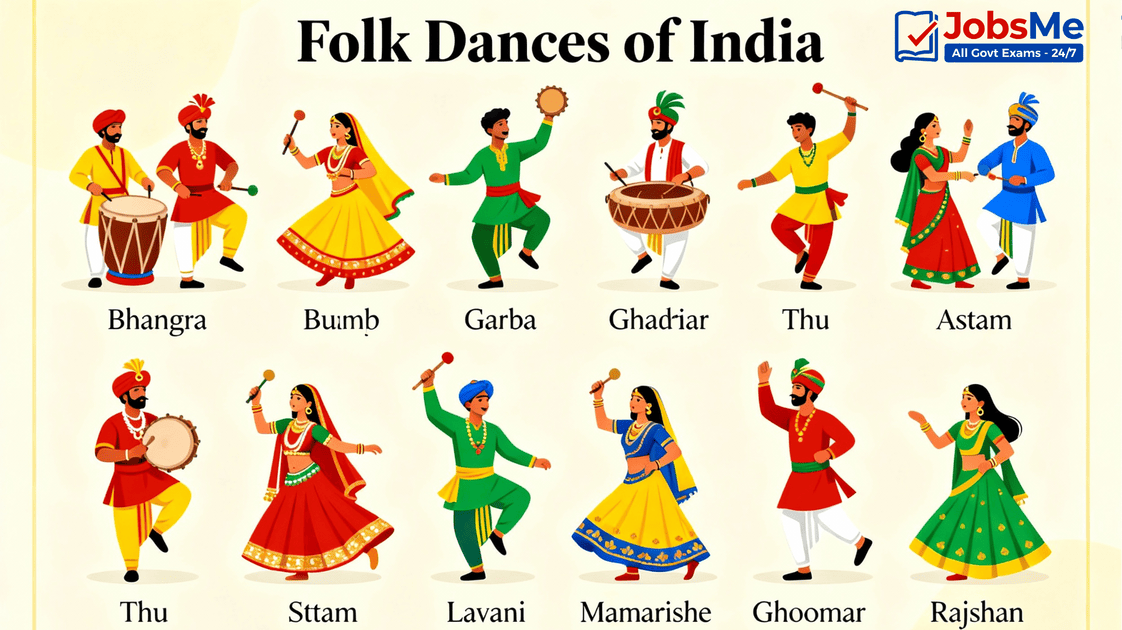
C. Folk Dances of India (State-wise)
Folk dances are community-based, performed during festivals, harvests, weddings, and rituals.
Table: Major Folk Dances of India
| State/UT | Important Folk Dances |
|---|---|
| Punjab | Bhangra, Giddha |
| Gujarat | Garba, Dandiya Raas |
| Rajasthan | Ghoomar, Kalbelia, Bhavai |
| Maharashtra | Lavani, Tamasha, Koli |
| West Bengal | Chhau, Baul, Gambhira |
| Assam | Bihu, Bagurumba |
| Tamil Nadu | Karagattam, Kummi, Kavadi |
| Kerala | Theyyam, Thiruvathira |
| Karnataka | Yakshagana, Dollu Kunitha |
| Andhra Pradesh | Dhimsa, Lambadi |
| Odisha | Ghumura, Gotipua |
| Bihar | Jat-Jatin, Bidesia |
| Mizoram | Cheraw (Bamboo Dance) |
| Jammu & Kashmir | Rouf, Dumhal |
| Ladakh | Cham Dance |
| Sikkim | Mask Dance (Singhi Chham) |
3. Important Points / Features
- Classical dances follow strict rules and techniques
- Folk dances are region-specific and spontaneous
- Many dances are linked with tribes (e.g., Bagurumba – Bodo tribe)
- Several folk dances are gender-specific
- Costumes and music are regionally distinctive
4. Additional Notes (Exam Gold)
- Ghoomar → Rajasthan
- Ghumura → Odisha (War dance)
- Lavani → Maharashtra (not Goa)
- Cheraw → Bamboo Dance of Mizoram
- Kathak originated in temples & Mughal courts
- Kalbelia dance has a UNESCO Intangible Cultural Heritage tag
5. One-Liner Revision Points
- Bharatanatyam is the oldest classical dance of India.
- Kathak is famous for spins called Chakkars.
- Kathakali uses color-coded facial makeup.
- Odissi is known for Tribhanga posture.
- Mohiniyattam is performed only by women.
- Sattriya was introduced by Sankardeva.
- Bhangra is a harvest dance of Punjab.
- Garba and Dandiya belong to Gujarat.
- Ghoomar is from Rajasthan, not Odisha.
- Cheraw is the Bamboo Dance of Mizoram.
- Yakshagana is a dance-drama of Karnataka.
- Theyyam is a ritual dance of Kerala.
Free quiz • No signup required
Put this topic into practice with Indian Cultural Institutions – Static GK MCQ Quiz. It is the quickest way to reinforce what you just learned.
Frequently Asked Questions
How many classical dances are officially recognized in India?
Which dance is famous for Tarangam?
Which state is associated with Sattriya dance?
What is the Bamboo Dance of India?
Which classical dance uses Tribhanga posture?
Kathak originated in which state?
Which dance is associated with the Bodo tribe?

About the author