Population & Census in India – Static GK / General Awareness for Competitive Exams with Memory Tricks
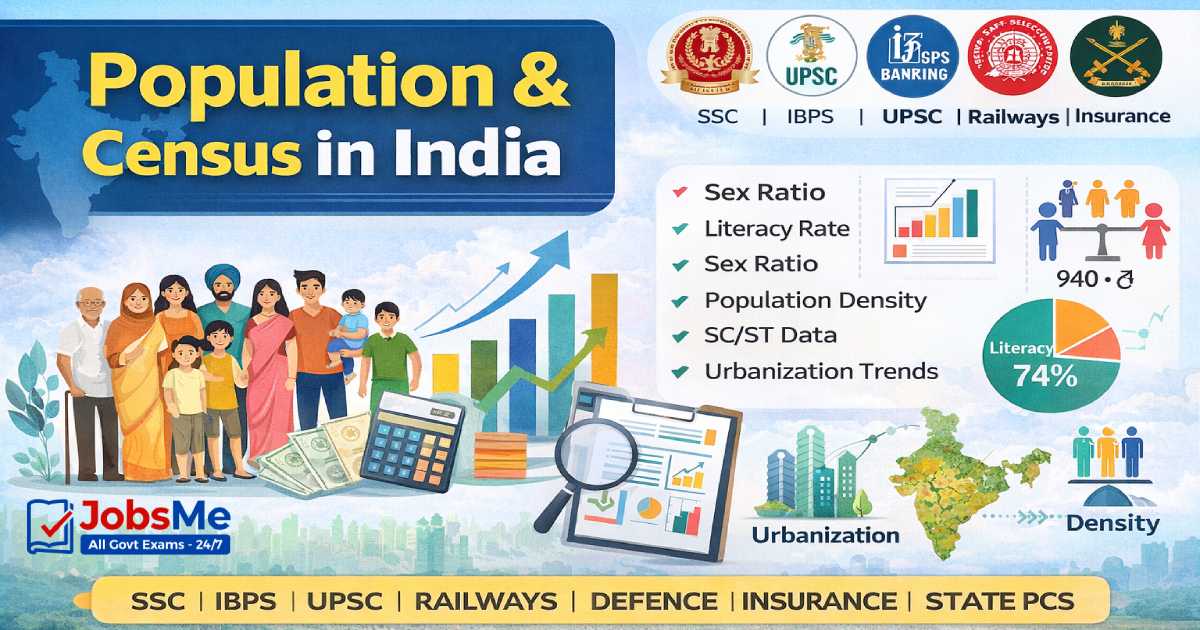
Population & Census in India is one of the most important Static GK / General Awareness topics for SSC, IBPS, UPSC Prelims, Railways, Defence, Insurance & State PCS exams. Questions are frequently asked on Census 2011, literacy rate, sex ratio, population density, decadal growth, SC/ST data, and urbanization trends.
Jump to section
- Population: Meaning and Basic Concepts
- Malthusian Theory of Population
- Demographic Transition Theory
- Population Density
- Census in India
- Population Growth in India
- Rural and Urban Population Trends
- Sex Ratio
- Literacy in India
- Scheduled Castes (SC) and Scheduled Tribes (ST)
- Push and Pull Factors of Migration
- 📌 QUICK-SUMMARY TABLE (Most Asked Facts)
- IMPORTANT ONE-LINERS FOR SSC/Banking/UPSC Prelims
- ONE-LINER REVISION POINTS
Population: Meaning and Basic Concepts
Population refers to the total number of people living in a particular geographical area. In demographic studies, three major processes determine population change: birth (fertility), death (mortality), and migration. Birth rate refers to the number of live births per 1,000 people in a year, while death rate refers to the number of deaths per 1,000 people in a year. These rates are always expressed per 1,000 population and not in absolute numbers. A high birth rate increases population growth, whereas a high death rate reduces it. Migration also plays an important role, as people move due to economic, social, political, or environmental reasons.
Malthusian Theory of Population
Thomas Robert Malthus (1766–1834), a British economist and demographer, presented the Malthusian Theory of Population in his famous 1798 work An Essay on the Principle of Population. He argued that population increases in a geometrical progression (2, 4, 8, 16…), whereas food supply increases in an arithmetical progression (1, 2, 3, 4…). Due to this imbalance, population growth would eventually exceed food supply, leading to natural checks such as famine, disease, and war. These checks control population growth when it becomes excessive.
Demographic Transition Theory
The Demographic Transition Theory was first proposed by Warren Thompson in 1929 and later developed and popularized by Frank W. Notestein in 1945. This theory explains the natural changes in population over time as a country develops economically.
In the first stage, known as the High Stationary Stage, both birth rate and death rate are high, resulting in slow population growth. This stage was common in pre-industrial societies.
In the second stage, called the Early Expanding Stage, death rate declines due to improvements in healthcare, sanitation, and food supply, while birth rate remains high. This leads to rapid population growth or population explosion.
In the third stage, known as the Late Expanding Stage, birth rate begins to decline due to urbanization, women’s education, contraception, and changing social values. Population growth starts slowing down.
In the final stage, both birth rate and death rate are low, leading to a stable or slowly declining population. This stage is common in developed countries.
Population Density
Population density is defined as the number of persons living per square kilometre of area. It helps in understanding the pressure of population on land and resources. According to Census 2011, India’s population density was 382 persons per square kilometre, compared to 325 in 2001. In 1951, it was only 117 persons per square kilometre. States like Bihar and West Bengal have very high population density, while Arunachal Pradesh has very low density. High population density areas usually have fertile land, good climate, availability of water, and better economic opportunities.
Census in India
A census is the official counting of population conducted at regular intervals. In India, it is conducted every ten years under the provisions of the Census Act, 1948, and it is a Union subject under Article 246 of the Constitution.
The first non-synchronous census in India was conducted in 1872 during the time of Lord Mayo. The first synchronous (complete) census was conducted in 1881 under W.C. Plowden. Census history in India began earlier with limited attempts such as census exercises in Allahabad (1824) and Banaras (1827–28) by James Prinsep, and in Dacca in 1830 by Henry Walter.
Census 2011 was the 15th Census of India and was conducted in two phases: the House Listing & Housing Census (April–September 2010) and the Population Enumeration (February 2011). Its slogan was “Our Census, Our Future.”
Population Growth in India
India’s population increased from 238 million in 1901 to over 1.2 billion in 2011. The period between 1901 and 1921 is known as the phase of stagnant growth because both birth and death rates were high. Between 1921 and 1951, death rates started declining due to improvements in health and sanitation, leading to steady population growth. Between 1951 and 1981, India experienced a population explosion due to rapid fall in death rates but persistently high birth rates. After 1981, growth continued but at a gradually slowing rate as birth rates started declining.
The decadal growth rate from 2001 to 2011 was 17.64%. Dadra and Nagar Haveli recorded the highest decadal growth rate among all states and union territories, while Nagaland recorded a negative growth rate.
Rural and Urban Population Trends
Although India has witnessed increasing urbanization, it still remains predominantly rural. In 2011, about 31.16% of India’s population lived in urban areas. Urbanization increased due to rural-to-urban migration, industrialization, and better job opportunities in cities. Highly urbanized regions include Delhi, Chandigarh, Goa, and Mizoram, while states like Himachal Pradesh and Bihar have low urbanization levels.
According to the Economic Survey 2023–24, more than 40% of India’s population is expected to live in urban areas by 2030.
Sex Ratio
Sex ratio refers to the number of females per 1,000 males. India’s sex ratio improved from 933 in 2001 to 943 in 2011. Kerala recorded the highest sex ratio, while Daman & Diu had the lowest. However, some economically developed northern states still show a low child sex ratio due to misuse of prenatal sex determination technologies and strong preference for male children.
Literacy in India
Literacy is defined as the ability to read and write with understanding for persons aged 7 years and above. In 1951, India’s literacy rate was only 18.33%, but it increased to 74.04% in 2011. Kerala has the highest literacy rate, while Bihar has the lowest. Male literacy (82.14%) is higher than female literacy (65.46%), showing a gender gap.
Scheduled Castes (SC) and Scheduled Tribes (ST)
According to Census 2011, Scheduled Castes constitute 16.6% of India’s total population, while Scheduled Tribes constitute 8.6%. Uttar Pradesh has the largest SC population, and Madhya Pradesh has the largest ST population. Some states and union territories like Punjab and Puducherry have no Scheduled Tribe population.
Push and Pull Factors of Migration
Migration occurs due to push and pull factors. Push factors include unemployment, poverty, natural disasters, and political instability, which force people to move away from a place. Pull factors include better job opportunities, higher wages, education, healthcare, and improved living standards, which attract people to a particular area.
📌 QUICK-SUMMARY TABLE (Most Asked Facts)
| Most Asked Point | Answer / Fact | Exam Relevance (SSC/UPSC/Banking/etc.) |
|---|---|---|
| First Census in India | 1872 (Non-synchronous) | SSC, Railways |
| First Complete Census | 1881 (Synchronous) | SSC, UPSC |
| Census Act | 1948 | Polity + SSC |
| Conducted by | Registrar General of India | UPSC Prelims |
| Population (2011) | 1.21 Billion | Banking, SSC |
| Highest Population State | Uttar Pradesh | All Exams |
| Lowest Population State | Sikkim | SSC GK |
| Literacy Rate (2011) | 74.04% | SSC, IBPS |
| Sex Ratio (2011) | 943 females per 1000 males | UPSC, Railways |
| Population Density (2011) | 382 persons/sq km | SSC, Defence |
IMPORTANT ONE-LINERS FOR SSC/Banking/UPSC Prelims
- First synchronous census – 1881
- Census Act passed in 1948
- Literacy defined for age 7 years & above
- Density 1951 – 117 persons/sq km
- 2011 Decadal Growth – 17.64%
- Highest Density State – Bihar
- Lowest Density State – Arunachal Pradesh
- SC Growth Rate (2001–11) – 20.8%
- India Urban Population (2011) – 31.16%
- ST Population Highest in MP
ONE-LINER REVISION POINTS
- Census = Every 10 years
- 1872 → First attempt
- 1881 → First complete
- Literacy = 74.04%
- Sex Ratio = 943
- Density = 382
- UP = Highest Population
- Sikkim = Lowest Population
Free quiz • No signup required
Put this topic into practice with Indian Cultural Institutions – Static GK MCQ Quiz. It is the quickest way to reinforce what you just learned.
Frequently Asked Questions
Q1. When was the first complete census conducted in India?
Q2. What is population density?
Q3. Which state has highest literacy rate?
Q4. What was India’s decadal growth rate (2001–2011)?
Q5. What is the sex ratio of India as per Census 2011?

About the author