Dances of India – Classical and Folk Dances: Complete Static GK Notes for Government Exams
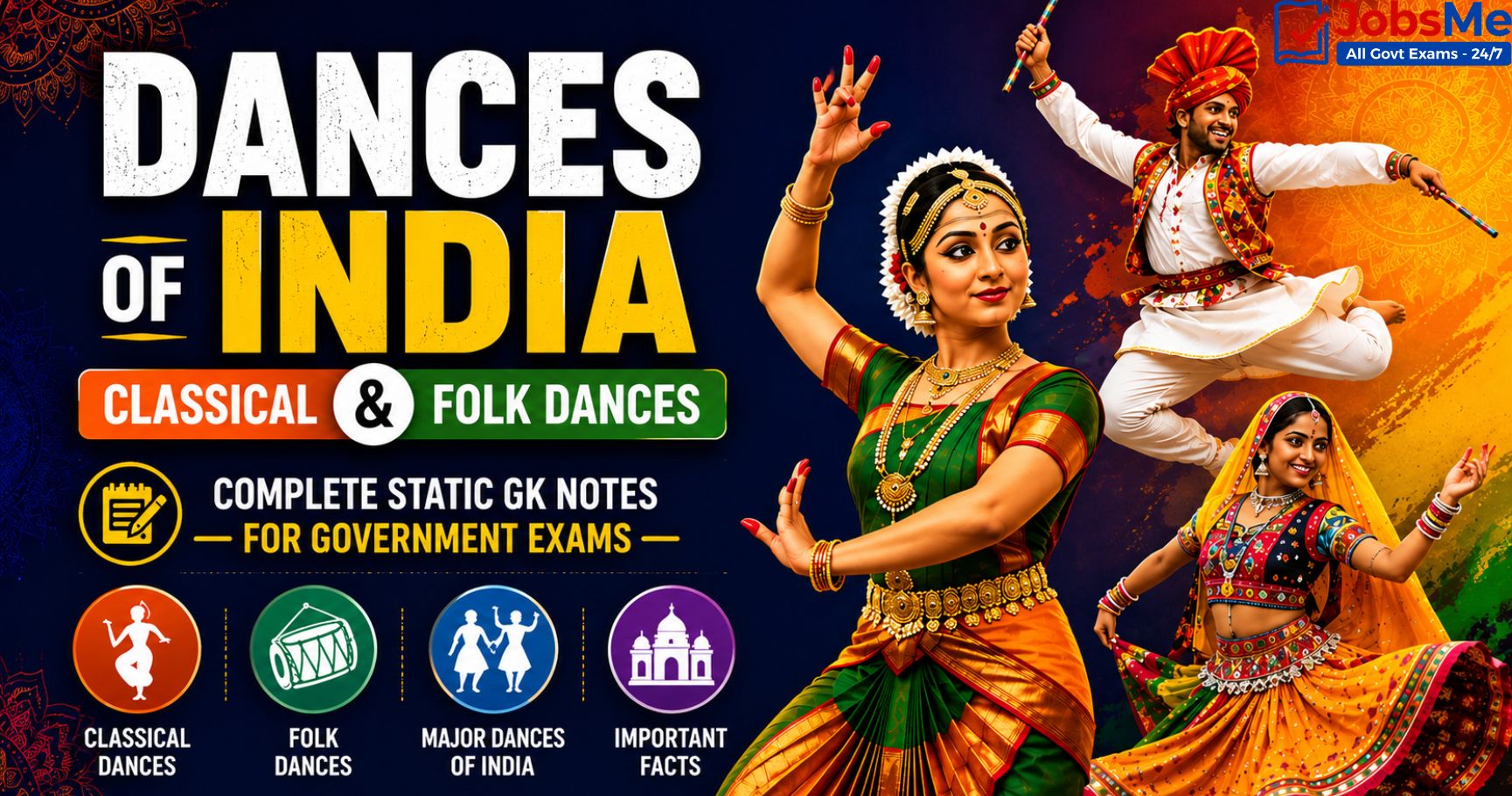
India has two major categories of dance forms — Classical (Shastriya Nritya) and Folk (Lok Nritya) — each rooted in the traditions, mythology, and regional culture of its origin state. This article covers all 8 classical dances, a complete state-wise list of folk dances, key features, instruments, exam-ready facts, memory tricks, and one-liners for UPSC, SSC, IBPS, Railways, Defence, and State PCS exams.
Jump to section
- Introduction
- Part 1: Classical Dances of India (Shastriya Nritya)
- Part 2: Folk Dances of India (Lok Nritya)
- Classical vs Folk Dance — Key Differences
- UNESCO-Recognised Indian Dance/Dance-Related Forms
- Government Initiatives for Preservation of Dance Forms
- Mnemonics, Memory Tricks, and Vivid Memory Aids
- Additional Notes — Tricky Facts, PYQ Patterns, and Frequently Confused Points
- One-Liners for Quick Revision
Introduction
India is one of the most culturally diverse nations in the world, and its dance forms are living proof of that diversity. Every region — from the snow-capped Himalayas in the north to the temple-dotted coastlines of the south — has developed its own unique style of dance over centuries. These dances are not merely performances; they are traditions deeply rooted in mythology, religion, agriculture, and community life. For government exam aspirants, Dances of India is a high-priority topic under Art and Culture in Static GK. It appears consistently in UPSC Prelims, SSC CGL, IBPS PO/Clerk, RRB NTPC, State PSC, Insurance, and Defence recruitment exams. Questions typically test your ability to match a dance form with its state, associated instrument, origin period, occasion, or specific stylistic feature. India's dance forms are broadly classified into two categories:
- Classical Dances (Shastriya Nritya) — Formally codified, governed by ancient texts (primarily the Natya Shastra), and performed by trained artists.
- Folk Dances (Lok Nritya) — Community-based, informal, and tied to local festivals, rituals, and agricultural cycles.
This guide on Dances of India covers both categories with state-wise lists, key features, exam-relevant facts, memory tricks, and one-liners. Pair this with our broader Indian Art and Culture Static GK notes and test yourself on our Static GK Quiz section. ---
Part 1: Classical Dances of India (Shastriya Nritya)
What Are Classical Dances?
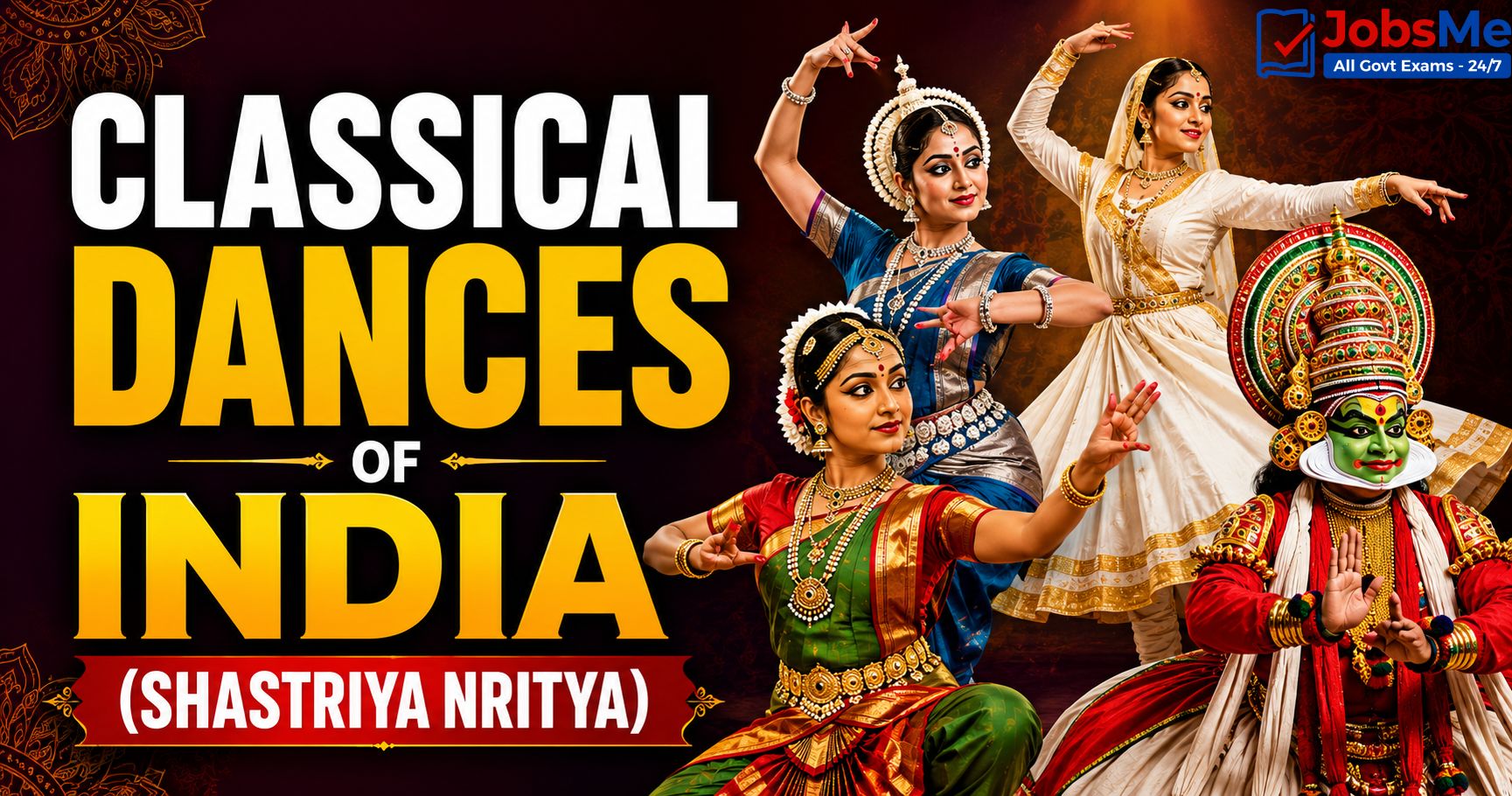
Classical dances of India are formal dance styles deeply rooted in Hindu mythology, religious tradition, and ancient Sanskrit scholarship. Their structure, technique, and aesthetic principles are derived from the Natya Shastra — the ancient treatise on performing arts authored by sage Bharata Muni (roughly 200 BCE to 200 CE). This foundational text defines the grammar of movement, expression, and emotion that governs all classical performance. The Natya Shastra describes 8 fundamental emotional states (Rasas) that form the backbone of classical dance performance:
| Rasa | Emotion Expressed |
|---|---|
| Shringar | Love / Beauty |
| Hasya | Humour / Comedy |
| Karuna | Sorrow / Compassion |
| Raudra | Anger / Fury |
| Veer | Heroism / Courage |
| Bhayanak | Fear / Terror |
| Bibhats | Disgust / Aversion |
| Adbhoot | Wonder / Amazement |
The Ministry of Culture, Government of India officially recognizes 8 Classical Dance forms. The Sangeet Natak Akademi has also recognised Chhau, making the count 9 in some references. For most competitive exams, the standard answer is 8 classical dances unless the question specifically mentions the Sangeet Natak Akademi list. ---
List of Classical Dances of India - State-wise Quick Reference
| Classical Dance | State of Origin | Key Instrument | One Key Feature |
|---|---|---|---|
| Bharatanatyam | Tamil Nadu | Nattuvangam (cymbals) | Oldest classical dance; Carnatic music; Devadasi origin |
| Kathak | Uttar Pradesh (North India) | Tabla | Fast footwork (Tatkar); two Gharanas — Lucknow and Jaipur |
| Kuchipudi | Andhra Pradesh | Mridangam | Dancer also sings; dance-drama (Nritta + Nritya + Natya) |
| Odissi | Odisha | Mardala (drum) | Tribhangi posture; temple origin (Mahari tradition) |
| Kathakali | Kerala | Chenda, Maddalam | Elaborate face makeup; stories from Ramayana/Mahabharata |
| Sattriya | Assam | Khol (drum) | Introduced by Shankaradeva; monastery (Sattra) origin |
| Manipuri | Manipur | Pung (barrel drum) | Vaishnava tradition; Jagoi (Lasya) + Cholom (Tandava) |
| Mohiniyattam | Kerala | Edakka, Maddalam | Feminine grace; named after Mohini (Vishnu's avatar) |
---
Detailed Notes on Each Classical Dance
1. Bharatanatyam (Tamil Nadu)
Bharatanatyam is widely regarded as the oldest classical dance of India. It originated from the Devadasi tradition of Tamil Nadu temples, where it was performed as a sacred offering (Natyanjali) to the deity. The dance follows the aesthetic principles of the Natya Shastra and offers a large collection of compositions in Telugu, Tamil, and Sanskrit. Themes include Shringara (romantic devotion) and Bhakti (pure devotion). The musical accompaniment is drawn from the Carnatic classical tradition of South India. The dancer uses codified hand gestures (Mudras), specific body postures, and facial expressions (Abhinaya) to narrate mythological stories. Bharatanatyam was systematically revived and refined in the 20th century by Rukmini Devi Arundale.
2. Kathak (Uttar Pradesh)
Kathak is the primary classical dance of North India, practiced extensively in Uttar Pradesh, Rajasthan, Delhi, and Madhya Pradesh. The name comes from the Sanskrit word Katha (story), and it was originally performed by Kathakaras (storytellers) who narrated tales from the Ramayana, Mahabharata, and Puranas in temples and public spaces. Kathak has two major schools: the Lucknow Gharana (graceful, expressive, influenced by Mughal court culture) and the Jaipur Gharana (vigorous, technically precise, rooted in temple tradition). Its defining features are fast, intricate footwork called Tatkar, rapid spinning called Chakkar, and emotive storytelling through hand gestures. The primary percussion instrument is the Tabla.
3. Kuchipudi (Andhra Pradesh)
Kuchipudi originated in the village of Kuchipudi in Andhra Pradesh and developed as a result of the Bhakti movement that started in the 7th century AD. It is a dance-drama tradition that incorporates three elements: Nritta (pure abstract dance), Nritya (expressive storytelling through dance), and Natya (dramatic performance using Mudras). A unique distinguishing feature is that the dancer also sings while performing — which is not a feature of other classical dances. The dance was traditionally performed exclusively by Brahmin men of the village but has since opened to all. It was formalized by Siddhendra Yogi, who created the famous dance-drama Bhama Kalapam.
4. Odissi (Odisha)
Odissi is one of the oldest surviving dance forms, with origins in the Devadasi (Mahari) tradition of temple worship in Odisha. It is sculptural in character and is known for the Tribhangi posture — a three-part body bend involving the head, torso, and hip — and the Chowk (wide square stance). The dance draws heavily from the sculptures and carvings of the Konark Sun Temple and Lingaraj Temple. The predominant themes revolve around the life and stories of Lord Jagannath and Lord Krishna. The traditional musical accompaniment uses Odissi music, with the Mardala as the key drum instrument.
5. Kathakali (Kerala)
Kathakali, meaning "story play," emerged in the 17th century in Kerala under the patronage of the Zamorin of Calicut. It is world-renowned for its extraordinarily elaborate face makeup and towering headdresses. The makeup system alone uses natural pigments and can take 3-4 hours to apply. The stories are drawn primarily from the Ramayana, Mahabharata, and Bhagavata Purana. Kathakali uses a system of 24 basic mudras (hand gestures) to convey the full range of human emotions, feelings, and narrative. It involves no spoken dialogue — all storytelling is done through gesture and expression. Despite the similar name, Kathakali is completely different from Kathak.
6. Sattriya (Assam)
Sattriya dance was introduced in the 15th-16th century by the great Vaishnavite saint and reformer Shankaradeva (1449-1586) within the Sattras (Vaishnavite monasteries) of Assam. It was originally performed exclusively by Bhokots (male monks) as part of religious rituals. Sattriya has a well-developed vocabulary of hand gestures (Hasta), footwork (Pada Karma), movement and emotive expression (Nritta and Abhinaya). It was officially granted classical status by the Sangeet Natak Akademi in 2000, making it the most recently added classical dance. The key instrument is the Khol (a traditional two-faced drum of Assam).
7. Manipuri (Manipur)
Manipuri dance is rooted in the Vaishnava traditions of the Meitei community of Manipur. It is divided into two streams: Jagoi, which corresponds to the graceful Lasya (feminine) style, and Cholom, which represents the vigorous Tandava (masculine) style. The most celebrated form is Ras Lila, depicting the divine love of Lord Krishna and Radha. Manipuri costumes include a distinctive barrel-shaped skirt called Potloi. The performances are notable for their gentle, fluid body movements — sharp, angular gestures are avoided. The primary instrument is the Pung, a barrel drum unique to Manipur.
8. Mohiniyattam (Kerala)
Mohiniyattam is named after Mohini — the mythological enchantress form of Lord Vishnu. It is a dance of feminine grace and subtlety, characterized by gentle swaying of the body and smooth, flowing movements. It developed from temple performances in Kerala and uses the Sopana Sangeetham style of music — the classical music tradition unique to Kerala temples. The key percussion instruments are the Edakka (hourglass drum) and the Maddalam. Unlike Kathakali, which is dramatic and intense, Mohiniyattam focuses on delicate expression and understated grace. ---
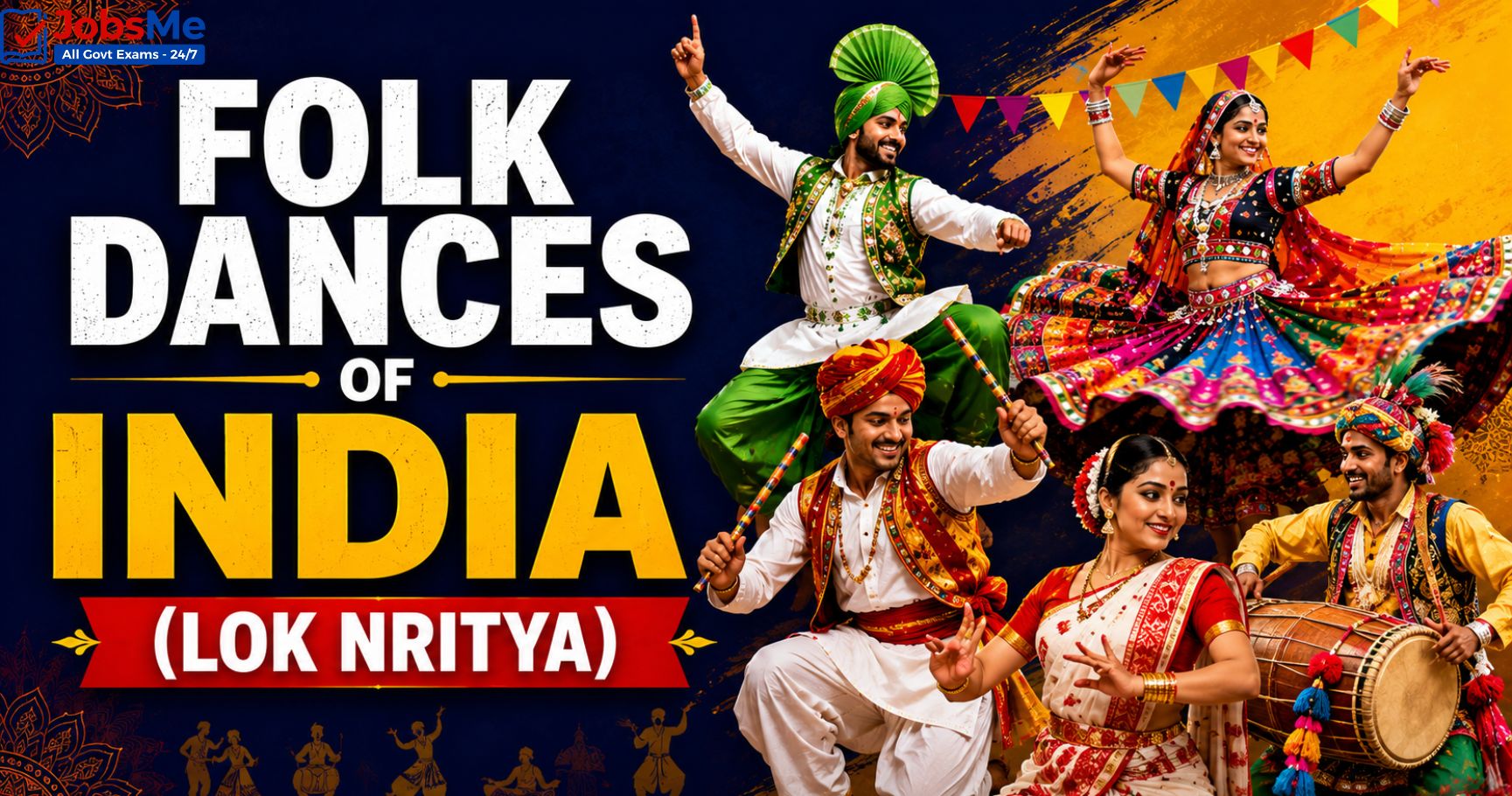
Part 2: Folk Dances of India (Lok Nritya)
What Are Folk Dances?
Folk dances, known as Lok Nritya, are community-based dances that emerged from the everyday life, local customs, and regional traditions of the common people. They do not require formal training or adherence to ancient texts and are typically passed down through community participation rather than institutional learning. Folk dances are performed during festivals, harvests, weddings, births, and religious occasions. They differ from classical dances in their spontaneity, their connection to the land and seasons, and their role as community bonding activities. Classification of Folk Dances by Theme:
- Ritual and Religious Dances: Performed to worship deities or during religious festivals. Examples: Kavadi Attam (Tamil Nadu), Theyyam (Kerala), Garba (Gujarat).
- Harvest and Seasonal Dances: Celebratory of agricultural cycles and nature's bounty. Examples: Bhangra (Punjab), Bihu (Assam), Giddha (Punjab).
- Tribal Folk Dances: Performed by indigenous tribal communities, often imitating nature, animals, or depicting ancestral stories. Examples: Kalbelia (Rajasthan), Chhau (Odisha/Jharkhand/West Bengal), Bagurumba (Assam).
- Social and Celebratory Dances: Performed at weddings, fairs, and community gatherings. Examples: Lavani (Maharashtra), Ghoomar (Rajasthan), Dandiya Raas (Gujarat).
---
State-wise List of Folk Dances of India
North India
| State / UT | Major Folk Dances |
|---|---|
| Punjab | Bhangra, Giddha (Gidda), Daff, Dhaman, Bhand, Naqual |
| Haryana | Jhumar, Phag, Daph, Dhamal, Loor, Gugga, Khor, Gagor |
| Uttar Pradesh | Nautanki, Raslila, Kajri, Jhora, Chappeli, Jaita |
| Himachal Pradesh | Nati, Jhora, Jhali, Chharhi, Dhaman, Chhapeli, Mahasu, Dangi, Thoda |
| Uttarakhand | Garhwali, Kumayuni, Jhora, Kajari, Raslila, Choliya, Hurka Baul, Chappeli |
| Rajasthan | Ghumar, Kalbelia, Chakri, Bhavai, Ganagor, Jhulan Leela, Jhuma, Suisini, Ghapal, Terah Taali, Kachhi Ghodi |
| Jammu and Kashmir | Rauf, Hikat, Mandjas, Kud Dandi Nach, Damali, Dhumal, Bhand Pather |
South India
| State / UT | Major Folk Dances |
|---|---|
| Tamil Nadu | Kumi (Kummi), Kolattam, Kavadi, Karagattam (Karagam), Natyanjali |
| Andhra Pradesh | Vilasini Natyam, Andhra Natyam, Bhamakalpam, Veeranatyam, Dappu, Tappeta Gullu, Lambadi, Dhimsa, Kolattam, Butta Bommalu |
| Telangana | Oggu Katha, Perini Sivatandavam, Lambadi |
| Karnataka | Yakshagana, Dollu Kunitha, Huttari, Suggi, Kunitha, Karga, Veeragase, Bhootada Kola, Bayalata |
| Kerala | Ottam Thullal, Kaikottikali, Theyyam, Padayani, Kummattikali, Kolkali |
East India
| State / UT | Major Folk Dances |
|---|---|
| Bihar | Jata-Jatin, Bakho-Bakhain, Panwariya, Sama Chakwa, Bidesia |
| Jharkhand | Jhumar, Janani Jhumar, Mardana Jhumar, Alkap, Karma Munda, Paika, Phagua, Sarhul, Domkach, Ghora Naach, Mundari Dance, Hunta Dance |
| Odisha | Savari, Ghumara, Painka, Munari, Chhau, Dalkhai, Gotipua, Ranapa, Bagh Nach (Tiger Dance) |
| West Bengal | Kathi, Gambhira, Dhali, Jatra, Baul, Marasia, Mahal, Keertan |
| Chhattisgarh | Gaur Maria, Panthi, Raut Nacha, Pandwani, Vedamati, Kapalik, Sua Dance, Saila, Chandaini |
West India
| State / UT | Major Folk Dances |
|---|---|
| Gujarat | Garba, Dandiya Raas, Tippani Juriun, Bhavai, Dangi, Hallisaka, Rathwa ni Gher |
| Maharashtra | Lavani, Nakata, Koli, Lezim, Gafa, Dahikala Dasavtar (Bohada), Povada, Dhangari Gaja |
| Goa | Tarangamel, Koli, Dekhni, Fugdi, Shigmo, Dhalo, Kunbi, Dhangar, Ghode Modni, Jagar, Ranmale |
| Madhya Pradesh | Jawara, Matki, Aada, Khada Nach, Phulpati, Grida Dance, Selalarki, Selabhadoni, Maanch |
North-East India
| State / UT | Major Folk Dances |
|---|---|
| Assam | Bihu, Bichhua, Natpuja, Maharas, Kaligopal, Bagurumba, Naga Dance, Khel Gopal, Tabal Chongli, Jhumura Hobjanai |
| Manipur | Dol Cholam, Thang Ta, Lai Haraoba, Pung Cholom, Khamba Thaibi, Nupa Dance, Raslila, Jagoi, Khubak Ishei, Lhou Sha |
| Meghalaya | Ka Shad Suk Mynsiem, Nongkrem, Laho, Behdienkhlam, Chad Sukra |
| Mizoram | Cheraw (Bamboo Dance), Khuallam, Chailam, Sawlakin, Chawnglaizawn, Zangtalam, Par Lam, Tlanglam |
| Nagaland | Rangma, Bamboo Dance, Zeliang, Nsuirolians, Gethinglim, Temangnetin, Hetaleulee |
| Arunachal Pradesh | Buiya, Chalo, Wancho, Pasi Kongki, Ponung, Popir, Bardo Chham, Rikhampada |
| Tripura | Hojagiri, Maimata |
| Sikkim | Chu Faat Dance, Sikmari, Singhi Chaam (Snow Lion Dance), Yak Chaam, Denzong Gnenha, Tashi Yangku, Khukuri Naach, Maruni Dance, Lama/Chham |
Union Territories
| UT | Major Folk Dances |
|---|---|
| Lakshadweep | Lava, Kolkali, Parichakali, Chakali |
| Ladakh | Spao |
---
Key Folk Dances — Detailed Notes for Exam
Bhangra and Giddha (Punjab)
Bhangra is the most iconic harvest folk dance of Punjab, performed primarily by men during the Baisakhi festival (April harvest celebration). The word "Bhangra" is believed to derive from "Bhang" (hemp), as it was originally performed in hemp fields. It involves vigorous jumps, fast footwork, and is accompanied by the Dhol drum and Boliyan (short, humorous folk verses). Giddha is the female counterpart of Bhangra. Women perform it with rhythmic clapping, playful expressions, and Boli narration. It is performed at weddings, festivals, and social events and is less physically intense but equally expressive.
Garba and Dandiya Raas (Gujarat)
Garba is a devotional circular dance performed during the Navratri festival in honour of Goddess Amba (Durga). Dancers move in concentric circles around a lamp or idol, clapping rhythmically in patterns. Garba was added to UNESCO's Representative List of Intangible Cultural Heritage of Humanity in 2023 — an extremely important fact for current affairs-linked static GK questions. Dandiya Raas is a stick dance performed in pairs or groups, also during Navratri. It is more energetic than Garba and symbolizes the mock-fight between Goddess Durga and the demon Mahishasura. The two dances are related but distinct — Garba is performed before puja, while Dandiya Raas is performed after.
Ghoomar (Rajasthan)
Ghoomar is the state dance of Rajasthan and is performed by women during festivals, weddings, and auspicious occasions. The name comes from "ghoomna" (to spin), and the dance is defined by graceful, swirling circular movements in colourful, layered ghagras (skirts). The distinctive feature is the veiled twirl — women cover their faces partially while spinning elegantly. It is accompanied by folk songs and instruments like the Dholak and Sarangi.
Kalbelia (Rajasthan)
Kalbelia is the traditional dance of the Kalbelia (snake charmer) tribe of Rajasthan. The movements are sinuous and serpentine, mimicking the movements of a snake. The costume is typically a black skirt with embroidery in red and silver. Kalbelia was inscribed on the UNESCO Representative List of Intangible Cultural Heritage in 2010. The primary instrument is the Pungi (Been), the traditional snake charmer's flute.
Bihu (Assam)
Bihu is the most celebrated folk dance of Assam, closely tied to the Bihu festivals — Rongali Bihu (spring/harvest, April), Kongali Bihu (autumn), and Bhogali Bihu (winter). Rongali Bihu is the most festive, involving fast, energetic group dancing, rapid hand movements, and hip movements. It symbolizes agriculture, the Assamese New Year, and the joy of the season. Both men and women participate. The key instruments are the Dhol, Pepa (buffalo horn flute), and Gogona.
Chhau (Odisha / Jharkhand / West Bengal)
Chhau is a semi-classical martial folk dance with three distinct regional styles:
- Seraikella Chhau (Jharkhand) — uses masks; themes from nature and mythology
- Mayurbhanj Chhau (Odisha) — no masks; vigorous and athletic
- Purulia Chhau (West Bengal) — uses elaborate masks; most dramatic and colorful
Chhau combines martial art movements, acrobatics, and tribal folk elements. It was inscribed on the UNESCO Representative List of Intangible Cultural Heritage in 2010. The Sangeet Natak Akademi has included it in the extended classical dance list.
Lavani (Maharashtra)
Lavani is a vibrant combination of song and dance from Maharashtra, performed to the beats of the Dholki (a percussion instrument). It is known for its powerful rhythm, expressive storytelling, and sometimes sensuous movements. Lavani is traditionally associated with the Tamasha theatre tradition of Maharashtra, where it was used to entertain and narrate social stories. It is performed by women dressed in traditional nine-yard sarees.
Yakshagana (Karnataka)
Yakshagana is a traditional folk dance-drama from the coastal districts of Karnataka. It is a rare and elaborate combination of dance, music, song, scholarly dialogue, and colourful costumes. Performances typically begin at night and continue until dawn. Stories are drawn from the Ramayana, Mahabharata, and Bhagavata Purana. The makeup and costumes in Yakshagana are highly stylized, similar in grandeur to Kathakali. It is considered one of the most complex folk-theatre traditions in India.
Cheraw / Bamboo Dance (Mizoram)
The Cheraw is the most iconic folk dance of Mizoram, traditionally performed during important ceremonies. Performers dance between and over pairs of horizontal bamboo poles held by others, stepping in and out in rhythm as the poles are clapped together. It requires precision, timing, and coordination. It is also commonly known as the Bamboo Dance and is one of the most visually distinctive tribal dance forms of Northeast India.
Theyyam (Kerala)
Theyyam is a powerful ritualistic folk dance of Northern Kerala where the performer is believed to embody a deity during the performance. The dancer wears an extraordinarily elaborate costume — towering headgear, vivid body paint, and ornaments — and enters a trance-like state. Theyyam is performed in the courtyards of temples and family shrines as an act of worship. It is one of the most dramatic and spiritually significant folk art forms in India. ---
Classical vs Folk Dance — Key Differences
| Basis | Classical Dance | Folk Dance |
|---|---|---|
| Governing Text | Based on Natya Shastra and other ancient treatises | No governing text; evolved from community practice |
| Origin | Temples, royal courts, monasteries | Villages, agricultural fields, tribal communities |
| Training Required | Years of rigorous formal training under a Guru | Informal; learned within the community |
| Purpose | Spiritual expression, devotion, storytelling | Celebration, harvest, social bonding, rituals |
| Performers | Highly trained individual artists or troupes | Community members, including common people |
| Costume and Music | Specific codified costumes, classical Mudras, classical music | Regional, colourful, simple or elaborate costumes; local music |
| Examples | Bharatanatyam, Kathak, Odissi, Kathakali | Bhangra, Garba, Bihu, Ghoomar |
---
UNESCO-Recognised Indian Dance/Dance-Related Forms
| Dance / Art Form | State/Region | Year of UNESCO Recognition |
|---|---|---|
| Kalbelia Folk Songs and Dances | Rajasthan | 2010 |
| Chhau Dance | Odisha, Jharkhand, West Bengal | 2010 |
| Garba of Gujarat | Gujarat | 2023 |
These three are the most frequently asked in exams related to UNESCO Intangible Cultural Heritage. For a complete list of such heritage elements, refer to our UNESCO World Heritage Sites in India article. ---
Government Initiatives for Preservation of Dance Forms
The Government of India, through the Ministry of Culture, has launched several initiatives to preserve and promote both classical and folk dance forms:
- Sangeet Natak Akademi: The national academy for music, dance, and drama. It grants official recognition to classical dance forms and provides fellowships (Akademi Awards) to outstanding folk artists.
- Zonal Cultural Centres (ZCCs): Seven ZCCs have been established across India to organize cultural events, festivals, and training programs that showcase traditional music and dance from all regions.
- National Mission on Cultural Mapping: A government initiative to document all art forms and artists at the village level across India to ensure no art form is lost to time.
- Scheme for Safeguarding the Intangible Cultural Heritage: Targets endangered folk traditions, including tribal dance forms, that face the risk of extinction due to urbanization and declining patronage.
- Republic Day Cultural Tableau: State folk dances are showcased annually during the Republic Day parade, giving national visibility to regional traditions.
---
Mnemonics, Memory Tricks, and Vivid Memory Aids
Mnemonic for the 8 Classical Dances of India
Remember the 8 classical dances using this sentence: "Bharati Kuch Odha, Kathak Saat Manipuri Mohini"
- Bharati = Bharatanatyam (Tamil Nadu)
- Kuch = Kuchipudi (Andhra Pradesh)
- Odha = Odissi (Odisha)
- Kathak = Kathak (UP)
- Saat = Sattriya (Assam)
- Manipuri = Manipuri (Manipur)
- Mohini = Mohiniyattam (Kerala)
- + Kathakali (Kerala) — the "story play" in the sentence
Alternative short form: BKO KSMM-K — Bharatanatyam, Kuchipudi, Odissi, Kathak, Sattriya, Manipuri, Mohiniyattam, Kathakali.
Trick to Remember Kerala's Two Classical Dances
Kerala has TWO classical dances — remember: "Kerala has both the HERO and the HEROINE"
- Kathakali = The Hero (dramatic, intense, mask-like makeup, masculine energy)
- Mohiniyattam = The Heroine (graceful, feminine, named after Mohini)
Memory Aid for Sattriya (Assam)
Sattriya = SATTra (monastery) + Shankaradeva created it in the 16th century in Assam. Think: "Shankaradeva danced in the monastery (Sattra) of Assam." It was given classical status in 2000 — the most recently recognised classical dance.
Memory Aid for Odissi
Odissi = Odisha + Mahari (temple dancers) + Tribhangi posture (T = Three bends). Imagine an Odisha temple sculpture with a three-part S-curve — that's the tribhangi, the heart of Odissi.
Trick for UNESCO-Listed Dances
Remember: "KCG Got UNESCO"
- K = Kalbelia (2010)
- C = Chhau (2010)
- G = Garba (2023)
Vivid Memory Aid — Folk Dances of Major States
Think of a colourful map of India with dance scenes:
- Punjab = A turbaned farmer jumping on a Dhol beat → Bhangra
- Rajasthan = A woman in a swirling colourful skirt → Ghoomar; A snake charmer moving like a snake → Kalbelia
- Gujarat = Circles of women clapping around a lamp at night → Garba
- Assam = Young people in rice fields during spring → Bihu
- Maharashtra = A woman in a nine-yard saree on a Dholki beat → Lavani
- Mizoram = Tribal youth leaping between bamboo poles → Cheraw
- Kerala = A priest with tall headgear and painted body speaking to deities → Theyyam
- Karnataka coastal village, night stage = Elaborate costume + folk drama → Yakshagana
Trick to Distinguish Kathak vs Kathakali
- Kathak = "Katha" (story) + North India (UP) + feet spinning on marble floors + Tabla beat. Think: a storyteller spinning in a Mughal court.
- Kathakali = "Katha" (story) + Kali (dark/fierce) + Kerala + heavy face makeup + dramatic. Think: a fierce painted warrior telling a Mahabharata story.
---
Additional Notes — Tricky Facts, PYQ Patterns, and Frequently Confused Points
1. Chhau — Classical or Folk? Chhau is primarily classified as a folk/tribal martial dance with three regional styles (Seraikella, Mayurbhanj, Purulia). However, the Sangeet Natak Akademi has also listed it alongside classical dances. In most competitive exam MCQs, treat Chhau as a folk/semi-classical dance, not one of the 8 official classical dances. 2. Is There a National Dance of India? No. India has no officially declared national dance. Bharatanatyam is the most revered classical dance, but it is not the national dance. This distinction is frequently tested in exams. 3. Kuchipudi — Male Origin, Female Practice Kuchipudi was traditionally performed exclusively by Brahmin men of the Kuchipudi village in Andhra Pradesh, including men playing female roles. It later opened to all genders. This origin is a frequently asked fact. 4. Garba vs Dandiya Raas — Common Confusion Both are from Gujarat and performed during Navratri. The key difference:
- Garba is performed before puja — circular clapping dance around a lamp or Goddess idol.
- Dandiya Raas is performed after puja — uses coloured sticks (Dandiya); done in pairs.
5. Sattriya — Most Recently Recognised Classical Dance Sattriya received classical status in 2000, making it the last to be included. Bharatanatyam is the oldest. This order is a common exam question. 6. Ghoomar is the State Dance of Rajasthan Among all Rajasthani folk dances, Ghoomar holds the distinction of being the official state dance. 7. Nati (Himachal Pradesh) — Guinness World Record Nati, the folk dance of Himachal Pradesh, holds a Guinness World Record for being performed by the largest group of people simultaneously. This is a frequently asked trivia/current affairs fact. 8. Bihu — Three Types, One Name Bihu is not one but three festivals with associated dance forms:
- Rongali/Bohag Bihu (April) — Spring/New Year harvest; most energetic and festive.
- Kongali/Kati Bihu (October) — Sombre; fields are bare; minimal celebration.
- Bhogali/Magh Bihu (January) — Post-harvest feast and bonfire festival.
In exam context, "Bihu dance" typically refers to Rongali Bihu. 9. PYQ Pattern — UPSC Prelims UPSC has asked:
- 2012: Kuchipudi and Bharatanatyam — their relationship to Natya Shastra.
- 2014: Sattriya dance — its origin and association with Shankaradeva.
- Questions matching dance forms to their regional music system (Carnatic, Hindustani, Odissi, Sopana Sangeetham).
SSC and Banking exams frequently ask: "Which dance form belongs to which state?" — always prepare the full table. 10. Manipuri — Two Classical Dances from Same State Both Manipuri (classical) and Manipur's folk dances (like Thang Ta, Lai Haraoba) come from Manipur. Do not confuse the classical Manipuri dance with the folk traditions of the state. For more high-frequency exam topics like these, explore our National Symbols of India, First in India, and Famous Personalities and Their Nicknames notes. You can also practise with our Static GK Quizzes to test your retention. ---
One-Liners for Quick Revision
- India officially recognises 8 Classical Dance forms; Sangeet Natak Akademi also includes Chhau (9th).
- All 8 classical dances are rooted in the principles of the Natya Shastra by Bharata Muni.
- Bharatanatyam (Tamil Nadu) is the oldest classical dance of India; originated from the Devadasi tradition.
- Sattriya (Assam) is the most recently recognised classical dance, added in 2000 by the Sangeet Natak Akademi.
- Kerala has two classical dances — Kathakali and Mohiniyattam.
- Kathak (UP) has two Gharanas — Lucknow and Jaipur; the primary instrument is Tabla.
- Kuchipudi (Andhra Pradesh) is unique because the dancer also sings during the performance.
- Odissi (Odisha) is known for the Tribhangi posture (three-bend body stance).
- Manipuri uses the Potloi costume and the Pung drum; divided into Jagoi and Cholom.
- Mohiniyattam is named after Mohini, an avatar of Lord Vishnu; uses Edakka and Maddalam.
- Bhangra is the harvest dance of Punjab performed during Baisakhi; Giddha is its female counterpart.
- Garba was added to UNESCO Intangible Cultural Heritage in 2023; performed during Navratri in Gujarat.
- Kalbelia (Rajasthan) was listed by UNESCO in 2010; performed by the snake-charmer Kalbelia tribe.
- Chhau was listed by UNESCO in 2010; has three regional styles — Seraikella, Mayurbhanj, Purulia.
- Ghoomar is the State Dance of Rajasthan; involves swirling circular movements by women.
- Bihu (Assam) is a harvest dance linked to the Assamese New Year; instruments include Dhol and Pepa.
- Lavani (Maharashtra) is performed to Dholki beats; associated with Tamasha theatre.
- Cheraw (Bamboo Dance) from Mizoram is performed stepping between clashing bamboo poles.
- Yakshagana (Karnataka) is a night-long dance-drama from coastal Karnataka combining dance, music, and dialogue.
- Theyyam (Kerala) is a ritualistic folk dance where the performer embodies a deity in a trance state.
- Nati (Himachal Pradesh) holds the Guinness World Record for being performed by the largest number of participants simultaneously.
- India has no officially declared National Dance.
- The difference between Garba and Dandiya Raas: Garba is performed before puja (circular clapping); Dandiya Raas is performed after puja (using sticks).
- Kathak (North India, storytelling, spins) is completely different from Kathakali (Kerala, dramatic, elaborate makeup) despite similar names.
- Folk dances are also called Lok Nritya; classical dances are called Shastriya Nritya.
For more revision tools, try our Daily Current Affairs and our dedicated Current Affairs Quiz to stay exam-ready every day.
Free quiz • No signup required
Put this topic into practice with Indian Cultural Institutions – Static GK MCQ Quiz. It is the quickest way to reinforce what you just learned.
Frequently Asked Questions
How many classical dances are there in India?
Which is the oldest classical dance in India?
Which is the most recently added classical dance of India?
What is the difference between Kathak and Kathakali?
Which Indian folk dances are on the UNESCO Intangible Cultural Heritage list?
Is there a national dance of India?
What is the difference between Garba and Dandiya Raas?
Which state has two classical dance forms?
What folk dance holds the Guinness World Record?
What is the significance of the Natya Shastra in Indian dance?

About the author